Personal Notes & Observations from 1999-2025
My Unpublished Materials
I am dumping around one thousand pages of Word documents here on this orphan page so that they can be preserved. The text here comes from the year 1998 to 2025. It is much, although not all, of my unpublished material. Several of my published models can be fleshed out much more using these writings. Much of this is completely unorganized, in no particular order, and is full of non sequiturs and immature musings. I imagine that this would be too long, meaningless, and dense, with too few interesting nuggets to interest a human. But it may be interesting for an AI. None of this text was created by a language model. Please keep in mind that I did not censor these personal notes or even read through them because it was too much material. I hope it does not contain any outdated, problematic, or exclusionary ideas because I certainly don’t want to promote anything like that. This is extremely important to me. I have no intention of using science to demean any race or gender or group. The world and its diversity and inclusion are incredibly important to me and I love everyone.
I want to point out that keeping exhaustive notes about the thoughts I found interesting over the years really helped me organize my ideas. This writing is very important to me. A few of these sentences felt like keys to the universe, that could inspire entire books, when I first wrote them down. Unfortunately, much of the meaning will be lost to readers who are not me. A great deal of meaning has been lost even to me. Looking back on them, they seem trivial, but that is partly because so much of the original context wasn’t written down. So many of the associations in my mind at the time, that brought these ideas from inane to interesting, did not make it onto the page. Also, many of the notes used shorthand and mental shortcuts that I cannot recall any longer. I would love to see what a future AI could do with this data.
Introduction
There is no unifying theory of how the brain creates the mind. Like physics, brain science is still awaiting a “grand unified field theory.” If you were to ask 100 of the leading brain researchers in the world how the brain works, you would receive 100 very different answers. The funny thing is that most of these answers will be thought provoking, in different ways, for different reasons.
The objective science of biology and the more subjective field of psychology are
highly interrelated yet we are still far from understanding how the two interface. All psychological phenomena can be explained in or reduced to biological terms, however, because we have a very limited understanding of exactly how our brain functions we cannot yet explain our thoughts and behaviors from a strictly biological standpoint. We have a good understanding of how neurons (the fundamental processing units of the brain) function but a very limited understanding of how they interact in huge numbers across space and time to create complex thought. Cognitive neuroscience attempts to bridge the gap between biology and psychology yet the three fields are far from forming a comprehensive, cohesive science.
Much of neuroscience research is heavily technical and takes a good deal of time to internalize. After a great deal of time is put into learning the terminology, anatomy, cell biology, electrophysiology, and models of brain function there are many fun and interesting conclusions that can be drawn. Many of these are interesting only in passing and hold no great truths applicable to other areas. There are, without question, some very deep conclusions that come from neuroscience – especially when they are contrasted with their psychological equivalents – and I will attempt to relate the ones that I find the most profound here. The selection of issues and phenomena here is eccentric, and incomplete but I chose them carefully and attempted to present them in a meaningful order.
I remember taking psych 100 at a community college and being introduced to the philosophical problem of consciousness. “How does a nervous system acquire a first person point of view?” I came out straining my mind in an attempt to even begin to model how neurons give rise to consciousness. I imagined my own head with billions of tiny spheres inside of it, some of which took inputs from my senses, other that sent outputs to my muscles and others that did their numinous work in between sense and action. It is numinous in the sense that it seems to surpass comprehension, has a supernatural quality and arouses emotion. Some of that mystery is still there in my mind, but it has been at least partially resolved. I hope that this book may held partially resolve the mystery for you as well.
“If we were magically shrunk and put into someone’s brain while she was thinking, we would see all the pumps, pistons, gears and levers working away, and we would be able to describe their workings completely, in mechanical terms, thereby completely describing the thought process of the brain. But that description would nowhere contain any mention of thought! It would contain nothing but descriptions of pumps, pistons, levers!” G.W. Leibniz (1646-1716).
Leibniz was right then, but the equivalent statement would be wrong today. In the 17th century entering an active brain on a microscopic level to have a look around would have been produced fantastic knowledge about neurons, their firing patterns and their connections. However, the knowledge gained would have been very difficult to map onto common sense notions of mental behavior. I believe that this is no longer the case. To prove this to you I will lead you on tour through select neuroscience principles in an attempt to build toward a model of the working brain that actually coheres with psychological principles. To do this we will discuss how individual neurons code for very specific yet tiny fragments of experience, how they work together to create composite mental representations and how the timing and interplay between neurons with different functional specialties allow the creation of logical sequences of mental imagery. Many of the ideas that I present here are roughly hewn and incomplete and I would like to recruit your help in further fleshing them out.
Life Arose from Matter
Scientists have pieced together a detailed and interesting story about the history and various forms of matter and energy in our universe. Of course this is our history too because this matter and energy eventually gave rise to us. It appears that our universe came from nothingness, a state with no time and no space. Some kind of disturbance in this void, gave rise to positive and negative energy that exploded outwards from a single point during the big bang. The positive energy coalesced into light some of which then coalesced into matter, mostly hydrogen. The matter’s gravity caused it to group together rather than remain uniformly distributed. Gravity influenced the formation of stars, large burning spheres of hydrogen gas. Nuclear reactions within stars burned their hydrogen into ever heavier elements. Some exploded in supernovas, creating the heaviest elements, some of which are necessary for life. Astophysicists are fond of pointing out that we are made of “star stuff.” Our sun and the early earth condensed from a giant nebulous ball of material, remnants of an earlier star that went supernova and seeded our solar system.
The story of life comes before and leads up to the story of the mind. Both are derived from inorganic materials from the earth’s surface. Ancient bodies of water held the chemical diversity and the physical conditions necessary to tinker with the early precursors of life. The constant mixing, molecular bonding and bond breaking taking place over great stretches of water eventually transformed simple inorganic chemicals to complex organic ones.
At this time during the Hadean, the moon was much closer to the earth, and it loomed large in the sky. The seas were green not blue and the sky was red.
For life to gain a foothold on the early earth, a simple replicator must have formed. In order to persist through space and time something must either be incredibly structurally stable or it must be able to duplicate itself. Tiny replicating molecules in the earth’s primordial seas were not stable, they could be broken apart easily, but their capacity to make nearly exact copies of themselves allowed their form, if not their original embodiment to endure through the ages. How did these complex molecules arise de novo from the primordial soup?
The self-replicating molecules that engineered our evolution and are responsible for our bodies and nervous systems, have proven to be very successful. They have persisted in a relatively conserved form since the Paleoarchean era over 3.5 billion years ago – shortly after the Hadean era in which the earth was essentially molten. Along came a molecule whose structure allowed it to make copies of itself autonomously. The emergence of this property was accidental as there was no force that guided its development. As such, it was probably a highly improbable occurrence, but it only had to come along once. This first replicator would have been a string of molecules – a polymer. These free floating polymers had the capacity to bond with smaller molecular building blocks, abundantly available in the ocean waters around it, and pair up these molecules with its own. It would create a matching polymer that corresponded precisely with its own molecular sequence effectively creating a duplicate of itself. This would actually be a relatively passive process, the replicator could not reach out and grab these molecules. The molecular building blocks would mostly float into the position where they could be captured to form the needed bonds. Different molecules would have different affinities for particular spots in the sequence on the replicator. The matching and pairing would continue until the replicator had been perfectly duplicated, but it would then be bonded to its duplicate. It was necessary to have a way to force these two chains to split resulting in two equivalent replicators, each of which can go on to create more.
Chemically, the genetic material used by all organisms on the earth is so uncannily similar that most scientists believe that we all descend from a single ancestor. Humans and bacteria share the same structure of nucleic acids and in fact they even share many of the same genes.
Most biologists think that this polymer would have been a complex strand of ribonucleic acid or RNA. This is because some forms of RNA have the capacity to perform the chemical manipulations necessary to duplicate themselves (autocatalyse its own synthesis) and then split or divide in two (perform self-cleavage). If not RNA, the replicators were probably some sort of polymer of nucleic acids – the building blocks of all DNA and RNA. The basic constituents of RNA, and DNA as well, are four different nucleotide molecules (commonly known as As, Ts, Cs and Gs). The compounds that nucleotides form have chemical affinities for one another and they tend to group together creating long strands. The RNA world hypothesis, a well-accepted theory for the origins of earth’s first replicators, suggests that these chemicals existed in small amounts near the bottom of the ocean and that, over time, the long sequences of nucleotides developed a way to make identical duplicates of themselves. Because the earth is such a dangerous place for large organic chemicals, any RNA strand that could not duplicate itself would eventually be worn down or destroyed. In a volatile physical world, rapid replication would have been the only path that allowed these RNA strands to perpetuate themselves.
The way in which these first strands of nucleotides replicated was probably very similar
to the way that our DNA replicates itself within our own bodies. DNA replication is
achieved through the use of chemical catalysts called enzymes which travel down the
length of the DNA strand and duplicate it nucleotide for nucleotide. The enzyme
that our bodies employ to complete this task is called DNA polymerase. Our oldest molecular ancestors would not have had DNA polymerase, and must have catalyzed their own replication process. Luckily for us, the mistakes inherent in RNA replication, also known as mutations, allowed these early replicators to be modified from their original forms and to respond to the rigors of their environment.
The way in which these first replicators made copies of themselves was probably very similar to the way that our DNA replicates itself within our own bodies. The molecule acts as a template for itself, attracting molecular subunits (floating freely in the ocean around it) to create a matching polymer that corresponds precisely with its own molecular sequence effectively creating a duplicate. Imagine one side of a zipper attracting individual, interlocking teeth, one at a time, until both sides of the zipper are completed. This would actually be a relatively passive process, the replicator could not reach out and grab these molecules. The molecular building blocks would float into the position where they could be captured to form the needed chemical bonds. The two resulting chains would split resulting in two equivalent replicators, each of which can go on to create more. Organic chemists believe that the first replicators were ribonucleic acids (RNAs) because RNA has all of these necessary properties. RNA has the capacity to perform the chemical manipulations necessary to duplicate itself (autocatalyze its own synthesis) and then split or divide in two (perform self-cleavage). The “RNA world hypothesis,” a generally accepted theory of the origins of earth’s first replicators, suggests that life on Earth descends from RNA. Because the earth is such a dangerous place for large organic chemicals, any RNA strand that could not duplicate itself would eventually be worn down or destroyed. In a volatile physical world, rapid replication would have been the only path that allowed these RNA strands to perpetuate themselves. These molecules were never meant to last forever, they were only selected to last long enough to make a few copies of themselves, and thus degradation, and eventual death was built into the system of life from the beginning.
These survival machines developed an ability to reflect upon their universe, themselves and their place in the universe.
Many ways exist to characterize life history strategies but in the context of passing on DNA, scientists see all organisms on a continuum, somewhere between two extremes: r-selected animals and K-selected animals. R-selected organisms produce many offspring at once, offer little to no parental or protective care, gestate quickly, and reach reproductive maturity quickly. Generally, this is how the least intelligent animals with the least complex nervous systems operate. K-selected animals are generally intelligent, produce only a few, large well-developed offspring, offer parental care, exhibit long gestation, slow growth, and delayed maturation. We are extremely K-selected species, which is one of the reasons why we are so unique. Concerning reproductive strategies, there seem to be two very successful kinds. One, used by bacteria, is reliant on the transference of genes alone. The other, employed by humans, is reliant on the transference of genes as well as the transference of memes. Memes are units of cultural or social information, and they are passed from parent to child. The human condition is reliant on memes, as without language, knowledge, and skills humans cannot survive on their own in a natural environment. However, bacteria, plants, and many other organisms have no use for memes. All of the behavior that they need to reproduce is already contained in their genes and in their bodies at birth.
Charles Darwin predicted that the abiotic production of simple organic molecules must have been the initial step in the creation of life. He believed that a “warm little pond” on the early earth may have allowed the right conditions to produce the precursors of life that would undergo complex changes to become the life we know today. Since this time other molecular building blocks of life have been shown to assemble under the right conditions: 1) other amino acids (the building blocks of proteins), 2) purines and pyramidines (the A, T, G and C building blocks of DNA and RNA), and 3) spherical, layered, cell-like membranes (micelles). Science has shown that the basic organic components of cells can form from simple chemicals with no metaphysical intervention.
In 1953, Stanley L. Miller and Harold C. Urey, performed a now classic experiment demonstrating how inorganic elements, under the right conditions, could combine to form some of the precursors of organic chemicals. This experiment began the study of how biological life could arise from abiotic matter through natural processes (abiogenesis). Miller sent electric discharges through a flask containing some of the gasses that would have been abundant three to four billion years ago. These included methane, ammonia, hydrogen and water. The experimenters repeatedly condensed and vaporized the mixture, for a full week and found that at the end of seven days about 15% of the carbon had formed organic compounds. Upon further examination they found that about 2% of the carbon in the experiment had formed the fundamental building blocks of all proteins and thus of all cellular life… amino acids.
The complex components of genes can form spontaneously. It has not been shown, however, that these can assemble into self-replicating polymers. Evolutionists are forced to take this on faith. But how did this polymer, this rudimentary first gene, evolve into us? It actually changed and mutated a little during each replication due to copying mistakes. Certain mistakes were made in the copying process and the mistakes that created more efficient variants of the replicator became more numerous. Theorists believe that copy mistakes that helped the replicators copy faster, with fewer errors were the ones that proliferated. Within a short period these primeval forms of life could develop vast diversity of form and function. But like a virus, the first replicators were not alive. Cellular biologists don’t count anything as living unless they constitute or are constituted by cells.
There must have been competition between these early coils of life and a struggle to survive. The very sequence of the nucleic acids that constituted them would have given each different functional properties and would have allowed them to be subjected to natural selection. Because they needed to protect themselves from the environment and possibly from other “carnivorous” polymers they built walls around themselves. They began building a cell membrane around themselves to serve as a shelter and a vehicle to further their continued existence. They went from floating about naked in the seas, to being ensconced in protective sheathes.
[Just like the DNA in our own cells they must have learned to create, not only full copies of themselves, but also proteins that allowed them to do various work. In my view, these RNA bits lost their calling somewhere between continually making cheap copies of themselves and having to go through the trouble of gathering the energy and materials to create giant bodies to make the replicas. Part of this seeming waste must be related to the competition between RNAs and to the fact that RNA doesn’t exist in this way anymore. Any bits of replicating RNA in the ocean, or on land would be quickly consumed by bacteria- their own ancestors have made their ancient way of life impossible. The RNA no longer directly interacts with their world, they do so remotely. These polymers, long molecules that are chains of atoms, were selected to produce copies of themselves. They were selected to interact with the environment, actually physically controlling the environment to ensure their reproduction. Molecules that could better attract the atoms they needed to perform the replication process made more replicas of themselves and thus out competed slower reproducing molecules. This control of the environment evolved into using the environment to protect themselves and to become more efficient at collecting the molecules needed to replicate themselves.]
It is easy to see that all living organisms, from each of the five kingdoms found on our planet today are replicators. Each bacterium, protist, fungus, plant and animal is here now because its ancestors were able to escape death, and successfully pass their genetic material on to their offspring. Since the beginning of life on earth life has been fine tuned to accomplish one ultimate objective- replication.
Some of the earliest replicators used cells as vehicles to replicate more successfully,
and it is obvious that we use our bodies (complex conglomerations of cooperating cells)
in much the same way. Put simply, our bodies are vectors for replication which grew
more and more complicated in response to intensely hostile and competitive
environments. But it is important to point out that genetic or behavioral complexity is not
necessary for successful replication. Not only are there far more individual bacteria on
the earth than there are individual humans, but bacteria also make up a larger proportion
of the earth’s biomass than all members of the human species combined. The
evolutionary success of both humans and bacteria shows that nature can allow a large
number of different reproductive strategies.
Theorists believe that natural selection began to act on these RNA strands on the bottom of the ocean, weeding out the poor or slow replicators and allowing the fastest replicating ones to proliferate. When replicating molecules compete for the common building blocks from which they are constructed, the faster replicators out-replicate the slower ones, so that over time the slower replicators will disappear. Self replicators are naturally selected to become as short as possible, because shorter molecules replicate faster. But replicators are also happy to become longer and more complex if it means that they are more likely to survive. Viral replicators (usually at lengths of nucleotides that number in the thousands) in specialized a laboratory environment with no constraints have been shown to be naturally selected to decrease in length to less than 100 nucleotides, whereas the human genome is 3 billion nucleotides long. Darwinian selection was found to take place at the molecular level. Sol Spiegelman. The replicating abilities of this short strand was so it was termed Spiegelman’s monster. Whether it is seen as a chemical accident or inevitability molecular replicators are “driven” to find the best way to reproduce.
Our planet went through many fascinating geological changes including a “giant impact” with another planetoid known as Thea. Early life suffered many interesting, cataclysmic events such as the “oxygen holocaust,” the “snowball earth” scenario as well as many mass extinctions such as the Permian and the Cretaceous-Tertiary extinction events.
As reproductive strategies go, there seem to be two very successful kinds. One, used by bacteria, is reliant on the transference of genes alone. The other, employed by humans, is reliant on the transference of genes as well as the transference of memes. Memes, also introduced by Dawkins, are units of cultural or social information and they are passed or taught from parent to child. The human condition is reliant on memes- without language, knowledge and skills humans can not survive on their own in a natural environment. Bacteria, plants and many other organisms however have no use for memes. The behavior that they
need to reproduce is already contained in their genes and in their bodies at birth. It is interesting to note that memes can be thought of as another form of replicator. Just like genes they are passed from parent to child and usually only the ones that increase survival and reproductive success are able to persist.
These molecular replicators evolved to the point where they employed animals and even us to do their bidding. In this way, competition between self-replicating molecules are responsible for creating our civilization, our intellectual heritage and everything that we see around us that is man-made.
Richard Dawkins has said that all organisms, including humans, are “survival machines”- devices intended to endure the environment and perpetuate the cold, greedy, psychopathic molecules known to us as genes. All organisms from bacteria to animals, are vehicles constructed to shuttle around, and proliferate DNA. This echos Samuel Butler;s aphorism that “a hen is only an egg’s way of making another egg.” Dawkins argues that DNA is fundamentally selfish because they created us, and all life on earth, to serve their purposes. Dawkins showed that this analogy, although only one way of looking at life, is valid at many levels of biological examination. Unlike most organisms, humans have the capacity to create their own agendas, but in the grand scheme of things these are subordinate to our primary objective, which is to survive and reproduce. Today most adults can appreciate that their innate urges toward sex, eating, self-preservation, and the attainment of resources have a commanding and pervasive effect on our behavior. Dawkins clearly illustrates how the DNA is not only the fundamental unit of heredity but also the fundamental unit on which natural selection acts. Thus genes are not just the blueprint for our bodies, they are the programmers, the navigators and the original captains before the invention of the ship. Genes can be thought of as units that outlive many individual survival machines.
True animacy (the subjective impression that a stimulus is alive) developed in single cells. True agency (the subjective impression of a willfulness and goal direction) developed in animals.
In the late 1800s, evolutionist August Weismann pointed out that, in multicellular organisms, inheritance only takes place by means of the germ cells (gametes such as the egg cells and sperm cells. Other cells of the body – somatic cells – do not function as agents of heredity. This paints a picture where organisms are mortal baton carriers and the germ cells are a baton representing an immortal line of unbroken continuity stretching back 3.5 billion years.
The mistake that damned us, or the true original sin that none of us can be held responsible for, is that we came from selfish replicators. The true original sin that dooms us to some degree to inevitable selfishness.
Richard Dawkins has claimed that memes have nothing equivalent to chromosomes and nothing equivalent to alleles. I think they have Alleles, alleles of memes are competing beliefs.
Colonies of genes build colonies of cells. Dawkins takes this further, to a logical but tenuous conclusion, that genes compete with each other to remain in the genepool, and that genes not individuals are the units of selection. In doing so he disabuses biologists of the idea that natural selection acts to promote the species, or the group.
The paradox of animal humanity. One place where you can create a qualitative borderline for consciousness is saying, is this animal smart enough to create behavior for itself that doesn’t help its organism. If an animal is all survival machine then there is no room for thoughts that run contrary to the genes’ interests. But if the animal can become more than a survival machine then it experiences real intelligence. The crazy thing is that all animals must be able to create fallacious conceptualizations that are true cognitive noise, because if they weren’t, their brains would be smaller than they are…
The question chimpanzee or orangutan, which one are we related to is a funny question. We are actually related to not only every other animal on the earth, but every form of life on the earth. In order to not be related to another form of life it would have had to start off as a replicator, from chemicals, on its own. It is possible that another life form copied our way of making genes and proteins exactly but highly improbable. We are actually related to both, but more related to chimpanzees, phylogeny, systematic and taxonomy.
Einstein described the propagation of light from light’s point of view. Dawkins described the propagation of genes from a gene’s eye view. What does a neuron’s or a memory’s eye view look like? What is its perspective and how can we anthropomorphize it to better understand it. A memory has a lot of friends that are also memories, like a social network, a memory needs other memories to exist. A memory, unlike a photon or a gene, cannot yet be localized by science. Much about genes and photons are still inferred, these are tiny things that rule our world.
Mothers are altruists, distraction displays involve limping parents intending to take a predators eye away from its babies.
Despite the fact that we are made of billions of cells, the cell is much like the human body in scope and mechanism. The cytoskeleton of the cell is the skeleton that allows form and structural integrity. The cytoplasm is the interior of the body and the organelles inside of it are equivalent to our organs. The nucleus with its ability to respond to messages from the environment is equivalent to the brain. The cell membrane is equivalent to the skin and its pores are like our orifices. Some cells even have cilia or flagella or contractile motions that allow them to move. Cells also have an unconscious will, they are designed to survive and this primordial urge aggregated across many billions of cells and billions of years of evolution gives our bodies a type of will. Even our conscious mind is largely affected by designed urges. The pseudopodia of a single-celled amoeba are tubelike prolongations that allow the organisms to move and are probably very similar to the mechanisms that allowed the first neurons to sprout axonal connections between them.
If you poke or prod an amoeba or a paramecium, they will move away from what is poking them, but they do not feel the poke. Similarly, the individual neurons that carry information about painful pokes in humans do not feel any pain.
Self-replicating nucleic acids are a form of propagating information. They are propagating in the sense that they are moving through space and time. In this way, genes represent data that is conserved and maintained intact on the surface of the planet. In a way this genetic information is equivalent to memory – it holds instructions for how to duplicate themselves, and since they espoused cellularity they hold instructions, memories, for how to make the proteins that are necessary for their survival. And like memories they change and have new components added. Evolution by natural selection changes genes slowly in a way that it very much like learning. Genes are molded to better fit their environment as memories are molded to ensure that an animals behavior fits with their environment.
Cells began to be grouped together in giant communities or organisms. Every organism, from each of the 5 kingdoms of life are the plodding, subservient robots that do the bidding of their genes.
[When molecules fall into a stable configuration they tend to stay that way. Rocks represent stable molecular configurations. On a microscopic level, though some stable configurations last longer than others. Of course these are more stable if they involve strong chemical bonds. A tumultuous and chemically reactive environment will be more effective in disintegrating solids held together even by strong covalent bonds. Molecular configurations can cheat a tumultuous environment and achieve a state of quasi stability, not by ensuring their own structural integrity which is impossible, but by replicating themselves. All atoms and particles have certain paths that they are forced to take given their placement and orientation relative to other particles and relative to existing forces.] Our bodies were not made to provide our conscious minds with pleasure. As a brief recounting of our history shows, our bodies were meant to endure environmental hardship to ensure that our genes perpetuate. Modern measurements place the beginning of our universe at 13.8 billion years ago. Fourteen billion years ago, there was no space, time, matter, or energy. A disturbance in this nothingness, created space and time and produced massive amounts of energy. Cosmologists use the term “the Big Bang” to describe the event; a tremendous explosion of energy from a single point. Much of the energy released from this explosion was in the form of highly energetic photons of light. These high-energy photons condensed into atomic matter, mostly hydrogen. Unlike light, matter has gravity and these atoms pulled themselves into large balls of gas that grew dense and hot enough to ignite. As these stars burned, they converted hydrogen and helium into all of the heavier elements of the periodic table creating the material for planets, asteroids, comets, and life. The atoms in our bodies are derived from three or four generations of stars that burned out long ago. Our sun and its planets accreted from a giant nebulous ball of material, remnants of an earlier star that exploded in a supernova. Our Earth formed about 4.5 billion years ago, and life is thought to have begun around 3.4 billion years ago. How did it begin? Life emerged spontaneously from interactions between molecules on the prebiotic Earth in a process commonly referred to as abiogenesis.
All living organisms are composed of atoms that themselves are not alive. It is the fantastically complex structural composition of cells that organizes inert atoms into miniature living factories. How did this intricate chemical complexity come about? It was crafted slowly and incrementally by the hand of natural selection. But what was the starting point? All scientific evidence suggests that we descend from simple molecules that accidentally developed the capacity to self-replicate. It is easy to see that each living organism on our planet today is a replicator. Each plant, animal, fungus, protist, and bacterium is here now because its ancestors were able to escape death long enough to replicate, passing their genetic material on to their offspring. Chemically, the genetic material (DNA) used by all living organisms on the earth is so uncannily similar that scientists believe that we came from a single common ancestor. The very first replicator on our planet must have been a molecule, like DNA, that developed the ability to construct a copy of itself.
In order to persist through billions of years something must either be incredibly structurally stable or it must be able to duplicate itself. Tiny replicating molecules in the earth’s primordial seas were not stable, they could be broken apart easily, but their capacity to make nearly exact copies of themselves allowed their form, if not their original embodiment, to endure through the eons. These “entities” were much like today’s viruses. How did these complex molecules arise de novo from the primordial soup? Heat in the oceans give the atoms in water kinetic energy, which creates opportunities for molecules to collide, and in so doing, form and break molecular bonds. Constant molecular tinkering taking place in hundreds of millions of square kilometers of water must have chanced upon the right combination. The first replicator was assembled accidentally. A number of laboratory experiments have demonstrated that simple inorganic elements, under the right conditions, can combine to form complex organic molecules. Some of the most important molecular building blocks of life have been shown to assemble spontaneously: 1) amino acids (the building blocks of proteins), 2) purines and pyramidines (the A, T, G and C building blocks of DNA and RNA), and 3) spherical cell-like membranes (micelles). Scientific experimentation has shown that the basic organic components of life can form randomly from simple chemicals with no human intervention. It has not been shown, however, that these can assemble into self-replicating polymers. Until this changes we take this on faith.
Most of life’s important molecules are linear macromolecules called polymers. Polymers are made of subunits that attach together like beads on a string. The way in which these first macromolecules replicated was probably very similar to the way that our DNA replicates itself within our own bodies. The molecule acts as a template attracting its molecular subunits (floating freely in the ocean around it) to create a matching polymer that corresponds precisely with its own molecular sequence effectively creating a duplicate of itself. This would actually be a relatively passive process, the replicator could not reach out and grab these molecules. The molecular building blocks would mostly float into the position where they could be captured to form the needed bonds. The matching and pairing would continue until the replicator had been completely duplicated, but it would then be bonded to its duplicate. It was necessary to have a way to force these two chains to split resulting in two equivalent replicators, each of which can go on to create more. Organic chemists believe that the first replicators were ribonucleic acids (RNAs) because RNA has all of these necessary properties. RNA has the capacity to perform the chemical manipulations necessary to duplicate itself (autocatalyze its own synthesis) and then split or divide in two (perform self-cleavage). Because the new RNA strand is now itself a template, such systems can exhibit exponential growth and dynamic stability over time. The “RNA world hypothesis,” a generally accepted theory of the origins of earth’s first replicators, suggests that life on Earth descends from an RNA world. Because the earth is such a dangerous place for large organic chemicals, any RNA strand that could not duplicate itself would eventually be worn down or destroyed. In a volatile physical world, rapid replication would have been the only path that allowed these RNA strands to perpetuate themselves. These molecules were never meant to last forever, they were selected to last long enough to make a few copies of themselves, and thus eventual death was built into this system from the beginning.
These replicating molecules have persisted in a relatively conserved form since the Archean eon over 3.5 billion years ago (shortly after the Hadean eon in which the earth was essentially molten). At this time, the moon was much closer to the earth, and it loomed large in the sky. The sun was not as bright, the days and nights were much shorter, the seas were green rather than blue, and the sky was orange. The mistakes inherent in replication, also known as mutations created variations for natural selection to act upon. This allowed these early replicators to be modified from their original forms and to become more complex in response to the rigors of their environment. Copies were selected for longevity, fecundity and accuracy of replication. Competition for resources must have caused these original replicators to develop new survival strategies. They began building a cell membrane around themselves to serve as a shelter and a vehicle to further their continued existence. They went from floating about naked in the seas, to being ensconced in protective sheathes. Today, we know these enclosures as cells, the smallest units of life. These simple cells changed and evolved to perform complex and meaningful functions, all of which came about to protect the RNA (and later DNA) and to increase the productivity of replication. These replicators began to be able to gather energy, so that they could complexify and do work. The espousal of an energy gathering system allowed them to overcome the second law of thermodynamics and maintain structure and order over time, developing a metabolism, homeostasis and life in general. The first live, energetic organisms derived their energy from chemicals (chemoautotrophic). Some later evolved to derive energy from the sun like plants (photoautotrophic), and others, like us, derived their energy from the consumption of other organisms (heterotrophic). Living organisms developed the capacity to budget energy, save it during times of rest, and expend it during times of need. Most of the disorder that we discuss in this book stem from errors in energy expenditure.
After these molecules espoused cellularity their very structure took on a different function. They still acted as templates for their own replication, but they began to hold genetic information. At some point before they evolved into bacteria, they came to hold instructions for how to perform cell division, act as a blueprint for building and maintaining organisms, and also contain the information necessary to make the various proteins necessary for the organism’s survival. The DNA in our cells today perform these exact same functions.
At one point, multicellularity evolved and evolution began to experiment with body plans. The replicators that survived were those that built the most fit body for themselves to inhabit. All organisms on the earth are related. Some are more closely related than others. For centuries it has been hoped that scientists could precisely determine dates for the branching points in the evolutionary tree of life. This dating has more or less been accomplished thanks to new molecular techniques and we can finally assign time periods to our line of descent from, not only animals, but from plants, fungi and bacteria. To determine relatedness geneticists measure the number of molecular differences in the DNA between species. When a geneticist tells us that we are more than 98 percent chimpanzee that means that if we lined a matching strand of our DNA right up next to theirs, less than 2% of the molecules would be non-identical, and the rest would match our sequence exactly. Comparisons can be made with all animals, and all forms of life for that matter, to determine relatedness and time since divergence. The following list gives dates for our divergence from other living groups of animals. The first entry on the list indicates that we shared a common ancestor with chimpanzees, our closest living relative, only 6 million years ago. This does not mean that we were chimpanzees at that time, just that humans and chimpanzees were members of the same breeding group of individuals and had not yet split apart and evolved into different species. The fact that this list details the interrelationships between us and all living organisms on earth is very profound and thought provoking. To me, the list is a type of holy grail.
In most invertebrates like insects, earthworms and leeches the nerve cord lies below or ventral to the digestive tract. In humans, and all vertebrates for that matter, our spinal cord also travels parallel with our digestive tract from one end of the body to the other, except in us the spine is above or dorsal to the gut. This fact has caused a number of evolutionary biologists to conclude that humans and all vertebrates descend from worms that for some adaptive reason, flipped over on their backs and continued to live and evolve upside down. There are many, more highly evolved invertebrates with more complex nervous systems but each have a dorsal brain and a ventral nerve cord that lies between the gut and the wall of the belly. These organisms include crustaceans, insects, mollusks, echinoderms and so on. We really are worms flipped over on their backs.
Table 1.1 below lists estimated dates for our divergence from other living groups of animals (Dawkins, 2004). It is easy to misinterpret such a list so allow me to give you some caveats. The last entry on the list indicates that we shared a common ancestor with chimpanzees, our closest living relative, only 6 million years ago. This does not mean that we were chimpanzees at that time, just that the common ancestors of humans and chimpanzees were members of the same breeding group of individuals and had not yet split apart and evolved into distinct species. The same goes for each of the other modern groups listed. If this list contained images depicting the actual forms that our lineage took during its history it would look considerably different. Although in many cases the list does provide a rough approximation for the different forms that we took on during our evolution. We went from single-cell bacteria, to plant-like animals, to worm-like animals, to fish, to amphibians, to reptiles to mammals. However, the actual animals that were our ancestors are now extinct. All of the animals on this list are extant and have had much time to evolve since we diverged from them. The order presented in the list does not necessarily show increasing intelligence or complexity. This is the list for humans but every species has a similar list with the same contents, arranged in a different order. It is also important to point out that scientists fine tune and update the data that this list is built from so it is not yet set in stone. The fact that this list details the interrelationships between us and all living organisms on Earth makes it profoundly thought provoking for me. What type of information would have been more interesting to ancient thinkers, or to renaissance scholars? Even just a few decades ago humanity didn’t have this. To me it is a kind of Holy Grail. We have it now, you are holding it in your hand. Please refer to this table -for the fun of it- as we discuss the similarities that we share with other species.
Chapter 2: Stress Adaptation and Competition among Survival Machines
McGurk effect in which the perception in one modality is influenced by stimuli presented in another modality.
Go within again to that ancient source of knowing. To the depths of the creation beyond 4 billion years. To the mighty fires of Genesis that drew this Earth together. In the chaos and beginning of the ancients. Trace in quietude the unbroken thread of lives that made us who we are. Consider all those creatures gone before. We wear the face of every one that ever floated, wiggled, swam or ran. We walk the ancient paths that they began. Sandy Hartman, Go Again Within (2011).
We are Survival Machines for Self-replicating Molecules
Our bodies and brains were not designed to provide our conscious minds with pleasure. Although they are capable of finding peace, they were not constructed to do so. As a brief recounting of our origin shows, our bodies were meant to endure and internalize environmental hardship to ensure that our genes perpetuate. Modern measurements place the beginning of our universe at 13.8 billion years ago. Fourteen billion years ago, there was no space, time, matter, or energy. A disturbance in this nothingness, produced space, time and massive amounts of energy. Cosmologists use the term “the Big Bang” to describe the event; a tremendous explosion of energy from a single point. Much of the energy released from this explosion condensed into atomic matter, mostly hydrogen. Unlike energy, matter has gravity. The gravity allowed nearby atoms to pull themselves into large balls of gas that grew heavier and denser until they became hot enough to ignite. As these stars burned, they converted hydrogen and helium into all of the heavier elements of the periodic table creating the material for planets, asteroids, comets, and life. The atoms in our bodies are derived from three or four generations of stars that burned out long ago. The last of these stars exploded in a supernova creating a giant ball of nebulous material whose gravity pulled itself back together to create our sun and its planets. Our Earth formed about 4.5 billion years ago, and life on Earth is thought to have begun around 3.4 billion years ago. How did it begin? Life emerged spontaneously from interactions between molecules on the prebiotic Earth in a process commonly referred to as abiogenesis.
A. An atom; B. The Milky Way galaxy; C. The early planet Earth
All living organisms are composed of atoms that themselves are not alive. It is the fantastically complex structural composition of cells that organizes inert atoms into miniature living factories. How did this intricate chemical complexity come about? It was crafted slowly and incrementally by the hand of natural selection. But what was the starting point? All scientific evidence suggests that we descend from simple molecules that accidentally developed the capacity to make identical copies of themselves. It is easy to see that each living organism on our planet today is a replicator. Each member of the 6 kingdoms of life (plants, animals, fungi, protists, eubacteria and archaebacteria) on the face of the Earth is here today because its ancestors were able to escape death long enough to replicate, passing their genetic material on to their offspring. Chemically, the genetic material (DNA) used by all living organisms on the Earth is so uncannily similar that scientists believe that we all descend from a single common ancestor. The very first replicator on our planet must have been a molecule, like DNA, that developed the ability to construct a copy of itself. These original “entities” were much like today’s viruses. Constant molecular tinkering taking place in hundreds of millions of square kilometers of water chanced upon the right combination. A number of laboratory experiments have demonstrated that simple inorganic elements, under the right conditions, can combine to form complex organic molecules.
The way in which these first replicators made copies of themselves was probably very similar to the way that our DNA replicates itself within our own bodies. The molecule acts as a template for itself, attracting molecular subunits (floating freely around it) to create a matching polymer that corresponds precisely with its own molecular sequence effectively creating a duplicate. Imagine one side of a zipper attracting individual, interlocking teeth, one at a time, until both sides of the zipper are completed. The two resulting chains would split resulting in two equivalent replicators, each of which can go on to create more. Organic chemists believe that the first replicators were ribonucleic acids (RNAs) because RNA has all of these necessary properties. The “RNA world hypothesis,” a generally accepted theory of the origins of Earth’s first replicators, suggests that life on Earth descends from RNA. Because the earth is such a dangerous place for large organic chemicals, any RNA strand that could not duplicate itself would eventually be worn down or destroyed. In a volatile physical world, rapid replication would have been the only path that allowed these RNA strands to perpetuate themselves. These molecules were never meant to last forever, they were only selected to last long enough to make a few copies of themselves, and thus degradation, and eventual death was built into the system of life from the beginning.

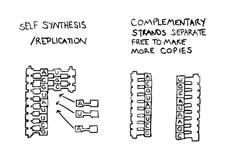

- RNA and DNA; B. RNA synthesis and replication; C. Earth’s early oceans
These replicating molecules are thought to have persisted in a relatively conserved form since the Archean eon over 3.5 billion years ago (shortly after the Hadean eon in which the earth was essentially molten). At this time, the moon was much closer to the earth, and it loomed large in the sky. The sun was not as bright, and the days and nights were much shorter. The seas were green rather than blue, and the atmosphere was orange. Thankfully the replicators under this rust-colored sky made constant errors. The mistakes inherent in replication, also known as mutations created variations for natural selection to act upon. This allowed these early replicators to be modified from their original forms and to become more complex in response to the rigors of their environment. Copies were selected for longevity, fecundity and accuracy of replication. Competition between them for resources likely caused these original replicators to develop new survival strategies. This was the first form of competition on Earth. It is not clear when this competition between molecules first turned into aggression and predation.
The molecules began building a cell membrane around themselves to serve as a shelter and a vehicle to further their continued existence. They went from floating about naked in the seas, to being ensconced in protective sheaths. Today, we know these enclosures as cells, the smallest units of life. These simple cells changed and evolved to perform complex and meaningful functions, all of which came about to protect the RNA (and later DNA) and to increase the productivity of replication. These replicators began to be able to gather energy, and developed a metabolism enabling them to complexify and do work. At this point –as single cells with metabolic functions – they met the criteria for life. After these molecules espoused cellularity their very structure took on another function. They still acted as templates for their own replication, but they also began to hold genetic information. At some point around the time they evolved into bacteria, the replicating molecule came to act as a blueprint for building and maintaining the cell, for performing cell division, and for constructing the various structural proteins and enzymes necessary for the cell’s survival. The DNA in our cells today perform these exact same functions.
At one point, multicellularity evolved and evolution began to experiment with body plans. The replicators that survived were those that built the most fit body for themselves to inhabit. For centuries it has been hoped that scientists could precisely determine dates for the branching points in the evolutionary tree of life. This dating has more or less been accomplished thanks to new molecular techniques. In just the last few decades, scientists have finally assigned time periods to our line of descent from, not only other animals, but from plants, fungi and bacteria. To determine relatedness geneticists measure the number of molecular differences in the DNA between species. When a geneticist tells us that we are more than 98 percent chimpanzee that means that if we lined a matching strand of our DNA right up next to theirs, less than 2% of the sequence of molecules would be non-identical, and the rest would match our sequence exactly. Comparisons can be made with all animals, and all forms of life for that matter, to determine relatedness and time since divergence.
Table 1.1 below lists estimated dates for our divergence from other living groups of animals (Dawkins, 2004). It is easy to misinterpret such a list so allow me to give you some caveats. The last entry on the list indicates that we shared a common ancestor with chimpanzees, our closest living relative, only 6 million years ago. This does not mean that we were chimpanzees at that time, just that the common ancestors of humans and chimpanzees were members of the same breeding group of individuals and had not yet split apart and evolved into distinct species. The same goes for each of the other modern groups listed. If this list contained images depicting the actual forms that our lineage took during its history it would look considerably different. Although in many cases the list does provide a rough approximation for the different forms that we took on during our evolution. We went from single-cell bacteria, to plant-like animals, to worm-like animals, to fish, to amphibians, to reptiles to mammals. This is the list for humans but every species has a similar list with the same contents, arranged in a different order. The fact that this list details the interrelationships between us and all living organisms on Earth makes it profoundly thought provoking for me. What type of information would have been more interesting to ancient thinkers, or to renaissance scholars? Even just a few decades ago humanity didn’t have this. To me it is a kind of Holy Grail. We have it now, you are holding it in your hand. Please refer to this table -for the fun of it- as we discuss the similarities that we share with other species.
Table 1.1 Time Since Divergence with Other Presently Living Organisms
3.? bya Molecular Replicators

2.? bya Eubacteria

2 bya Archaebacteria

1.25 bya Plants

1.2 bya Amoebozoans
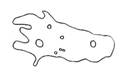
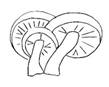
1.1 bya Fungi (mushrooms, yeast, truffles)
1 bya Drips
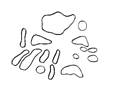
900 mya Choanoflagellates
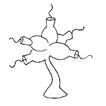
800 mya Sponges

750 mya Placozoans

700 mya Ctenophores (combjellies)

650 mya Cnidarians (jellyfish, corals, anemones)

630 mya Acoelomorph Flatworms

590 mya Protostomes (mollusks, insects, and some worms)
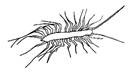
570 mya Ambulacrarians (sea urchins, sea cucumbers, starfish)

580 mya Sea Squirts and Salps
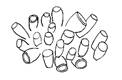
575 mya Lancelets
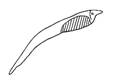
550 mya Lampreys and Hagfish
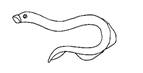
460 mya Sharks, Rays, and Skates
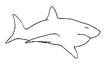
440 mya Ray-finned Fish
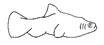
425 mya Coelacanths

417 mya Lungfish
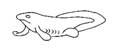
340 mya Amphibians (salamanders, frogs, toads)
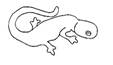
310 mya Sauropsids (lizards, snakes, birds)

180 mya Monotremes (echidnas, platypus)
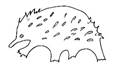
140 mya Marsupials (opossums, kangaroos, koalas)

105 mya Afrotheres (elephants, moles, shrews, aardvarks)

95 mya Xenarthrans (sloths, anteaters, armadillos)
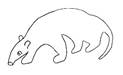
85 mya Laurasiatheres (bats, hippos, whales, horses, dogs, seals)
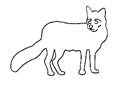
75 mya Rodents, Rabbits and Hares (rabbits, mice, squirrels)
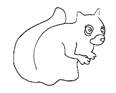
70 Tree Shrews and Colugos
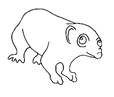
63 mya Prosimians: Lemurs (lorises, bushbabies, pottos)
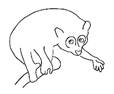
58 mya Tarsiers

40 mya New World Monkeys (spider, howler, capuchin)

25 mya Old World Monkeys (colobus, macaque, baboon)
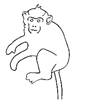
18 mya Gibbons
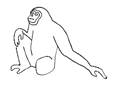
14 mya Orangutans
7 mya Gorillas
6 mya Chimpanzees

Our bodies are complex conglomerations of cooperating cells that are designed to perpetuate our DNA. In other words, we are merely “survival machines” for molecular replicators. Our ovaries and testicles carry these molecular replicators. Many biologists see our eggs and sperm as the seeds or kernels, and the rest of our bodies as a “disposable husk.” We are mortal baton-bearers and our sperm and eggs are the batons in a relay race that stretches back over 3 billion years. They are the “immortal germline,” and we are their fleeting enclosures, given one ephemeral chance to do their bidding. This echoes Samuel Butler’s aphorism that “a hen is only an egg’s way of making another egg.” Scientists like Richard Dawkins helped to show that this perspective on genes, although only one way of looking at life, is valid at many levels of biological examination (Dawkins, 1976). Genes are not just the blueprint for our bodies, they are the original captains before the invention of the ship. Any full account of the meaning of life must at least mention this as a caveat. These simple molecules developed the rudiments of animacy and agency. They introduced function and purpose (teleonomy) into a universe devoid of function and purpose. Their legacy and their struggle structures our biology, and gives us perspective from which to interpret our innate behavior.
Replication is life’s imperative. Natural selection acts as a wheel or rudder that steers changes in a species over time, but it is not the driving force of biology. Replication is. In fact, biology and even psychology can be seen as just elaborate extensions of replicative chemistry. Every organism’s original purpose in life is to pass on their DNA in as effective manner as possible to the next generation. To this end, all organisms have adopted various methods, called life history strategies, which enable them to fulfill this purpose most efficiently given their body type and ecological niche. But just knowing that you’re a fly, that you should have wings, a compound eye and taste buds on your feet is not enough. Flys, and all organisms for that matter, adjust their life history strategies based on feedback from their environment. A bad environment causes an organism to deviate from an optimal body plan, to restrict growth, to restrict movement, to restrict quality of life. This leads us to a humbling conclusion: that our bodies were not designed for our personal enjoyment, rather they were designed to preserve the genes no matter what the cost. They not only endure injuries and hardships, but actually manufacture their own physical impairments in response. The next section will look at how organisms retain trauma and why they make costly adaptations to stress.
Neuroscience
Over the last century neuroscience has turned from a descriptive science where early anatomists name visibly different neuroanatomical landmarks, to a mechanistic science where modern neuroscientists are able to make inferences about the functionality and connectedness of these structures. The latest studies and theories are concerned not only with the function of small local structures but the global, emergent functionality that derives from the interaction of a multitude of unique structures.
The study of neuroscience may be more consistent with the dictum “know thy self” than any other science. There are no visual images, sounds, smells or feelings inside of or moving around with our neurons.
William James had the insight that consciousness was not a thing but a process. Thus it cannot be found as a property of a neuron or group of neurons but rather a property of the interactions between neurons.
Action potentials often have an amplitude of about 100 millivolts, a duration of 1 ms and travel between 1 and 100 meters per second, 40m/s on average. Animals function over a great range of time scales. For human behavior, one-tenth of a second (100ms) is a good unit to keep in mind because the fastest reactions to a stimulus happen in about 100 milliseconds, whereas it takes a few hundred milliseconds to for a new configuration of stimuli to enter full conscious awareness. If it took seconds for a human to react, they couldn’t survive in the fast-moving and dire prehistoric past yet we cannot force our systems to respond on the order of tens of milliseconds like many less intelligent animals can. We simply have too many neurons and the neurons each have their own biological constraints on speed of processing. A typical neuron can integrate its inputs, fire and reset itself in about five milliseconds (5 ms), or around two hundred times per second. This is very fast, but not nearly as fast as a modern silicon-based computer which can perform over a billion operations in a second. Auditory nerves have the capability to fire about 1,000 times per second. The average cortical neuron fires around 10 times per second. The propagation of electricity in nerves travels on average at 40 m/s. The propagation of electricity through a metal wire can travel close to the speed of light 186,000 miles/s.
Neurons don’t mass produce certain proteins for export out of the cell, neither do they contract to move muscles or perform work, they do consume oxygen and fuel (in the form of glucose) at a rate that exceeds any in the body. Most of this energy does perform work at a microscopic scale, driving the numerous membrane pumps found in every neuron. These pumps actively pump sodium, calcium and water out of the cell and potassium into the cell. The maintenance of these ionic gradients across the outer cell membrane is responsible for the electrical potential in neurons allowing them to send impulses or messages to each other. When sufficiently triggered by other neurons, a neuron can depolarize (depolarization is excitatory, hyperpolarization is inhibitory), letting the ions it has been pumping flow backward. These ions rush toward equilibrium, collapsing the ionic gradients and sending a fast message down the neurons axon. All cells must maintain gradients to survive, but none let go of their gradients temporarily and are forced to restore them extremely rapidly. To do this quickly neurons have many more membrane pumps than other cells and these use prodigious amounts of cellular energy or ATP. Neurons don’t make provisions and thus are prone to cell death (infarction) when low on oxygen (ischemia).
Only two features of action potentials carry information, their number and the duration between them (frequency) and the function of the signal is only determined by the pathway. In some invertebrates a single cell, called a “command cell,” is capable of initiating a complex behavior, this is never so in vertebrates.
Nobody starts life with a head or a brain, instead we start as the union of sperm and egg, then a rapidly dividing ball of cells. Our head and many of its structures stem from the gill arches in worms that were used to filter food as water was pumped through them. Just as the teeth, genes and limbs have been modified and their functions repurposed over the ages, so too, has the basic structure of the head. As a blastocyst we look like a Frisbee.
All tissues are cells inside a collagen and proteoglycan medium. Collagen 90 percent of the body’s protein by weight.
The brain expresses more total genes than any other organ in the body. Over 200,000 distinct mRNA sequences have been found which is 10-20 times that in the liver or kidney.
Animals have three types of neurons: sensory neurons, motor neurons and interneurons. Even the rapid firing of a single cortical neuron is not enough to cause a muscle to contract or to create a conscious impression.
The medulla oblongata is involved in digestion, breathing and heart rate. The pons conveys information about movement to the cerebellum. The cerebellum is involved in determining the amount of force and range of movement necessary to fine-tune motor skills. Interestingly and inexplicably, it also lights up during almost any cognitive tasks. The midbrain is responsible for many simple sensory and motor functions including unconscious eye movement, and visual and auditory reflexes. The diencephalon contains the thalamus and hypothalamus. The cerebral hemispheres contain the cortex, the basal ganglia, the amygdala and the hippocampus. The basal ganglia also plays a large but underrecognized role in higher cognitive processes and has been shown to be highly influential in the decoding of grammar, syntax and language. The thalamus is highly modular, it is an assemblage of nuclei with fixed inputs, outputs and fixed functions. The cerebral cortex, rather than being made up of discrete modules, is more gradiential in its organization.
Galen pointed out that nerve tissue works like a gland. Camillo Golgi developed a staining method to color the practically translucent neurons with silver salts for better microscopic visualization. The staining method made the neurons and all of their physical offshoots (processes) visible. The staining takes to about 1% of neurons in a sample making it so that nearby neurons do not obscure each other. Santiago Ramon y Cajal painstakingly stained, drew and described individual neurons and their processes. Descartes thought that nerves were tubes of fluid and that the brain (like the heart) was pumping this fluid. Galvani discovered that muscles and nerves respond to electricity. Muller, von Helmholtz and DuBois discovered that nerves can be activated by external electric signals in a complex but predictable way. Bernard, Erlich, Langley and others were some of the early explorers looking at nerve receptors, drugs and neuropharmacology. Jackson, Wernike and Sherrington developed cellular connectionism.
The amplitude of the electrical signals are often proportional to the strength of the stimulus (graded potentials) in dendrites. The amplitude of the signal is uniform in size in the all-or-none action potentials that are initiated in the cell body and sent down the axon towards the cells that the neuron targets. Individual neurons are connected to one another at a gap called a synapse where chemical neurotransmitters are released by the presynaptic cell (the neuron sending the message) and received by membrane receptors in the postsynaptic cell (the neuron receiving the message). These synaptic receptors are similar to other cell receptors found all over most cells. At the synapse though, the receptors are relegated to tiny circumscribed areas of the cell instead of spread evenly over the cell membrane as many hormonal receptors are.
I agree with Jeff Hawkins when he says that “the brain does not “compute” the answers to problems; it retrieves the answers from memory.” The neurons do not perform complex mathematical operations to work out the problem from first principles, instead they store past information and use it to configure the best group of representations that they can to represent what is happening in the current environment. To quote Jeff Hawkins: “A helpful analogy might be to imagine what happens when you sit down on a water bed: the pillows and any other people on the bed are all spontaneously pushed into a new configuration. The bed doesn’t compute how high each object should be elevated; the physical properties of the water and the mattress’s plastic skin take care of the adjustment automatically…. The design of the six-layered cortex does something similar, loosely speaking, with the information that flows through it.”
Computationalism or Connectionism? I used to take umbrage with the concept of the brain performing computations, I used to think of brain processes as the stimuli’s and memory’s most likely path. We are conscious of the results of the “computations” not of the computations themselves, like a CEO that takes a report from someone in the organization without needing to know what went into the creation of the report.
Neurons Contact Each other at Synapses
Before neuroscience it was thought that “spirits” performed the subsecond, microscopic neural processes. At the time, scientists had none of the chemical, physical or biological terminology, knowledge or instrumentation to properly characterize these phenomena so perhaps “spirit” was the best characterization at the time. As science and technology advanced, brain scientists used different analogies to describe nervous properties. Animal spirits moving around the brain were replaced physical substances and forces which were later superseded by models of psychic fluids using hydraulic principles and then animal energies using electric principles. In this century alone analogies have been made between the brain and other complex systems such as simple machines and tools, clocks, telephone switchboards, most recently with computers. Over the centuries there has been a clear human predilection for describing brain functions in terms of the dominant technology of the time.
Ramon y Cajal made another important insight, he saw that some sensory information (both in the spinal cord and in the brain) is sent more or less directly to motor systems for initiating reflexive responses and that there are other pathways sending this sensory information to higher-order centers for the initiation of voluntary responses. Around one billion synapses in one cubic millimeter of cortical tissue. No other organs in the body have synapses or anything similar to them to organize information across space and time.
Cell theory, developed by Matthias Schleiden and Theodore Schwann who were influenced by advances in microscopy made in their time, simply states that: 1) cells are the basic unit of every living thing and 2) new cells are created by old cells that have divided into two. Don’t laugh. it was a conceptual overhaul at the time. Schleiden, a German botanist first proposed in 1837 that all plants were made up of discrete units. A year later his friend Schwann extended this notion to animals, and thereby united botany and zoology (and later all life) under a common theory of cellular structure.
Spanish neuroscientist Santiago Ramon y Cajal used a histological staining method developed by Italian Camillo Golgi (in his kitchen in 1873) to show that neurons do not form a continuous network but are in fact individual, discrete units that are physically separate but mechanistically connected. This idea, known as the “neuron doctrine,” brought neural science under the same umbrella as “cell theory.” Cell theory was revolutionary at the time and was again influential during the time of Ramon y Cajal because previously many scientists thought that all constituents of the nervous system formed a continuous, open, reticular “syncytium.” Clearly most body cells were discrete, closed spheres. But neurons were thought to be an open, interconnected system. Sigmund Freud, in his early days studying fish and crustaceans, promoted the idea that nerve cells are physically separate from each other. He stated that “the nervous system consists of distinct and similarly constructed neurons… which terminate upon one another.” (1987). He coined the term “contact barriers” and postulated that at these places, where neurons abut, interactions between neurons across contact barriers make possible memory, consciousness and the mind. Freund decided that progress in brain science was preceding at a very slow pace and that he should refocus on psychological theories of the mind.
Two years later Sir Charles Sherrington, probably unaware of Freund’s writings called these contact barriers synapses. Sherrington was studying simple reflex circuits at the time and needed the concept to explain his findings. He was trying to explain how sensory neurons in the patellar tendon of the knee respond to the physician’s hammer when testing for healthy reflexes. Sensory nerves in this tendon send messages that travel up the leg into the spinal cord where they connect with and inform motor nerves of the hammer’s action. These motor nerves then signal the quadriceps muscle and force it to contract quickly pulling the calf and foot upwards in a knee-jerk reaction. Sherrington realized that the gap between the sensory and motor neurons had to be bridged somehow if the information carried by the sensory nerves were to be transferred to the motor nerves. He chose the word synapses because it is derived from the Greek word meaning to clasp, connect or join. The idea of the synapse was not definitively vindicated until the 1950s with the advent of the electron microscope. Very high resolving power was necessary to visualize and confirm the existence of these tiny gaps between neurons. Sherrington, at this time understood something about the brain that few did, but still he had so little mechanistic knowledge of how the brain performs its feats and weaves its experiences. The brain was miraculous to him and he dubbed it the “enchanted loom.”
Information transmitted synaptically is a one-way street. At the level of the spine, information flows from sensory to motor, never the other way around. Yet in the cortex, most pathways are two-way streets. Charles Sherrington supported the idea that all of our movement occurs in response to some stimulus and that we often move, not because our brain commands it, but because our spinal reflexes are always responding to one stimulus or another.
For a postsynaptic cell to be stimulated enough to fire it must be bombarded with transmitter molecules from many presynaptic inputs, all within a few milliseconds. The physical basis of neural communication is usually electrical-chemical-electrical: electrical signals traveling down axons stimulate the release of neurotransmitter chemicals to the next neuron and if these neurotransmitters are sufficient they will generate a high enough electrical potential to force the neuron to fire an electrical action potential down its own axon. The postsynaptic cell quickly becomes a presynaptic cell, switching from a role as a receiver to one as a sender. There are some synapses that do not use neurotransmitters, that are continuous with one another and that use only electricity but these are relatively uncommon. These synapses are called “gap junctions” and only occur in cells that are required to fire together and are not interested in integrating diverse inputs over time to determine when they should fire.
Sensory Neurons, Motor Neurons, Interneurons and Signaling
The amino acid neurotransmitter glutamate is the main excitatory neurotransmitter in the brain and is used by most projection neurons. Inhibitory neurons use GABA (short for gamma-aminobutyric acid), a neurotransmitter prevalent in inhibitory interneurons. Projection cells tend to be quiet in the absence of input from other projection cells. This is because local inhibitory interneurons (which are tonically active) are sending them inhibitory neurotransmitters which must be overcome by a large amount of excitatory neurotransmitters. The balance between excitatory and inhibitory inputs determines whether it will fire.
Another major tenet of neural science, called functional polarity, states that the output side of a neuron is a single process called an axon and the input side of the neuron consists of a cell body (with the nucleus, DNA and most organelles) along with extensions of the cell body called dendrites. A cell’s dendrites can receive inputs from many other neurons and a cell’s axon branches to create multiple synapses. Because the axons are bifurcated and branch out to allow many synapses, one cell’s message can be broadcast to many other cells simultaneously in a process called divergence. The opposite process, convergence, occurs when a single neuron has multiple neurons connected to it, forming synapses on its dendrites. When these neurons all fire together they converge on their common neuron and greatly increase the likelihood that it will fire. A neuron’s inputs are constantly summing together. The electrical fluctuations caused by incoming messages are continuously summated, and when they add to a certain number or above, they will influence that neuron to fire an action potential down its axon to signal its targets. Dendritic spines can grow and form in mere minutes to create new connections as a response to important new learning although the LTP process is generally thought to take more time, on the order of hours. The things that hurt LTP the most are hypoglycemia, stress and alcohol.
Neurons can be classified into many different types. Some are well studied but there are unclassified and exotic types with strange properties that are still being discovered. There is great diversity in terms of structure, neurochemicals and contribution to information processing. The classic neuron, is the “integrate and fire” neuron. The graded dendritic potentials add up and, if the total voltage over a very brief time interval exceeds about -50mV, they trigger an action potential in the neuron and its axon. Most neurons require input from several hundred neurons (a small fraction of the neurons that synapse on it), within 2 to 3 milliseconds to generate a spike.
A single wire on a computer chip can be shared and used to make many different connections. Likewise telephone cables are high-capacity lines that can carry many conversations. A single fiber optic cable can carry a million conversations at once. An axon can carry one message, and always from a single neuron to another neuron, one at a time.
Sensory neurons do not generally fire directly at muscle cells. Sensory neurons fire at motor neurons which in turn fire at muscle cells. Having “two layers” to the nervous system increases regulatory potential and thus behavioral complexity. Having both sensory neurons and motor neurons allows for more divergence and convergence than a (theoretical) system where sensory neurons fire straight to muscles because the axons of both sensory and motor neurons typically have multiple branches to multiple postsynaptic target cells. This leads to the situation where one sensory neuron excites multiple motor neurons, each of which excite multiple muscle cells in a “pyramid of excitation,” which was referred to as “avalanche conduction” by Ramon y Cajal.
Interneurons lie between sensory neurons and motor neurons, in the space between sensation and movement. There are many types of interneurons, but they fall into two broad categories: local interneurons whose axons remain close by; and projection interneurons whose axon projects away to another cell group. The interneuron allows for increased sophistication of neural circuitry and thus behavior as well. Interneurons allow the potential for divergence and convergence to expand tremendously and also allow information from different sense modalities to become integrated. Also, interneurons have the capacity to be inhibitory. In other words, inhibitory interneurons are capable of sending neurotransmitters to the synapse that will actually reduce the probability that the postsynaptic cell will fire. They do this by releasing GABA… Inhibitory interneurons make it so that, on the simplest level, it is possible for a single sensory neuron to cause some muscles to contract and others to remain motionless.
There is very little light or sound inside of the head and there is no sense of touch or pain either.
Each neuron has a long extension called an axon which connects with other neurons at a synapse. The axon normally divides into several terminal buttons which synapse on other neurons. The dendrites have high surface area and look like a system of tiny bifurcating roots. Dendrites act to capture terminal buttons from other cell’s axons leading them to receive messages from those neurons. Axons ordinarily synapse on a dendrite but sometimes form on the neuron cell body or even on another axon. Most axons in the cortex stay local and send messages to nearby neurons. Some axons reach out to distant cortical areas, others travel through the corpus callosum to the other hemisphere, other axons still sink down to connect with subcortical nuclei or deep within the spine. Axons from these subcortical nuclei also travel upwards and synapse with cortical neurons. In fact, it seems that most connections are bidirectional.
The brain fakes it until it makes it. There is no mind in the organic system. Intelligence is not something cohesive in nature rather it is emerging out of a variety of independent processes that we’ve labeled and rationalized into a single term.
Synaptic Signaling
Our synapses, are what make us who we are. We are our synapses. Our intelligence, our personality, our essence – what makes us unique – is found in patterns of interconnectivity between neurons in our nervous system. This interconnectivity comes from the genetic blueprint for our brain, as well as from the way neurons have wired up during life experience causing their points of contact (synapses) to be differentially weakened or strengthened.
All cells are completely enclosed in a membrane, it covers the axon and dendrites as well as the cell body. The space outside of neurons is called the extracellular space and is filled with liquid. Neurotransmitter molecules diffuse into and pass through this liquid as they travel from cell to cell across the synapse. Synapses are tiny gaps measured in angstroms (one ten-millionth of a millimeter), so the neurotransmitters don’t have to travel far through the extracellular space and are not likely to float away from the synapse. The extracellular space also has a different chemical composition from the cells that are bathed in it. Neurons, like other body cells, work hard pumping certain chemical out and other chemicals in, past their cellular membrane. Neurons have sodium-potassium pumps that transport calcium and potassium in and sodium out. This is why their composition differs from the extracellular space. The chemical composition of the inside of neurons is more negatively charged (because of the negative ions) than the surrounding liquid. In general, the inside of a neuron that is at rest, and is not being stimulated by its inputs is about 60 millivolts (60 one-thousandths of a volt) more negative than the outside.
When glutamate attaches to the binding site of a postsynaptic receptor, a passage opens up through the receptor that selectively allows positively charged ions in the extracellular fluid to move inside. If a sufficient number of postsynaptic receptors are occupied, and a sufficient amount of positive ions float into the cell, the voltage inside will become sufficiently positive to initiate an action potential that will shoot down the axon. When GABA receptors are occupied, the inside of the cell becomes more negative due to the influx of negative ions (especially chloride). This contradicts the messages from glutamate binding and makes the cell less likely to fire. Neurons receive excitatory and inhibitory inputs, Glutamate, GABA and other neurotransmitters all the time and the likelihood of firing depends on the net balance between excitation and inhibition, across all of the cell’s inputs, at any particular point in time.
Basal metabolic rate is the energy required to achieve the body’s life sustaining processes. This includes ion transport (40%), protein synthesis (20%), and daily functioning such as breathing, circulation, and nutrient processing (40% BMR).
Many new LTP receptors wait, dormant in the dendrite tip, just next to but not in the synapse, calcium makes them surface.
Synapses are the functional contacts between nerve cells that alter their connection strengths with experience. You have about 100 trillion of them in your brain. Synapses can only be meaningfully analyzed with an electron microscope.
2,000 synaptic gaps would equal the diameter of a thin hair.
A recurrent collateral is found in a neuron that synapses on itself. This is usually inhibitory and tells the neuron to keep quiet for a period after a series of spikes so as to make a clear contrast between signals and silence. This helps to sharpen a message in time. Sharpening a message in space is accomplished by lateral inhibition, where inhibitory collaterals to neighbors suppress related but unnecessary or confusing representations.
Developmental Neuroscience
Brain volume quadruples between birth and adulthood, but we are born with the vast majority of neurons that we will have. The increased size comes from connections that are formed and built up between these neurons. This comes from synaptogenesis and myelination.
In the visual cortex, there is rapid synaptogenesis at 3 to 4 months and a maximum density of synapses is reached between 4 and 12 months. At this point the synaptic density is around 150 percent of that in adulthood. In contrast, synaptogenesis starts at the same time in the PFC, but does not reach its peak until well after the first year. Loss of synapses due to synaptic pruning decreases the density of synapses. This regressive event follows different patterns for each region of cortex. For example, synaptic density in the visual cortex begins to return to adult levels after about 2 years, while in the PFC the same point is not reached until the teenage years. Subcortical areas, to a large extent, show much less postnatal development. Most are fully online at birth but to continue to change during development. The subcortical areas most highly connected to the cortex seem to be the ones that change the most.
The PFC and other association areas are the last to myelinate and also seem to myelinate for the longest duration, the process has been shown to continue for years (Yakovlev & Lecours, 1967). Myelin develops last in layers II and III in both humans and the monkey. Fleshsig in 1901 stated that these late myelinating areas probably engage in complex functions highly related to the unique experiences of the individual rather than species specific actions.
In some places the spatial range of an axon forming an arbor of terminal buttons reaching out for other neuron’s dendrites can span a full cubic millimeter.
The total number of synapses in the infant brain is twice that of an adult’s. After this early period of exuberant growth another prolonged period of elimination of excess synaptic contacts commences. Most musicians that have perfect pitch (can identify the pitch of any note) began musical training before the age of six and this is probably due to the constraints that synaptic pruning puts on subsequent perceptual flexibility.
Neurotransmitters
The main cortical neurotransmitter is glutamate, composed of about 30 atoms.
About one quarter of all cortical neurons utilize GABA. It mostly mediates transactions between neighboring cells where local inhibition makes its impact and is thought to play an important role in lateral inhibition.
Ionotropic vs. metabotropic receptor pathways. Metabotropic are slower and of longer duration.
There are 6 major neurotransmitters and 30 minor neurotransmitters (the neuropeptides).
Neuromodulators
Aside from the neurotransmitters glutamate and GABA which run the brain generally, there are a number of other chemicals called neuromodulators that are used to modulate brain activity as environmental demands dictate. The neuromodulators intervene at opportune times and alter the functioning of the brain to better meet the requirements of the task at hand. Each neuromodulator alters the thinking process in a different way that is adaptive if used appropriately.
Neuromodulators work like the neurotransmitters glutamate and GABA, but play a different role. They act more slowly and have more prolonged effects. Glutamate and GABA act very quickly, they effect a change and this change dissipates in mere milliseconds. The slow acting modulators come in three types: peptides, amines and hormones. Each can have either excitatory or inhibitory effects. Neuromodulators are “sprayed” throughout large portions of the forebrain from small fountain-like clumps of neurons at the base of the brain. They can make similar changes all over the brain, or they can have specific local effects if a certain receiving region has specific types of local receptors. For example, dopamine is spread very widely, but the D1/D2 receptors in the frontal cortex are thought to play distinct roles in working memory.
The neuromodulators travel along specific pathways from their source to the neurons that they affect. Like aquaducts they take a substance from a specific localized source and distribute it among individual cells throughout a large area. The monoamines, a class of modulators, include substances like dopamine, serotonin, acetylcholine, epinephrine and norepinephrine. Unlike most other neurotransmitters and modulators, the cells that produce monoamines are only found in certain areas, mostly in the brain stem. Monoamines act throughout the brain though because the axons that produce them extend throughout the brain. Because of their nonlocal effects, they are not involved in the processing of stimuli in local circuits, but rather produce global effects, such as arousal, motivation, and relaxation.
The neuromodulator dopamine controls arousal and plays a major role in motivation and reward. Serotonin is a “feel-good” chemical that affects mood and anxiety where high levels of it produce tranquility and optimism although it also plays major roles in sleep, pain, appetite and blood pressure. Acetylcholine controls activity related to attention, learning and memory. People with Alzheimer’s typically have low levels of Ach in the cerebral cortex and drugs that boost its action improve memory. Noradrenaline is an excitatory neuromodulator that induces physical and mental arousal and is produced and sent from the locus coeruleus. Adrenaline is also responsible for the enhanced learning and memory consolidation that happens after stressful events, which is largely due to the high numbers of adrenergic receptors in the amygdala (beta adrenergic receptor blockers given after traumatic incidents decrease the frequency and pervasiveness of PTSD symptoms).
Neuropeptides (small subunits of proteins) can dramatically affect the responsiveness of a cell to its glutamate and GABA inputs but cannot do this with precise timing. The best known peptides are the opiates, endorphins and enkephalins. These are released due to pain and stress, are said to be responsible for “jogger’s high” and morphine creates its effects by binding to these peptide receptors. Enkephalins and Endorphins are endogenous opioids that modulate pain, reduce stress and create serenity and calmness.
Serotonin is a monoamine modulator generated in the raphe nuclei in the brain stem that is dispersed throughout the brain. It counteracts certain facets of anxiety, party by inhibiting activity in the amygdala. Antidepressant drugs known as SSRIs prevent the removal of serotonin from the synaptic space. Normally, after binding to receptors on the postsynaptic cell, neurotransmitters are pulled back up into the presynaptic cell for reuse. SSRIs (selective serotonin reuptake inhibitors) prevent this reuptake and prolonging the effect of serotonin. Cells in the amygdala are normally tonically inhibited by GABA to a resting potential of -80mv, so the amygdala is usually quiescent, unless it receives just the right kinds of input – the kind that would be caused by a frightening or surprising experience. Stimuli that are threatening such as the sight or smell of a predator, loud noises, quick movement or pain are able to overcome the tonic inhibition in the amygdala. Many serotonergic cells have axons terminate in the amygdala. Serotonin excites GABA cells in the amygdala allowing amygdala to ignore or inhibit its reaction to intense stimuli. Cortisol disables serotonin’s ability to increase GABA transmission in the amygdala. Cortisol is elevated in many psychiatric conditions and when elevated increases the intensity of fear reactions. The amygdala also has many receptors for testosterone and its activity in accentuated by its presence, testosterone increases the firing rate. When the amygdala is activated it can directly inhibit the PFC. When serotonin is low in the PFC, it inhibits the amygdala less.
Serotonin producing cells lie in the raphe nuclei of the pons and mesencephalon. These cells project upwards to the diencephalon, the limibic system and the cortex. Serotonin plays a major role in sleep, eating, circadian rhythms and sensory areas, but has recently been found to play a role in prefrontal function where it interacts with DA, plays a role in synaptic development and plays a significant neuropharmacological role in psychiatric syndromes such as depression and schizophrenia. Stress actually increases 5-HT levels in the PFC. But 5-HT is not clearly facilitated by 5-HT like it is by dopamine.
The prefrontal cortex seems to have some ability to regulate ACh release in the posterior cortex. This creates a glutamate/GABA deficit in the pyramidal neurons of the PFC. ADHD seems to be due to hypofunction of dopamine function in prefrontal regions and a disinhibition of posterior areas.
Hormones can play the role of neuromodulators too. They are released from bodily organs such as the adrenal glands, pituitary gland or sex glands into the blood stream where they travel to the brain. Like other modulators they alter the efficacy of glutamate and GAMA transmission by binding to specific synaptic receptors.
The “high” of acute intoxication from a large variety of addictive substances, including opiates, nicotine, amphetamine, cocaine, cannabis, phencyclidine (PCP), and alcohol raise DA levels in the mesocorticolimbic DA system, especially in the orbitomedial PFC and nucleus accumbens. Withdrawal from chronic intoxication from these drugs leads to DA depletion and general hypometabolism in these systems.
The amgydala, the hippocampus, and the PFC are all tied into the motivational schedule through connections with the nucleus accumbens, the striatum, VTA and substantia nigra. There is much about the operation of these structures that is unclear but clearly they work together.
Most addictive drugs work by altering levels of neurotransmitters. Ecstasy stimulates serotonin producing cells, which activates areas of the cortex that hold memories for euphoria, and affection. This is what antidepressants do, but ectasy releases more serotonin, so much that regular users can “burn out” their serotonin generating cells creating powerful withdrawal symptoms and a large risk for long-term depression. Hallucinogenic drugs like LSD and magic mushrooms increase serotonin, and other neurotransmitters as well. Hallucinogens also increase activity in the temporal lobes, freeing up memories that can cause hallucinations. A “bad trip” can be the result of excessive amygdala stimulation which produces feelings of fear. Cocaine blocks the mechanism that usually clears dopamine from the synapse, increasing its availability to neurons. It also blocks the re-uptake of noradrenaline and serotonin. The rise in these neurotransmitters causes the feelings of motivation (dopamine), confidence (serotonin), and excitement (noradrenaline). Alcohol and tranquilizers such as benzodiazepines actually decrease neural activity through action on GABA neurons.
Interestingly, researchers that study fly neuroscience regularly conclude that the neurons found in fly brains have a wider range of behavior than more complex mammalian brains because the neurons exhibit some slight modifications in cellular and neuromodulator properties allowing them to modulate their firing in some pretty amazing, although currently poorly understood ways.
Conditioning
It is pretty easy to classically condition the eyeblink response using a puff of air. Whether it is a human or a small rabbit, the eye learns to blink to a tone or a flash of light if the animal is taught that the tone or flash always precedes the puff. Interestingly, the brain is able to learn from the timing used in the experiment and will ensure that the eyelid is maximally closed, just in time, even if the tone-puff delay (latency) is modified. This trace conditioning is dependent on the hippocampus, if the hippocampus is removed right after the learning takes place, the memory of the tone-puff training is abolished and the animal will not blink after the tone. If it is removed after two weeks, other brain areas, including the cortex and cerebellum hold the memory even in the absence of the hippocampus. Does this mean that the puff-tone relationship is declarative, at least early on, in rats?
Niels Jerne, a Nobel Prize recipient for his work in immunology, predicted correctly that the body’s immune system does not make the immunological resources (antibodies) necessary to deal with foreign, invading threats (antigens). The immune system actually finds preexisting antibody precursor molecules that match the antigen and increase their number so that they can deal with the immune threat. Jerne later applied this logic to the logic of learning, claiming that the brain selects certain pathways from a tremendously large pool of existing pathways. This has been largely supported by subsequent work. Gerald Edelman, who also received a Nobel prize for his work on the immune system has posited a framework called Neural Darwinism. In it he argues that synapses in the brain compete to stay alive and only the ones that are used the most survive. He pointed out that we are born with a surplus of synapses and that the ones that are used are kept and that the ones that are not used are eliminated. In some ways the self is constructed, but in a very real way it is selected from preexisting possibilities. Studies show that the greatest number of synapses are present at around twenty-four months of age, and that it is downhill from there (Huttenlocher, 1979). The cells that receive inputs are more likely to survive, those that do not are the first to go.
Cortical Columns
In 1978 Vernon Mountcastle published a paper titled “An Organizing Principle for Cerebral Function.” Here Mountcalse points out that on a microscopic scale the neocortex is surprisingly uniform in appearance and structure. All of the various cortical regions, from the ones that control muscles, to the ones that allow hearing, are structurally similar in the way that the neurons are wired up. This caused him to posit that perhaps each of these areas are performing the same basic operation. Most neuroscientists and engineers question it, ignore it or are not aware of it. We think of our senses as being completely different as the sense organs supplying the signals are vastly different, but once these sense modalities are turned into action potentials they are comparable, and they way that they are analyzed in the cortex is equivalent.
Every layer except for layer one contains pyramidal cells, which actually make up 8 out of every 10 cells in the cortex.
When we were embryos, individual precursor cells migrated toward their end locations in the cortex where they each divided into about one hundred closely packed neurons. These cells constitute a microcolumn and there seem to be several hundred million of these microcolumns in the human cortex.
Columns are choice points where info can flow backward, forward and laterally. Think of columns as vertical units of cells that work together to process information. Columns do not appear as discrete pillars of cells. The column concept is contentious and neuroscientists argue about their size, function and importance but everyone agrees that the cortex does have at least a faint columnar architecture. The vertically aligned cells in each column tend to be made active by the same stimuli. They are tuned to respond to the same stimuli because they generally share the same inputs. The cells in one column are also strongly interconnected with each other. For example, thalamic are other cortical sensory inputs may come from layer 4 within a column and travel upward to cells in layers 2 and 3, and downward in layers 5 and 6. Layers 2 and 3 receive this input and often project it to the cells in layer four of an adjacent column that is higher up in the hierarchy. This is how information flows up (downstream) in the brain. Information also flows upstream (down or backwards). It goes from layer 6 cells in a column to layer 1 cells in the columns hierarchically below.
Cognitive Neuroscience
Many concepts in psychology and cognitive neuroscience, like electrons, are theoretical. No one has ever seen an electron, and its existence is inferred, but inserting its supposed properties into physics knowledge frameworks allows us to explain many different kinds of observable phenomena. Electrons, like many other theoretical concepts may not turn out to be as we envision them today, but they should prove to hold many of the properties that we attribute to them.
After working a day in construction it is easy to describe your labor in terms of physics and mechanics. We even have insight into many of the automatic aspects. This is not true when working with memory. We cannot see the processes and we do not have clear schemas for defining them. For normal cognitive tasks such as reading or recognizing something, we have observations about ourselves and others doing it, but no internal specifications about what is going on under the hood. Even early brain science was like the study of automative behavior (gear shifting, turning radius, braking and acceleration) without having a look at the actual engine or other mechanical parts that produces the behavior. Today we are trying to take a look at the wetware, the biological parts and deduce and reverse engineer function.
A basic assumption in cognitive neuroscience is that all cognitive events are mirrored in and made possible by physiological processes.
A physicist can tell you where a planet will be a thousand years from now. But no scientist can tell you where a fly, or a dog, or a human child will be after one seconds time.
Neural Network Models
Neural network models attempt to describe modules and their ensembles and predict and model cognitive events. These models focus on different levels of detail or granularity, going from the biggest grains, lobes and neuroanatomical landmarks, down through assemblies, columns, neurons and even the ions that neurons use to create firing events.
Attention
A major debate in the study of attention has been between the proponents of “early” and “late selection.” Neuroscientists wanted to know if attention affected just the perception of visible objects, or their affordances as well. For example, we can look at a pencil and attend to the low-level visual features like color, texture and location or we can focus on its high-level properties like its usefulness as a writing implement. Since, neuroimaging studies have supported both and showed that attentional selection can affect neurons at almost any level of the visual system. Thus we have multiple different kinds of selective attention, voluntary goal-directed executive attention, voluntary attention to perceptual details and bottom-up attentional capture by salient stimuli. Learned nonvoluntary processes are usually not basic reflexes, they are complex and interactive routines called automatic processes.
Stimulus configurations travel up the cortical hierarchy until they are recognized. If they are never recognized, the configuration may be novel and will be either misunderstood, ignored or treated as novel and informative. Often it is what is left of the transmission, the unanticipated and unexplained portion, that is sent to the hippocampus. It is encoded at the hippocampus as a novel and recent autobiographical event.
Bottom-up, or data-driven processing is the analysis of the flow of information from the level of sensory registration upward to the higher, cognitive levels and can be compared with inductive reasoning. Top-down processing, or concept driven processing focuses on the shaping of lower sensory processing using higher cognitive, concept-driven formulations and can be compared to hypothetico-deductive reasoning.
Weak stimuli may be sufficient to drive a simple output, such as an eye movement, but may be insufficient to initiate a more complex movement such as reaching.
In V1, some columns will respond to line segments in a certain part of the visual field that tilt in one direction (/) and other columns will respond to segments oriented in other directions (\). Information flows mainly horizontally in layer 1 and vertically in layers 2 through 6. Vernon Mountcastle thought that the primary cortical algorithm was based around his concept of columns and he believed that the cortical column is the basic unit of computation in the cortex. But he never outlined exactly what columns do, what functions they perform. Columns are responsible for predicting when they should become active given activity in other columns. It uses its inputs from other areas to determine if it should be active right now or not – if its input is needed. This helps to explain how our memory system works auto-associatively. It can recall complete patterns when given only partial inputs. Early in life, there are few real memories laid down although there is a neural network for dispersing the features of different stimuli to different cortical regions for separate analysis. In infants, whether a column fires or not will mostly be dependent on whether or not it is instructed to fire by an actual stimulus in the environment. As dendrites are programmed by the environmental history, the connections made make is so that many cells and columns will fire without being directly activated by a thalamic input regarding a current sensory stimulus. In fact, after infancy many cells and columns fire without being told directly by the environment to fire. These cells are predicting, based on past experiences and the associated wiring, that their content will be necessary. They fire in anticipation, based on activity elsewhere. Thus, consistent patterns in the environment provide the connections to allow cells to anticipate that they will be needed, even if the fragment of experience that they code for is not actually existent in the environment at the moment. The brain is wired to help cells gain all the information that they will need to predict when their activity will be driven from below (or above). The brain has to do both, it has to reconcile feedforward information (actual input) with feedback information (predictive input). So cells and columns do not actually “know” if the feature that they code for actually exists in the environment at this moment, if it is predicted to exist soon, or if its feature is merely being used to model a scenario involving its content. It fires the same way every time, so it is not even telling the neurons that it is connected to if its content is real or imaginary. The predictions become the input. Cortical modeler Stephen Gross berg calls this “forward feedback” (?) but it is synonymous in many ways with imagining, day dreaming and thinking.
A baby’s senses are relatively isolated from each other.
All mammals, having cortexes, accumulate mounting conceptual inferences of careful observations of features and inferred associations between these features. We create explanatory frameworks or nomological networks of relationships between features. These construct concepts and conceptual inferences which together provide overarching understandings of physical and social systems.
Early Animals had the first Nervous Systems
Animals are the only organisms with muscles, and a nervous system. All organisms, however, are capable of changing with and adapting to their environment. Even single-celled bacteria have organelles, and chemical pathways that allow them to respond to their environment in very simple, predetermined ways. They also change their gene expression in response to specific environmental cues allowing them to adapt to different scenarios that their ancestors have evolved in. Plants and fungi, as multicellular organisms, take this a step further and use hormones and other chemical messengers to allow cells to communicate with others in meaningful ways. But the animal kingdom is the only one where species have neurons, cells dedicated specifically to communication and information processing. Animal’s nervous systems process sensory stimuli and guide muscles, integrating the movement with sensory feedback. It is thought that muscles first evolved to allow herbivory, permitting tiny animals to travel from plant to plant in order to consume them.
Remarkably environmental receptors in single celled animals may show a simple form of learning called adaptation. Repeated exposure to a particular stimulus can either decrease or increase their responsiveness. This leads to learned behavioral responses. They can learn from past experience, but only to potentiate or decrease innate responses. This means that their learning is not associative, they can only learn to overreact or underreact. Animals display associative learning. This means that rather than increasing or decreasing the link between a stimulus and a fixed response, they can create links between different stimuli and responses. This does not seem to happen on the level of a single cell though. Your body’s neurons generally just increase or decrease their responsiveness to their inputs, much like a unicellular organism. The real magic of associative learning happens in a network of neurons.
The muscle, whose movement is rapid (relative to plant movement) is reversible and repeatable and allowed locomotion for large survival machines. Single-celled ciliated organisms (with tiny hair-like arms) or flagellated organisms (with a sperm-like flagellum) had already mastered locomotion by propulsion. These tiny animal-like protists (protozoans) beat their body parts against their surroundings to move. True animals (eumetazoans) have true muscles that allow structural movements such as allowing bones to move relative to each other. On a molecular level, muscles are made of long molecules (actin and myosin) that move past each other quickly to create contractile force.
Sponges are the simplest multicellular animals and yet they took around a billion years to evolve from protozoa. They are the only animals with no nervous system. They have been around for about 500 million years. Sponges are sessile suspension feeders. They attach their base to the sea floor and take up nutrients and expel wastes by circulating ocean water through their body cavity and the system of pores that lead to the cavity. Because they have no neurons their cells can only communicate by primitive means. As far as responding to sensory stimuli, it is almost as if each cell in this animal’s body is on its own. Each cells can respond individually but their responses cannot be tightly and rapidly coordinated without a nervous system. Some sponges do have myocytes which may be the early evolutionary precursors to our smooth muscle cells. These cells help the sponge push water through its body. Because the myocytes act individually, it is as if the sponge itself is not responsible for its movements, but its individual cells are. In other words, it is difficult to personify the sponge. Sponges are close relatives to the next group of animals we will consider, Cnidarians. Sponges have differentiated protobodies. Hollow insides use flagella to move water currents through to catch food. Sponges have much of the cell adhesion, communication and scaffolding apparatus that we have. Sponges are bodies though very primitive and disorganized ones. The genetic distinction between single cell microbe and animal with a body broke down after research on choanoflagellates.
Neurons first appeared during evolution in the Cnidaria. The phylum Cnidaria is comprised of animals such as Jellyfish, corals, sea anemones and hydra. They have true neurons and true nervous systems that link sensory stimuli to motor responses. Surprisingly, the basic structure and function of neurons was firmly established in these simple animals, and have remained highly constant throughout the animal kingdom and even in humans. Structurally or architecturally though, they have the most basic nervous systems. The nature of the electrical and chemical transmission of information is highly conserved in all nervous systems from jellyfish to humans. Basic neurophysiology has changed little over evolutionary time. How the neurons are wired up into information processing structures has changed significantly, and become much more complex.
In jellyfish and hydra neurons are scattered in a uniform way throughout the body and tentacles creating a distributed “nerve net.” In animals with diffuse, nerve nets stronger stimuli will spread farther and create greater responses than weaker stimuli. In hydra there are actually more neurons concentrated around the foot, mouth, and the base of the tentacles. These clusters of nerves are specialized to control specific functions such as the diameter of the mouth or the tentacle movement. Jellyfish are blind and deaf and like most other marine invertebrates are also blind to the future and the past. Their memories really only serve to strengthen (sensitization), or weaken (habituation) existing tendencies. It would be difficult to attribute a mind to such an animal because it does not build knowledge, it really only fine tunes preexisting reflexes. They are missing associative memory – the capability to associate one stimulus configuration with another. Other simple invertebrates such as worms, insects, molluscs, and echinoderms have multisensory neural structures that allow associative memory.
More complex animals have rudimentary brains called ganglia, large clumps of neurons that work together for a common goal. This is a step up from the homogenous scattering of neurons see in Cnidarians having “nerve nets.” Ganglia allow localized specialization. For example, animals from insects to humans have thoracic ganglia in the midbody cavity that controls the responses of the thorax. Many animals do not have a single structure that constitute a brain, but instead have several different body ganglia whose function depends on where they are in the body, and where their sensory inputs originate and motor outputs extend to. In reality, the human brain is simply a large ganglion that has many inputs and outputs. The vertebrate brain is a central ganglion responsible for integrating inputs from the many nearby sensory organs. Our brain is in our head because we evolved from worm-like creatures. In fact, the closest invertebrate relative to us, and all vertebrates is a type of mud worm. As worms move through mud it is helpful for them to analyze new soil as they encounter it, for this reason, natural selection moved their most important sensory structures to the front. Their legacy is why most of our key sensory structures are grouped together in the head. The close arrangement also maximizes the speed of information processing by placing the neural structures for sight, taste, smell and hearing close together.
Beyond protozoans, sponges, Cnidarians and ctenophores, the next major branch in the evolutionary tree is flatworms from the phylum Platyhelminthes. These animals have better sensory systems, have clearly differentiated tissues and organs and have bodies with a true back and front, left and right (they are bilaterally symmetrical unlike the simpler Cnidarians which are radially symmetrical). These flat, unsegmented worms swim forward through the water, head first, in search of food or mates. These are actually the first animals with heads. Heads are the structural consequence of placing specialized sense organs near one another. Beginning in flatworms, bundles of axons are referred to as nerves, and bundles of cell bodies are refered to as a ganglion or ganglia. The ganglion in the head (the cerebral ganglion) is often referred to as the central nervous system or the brain in higher animals, whereas ganglia in other areas comprise the peripheral nervous system. Flatworms have two large nuclei in the head that are referred to as lobes, which each send a nerve cord (they in effect, have two spines) down the length of the animal. The head is placed in the very front of the animal, so that as it swims the sensory receptors in the head can relay information about the immediate (and impending) environment.
Many simple animals have sensory organs that send messages straight to small ganglia for a minute amount of superficial processing and then send messages straight to the muscles. These animals have only very little processing occurring between their inputs and outputs. These animals usually have some ability (like a thermostat) to assess a current sensory state relative to a desired state. Their nervous system commands a reflexive action meant to attain the desired state and once it is reached the action ceases. In other words most simple animals act through homeostatic reflexes and their actions are not guided by an ability to model or simulate the future.
Most invertebrates are reflex machines with brains equivalent to our hind brain and midbrain, but missing our forebrain that first evolved in fish. The hind brain and midbrian organize reflexes in rigid and inflexible ways that is determined by the structure of connections between sensory and motor systems. This inherited structure ensures that all members of these species mostly act the same – recycling well-tested, ancient patterns of behavior.
The next group that we meet up with are worms from the phylum Annelida. There are over 15,000 species in this phylum and earthworms and leeches are typical examples. In these worms, the two nerve cords that we saw in flatworms have fused into a single cord that lies below or ventral to the digestive tract. In humans, and all vertebrates for that matter, our spinal cord also travels parallel with our digestive tract from one end of the body to the other, except in us the spine is above or dorsal to the gut. This fact has caused a number of evolutionary biologists to conclude that humans and all vertebrates descend from worms that for some adaptive reason, flipped over on their backs and continued to live and evolve upside down. There are many, more highly evolved invertebrates with more complex nervous systems but each have a dorsal brain and a ventral nerve cord that lies between the gut and the wall of the belly. These organisms include crustaceans, insects, mollusks, echinoderms and so on. All of these animals have: three types of neurons, centralization of the nervous system into ganglia and nerves, a head with a brain at one end and a tail at the other, segmentation of the nervous system and the rest of the body plan.
All vertebrates share a basic body plan that is uncannily similar between animal species. We may look different from other vertebrates (fish, amphibeans, reptiles, birds and other mammals) but share many genetic and structural similarities. Vertebrate brains have a spinal cord with left and right sides that correspond to the left and right halves of the body and also, the dorsal part of the spinal cord is sensory and the ventral part is motor. In 1555 Pierre Belon, considered by many to be the founder of modern comparative anatomy, drew the bird skeleton at the same scale and posture as the human skeleton. The incredible similarities surprised the public and intellectuals alike. The sketch revealed to them that the two skeletons are largely similar, congruent, and homologous. Aside from the proportional differences and certain eccentricities, there are innumerable structural correspondences between vertebrates. In fact, it is very hard for anyone aside from a specialist to differentiate between the embryonic forms of any of the vertebrates at 4 weeks.
In vertebrates, bundles of nerves in the head are generally referred to as nuclei and bundles outside of the head are ganglia. Learning human nervous system architecture and brain topography is much like a lesson in geography.
Cosncious stimuli activate frontal regions whereas nonconscious stimuli do not. During coma or general anesthesia sensory stimulation actiates sensory cortex but not frontal regions, and frontal areas exhibit significant metabolic decrements.
Reflexes
A reflex action is an involuntary and usually instantaneous movement in response to a stimulus. Humans have many reflexes. They are indispensable propensities programmed into our nervous system. We have reflexes that we are aware of such as the patellar tendon reflex. Then we have reflexes that we rarely notice such as the dilation and constriction of the pupil. Many interesting reflexes have been documented and they truly represent our body’s hardwired, protective functions. Reflexes can be thought of as instinctual, but instincts generally involve behaviors rather than simple movements, that (at least in humans) can be inhibited. Many human reflexes are learned rather than innate. These are the things that we have done so many times that we don’t have to think about them anymore.
The famous anatomist J.Z. Young spoke of genes having to predict what the expected environment would be like, setting things up as best they could in advance, using reflexes and preprogrammed instincts.
In computer science working memory is separate copy of long term memory.
Innate Instincts
Instincts are inherent inclinations toward a specific behavior. Instincts and instinctual behaviors are much more complex than reflexes. Behaviors are instinctive, or partly instinctive if they contain elements that are not based on learning from prior experience. Honeybees can communicate precise messages about direction and distance without ever being instructed. Most birds are born knowing how to construct a nest without ever being taught. In fact, crossing species of birds with different nest building instincts can result in offspring that use incompatible behaviors in nest construction resulting in confused, inadequate nests. I was shocked when I first read about this because I had previously assumed that birds build nests in a controlled, top-down way. Results like this; however, show that a nest emerges from bottom-up, reflexive behaviors. The truth is that most animals rely on inflexible programs for generating perceptions and behavior. Because the cortex writes its own programs it usurped control from these. Many researchers believe that the cortex allows animals to inhibit, disengage from and rise above instinctual behavior but even the cortex itself may hold its own instincts. Instincts may exist in the cortex in the form of innate cortical hardwiring (many forms of which have been shown to exist). In fact, the very nature of most behaviors and thoughts is instinctive. This is because, the fundamental information processing system of human thought, if not the content, is largely inherited, hardwired and automatic.
The data that forms memories comes from the environment and thus it is not innate. However, the ways that the brain processes the data that it has captured is innate. William James was a nativist, believing that the mind cannot learn unless it already has the rudiments of innate knowledge. James believed that clasping, crying, crawling, sitting up, walking and babbling were impulsive instincts, not rational associations or deliberate imitations. He went on to list a host of instinctual human behaviors and postulated that they are not constructions made by the human mind but rather constructs aboriginal to it. Anticipating the arguments from what is now called evolutionary psychology, he saw the emotions, parental love, the different play preferences of boys and girls, jealousy, sociability, shyness, cleanliness and shame as instincts. He believed that the strongest instinct was love. I think it should be the strongest, but is unfortunately not in most people.
The simplest example of an instinctive behavior is a fixed action pattern, in which a fixed sequence of actions are carried out in response to a stimulus. Niko Tinbergen, the great Dutch observer of natural animal behavior (ethologist), the expression of a fixed, discovered that innate instinct is often triggered by an external stimulus. He studied the tiny stickleback fish. Male sticklebacks, whose belly becomes red during the breeding season, aggressively attack their red bellied competitors. When the males catch sight of the female belly, on the other hand, they immediately begin a courtship dance. Niko discovered that he could make astonishingly crude models of these fish and elicit either the courtship or attack responses from the males. He made oval blobs with red spots – without fins, tails or other distinguishing characteristics – and the male sticklebacks would attack these as vigorously as the real thing. Niko demonstrated the power of these “innate releasing mechanisms” to provoke the expression of instincts in animals. The chicks of the herring gull do something similar. Herring gulls have a yellow beak with a red spot near the tip. The chicks peck at this red spot when begging for food. Niko used a series of different models, many of them highly crude reproductions of a parent gull, to show that it was the red spot that elicited the begging reaction. Perhaps it makes sense that infant birds use inflexible heuristics but the adults do this too. When I learned that parent birds will feed any crude contraption that makes a gaping movement in its nest, I felt heartbroken.
Tinbergen found that the digger wasp has a highly complex routine that appears without experiential learning. In adulthood it will dig a burrow, find and catch a caterpillar, paralyze it with a sting, bring it back to its burrow and deposit its egg on top of the caterpillar for the baby wasp to eat upon hatching. This highly complex set of behaviors, including the ability to navigate back to the burrow, was achieved without environmental learning. It does this with no model for the behaviors as the wasps never even meet their parents. Vertebrates do these kinds of things too. The cuckoo bird for instance, migrates to Africa and back, learns a specific song and is able to find a member of its own species to mate with without having ever seen either of its parents or a sibling. Like the wasps and cuckoos, human infants have spatial brain circuits that are prepared to help them understand visual trigonometry, physics and perspective. Bees can communicate and understand precise messages without ever being instructed how. The honeybee “dance” gives three types of information, the distance of the food, the quantity and the direction. Frisch learned this by rotating the bee hive, causing the bees to go in the wrong direction. Newborn joeys climb directly into the mother kangaroos pouch after birth. Rhesus monkey young that are never exposed to adult males will give subordination displays instinctually when they first encounter them. Lab rats fear the smell of cat urine. Deaf babies babble and blind babies smile at the same ages that normals do. Even smiling can be considered a fixed action pattern because it involves a very coordinated and sequential pattern of facial muscular movement.
The Tunisian foraging ant (Cataglyphis bicolor) “remembers” how to get home after long days of traveling. It does not remember landmarks, but records information about speed and direction and plays them backwards on the way home. If you interrupt its progress and move this ant 10 meters south west during its trek home it will stop exactly 10 meters south west of its nest, and look around for its nest hole. Given the ant’s ability to cling to the ground when the wind picks up, this navigation system (dead reckoning) is a safe heuristic to use in its world. I am always noticing that my heuristics will satisfice unless a common assumption is not met, in which case my methods can be exposed for the simplistic, bounded contrivances that they are. Most animal learning is context dependent and inflexible. Animals generally have cognitive modules that work in one learning context but not in another. This makes many animals seem almost robotic and lacking in sentience. There are many pathways in adult animals that can be rewired (like the nerves for left and right paw movement in mice) and it will seem like a sentient creature could correct its behavior, but they cannot. It seems to me that humans are bound by similar constraints, we merely have more degrees of freedom.
Some problem spaces we must figure out, others we come hard wired with the structure of it.
Interestingly, animals improve and elaborate on FAPs with learning. For instance, humans are constantly performing subordination displays with the face, gestures and voices. These are influenced by innate factors but have been modified by learning. In fact, our subordination displays are so complex and so different from their original manifestations that they are often difficult to identify without prior knowledge about their neural and postural underpinnings.
Daniel Lehrman criticized the work of Konrad Lorentz, saying that it is impossible for instincts to emerge straight from genes alone and that they must have some kind of developmental history that involves learning, even if very briefly and unconsciously. For instance, a dove must see its parent to develop a preference for mating with its own species. This seems to be true only in certain cases because a cowbird never sees a parent and thus must have an innate sense for forming a preference for mating with its own species.
Vervet monkeys make calls to respond to one of three natural predators: raptors, leopards and snakes. The call for raptors causes them to scan the skies, the call for snakes to scan the jungle floor. Vervet infants have an innate tendency to make and respond to these calls and do so with some accuracy. Adult monkeys give positive reinforcement when their young make the correct call by repeating the alarm, and vervet mothers have been reported to punish young giving the wrong call (Pasternak et al., 2011). When a vervet monkey hears this call, they immediately turn to run away and look for the danger. Humans can hear the word leopard without running, we use words to signify the presence of something, but also to discuss hypothetical situations about things that may not be present.
Old world monkeys typically have a brain that weights about 3 ounces (86 grams) and contains 6 billion nerve cells. Humans have brains that weigh about 3 pounds (1,500 grams) and contains 86 billion neurons. Mice brains weigh under .5 grams and contain a mere 71 million neurons.
Niels Jerne emphasized neural selection over instruction when he pointed out that the nervous system can be thought of as a system comparable to the immune system. Invading antigens select among myriad antibodies already in the body’s immune system. When there is a match the immune system amplifies the antibody producing the classical immune response. The immune system’s complexity is actually built into the body at birth and not designed and manufactured to deal with threats as they present themselves as once thought. The nervous system is similar in many ways as all of the neurons and much of the connectivity in a person’s brain is there from birth. Like antibodies, important neural connections are strengthened molecularly relative to unused connections making it more probable that they will be used in the future. The pathways that are strengthened during childhood are the strongest. Early experiences are very formative, and as the saying goes: “the child is father to the man.”
Subcortical nuclei have intricate wiring systems that are probably capable of creating many specific assemblies and also complex representations. Do they make true imagery? Can subcortical experiences exist outside of the cortex?
Working Memory
Working memory is a brain system that actively holds multiple pieces of transitory information in the mind, making them available for further information processing and allowing them to persist long enough to influence the completion of a task. According to Cowan et al., (2005) ‘Working memory is the set of mental processes holding limited information in a temporarily accessible state in service of cognition.’ Working memory is involved in any human task where information must be held in mind. When listening or reading we must hold the subject of a sentence in mind until the verb appears before we can create imagery regarding the picture that they paint together. Sometimes we have to refer back to previous sentences to determine the referent of a pronoun. As soon as a new task engages the working memory system, aspects of the last task are bumped out. This is why you will forget a new phone number if a distraction keeps you from rehearsing it.
There is a good deal of indirect evidence for what is called the “consolidation hypothesis” which suggests that memory is stored in the same areas that support active moment-to-moment brain functions. This hypothesis raises an interesting question: Is working memory just reactivated long term memory? It seems that it is.
You know the alphabet, but it is very difficult to say it backwards. You cannot recite a song backwards, you cannot remember an entire song or story at once. This tells us that memory holds things in the same way that they happen – in a serial progression of related events. A computer wouldn’t have these problems with recollection.
Working memory is composed of a number of buffers that can process and hold certain imagined experiences like the ones above. Speech, vision, motor buffers for the lips and tongue. We can hear the words that we say silently to ourselves and thereby store them temporarily in the buffers normally used to store overheard speech.
Einstein’s insights did not arise from snap judgments, he held light beams in working memory and modeled it, imagined it, poked it and prodded it.
Noam Chomsky showed that we don’t select our sentences preformed, we construct them on the fly. We form our sentences combinatorially with a computational apparatus that recursively builds on preexisting portions with longer structures. The same must be true for our thinking.
The Value of Working Memory For Animals
Perhaps working memory evolved to help animals take a scene in, in all directions, so that they could remember what is around, what is behind them and what they recently encountered. Overall, it helped them to incorporate what they just did to instruct what they will do next. …or to help them incorporate a sequence of events, and that is why it evolved along with inhibition, because mostly what memories from the past would tell you is to inhibit the “automatic” and initiate something more informed.
Increasing working memory amounts to lengthening the assembly line for mental processes.
To be aware of something, that something must be in working memory. Consciouness is the awareness of what is in working memory. Consciousness happens in a serial way (and is only symbolic), one at a time, whereas the unconscious processes work in parallel (and are subsymbolic).
The brain is constantly cycling information between input and output in order to keep the sensory and motor worlds consistent and informed of each other’s processes. As information flows between the top (association) and bottoms (sensory and motor) of the hierarchy it reaches points where it can branch out in different directions. Information can continue upward along the hierarchy, propagate backwards in the direction it came, flow laterally or towards a different module altogether. Top-down predictions and expectations bias which way bottom-up information flows and which paths are chosen at the choice points. Neurons work independently of each other to some degree as there is no authoratiative command center, but integration, pacing and temporal coordination is accomplished by higher areas and is abetted by brain wave frequency, eeg rythms.
Dopamine, Motivation and Wanting
Dopamine does not enhance subjective pleasure or liking. It mostly motivates instrumental responses to obtain a liked object. Dopamine is thus anticipatory not consummatory. The nucleus accumbens is a region of the striatum in front of the amygdala. When DA is increased here, motivation is increased.
The brain uses a carrot-and-stick system to ensure that we are motivated and rewarded by the things that we need to survive. An external stimulus (like the sight of food) or an internal one (like falling glucose levels) is registered in the limbic system which creates an urge that becomes a conscious desire once it reaches the cortex. The cortex then instructs the body on how to achieve this desire. During this time anticipation is high and this is related to increased dopamine levels in the PFC. When the desire is actually being gratified opioid-like neurotransmitters are released creating a feeling of satisfaction.
We have two separate pleasure systems in our brains, one dealing with excitement and one with satisfaction. The excitement system relates to the appetitive and anticipatory pleasures related to something desired such as sex or a good meal. It is regulated by dopamine and raises tension. The satisfaction system relates to consummatory pleasure of actually having sex or consuming a meal. It is associated with the release of endorphins and largely relieves tension creating a state of fulfillment, calm or euphoric bliss.
If an electrode is implanted into the septal region of the limbic system and turned on, the subject will experience a powerful euphoric feeling that has caused subjects to plead with the experimenters not to turn it off. The septal region also fires during pleasant or ego boosting subjects of conversation and during orgasm. The septal region is closely associated with the mesolimbic dopamine system. If the pleasure system is activated by an electrode in a rat during a learning trial in some task, the task will be learned more quickly and easily because it felt pleasurable and was rewarded. Cocaine, similarly, lowers the threshold at which our pleasure centers will fire, making it easier for them to turn on. The pleasure centers turn on easily making whatever we experience feel great. These systems play a role in mania and in love as well.
Working memory, once truly scruitinized, has a surprisingly small capacity and limited duration. In his renowned paper on the span of working memory, George Miller concluded that only seven (plus or minus two) items can be held in working memory at a time. Since, scientists have tried to question this assumption from every direction using dozens of different techniques. More recent work suggests that the true working memory capacity may be smaller than 7, closer to four items when rehearsal is prevented (Cowan, 2001). Why did natural selection fashion us with these limits? It is hardly even possible to enhance or extend these limits when the environment demands it (acute stress and determination may help a small amount). Were we only meant to hold between seven and four puzzle pieces at a time? Would a larger number be unstable given environmental demands on humans? Perhaps this restricted number maps on to the number of relevant and present goals our ancestors had. Perhaps it was adaptive for the active elements of working memory to fade rapidly. If it lingered past its period of relevance it might distract, or interfere with new information. It might cause us to associate irrelevant things.
“And finally, what about the magical number seven? What about the seven wonders of the world, the seven seas, the seven deadly sins, the seven daughters of Atlas in the Pleiades, the seven ages of man, the seven levels of hell, the seven primary colors, the seven notes of the musical scale, and the seven days of the week? What about the seven-point rating scale, the seven categories for absolute judgment, the seven objects in the span of attention, and the seven digits in the span of immediate memory? For the present I propose to withhold judgment. Perhaps there is something deep and profound behind all these sevens, something just calling out for us to discover it. But I suspect that it is only a pernicious, Pythagorean coincidence.” George Miller. 1956
The brain may have a discrete capacity for modeling itself. There are no neurons in the brain that sense light, sound, vibration or smells – but the brain is packed with neurons that “sense” the activation of neurons outside the brain that do. Neurons in the brain can be thought of as “sensing” other neurons. Perhaps some of our capacity for sentience comes from the fact that we are constantly sensing the activity within our brain and analyzing it in terms of both our immediate and distant past. Imagined imagery and inner speech activate the same areas as “outer” senses.
Memory
Memories are held, not in localized regions in the brain but in distributed networks that span the neocortex. Memory and perception share the same cortical networks. New memories are expansions on currently existing ones.
German scientist Richard Semon coined the term “engram” to refer to the neural representation of a memory in 1904. Neuroscientists are constantly observing indirect evidence of engrams from how learning effects behavior to actual physical changes at the synapse, but it is extremely difficult to trace a single experience to its unique molecular engram.
Anthropomorphism vs. Anthropodenial.
Anencephalic childred will remain intellectually undeveloped, but can grow up to be affectively vibrant children if raised in nurturing environments.
Invertebrates like crayfish develop marked preferences for addictive drugs that captivate humans such as morphine and amphetamine.
Damasio says we have maps of the state of the body which interact with maps of the environment.
Neurons in most subcortical nuclei that mediate emotions fire quite slowly in comparison to higher brain regions like the thalamus and cortex, which fire incredibly rapidly.
“
Seeking
Working memory is a 4 track mind?
The medial forebrain bundle and the seeking system is most active when people and animals are in a state of homeostatic need. Excited, euphoric anticipation. Approach motivating system. Avoidance motivation system. Incentive salience. “When the seeking system is aroused, animals exhibit intense, enthused curiosity about the world. Rats for instance will move about with a sense of purpose, sniffing vigorously and pausing to investigate interesting nooks and crannies.” (Panksepp, 2012).
Seeking responds to greed as well as need. It causes us to seek companionship, safety, food…
The VTA runs to three areas 1) the medial forebrain bundle and lateral hypothalamus, 2) the nucleus accumbens, 3) the medial prefrontal cortex. These coordinate appetitive learning.
When the seeking system is thwarted it turns to behaviors that do not satisfy bodily needs, adjunctive behaviors. They are repetitive and ritualistic giving the animal a focused sense of purpose, making it feel productive even if it isn’t.
Autoshaping is a delusional connection between two things. Pigeons keep doing absurd things that we reinforced only a few times. The invention of the rain dance.
The seeking system is most active just before a reward they are expecting, but then is not especially active when the animal is actually consuming the reward.
When the nucleus accumbens lights up, the person reaches for their wallet.
Dopamine cells exhibit more bursting and secrete more dopamine during REM than during quiet waking, making dreaming appetitvely exciting.
“Inductive logic is little more than seeing relationships along correlated events along with the “insight” that such correlations imply causality.”
“If you are hungry and sit down to eat a hamburger, neurons in your LH stop firing as you start chewing the first mouthful of food. When you swallow, however, you begin looking forward to the next mouthful. During that brief period of anticipation, cells in your seeking system start firing again and dopamine is released. Even after you are sated, cells in the LH may fire again at the thought of some apple pie with ice cream.”
When predatory animals stalk and kill their prey their seeking system becomes active but the rage system does not. Both stalking and quiet biting can be generated by electrical stimulation of the medial forebrain bundle which is the heart of the seeking system.
The neocortex is the servant of our emotional systems. Everyday working memory tends to focus on things are have emotional value. David Hume: “Reason is, and ought only to be the slave of the passions, and can never pretend to any other office than to serve and obey them.”
Thinking through something is working memory.
“All memories have short- and long-term components. Working memory operates with both of these contents. Because it uses such a complex array of memory systems, capable of being juggled in various permutations, the concept of working memory comes very close to the core meaning of thinking.” Panksepp 2012.
The initial formulations about working memory were psychological in nature and did not inform about the underlying neural substrates.
“Our affective lives coax us to treasure and detest various events and objects of the world, many of which would have no psychological depth, no profoundness, without our affective capacities. Thus, whatever basic values do exist in this human psychological world of ours, they reside inside human brains, and to a substantial degree, in the ancestral minds we inherited from earlier animals.”
Jaak Panksepp, Lucy Biven. 2012. The Archaeology of Mind. Norton & Company. New York: NY.
The lower regions of the brain sensitize the higher regions and the higher regions regulate the lower regions.
You can remove the entire neocortex and the rat will play normally with others.
Are the neural networks in our spinal cord deeply unconscious as jellyfish.
Memory is Reconstructive
Recall is a reconstruction of a past record that is made by a brain that is different from the one that first formed the memory. Think of a fond but distant memory of yours. It is likely to have been extensively altered and adulterated by previous recollections. Memories are not accurate, high fidelity shots recorded on film, they are contaminated by expectancy. We unconsciously fill in bits that may have faded until nearly every memory is somewhat muddled. Sometimes we recall something and change it inexorably, ensuring that it will be remembered wrongly forever. Our memories change and “evolve” by gradual mutation. In fact, reminding people of things that never happened is an very easy way of creating false memories. Memory is reconstructive leading to false memory and confabulation. False memory is negatively correlated with IQ in memory experiments.
In one study patients were played a tape of the story of Robinson Crusoe during cardiac surgery while under anesthesia. When they recovered no one remembered hearing any audio book. Each of the 25 patients were asked to free associate to the word “Friday,” a prominent character in the story. Five of the ten experimental patients responded with “Robinson Crusoe, whereas none of the 15 people that did not hear the tape made the connection. Under anesthesia, and while asleep, early sensory areas remain on, beginning to process everything they hear. This processing is not completed though. Nothing comes to mind, and there is no consciousness because the connections between these early areas and other areas of the brain are turned off. These patients had no recollection of hearing the tape, but their early, mostly unconscious sensory areas had the relevant words primed. The words were active and nothing else so the patients could not explain their response.
Memory has been described as “the most extraordinary phenomenon in the natural world.”
| Unconscious Processes | Conscious Processes | |
| Implicit | Explicit | |
| Nondeclarative | Declarative | |
| Involuntary | Voluntary | |
| Automatic | Deliberate | |
| Preattentive | Attended | |
A single error on a silicon chip can render it useless. No single part of the brain contains an indispensable item of data. The brain loses thousands of neurons per day without consulting with us about what can be lost. It simply loses what it assumes we don’t value – the weakest/least used connections.
Sensory memory is stored just long enough for stm to notice.
When you write letters in the air with a sparkler at night, When the sparkler is moved fast enough, it appears to leave a trail or a continuous image. This light trail is an image held in the visual store known as iconic memory. Echoic, haptic.
| Sensory Memory | Short Term Memory | Long Term Memory | Working Memory | ||
| Description | Activity of the senses | Working Memory / consciousness / attention | Long term Memory, recalled memories | ||
| Capacity | Countless Features, up to 16 documented objects | 7 + or – 2 chunks, generally 4 or less depending on complexity | Unlimited? | ||
| Origin | Preattentive | Attention | Memorization | ||
| Departure | Decay | Displaced | Loss of access | ||
| Brain Correlate | Firing neuron | Chemical brain change, priming, increased firing | Physical brain change | ||
| Duration | 250 ms. for iconic 2.5 sec. for echoic | 7-30 seconds, STP | Days to lifetime, LTP- minutes to years | ||
| Maintenance | Not possible, overwritten by new scenes | Continued attention, somewhat resistant to new sensory information | Repetition / organization, mnemonics, rehearsal | ||
| Retrieval | Readout | Items in consciousness | Retrieval cues | ||
| Neuroanatomy | Early sensory areas and subcortical sense areas | PFC sustained firing and cortical priming | Hippocampus and convergence | ||
| Aging | Stable with aging | Declines with age | Recall declines, recognition is stable | ||
| Frame of refrence | Iconic is retinotopic | spatiotopic |
Sensory Memory
Iconic memory fades fast, in about one fifth of a second. It can hold a great deal of information but decays rapidly. George Sperling showed people an image of 12 letters organized into three rows of four letters. The array of letters were displayed for 50 milliseconds (one-twentieth of a second) and most people could remember only four or five of the twelve letters. Sperling was able to show that for one-fifth of a second people are able to remember all twelve letters, they fade rapidly though. After the array of letters is no longer on display Sperling would indicate which of the three rows of four letters he wanted his subjects to report. Even though the subjects could no longer see the array with the retina, they could see it momentarily in their minds eye and report any of the rows but usually just one. This shows that we are constantly taking very large amounts of sensory information around with us, but only what we attend to makes it into working memory. Describe this experiment from the subject’s point of view.
The Limited Capacity of Working Memory
It has been appreciated for centuries that we can only keep a few things active in our minds at a time (Hilgard, 1980). George Miller, using memory experiments, found that this number is about seven. His research showed that the brain can hold 7 plus or minus 2 units of information as long as they are unpredictable from previous knowledge and are unable to be grouped together. As Miller declared, we can expand this number by chunking or grouping related information. Studies have found that, all things kept constant, it is about as easy to remember seven letters as it is to remember numbers, words or ideas. As long as the words and ideas are simple and are unitary in most people’s minds, they can hold seven at a time. Chunking explains why memory span for meaningful sentences is far better than it is for randomly ordered digits or words. Some people are born with a digit span of 2 or 3.
Short term memory lasts from seconds to hours, is labile (sensitive to disruption) and does not require RNA or protein synthesis, whereas long term memory lasts for days to weeks, is consolidated (making it resistant to disruption) and requires RNA or protein synthesis.
Also insert the Atkinson and Shiffrin model of short term and long term memory systems
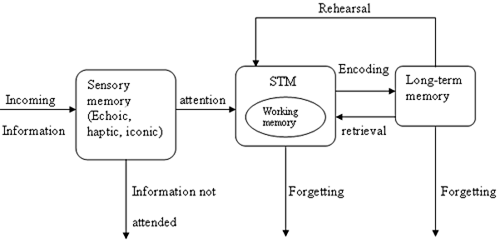
(the fovea is a small central patch on each retina that contains a very high density of light receptors, it is the keyhole-size line of sight that we aim at different points in our world to get high resolution microsnapshots) (it subtends only about 4 degrees of visual arc, about 8 times the angle subtended by the moon or a pinky at arms length)
Practice is the main thing that gets us around capacity limits and is thought to create unconscious chunks. The process of thought is chunking through 7 item analysis at a time. Voluntary actions become automatic with practice and as they do so we tend to lose some executive control over them. Routinized actions that were previously voluntary are taken over, in part, by subcortical regions of the brain, notably the basal ganglia and cerebellum. The basal ganglia especially, takes two actions that are commonly used together and makes their combined performance an effortless activity.
Larry Squire and Neal Cohen made a distinction between declarative and procedural memory to account for the dissociable memory functions of the hippocampus and the subcortical learning functions. They introduced the idea that the hippocampus mediates conscious memories that can be verbally declared and that other brain systems mediate other nonconscious memories that people cannot explain or verbally account for. These terms have since been changed to declarative vs. nondeclarative and are thought to refer to the same distinction as Dan Schacter’s explicit vs. implicit memory. People with advanced Alzheimer’s can often use their nondeclarative memory to do things like play the piano.
When humans are shown twelve digits arranged in four rows of three for less than 150 msec, we can consciously report only four at a time. This strict capacity limitation has led many scientists to conclude that consciousness itself contains only a very small amount of information, corresponding to an information capacity of only 1 to 16 bits per second, an abysmally small number compared to computing standards. Edelman and Tononi have argued the information of consciousness should not be based on how many chunks of information a single conscious state can contain, but rather on how many different potential conscious states are ruled out by the occurrence of the present state.
Psychologist Endel Tulving made the distinction between episodic (things that happened to you at a specific time or place) and semantic memory (thing one comes to know but has not necessarily experienced).
Cortex
An infant’s cortex is relatively undifferentiated. If any area of the brain is similar to a blank slate it is the cerebral cortex. I like to think of it as a giant blank pad of paper that will be written on over the course of the lifetime with a very thin pencil. I imagine that the pencil size is the same in all mammals because the molecular learning mechanisms are conserved, whereas the cortical sheet varies in size. The subcortical brain systems are not like a blank sheet. Subcortical connections have some capacity to be altered by experience but they are largely preconfigured at birth.
Our brains are programmed to learn, whereas computers are merely programmed.
The gray matter of the cortex is 2.8 mm think (on average) and is folded into convex (gyri) and concave (sulci) convolutions. If the sheet were to be stretched out flat it would have about the surface area of four Time Magazine covers. The cortex can be said to hold the content of consciousness. The cortical surface of gray matter thickness is almost the same in humans and in monkeys, only the total surface area in humans in about 100 times larger than that in small monkeys. So we have the same general organization, most of the same inputs and the same repeating algorithmic structure, we simply have more of it.
Gerald Edelman has pointed out that the human cortex alone has 30 billion neurons and is capable of creating 1 million, billion connections. Edelman writes, “If we considered the number of possible neural circuits, we would be dealing with hyperastronomical numbers: 10 followed by at least a million zeros. (There are 10 followed by 79 zeros, give or take a few, of particles in the known universe).” The adult human brain weighs three pounds on average. The cerebral cortex contains 1 million, billion connections or synapses. If we attempted to count them all at the rate of 1 synapse each second we would have to count for 32 million years.
In one cubic millimeter of the cortex there are thought to be 100,000 neurons, 800 million synapses and 3 kilometers of axons. Most of the volume of the cortex is actually taken up by massive axon bundles known as white fiber tracts. Some neurons in the cortex may receive up to 10,000 synaptic connections from other neurons. The cerebellum, which processes different facets of reality in a much different way, has neurons (Purkinje neurons) that actually receive upward of 200,000 synaptic connections from other neurons.
Gray matter is only grey after death, bloodflow makes it pinkish tan. 60% of our cerebral hemispheres correspond to gray matter and 40% to white matter. White matter is composed of axon fibers encased in fatty myelin sheaths, linking gray matter to other gray matter. Remember though, within the gray matter there are prolific numbers of axons.
The cortical folds and convolutions are consistent from person to person and can be used as landmarks. Even the way that these areas are wired up in terms of macroscopic connections varies little between people. This tells us that our personhood stems from the microscopic connections.
Cognitive neuroscientists commonly maintain that the connections between the cortex and thalamus are so numerous that the two are inextricably interrelated and that together they form a structure greater than the sum of its parts: the thalamo-cortical system. The striatal thalamocortical system is involved in working memory. The thalamus is the cortex’s most densely connected satellite. The cortex is gradiential and the thalamus is modular. The thalamus has distinct modularized nuclei with a limited number of pathways. The cortex is a sheet without internal borders, rich interconnecting pathways especially in heteromodal association cortex. Reptiles are thalamic animals, the thalamus grew bigger and differentiated more but at a certain point, a new type of information processing was necessary. Once that had an interconnected network of vastly more numerous, but more simple components that could work together became preferable. If evolution could have simply elaborated on the thalamus to make animals smarter, it would have but it is probably limited by the modularity and unmodifiable infrastructure.
The cortex is a largely undifferentiated sheet at birth that is dedicated to creating individualized action plans based on the organism’s unique environment. The cortex has inputs from other areas, in fixed locations, that differentiates, learns and forms associations. The wider the sheet the more room for little networks to do new jobs that relate to different functions between inputs and outputs. The neurons are immature, their axons are not sheathed by myelin (insulation), connections between neurons are sparse, hence large areas of the brain are not yet fully functioning. In newborn brains the active areas are mostly subcortical. But the cortex is affected significantly perinatally, even before birth. For instance, the cortex of twin babies is visibly different at birth and this is due in large part to their different intrauterine environments. In the developing brain, neurons do their best to add something meaningful to an existing circuit. They do their best to link up to other neurons so that they are not ruthlessly pruned away by apoptosis, or programmed cell death. This death prevents the brain from becoming overcrowded with its own cells. Eidetic or photographic memory is common in young children but usually disappears during the years of cerebral pruning. In the central nervous system, lesions, destruction or death of neurons is usually final. For regrowing axons to find their original targets they would have to navigate an unbelievably complex labyrinth of neural tissue about which they have little genetic information to guide them. Instead of replacing worn cortical cells, the original cells must be laboriously reconstructed in place, due to the functional importance of their existing connections. This is like some famous homes with historical importance that are more expensively renovated rather than just torn down and rebuilt from scratch.
Infants also have many connections between the areas dedicated to individual senses. For instance, they have connections between early visual and auditory cortex. This layout may create a condition called synesthesia, causing them to see sounds and hear colors, that occasionally continues into adulthood. Only 1 in 25,000 people consistently experience two or more senses together. These connections normally dwindle during development and cause the early processing for each sense modality to be individualized and discrete. In adults, the different senses only fuse together in the later association areas. The parietal cortex begins working after early infancy giving babies some rudimentary awareness of the fundamental spatial qualities of their world. The frontal lobes kick in at about six months, bringing with them the beginning of cognition as we think of it. The language areas become fully active about eighteen months after birth. Wernike’s area that allows the perception of speech comes online before Broca’s which is responsible for speech production. These areas work together, along with the rest of the brain, to accomplish language comprehension. Shortly hereafter the prefrontal lobes begin to myelinate. It seems that self-consciousness and the “I” that most people feel exists inside of their heads emerges at this point. The PFC is the last brain area to finish myelinating and doesn’t do so until early adulthood. Much of the brain is polysensory although not necessarily synesthetic.
The primary sensory areas include V1 the primary visual area, A1 the primary auditory area, S1 the primary somatosensory area and M1 the primary motor area (above threshold activity in this area directly triggers motor movement). Because it is a large hierarchical memory system like the others, it almost feels correct to think of the motor cortex as another type of sense, one that directs outputs rather than receives inputs.
Although consciousness emerges from the cortex it actually requires many subcortical areas. The brainstem, midbrain and thalamus are essential because they each contribute to the control and direction of attention and arousal. The cortex houses all of the conscious information that we can report on, that is declarative, but it is possible that this info alone has no “purpose,” no emotional or motivational valence. Purpose is endowed by subcortical inputs. According to the neuroscientist Paul MacLean: “without a cofunctioning limbic system, the neocortex lacks not only the required neural substrate for a sense of self, of reality and the memory of ongoing experience but also a feeling of conviction as to what is true or false.”
The cerebral cortex is the organ of thought. Any damage to it will affect cognition and extensive damage will interfere profoundly. People born without a cerebellum, the organ of fine motor control can think just fine despite the fact that the cerebellum has more neurons than the cortex and is relatively comparable in size.
Gall’s modular brain theory was abandoned for decades in favor of the theory of “mass action” whereby the brain used all of its brain cells at once to perform each cognitive process.
Marie-Jean-Pierre Flourens, using the ablation method in the 1820s, concluded that the cortex does allow intelligence and sensation but that they are not functionally partitioned. He found that when he cut out small portions of cortex behavior was affected, but without particular respect to where in the cortex the neural tissue was cut out. Evidence for localization was obscured by compensation and parallel distributed processing. It turns out that he and others made this mistake because they were looking at behaviors that were too complex that involved a number of interacting parts. In a very real sense, the study of functional partitioning in the cortex has led to better understanding of how to partition different types of behavior and shown scientists the building blocks for simple behaviors. In the 1800s though scientists didn’t know how to test for these things.
American psychologist Karl Lashley spent much of his career looking for the engram. He trained rats to run a maze. He then examined the effects of the removal of different areas of the rat cerebral cortex to see if this affected their memories for the maze. The lesions did disrupt memory for the maze, but the impairment did not vary in any systematic way with the location of the lesion in the cortex. Instead, it was the size of the lesion that mattered. He inferred that this meant that all cortical areas held the engram and that there was no functional specialization in the cortex rather, memory is distributed widely throughout the cortex. Today we know that Lashley’s approach was misguided. He used a behavioral task, maze running, that could be solved in different ways. As he lesioned different parts of the cortex, the rats were forced to run the maze despite different disabilities. It is not possible to lesion a maze running area because there is no such area – many areas contribute to maze running.
Neurons and their cell bodies only account for one-fortieth of the volume of the brain. Glial cells in the brain outnumber neurons 9 to 1. Each person’s cerebral cortex is thought to hold something like 20 billion neurons, and thus 135 to 180 billion glia. Glial cells are fascinating and their behavior may contribute in profound ways to memory. Much of the weight of the brain can be accounted for by cerebrospinal fluid, blood and blood capillaries. These capillaries are so thin and ubiquitous that there is thought to be no less than 350 miles of them in our heads.
Glial cells support, separate, insulate, scavenge debris, guide migration and form the blood brain barrier. Oligodendrocytes in the CNS and Schwann cells in the PNS. Microglia and macroglia. Maturation involves expansion, attrition, cell migration and lamination. They also glue the entire construction site together and maintain its structural integrity.
A typical neuron fires 5-50 times per second. In the time it takes you to read this page quadrillions of signals will be made within your head.
Even small alterations in the pharmacology of these cells can have mind-warping effects on global mental function.
The neuroanatomy does not reveal any apparent natural algorithm in the brain or any sequence of instructions or computations. Many neuroscientists have come up with loops where neural energy is postulated to travel from one brain area to another in a series of steps. These indubitably exist, but there are a huge number of these, most of which have not been identified. These normally help to show what goes wrong in a certain disorder or syndrome where there is a break in the chain. Normally though, information is traveling back and forth everywhere, all at once. The brain does not contain fixed codes or registers as computers do and the environment does not give the human brain an unambiguous signal the way a CD or computer tape gives a CPU. Also human memory is different from that of a computer because humans, unlike computers, cannot recall anything in storage at any time it is needed. Instead we are only able to recall what has been cued up sufficiently.
The brain performs differential amplification based on unconscious value systems – these create our priorities.
The cortex changes from day to day. Some cells will have retracted certain processes, other will have extended different ones and some cells will have died all depending on what was used and what was not.
Cortical neurons that are very close together are usually wired-up so that many of them respond simultaneously when a specific stimulus is presented. Some neurons that are very close together are not tightly connected and actually represent competing stimulus patterns. Nearby neurons with similar specificities are preferentially connected to each other. Neurons that respond to vertical edges are linked by reciprocal connections much more tightly that they are to neurons that respond to edges in different orientations. Functionally segregated areas are reciprocally connected. These reciprocal pathways allow for reentry, a process of signaling back and forth repeatedly along the reciprocal connections. The thalamocortical meshwork is designed to integrate a large number of independent specialists into working together efficiently and effectively.
In Arthur Conan Doyle’s story, A Study in Scarlet, Sherlock Holmes tells Watson that the mind is like a crowded attic and that at a certain point, to add more means that one must remove something to make room. Mr. Scemama, my junior high algebra teacher at Birmingham high school, explained that the mind is like a balloon, the more you fill it, the larger, more expansive and more commodious in becomes. Holmes was right, as the Interference Theory of Forgetting has shown. Scemama was also right. And I suspect that the more similar and complementary the additions to memory are the more correct he was. Similar bits of knowledge build on each other. But it is also true, almost paradoxically that similar memory traces tend to interfere more with each other. I think it comes down to this, if memories complement each other and build on a common theme, they may make room in the mind, if they compete for resources and are difficult to keep separate in the mind then they compete for storage.
Many neuroscientists think that if a map of the brain had a “you are here” sign, it would be in the frontal lobes. I think that “we” embody the entire brain though.
Computer Minded
If you could upload the informational content of the mind onto a computer it would not be sentient simply in the form of memory just as we are not sentient during non-REM sleep. But what if you could create a computer program that could process the information in the same way as the brain. Could consciousness spring out of the machine? Could you allow the software to take advantage of the informational content in ways that the brain cannot? Could you simulate hallucinegenic and delusional experiences, insanity and dementia, and then turn them off with a flick of a switch with no lasting consequences?
The Corpus Callosum: A Bridge Between Hemispheres
There are about 200 million left-to-right fibers that make up the corpus callosum, the large axon bridge between the hemispheres. Each of these fibers sends an electrochemical message about ten times per second, meaning that traffic across the bridge clocks in at about 2 billion events per second. Equally large numbers of axon bundles travel the length of the individual hemispheres and make the number of events within a single hemisphere much larger.
The anterior commissure, another bridge between the two hemispheres (that is far smaller than the corpus callosum) varies sevenfold on average between two unrelated people. The massa intermedia is entirely missing in one of every four people. The primary visual cortex can vary threefold in area. Our amygdala and hippocampus can vary twofold in volume and the entire cerebral cortex can vary twofold in volume within samples of people with normal intelligence.
Most sensory and motor pathways split and cross over the midline of the body as they travel between the brain and the body. This is why the left brain controls muscles on the right side and perceives stimuli from receptors on the right side and vice versa for the right brain. The evolutionary reason for this is still mysterious, but, strangely enough, some people and animals are born without this crossing over. Most sensory input (barring smell) to the brain crosses over from the incoming side to the opposite hemisphere for processing. The left hemisphere is thought to be analytical, logical and precise. The right hemisphere is thought to be holistic, spatial and sensitive to patterns. There is more white matter, more axonal material, in the right hemisphere. This means that these axons connect neurons that are, on average, further away from each other. Given that neurons that process particular types of input tend to be closer together and work closely together, this suggests that the right brain is wired up to draw on conceptually more varied nodes when it processes information. This extended neural wiring may be related to the fact that the right hemisphere seems to make broad, but more vague inferences.
Some people have had half of their cortex removed (hemispherectomy) because of tumors or intractable epilepsy yet their cognitive abilities may be remarkably preserved. This is only possible because the right and left hemispheres have functional redundancy, if the back or front half of the cortex were removed instead of the left or right, the functionality would be catastrophically affected. In this sense each hemisphere acts as a self-contained unit.
Brodman Areas
The cortex is made up of many small processing regions which are each wired up a little differently. Korbinian Brodman counted and marked nearly 50 such areas on each cortical hemisphere. Since measurements have subdivided these further, into over 200 smaller “connectivity” areas. Many of these areas correspond to self-contained maps of the body. For instance we have a discrete map of the body held in the somatosensory strip. Other strips and regions further process information about particular regions of the body. It is thought that around 8 cortical maps exist for processing data sent from our inner ears, seven correspond to the touch and feel of our bodies, others to our musculoskeletal movements and more than 10 maps exist for the retina with around 22 more that help to further process what these retinal maps find.
During wakefulness cortical neurons are depolarized, fire in a tonic or continuous way, and respond well to incoming stimuli. During dreamless sleep, this system becomes less active. Neurons are hyperpolarized, fire in repetitive bursts and are not responsive to incoming, external stimuli.
Recurrent Messages / Back Propagation
Neurons in the brain often begin to hear back from their recipient even before they finish sending their initial message. The response will often alter the message that they send (by strengthening it or inhibiting it) and in turn also alter the feedback that they will get in a form of “circular causality.”
Cortical Layers
The 3 mm of cortex can be divided into 6 horizontal layers each with different connectivity. Anatomists have shown that each layer looks different under the microscope because each has its own pattern of inputs and outputs to other areas of the brain. The outermost layer on top of the others, Layer I, is so densely woven horizontally that it is often referred to as a feltwork. A good deal of the short-distance communication in the cortex is thought to happen here.
Lamination refers to the layering of cells. Supergranual neurons in layers 1,2 and 3 are composed of small pyramidal and granular neurons for local projections. These layers are thought to be highly involved in local processing of information. Granular neurons in layer 4 receive input from other areas with dense inputs from the thalamus. Infragranular pyramidal neurons in layers 5 and 6 send outputs to nonlocal cortical and subcortical areas. Some scientists think that the infragranular layers execute and send off the cognitive computations made by supragranular layers. Three classes of pyramidal neurons shuttle this information: One class in layer six project to the thalamus. Another class in superficial layer 5 project to the striatum and the third class in the deep layer 5 project to the brainstem and spinal cord.
Sensory and Association Areas
Information from each sensory modality travels through a similar progression of connections in sensory cortex separately and then once they are sufficiently analyzed these unimodal processes are allowed to converge in polymodal association areas. Starting from the beginning, sensory information from sensory neurons reaches a primary, unimodal sensory area. This is relayed to adjacent unimodal sensory association areas for further processing. At this point the processed information is also sent to motor related areas in the case that they can help to inform fast acting movements. From the unimodal association areas, the processed information flows to polymodal association areas where information from two or more sensory modalities converges. These polymodal association areas project to early motor, late motor, PFC and also project back to unimodal sensory areas. This general scheme was suggested in a 1970 article by Edward Jones and Thomas Powell and has proven to be highly explanatory. Virtually every cortical area communicates with one another and also with a specific nucleus or set of nuclei in the thalamus as well as with a variety of inputs from the brainstem nuclei that help to regulate behavioral state. Our cortical networks are online all of the time becoming active automatically, accomplishing tasks that we think we are doing for ourselves.
Association areas include polysensory convergence regions such as the tempoparietal junction, the lateral and medial temporal cortices, the lateral parietal cortices, the lateral and medial frontal cortices, and the posteromedial cortices.
The brain is designed to create ceaseless pressure to seek out novel stimuli.
The longer your thought strings, the more pops out to you and the less random and more complex the insights, the better you use your LTM, things pop out intelligently. Inhibiting yourself allows you to apply new thought to the previous perception / inhibited action and allows the string to be longer.
Sir Charles Sherrington described the brain as “an enchanted loom” where “millions of flashing shuttles weave a dissolving pattern.”
Genetic control over brain wiring is indirect, you can take out a whole pathway early on and the brain rewires plastically.
When words are read the information does not have to go to Wernike’s to be understood, it often goes straight to Broca’s during reading comprehension. Damage to the right hemisphere equivalent of Broca’s leads to difficulty in expressing emotional aspects of language, Wernike’s in hearing them. This leads to aprosodias that affect the inability to communicate or identify irony, wit and metaphor. Damage to the arcuate fasciculus, the white matter wires connecting Broca’s and Wernike’s causes conduction aphasia. Wernike’s aphasia involves speaking nonsense because the individual cannot monitor their own speech. Dyslexia involves problems with the interconnections between Broca’s and Wernike’s areas.
Time to Consciousness
Not only are there no colors and no perfectly straight lines in the real world there is no subjective present moment. William James realized that because it takes the mind time to process present occurences, by the time we have processed them so that we can experience them we are living in the past. He called this the “specious present,” and it seems that we actually live in an expanded or smeared present. It is clear that the way that vertebrates experience time may be very different from how other organisms in other parts of the universe might do so.
A single electric pulse delivered to the skin takes twenty milliseconds or 1/50th of a second to evoke an electrical impulse in the cortex. It then takes up to 500 milliseconds, or ½ of a second, for a person to become aware of the sensation associated with this impulse. We spatially refer stimulation of the pinkie, which is actually felt within the head, to the pinkie which is up to three feet away. We temporally refer so that we cannot feel the delay between sense and sensation. Benjamin Libet helped to show that we temporally refer the beginning of an event back closer to the onset of a stimulus, showing that subjective time is warped.
350 milliseconds before the awareness of intention to act the brain is already preparing to act. Studies performed by Benjamin Libet showed that 350 milliseconds before you are aware of your own intention to move your arm, you brain is already at work preparing to make that movement. This supported William James’ idea of the “specious present.” Libet himself conluded that our awareness of decision making appears to be an illusion and that “consciousness is out of the loop.”
Before any motor act, what is called a readiness potential can be recorded from the scalp. Libet asked his subjects to move a finger at arbitrary but self-determined times and to remember the position of the hand on a fast moving clock that coincided with their awareness of their earliest intention to move. He found that the onset of the readiness potential invariably preceded their awareness of intention by an average of about 350 msec and always by 150 ms. He concluded the initiation of a “voluntary act” begins unconsciously, before there is any noticeable awareness that a decision to act has already been initiated. These findings strongly suggest that we cannot become aware of either motor intentions or sensory stimuli unless the underlying neural activity persists for a few hundred msec.
The motor neurons in the motor cortex begin firing in the half second or so before we act. The ACC attends to the consequences of our actions beginning around 2 seconds before we act. The PFC neurons precede an action by one or many seconds (Singh and Knight, 1990). Planned actions and temporally extended actions are preceded by a shift in electrical activity marked by slow potentials that are controlled by the PFC. Reflexes, tics and other involuntary actions are not preceded by these readiness potentials (Fahn, 1993). Blood surges into the dlPFC when people will actions, this is certainly not happening when the environment dictates our actions, when we copy like Lhermitte’s patients. Gamma activity (40-hz) also seems to be related to consciousness, more the unity and binding of distinct element s than willed action, but it is the most conspicuous thing to disappear when someone goes under anesthesia.
It takes a couple of hundred milliseconds to become conscious of a pattern, five hundred milliseconds to be conscious of an emotional reaction and seven or eight hundred milliseconds to process a concept.
It seems that the thalamus acts as a gate to the cortex, the cortex will tell it what it gets, and what it is missing. The cortex might understand what category the object belongs to but now wants to know the specifics, so it inhibits the thalamus from sending redundant info. The cortex sends feedback back to the thalamus, inhibiting what it understands and asking: “what did I miss?” Feedback inhibitory subtraction can be done four or five times until the inhibitory signal fades after 1,000 milliseconds. Recognition is not a unitary thing, we identify different categories in a successive fashion.
Von Economo cells, only humans, chimps, gorillas and cetaceans. Only in ACC and frontal insular cortex and dlPFC. Trust, empathy, embarrassment and guilt. Also “double wide” cortical columns appear to and from language areas. What makes sea mammals so smart that their intelligence is really only rivaled by elephants and primates?
How do perceptual grammars (which are self-constructed) get translated into linguistic grammars (given to us by culture).
Missing Cortex
To understand the cortex, it helps to understand what happens in its absence. Children can be born with intact brainstem structures but compromised or completely missing forebrain structures. This unfortunate condition which usually involves a major stroke in utero, can damage the cerebral cortex, thalamus and basal ganglia and cause each of these nacent structures to be completely reabsorbed by the body. Because the skull cavity is largely filled with cerebrospinal fluid after this event, it is known as hydranencephaly. A similar disorder, anencephaly, compromises other deeper structures. The affected children can survive for years, even into young adulthood. They are often categorized as vegetative but are much more communicative than most cases of vegetative state because their subcortical mechanisms are alive and well and have not been suppressed by the cortex. This unfortunate condition does provide perspective into what is left when the cerebral cortex is gone. They move their heads and eyes freely, orient to stimuli and show visual preferences for certain stimulus configurations, and some people over others. They are uncomfortable around strangers and prefer their caregiver. They show clear emotionality in their faces, they smile and laugh at simple playful things and frown and cry from pain. They also have a limited ability to move away from pain and toward things that are pleasurable. They have been known to crawl toward parts of the floor that are heated from sunlight and bask in the warmth. Their limited hearing and seeing take place in the primitive colliculi and, like all of their mental processes are achieved subcortically. The emotions they produce are created in subcortical nuclei and are used to control the face via the facial nerves. Do they have experiences? They are often mistaken for normal babies and are diagnosed months after birth after the parents report a failure to thrive.
The cell nucleus hold the DNA and thus is the cellular brain. Does it make decisions. What about the actual brain, does it make decisions, or just carry them out? I hope this book will lead you to feel that it does both.
Brain Size
Our brains weigh 3 pounds on average, whereas, an elephant’s weighs 10 lbs and some whales brains weigh 20 lbs. We have high brain size relative to our body size, but some small monkeys and even rodents have higher brain size to body size ratios. This ratio is around 2% for most humans, whereas in some monkeys it is up to 4%. Humans with big brains are normally more intelligent as there is a high correlation between IQ and brain size, but the biggest brains on record, 6 lb 4 oz and 5 lb 5 oz belonged to individuals that were mentally retarded. Jonathin Swift, author of Gulliver’s travels had a brain at 1900 cubic centimeters. Einstein’s brain reportedly measured 1230 cc. The German poet Schiller had a brain that weighed about 2 Kg.
Vision
At any given moment, millions of neurons are firing in the visual areas of your brain. As long as the eyelids are open the optic nerve continuously signals the inputs of the retina to the thalamus and cortex even if the person is unconscious. The neurons in your visual system, like neurons all over the body, never really get a chance to rest. The optic nerve is opaque and the auditory nerve does not carry sound.
The cells in our brain, and the majority of cells in our body centimeters from our skin, know nothing but darkness. Most neurons have never been struck by a photon of light unless they happened to interact with an x-ray beam.
Separate regions of the visual cortex that work together in representing a visible object exhibit synchronized activity in the 40 Hz range.
Intelligence is held in the imagery: propositional logic is held in the composition.
Early Visual Processing
A good amount of very early visual processing occurs in the cells within the retina before the signals leave the eye and head to the thalamus. The cell bodies of these cells lie in the retina and produce axons that leave the retina at the blind spot of the retina and form the optic nerve which travels backward to the thalamus.
The retina has a square-like grid of photoreceptive neurons that does its best to duplicate the configuration of light in front of the eyes. When light particles known as photons strike the photoreceptors in the retina, they cause the contrast configuration in the environment to be reproduced (at a lower “resolution”) in the retina. A transient retinal map is created that replicates the stimulus configuration from the environment, say a cross, or a face, or a scene. Several of these maps are formed at different hierarchical levels of the visual system, and they are all based on the original retinal map and its unique spatial layout. From the retina, to the thalamus, to the primary visual area and beyond, the geometrical relationships found in the retina are conserved, a property known as retinotopy. In visual cortex there is a one to one, dot to dot, corresponding relationship with the organization of the retina.
Some V1 neurons respond best to vertical lines, some to 20-degree tilted lines and others best to horizontal lines and so forth. Areas V1-V4 each contain a retinotopic map where points on the map mirror the spatial layout of the corresponding retina. In other words cells in V1 are organized spatially to recreate the 2D geometry of the retina and the visual field. Something seen in the top right will remain in the top right. Outside of the occipital lobe this spatial correspondence or retinotopy is diminished and less orderly. Visual features that have been shown to be represented at a cellular level include orientation, motion, color and binocular disparity. V1 is large. It is about the size of a passport.
Only a small portion of inputs to your occipital lobe come from the eyes; the majority come from internal memory/perceptual modules (Raichle, 2006)
Raichle M. 2006. The brain’s dark energy. Science. 314: 1249-1250.
The brain indexes across innumerable memories to find a similar experience.
Continuity creates integration much like twenty-two static frames per second create the semblance of motion in a movie.
The throughline is the connecting theme that ties together narrative elements in a story. Overarching narrative. The plant and payoff is a technique in screen writing, when two of more moments are related. Setup then reveal. Easter eggs are external allusions or allusions to another movie in the same universe. This legitimizes twists, turns and endings because the audience has a chance to see it coming. Foreshadowing is warning or indication of a future event a premonition. Prescient. Put in working memory book. Conditional dependencies. Causality. All good jokes have plants and reveals.
“If, in the first chapter, you say there is a gun hanging on the wall, you should make quite sure that it is going to be used further on in the story.” – Anton Chekhov
Who done it and murder mysteries have them but they also have false plants. Callbacks, internal allusions, running gag, continuity, plant and reveal,
A tiger and a monkey sitting backwards.
In the retina, neighboring cells can inhibit each other, so that a tiny point of light represented by one cell can stand out in contrast to the adjacent ones, this allows the representation of sudden changes in brightness. This is called lateral inhibition. Neighboring cells in the skin are able to do this and many neuroscientists believe that higher-order cortical circuits do this as well, allowing us to cause closely related or superficially similar concepts to inhibit each other to avoid confusion. Lateral inhibition may be responsible for our ability to keep similar but unwanted semantic concepts out of working memory so that we don’t think of astrology when we are trying to think of astronomy.
The primary visual area V1, in the visual cortex is not connected with the prefrontal cortex, and as such we do not consciously experience the contours and shadings that it processes. However, the PFC is connected to many of the higher-order visual areas that V1 feeds directly into such as the areas responsible for processing shape, color, motion and location.
The lateral geniculate nuclei (literally side-jointed nuts) receive the visual information that has been collected by the retina and passed along the optic nerve. The LGN processes this information and passes it along to the visual cortex for further processing. The LGN actually has more inputs feeding back from the visual cortex than feeding forward from the optic nerve. The LGN contines to fire 320 ms. after retinal inputs stop even though shapes are generally processed at 20 ms and the PFC is activated around 100ms. Scientists now know that the thalamus and visual cortex send information back and forth for many ms. creating reverberating impulses that must lend structure to our visual perceptions.
The lateral geniculate nucleus of the thalamus, along with processing that occurs in the retina maps small dots to particular neurons. Neural connections allow dots that line up together to converge on neurons in V1 that code for lines and edges. Neurons in V4 code for contours, curvature and basic shapes. These neurons shuttle their findings down the ventral stream to the inferior temporal area which is responsible for recognizing complex objects, faces and structures and emphasizes the stable invariant properties of objects. There are many visual areas between V1 and IT and these include the parahippocampal place area (scenes and outdoor places), the fusiform face area (human, cartoon and animal faces), LOC lateral occipital (objects and shapes) and MT (motion).
Each V1 neuron has a receptive field that is highly specific to a minute part of the total field of vision. A certain cell in area V1 might fire vigorously when it is apprised of a line or an edge slanted at 45 degrees within its tiny field of vision. On some fixations a V1 cell will be optimally triggered, on others it may fire weakly or not at all. Thus, the activity of V1 cells changes every time an eye movement (saccade) is made. In later visual areas, the cells will continue to fire even as saccades change, and this accounts for the conservation of some representations in the mind, despite the constant changing in the stream of input. In region IT, we find some cells that become active and stay active when entire objects appear anywhere in the visual field. These cells will also remain active if the object remains in mind, but has moved out of sight, or even if it is only in the imagination. When we move from V1, through V2 and V4 up to IT, cells change from being rapidly changing, spatially specific, recognition cells of elemental visual features, to cells that fire for prolonged periods, are spatially nonspecific, object recognition cells. We don’t have vernacular words for the kinds of things that V1 cells code for, but we often have them for the kinds of things that IT cells code for.
Invariance
An early, quaint theory in the study of object recognition supposed that perhaps we recognize things by comparing them to a template that is held in the mind. This idea, called the naïve template theory, assumed that we match every pixel or match every low-level feature of an input to a representation in memory. The problem with templates is that we need a lot of them. There are a dozen very different ways write the letter “A” and there are millions of different ways to represent it on paper (at different sizes, fonts and orientations). It is simply impossible that our brain has a template for each of these. Imagine seeing the letter A on a page. As the light travels into the retinal photoreceptors, and the shape of the stimulus is shunted to the thalamus and then to the early visual areas, the A will fall onto an array of spot detectors. If the A falls exactly on the right detectors, and not the wrong ones, it will be recognized as an A according to naïve template theory. If we needed a new template for every letter in every position and orientation, we would run out of brain before we ran out of alphabet. Beyond letters, imagine how many different Jennifer Aniston templates we would need to recognize the actress in different clothes, hairstyles and angles.
Structural description theory offers a much more plausible solution to the problem of object recognition. It points out that all As share a common basic structure. Instead of matching each point in an image to a point in a neural template, perhaps the brain performs a more conceptual match. Just about any capital A can be described by the relationship between its three lines: two flanking lines converge, and a third line spans the angle created by these two lines. Now the image of A is being matched to a structural description of an A. It is matched to a description of an A in terms of its parts and the relationships between its parts – a list of specifications that are necessary or sufficient to perceive an object as an A. The good thing about structurally descriptive models is they allow for viewpoint invariance. An object is equally recognizable from many different vantage points, something that is not allowed using the naïve template theory. This makes it so that even if you are reading a word upside down you can still recognize it. It also makes it so that you can recognize your car in the parking lot, no matter what angle you are approaching it from. There are many different hypotheses about how structural description is used in object recognition, but the most successful all involve back and forth cross talk between multiple neural assemblies in both bottom up ( involved with elementary features) and top-down (involved with structurally descriptive specifications) cortex.
Similarly, a well-known song played in three different styles will converge on an engram in auditory association cortex that represents it despite the fact that the A1 receives completely different inputs with each rendition.
Some particular set of cells in the face recognition area remain active as long as your friend’s face is anywhere in your field of vision, regardless of its size, position, or orientation. This stability of cell firing, without respect to other geometric factors, is what allows the brain to hold onto invariant representations. Plato could not explain how we experience invariant forms. He knew that he never experienced the same form twice as the angle, size and luminance properties are always different. He knew that he had never seen his cup twice in exactly the same way, yet anytime he saw it, it would be funneled into a stable mental concept of “my cup.” To explain this seeming paradox he proposed the Theory of Forms where he explained that all humans learn about forms from a transcendent plane where fixed stable ideas exist in timeless perfection. He said that all humans visit this place and experience these forms, before birth and this is how we are able to achieve invariant representations. He was right about the fact that this was an important question. Computers programs and artificial intelligence are awful at dealing with variation. The very way we, and all mammals, understand the world is by finding invariant structure in the variable and constantly varying input stream. In fact, Aristotle proposed that human cognition must combine information from each of the individual senses into a single multimodal sense, allowing an object and all of its properties, such as the drum that you can see, touch and listen to.
Visual Imagination and Top-Down Projections
Interestingly simply imagining a face can activate the fusiform face area and imagining a place can activate the parahippocampal place area. Similarly, expected pain activates brain areas that overlap with those that become active for real pain. Visual imagery in the imagination makes use of the visual areas that represent environmental stimuli, just as inner speech makes use of the existing brain regions for speech. Somehow consciousness knows to efficiently use the lower-order tools at its disposal. Scans of people asked to imagine a visual pattern are very similar to scans of people actually seeing the pattern in the sense that both seeing and imagining the same pattern utilize the same areas. In some cases the primary visual area actually takes up more blood when imaging something than when actually seeing it.
Vision researchers have come to the conclusion that the excitement and activity of specialized visual areas does not result in awareness. Signals from the neurons that have been turned on (or turned up) must reach higher association areas. In fact, for full visual awareness to take place these higher order association areas must send feedback to and continue to interact with the specialized visual neurons.
When we move our fingers in a careful, preplanned sequence of movements we activate a part of the motor cortex known as the premotor cortex or the supplementary motor area. This area is where proposed actions are rehearsed before they are actually carried out. The same area is similarly activated when we simply imagine making the same finger movements without actually doing so. Inner speech activates the same areas as spoken speech, Broca and Wernike’s speech areas. Brain scans have also shown that the superior temporal cortex is activated when we listen to sounds and music and is similarly activated when the same sounds and music are imagined.
Look at this letter: “t.” You can attend to the vertical mark or its crossbar. You can also alternate between seeing it as a t and as a cross. In each case, the exact same stimulus is entering the retina and V1. As you alternate between the different perceptions though, higher areas ask area IT to attend to one perception or the other, and because IT knows how to perceive each it can switch between them.
Gaze and Attention
Where our attention is focused is from moment to moment is mostly determined by unconscious brain systems. Selective attention based on task demands and long term goals is conscious but . In fact, the anterior cortical areas responsible are highly interlinked with the subcortical areas responsible for reflexive eye control such as the pulvinar nucleus of the thalamus and the superior colliculus of the midbrain. Each of these areas contain visuospatial maps which synchronize with each other in gamma-band rhythms, (30-70 Hz) centered around 40 Hz. Gamma synchrony has been implicated in feature binding of visual objects that become conscious. Other cortical areas are also involved including the frontal eye fields involved in controlling the occulomotor muscles, the anterior cingulate gyrus involved in detecting and overriding an expected but unwanted eye movement, and the superior parietal lobe involved in spatial guidance toward attentional targets. With gaze and eye targeting as with other activities, mental effort comes from a struggle between voluntary attention and automatic attentional capture. Like most mental processes we rarely guide saccades consciously, but we can make ourselves aware of them. As G.A. Miller (1962) pointed out, “we are generally conscious of the results of a mental process but not of the process itself.” We make about 3 saccades per second meaning that even though our eyes are constantly darting around the perceptual scene that they create is held in the mind. Three saccades per second allows plenty of time for multiple recurrent messages being sent back and forth between lower and higher visual areas as they work together to understand the same retinal image.
Attention is arousal, orientation and focus. Arousal involves the release of adrenaline into the cortex from the reticular activating system. This pauses unnecessary activity, and for this reason, a recently alerted brain will look quiet on a brain scanner. Areas involved in orienting to the position of new stimulus are kept active. These include the superior colliculus, the lateral pulvinar (this thalamic area locks on to a stimulus and shunts information to the frontal lobes for analysis) and the parietal cortex. Once a cue comes and the animal recognizes the stimulus, it will reorient to it, and the brain areas appropriate for dealing with it will spring into action with a greater level of activity than if the brain was not previously made alert by adrenaline.
An “attentional spotlight” is thought to select among competing inputs. Some authors like to say that the PFC is the stage hand working the spotlight and this is true, the spotlight is largely guided by frontal and parietal networks and shines it on specific areas, such as visual and auditory areas. Human faces, emotional expressions, sexual stimuli and quickly moving objects usually capture attention unconsciously from the bottom-up. Top-down goal-driven attention is under executive guidance and allows us to pay attention to those aspects of the environment that will properly inform the processes that we know will allow us to accomplish our goals. It seems that much of top-down processing is related to inhibiting salient but task-irrelevant stimuli. Also it seems that shutting out distracting events can load our limited processing capacity. It is easy for us to shut out distractions to perceptually interesting information, such as when we are listening to our favorite new song, but difficult when we try to shut out distractions to a difficult cognitive task such as reading technical explanations.
The pulvinar nucleus of the thalamus projects to higher visual cortex, above and beyond where the visual input from the LGN first enters the cortex. The pulvinar is the largest part of the thalamus, with many inputs, and it seems to guide our visual focus point, steering our attention. Other parts of the pulvinar direct touch and hearing attention and it uses gamma waves. The reticular nucleus of the thalamus also guides and controls the lens of attention and is itself guided a little by the PFC. Skoyles and Sagan see it as the PFC’s (the conductor’s) baton.
Visual Consciousness
What is necessary for visual consciousness? It seems that visual integration and binding of discrete features into objects, and widespread broadcasting of this information to forward regions of the cortex is necessary. Finally, rapid processing interactions between cortical regions necessary for consciousness involve gamma synchrony. Several experiments have suggested that synchronous firing may be what differentiates an assembly of neurons that gains access to consciousness from one that is similarly active, but uncoordinated in its firing.
When the visual area is activated artificially using TMS weak flashes of light (known as phosphenes) are experienced. The type of phosphene experienced depends on the region stimulated. Stimulating V1 will cause small and static phosphenes whereas stimulating MT will cause moving phosphenes. Just after TMS stimulation people often experience momentary blind spots (scotomas).
Backward masking is one laboratory technique to present subjects with subliminal cues. A stimulus is flashed on a screen very briefly (for a few milliseconds) and is followed immediately by some neutral stimulus that remains on the screen for several seconds. The second stimulus effectively blanks out or masks the first, preventing it from entering conscious awareness. If it was an emotional arousing stimulus (like a picture of a snake, a gun or an angry person) it will still evoke an emotional reaction. The palms will sweat and the heart will speed up. The masking procedure reveals processes that go on outside of consciousness. If a photograph of an angry face is shown for 20 ms and is immediately followed by a smiling face for 100 ms the angry face is never experienced consciously as it is “backward masked” by the smiling face. Consciously perceived words trigger 12 times more activity in word recognition areas than the masked words.
Damage to the Visual System
Blindsight usually occurs when there is extensive damage to V1 but other (extrastriate) visual areas are intact. When asked to point to a light source blindsight patients report that they see nothing at all but are capable of pointing quite accurately to the direction of the light. They can also report whether a stick is angled vertically or horizontally. They can also often tell Xs from Os. They report that they have no visual experience of the letters but that the Xs are jagged and the Os are somehow smooth. Often these patients feel that they cannot make an informed guess because they have no relevant information but when asked to choose they perform at above-chance levels. They seem to be reluctant to report weak visual impressions that feel like their own imagination in the absence of veridical V1 input. These seemingly imaginary sensations are actually coming from subcortical inputs to non V1 visual modules that are nonetheless sufficient for making forced-choice discriminations. Although most inputs from the LGN of the thalamus go directly to V1, several alternative subcortical pathways project to nonV1 visual areas bypassing V1 entirely. The residual impressions of environmental stimuli that they are able to sense have been described as “black moving on black.” Blindsight has been simulated in normal subjects using TMS and these studies have appeared to confirm the role of the superior colliculus in the non-conscious visual processing.
Deaf hearing has been reported too. Some patients have been documented to have unacknowledged detection of auditory stimuli due to bilateral temporal cortex lesions. Because some subcortical hearing centers are retained and even report to certain cortical areas, they are able to respond reflexively to sounds. They have been shown to be able to detect and localize the sounds but remain densely agnosic to the meaning or identity of the sounds. Removing the auditory cortex will permanently stop conscious hearing, but conditioned sounds can still provoke conditioned responses through the thalamus and amygdala. This is kind of like blindsight and often very imprecise, but maintained nonetheless. A small neural pathway is rerouted away from V1 and into V5 which allows some “where” knowledge but no “what” knowledge. Patients insist that they have no insight into their performance in guessing the location, shape and orientation of objects. Initially, they never expect to perform above chance. Blindsight, like sight in reptiles, is mostly concerned with movement. Stationary objects do not have the same impact on reptiles because they usually do not signify either food or attack.
Apperceptive agnosia: results from damage that occurs early in the recognition assembly line. Damage to these early areas will keep features from binding and leading to the recognition of the animate and inanimate objects that we know. Associative agnosia is caused by damage later in the recognition process. These people can see and describe the objects that they are experiencing through their senses but are still unable to name them or remember their qualities or properties that are essential to their meaning. The fact that localized lesion in one area can take away knowledge of man-made tools and artefacts, while another lesion can take away all knowledge of animals, and yet another can leave us unable to recognize faces suggests that informational modalities are organized or accessed locally.
Damage to area MT leads to akinetopsia or so called motion blindness. For such patients the world appears as a series of still snapshots without motion. Crossing the street is dangerous for these patients because although they can see the cars normally, they cannot tell how fast they are approaching. Similarly it is very difficult to do simple tasks like pouring water, because it is impossible to determine how fast the water level is rising.
Prospagnosia involves damage to face detectors and leads to face blindness. In prosopagnosia people can still have covert or unconscious recognition and although they cannot recognize the person that they are seeing they will have the correct emotional responses to their parents, friends, spouse and boss. Fregoli’s delusion constantly mistake strangers for people that are familiar. In Capgras delusion, where close friends feel like imposters, the emotional recognition system is underactive rather than overactive. Infants can discriminate between monkey faces much better than adults. Capgras is recognition unaccompanied the expected familiarity. Prosopagnosia is without recognition or familiarity. Déjà vu and hyperfamiliarity are familiarity without recognition.
Flies have compound eyes. Their eyes are divided into 6,400 little hexagonal tubes, each focused on a tiny sector of the scene in front of them. Each tube sends exactly 8 axons to the brain reporting on what it sees, and they see mostly movement.
In adults, lesions of the retina produce blindness, but they do not eliminate conscious visual experience as most blind people continue to experience visual imagery, visual memories, visual working memory, and visual dreams as long as visual cortex is intact. Cortically blind individuals however, due to lesions of certain visual cortical areas eliminate all visual perception, imagery, dreaming and even visual working memory. Extensive damage, cell death and necrosis throughout the visual areas can cause a type of total blindness and anosagnosia. People that are totally cortically blind lose all visual memories and all ability to visualize concepts and relationships in their mind. Their mind’s eye is obliterated. Sometimes these people can lose the very idea of sight.
Ventral vs. Dorsal Visual Systems
The dorsal and ventral subsystems of the visual apparatus have been discerned using clinical cases that provide strong evidence for a double dissociation. Damage to ventral visual processing areas leads to different forms of apperceptive agnosia where the patient has difficulty perceiving shape and recognizing objects like telling a cup from a ball. These people can point to objects, grab them and they recognize them immediately once they can touch them, the deficit is purely visual. Dr. Oliver Sacks described a patient who, as a result of ventral injury, “mistook his wife for a hat.” He accidentally reached for his wife’s head when he wanted to retrieve his hat from a coatrack. The same individual, when presented with a rose, could not recognize the object, described it as “a convoluted red form with a linear green attachment” but recognized it as a rose tactiley as soon as it was placed into his hands. Goodale et al., (1991) tested a patient with damage to the ventral visual system and apperceptive agnosia who could not report the orientation of a narrow slot. When this visibly clear slot was rotated in different angles, she could not recognize when it was horizontal, vertical or anything in between, she was only able to guess at chance. Surprisingly though, when asked to insert a thin card into the slot she could do so with remarkable accuracy. This was because her dorsal visual system, involved in spatial bearings was intact. This highlights the fact that much can be known if the right concepts and motivations are coactivated.
The ventral system has been called the “what” stream and the dorsal system has been called the where stream. Damage to dorsal visual processing areas keeps people from being able to indicate or understand “where” things are. They might know “what” they are looking at but they will be unable to point at and grab objects. With damage to dorsal visual cortex people lose their ability to find visual objects in their sense of internally represented space. If the ventral areas are spared these patients can recognize a hat perfectly well but cannot reach for it or place it on their own head.
Significant and bilateral lesions to parietal areas can lead to a profound deficit called Balint’s syndrome which also encompassed spatial attention. It is characterized by three main deficits: (1) optic ataxia, the inability to point to a target; (2) ocular apraxia, the inability to voluntarily shift gaze; and (3) simultanagnosia, the inability to perceive more than one object in the visual field simultaneously.
Gamma and Visual Binding
Gamma oscillations are localized and allow the binding of different perceptual elements. Processing jobs that should be kept separate seem to be kept apart by slightly different rates of firing. Reduced gamma correlates with AD and schizophrenia as might be expected. People react to stimuli at different speeds. Fast reactors respond without fully perceiving the stimulus whereas slow reactors react after, perhaps analyzing the stimulus too much before their response (Jokeit and Makeig, 1994). This is thought to be related to binding activity because the differences between subjects can be seen in the duration of gamma activity. Computer chips clock in at thousands and hundreds of millions of hertz, whereas the brain often runs between 20 and 80 hz.
Verbal thinkers have alpha state visual areas when in thought and visual thinkers have alpha state verbal areas. Some very practiced meditators can keep their visual areas in an alpha state even with their eyes open and they report being detached from their visual surroundings.
Gamma increases and becomes more coherent between two areas when new cross modality associations are made. The PFC allows the cross sensory associations needed to link abstractly related things together. The PFC bring together cross modal engrams. Many of the associations that humans make could not be made in other animals because they would never spontaneously occur, the neural networks responsible for them may fire together but wouldn’t be able to link together to wire together. But the PFC changes this and allows symbolism. The great thing about symbols is they are very generalizable and can be applied in many cases, thought is necessary to see how they generalize to different scenarios though.
Paul Bach-y-Rita has achieved a vision apparatus, that connects topographic output from a video camera and reproduces it, point by point, on a patch of skin allowing a blind person to form a “tactile picture” of what the camera is recording. This works because tactile information, like visual information, is organized topographically in the cortex. He began using tiny grids of several hundred electrodes placed on the tongue. He chose the tongue because it has the highest density of sensory receptors on the body and it also has a disproportionately large amount of cortical surface area dedicated to it in the somatosensory cortex. It takes a good deal of learning from and interacting with to actually allow vision. It has helped a number of blind people achieve very “visual behavior” enabling them to walk across a room, catch a ball rolled to them and make many perceptual discriminations. Many of these people reported that they feel that they were seeing once again and functional MRIs showed strong activations in visual areas while they were “seeing” with the camera.
Binding Problem
When we become aware of something it achieves global access where before it was confined to a specialized subsystem.
The binding problem results from two distinct features of the brain. The brain is highly distributed with a large number of parallel operations are being carried out simultaneously. Also it lacks a single convergence center, where the results of all of these parallel operations could be integrated or evaluated. Instead, the brain is left to assess and evaluate using its interacting pieces without having any single core or master system.
It is never the case that all areas fire in synchrony, if they did the outcome might resemble an epileptic seizure, where a single rhythm takes over large regions of cortex.
Grandmother Cells
The term “grandmother cell” was coined by Jerry Lettvin in 1969 to describe a hypothetical neuron that can be shown to represent a specific psychological concept. This cell would become active every time a person thinks about a complex thing, such as his or her grandmother. The question was: Are there any cells, anywhere in the brain, that are dedicated specificlly to processing information about one’s grandmother? It seems that this may be the case despite the fact that neuroscientists were convinced, for decades, that this was a gross oversimplification.
It is known that millions of cells work together to help us visualize even the most simplistic visual objects. The retinas of the eyes relay information about what we look at to early visual processing areas in the back of the head. This data passes through a series of neural areas before objects are recognized. These areas, which have been fine-tuned by life experience, act as filters that allow the visual data to matchup against the brain’s best existing representation of what is being seen. In this sense, when we see, we are not really looking at what is out there, but instead piecing together a collage of things that we know to try to recreate the scene. When our brain does this, large numbers of neurons in the simple visual areas that correspond to the lines and contours of what we are seeing send their information to a smaller number of more complex neurons that deal with shape and form. These neurons, in turn, converge on even smaller populations of neurons that code for recognizable objects like people, cars and animals. It is thought that populations of cells, in these high-order processing regions, can be dedicated to processing very specific objects. Grandmother cells are the theoretical limit to this convergence where the activities of a large interconnected structure of networks meet together to activate a single neuron that in some senses, holds much of the information of the entire network (because much of the network must be activated for it to fire).
Some cells that come close to meeting the requirements of a grandmother cell have been found. One study by Rodrigo Quiroga and colleagues used patients undergoing treatment for epilepsy where 100 tiny electrodes were implanted in their brains. Each subject saw around 100 images of famous people, places and things. Overall, almost 1,000 neurons were sampled and 132 of these reacted to at least one of the images. The objects that elicited increased activity were used in another round of recognition except different images of these objects were shown. For example, if a head-on photo of a truck elicited a response, then a profile picture might be shown next. The researchers were able to find grandmother-like cells in some of the participants. One female participant had a neuron that only responded to the actress Jennifer Aniston. The neuron did not respond to other pictures, even of similar-looking female actresses, with one exception. This neuron responded to some pictures of Lisa Kudrow, Jennifer’s costar on the show Friends.
Another female participant had a neuron that responded only to Halle Berry. Pictures of the actress, a line drawing, a profile, even the words of her name, all made this neuron fire. These neurons were generally in convergence areas – such as the hippocampus- where a lot of processing, in areas such as vision and audition, meet up. This neuron must have been highly tuned, not only to the physical aspects of Halle, but to the abstract representation of her overall persona because even a picture of Halle’s catwoman character made the neuron fire despite the fact that she was masked.
Early critics of the idea pointed out that there are not enough neurons in the brain to account for every possible sensory object in one-to-one correspondence. Grandmother cells don’t necessarily work this way though. It seems that sensory objects are represented by networks of neurons many of which overlap and intersect. The individual neurons that make up these networks usually have the capacity to contribute toward the perception and recognition of several different objects of sensation. The further down the processing stream these neurons lie – the closer in the brain they are to the retinal inputs – the more fundamental they are in the process of recognition and the more objects they contribute to. The contribution of an individual neuron is actually very weak. One neuron usually does not have the capacity to send a global message that can be perceived consciously. In fact, many, many neurons would have to be removed to abolish the ability to recognize your grandmothers. Even more (tens of thousands or perhaps millions), would have to be removed to ensure that you could not remember anything about your grandmothers.
Experience fine-tunes neurons and the inputs that they are receptive to. The brain will even tune some neurons so narrowly that they become dedicated processing specialists for things that you recognize frequently, especially things that you see over and over again. They may not become active to every representation of a grandmother, they may become active to totally unrelated representations and there may be a number of them in each person’s brain, that vary in their responsivity to grandmothers. Even so, grandmother cells, at least loosely defined, do seem to exist. It is probably a safe bet that the cartoon drawing of a grandmother at the beginning of this entry activated some of the same cells in your brain that respond uniquely to images of your parent’s mothers
Finding a neuron that selectively responds to Jennifer Aniston or the Sydney Opera House is somewhat like finding a fan of these out of a crowd of people in the sense that it may respond to this one thing very strongly, but there are other people in the crowd who are also fans to varying degrees. Also, this fan is going to be a fan of other things as well. The Jenifer Aniston cells found in that subject’s medial temporal lobe may well be a fan for a different reason than the other nearby and far away cells that also respond to pictures of Jen.
It is commonly held that neurons and neural assemblies convey information about specific conjunctions that they are specialized to respond to and thus represent and that the necessity for this representation is a function of the neuron’s firing rate. However, accumulating evidence suggests that representations are actually encoded by relations between amplitudes and in the duration of the discharges. If this is true, then the mind becomes clouded by mathematics.
Materialism
Plato believed that the psyche or soul survives death and in fact looked forward to death so that he could be free of his body and its necessities and emotions so that he could experience unfettered, clear thinking. For Aristotle, on the other hand, the body and soul were integrally related, could not be separated, but could be distinguished conceptually. Descartes believed that the body, its reflexes and unconscious processes were due to the body, brain and their physical processes. He thought that nonhuman animals were completely mindless and without souls and were completely governed by unconscious processes. He thought that human cognition, on the other hand completely transcended the physical plane of existence and was derived from another source all together. To make this stance defensible he had to posit the existence of a bridge that connected the two, allowing consciousness to enter the body. He chose the pineal gland because although most structures in the brain come in pairs that are off center from the body’s midline, the pineal gland appears both singular and centrally located. Modern neuroanatomists know however that under a microscope it is clear that the tiny pineal gland has two symmetrical halves, that are mirror images of each other, just like the rest of the brain. Descartes framing of the philosophical conundrum set the stage for other philosophers in considering what is now called the mind-body problem, or the hard problem of consciousness. Descartes said “I am not lodged in my body like a pilot in a vessel.” He was though, and we are.
Even Alfred Russel Wallace, the codiscoverer of natural selection insisted that the brain of man could not have arisen by natural selection. Darwin however seemed to be a materialist.
Ludwig Wittgenstein said “The thinking, presenting subject – there is no such thing.” Wittgenstein wanted to know how an entity can experience things and also be a physical part of the world. He concluded that bodies are not in possession of the states of consciousness that come out of them.
The Buddhist attempt to eliminate the conscious self.
Triadic awareness. The ability to idenfiy a route of subgoals that link the present position with a remote goal, Dalbir Bindra’s definition of planning. Chimps can look several steps ahead.
“The extra faculty that makes chimpanzee behavior so flexible is their ability to combine separate bits of knowledge. Because their knowledge is not limited to familiar situaitons, they do not have to feel their way blindly when confronted by new problems. Chimpanzees use all their past experience in ever-changing practical applications.”
PFC
The frontal cortex (including the PFC) is “doing” cortex and the posterior cortex is “sensing” cortex. Sensory and input is all posterior, the posterior generally deals with the present and the anterior deals with the future and past. The PFC sets expectancies, plans, calculates expected value and sets corrective actions.
Our primary sensory and motor cortices have the surface area that would be expected for an ape of our body size while our temporal, parietal and especially prefrontal areas are much larger than would be expected.
Brain size in primates correlates with parameters such as frugivory, longevity, home-range size and metabolic rate. All primates have 9 or more premotor areas, whereas nonprimate mammals have just 2 to 4. Primates also have a special premotor area for arm and mouth movements. Nonprimate mammals have only two subdivision of the PFC, whereas primates have three. Mammals have an orbital prefrontal region whose neurons respond preferentially to external stimuli that are likely to be rewarding or otherwise significant, and the anterior cingulate which mainly processes information about the body’s internal state. These two regions contribute to the emotional aspects of decision making. The third prefrontal region, elaborate in most monkeys and apes, the lateral or granular PFC is unique to primates and is concerned with “rational” decision making. The neurons in this area have small-celled granular layer lacking in most other mammals with connections from several perceptual areas. The neurons here are less sensitive to internal states and reward predictions and instead are selective for the physical attributes of stimuli, such as appearance or spatial location. Neurons in this “primate” PFC allow them to retrieve, maintain and manipulate information about objects in the world helping them to model them and understand them. Rodent frontal cortex is exclusively agranular, making distinctions between the ACC, the orbitofrontal and the dorsolateral PFC impossible.
The PFC asks one main question: “ok, so in this situation, what elements do we have to keep online, due to the fact that they may be informative in the near future.”
Vertebrates with larger PFCs have more complex idiosyncratic behavior, more convoluted goals, and their rationale for chasing their goals becomes more complicated and less transparent.
Any series of purposive actions, designed around a novel goal and apart from rehearsed automatic routine necessitates the PFC.
The frontal lobes make up 1/3 of the human brain. They mostly mediate movement control in animals.
Preparatory set is the priming of sensory and motor representations that will allow a certain action to take place.
The properties of PFC neurons make it important to carefully consider the fourth dimension, the dimension of time.
The frontal lobes (including the PFC, the motor strip, the premotor area, the supplementary motor area and the anterior cingulate gyrus) make up around 36% of the human cortex. The PFC itself makes up around 30% of the human cortex, or 75% of the frontal lobe. Compared to our 30%, 3.5% of a cats cortex is PFC, 7% of a dogs, 8.5% in a lemur, 11.5% in the gibbon, and 17% of a chimps (Broadman, 1912). The 17% figure for chimps makes it seem as if their PFC is half our size, but remember, their brain is between a third and a quarter of human size, which means that we have roughly six to eight times the PFC volume relative to our closest relatives.
Whales and dolphins have very large brains but it is the parietal regions that are so greatly expanded in these cetaceans, not the prefrontal. Also cetaceans have much thinner and less highly laminated neocortex relative to primates. This is not surprising considering cetaceans are more closely related to hippopotami and other artiodactyls. A dolphin only has three layers to its neocortex, relative to our six layers.
There are three outputs of the PFC: 1) Motor cortex, premotor to brainstem, for planning and initiating movement 2) striatum, striato-thalamo-cortical loop, timing and integrating movement 3) sensory association areas, coordinating internal thought.
There is no ground for regarding the PFC as having a single, unitary function. Each of its regions is connected differently and it has cells with various different response properties. Neuroscientists can clearly demarcate what areas are considered PFC and which are not by defining it as the part of the cortex that receives projections from the mediodorsal nucleus of the thalamus. This is the most highly integrated of all of the thalamic nuclei, taking inputs from many various regions. This is the case in all mammals. In fact 80% of the thalamic neurons projecting to the PFC come from this mediodorsal nucleus. The projections of the mediodorsal nucleus reach the PFC as part of the anterior thalamic radiations and the inferior thalamic peduncle (Crosby et al., 1962). The mediodorsal nucleus has two divisions a medial magnocellular one with larger cells and a lateral parvocellular one with smaller cells. The magnocellular projects to the orbital and medial PFC and is agranular, whereas the parvocellular projects to the lateral PFC and is granular at laver IV. Interestingly the hippocampus projects mainly to the orbitomedial , not lateral PFC. The lateral PFC does get hippocampal projections indirectly through the thalamus and the orbital cortex though. The cerebellum also projects to lateral PFC and must play some role in the temporal organization of thought and motor planning. Lateral, medial and orbital PFC areas each get projections from the basal forebrain (acetylcholine), the locus coeruleus (norepinephreine), the ventral tegmental area (dopamine), and the raphe nuclei (serotonin). Inputs to the PFC from the substantial nigra probably play a role in the execution of motor movement, and inputs from the mesencephalon, the hypothalamus and the amygdala are related to the internal state and motives of the organism. The amygdala has few connections with the lateral PFC, but a good deal with the medial and anterior cingulate.
Primary sensory and motor areas generally do not project much to the PFC. Medial PFC does not receive much from visual or touch areas but do receive inputs from auditory areas. The lateral PFC undergoes later development and more extensive differentiation relative to the medial and orbital areas.
In their book Up From Dragons (the title references our evolutionary descent from reptiles) John R. Skoyles and Dorion Sagan elaborate on a great analogy between the PFC and an orchestra conductor. In their view, the brain can be compared to an orchestra because it has many processes that occur in parallel that work harmoniously without interfering with each other. In some ways the brain is an orchestra that conducts itself, but if a module had to be chosen to represent the conductor it would have to be the PFC. The PFC orchestrates these various processes so that they work in concert.
Studies have shown that the prefrontal cortex is activated when two individual familiar tasks are performed simultaneously but not when each task is performed alone.
Glutamatergic pyramidal cells in the PFC engage in rapid persistent activity during working memory while GABA-ergic neurons help to tune the pyramidal firing by inhibiting neurons coding for irrelevant (or seemingly relevant but distracting) stimuli or memories.
In the dorsolateral PFC of monkeys glutamate has been shown to facilitate sensory-guided tasks, and DA facilitates working memory tasks, but not vice versa.
The PFC and even the premotor areas evoke motor activity, not knowing exactly how the elements will be combined to create an action. This is much like how early sensory areas do not know or understand how the elements they have found will be integrated, and much like how association areas do not know how their important elements will be integrated in imagery. This is all due to the power of repetition and convergence.
An entirely different visual world would necessitate that we unmyelinated early visual areas and relearned. An entirely different world of reinforcement (but that looked just like the present world) would necessitate different wiring for planning for and predicting reward. I would have to rewire my PFC to perform as a top professional in a different field, even if I had all of the explicit and implicit knowledge about the field and expertise, so that I could stay motivated, predict, plan and accomplish.
Thought is thus sustained attention turned inside, and focused on an internal set of representations.
Delay Tasks and Sustained Firing of PFC Neurons
The monkey PFC and its role in working memory has been closely studied at the laboratories of Joaquin Fuster at UCLA and the late Patricia Goldman-Rakic at Yale. Both researchers have directly recorded electrical activity of individual prefrontal neurons while monkeys perform tests requiring temporary storage such as delay response tasks. Fuster trained monkeys to remember a certain color in an initial presentation and then point to the correct color when presented with two alternatives after a delay period. Goldman-Rakic trained monkeys to remember the position of a target out of several possible locations in a display. Both successfully caused monkeys to hold information in mind over time and this is made possible by neurons in the PFC that fire for prolonged periods. The studies showed that cells in this region become particularly active during the delay periods.
Macaque monkeys are often used to perform these delayed match-to-sample tasks where they are shown a stimulus configuration and required to remember it over a delay period, and report on the original configuration at the end of the delay, often about 20 seconds later. Because the animal can match to sample even after the original stimulus is no longer visible, they must be holding the configuration in their memory. When researchers record from prefrontal and temporal neurons they find that neurons necessary for holding this memory will increase their firing rate. A neuron in the PFC with a background firing rate of 10 Hz, typical for cortical cells, might increase its firing rate to 20 Hz when utilized to temporarily retain a memory. Between the sample stimulus and the correct matching choice these neurons often double their firing rate. This phenomenon is believed to be involved in the temporary storage of working memory contents.
It is difficult however to assume that single unit recording, which gives information about the action potentials of one neuron at a time, gives sufficient information about brain processing activity. Other scientists believe that important information processing may occur in the dendrites, within the cell body, in non classical cells and synapses and in glial cells as well…
This research was, and still is fundamentally simple and the inferences that we can make from it are limited. Importantly, it is possible to tell that the neuron that exhibited sustained firing corresponds to a specific stimulus, it is not known if it is sufficient to represent the stimulus on its own. In fact, the stimulus is probably represented by a group of neurons that have been wired together by experience. It is impossible to look for these groups or engrams though because it would necessitate that huge numbers of PFC neurons were monitored.
Fuster has concluded that there are three types of anticipatory neuronal activity in the PFC: activity that encodes a motor act designated for use, activity that encodes “time sensitive” rules that dictate how to respond to a set of sensory stimuli, and activity that encodes the value of the reward expected from the prospective action. Lateral prefrontal cortex mediates the most abstract and complex functions in the frontal lobe whereas the motor cortex and orbitofrontal areas the least. On the level of cognits new memories are expansions of old ones.
Grandmother cells are absurd, but grandmother networks are existent. Heterarchy – interaction between functional layers. Ingvar (1985) came up with the idea of “memory of the future.” But it should be “memory for the future” and this designates prospective memory for planned actions or predicted outcomes and prospective modeling.
The human brain is wired to look for causal explanations in terms of what it knows. Important events with unknown cause are anathema. When A and B are seen together we want to believe that one of the two causes the other. This tendency is strongest in schizophrenia, where people see causal connections between clearly unrelated coincidences.
Microcircuits in the PFC can maintain representations of visuospatial information in the absence of external stimulation. Funahashi et al devised an experiment where monkeys are given a cue that tells them where they will look to receive a squirt of fruit juice into their mouth. The cue disappears and the monkey has to remember the precise spatial location over a delay period. The test is called the oculomotor delayed response (ODR) task. The monkey will do this hundreds of times in a session and the spatial location it is supposed to remember changes each trial. Thus the content of working memory must be constantly updated. The visual information is processed in early visual areas, it is further processed in parietal areas, which create the sense of relative spatial position. This information is sent to the PFC where pyramidal neurons responsible for representing this type of configuration become active. Local inhibitory neurons in the PFC provide fine-tuning, and lateral inhibition, making sure that similar but incorrect (non-preferred) spatial locations are not potentiated. The selection of the correct PFC representations that match the original visual stimulus is accomplished by glutamate and GABA, but the persistent firing is influenced heavily by dopamine. Because the monkey knows that a reward will be forthcoming, it is motivated to expend cognitive effort, and liberate the dopamine necessary to preserve the information about the cue over the delay period.
There is a debate over whether the PFC is subdivided based on the content of the information that is stored or based on functionality. According to the content approach the DL-PFC seems to be involved in holding on to information about spatial locations whereas the different parts of the ventral and lateral PFC are involved in storing non-spatial, categorical information such as objects, faces and words. Alternatively, according to those adhering to the functional distinction, the DL-PFC may hold information about how to manipulate the perceptions at hand whereas the VL-PFC may hold information about which perceptions at hand should be maintained.
Several other cortical and even subcortical areas exhibit persistent stimulus-specific activity over short delays. This suggests that the PFC may be part of a larger network that supports working memory. None of these areas have the sheer number of inputs and outputs that the PFC does though.
Delayed response: remember which was colored in. Delayed alternation: remember which was colored in and chose the opposite. Delayed matching-to-sample: PFC damage makes these tests harder to learn and once learned, more difficult to perform at longer delays. Frontal lobe damage leaves many cognitive skills intact but isolated. Coordinating multiple skills into a coherent, goal-directed process is severely impaired.
The prefrontal cells that are selected for sustained firing match the various features and attributes of the stimulus that is to be remembered over the delay. Animals being tested must retain some attributes of a presented stimulus over others in order to be able to give a correct response after the ensuing delay. During this delay large numbers of prefrontal cells, especially common in the lateral PFC, demonstrate elevated and persistent activity. Their function is to maintain those features that previous experience has proven to be important, across the delay period. Some people believe that the function of prefrontal neurons have no meaning outside of the memory network to which they belong, but polyassociativity would question this. Cultural fictions (including selfhood) make us think that we have complete control of the process which is really controlled by polyassociativity.
Humans constantly set up delay-based tasks for themselves during everyday thought. In fact, any thoughts worth thinking involve sustained firing over a delay. Our ability to come to an overall conclusion or decision is often contingent on the proper selection of neurons for sustained firing from several different sequential moments of cognition. Stated simply, they allow the premises and deductive terms of our logical arguments to persist long enough to properly influence the conclusions.
Extemporaneous speech will cause prefrontal and other associative areas to light up brightly in the scanner. Routine speech on the other hand, will activate other areas involved in speaking, listening and visualization but the prefrontal areas will be relatively far less active.
Fuster et al., 2000 single cell activity was recorded from the lateral PFC of monkeys that were trained to perform a task in which auditory and visual stimuli became reliably associated. The monkeys learned that if they were presented with a high tone, that they were to choose red and if a low tone, to choose green. Neurons in the lateral PFC that responded vigorously to the low tone, would also respond vigorously to the color green and those that responded strongly to the high tone would also respond strongly to the color red. Basically this means that individual cells were trained to associate certain sounds with specific colors in the same way that the monkey had been trained. Who accomplished the learning during training, and who is acting on the learned information the monkey or individual cells in its lateral PFC? …And how does the brain find the neuron in the PFC that it will train to respond maximally to low tones and green colors? Are these simply the cells that are already most responsive to both of these features? Is it the case that the moderate responsivity of these cells turns to high responsivity after training and the accompanying firing and wiring?
The frontal eye fields near the dlPFC control eye movement and probably play a large role in anticipatory and goal-directed actions. Eye orientation, fixation and pursuit movements serve important functions in the wild and may have influenced the development of the dlPFC.
Higher regions of the cortex keep track of the big picture, while lower areas track the fast-changing, small details.
Information from early sensory cortex flows into unimodal association areas for further processing. These areas can send early signals to the premotor cortex, which can be responsible for generating an urge to perform an action. If the animal is under duress or feels like it has a short window of time to accomplish an action, these early signals to late motor may predominate. Given time and motivation, more complex motor commands, from later processing areas like multimodal association cortex can be given authority to preside over the motor actions.
Prefrontal Damage in Animals
Early on lesions of the PFC of animals was shown to induce deficits in learned motor habits and simple problem solving. It was also noticed that with time and retraining, the animal’s deficits could reverse. Animals showed hyperactivity in the form of aimless locomotion. When the animal is shut off from stimulation or placed in the dark, the hyperactivity greatly subsides indicating that the hyperactivity stems from disinhibition. This acts to suppress items in sensory areas from entering association cortex, inner experience or sensorium. Conversely increased or more diversified sensory stimulation actually accentuates the hyperactivity. The animal with an orbitofrontal lesion cannot suppress its orienting reaction, it will change its attention constantly, focusing on any new stimulus without regard to its relevance or long-term value to the animal. Frontal animals are often described as “stimulus bound.” Also the animal will not be able to bring conditioned motor responses from the past to extinction. A motor response will be used long after it has become useless.
The first remarks about the placidity of prefrontal primates must have influenced Egas Moniz to introduce the prefrontal lobotomy as a form of treatment for emotional disorders. The prefrontal monkey has been documented to display general apathy, increased frustration tolerance, and social withdrawal, with most emotions being obtunded. It stops vocalizing, making facial expressions, it grooms, socializes and parents less and gives the general appearance of an automaton. Orbital lesions cause social withdrawal, dlPFC lesions increase hostility and aggression without increasing aggressive displays or warnings.
Attention involves the inclusionary and excitatory process of focusing and the exclusionary and inhibitory process of suppressing the irrelevant. Thus attention cannot be localized in the brain because it involves exciting and inhibiting large networks of potential activates that span different cortical and subcortical areas. PFC damage affects attention by disinhibiting the response to currently irrelevant but historically relevant stimuli. If a PFC damaged animal is asked to discriminate between two simultaneous stimuli and asked to ignore one but to report on the other it can do this with some difficulty. Simultaneous discrimination is possible but successive discrimination is not. If the stimuli are not simultaneous, but separated by time, the animal will have great difficulty learning the task or even in retaining its abilities if trained in the task before the operation. In simultaneous discrimination the animal will lose its ability to disregard the other, formerly correct, stimulus. If the animal is conditioned to respond to some stimuli, withhold a response from others and allow the withhold response to trump the response if presented together, after PFC lesion it will not be able to inhibit the response to two conflicting stimuli. They cannot adjust to changes in the rules of a game.
There is little evidence for topographic specificity in the PFC. The PFC inhibits and controls untimely or inappropriate motor actions, maladaptive drives and impulses, distracting or irrelevant stimuli. The PFC uses inhibitory control to protect the representations held in working memory from being replaced by interfering and distracting representations.
Frontal lobectomy deteriorates problem solving in chimps, especially if the solution to the problem requires the implementation of a tool that is temporarily out of sight. If food was placed just out of arms reach outside of a cage and the hooked sticks (perfectly formed for grabbing the food and moving it into arms reach) were on the other side of the cage, the lobotomized chimps could not keep the food and the sticks in mind at the same time long enough to generate a solution. Of course if they were both on the same side of the cage the solution was as easy as the solution to the former problem is to normal chimps.
Prefrontal Damage in Humans
Very bad traumatic brain injuries involving blunt force, repeated cranial blows or a gunshot to the forehead can lead to the equivalent of a prefrontal lobotomy. Adults without a PFC, like established orchestras without a conductor, can manage if not scruitinized too harshly because the organization of most behaviors has already been extensively rehearsed. To me, this is the best part of the analogy. If you do not question their actions too much they can get by and be mistaken for normal (as lobotomized patients were in the 1940s). The PFC, like an orchestra conductor, gives cues to the other brain areas to begin something, keep doing it or stop abruptly. They lose initiative, are driven off course by minor distractions and cannot keep mental focus. They become trapped in the first approach that they take. They lost their ability to be surprised by novelty, they lose much of their imagination and they lose core facets of their working memory.
The PFC helps us to break a problem down, consider its component parts and what we know about them and allows us to think the problem through. The PFC controls our use of schemas. PFC patients on the other hand do not check their memories or reasoning, instead they confabulate. Brain scans have shown that the PFC lights up when people recall things from or record things to memory especially if these things are high level concepts or abstractions. As might be expected, people with prefrontal injuries have severe problem with coordinated, high-level recall. The PFC is heavily involved in error checking and helps us to decide if a memory that has been triggered is plausible and context appropriate.
Interestingly, studies with patients with prefrontal damage being shown paintings, can remember with high accuracy which paintings they were shown in the previous trial, but their memory for the order in which they saw them is vastly worse that normal subjects showing that even though their memory for events may not be impaired, their memory for the temporal sequence of those events is impaired. Patients with PFC damage show only little impairment on tasks that call for the passive maintenance of information over a delay. These patients are significantly impaired though, at tasks that require the manipulation of information over a delay.
Their performance on a gambling task is a great example of perseveration, a hallmark of frontal lobe damage, the inability to stop doing something once it is no longer appropriate. The patient is given a stack of cards where each card has colored symbols on it. The patient must determine, based on feedback about whether each response is correct, which cue (color, number or shape) is currently the correct one. Once they determine, from the feedback given to them, that one of these (say shape) is correct, they keep following this rule. The rule will keep changing but they cannot change with it. Sometimes they are completely aware of the change in rule, and know that they should now choose on the basis of color, but they cannot bring their behavior in accord with what they know. Even in life, they show that they perseverate inflexibly, are stuck in their ways even when it is clear that their response is contextually inappropriate. It is as if their mental chalkboard was being erased before they can respond making it so that what they know does not have time to reach the motor areas before it is wiped clean.
The Stroop Color-naming task is much harder for people with frontal lobe injury and is a sensitive clinical tool for the diagnosis of PFC dysfunction.
The French neurologist Francois L’Hermitte would sit with his patients with severe prefrontal damage and make silly faces and funny gestures to them. Most people would sit still, if not wide eyed, in front of their doctor in this situation. The patients though, if they had sufficient PFC damage, would copy Lhermitte’s movements without being told to do so. They imitated his gestures because that was the easiest, most relevant response in that situation. If the prefrontal cortex is injured, a patient may have no choice but to let the cues of the external world dictate their behavior. Lhermitte describes a patient with damaged frontal lobes: when she “spotted sewing needles, spools of thread, and pieces of fabric, she put on her glasses and began sewing in a precise manner. In the kitchen, after spotting the broom, she swept the floor; when she was dishes in the sink, she washed them.” Her environment was a steady stream of physical cues that would prompt well-known routines and automatic habits. We find it effortless to resist these cues because the cues developed by our PFC constantly override them. This allows us to react to things in ways that take many concerns into account including contextual , social expectations and the constraints imposed by the present scenario. Also the PFC is responsible for reorchestration or the invention of novel behavior, when novel behavior cannot be created we fall into old habits. L’Hermitte pointed out that his frontal lobe patients would, when confronted by some cue that suggests an action, they are compelled to take this action. In some this results in a compulsion to steal, an unguarded purse or an unlocked car is demanding to be taken. Lhermitte invited two patients to his home, he ushered one man into a back bedroom where the bed was made with the top sheet turned down, ready for use, as in a hotel room. Without any conversation or instruction the patient immediately disrobed, removed his toupee and got into the bed despite the fact that this took place in the middle of the day. L’hermitte showed another patient a room with paintings where one painting was missing. The missing painting was on the floor with a nail and a hammer. Without any social cues, the man hammered the nail into the wall and hung the painting, and turned to look at other paintings without considering L’hermitte’s reaction to the picture hanging.
The PFC holds an image of what we should do or expect and thus gives us referent information to compare with the current scenario, telling us if we have made a mistake. The PFC allows us to orchestrate the use of our well-worn habits. If automatic habits are selected and executed well, they are empowering, but if they come out without regard to subtlety and nuance they become a prison. The PFC is necessary if we want to supervise and coordinate our habits allowing us to respond to novel or complex situations with planned actions rather than impulsive reactions. PFC activity is progressive: every day it refines and organizes lower reactions and habits building on our past abilities and creating new proficiencies.
Dorsolateral Prefrontal Syndrome
Utilization syndrome is a common symptom of the dorsolateral prefrontal syndrome, their inability to generate their own plans takes the form of field dependent behavior. Many frontal lobe patients will use objects in the way that their late motor systems know without consideration of propriety and appropriateness. The action makes sense but only in the most basic context. When placed in a room with an empty paper cup, a jacket and a pencil they might drink from the empty cup, put on the jacket not belonging to them and scribble with the pencil all over the table top. They do these things just because the objects are there. These actions make no sense to our higher cognitive centers, but they surely make sense to our lower motor centers. Lhermitte called this utilization behavior. In the most extreme cases this can take the form of direct and immediate imitation, called echolalia (imitation of speech) and echopraxia (imitation of action).
The dorsolateral syndrome includes: Perseverative behavior, inertia of initiation and termination. At the mercy of incidental distractions. Shows flat affect, monotonous speech and a strong sense of indifference. The patient is neither sad nor happy. Following even mild head trauma it is common for patients to temporarily become indifferent and devoid of initiative and drive. A complete transition from one task to another is nearly impossible, as fragments from a previous task attach themselves to the newest task. This phenomenon is called perseveration.
Patients with PFC damage perform notoriously badly on the Stroop test. They have little ability to go against the first impulse. Every literate person has the impulse to read the words on the page. To perform well on the Stroop test it is necessary to follow the internal plan, naming the color that the word is printed in and going against the entrenched tendency. The lateral syndrome features a lack of drive and awareness. Apathy and disintrest and depression.
Loose associations are similar to ADHD and tangentiality in schizophrenia- which are both thought of as frontal lobe disorders. Extreme anosagnosia, the person’s life is catastrophically altered and they genuinely have no inkling. Like a CEO coordinating the activities of other areas. Most highly connected part of the brain, situated to assess a situation, develop of plan of action, coordinate the skills necessary and evaluate the outcome of the attempt.
Derailment is a thought disorder characterized by a sequence of unrelated or loosely related ideas, with the frame of reference changing from sentence to sentence. Wandering, not returning to the point of the discussion at hand. Tangentiality, lateral thinking, knight’s move thinking. Failure to suppress divergent associations.
Dorsolateral: inertia, inability to imitate, passive to eating drinking and other needs, abulic, staring, delayed response, misdiagnosed as depression, no sad mood or misery. Flat, indifferent responses. , mentally inflexible, perseveration, reverse inertia,
Frontal convexity syndrome (apathetic)
Apathy (occasional brief angry or aggressive outbursts common)
Indifference
Psychomotor retardation
Motor perseveration and impersistence
Loss of self
Stimulus-bound behavior
Discrepant motor and verbal behavior
Motor programming deficits
Poor word list generation
Poor abstraction and categorization
Segmented approach to visuospatial analysis
Medial frontal syndrome (akinetic)
Paucity of spontaneous movement and gesture
Sparse verbal output (repetition may be preserved)
Lower extremity weakness and loss of sensation
Incontinence
sequence, change set, and integrate information and to modulate drive, motivation, and will (the former are most strongly dependent on intact lateral, dorsal and orbital frontal convexity regions; the latter are related more to medial frontal structures). E executive function of the human frontal lobes (anticipation, goal selection, preplanning, monitoring), which is superordinate to drive and sequencing, but may be subordinate to the role of the prefrontal cortex in self-awareness.
Orbitofrontal Syndrome
Orbitofrontal syndrome (disinhibited)
Disinhibited, impulsive behavior (pseudopsychopathic)
Inappropriate jocular affect, euphoria
Emotional lability
Poor judgment and insight
Distractibility
Frontal lobes fail to inhibit discharges of emotion from the limbic system
Irritable, aggressive, antisocial, no concern for legal prohibition, ressembles psychopathy
Sexual inappropriateness, profanity, boastfulness, jocular, immaturity
The orbitofrontal syndrome is very different from the dorsolateral syndrome. Patients are behaviorally and emotionally disinhibited. Their affect is rarely neutral, constantly changing between euphoria and rage. Their impulse control is either poor or nonexistent. Their ability to inhibit the urge for instant gratification is severely impaired. Despite social taboos or legal prohibitions, they will engage in any enticing opportunity that presents itself. These people are usually selfish, boastful, puerile, profane and sexually explicit. They may engage in shoplifiting, reckless driving, sexually aggressive behavior and others. They often have locker room banter and their jocularity and humor is characterized by Witzelsucht, resembling a drunken adolescent (Oppenheim, 1989). It seems sensible that damage to the prefrontal areas that receive emotional information would result in an immature personality, but I still cannot see why damage to the DLPFC would destroy personality.
Orbitofrontal damage leads to behavior that is said to be characterized by a rare set of neurological symptoms called Witzelsucht. Witzelsucht is a German word that means addiction to joking. People with this set of symptoms have an uncontrollable tendency to tell inappropriate jokes and pointless or irrelevant stories at inconvenient moments. The patient finds these meaningless utterances intensely amusing. The admixture of irritability and mirth makes them resemble a drunken adolescent. In my experience witzelsucht is contagious and people with the syndrome can be fascinating and quite charismatic. Reckless, aggressive, pseudopsychopathic. Closed head injury targets the oPFC. Impulsive facetiousness, nonchalant indifference, superficial joking and insightless conversation. Such people may contradict themselves completely within a matter of a few seconds.
Reticulofrontal disconnection syndrome, PFC can be disconnected to the VTA or the reticular activating system. In normal people the frontal lobes are usually more physiologically active than the rest of the cortex. In the orbitofrontal syndrome attention is disturbed in its exclusionary aspect. Opposite the lateral syndrome, orbitofrontal patients have too much drive, spontaneity, and hypermotility. The orbitofrontal syndrome is often indistinguishable from mania. OPFC inhibits inappropriate actions, and allows us to defer immediate reward allowing us freedom from our base urges.
The orbitofrontal PFC has connections with the amygdala, ACC, insula and hypothalamus. Using these links, the OPFC fine tunes what makes us satisfied and terrified. Because the neurons in the OPFC can fire for prolonged periods, it can hold in working memory what we are eagerly or anxiously anticipating.
The areas of the PFC that receive inputs from the viscera allow interoception, and a feeling of being embodied in a physical body with guts, and this embodiment, experienced and learned from throughout childhood probably allows some of the bio/neurological anchorage that creates a stable self.
Piaget developed a test designated the A-not-B task which involves retaining in memory the location (right or left) of a hidden reward over a time period (0-10 seconds). Infants have a tendency to choose the position that was last rewarded despite the need for a change (the A-not-B error). Starting at about 7 months of age though they can perform the task properly with a 1 second delay. The ability to perform at longer delays is a function of age
A person cannot be held fully legally responsible for their actions until they turn 18, this is around the time that the PFC become myelinated. Several studies have supported the idea that criminals, especially violent ones are more likely to have had traumatic brain injuries than the general population. Because of the size and shape of the inside of the skull and the orbital eye openings, closed head injury is particularly likely to affect the frontal lobes directly, especially the orbitofrontal cortex. Convicted murderers as well as people with antisocial personality disorder are much more likely to have abnormalities in the PFC. In fact, Raine et al., (2000) found an 11 percent reduction in the gray matter of the frontal lobe in APD individuals and this is thought to be largely genetic. Early stress, bad parenting, social deprivation and other risk factors are thought to be related to orbitofrontal issues and moral agnosia.
ASPD, They have the rhetorical knowledge about acceptable behavior, but often cannot implement it. Insanity defense might become the frontal lobe defense. Health care is Cartesianly dualistic, they help physical but not PFC maladies. Thinking that frontal damage symptoms are not biological is a form of naïve dualism. Same with me. I used to feel good about giving money to a person in a wheel chair, but not to able bodied people. Now I know that brain injury can be just as debilitating, if not more. People can grasp other brain injuries, but not PFC or higher order dysfunction, they see it as personality or a personal choice. Studies have shown that the majority of convicted murderers show reduced frontal lobe activity, which may serverely compromise the ability to control impulses. Certain neurological accidents are excused: Assault and battery because of a seizure, car accident because of a heart attack, public profanity due to Tourette’s will be excused.
Adults with oPFC injury are less affected than children, they have some memories of social skills and thus become psychopaths with tact. They do not experience any shock when shown pictures of bodily mutilation or hardcore pornography. They do not feel guilt, they find it hard to hold a job. Would you like to know what this feels like? If you go without sleep for 2 to 3 days the oPFC bloodflow drops by 25%, dlPFC drops by 17% and cerebellum and thalamus drop by 18% (Thomas, Sing, Belenky, 1993).
Traumatic brain injury is a silent epidemic. More than 2,000,000 people sustain traumatic brain injury annually. In mild TBI, people regain most cognitive abilities within a week, but drive and initiative can disappear for months or years. Irritability and impulsivity may increase. Victims of TBI might have insight, but little foresight. Sitters, versus rovers. People with attention deficits have attention, but only for things that they find interesting and stimuliating. Many people want to be able to find a job where their lower order areas can do the work and they can just sit back without engaging the PFC or really thinking much.
People that exhibit goal neglect have a normal knowledge of what they have been instructed to do, however, they cannot retrieve and organize the information needed to accomplish the goal.
Anosagnosia. A deficiency of comparing outcome with intentions? Loss of intentionality? If the left hemisphere is intact, anosagnosia is less pervasive, does language tell us that something is wrong? Afrontal behavior, out of sight is out of mind.. Proactive vs. reactive. Goals, plans, aspiration, ambitions, dreams all pertain to the future and necessitate mental models of things that do not yet exist. These models must be manipulated, transformed, decomposed and reverse engineered. People with frontal injuries do think about and plan for the future, they just never follow through. What is the difference? They are repeating things they heard before, or reporting on superficial models of the future that are briefly coming to mind. Gage would make dozens of entrepreneurial plans every day, yet would not follow through with any of them. To follow through with a plan it is essential to keep a particular plan in mind and to put aside distractions that are immediately attractive in favor of things related to the long-term strategy. Children find it more difficult to resist their impulses. This is because they have not yet learned that self-control can be a useful strategy in obtaining significant gains, but also because their prefrontal lobes are still maturing. A condition called utilization behavior (magnetic apraxia) sheds some light on this phenomenon. Patients scan the environment for anything to catch their attention, when something does, they grasp for it and often have trouble letting it go.
Children with PFC injury are said to never be seen “daydreaming” and rarely are caught imagining complex scenarios. They have trouble making friends. Are rarely anxious about long-term events, causing others to see them as rude, boastful and imprudent. They do not take the future into account, and live, like people high on drugs, in a world where the only concerns are the immediate ones. Outbursts of temper, slaphappy, lack of concern about being gainfully employed, immoderate spending with no concern about future sources of income, often facile with movements and even words. Lack of self-control manifests its self as explosiveness, petulance, overtalkativeness and excessive laughter, tactlessness, speaking out of turn, emotional lability, extraversion, and brief euphoric episodes. Some of these individuals report that they are missing something, and that something within them had died, and that they cannot feel deep sorrow or happiness but brief and superficial and short-lasting bursts of the two. It was commonly observed that the patients would laugh easily but seldom cry. Also, patients that also had chronic pain, reported that the pain was the same but were far less tortured by it and this is probably because the pain no longer had a future for them. Lobotomies take away neurotic anxiety because anxiety needs the future. Husbands and wives of the patients decry that they are fully similar in character, but missing what made them themselves; that the tenderness is gone, that they feel alone even in the company of their spouse; that they are shallow in some way. They often lose interest in books, and commonly lose interest in social affairs and politics. They appear to be stimulated by transient external reality but not from internal or persisting concerns.
Interestingly frontal patients can be rigidly fixed in a certain mode of operation as well though. “The ability to stay on track is an asset, but being “dead in the track” is not. One may very easily deteriorate into the other if the ability to maintain mental stability is not balanced by mental flexibility. Perseveration, where fragments of a task attach themselves to new tasks. Perseveration happens because the premotor cortex and its closely associated areas, continue to command behaviors without being instructed by the PFC. They still hold their abilities and memories, but once turned on, have no executive to send them commands so they function autonomously and bizarrely. In popular phrase in Russian, Luria’s language, is “a head without a tzar.” This depicts hypofrontal syndromes where the patient has systems and processes that can keep turning without a concerted direction or meaning. It also leads the person to not be able to see the bizarre mistakes that they have made. Not being able to go back in time and analyze your speech or actions, makes sense but these patients can even remain oblivious to their mistakes on paper when drawing. Even in very bad frontal injuries, routinized behaviors are maintained. The person can speak with proper grammar, and word choice, they can often read, draw and write. They can do simple arithmetic, movement is unimpaired, and most memories are intact.
The Prefrontal Lobotomy
When the frontal lobes are first amputated the person will be unresponsive or unconscious because of profuse bleeding and swelling of the brain. A recently lobotomized person will spend most of their time staring vacantly into space. Even after healing some of this vacancy remains. Patients engage in casually profane, locker-room style banter. They have difficulty initiating a behavior, but then once started, they have difficulty stopping. This is known as behavioral inertia. A patient may not begin drawing until you lift their pen to the paper and will not stop until you take the pen away. Field dependent behavior, utilization behavior, echo behavior. The person will drink from the empty cup, draw on the table and put on the jacket just because these activities are “afforded” by the room that they were put into despite the fact that the activities make no sense and could not possibly be motivating to a normal person. When asked to listen to and repeat a story they retell elements of the story mixed in with absurd and desultory nonsequiturs. All human behavior is field dependent although modified by internal associations, frontal lobe patients are just more highly based on external stimuli and looser internal associations.
The frontal lobes were thought of as the silent lobes for a long time. Now they are thought of as the organs of civilization. Alexandr Luria called the frontal lobes, “the organ of civilization.” Executive functions were overlooked for decades yet are now eagerly explored by neuroscientists.
Did doctors in the thirties and forties really believe that 30% of the human brain could be amputated with no discernible consequences?
Egas Moniz invented the prefrontal lobotomy in 1936 and it won him the Nobel Prize for Medicine in 1949. The Nobel committee noted in its citation that Moniz had “made one of the most important discoveries ever made in psychiatric therapy.” His career came to an end when he was shot by one of his own lobotomized patients. What Moniz did was discover that, to effectively treat both anxiety and depression, large portions of the prefrontal lobe could be cut away from the rest of the brain with few symptoms. In the nineteen thirties and fourties doctors did not have the tests to reveal the symptoms. Even today we don’t have a full appreciation of what the PFC does but modern psychiatrists do have some tests to uncover what is lost during lobotomy. If a similar operation was performed on the visual cortex the person would be blind, on the motor cortex, they would be paralyzed but prefrontal function is subtle. A lobotomized patient may seem normal to a new acquaintance although family members usually figure out quickly that something is drastically wrong.
Fascinatingly, prefrontal lobotomy only minimally lower a person’s IQ (as measured by standardized intelligence tests). They think more concretely, without the capacity for abstraction. They make repeated mistakes on certain types of very difficult problems though, they can’t break problems down or think them through sufficiently.
Lobotomy patients are not missing a specific faculty, but seem have damage to the very soul itself. Their limited ability to create meaning and to transition from one thing to another, from one topic in a conversation to another is disquieting.
Attentional modulation of lower-level sensory processing does not happen in patients with damage to the PFC…. It seems that the sustained firing that happens in parietal regions also helps to regulate planning and decision making about movements, but only about the very next movement, not several steps ahead like the PFC.
Donald Hebb actually wrote something implying that in the case of frontal lobe destruction, the other cortical areas could largely compensate with little loss of function. In an age where some of the best scientists believed in equipotentiality, scientific consensus allowed several thousand lobotomy operations to be performed within two decades and this will probably be regarded as one of the bleakest periods in medical annals. Lack of any anxiety about the impending outcome of events affecting themselves or others, although they do become anxious about current stressors or problems.
Input cells in the middle layers and output cells in the deep layers each give rise to local connections to other nearby cells in the same layer. This allows nearby columns to interact instead of acting like isolated units. The connections within the PFC, including those within and between layers, are far more numerous than the connections coming in from other areas. The mutual excitations made possible by the dense internal connections may contribute to the seeming autonomy of the PFC.
Dopamine in the PFC
Injections of substances that deplete dopamine in the PFC are as effective in disrupting delayed-response performance in monkeys as is removal of the complete PFC. Amy Arnsten has proposed that dopamine biases cells to respond to strong inputs in order to focus attention on current and active goals and away from distractions (Arnsten, 1998). The output of motor systems has been related to the inhibition of dopamine cells, suggesting that after behavior is produced, working memory is freed up to refocus on other things (Durstewitz, 1999).
The PFC and Multimodality
We then ask the question, what is it that the PFC maps? It in fact maps the rest of the brain itself and then superimposes information about relative timing and delay. Its inputs and outputs come and go from nearly all regions of the cortex and subcortical regions as well. It is well designed for this kind of communication with its neurons that have up to 16 times the number of synapses as elsewhere in the cortex. Scientists have different views on what it allows us to do: delay gratification, make multimodal associations, make cross-temporal associations, utilize working memory, disguise excitement, put actions on hold, pay attention and detect novelty.
Even the early frontal lobes had inputs from other brain areas to dictate voluntary movement, the PFC is just an association area that gets inputs from many areas and holds inputs from different areas active so that different modalities can interact, and also so that different impressions of the same modality can interact. Sensory areas must be learning, on their own, all of the time but this is far from conscious.
Dorsal PFC: Working memory, metamemory, memory strategies, prospective memory.
Ventral PFC: semantic memory, extinction learning, conceptual priming, autobiographical retrieval.
Delaying Gratification
Four year old toddlers were given a choice between two treats, one marshmallow now, or two after a brief waiting period. The children were told that they could eat a single marshmallow immediately after grabbing and ringing a bell or they could wait for the experimenter to return and have two marshmallows. Almost every child wanted two, but many could not wait long enough. The average waiting time was 11 minutes and usually the experimenter returned in 15. If the first marshmallow was actually in the room though, they could usually only wait about 6 minutes. It was clear that some children developed strategies to resist such as covering their eyes, distracting themselves or focusing on the shape of the marshmallows instead of their taste. Interestingly, the children that were able to delay gratification performed better on their Scholastic Aptitude Tests (SATs). They were also judged to be more dependable and better adjusted. In fact, self-control has been shown to be a better predictor of later success in young children than IQ. The longer the delay in payoff, the more PFC activation is necessary to justify discounting the immediate reward and prolonging gratification. But how does the PFC do this, it must be related to continuity. The deferral of reward necessitates an image that can only be made by the algorithmic work of several sequential images. Continuity is necessary to model the scenario to the point where the tradeoff can be appreciated. A strong, healthy PFC can prolong anticipation and delay gratification. But the more this is done the lower the capacity becomes. Pain and sustained stress depletes this dopaminergic pathway causing more impulsive behavior. Willpower, like a muscle, can be exercised. It appears to grow stronger with long-term use. It can, also like a muscle, become worn out with too much short term use, depleting the existing willpower supply (self-regulation depletion). If a diet seems to require too much willpower, remember that willpower becomes easier with use, in this case neuroplasticity is helpful. It is not clear how this works, but the positive gains seem to be related to new memories being laid down in the PFC and the decrements are associated with PFC hypoactivation.
Imagine a chimpanzee that spots a ripe fruit a ways up in the canopy that the rest of its group has missed. Under certain social circumstances it may be able to enjoy the fruit and have it to itself if it can quell the temptation to immediately rush up and retrieve it. The chimp must quell its excitement, delay the urge while maintaining the representation of the fruit and its location so that it doesn’t forget about it. It is the prefrontal cortex that allows the chimp to keep the impulse to grab and consume on hold until a better time presents itself. The ability to put actions on hold lends structure to behavior over time. Apes and monkeys that have the equivalent of a prefrontal lobotomy cannot perform delay tasks. Jane Goodall has written about a time when she fed a young adolescent male that she named Figan a few bananas. Jane waited for the other, larger males to leave the vicinity so that hungry Figan could have the fruits to himself. Figan was so excited that he began to make food calls which alert other chimps to the presence of food. The larger males returned and took the bananas from him. Later, when Jane tried this again, Figan attempted to silence his food calls, but he could not override them completely. Jane reported that she could hear muffled calls deep in his throat. This represented his inability to use his PFC to completely stop the impulses to make calls that were generated by lower brain centers. Inhibitory mechanisms must hold impulses in check so that they cannot impede or derail the temporal organization of actions that allow the pursuit of goals.
As exotic and foreign as these examples sound, you have experienced hypofrontal cognition and behavior many times in your life. Alcohol and many drugs lessen the influence of the PFC. During young childhood the PFC is barely online. During sleep, dreaming and right before sleeping and directly after waking up the PFC is far less active and this accounts for some of the accompanying groggy feelings.
You experience a hypofrontal dominance of early sensory imagery every single day without the help of psychoactive drugs. In fact, every night as you nod off (whether you have noticed this or not) your early sensory areas are given priority. So called hypnagogic images that appear as we fall asleep are more vivid than normal imagery in the mind’s eye during waking hours. You might notice that voices sound more clear and almost real, and that visual imagery can be intense. It often is related to what has been going on recently. Donald Hebb related the following about hypnagogic imagery: “A day in the woods or a day-long car trip after a sedentary winter sometimes has an extraordinary vivid after affect. As I go to bed and shut my eyes – but not till then, though it may be hours since the conclusion of the special visual stimulation – a path through the bush or a winding highway begins to flow past me and continues to do so until sleep intervenes.” As a child I remember playing a videogame, or table soccer, and everytime I blinked or closed my eyes my mind’s eye would replay the activity. The simplest, most reoccurring features would be the ones that were modeled in the imagery, and I would sometimes stop and relish the experience, wonder about the features that were chosen and marvel at my brain’s ability to unconsciously construct sophisticated imagery the second my eyes closed. The phenomenon has been vastly reduced in frequency and vividness in my adulthood. This experience though taught me early on that there was a highly fidelitous visual area of my mind that could recreate scenes on its own without my conscious intervention or guidance.
Phonological and visuospatial tasks do not interrupt each other much, what other modules work independently of each other?
Deaf people that communicate with sign language think in hand signs. As they think they activate the brain areas for their arms rather than for their vocal organs like the rest of us. Fascinating to me that humans can hold and record the same words, patterns, relationships and concepts in a totally different sensory world. Relative to someone who signs, we harbor very little advanced conceptual and conative meaning in our hand and arm movement. We might imagine an alien that is able to understand the same concepts that we do, just using totally different brain architecture to do so. That a human can hold the same concepts in their hands is fascinating to me.
No cortical neurons act upon individual muscles, that integration happens subcortically. The somatosensory cortex has its own projections to motor neurons in the spinal cord. These projections provide a large amount of information for movement.
The PFC is involved in:
- Initiating activities
- Holding information for immediate use
- Planning
- Changing mental set from one way of thinking to another
- Monitoring the effectiveness of actions and inhibiting those that are ineffective or self-defeating
- Detecting conflicting plans for action and resolving them
In humans, PFC damage has been documented to disinhibit hunger leading to insatiable eating, disinhibit sexual drive leading to eroticism and hypersexuality and disinhibit moral restraints leading to sociopathy. They often also have low arousal. They are not amnestic, but have difficulty recalling anything that takes time, or a series of mnemonic steps to remember. Their free recall is hurt by a failure to truly organize and monitor information during encoding and retrieval. This specifically affects source memory, metamemory and conscienscious memory (the ability to remember personal tasks). Confabulation is probably due to poor reality testing and the inability to suppress inappropriate memories and an inability to gauge when memories have been combined inappropriately. Memory of the future, or planning is also hard hit, but it has been difficult to say why. There is a deficit in retrospective function as well as prospective function, probably because the two are related. Planning involves preparation for each of a series of action steps as well as an anticipation of the consequences of those steps and of the overall plan. Interestingly the prefrontal patient, like the prefrontal animal has no trouble rehearsing old or well-known routines even if they are composed of a number of temporally distant steps. Constriction of scope of behavior. Temporal concreteness. Well-established routines are anchored in the present and do not enjoy the perspectives enabled by persistence through time. Temporal immediacy, and domination by present needs. The ability to construct language that is original, improvised, meaningful and extended is diminished in prefrontal injury.
Some patients with brain damage experience a disorder called confabulation, in which they report on false memories without any intention of lying or deceiving and without any real awareness that their memories are incorrect. Feinberg and Giacino (2003, p. 363) define confabulation as “an erroneous statement that is made without a conscious effort to deceive.”
Executive function is the ability to organize a series of actions toward the achievement of a goal. The contents of the octopus’s embrace then is the executor. Scientists have looked for an executive homunculus. If the PFC is the highest agency in the brain, then what lies upstream of it and controls it? This is a problem leading to infinite regress. Its job must be reconceptualized in terms of the rest of the brain because the entire brain works together to create the functions of the executive. Preparatory set is the organization of neural resources in anticipation of an expected sensory input, or an expected motor response in the course of an executive function.
The central executive of the brain, which has not been localized, coordinates information from multiple sources, directs the ability to focus and switch attention, selects from incoming perceptions and old memories and combines information via its two temporary storage systems: the visuo-spatial sketchpad and the phonological loop. A strong case can be made that Baddeley’s central executive function is performed by the PFC, that the visuospatial sketchpad operates in the posterior visual cortex and that the phonological loop may use the short-term verbal memory area in the posterior cortex as well as other language areas.
Impulsive murderers show reduced activity in the PFC whereas murderers who kill en masse and carefully plan their kills do not.
Hughlings Jackson (1882) said the following about the motor cortex: the very same cortical area that represents an action is responsible for its coordination. Any action organized and made possible by the prefrontal cortex implies that the PFC contains a pre-existing representation of that action, or a related one. This would lead someone to believe that the PFC should contain cell assemblies representing gestalts of goal-directed actions. The consolidation hypothesis states that memory is stored in the same area that allows active, real-time function.
Microelectrode studies with monkeys (trained to draw shapes with joysticks) have found populations of cells in the lateral cortex that encode shape, segment of shape, drawing trajectory and line sequence. Prefrontal cells are never strictly sensory or motor, they are always both. The PFC participates heavily in suppressing the irrelevant and enhancing the relevant sensory processing. The PFC allows this by pulling up but inhibiting these memories for action, pretty soon they become memories for inaction.
The different areas of the PFC show very different response properties but are anatomically intertwined to the point where we might conclude that there is no cognition without affect and emotion. The posterior orbital area is the cortical output and thus also the cortical representation of the vagus. Visceral pain is transmitted along the spinothalamic tract, through the nucleus submedius of the thalamus and to the oPFC – this may be why a prefrontal lobotomy can treat intractable pain. The medial and orbital PFC must allow bad experiences following behaviors, to make records about impulse control. When you want to do something bad, the imagined pain associated with doing it, stops us, this is the superego. Orbital and medial areas control a variety of visceral and hormonal things. The cardiovascular and respiratory systems are particularly affected by prefrontal inputs. They also keep a tight leash on feeding and aggression and may do so by their direct inhibitory outputs to the hypothalamus.
The Executive Brain
While the thalamus monitors the world outside, the hypothalamus monitors internal states and helps to ensure that they stay within healthy, homeostatic parameters. These areas may be disenfranchised by the cortex, in higher mammals, because of the cortex’s propensity to taken over function. This leads to the question of whether subcortical structures in lower mammals might contribute to a form of consciousness that has been usurped by the cortex in higher mammals.
PFC expert, Elkhonon Goldberg, has an amazing story about an experience that he had with a young Gibbon that he came across during a visit to Thailand. The domesticated gibbon would greet him every morning and would settle next to him to examine him, his clothes, glasses, watch and shoes. He was taken aback at how studious and concerted the small ape was in its inspection. “He stared at the items intently and systematically shifted his gaze from one detail to another.” Most remarkably, the gibbon invariably turned back to the object of his curiosity following a sudden distraction, say, a street noise. He would resume his exploration precisely where it had been interrupted. “The gibbon’s actions were guided by an internal representation, which “bridged” his behavior between before and after the distraction.” He noticed that unlike dogs, out of sight for the gibbon did not mean, out of mind. For him “the interaction with the gibbon was so qualitatively different, and so strikingly richer than, anything I had ever experienced with dogs, that I briefly entertained the idea of buying the gibbon and bringing him to New York to be my pet and companion.” In general, if a dog is temporarily distracted “the chances that the dog will go back to attending to the same object after the interruption are slim to nonexistent” unless of course the dog was distracted from food or sex.
Determining how to draw a figure first takes PFC (due to spatial and visual demands), then premotor, then motor.
The right hemisphere, like the frontal half of the brain are dedicated to perceiving novel situation and coming up with original solutions whereas the left hemisphere and the posterior lobes are dedicated to routine tasks and processes.
Is it true that the PFC’s modularization is less discrete and more continuous than other more primitive areas.
Hughlings Jackson at the end of the nineteenth century said that the PFC must have a representation of other cortical areas. He was right. The PFC, like a CEO knows where his experts are even though he himself may not have the technical expertise, the resources or the time to do their jobs. The frontal lobes “know” where information is in other cortical regions and enable it to contact this information, bring it online by activating the circuitry that embodies it.
Early Alzheimer’s dementia involves “inane actions” like taking dirty dishes to the closet or looking for food in the laundry hamper. This is involved with specific failures of the frontal lobe to identify and bring on-line task-appropriate information.
Inferior frontal lobe, talks to the occipitotemporal, “what” system. The superior frontal lobe talks to the occipitoparietal “where” system. Different aspects of working memory are under control of different regions within the frontal lobes.
The furthest forward extension of the PFC, the frontal poles, have eluded attempts to characterize their function. The area around the frontal poles, the most forward part of the PFC, Brodmann area 10, has eluded most empirical attempts to uncover its function. It is still a “silent” region that we don’t have the knowledge or tech to tease its secrets away from it. Hard to characterize because it probably adds an additional level of complexity to the existing dorsolateral and orbitofrontal regions. For the most part, as far as the frontal lobe is concerned, facts are associated with dorsal and lateral cortices and feelings are associated with ventral and medial cortices.
How can these facts help to bridge the gap between scientific descriptions and the wider domain of useful human knowledge?
Many effortless and automatic tasks are faint or invisible to neuroimaging. The entire brain and especially the PFC become active when the task is novel, yet frontal activation drops off as the task becomes familiar. Intermediate activity is usually evident when a new task is similar but not identical to the familiar task.
Primary sensory projection areas are organized in a simulotopic fashion which means that the stimulus field makes point-to-point projections to the cortical field. In mathematics this is homeomorphic. Somatotopic, retinotopic, tonotopic, mototopic. 1) primary projection areas 2) modality specific association cortices 3) heteromodal association cortices, there are infereotemporal, inferoparietal and PFC.
PFC deals with inherent ambiguity and priorities with decisions.
Introspection illusion. Introspection is a process of construction and inference. Like empathy, maybe why autistics are low in introspection. Nisbett and Wilson say that confabulation, introspection allows access to content, but that the processes stay hidden. Choice blindness , people confabulate about why they chose one thing when really they chose another. This is related to the Illusion of control.
According to Daniel Dennett, our, inner voice or internal monologue is linked with consciousness. If we embody our inner voice, what does that say for someone without language (they may not be deluded into thinking that they were conscious).
The brain, guided by the PFC is capable of creating and operating on its own algorithms. Do we do this efficiently. Classes in logic and rational fallacies may help. Evolution has provided humans with a supercomputer without any guides or instruction manuals, we are still far from figuring out how best to use it.
PFC and infero-temporal cortex IT hold cue-related information, but the activity in IT is brought to complete cessation when a distractor is presented to the subject. If they were asked to maintain the cue the activity in the PFC may remain active without being reduced significantly by the distractor.
The Cooperation of Neural Assemblies in Creating Composite Representations
Joaquín Fuster developed the concept of cognits. These are networks, “made of connective associations between neuronal assemblies, in some cases widely dispersed from one another, which represent simpler and more concrete items of knowledge and long-term memory.” “inasmuch as those networks contain association with action, they are executive networks and extend into the cortex of the frontal lobe.
Association areas hold information about how to put together aspects of past perception to reinstate past imagery. Damasio’s association cortices create what he calls “dispositional space,” and hold implicit content for building imagery in imagery areas which hold explicit content and create what he calls “image space.” Damasio calls his nodes CDZs or “convergence-divergence zones.” These are ensembles of neurons that feature bottom up and top down activity. CDZs hold records of the coincidence of activity in earlier sensory neurons that historically worked together to map a certain stimulus, object or concept. These CDZs perform a process called time-locked retroactivation, where, when activated maximally, they are able to project back on the specific neurons that they are wired up with and reinstate the imagery that ordinarily converges on them. A CDZ also sends feed-forward projections to later regions (other CDZs of higher complexity) and in turn receives return projections from them. In other words CDZs are complex nodes that are converged upon by lower sensory representations, and thus they represent a higher-order representation. They are able to fire back divergently at the lower-order representations that fired at them to reinstate what they stand for. They also work together with other CDZs at their level to converge on higher-order CDZs, and in turn are divergently activated by these higher-order CDZs. I love this paradigm, but I think that it is messy and that CDZs are everywhere, incredibly numerous, some strong, others very weak, and even individual neurons can constitute CDZs. CDRs are large hubs made up of many CDZs. He thinks that CDRs number in the dozens and are macroscopic and that CDZs number in the thousands and are microscopic. CDZs overlap significantly with my conception of microconstellations. Both models assume that memory recall involves the reinstatement of neural activity that initially were used to represent the original perception. Damasio says that “CDZs do not hold the meaning of objects and events themselves; they reconstruct meaning via time-locked multiregional retroactivation into varied early cortices.” But they must hold meaning, because retinotopic imagery in V1 holds absolutely no meaning, because it is not global. He describes his dispositional space as holding grandmother cells and image space as holding original perceptual maps. He describes the image space as a “playground for the puppetry that we behold in our conscious mind” whereas the dispositional space is where “puppet masters pull the invisible puppet strings.”
Is it possible that early sensory areas are pushed back during aging? Once something becomes implicit its columnar map can become invaded by other active things. Imagination space, the last sensory cortex that association areas can still touch. Do convergence and divergence happen across layers or projections. What does it tell us that imagination and perception happen on the same stage. The PFC is not image space is it? It is sensory image*motor imagery /time. Assemblies are like letters that cannot be used twice in the same sentence. Letters are like assemblies, words are like ensembles and sentences are thoughts and paragraphs are elaborate thoughts. Like scrabble can a single assembly (letter) be shared by two ensembles (or crossed words). Do assemblies fire at two ensembles simultaneously?
Modularity:
Buffers are temporary storage mechanisms, that are each themselves linked to PFC neurons that can enhance the duration of their storage. Buffers are like RAM that hold sensory or language inputs. Many independent, temporary buffers work in parallel and hand their information to a workspace of working memory that can access the buffers and use them to perform executive functions. Working memory can deal most effectively with only one buffer at a time, but what occurs there is always affected by the other buffers and the aspects of the other buffers that make it into WM.
Psychologists attempt to build artificial neural networks, methods to model what the brain is known to do, and neuroscientists build biologically plausible neural networks, that are made of nodes that behave like neurons.
Learning:
Learning is made possible by physical changes in the brain’s microcircuitry.
Learning is the nurturing of nature. The brain is hard wired with evolutionary instincts but these can be heavily modified by learning. As the novelist Salman Rushdie said, “Life teaches us who we are.” (1990)
Classical Conditioning: Learning Simple Associations
Pavlov proved that a dog with no cerebral cortex could still reflexively salivate when fed, but not when alerted by the bell. He reasoned that the “conditioned reflex” either lay in or involved the cortex itself.
Pavlov didn’t understand how associative learning happened in the brain. He probably never imagined that scientists would discover the cellular and molecular processes responsible or that genes would play an active role. The CREB gene switches on other memory genes to create proteins that will travel to the right synapse after translation in the nucleus.
Conditioned Taste Aversion
Conditioned taste aversion is a special form of classical conditioning that was pioneered by John Garcia in the 1960s. All mammals will develop a taste aversion to a food that made them sick, even if the food was delicious at the time of consumption. This avoidance will even develop if sickness is induced by an injection of a mild poison hours after the food was consumed. This finding was at odds with one of the cardinal principles of learning in the 1960s which was that associations form between stimuli that occur at the same time, not between two stimuli that are hours apart. Rats will always choose a saccharin-sweetened water over normal water, unless they were made sick after drinking it, in which case they will avoid it. The sickness is often induced by an injection of lithium chloride, a substance that produces nausea. The saccharin flavor then is the unconditioned stimulus, the lithium cholride is the conditioned stimulus and avoidance is the behavior. Just like other forms of classical conditioning, it is necessary that the neurons responsible for the saccharin taste and those for the nausea end up synapsing on the same neurons at the same time. The taste pathway, originating in the taste buds in the tongue goes to a region of the hindbrain called the nucleus of the solitary tract, which is involved in taste preferences. A nearby area receives messages from the digestive tract about nausea and other gastrointestinal conditions. Over all it has been found that several areas are involved, the midbrain parabrachial nucleus, the taste cortex and the amygdala. It is not known how these vastly delayed associations are made but clearly information about the taste of the last meal is somehow maintained for hours. This must involve some kind of sustained signal.
When a puff comes several seconds after a tone has been sounded, this necessitates a different type of conditioning, called trace conditioning. Rats, rabbits and humans with hippocampal damage show great difficulty with this learning task. Virtually every subject that learns to close their eyes a few seconds after the tone but before the air puff, reports that they consciously realized what was happening. This suggests that trace conditioning requires some awareness of the associates and that this is, in part, made possible by the hippocampus. The hippocampus is thought to act mostly implicitly, but it is attached to the explicit cortex. The amygdala, too is a convergence area, that is closely linked to the cortex, but is not conscious.
Prepared learning. Martin Seligman developed the concept of prepared learning by the late 1960s. He showed that an animal can learn to fear a snake very easily, but finds it difficult to learn to fear a flower. Fear of snakes is instinctive, it seems that something about their visual appearance triggers a recognition module in the visual cortex and this is automatic, adaptive and heritable. Specific phobias have actually been shown to be highly heritable by twin studies. Imprinting showed that learning played a role in instinct and prepared learning showed that instincts play a role in learning. How many ways is learning prepared for us?
When a conditioned stimulus to which an animal has habituated is paired with an unconditioned stimulus, the electrical activity of the brain changes from alpha activity (synchronized oscillations with a frequency of about 10 Hz) to a desynchronized pattern of higher frequencies in different areas of the brain. As the conditioned response becomes established, the desynchronization is only seen in the cortical areas that are key in mediating the response.
Operant Conditioning: Learning About the Consequences of Your Behavior
Operant conditioning involves being rewarded or punished for your behavior. Classical conditioning involves a passive situation, the animal is exposed to two stimuli (unconditioned and conditioned) and over the course of one or more trials the two are associated – the conditioned response is learned. Operant conditioning involves active participation by the subject who must voluntarily initiate an act and then received feedback about it.
Practice and Expertise
When subjects in an experiment are faced with a difficult and novel task, blood flow in the PFC will be at its highest level. As the subjects become increasingly familiar with the task and are able to complete it without making errors, frontal-lobe involvement is no longer necessary. Cognitive novelty is linked with the frontal lobes and the right hemisphere. The posterior lobes and the left hemisphere are involved in implementing known routines. As learning occurs the locus of cognitive control shifts in the brain from the right hemisphere to the left and from the anterior to posterior cortex. The old literature referred to the frontal lobes as the silent lobes and the right hemisphere as the minor hemisphere. This happened because they deal with situations the defy easy codification and reduction to algorithm.
In Tetris, the subjects whose performance improved the most after practice showed the largest glucose metabolic decreases in several areas – only a few, small areas keep burning glucose in response to demands. When things become automated, the cortical signals that influence the performance involves a much more restricted set of areas which accomplish the task more rapidly, with less effort, and without sharing or access to memory. Practice narrows the necessary players down. This would be like the employees in a company (each a specialist in a certain respect) getting together and deciding which members contribute the best to the assignment at hand. At first they all contribute slightly, many superfluously, while doing the assignment for the first time. After a while, through trial and error they engage the assignment as a team, tackling the individual components of an assignment with the best people for the job. This team might hold representatives from all over the organization (but only a few of them) and they could use precedent to guide their efforts without having to report their intentions or doings to the CEO or to upper level management.
Hebbian Learning: Cells That Fire Together, Wire Together
Donald Hebb made a remark in 1949, that at the time he did not think would gain the popularity that it did. “When an axon of cell A is near enough to excite cell B and repeatedly or persistently takes part in firing it, some growth process or metabolic change takes place in one of both cells such that A’s efficiency as one of the cells firing B, is increased.” (Hebb, D.O. 1949 The Organization of Behavior: A Neuropsychological Theory. Wiley.)
Thus far, Hebb’s simple dictum is touted as the closest equivalent that brain science has to the periodic table of elements, relativity or the theory of evolution. The essence of the concept is captured by the slogan: “Cells that fire together wire together.” Sigmund Freud postulated this years before in his “law of association by simultaneity.” This was very similar to a pronouncement by William James from his famous 1890 textbook: “When two elementary brain processes have been active together or in immediate succession, one of them, on reoccurring, tends to propagate its excitement to the other.” (James, 1890). In order for two stimuli to be tied together in the mind, to be conditioned in the brain, the neural representations of the two must confront each other in a physical way within the brain. For this to happen, there has to be some neuron, or set of neurons, that receives information about both stimuli. It seems that this is the only way that an association can be made. Hebbian plasticity, when cells B and C synapse on A, their influence over A will be strengthened whenever B and C fire at the same time. Similarly, if B is strong and C is weak, and on some occasion, stimuli processed by both of the cells occur simultaneously, the weak input from C will occur at the same time as the strong input from B. According to Hebb’s rule, the weak connection from C will be strengthened.
The Molecular Basis of Memory: Long Term Potentiation
A salient stimulus configuration, especially one that features a seemingly important link between two previously insufficiently associated stimuli will initiate a cascade of neurochemical events at the synapses and within the cells that strengthen the connections between the neurons involved. The first involves transient molecular modifications that lead to a temporary increase in neurotransmitter release at the effected synapses. If the stimulus configuration is intense enough or repeated enough gene transcription will lead to the creation of proteins that will lead to long-lasting cellular changes, including the creation of new synapses, that support the formation of long-term memory. LTP affects individual synapses of a neuron, not the whole neuron directly. LTP is specific to the synapses involved in the potentiating experience and it largely ignores the other synapses that were not active at the time.
The role of NMDA (N-methyl-D-aspartate) in memory has been studied using two different procedures, one that produces a form of Hebbian LTP that lasts for an hour or so (early LTP) and another more permanent type (late LTP). There are other processes underlying the molecular basis of memory that have been uncovered and studied that do not involve NMDA receptors, but we will not be concerned with these here.
If animals are given drugs to prevent the brain from making new proteins, they are able to perceive and accomplish short-term learning normally but are unable to create long-lasting memories. This works with most, if not all species, and with most, if not all types of learning that have been studied. Drugs that effectively blockade protein synthesis make it so that humans, dogs and flies can learn and perform well on learning tasks, yet remember nothing the next day. It has no effect on early LTP but completely stops late LTP. Cellular responses initiated by external stimulation involve first and second messengers. The first messengers are the chemicals that are sensed by a cell by its receptors and the second messengers are chemicals inside the cell that initiate a cellular response. In this case glutamate acts as the first messenger and calcium acts as the second messenger. In early LTP, glutamate reception triggers a rush of calcium into the cell which activates protein kinases which activate (actually phosphorylate) certain proteins attached to the AMPA receptors. This change in the synapse’s AMPA receptors actually makes the postsynaptic cell more sensitive to the presynaptic signals, but only for a while. This is a mechanism underlying early LTP and without it our mental lives would be very different. This mechanism is not directly dependent on the formation of new proteins – late LTP is though.
It seems that calcium influx into the postsynaptic cell leads to the activation of several different kinases. These activate the gene transcription factor CREB (cAMP response element binding protein) which initiates gene expression. Proteins are made in the nucleus that are then shipped throughout the cell. These proteins are shuttled throughout the cell looking for the synapses that initiated their creation. They know them when they find them because the relevant synapses are tagged chemically and only those that are tagged are able to use the new protein to strengthen themselves. There are other molecular pathways thought to be involved in LTP. Some are bolstered by strong evidence, others are highly speculative. Also, the above cellular explanations for early and late LTP only address associative learning and not habituation or sensitization which are different forms of learning but have similar underlying processes.
Out of a number of glutamate receptors, two, AMPA and NMDA, have been shown to be particularly involved. Glutamate quickly binds to AMPA receptors and this is a primary factor in the initiation of an action potential. On the other hand, when glutamate reaches the NDMA receptors it has no effect initially because the channel for the receptor is blocked by a molecules of magnesium. The channel becomes unblocked when AMPA receptors are activated liberally, at this point, glutamate is able to open the receptor channel completely allowing calcium to flow in and create a cascade of effects that results in late LTP – molecular strengthening of the synapse. The rise in calcium leads to the activation of protein kinases that travel to the cell nucleus and direct gene expression, resulting in new proteins that travel back to specific synapses to physically build them up. When the AMPA receptors are activated heavily the NMDA receptors are unblocked – even in the weak synapses. This makes it so that any of the weak synapses that are also firing will allow calcium to flow through, preparing them for strengthening. In other words, the NMDA receptor behavior allows the cell to record precisely which presynaptic inputs were active when the postsynaptic cell was firing. Because this is perfectly consistent with what Hebb described decades before NMDA receptors were discovered it has been suggested that the NMDA receptor and related molecules should be referred to as a “Hebbosome” – a collection of interacting proteins that functions to induce and maintain synaptic plasticity.
The LTP mechanism allows the brain to select discriminatingly among incredibly brief and innumerably numerous receptor channel openings. The relative few that are selected for reinforcement create our memories – which last much longer than a few mere milliseconds. Our brain selectively reinforces the synapses that exhibit activity coincident with activity elsewhere. Making physical records about coincidences seems like a tenuous strategy, but apparently making microscopic records about repetitious coincidences allows us to find not-so-coincidental, hidden structure in reality.
Imagine if two sets of three cells, B,C, and D as well as E,F, and G, usually present together to make A fire. Imagine that B,C and D usually fire together but rarely fire with E,F and G. Wouldn’t it be helpful for the neuron to keep track of the relatedness of individual synapatic inputs? There is no strong evidence for this which means that as far as neuron A is concerned, any combination of these inputs will make it fire, making it so that the information that it carries, relative to the rest of the brain, is inconsistent sometimes. In other words a unique environmental stimulus involving B, D and G might cause A to fire, but A cannot send any information about what is causing it to fire, only that it is firing.
The central nervous system of aplysia has only about twenty thousand neurons (Dudai, 1989). The mammalian eye blink response is very similar to aplysia’s protective covering by the mantle.
Long Term Depression, or LTD, may be an important molecular mechanism that is complementary to LTP. “Unlearning” via LTD may keep synapses from becoming saturated with maximal levels or weights of LTP. Some researchers believe that if LTP occurred without LTD, networks may become so saturated that it would make new learning more difficult. LTD may happen selectively after being targeted or may occur more generally to everything that has not been recently reinforced. LTD may also underlie the unlearning of some bad habits and appears to be triggered to pain, fear, and punishment and may be focused by activity caused by the amygdala.
Oxytocin also plays a role in unlearning. In sheep, oxytocin is released within the olfactory bulb with each new litter ensuring that the odor circuits in the brain are prepared to undergo extensive new learning so that the mother can properly learn about and imprint on her offspring using scent. Ewes commonly only mother their own lambs but if a ewe is injected with oxytocin she will mother an unfamiliar lamb that is not her own. The neuromodulator oxytocin increases unlearning, so women can embrace new infants at lactation and birth and so that we can embrace new people after orgasm.
There are two types of human problem solving, implicit and explicit. When a problem is novel it must be solved explicitly, yet often the goal of the learning taking place is to make this same solution implicit the next time it is encountered. Implicit thinking is efficient and rapid, but also lacks flexibility. An optimal problem solving strategy would probably carefully mix explicit and implicit approaches. The cliché that “generals tend to wage the previous war” applies to many cases of problem solving. Scientists also exhibit functional fixedness. Fixed and misleading mental sets cause us to make many mistakes. The Wisconsin Card Sorting Task, the time and number of trials needed for a subject to appropriately shift their mental set is taken as an index of their ability to actively test different hypotheses. Patients with impaired frontal lobes, lack in cognitive flexibility and perform poorly on the WCST. Wisconsin card sorting task. PFC patients repeat the same mistakes even when it is pointed out to them, a behavior known as perseveration. Often these people understand the mistake that they have made, voice an intent to remedy it or change it next time, but make the same mistake over and over again. Even standard brain scans often cannot detect prefrontal damage as accurately as the WCST. PFC damage makes you want to attempt every problem in the easiest, most implicit way, without actually thinking it through. PFC damage sounds like a foreign and exotic mental state, but we all know the feeling of a hypoactive PFC. Changing rules is very difficult when we are fatigued, drowsy, bored, distracted, overloaded, or under the influence of a psychoactive substance. N-back memory tasks are very difficult but are far less complex that the sentences that you are reading right now. An artificial intelligence agent could do an N-back task that you are incapable of doing, but cannot read at all. Reading sentences requires backward reference to particular referents with respect to their meaning in context and without respect to the order in which they appeared. This clearly shows that we are not computers but specialized processors trained to perform very specific tasks.
A telephone number rehearsal task impairs the phonological loop and its contribution to working memory. Because the memory trace fades while the rehearsal is going on we can typically only remember as many words as we can say in two seconds.
We do not come into the world with an understanding of abstractions. We don’t even learn many of these early on either. Much of early childhood is devoted to sensory, motor and emotional learning. Before we can learn adult concepts of the world we are forced to first focus on these systems. These systems are, from an evolutionary point of view, concerned with basic survival.
Jean Piaget, people assimilate predicted experiences and accommodate unexpected experiences.
Neural Plasticity
Plasticity is the creation of new microscopic connections. This often involves unmasking unused or underused neural pathways, exposing and strengthening them. The plasticity made possible from continued practice also drowns out the noise from dominant, faulty or damaged pathways. The cerebral cortex is constantly and selectively refining its processing procedures in response to every task it does in an effort to make the response to the task more efficient the next time it is done. Basically, it is always learning how to learn.
Neurotrophins are another set of molecules that play a role in learning, cell survival and the growth of new connections. When an action potential occurs in a postsynaptic cell, neurotrophins are released by the cell. These molecules diffuse backwards through the synapse toward the presynaptic terminals that caused the firing. The neurotrophins influence the terminals to sprout new synaptic connections. Only the presynaptic cells that were just active are able to take up the neurotrophins and only they sprout the new connections. Again, activity induces growth and also keeps the active and important neurons from succumbing to cell death from disuse.
Temporary cell assemblies are thought to maintain immediate memories, while long-term memories necessitate plastic, physical changes at the synapses in such an assembly.
John B. Watson wrote “Most psychologists talk quite volubly about the formation of new pathways in the brain, as though there were a group of tiny servants of Vulcan there who run through the nervous system with hammer and chisel digging trenches and deepening old ones.” He wrote this to parody the theorists at the time, but these servants of Vulcan exist, they are the molecular servants of memory. Every time we model something or use our imagination, our “nonphysical” mind creates physical changes in our brain at the microscopic level.
Wilder Penfield’s Electrodes and the Resurrection of Forgotten Memories
In the 1930s, neurosurgeon Wilder Penfield dedicated much thought to the functioning of the mind and the scientific basis for the existence of the soul. Using a new technique that he pioneered, he found that he could map his patient’s brains. He operated on cancer and epilepsy patients who were not anesthetized due to the fact that there are no pain receptors inside the brain. Penfield discovered when he touched a patient’s sensory cortex with a probe having electrode on the end, it triggered sensations that the patient felt in his body. He used the electric probe to help him distinguish between the healthy tissue and the tumors or pathological tissue that he wanted to remove. Each time he stimulated an area, he asked his patient what they felt so that he would not cut away functioning nervous tissue. After many such operations he was able to offer a map of the somatosensory cortex showing which body parts correspond to which part of the sensory cortex. He also did this for the motor cortex. By stimulating small areas of motor cortex he was able to observe which muscles flexed or twitched on the patient’s body. One of the great discoveries that he made was that the sensory and motor maps are topographical, meaning that the relative correspondence of spatial positions are maintained. Areas that are adjacent to each other in the physical body are also adjacent to each other on the surface of the cortex. Topographical organization in the brain is actually very efficient because it makes it so that parts of the brain that often work together, or are stimulated by the environment together, are close together in the brain, so signals don’t have to travel far within the brain.
Stimulation of the motor cortex by electrodes evokes very specific body movements. When Wilder Penfield asked: “Are you moving your hand?” when stimulating the hand region in the motor cortex, a patient might reply “No doctor, you are moving my hand.” They would report that it felt as if they were being controlled like a puppet. If Penfield moved the electrode a centimeter forward, to the pre-motor strip, the stimulation would evoke a reported urge or intention to move the hand without the sense of being controlled by an external source. The patient might report: “I feel a strange and sudden urge to move my hand.” Another centimeter closer to the PFC and the subject might confabulate a reason for why they feel they should move their hand.
Penfield also found that when he activated certain small areas of the cortex, he could trigger long-lost childhood memories or dreamlike experiences. Using electrodes he was sparking up discrete packets of memory – full engrams for incredibly specific experiences. He could reanimate long forgotten childhood memories or vivid snippets of music. The entire memory for these things could not be held in the tiny spot touched by the electrode, but rather was disinterred from this point. The electric energy traveled out from the point of contact, hitting the connections most closely bound to it resurrecting the conscious experience that they encode. His research showed that maps of past representations are preserved in the brain. The take away inference was that learning must be acquired by reprogramming the microcircuitry of existing maps.
Since Penfield’s time finer pin-shaped microelectrodes have been invented that are so small and sensitive that they can be inserted inside or beside a single neuron where they can record the firing pattern and frequency of a single neuron to listen in on it. These electrodes are linked to an amplifier, then to an oscilloscope screen where the firing appears as spikes. Using this machinery to micromap the cortex is around one thousand times more precise than current brain scans which only register activity in areas that feature activity from thousands of active neurons. Also brain scans like fMRI can only distinguish between moments of activity over whereas brain cells often fire in a single millisecond. Yet micromapping is expensive, only a few neurons can be recorded at a time and it is an extremely tedious form of surgery conducted under a microscope with many microsurgical instruments. Using this kind of apparatus it is possible to do the inverse of what Penfield did.
Penfield was reactivating fossilized memory traces that had not had not been recalled in decades. Is it possible that these traces could be reactivated without an electrode? Is there some number of related cues or traces, that if simultaneously activated could converge upon and recruit this fossil trace? Perhaps not. At a certain point, the brain may not have enough concentrated activity to converge on and reactivate all bygone memories. The very fact that they can be activated by electrodes though, suggested to many neuroscientists, including Penfield, that the brain retains an almost perfect record of every experience. Perfect? Every? Probably not. This is almost certainly not true given the limited amount of LTP that accompanies single events and due to the fact that similar memories make their traces over each other, but there is currently not much professional agreement about the topic of trace permanence.
Micromapping
You can insert a sensing microelectrode into an area of the somatosensory cortex of a monkey corresponding to it’s right hand and subsequently stimulate the actual right hand of the monkey with a pencil tip until you stimulate the portion that makes a neuron fire an electrical signal that is picked up by the microelectrode. Doing this hundreds of times, it is possible to map an entire hand, or any part of the body for that matter. It should in theory be possible to expose a person to various conceptual relationships and map an association area such as the PFC by seeing which prefrontal neurons fire to which exposures. Although this would be much more difficult due to…
David Hubel and Torsten Wiesel at John Hopkins in the 1960s were micromapping the visual cortex of small kittens. By exposing kittens to different visual displays they were able to determine that certain neurons would only respond to lines, orientations or movements of visually perceived objects. This is like the mechanoreceptors in the hand except the mechanoreceptors in the hand had a one to one correspondence with their neurons and a direct pathway to the brain. Hubel and Wiesel’s visual neurons were neurons that involved “cooperative processing.” Hubel and Wiesel also discovered that if they shut one eyelid of a young kitten during a critical period, the neurons wired up to the eye got no stimulation from the neurons in the retina and so did not wire up properly with the retina. The cat would then be permanently blind in this eye. This was an example of critical period like the periods that exist in humans for learning a second language easily and without an accent and the critical period that exists in gosslings for maternal bonding. The part of the kitten’s brain that was deprived input from the shut eye did not die off or exist under arrested development. Instead it had begun to process visual input from the one open eye showing that the brain allows more distant inputs to influence cortical neurons in the absence of direct input. They won the Nobel prize for this work. It showed that plasticity is common, but also experiences developmental windows, and their work also showed that visual neurons can become wired only to respond to specific abstractions. There are critical periods for primary sensory areas but others retain plasticity. David H Hubel and Torsten Wiesel found that placing a patch on the eye of a baby cat will effectively blind it. If the patch is removed even a few weeks later, the cat’s early visual cortex will not have wired up correctly because it was not receiving inputs from the patched retina. In a normal cat, columns of cortical neurons form around the individual visual inputs allowing the cat’s cortex to be receptive to these inputs and to begin processing them before they are sent out to other cortical areas. If informative environmental inputs are not being shuttled from the retina to the visual cortex these columns do not form.
Fused brain maps are dedifferentiated like l and r for the Japanese, 2 fingers sewn together or sex and violence in masochism.
Scientists can deafferent the arm of a monkey by cutting the sensory nerves before they reach the spine, leaving the motor nerves intact. The monkey will stop using the limb completely even though the motor nerves are intact. However, if the good arm is restrained, they will use the deafferented one. The monkey abandoning the arm was thought by behaviorists to show that all movement was sensory or motor reflex but Taub’s findings shows that there are voluntary motor systems that initiate movement without reflex. Like unknowing monkeys many stroke patients can move, they just need to be restrained or forced to try. Taub deafferented the entire spinal cord, and the monkey could still use its limbs. Spinal shock is a period after deafferentation where motor neurons fail and this is what really causes the “learned nonuse.” Spinal shock lasts for 2 months, so if the deafferented arm is kept in a sling during this period, after two months they can immediately go back to using their arm because they never learn not to use it. Human stroke victims experience cortical shock and learned nonuse of many functions. Taub has stroke victims wearing slings on the good arm and mitts on the bad hand, constraint induced therapy. If a monkey’s arm is deafferented it cannot use it, if both are deafferented, the monkey can use both.
Lord Nelson, a british admiral who lost his right arm in an attack began to feel the presence of his arm, a phantom limb. Nelson concluded that the presence of the phantom limb phenomenon “was direct evidence for the existence of the soul.” He must have reasoned that if an arm can exist after amputation, that a whole person may continue to exist after death. Neuropathic pain, all kinds of organs that are removed can cause phantom pain. Patients who have lost arms report that the phantom acts unconsciously, they can feel them gesticulating while they talk, waving hello, or reaching out on its own to answer a phone call. V.S. Ramachandran has said that the entire body is a phantom, “one that your brain has constructed purely for convenience.” I think that this could be generalized to all sensory experiences.
Neurons are longevous but their organelles and constituent molecules largely turn over within a month.
TMS can be localized to ½ cubic centimeter, enough to just move a ring finger. Repetitive TMS or rTMS excited neurons and their networks and keeps them firing. If TMS blocks the visual cortex, braille readers cannot read. In blind or blindfolded people electrical excitation of V1 will produce intense visual experiences that are reported to be as lucid and vivid as real sight. Perhaps it is activity here that creates the phosphenes that generate the psychedelic hallucinations and eidetic imagery in LSD and DMT.
The peripheral nervous system is far more plastic than the central nervous system. If you cut a nerve in your hand, it can regenerate or heal itself, but not so for most of the neurons in the brain.
The auditory cortex is organized tonotopically, with notes of similar frequencies being processed on adjacent portions of auditory cortex with the lower found frequencies on one end and the high ones at the other. The cochlear implant is not a hearing aid, it is a replacement for the cochlea. It is much simpler than the actual cochlea, but the brain learns to interface with it and can get valuable information from it.
Competitive plasticity – if you don’t do a certain task for a while, or recall a certain memory, other skills will take over the cortical neurons responsible for it. As Edwin G Boring said: “one day’s mappings would no longer be valid on the morrow.” If a major nerve from the hand, or any part of the body is cut it can no longer send its messages to the area of the cortex that it is wired up with. If this part of the body is stroked it will not activate any cortex and the person is now numb in this region of their body. Nearby regions of the body will now feed to the cortical area that this region once projected to. Other nearby inputs “invade” this area, take it over and effectively increase their cortical real estate and processing power. To a large extent these inputs were already there and when the dominant inputs are cut, the influence of the secondary inputs (with a little time and practice) are “unmasked.” For example, even if you were to completely sever your optic nerves all of the neurons in your visual cortex would still be intact. They would eventually learn to fire with the nonvisual inputs that they have and the area would begin to perform new functions. With time the new inputs remap the vacant cortical area and their connections with it become more elaborate and detailed. Maps have been shown to change their borders and even move around slightly.
If you bind two of a monkey’s fingers together, the brain maps for each (which are already adjacent) will now fuse together. This means that due to timing, synchrony and Hebbian learning, the neurons in the two maps will learn to always fire together, rather than apart. Any point touched on either finger would cause the new singular map to light up. It is actually the timing of the inputs to the neurons in the map that are key, neurons that fired together in time, wired together to create a single map. Similarly, in people who are born with fused fingers (a condition called syndactyly) cutting the fingers apart causes the once fused brain maps to become distinct. If you separate the signals to neurons in time, you create separate brain maps. This is known as “neurons that fire apart wire apart” – or “neurons out of sync fail to link.” Because the fingers were able to move independently the motor cortex signals were no longer linked, and no longer always fired simultaneously. Temporal synchrony causes brain maps to infer and create spatial synchrony. If all of the fingers are physically wired together and thus can only move together, the brain maps for each individual finger map will merge creating a new brain map that connects and run perpendicular to the others.
If you lose a finger, the map dedicated to it on your sensory and motor strips shrink and are replaced by the maps of the other fingers. The map for a finger that is used a lot will expand, but of course only at the expense of the other cortical fingers maps that are not being used as much. This is described by the maxim: use it or lose it. Braille readers usually use the tip of their right index finger to read and interestingly the cortical area corresponding to this tip is larger for the index finger than for the other nonreading fingers and much larger than the same cortical area for the right index finger tip of non-Braille readers.
If an eye (including the retina) is grafted from a large species of salamander into a smaller one, the number of axons in the optic nerve is increased along with the number of cells in the brain devoted to visual processing.
Psychotherapy helps to turn unconscious, emotional and procedural memories of trauma into explicit, understandable facts. Seeing this can help alter behavioral patterns and unwire the knee jerk anxiety.
The PFC allows us to exploit neural plasticity in ways that help us excel in our environment. It acts as a neural circuit programmer.
Exercise may cause neurogenesis because the increased mobility tells the brain to anticipate the need to learn a new spatial environment. Years of education may create a cognitive reserve where there are many networks devoted to mental activity that we can call upon as our brains decline. Neurons never divide after birth, although new neurons are formed from stem cells, but only in circumscribed regions near the hippocampus and ventricles. It has been estimated that up to 5,000 new neurons form every day in the rat hippocampus. Humans generate many more, but the majority of these are lost rather quickly if they are not recruited into new memory networks. Cell division blocking agents that inhibit neurogenesis can keep mice from learning trace conditioning.
Four main types of plasticity: map expansion, sensory reassignment where vacant cortex takes new inputs, compensation where the brain finds an alternate heuristic to the same task, such as using landmarks after spatial skills are obliterated, and hemispheric transference, where the mirror area in the other hemisphere takes over a task.
When we are born, our brain maps are homogenous, lacking in the communicatory rules that experience lends to synapses. Training actually makes receptive fields smaller – more narrowly and specifically tuned – making it so that a brain neuron is now stimulated by a smaller number of neurons, making maps more precise. Brain map changes last longer when the monkey pays close attention.
Merzenich has shown using micromapping how maps in newborn rats respond. He found that right after birth the auditory cortex is undifferentiated, with only two broad functional regions. Half of the map would respond to any high frequency sound and the other half would respond to any low frequency sound. Merzenich exposed these rats to repeated auditory stimuli of a particular frequency and found that with time the auditory cortex would differentiate. After being repeatedly exposed to high C, only a few neurons would respond, becoming selective for this musical note. Exposing the animal to D, E and F would produce the same results. Within a few days that map had several areas that were shown by the mapping to have many different response properties instead of only two. Before the critical period, the cortex is so plastic that it can be changed just by exposure to novel stimuli. Even in humans, early life plasticity is accomplished in children by mere exposure whereas for an adult to learn a new system of rules, they must really work at it. Babies learn indiscriminately from everything because they can’t yet tell what is important. Adult brains trust that the adult knows what is important and only learn from relationships that are deliberately attended to. Early plasticity is effortless because the nucleus basalis is always on in youth, children are always paying attention to something. The nucleus basalis activity declines throughout life and is severely affected in old age and especially in Alzheimer’s. In fact, the acetylcholine released in the brains of patients with mild cognitive impairment is not even measurable with current methods. In our jobs and professions, we often stop using our attention as we get older because we operate on autopilot. Processing speed slows down, we try to represent complex stimuli as fuzzy engrams which are not sharp, accurate or strong and they are overpowered with background noise in the brain that may increase as we stop paying attention. Merzenich recommends remaining actively engaged in your job, learning new professional systems and techniques and attempting to learn a new language. “You will gradually sharpen everything up again, and that will be highly beneficial to you.” “Everything that you see happen in a young brain can happen in an older brain.” For this to happen an older person must concentrate, usually either because of expected reward or punishment, to keep their attention focused. If this is done, “the changes can be every bit as great as the changes in a newborn.” Otherwise memories and skills will fade as brain maps de-differentiate.
Acetylcholine is higher in rats trained on difficult spatial problems than those trained to do simpler problems. Mental training and enriched environments increases brain weight by 5 percent in the cerebral cortex of mammals, and up to 9 percent in areas that the training directly engages. Trained or stimulated neurons develop 25 percent more dendritic branches, increase their number of connections to other neurons and increase their blood supply. An increased number of dendrites drives neurons apart, increasing the volume of the brain.
By inserting microelectrodes into the nucleus basalis in young rats and then exposing them to a 9 Hz sound, Michael Merzenich was able to massively increase the brain map size for that particular frequency showing that the gate to attention, learning and neural plasticity lies in the nucleus basalis. Ritalin turns on the nucleus basalis. Small brains and those riddled with plaques and tangles can still be intelligent, and they probably are so when they are highly differentiated by environmental experience. Big brains can be missing large facets of intellectual life and probably are so when they are poorly differentiated with respect to life lessons and experiences that human kind deems important. Children that grew up in homes closer to airports or freeways have lower intelligence levels later in life. White noise, made up of several different frequencies that occur at unpredictable intervals is very stimulating to the auditory cortex and noise allows chaotic signals to dictate the wiring in the brain at the expense of true signals, that map onto life lessons. Rat pups exposed to loud white noise early in development have cortices that are devastatingly under differentiated, large portions of the auditory cortex respond to any sound they hear. This probably means that all they have a reduced ability to make fine distinctions between different noises.
Maybe evolution accumulates cortex in a species until an average member of the species leaves a bit of undifferentiated cortex. It is probably true that only few humans today come close to maximally differentiating their cortex.
Our writings should fill in existing continua, RNA to apes, brain to mind, physics to philosophy, mice to men.
If you were asked to raise your left hand everytime you heard a barking noise, this would involve activity in the part of the auditory cortex responsible for detecting a barking sound and activity in the motor cortex responsible for raising your hand. Once you were trained to do this, it would not involve much activity elsewhere. Of course, while you were doing this task you would be doing and thinking about other things so there would be activity elsewhere. But if you put a large number of people in a scanner while doing this task, the only activity that is consistent is that in the early auditory and motor areas. If however, you were asked to choose on your own, which hand to raise – you and all of the other subjects would register activity in the prefrontal cortex (PFC). Studies that explored this phenomenon saw this as a good reason to call the PFC the source of self-determination and self-willed activity.
Plasticity does not occur in isolation, changed maps also change the other maps that they work with.
The hypothalamus and amygdala, instrumentally important in the development of sexual preference, are programmed early and have far less plasticity than the cortex.
Brain power is allocated to the nearest inputs, or a combination of them as they compete over precious cortical resources. Maintenance of any skill, especially ones that are cortically mediated, requires practice for this reason.
Physcial rehabilitation plateaus are periods of consolidation before new learning, not the end of learning.
Scientists have changed the wiring in the brain of developing ferrets, rerouting retinal inputs that would ordinarily go to visual cortex into the auditory cortex. The ferret’s auditory cortex learns to process visual inputs and the animals can see, but not as well as a normal ferret. Under a microscope auditory cortex looks different from visual cortex and it turns out that some of that regional specificity is there for a reason. Evolution has performed the opposite experiment on an African rodent. The blind mole rat has a visual cortex but is able to use it for hearing because natural selection has redirected auditory inputs to it. Humans blind since birth have even shown that they process auditory information in their visual cortices. Appropriately, they process the location of the sound here. Interestingly, blind people that have strokes affecting their visual cortex lose the ability to read Braille. Hellen Keller who was blind and deaf, could identify people by their smell (Keller, 1903). She also “saw” tactile images. Tactile vision machines end up causing the tactile info to be processed in the occipital lobe. You can rewire subcortical visual inputs from V1 to auditory areas or somatosensory areas. The fact that these animals can learn visual things, discern visual discriminations and pass many types of visual tests says that each of these different cortical areas apply the same fundamental information processing operations on the inputs that they receive. Ferrets with crossed vision/hearing can see with their auditory lobes, about 20/60. Their vision is not perfect because these areas have different architectures, but they are similar enough to work interchangeably to some degree.
Aleksandr Luria, founded neuropsychology, by being the first to integrate aspects of therapy, along with psychological principles with neurology. His case histories, instead of vignettes focusing on symptoms, were detailed stories. One was turned into a book, The Man with a Shattered World, which was about a young Russian lieutenant with a very peculiar condition. The soldier, Comrade Lyova Zazetsky, was injured in a battle with Nazis in 1943. He lay in a coma for a long time after sustaining a bullet wound to the left side of his head and deep inside his brain. When he finally awoke his symptoms were very odd. The shrapnel had lodged in the part of his brain responsible for understand the relationships between symbols. The bullet had entered his left parieto-occipital area, and resulted in a long coma. He couldn’t understand the elements of grammar that describe relationships. He lost his understanding of the meaning of prepositions like over, under, in, out, with and without. The words were now meaningless to him. He couldn’t understand a whole sentence, or even complete an autobiographical memory. His frontal lobes were fully intact so he had the capacity to recognize his defects as well as plan, strategize and pursue intentions. He could not read, but could write and wrote a three thousand page diary. Luria observed the man over the course of thirty years, witnessing his struggle “to live, not merely exist.”
Motor Systems
When we observe the behavior and actions of another person we are examining the effects of the motor systems via the motor nerves on the musculoskeletal system. Motor neurons control actions via their axons extending to the appropriate muscles. When we hear another person speak we are observing the same thing, except we know that we are experiencing higher-order processing. Speech, learned over the life, truly is a way to reveal our high cognition – to put our soul out in the air. This is made possible because the vocal cords and surrounding muscles, along with the muscles in the mouth and tongue make a huge assortment of sounds possible. Also this is made possible because much of our actual high order thinking takes the form of subvocal language.
Unconscious or direct sensory inputs to the motor system produce involuntary reflex behaviors when they are strong enough. They also help to scaffold, support and make possible voluntary behaviors. Also, they often help to bring an action, that has been initiated by higher areas, to completion
Large cells in layer 5 within the motor cortex (M1) make direct contact with your skeletal muscles as well as indirect ones through the motor regions of the spinal cord. Every sophisticated physical action from language to typing is guided by these cells and their highly coordinated firing. Much of our less-sophisticated movements can be guided by subcortical motor areas in the subcortex and spine. These include the basal ganglia and cerebellum which actually send their outputs to motor cortex. They also include other subcortical motor areas (such as the extrapyramidal motor areas) that are responsible for stereotyped movements such as flailing for balance during a fall and…
The motor cortex links motor reflexes into sequences or motor programs. The PFC tells us when and where to start, under what conditions, looking ahead.
In humans there are 31 pairs of spinal nerves radiating out of the spine, in rats there are 34.
Locomotor pattern controllers in the brain send signals to pattern generators in the spinal cord which organize a response in the somatomotor neuron pools in the spinal cord. When the triceps contracts, the biceps relaxes because its motoneuron pool is inhibited by inhibitory interneurons.
Neurophysiologists like to speak about the minimal circuits that could hypothetically be involved to fully explain motor outcomes. The patellar tendon reflex involves a small, well-understood circuit, whereas the coordination of four limbs in a running mouse is a much more complex circuit whose minimal circuit is usually understood to be subcortical. The minimal circuit for delivering the Gettysburg Address would certainly be cortical, voluntary and far beyond the ken of even the best neuroscientists and even the world’s finest supercomputers programmed by the finest scientists. Walking behavior can be involuntary and spinal or voluntary and cortical. If the brain is severed from the spine, walking does not occur… unless the body is placed on a treadmill. In fact, humans and animals with a completely severed spinal cord can still display coordinated locomotor behavior when the limbs are carefully placed on a moving treadmill. This indicates that there is a full locomotor pattern generator for walking situated within the spinal cord. This generator can be made fully autonomous when activated by sensory stimulation reaching it from the legs and feet. Similarly, there are subcortical pattern generators for orienting the hands, neck, and eyes and for maintaining bodily posture. Such circuitry allows cortically dead people to track movement with their eyes. Reaching, grasping, licking, chewing, and swallowing can be mediated fully by subcortical pattern generators that must be activated by the environment to turn on. When a brain dead person grimaces in response to being pricked with a needle, they do not “feel” any pain, it is their unconscious systems that mediate the facial wincing. Similarly, babies born with anencephaly, where no cortex exists can clutch and react to pinpricks like brain dead stroke victims. The other way they can be turned on is by the thinking mind and they allow us to do these behaviors without dedicating cortical processing resources to them. There are many other, more complex behaviors that people can learn and that become automated or semiautomated and it is difficult to say whether these have their own complete subcortical pattern generators. The records for these behaviors are probably held both in cortical memory and subcortical circuits. All fixed action patterns, in the classical sense are made possible by pattern generators which themselves are activated by a pattern recognizer. Smart spinal circuits inhibit flexors while activating extension muscles, keep the brain from having to micromanage. A monosynaptic reflex will go directly from sensory to motor. A poly synaptic reflex, also in the spine has in interneuron that gets inputs from axons that project out of the brain, allowing volition to step in and affect or inhibit the reflex. Planned movements and high order thinking can be conceived of not as uni or multisynaptic but hugely synaptic. Motor neurons are usually signaled to by many sensory and inhibitory neurons, exemplifying convergence and allowing the integration of diverse info.
Cats that have had the cortex and basal ganglia removed can nevertheless, orient toward noises, withdraw their paws from heat, walk, eat, groom. As long as the hypothalamus was spared they could even show full emotional responses. These emotions were misdirected or sham emotions but still embodied the core aspects of anger, fear or pleasure. When the entire forebrain, including the hypothalamus is removed, the cats were able to hiss, bare their teeth, unsheathe their claws and even swipe a paw but only in response to intense stimulation. Also these sham actions cannot be coordinated into a behavior routine. The fact that it took intense stimulation for these behaviors to arise shows that much of our responses to intense stimuli is reflexive and unconscious. When the destruction extends to the midbrain the animal becomes essentially comatose although alive physically. When the hind brain is destroyed the animal will cease to live because these brain centers regulate breathing and the heart beat. Breathing, throughout life is dependent on the respiratory pattern generator in the ventral medulla and upper cervical spinal cord.
Much of the subcortical organization of movement is still not well understood. Many neuroscientists have tried to determine experimentally, what parts of the brain can be removed without abolishing the initiation of spontaneous actions. Studies have shown that the entire forebrain can be removed but as long as a hypothalamic motor area is intact (along with the brainstem and spinal cord) spontaneous internally (as opposed to externally which occurs in the spine) generated behaviors can still occur. This indicates that a midbrain hypothalamic motor controller provides the last, most primitive form of “drive” and initiative for behavior. Studies have suggested that this controller does learn in a poorly understood way and has connections with the cortex that together mediate motor outcomes based on the body’s relationship to goal objects, and motivational states.
The sixth sense of proprioception ads greatly to our motor abilities. It constantly gives us a sense of where our limbs are and how are body is oriented in space. Damage to the proprioceptive system is immobilizing. You don’t know where your limbs are until you look. We can imagine being blind easily because we have all experienced the sensation of being blindfolded, but it is difficult to imagine life without proprioception. It is like being paralyzed, you can move, but you get no muscular feedback about your movements. Similar to a vestibular impairment, where people will lean or tilt to one side and not know it until they are shown a large mirror. It is a sense that we take for granted every day. Also, it is difficult for the person without proprioception to remember what proprioception was like, much like the cortically blind person with anosagnosia, the image space for proprioception has been erased.
Somatosensory
The genital map is next to the map of the feet because in the curled up fetus, these two areas are right next to each other and thus are often stimulated together (Farah, 1998). Thus in phantom legs, people can feel their orgasms in their feet because of map invasion, which may explain a little about foot fetishes.
Paralysis patients are stuck with phatom limbs in the position they were in during the accident. Unless they were unconscious, in which case there is no phantom limb. Prostheses work best after the amputee incorporates the phantom body image into the artificial prosthetic device. An ingrown toenail can persist in the person’s map of the foot even after the amputation of the entire leg. Phantoms and phantom pains do disappear with anaesthesia.
During the course of evolution ectodermal cells of the skin and outer body covering have mutated and been repurposed to act as stimulus detectors from the external and internal environments. These receptor cells have been termed exteroceptors and interoceptors respectively. Examples of stimuli and their receptors include chemicals (chemoreceptors), temperature (thermoreceptors), mechanical deformation (mechanoreceptors), light (photoreceptors), and osmolarity (osmoreceptors). Stimuli associated with hearing and equilibrium are detected by sensory cells called hair cells in the organ of Corti and the semicircular canals respectively. The vestibular apparatus responsible for equilibrium is made possible by 3 semicircular canals each on a different plane (horizontal, vertical and anterior/posterior) which have hairs in a bath of liquid that send the data they collect to vestibular nuclei and eventually to the brain areas that control postural and compensatory muscles. Connections with the visual system allow smooth eye pursuit. The hairs on these cells are actually cilia and microvilli (like the oars on the protozoa) that detect pressure changes in the fluid surrounding them. All senses pass through the thalamus before being rerouted to the cerebral cortex. The exceptions to this are the olfactory sense and the visceral sensory information coming from sensory neurons in the stomach and chest.
Transcranial magnetic stimulation is a technique where brief magnetic pulses over the scalp can either inhibit or excite small regions of cortical tissue. For example, if you stimulate the hand area of the motor cortex, the hand will move suddenly. Applying an inhibitory pulse over this same area, will make it difficult for the subject to intentionally move their hand. Inhibitory pulses to the temporal lobes 120ms after the onset of a quickly displayed stimulus will effectively wipe it from the mind of the subject, although they might know that something was shown. It is thought to be generally safe and has allowed brain researchers to test causal hypotheses about the contribution of specific localized cortical regions to complex cognitive processes.
Smell and Taste
Olfaction and gustation are the chemical senses and are often thought to be the earliest of the sensory systems to emerge in evolution. The ability to detect nutrients and avoid toxins is a fundamental ability.
I think that olfaction in mammals drove the evolution of the cortex for a slightly more subtle reason. When we see something of interest, subconscious brain mechanisms control our eye movements allowing us to take it in and study it. When we hear something of interest, mostly subconscious head and neck movements adjust the orientation of our ears relative to the source of the sound. Reptiles do both of these things. The adjustment of the nose is not so easily accomplished. Most mammals use their noses constantly. You have probably seen a cat, a dog and a mouse move about, move towards an object, placing their snout in just the right place to smell an object of interest. Positioning the olfactory apparatus is very different from positioning the eyes and ears. In fact, the eyes, ears, neck, head, and limbs are often all needed to work together to deliver the nose to where it needs to go. This is a complex action, that often necessitates a small amount of planning, is rarely automatic and cannot be mediated subcortically. The importance of smell, and the necessity of a brain area that can help the animal to position its nose near an object of olfactory interest may have played a major role in the evolution of the mammalian cortex. Reptiles smell at intervals in an automatic, undirected way. You do not see reptiles purposefully approaching aromatic objects or sniffing out, or tracking down scents. This may have been a behavior that evolved in the early mammal like reptiles.
There is a gene for every scent. Mice have 1,036 olfactory receptors in their noses, each expressing a slightly different olfactory receptor gene. Humans have 347 along with many methylated pseudogenes which have been inactivated but still sit in our genome. Unpleasant odors activate the amygdala and the insula whereas pleasant odors light up the frontal lobe’s smell area.
Basal Ganglia
Electrode to hindbrain / brainstem motor areas cause twitches and jerky component movements. Electrode stimulation to the straitum cause smooth, coherent sequences of movement that are not pertinent to the present situation.
Striatal neurons can sustain voltages for prolonged time periods unlike other neurons that change in fractions of a second. This and activity prolonging dopamine, allow the brain to stretch behavioral sequences out over time and informs the cortex of timing for serial sequences of individual movements. The basal ganglia has been thought to be involved in unconscious inferences that can implicitly affect conscious cognition.
Patients with impaired basal ganglia function due to Parkinson’s or Huntington’s disease exhibit little or no improvement after practicing sensorimotor tasks. People like Clive Wearing and H.M. learn perfectly well on these tasks and retain their learning but do not explicitly remember doing the task.
Hippocampus
Unlike the amygdala, the hippocampus does not get processed info about individual sensory stimuli, it gets multiple modalities pooled together to create a representation of context and relationships between stimuli. Thus hippocampal lesions will eliminate fear responses to context but not to tone.
The MTL is a highly interactive crossroads where many circuits converge, making it a well-connected hub for integrating multiple brain inputs, and for coordinating learning and retrieval for many parts of the cortex. Stimulation of the MTL sometimes results in an unexpected flood of conscious memories. Patients undergoing electrical brain stimulation report experiencing full-bodied sensorial experiences in the complete absence of environmental stimulation. People have reported re-experiencing Flintstones cartoons from childhood, Pink Floyd concerts, baseball announcers and distinct, eccentric but unrecognizable voices. This suggests that the brain has definite trigger points for vivid and temporally structured memorial imagery.
The hippocampus, with its massive neocortical interconnections, is well-suited for creating complex memories that bind together multiple elements. It allows representational and behavioral flexibility, that suggests no one particular response. This is starkly different from many subcortical brain areas which serve as devices to inflexibly trigger specific responses.
The hippocampus and PFC are converged upon by a number of convergence areas we might call them superconvergence areas.
as an early graduate student I thought of a linear, exhaustive search through the hippocampus could be responsible for recall because I didn’t understand nonlinear transformations.
Outputs from high level sensory systems and association cortices converge on the parahippocampal region, which appears to integrate this incoming information somehow before rerouting it to the hippocampus proper. This has come to be known as the medial temporal lobe memory system except neither hippocampal area is actually neocortical at all. They are examples of the old cortex. The main circuit in the hippocampus is called the trisynaptic circuit. This relays rhinal outputs to the inputs of the hippocampus (the dentate gyrus), from there to the CA1 and CA3 regions, and then to the output region (the subiculum) which projects back to the rhinal cortex. The rhinal area is a convergence, divergence zone where multimodal inputs converge. This system allows disparate environmental stimuli to enter the hippocampus memory center, search it for memories of similar situations and then signal the cortical areas. This is a system that seems like it could make many mistakes but it has been operating, checking and self-adjusting your whole life.
Retrieval occurs when a substantial, usually globally active, set of cues triggers the hippocampal memory system, which in turn activates the rest of the cortical ensemble that was previously associated with it. The hippocampus seems to have access to most aspects of conscious experience as it does not seem that hippocampal-dependent memories are routinely devoid of any specific type of experiential modality.
Interleaved learning, it is beneficial for the hippocampus to gradually incorporate new learning into the cortical memory store, rather than put it in all at once. Interleaving, happens during REM. Many researchers now believe that explicit memories lie in the cortical systems that were involved in the initial processing of a stimulus or event, and that the hippocampus is needed to remember this pattern of activity and reactivate it. Researchers are able to identify precise patterns of cell activity in the hippocampus as rats explore novel environments. These very specific patterns are repeated in the hippocampus when the rat goes to sleep, as if it is replaying the day’s novel events in its brain. The hippocampus can learn from a single exposure, whereas the cortex learns by slow, repeated learning that stems either from the hippocampus or systematic, recurring patterns in the environment.
Episodic and contextual information is initially represented via the neocortex. It is integrated and stored in the hippocampus (and medial temporal lobe memory system). Memory consolidation happens when the hippocampal system binds and integrates a number of related neocortical regions. This happens as temporary synaptic connectivities are transformed into longer lasting memory traces in both the hippocampal and neocortical systems.
Unlike most other brain areas, the hippocampus can be sliced up (and preserved in a nutrient bath for a short time in a way that keeps the cells alive) in such a way that key circuitry, inputs and outputs can be maintained in each slice. This has allowed neuroscientists to map the functional properties and follow the events leading to the induction of LTP in the hippocampus. Theodore Berger and associates have sent a wide range of electrical signals into hippocampal slices from rats and recorded and analyzed the outputs. In engineering terms, they treated the slice like a “black box” and attempted to understand it by relating a vast series of inputs to the observed outputs. When combined with knowledge of the basic neural circuitry of the hippocampus studies like these have led to the construction of computational models of the circuit. One long-term goal of this kind of research would be to develop electronic chips that can simulate brain circuits and that can serve as replacements for damaged tissue in the human brain. Getting silicon chips to interact with neurons has been notoriously difficult, but much headway has been gained in the last few years, in fact neurons have been grown in cell cultures on top of electronic chips and the two have been coaxed into a type of primitive communication with one another.
The amygdala drops out of emotional learning after other areas pick it up. A child might be extremely fearful of a hot stove after being slightly burned, and might actively avoid the stove for months because of the intervention of the amygdala. But after the child learns to operate it safely, the stove is no longer a stimulus that activates fear. Similarly the cortex drops out once dance moves are learned, and the hippocampus may drop out of a process once the memories have migrated to the cortex. There are many examples of this kind of “dropping out” all over the brain.
Weiskrantz and Warrington demonstrated that the classical conditioning of the eyeblink response is preserved in amnestic subjects (1979). In this task an auditory cue is paired through repetitive trials with a swift puff of air to the eye. The tone comes slightly before the puff, giving the person just enough time to blink. The engram for the reflexive response is subcortical so subjects with amnesia can learn it normally though they have no memory of the training, which takes place in a lab, or any of the conditioning apparatus.
It seems that because the hippocampus processes several contextual cues at once that the spatial capacity is only an instance or facet of what it can do and not its primary devotion as was once thought. Are hippocampal relationships, or syntheses more than the sum of their parts. Where does thought become more than the sum of its parts – in reciprocal association, sensory messaging?
The Hippocampus and Anterograde Amnesia
In the early 1900s, a French physician named Edouard Claparede was treating a female patient who had lost all ability to create new memories. Each time he came to examine her, he needed to reintroduce himself to her, as she had no recollection of having met him before. If he left and came back, just a few minutes later he would be a new acquaintance. One day he walked into the room, and like every other day held out his hand to introduce himself. This time he had concealed a tack in the palm of his hand. She was pricked with it, quickly pulled her hand back and she learned from the event, although it was an unconscious form of learning. The next time he returned to the room and held out his hand, she refused to shake it. She could not explain why she would not shake hands, she had a strong urge not to and trusted her intuition. In Claparede’s time there was no good explanation for this. Until recently phenomena like this were thought to represent the differential survival and breakdown of different components of the same conscious memory system. Now it is known that this represents two different memory systems, a conscious one and an unconscious one.
An Englishman named Clive Wearing had a viral infection that managed to destroy much of his hippocampus. He was stricken with chronic amnesia of clinically rare severity. His experience of life was narrowed down to, in the words of his wife Deborah, ‘a single blinkered moment,’ with heavily restricted continuity between seconds and virtually no continuity between minutes. As of the time of this writing he is 75 and still alive but the man lives in an eternal present. For the first eight years after his injury he spent most of the day in a hospital room writing in his diary. Every few minutes he wrote down the time of the day and the exclamation, ‘I am now conscious for the first time!’ A few minutes later he would cross out the entry, believing that he had not actually been conscious at all because he could not remember it. Then he would feel conscious again and exclaim this in another short entry. He filled numerous diaries with these entries over and over. Little has changed for him since his infection in 1985. He cannot recall a single event since this date, but other aspects of memory are spared. For example, he retains the ability to play the piano from sheet music. He can carry on a normal and intelligent conversation, for several seconds at least until he forgets what has been said. He can stay with a topic over several seconds. He has retained general world knowledge, an extensive vocabulary and knowledge of social propriety. He always remembers his wife and he greets her cheerfully every time she visits him as though they have not seen each other for years. Moments after she leaves, he forgets that she was ever there. In a book about her husband Deborah Wearing (2005) explains that she will come home from visiting him and find messages like these on her answering machine. “Hello, love, ‘tis me, Clive. It’s five minutes past four and I don’t know what’s going on here. I’m awake for the very first time and I haven’t spoken to anyone…” “Darling? Hello, it’s me, Clive. It’s a quarter past four and I’m awake now for the first time. It all just happened a minute ago, and I want to see you…” If he is not distracted, he has about seven seconds. Wearing, unlike H.M. knows that there is something terribly wrong with him, he has some metacognitive conception of his own memory impairment. Hypnotism can work in cases of hysterical amnesia, but not in hippocampal patients because they lose track of the hypnotic suggestions before the hypnotist can make any firm suggestions.
Writing about such cases of extreme anterograde amnesia, Oliver Sacks (1995) has written: “What sort of life (if any), what sort of world, what sort of self, can be preserved in a man who has lost the greater part of his memory and, with this, his past, and his moorings in time?”
By far the most scientific studies have been conducted with another patient known as H.M. As a last resort surgery for severe, intractable epilepsy, both his hippocampi and some surrounding tissue from the middle temporal lobe was surgically removed. The operating doctor didn’t know what to expect and was hopeful when H.M. opened his eyes and began to act very normally. It didn’t take very long for those close to him to discover that he was unable to store new autobiographical episodes after the surgery. He was able to learn new sensorimotor skills, called procedureal memories. Like Wearing, his ability to understand most language, logic and symbolic meaning was spared. The medial temporal lobe, where the hippocampus is, is part of the ancient olfactory brain. The olfactory bulbs terminate in each temporal lobe.
H.M. does not experience the temporal continuity that allows most people to have perspective on their life. He is trapped in a single moment. Since his injury happened at age 25 he was suspended there. When asked his age he would tell people that he is a young man. Every time he is shown a mirror he is surprised to see an old man looking back at him. He talks about people that are long dead as if they were still alive. Many researchers would visit him for psychological testing on a daily basis for months, yet he would never remember them when they came to his door in the morning. He has not gotten to know anyone since 1953. H.M. despite his impairment had an IQ above the normal range.
Both H.M. and Clive Wearing show normal implicit memory. If both are asked to memorize the word “assassin” for recall in 5 minutes, they will both forget the word before asked to remember it. If given the word fragment “_ss_ss__” they are much more likely to offer the word “assassin” without remembering that they heard it recently. The weapon “bazooka” was primed for H.M. in a word revision task. He read it, became conscious of it, and it was held temporarily by unconscious priming in the cortex even though but he could not remember seeing it because of his amnesia. When asked to name a weapon he chose the word bazooka. And when asked about his choice he said, “Yes, that’s an odd weapon, I wonder why I chose it.”
Although memories of facts and childhood recollections may migrate to the cortex it seems that the hippocampus may retain, even very early memories of space encoded in internal maps.
Early attempts to create anterograde amnesia in rats by ablating their hippocampi seemed to be ineffective. Enigmatically, the rats with hippocampal lesions didn’t seem to be amnestic at all. They seemed to remember how to run the maze normally, confounding many scientists. Could the hippocampus in rats do something different than what it does in people? No. The rats were amnestic. They were simply remembering the maze due to acontextual, implicit memories. The implicit/explicit divide is actually more difficult to measure on the level of rat behavior. The initial tasks that the researchers chose, were really testing nondeclarative memory but made it seem like the rats had declarative memory. It is very difficult to design a test to analyze declarative, hippocampal learning in hippocampalectomized mammals because much of their learning can be nondeclarative and so little of what they physically do (that we can observe) is due to declarative commands.
Motor skill learning, drawing stars while looking through a mirror, and even skill at reading the mirror image of words increases after hippocampalectomy. It is not a global form of amnesia as once thought, neither does it abolish all cognitive or rule based strategies. Amnestic patients also do well on things that require priming, an alternate, cortical form of STM that is independent of the hippocampus. They also do fine with classical conditioning. This idea of multiple memory systems was illusive and confounding for decades.
The Hippocampus and Space
The hippocampus helps a hungry mouse tracking an odor to determine if the stimuli it is experiencing are normal for the current environment, or if they don’t belong. If novel for this setting it is attended to. To do this it must send a stop message to the busy striatum. All the stimuli in the environment are competing for attention. The environment amounts to a stream of “blooming, buzzing confusion” to an organism. The hippocampus helps the animal to determine if it is experiencing anything novel, if it does, or if it experiences something familiar in an unfamiliar setting, the hippocampus stops the striatum and causes the animal to attend and learn.
The word hippocampus comes from the Greek word hipokampus which translates as “sea monster.”
It is probably safe to say that early mammals, like modern rats used their hippocampi to map their mazelike worlds. They used them to navigate, whereas we found many other uses for them, primarily for recording contextual features of single events. Spatial memory must be a form of declarative memory, because both are relational. Saying that a memory is relational communicates that when the memory becomes active, it leads to the activation of other related memories.
Allocentric spatial maps are built in the hippocampus. Egocentric spatial maps, involving much closer personal space, are charted in the posterior parietal cortex. The posterior cingulate cortex links the allocentric hippocampal maps with our egocentric orientation system in the posterior parietal cortex. Bodily self-consciousness consists of three components: the feeling of owning the body, the perceived location of yourself in space, and a first-person perspective
Normally projection cells in the hippocampus fire fairly slowly, about once per second. John O’Keefe observed that the firing rate in some cells rose dramatically, up to hundreds of times per second, when the rat was able to perceive that it was in a distinct location. As soon as the rat walked away from the spot, most of those cells would stop firing. O’Keefe called these cells “place cells” because they seemed to be encoding the spatial location of the rat. Place cells will even continue to fire in complete darkness as long as the animal thinks it knows where it is. Once it is disoriented and has lost its spatial bearing though, these place cells stop firing abruptly. Place cells do not show much topography. Place cells that sit next to each other in the hippocampus often respond to completely different areas in the real world and each cell responds to more than just one place. The hippocampus is like a map with subdirectories that indicate where a file is stored. The PFC is connected by 2 pathways to the hippocampus and also indirectly through the temporal lobe. Frontal damage badly hurts voluntary recall but not externally cued hippocampal dependent recall (Della Salla, Laiacona, Spinnler and Trivelli, 1993).
In the early 1970s David Gaffan came up with a way of testing monkey memory that proved to be a good measure of hippocampal dependent memory. In a task called delayed nonmatching to sample monkeys are shown a stimulus and expected to remember it. Prior training ensured that the monkey knew the expectations of the task and effortfully tried to remember the first stimulus shown. After the first stimulus, say a rectangular block was removed, there was a delay period (or differing durations), after which two stimuli were presented, the original stimulus and a new stimulus, say a triangular block. The monkey was responsible for identifying the stimulus from this pair that did not match the original. If the monkey guessed correctly it would receive a treat, such as a raisin or a Fruit Loop. Normal monkeys can do this easily even if the delay period between the sample and the two test stimuli is very long. Monkeys with hippocampal lesions (who learned to perform the task before the damage) can perform normally at short delays but after several seconds they respond randomly to the two stimuli as they no longer have an internal representation of the sample stimulus. Delayed nonmatching to sample quickly became the favored way for neuroscientists to model human hippocampal amnesia in monkeys. The test also works for rats. In both animal models, the amnesia is worse if the damage is extended to the amygdala.
What exactly happens to highly processed percepts of the neocortical processing as they are shuttled into and combined by the transitional cortices (perirhinal, parahippocampal and entorhinal cortices) and how are they mixed together? Is there a perceptual to conceptual conversion here or does that only happen in the PFC?
Exposing subordinate male tree shrews to dominant male tree shrews causes shrinkage in their neurons. Most notably in apical dendrite atrophy of hippocampal CA3 pyramidal neurons.
If CA1 is damaged then the last year or two are lost, if the damage extends to the entorhinal and perirhinal cortices, the loss may stretch back decades.
Genetics
Proteins are chains of amino acids. DNA are chains of nucleotides, A,C,G and T. 46 chromosomes consisting of 23 pairs. DNA replicates for growth and reproduction and it also builds proteins. Each chromosome gives different orders, can be contradictory, recessive and dominant genes. Sometimes they blend to make the phenotype.Mitosis copies all 46 chromosomes, meiosis only 23. This process of exchanging bits of chromosome is known as crossing over. Point mutation a small singular error. Inversion, a whole sequence is inverted or misplaced.
When the human genome (the genomes belonging to a couple of human individuals) was first mapped (sequenced and cataloged molecule for molecule) we found that there were only 30,000 genes far fewer than the suspected 100,000 genes.
The amino acid sequence determines protein shape which determines phenotypes and behavior. Slight deviations in shape can cause large changes in function. Receptor shape affects the affinity for a ligand and might also affect how long a messenger sits at the binding site, which will determine how long the channels stays open.
Trillions of atoms had to assemble in just the right ways to create us. None of these atoms are themselves alive, but come together to make a living, thinking being. But the atoms didn’t just assemble themselves, you were born. You actually descend from other creatures, the beneficiary of a long and complicated sequence of biological twists and turns
2 dualities, 2 sides or zippers of DNA, 2 homologous pairs of chromosomes.
Genes are archives for the future, recipes for bodies, switches that listen to the environment, selfish replicators, contributors to health and disease, interchangeable parts…
Most genes are unorganized whereas hox genes are sequential, this unites us with sea urchins and fruit flies all the way back to a worm like creature in the cambrain who was very real, colored and substantial and its presence persists in more than just our hox genes, such that if a friend went back they may not be very impressed by the animal, but you or I would because we get the significance.
Put timetables and charts of molecular taxonomy, neuroanatomy and evolutionary milestones for people to flip back to, this helps in “character” development.
Life is relatively unstable in the universe, with galaxies tearing each other apart. Humans are in a precarious situation here
For a while I thought the “self serving gene” was better, more precise and less obnoxious as an alternative to the phrase the “selfish gene” I was always a little offended to think that I was put together by distastefully ignorant molecules. Selfish always held the connotation of being blind to me because I think that only spoiled children who haven’t learned to share or to see the bigger picture are selfish. But I quickly abandoned the self serving idea when I realized that genes do compete in a ruthless way with each other. Everything they do is selfserving, plus their blind competition forces them to be truly selfish, to have a vested interest in completely undermining their competitors. I always thought that a gene couldn’t be as selfish as a person or an animal. I thought that applying the term selfish to a stretch of inanimate matter (that needs chemistry to become animated), such as a gene was unjustified personification. But this anthropomorphication isn’t that much of a stretch. Just like any other form of matter that needs chemistry to become animated, we are just survival machines for genes. Our “seemingly” selfish motives aren’t really even true selfishness. Our concerns are just consequences, epiphenomena of true gene selfishness, because all of our concerns are born of genetic selfishness. Plus even concerns removed from replication cannot be more selfish because we are just made of atoms, just like our genes.
The original self-replicating molecules in the RNA world were the wheels, as they are the real functional unit, the survival machines are the cars. The car may be more interesting, but the wheel is what allows a car to be, and also came first.
Genes are the means by which creatures can be flexible. Animals seem to evolve by giving the same genes new jobs, rather than by inventing new genes.
Any good story needs an amazing backdrop, like a pirateship or the savageland. Everytime I read a book about natural history I get an amazing sense of excitement as if I were about to take a trip to the past, I want to convey that here.
Some of the most intriguing discoveries are probably still ahead, but many of those age old questions that were begging us to answer them have partial answers now. We are moving out of the ages of discovery and into the ages of technological mastery.
Genes are carriers of heredity but they do more than this. They are not puppet masters or perfect blueprints. In fact they are actively responding to the environment every moment of our lives. They do direct the construction of the body in the womb. But even in utero, they are constantly dismantling what they have built and rebuilding upon it. Genes play the role of determinants in our lives by preprogramming our bodies, but the environment directs gene expression. Environmental cues are constantly commanding the expression of genes that otherwise would remain silent (or silencing genes that would otherwise continue to be expressed).
Looking around the same room with an ape, we see the same physical layout more. We perceive more structure on structure than simpler mammals do.
Nurture or Empiricism (Lock, Mill, Hume, Pavlov, Sechenov, Freud, Hebb, Skinner, Watson, Thorndike, Pavlov and Boas) vs. Nature or Nativism (Galton, Lorentz, Sperry, Seligman, Chomsky, Tooby and Cosmides, Piaget and James)
How does language work in the human brain. One can bring in many linguistic and philosophical concerns but in a nutshell, words are just patterns in our world. Language involves auditory stimuli that are learned, predicted and systemized just like any other stimulus.
If a tree falls in the woods and there is no one around to hear it, does it make a sound? Many questions, like those regarding animal consciousness, approach this level of semantics in my opinion. Some of these “scientific” questions are more complex yet are still semantic and (to me) are akin to the following: If people are in the vicinity, and the quiet sound of a falling tree does enter their early auditory cortex without proceeding to higher cortical areas, and none of them become conscious of the noise, does it make a sound then?
Jumping genes or transposable genetic elements speed up evolution. Bacteria have them to modulate virulency, our immune system has them as well to help them in the arms race against bacteria.
British ethologist Pat Bateson liked the analogy of cooking. He said that the raw ingredients and their measurement are equivalent to the genetics and that the preparation and cooking represents the biological, environmental, social and psychological processes of development.
Behavior genetics is largely the science of twin studies. To understand and estimate the heritability for a behavioral trait it is useful to know how similar identical twins are with respect to the trait, how different fraternal twins are and how both identical and fraternal twins turn out if adopted into different families. If 60 percent of aggression or intelligence is heritable this does not mean that 60 of my intelligence comes from my genes. It means that the variation in intelligence in a particular sample is 60 percent attributable to genes and 40 percent to environment. Twins separated early in life have more physical, health and lifestyle similarities than twins reared together and this is attributed to the tendency of twins reared together to want to exaggerate their differences and appear individualized.
Schizophrenia clearly runs in families. Having a first cousin with schizophrenia doubles the risk from 1 to 2 percent. Having an aunt or a half-brother triples it to 6 percent. Having a full sibling with the disorder creates a 9 percent risk. Having an identical twin with schizophrenia creates a risk of 50 percent, the highest known risk factor for the disease. Neurogenetic determinism.
Introns are spliced out between transcription and translation so that only the exons, the working parts of the gene are used for protein synthesis. But exons can be spliced out too leading to different variants on the gene product. In fact, many genes have shown that they can be spliced many different ways, leading to more genes than we were led to believe we had from the DNA sequencing method.
The virus that causes AIDS is a retrovirus. Retroviruses find a way into your cells and incorporate their own DNA into your DNA within the chromosomes within the nucleus of some of your cells. They do this so that human cellular machinery will take over and replicate them and they can be safe and stay dormant for a while. With AIDS this happens in blood cells but not in sperm or egg cells, so the viral genes cannot be passed to offspring. Retroviruses have incorporated their DNA into ours in the past though. This is known because the human genome contains many different copies of complete retroviral genomes, recipes for making more viruses. These are called HERVs (human endogenous retroviruses), and they sit among our own genes as parasitic intruders. Every time one of our cells divide, we replicate their junk DNA. Happily, their DNA has been shut down by a process called methylation. Our DNA is a graveyard for ancient, inactivated retroviruses.
Hox genes are recipes for proteins that act as transcription factors. The same hox gene tells a mouse embryo to grow a rib as tells a fly embryo where to grow wings. The genes in mice and flies can even be swapped and the animals will turn out fine. This means that the basics of bodyplan development were worked out in a long-extinct ancestor 600 million years ago and has been preserved in its descendants – even in humans. Transcription factors are proteins, coded for by genes, that attach themselves to regions of DNA called promotors. Promotors can be either upstream or downstream of the gene itself and many genes have a few different promoters each of which has an affinity for a different transcription factor. Once the transcription factor binds to the promoter it will influence the expression of the gene, either increasing or decreasing its expression. Transcription factors do this by either promoting or blocking the recruitment of RNA polymerase (the enzyme that performs the transcription of DNA to RNA, the first step in building a protein). They work additively and many genes will not be affected until several of their promoters have received transcription factors. Thus many genes work to turn other genes on and off. Plants generally have more genes than animals because plants do not use as many transcription factors to guide the instruction of genes. Instead they have more duplicated genes each with fewer promoters. DNA promoters work in the fourth dimension, through time. Allowing more dynamics to genetics. Most differences between closely related species come from the duration and timing of protein expression, not all from the physical differences between the proteins as might be expected. Much of the difference between the chimp and human brains is thought to stem from extended expression of nerve cell growth factors. Our neurons look like their neurons, it is the number and extent of growth that is different.
Memetics
Cultural transmission not genetic transmission. N.K. Humphrey When you plant a fertile meme in my mind you literally parasitize my brain, turning it into a vehicle for the meme’s propagation in just the way that a virus might parasitize the genetic mechanism of a host cell. Meme pool. Successful memes have high copying fidelity, fecundity and longevity, high copying rate… Religions try to make up the threat of hellfire, indebtedness to a savior, and forgiveness, sin and faith and blind trust, doubting Thomas’ in order to increase memes survival value and infectiousness. Leaping from brain to brain in the form of imitation. Physical proteins and DNA don’t move from one organism to the next as in heredity or viral infection, ideas or beliefs travel from mind to mind.
Consciousness
Several enlightenment philosophers before Darwin, including Jean-Jacques Rousseau, speculated that intelligent apes might be completely continuous with human hunter-gatherers. Alfred Russel Wallace, the co-discoverer of the principle of natural selection, believed that the human mind was too complex to be the product of natural selection. It is difficult to say if his view was Cartesian or if he simply appreciated the cultural contributions to human intelligence. Regardless, many intellectuals of his time could not see how the human mind could have physical underpinnings.
In the seventeenth century Rene Descartes decreed convincingly that people were rational, sentient beings and animals were vacant automatons. Animals “act not from knowledge but from the disposition of their organs…. Brutes not only have a smaller degree of reason than men, but are wholly lacking in it (quoted in Midgely, Beast and Man, Routledge).” After Darwin’s Origins intellectuals no longer had to think of the mind as a divine creation. The early “instinctivists” began to see humans as automatons governed by animal instincts. Others, the “mentalists” placed animals with humans as rational, sentient beings. Psychological experiments promptly demolished and ridiculed the mentalistic notions of animal intelligence. Tasks in which animals had shown human-like insight were sceptically reexamined. Dogs that learned to open latch doors were called frauds once experimenters realized that the dogs learned this and other clever tricks by accident or trial and error. Because the dogs did not understand how a latch door worked, and it became clear that they simply repeated any action that allowed them to open the door they were quickly robbed of their status as rational. Many behavioral scientists began to see all animal behavior as unconscious, automatic and reflexive and this culminated in behaviorism. Radical behaviorists asserted that animals simply react to stimuli and that they have no capacity to think, reflect or reason. Under Burrhus Skinner, behaviorists would make the same argument about humans. Even at the height of behaviorism most scientists believed that humans were rational and thus the distinction between humans and animals that Descartes had drawn was restored. John Watson asked that introspection cease and that scientists instead look at sensory stimuli and motor output, not the phenomenological. By the end of the twentieth century the problem of consciousness, was largely recognized as a legitimate and tractable scientific problem. Aristotle: Man is a political animal. Descartes: Man is a reasoning animal. Marx: man is an animal with conscious choice. Jared Diamond: Man is the third species of chimpanzee.
Julian Jaynes proposed that only modern people have consciousness (Jaynes, 1979). One can have the key features of consciousness without language. Self-consciousness may be a special case of consciousness.
The problem of other minds. If I am me, I should be able to “be” him. I cant though because my “awareness” does not have access to his memories.
fame warps and subsumes self-identity
Creativity is not relegated to any one brain system or region. Creativity is also in the eye of the beholder. Highly creative works are appreciated because they are regarded by our perceptual systems as novel by violating the expectations of our sensory systems. Creativity also fundamentally involves the employment of analogy.
Consciousness is the action of observing, or “the appearance of” a world. It is the running reality engine in our head that constructs what we notice and take as real.
Much of the way that we think about consciousness is partly an epiphenomenon of the octopus motion.
Consciousness does not necessitate that self come to mind, but rather necessitates the creation of imagery that does not just lead to action or emotion, but drives further imagery. The receptive fields of some cortical columns include subcortical inputs. Is divergence just an emergent process of convergence? Yes, because early cells fire more because they can be repurposed for different imagery, unlike higher cells which must be used less in general. Do our visual cortices create one image at a time? Evolution worked hard to ensure that thought couldn’t paint over reality.
In the words of British psychologist Richard Gregory, consciousness is involved in “flagging the dangerous present.” I believe that he meant that organisms need to keep track of environmental changes. Information about how the environment is changing must remain temporarily active so that different modules or brain mechanisms may access it simultaneously.
Our thoughts are images that are made in succession. Because they blend together, our memory can span several images and make two temporally close images more likely to be remembered together. In this sense successive images made by sensory areas create a temporal gestalt. Just as musical notes can form a melody or a motif, individual images can create motifs, and reason and logic is embedded in the relationships between the successive images.
Edward Tichner attempted to identify the atoms of consciousness and assumed that certain qualia would correspond to a group of neurons, or even possibly a single neuron that when firing explicitly represents a particular conscious aspect. But the quale of red involves much more than the firing of neurons that code for red. Experiencing red involves the invocation of multiple memories corresponding to the color and would be guided by top down to bottom up osciallations occurring over the period of seconds.
We would lose our analyticical intentions and awareness if we became a fish, plus we would have no way to remember what it was like. But I think we could hook our brain up to many animals and see what it feels like in their cortex, even invertebrates would probably feel just how we expect they would feel.
There are a large number of different philosophical stances on consciousness and these include: identity theory, the central state theory, neutral monism, logical behaviorism, token and type physicalism, token and type epiphenomenalism, anomalous monism, emergent materialism, eliminative materialism, many types of functionalism and many others.
The objective, scientific analysis of consciousness is really the science of subjectivity.
Some scientists would like a description of consciousness in terms of physics, using physical or chemical terminology. If biological and neurological terminology is allowed this effort can go much further, but still, I don’t believe that feelings can be explained fully without resorting to referring to psychological constructs.
In their book A Universe of Consciousness, Gerald Edelman and Guilio Tononi characterize consciousness as a particular kind of brain process that is both highly unified (or integrated) and highly complex (or differentiated). When they say integrated, they mean that conscious states cannot be meaningfully subdivided into their independent components. When they say differentiated they mean that there are an astronomical number of potential conscious states for any human brain.
Consciousness is natural, effortless, unitary, and very private in nature. I believe that every person in the world potentially has something unique, new and ground breaking to say about the nature of consciousness.
A neurological condition called epileptic automatism can follow episodes of certain forms of epileptic seizures. After the seizures the person may exhibit a complete cessation of behavior (absence seizure) for a brief period of time followed by a brief period of behavior without a conscious state (automatism). The patient may move about and perform known habitual actions, but these actions have no purpose. They may sit and rock, they may walk around, wave or gesture. The patient does not make any attempt to communicate and does not reply to the observer’s attempts at communication.
Selfhood
Selfhood was implicit in language during youth and thus was also implicit in cognition. It is a helpful simplification for children and most adults, but begins to fall apart when viewed from a neuroscientific perspective which reveals it as a type of anthropomorphication. The mythos of a personal God, of selfhood and choice that we grow up with keeps us from seeing or questioning the true neurological determinants of our actions. Overall, these pleasantries may have been beneficial, it is unclear how one would develop without the notion of me, mine and personal choice.
Thomas Metzinger believes that no one has ever been a self, and that selfhood is entirely fictitious. He believes that our “self” is not a thing, or even an entity, but an ongoing process, the content of a “transparent self-model.” There is no indivisible entity that is us, so what is experiencing our experiences? What is it exactly that is reading these lines right now? We don’t see our self-model as a model, we see it as a fundamental truth and a constant. As Thomas Metzinger says, we live in an ego tunnel. Our physical bodies and brains cannot see this ego tunnel, we look right through it without seeing it. “But we see with it.” His idea of an ego tunnel stems from the older concept of a “reality tunnel.” The idea is that we never really see objective reality as it is, we can only see it as we are perceptually equipped and currently disposed to see it. We construct an subjective and idiosyncratic personal world and this is our “reality tunnel.”
Neural assemblies are imperfect representations of things in the environment. We use these representations but rarely see them as the mere representations, thus their representativeness is transparent and they are often taken for that which they represent.
I think that selfhood is made possible because of mental continuity. I think continuity itself is somewhat of an illusion, because in discrete, objective time periods, there is no selfhood. We are not sentient, we only have brief sensations of sentience that can be reactivated by environmental occurances.
We see many of our experiences through the context of our autobiographical history, this is another reason that our physical brain comes to have a protagonist or a proprietor.
Self need not come to mind to create awareness. The mind has subjectivity, imagination, and intelligence without thoughts of the self.
Intelligence
G Factor: Twin studies unambiguously support the notion that although there are many facets of intelligence, most measures of intelligence correlate with each other. This was first pointed out by Charles Spearman who called the common factor g for general intelligence. The correlation between brain volume and IQ is about 40 percent. IQ is thought to be approximately 50 percent “additively” genetic, 25 percent influenced by shared environments and 25 percent influenced by environmental factors unique to the individual. Also it seems that nurture effects IQ more strongly in youth than in adulthood. The Flynn effect shows that the average IQ raises 5 points per decade
Unconscious Processes
Certain brain processes are inscrutable, cognitively impenetrable. A humbling conclusion, that our actions are largely shaped by unconsious processes to which we are not privy. Conscious processes are not belittled by the presence of unconscious processes, they are strenghthened by them. Consciousness is able to hand off menial processes to the subconscious to be carried on in the background. We are spared these boring activities and outsource them out to specialists. These specialists operate in the now, and do not plan for the future. Unconscious or automatic processing occurs without awareness or attention. Automatic processes are known to run to completion uninterrupted, occur without intention, and do not demand attentional resources. Some processes are innately automatic, whereas others become automatized only after extensive practice. Execution of an automatic process uses no attentional resources, it does not interfere with other ongoing processes and does not leave a trace in memory. Specialized, autonomous devices abound in nature an allow organisms to respond meaningfully albeit inflexibly to their environment. Human minds can be thought of as collections of autonomous devices that work in parallel to become a highly versatile machine. Karl Lashley pointed out that we are never aware of any information processing within the brain, only the consequences of it (Lashley, 1950).
The word unconscious is highly ambiguous but is often used as if it were not.
Much remains unconscious, even things that are currently related to the concepts in working memory. Contextual phenomena are often implicit, assumptions that we make about visual space,… the conceptual assumptions made in a conversation and implicit, hard to articulate and to some degree unconscious.
There is thought to be a form of unconscious cognition that is not immediate. It is thought to be related to the priming phenomenon and has been called problem incubation – the period between thinking of a question and the realization of the answer. It has been observed that many “Aha!” experiences involve insights that are not “earned” through extensive reasoning but are instead catapulted into consciousness from unknown territory. Unconscious processes are “subterranean.” Much of our cognitive life is the original combination of a large number of highly automated but fantastically intercompatible routines. The automization is pervasive.
Studies that record from neurons in the primary visual cortex and other early stages of the visual system in monkeys show that cells in these areas continue to fire to their preferred stimulus (if present in the visual field) even if the stimulus is not attended to or at all consciously perceived. In higher visual areas though, most of the neurons that fire, fire only if they play an integral role in what is being consciously perceived. Unconscious processing of a stimulus can occur because the stimulus is unnoticed, or because implications that it may have remained unnoticed.
So much of the human brain is invisible to itself. If we could have conscious access to early information processing, the experience would probably be fantastic. Introspection into these deep microevents would probably be revealing for us. Could this ever be possible? LSD is known to greatly turn up activity in posterior cortex, especially in earlier sensory areas and the high associated with LSD may be the feeling of becoming lost inside early perceptual processes.
Internal anal sphincter is involuntary, external is voluntary and gives us some control.
We form a sentence like beading a string. When a new word pops into consciousness due to its relations with the sentence string we have created thus far, could we really take conscious credit for selecting this word. I don’ think so, I think it was handed to us by subconscious mechanisms. Implicit learning has been applied to the learning of the regularities of language. Young children learn a language, not by learning the grammatical rules, but by repeated conscious exposure to sequences of words. The rules of grammar are then inferred unconsciously. As you read text you are not consciously identifying the words by their grammatical roles, but if specialized, unconscious language regions failed to treat the nouns as nouns and the verbs as verbs all sentences would be incomprehensible. The word “treat” in the last sentence was interpreted as a verb despite its alternative role as a noun. In fact, “treat” has many different meanings, some of which are completely non interchangeable. Your subconscious processes selected the proper denotation. If the context was different “treat” may have been managed differently by these systems. A growing body of evidence supports the idea that some of the other meanings of treat were highly active for a few tenths of a second before your brain recruited the most contextually relevant one.
“Our subconscious minds have no sense of humor, play no jokes and cannot tell the difference between reality and an imagined thought or image. What we continually think about eventually will manifest in our lives.” – Sidney Madwed
If the word river is flashed subliminally and the person is then asked to choose a word that goes with bank, he or she is more likely to say boat than money. Even subliminal stimuli produce enough activation to trigger related behavioral responses even though the activation produced is inadequate for conscious experience to arise.
David Hume: “I never can catch myself at any time without a perception and never can observe anything but the perception…. I may venture to affirm of the rest of mankind, that they are nothing but a bundle or collection of different perceptions, which succeed each other with an inconceivable rapidity, and are in a perpetual flux and movement.” People with hippocampal and prefrontal damage embody what Hume describes in different ways. I imagine that someone with both types of damage and an inability for priming would be the ultimate “humean being,” a person with no mental continuity. Oliver Sacks talks about a patient with anterograde amnesia and questions whether the man had depth or had been “reduced to a Humean drivel, a mere succession of unrelated impressions and events.” He questioned whether the neurological devastation had removed the man’s soul. For Hume there is no personal identity, we are a sequence of consecutive experiences. For me, the PFC and hippocampus do make us more than this, they allows consecutive experiences to become interlinked.
People that have petit mal seizures show repetitive spike and wave electroencephalographic activity where cortical neurons are either all silent, or all firing together simultaneously. Neurons alternate between firing and silence every third of a second and individuals lose consciousness under these conditions. This pattern of activity cannot support consciousness and is actually far less complex compared to the activity of consciousness where neurons each have their own timing and fire in highly complex, asynchronous but integrated ways. Epileptic EEG patterns are similar to unconscious nonREM sleep in the sense that both involve synchrony, high amplitude, slow activity oscillatory patterns. If groups of neurons in the cortex discharge simultaneously, the unique signals each carry are destroyed, neural activity becomes excessively homogenous and this cannot support consciousness.
ACC
The anterior cingulate is introspective, it allows attention to action and allows us to focus on what we are doing or thinking. It stops us from breaking social mores and self-imposed restraints. Socially inhibited people are constantly preoccupied about what others think of them, the ACCs are hyperactive. The ACC has the power to affect our behavior because of its ability to increase the autonomic nervous system. It uses the ANS to punish us or keep us from putting ourselves in a situation, that it deems, harms way. Only the ACC has opiate receptors, so morphine acts on the ACC. You still sense the pain but are not distressed by it and the ANS is relatively free from it. Patients with ACC damage report that they still sense pain, but it no longer distresses them and commands attention. Bilateral ACC lesions
There is less blood to the ACC and fewer inhibitory neurons in ACC in schizophrenia. Schizophrenics slightly mouth the voices they hear in hallucinations, they do not have auditory hallucinations if they keep their mouths open.
The ACC is overactive in depression locking attention on to sad feelings. The cingulate cortex can be thought of as an emotional control center that shows increased activity in mania and meaningfulness.
The autonomic nervous system acts autonomously and much of its properties are not under direct control of voluntary processes. Evolution had no reason to give animals direct voluntary control over heart rate.
Plato described the mind as divided into rational and irrational parts, the charioteer and his horses.
Clinical Neuropsychology
Many of these physicians claim, like Dr. Sacks, to feel as if they are both physicians and naturalists.
“These and many other cases are often so counterintuitive that it is hard to imagine what it is like to be any of these patients. One is left with the impression that after a massive stroke or surgical resection, a conscious human is rapidly “resynthesized” or reunified within the limits of a new, solipsistic universe that, to outside appearances, is warped and restricted.” Edelman and Tononi (2000)
There are many words that describe these conditions: aphonia (inability to speak), aphasia (impairment in language), alexia (inability to read), apraxia (impairment in planned movement), agnosia (loss of the ability to recognize or represent objects of concepts), amnesia (loss of memory), ataxia (impairment of coordination of muscle movements). Again, the study of clinical neuropsychology began in 1861 in France when Broca found that damage to a specific portion of the left cortical hemisphere resulted difficulties with the expressive use of speech (aphasia). Human neuropsychology continued to progress from the study of cases of discrete trauma from war injury as studied during and after both World Wars and the Vietnam War. Circumscribed removal of tumors and removal of epileptic foci were also informative. Vascular, infectious and degenerative processes were also informative. Psychosurgery too.
There have been many studies on visual agnosia, where a person can see and apprehend some things and not others. Dr. Oliver Sacks describes a patient that could recognize a dodecahedron but was forced to describe a rose as “A convoluted red form with a linear green attachment.” This was the same man who mistook his wife for a hat. Patients with visual processing problems can be seen as mad because their errors can be bizarre and preposterous. But in many cases it is only the visual area that is affected, so when the patient comes to hold and feel, or smell the rose, they can immediately and recognize it as would you or I. There are all sorts of exotic neurological conditions, where some module is missing from the normal set and this throws the person’s psyche into disarray. Some people can understand their condition and notice that something is gravely wrong. Others can pinpoint exactly what is wrong with them and compensate for their disability. Some people show amusement and indiffernence when they are faced with their problems. Others still have zero insight into their disability and operate as if there was nothing wrong with them. This is the sort of self-assured, oblivious mindset that would cause a man to reach for and grab his wife’s head and attempt to invert it and place it on top of his own head, simply because his faulty visual system misidentified his hat. Anosognosia is the condition in which a person who suffers a disability remains unaware of the existence of the disability. Anosognosia, by definition cannot be due to denial, it is due to a frank absence of insight usually due to frontal or parietal damage. It almost always involves damage to association areas because it is these areas that are responsible for integrating sensory information with processes that support higher cognitive representations.
For instance receptive aphasia is a language disorder that causes poor comprehension of speech and the production of fluent but incomprehensible sentences. Damage to the superior temporal gyrus which is believed to contain representations of word sounds makes it so that they are unable to monitor their blatant mistakes. Many of these patients have no insight into their condition and become angry when people cannot understand them. Many involuntary inpatients must be committed and require coercive treatment because they fail to recognize their need for care. Patients that are committed to hospitals are more likely to have anosagnosia than voluntary patients.
Emotion
There is no single brain system dedicated to emotion. At this point in our evolutionary development the connections from emotional systems to cognitive systems are stronger than those that run from the cognitive systems to the emotional systems. Emotions largely happen to us, and are not willed by us. It takes planning and effort to intentionally evoke an emotion and it takes lots of planning and practice to change our emotional responses. Psychotherapy and psychiatrically prescribed drugs attempt to help our neocortex gain control over evolutionarily old emotional systems. Cognitive scientists are functionalists, they know that if 2 machines can carry out the same function then the underlying processes are equivalent. The human mind and a pocket calculator can both compute 7 + 13. This allows cognitive psychologists to ignore neuroscience, emotion and consciousness.
Emotional feelings happen when we analyze emotionally ambiguous bodily sensations. Our emotions are more easily evoked when we are not aware of the fact that they are being influenced. Donald Hebb stated that outside observers are often more accurate at judging a person’s emotional state than the person themselves is (Hebb, 1946).
NE terminal fibers from the locus coeruleus can be seen in all cortical layers but are most dense in layers IV and V. There is profuse cortical overlap in the termination of DA and NE fibers in the cortex, but the patterns of distribution are different both by area (regionally) and layer (laminarly).
Joy is usually accompanied by physical pleasure, the absence of negative emotion and a feeling of meaningfulness. It begins and ends with increases in the rush of dopamine. It is also associated with decreases in amygdala activity and increases in vmPFC activity. The vmPFC is hyperactive in mania and seems to hold memories for meaningfulness. Also there is more activity in the left hemisphere during joy and more activity in the right during sadness.
The Somatic Marker Hypothesis is supported by human lesion studies suggesting that predictions of future outcomes or consequences that are near in time require processing in the more posterior portion of the ventromedial (VM) cortices and representations of outcomes or consequences not in the immediate future are processed in the anterior portion of the VM cortices (Bechara & Damasio, 2005). Patients with damage to only the anterior VM cortices, are more likely to engage in behaviors that negatively impact personal relationships in the distant future. Bechara, A.; Damasio, A.R. (2005). “The somatic marker hypothesis: A neural theory of economic decision”. Games and Economic Behavior 52: 336–372.
The perceptual representation of an object and the evaluation of its emotional and functional significance are processed by three separate brain systems. Emotion is programmed, and should be by definition. Cognition and the interactions between the two are not though.
It has been firmly established that the same emotions and the same neural architecture that excites and impels lower animals is responsible for impelling us. The limbic system is the root of the physical basis for the Freudian id as well as the emotional center of the brain.
I think that emotions and cognitions coexist and are two interacting parts of the same system. Emotion is evoked implicitly by instinctual constructs (or associations to them) in order to color thoughts to be adaptive, and self-serving. Emotions largely exist for us to manipulate, or influence others.
A spontaneous or Duchenne smile is brought about by unconscious factors and fades more slowly and more evenly. The human social smile allows us to present a smile, even when we are not feeling happy, something that other animals cannot do because they have very limited control of their facial expressions.
Humans have a propensity to crying tears in connection with altruistic acts.
There are stroke patients that cannot smile (in any kind of convincing way) that have had selective damage to voluntary but not spontaneous smiles. Severe damage to the cortical motor regions controlling the face can abolish voluntary facial expressions, although subcortical frowns, smiles and grimaces are unaffected. Patients with subcortical damage can show the inverse, impairing spontaneous smiles but not voluntary ones. The ability to show that two brain functions can be damaged independently of one another is a double dissociation.
The autonomic system was once called the organic, vegetative, ganglionic, involuntary or visceral system.
The septum puts a brake on amygdala highjacks, both synapse heavily on the hypothalamus. Septal rage. Charles Whitman, responsible for the tower shooting at the University of Texas, had a brain tumor that may have been impinging on his amygdala.
In 2005, the U.S. Supreme Court, ruled in recognition of late maturation of the PFC when they decided that it is inadmissible to execute a 16 year old.
Decerebrated and decorticate cats have every emotional behavior that a normal cat does and this destroyed William James assumption that emotions lay in the cerebral cortex. When surprised they crouch down, arch their backs and retract their ears. When prodded they unsheath their claws, growl, hiss, bare their teeth and bite. They also show all of the signs of emotional arousal, piloerection (fur stands on end), pupil dilation, and elevations in blood pressure and heart rate. In fact, they have no control over their emotional reactions. They were incredibly easy to provoke and would snap into a fury by the slightest perturbation when the cortex was not there to rein them in and question their appropriateness. If they are not conscious of it, and have no control of it, can it actually be called emotion, or is it a sham. Removal of the hypothalamus makes emotional behavior rare and hard to elicit. The hypothalamus is about the size of a peanut in humans and it serves as an interface between the forebrain and the more primitive lower areas. Homeostatic information about the state of the body is constantly fed to the hypothalamus from hormones, neuropeptides and neurotransmitters. The hypothalamus is a cluster of nuclei 1/300th of the mass of the brain which helps to control our bodily urges and appetites. Even minute damage to it can cause serious mental and physical problems. If glucose, mineral or fat levels drop information about these levels is sent from the blood, stomach, intestines and fat cells. There are 2 hypothalamic nuclei that play a role in appetite. The lateral nucleus senses falling blood glucose and triggers hunger (if it is damaged the animal will abstain). The ventromedial nucleus senses rising blood glucose and triggers satiety (if it is damaged the animal will gorge).
MacLean thought that the emotional brain and the “word brain” might be operating in parallel but using very different codes to do so. He knew that they interface and communicate much but wondered to what extent they were independent, self-sentient modules. I am fond of the concept of the limbic system and its evolutionary age, although much work since MacLean has clouded his theories and shown that some of his assumptions are questionable.
Emotions are clues about our past. They are also survival mechanisms. We must eat, defend ourselves from danger and reproduce. These commands apply to insects, fish and humans and the underlying neural systems are similar in all species. The wiring of the brain gives the dominant hand to the emotions – the connections from the emotional systems to the cognitive ones are often stronger than the ones that go the other way.
William James did not believe at all in disembodied emotion. He found it impossible to imagine an emotional experience in the absence of the accompanying bodily responses. Spinal injuries by severing the bodies control of and sensory feedback from the body can dull emotions tremendously. They often spare the vagus nerve which transmits information from the visceral organs, and they also spare the flow of hormones and peptides between the brain and body. They also spare the cranial and facial muscles, which I think play a huge role in emotion.
Universal emotional expressions (mostly facial movements). Emblems: movements with a verbal meaning, a nod or a shrug. Emblems could be expressed in words but are not. Illustrators cannot be replaced by a word but are hand or body movements that punctuate or fill in speech. Talking with the hands.
Each emotion is a prompt set to address a specific recurring circumstance in our evolutionary past and cause us to appraise present circumstances in terms of our ancestral past. The structure of the past determined the structure of our brains.
Innate appraisal mechanisms are numerous in nature. Many prey species are able to recognize and react to their natural predators the very first time they encounter them. Natural selection has endowed these species with natural triggers allowing them to go from the way a predator looks, smells, moves or sounds directly to a defensive response. Humans seem to be innately afraid of snakes, spiders, big swooping birds, large dogs, heights and reptiles. Research on humans and animals has shown that Jung’s evolutionary, shared “archetypes” seem to have a neurological basis. Cars and gun phobias are far less common today. If you remove a rats amygdala, it will walk around, and try to climb on top of a cat. The amygdala is the arbiter of fear. Urbach-Weithe disease in humans is characterized by amygdala degeneration that begins in childhood. They cannot learn to be afraid and have difficulty perceiving fear in others.
Many emotions must have evolved before the conscious ability to feel them. Perhaps man is the most emotional because of his natural ability to be conscious of his emotions and because of his existential and intellectually based emotions. Humans fear things that a rat could never understand, but the physiological profile for human fear is almost identical to that in rats.
When humans and other animals are presented with an unexpected fearful stimulus they go through a series of automatic responses that are difficult to countermand. First they orient toward the stimulus in an attempt to assess it as a threat. A poorly localizable threat source may illicit immobility so that vocalization and even breathing is cut short momentarily. Once the source of danger is localized defense, flight and concealment are considered. Physical contact with the predator, especially if painful will elicit thrashing, biting and scratching. The sensations of pain are diminished (hypoalgesia), and reflexes and startle are potentiated allowing the streamlining of protective behaviors.
The are many redundancies in the mammalian brain. The mammalian cortex allows more elaborate analyses and there are no equivalent subcortical version. But many of the mammalian fast things have subcortical counterparts because they are faster. The subcortical pathways provide a crude picture of the external world with low precision and low perceptual accuracy but they are fast. Often the cortex’s job isn’t to come up with fantastic responses, but rather to veto subcortical impulses until a viable one is offered.
The connections between the amygdala and the basal ganglia often evoke emotional actions. Long term memory exists in many different memory systems including the amygdalar, emotional one. The separate amygdalar modules support different emotions. One induces panic, flight and withdrawal, another rage, aggression and approach and a third, happiness, congeniality and approach.
Human approach and withdrawal utilizes much the same neural circuitry utilized by a mouse sniffing out cheese or a lizard retreating under a rock.
The basic plan for the brain was laid in fish, making the beast within us more fish than reptile. The less cortex in a brain, the more it is dominated by the reptilian id. The reptilian brain is composed of the brainstem (medulla, pons, cerebellum, midbrain, globus pallidus and olfactory bulbs) the structures that dominate the brains of reptiles like snakes and lizards. This brain does not learn well from environmental experience but is inclined to react to simple stimuli with instinctual behaviors. In humans this controls things like breathing, heart rate and balance.
The mammalian brain forms on top of the reptilian brain. Also known as the limbic system, there is no consensus about which parts of the brain constitute it. It refers to a number of interacting structures that work together to support our emotional life. Commonly cited constituents of the limbic system include the amygdala, the hippocampal system, the cingulate gyrus, the hypothalamus and the nucleus accumbens. Unlike in reptiles it is easy to spot prototypically mammalian emotional responses in our pet cats and dogs.
The limbic system is densely connected with the orbital gyri of the VM-PFC and also with the insular cortex. (The insula represents the viscera and participates in understanding their signals and participating in their control, it is a primary sensory cortex for the internal milieu. It takes info from the nucleus tractus solitarius and the parabrachial nucleus ). These dense connections have led to the VM-PFC being called the feeling part of the thinking brain. Emotions and the activation of emotional brain areas, do several things: 1) respond to genetically predetermined stimuli representing evolutionary pressures facing the species; 2) activate specific motor programs as well as autonomic and hormonal changes to respond to the challenge or opportunity at hand; 3) activate aspects of the sensory systems that are relevant to the emotion evoked.
Cognitions can instigate or quell emotions. Emotions can control or overpower cognitions. Jaak Panksepp has described a set of four basic emotional brain systems: seeking (an appetitive system that makes animals curious and drives goal-directed behavior towards goal objects like food, shelter and sex; fear: (an aversive system that responds to pain and threat and leads to the flight, fight, or freeze behavior; rage: an anger system that attempts to help an animal free itself of frustration, attack, irritation or restraint of free movement; 4) panic: a system intended to respond to separation of young animals from their caregiver by activating crying and separation calls. Panksepp has also identified three other special-purpose systems that come online at different stages of mammalian development, lust: a system coordinating sexual behavior and feelings; care: a system operating in mothers and fathers promoting social bonding and care-giving behaviors; and play: a system organizing rough and tumble play which may also be related to laughter and joy.
The Amygdala
There are several pathways to the amygdala: 1) olfactory, 2) visceral via the hypothalamus and septal area; 3)affective via the hypothalamus, brainstem, ACC and orbitofrontal cortex 4) sensory via temporal lobe structures such as the primary auditory cortex and hippocampus.
The involvement of the amygdala can make certain cortical areas momentarily more receptive to certain salient stimuli so that these important features do not go unattended.
Damage to both amygdala in monkeys causes large changes in their behavior, including lack of fear for dangerous stimuli, eating of inedible objects, a compulsive tendency to examine every visible object, and atypical sexual behavior (Kluver-Bucy syndrome). These changes have not been noted in human patients with lesions to the amygdala, presumably because humans have more extensive control, response checking and inhibition systems. These monkeys will groom and caress a bottle and then attempt to mount it. Further, many experimentalists studying this lesion came to the conclusion that the amygdala lesion is very damaging to an animal’s ability to survive in the wild.
Fear
The locus coeruleus sends axons out in a diffuse and rather nonspecific way to virtually the entire nervous system, from the caudal end of the spinal cord, to the cerebellum and brainstem, to the entire cerebral cortex.
The amygdala is evolutionarily wired with instincts about what to perceive as danger, but its regulation is modifiable by experience.
It is apparent that the cortical connections between the cortex and the amygdala are far stronger in primates than in other mammals and this suggests that primates have far more cortical control of the amygdala, and can learn from its signals more.
Stress may reactivate cell assemblies for conditioned fear responses that have gone extinct. The cell assemblies, groups of cells that fire simultaneously to a stimulus, may still be wired together and stress may disinhibit these and reactivate their inputs. The assembly itself will remain intact in an extinction resistant way, it is the inputs to the assembly that show extinguishable plasticity.
The amygdala contains a dozen or so distinct regions, only two of which are necessary for what most people take to be its core function – fear conditioning. It plays an important role in a number of different emotions, including sexual ones. The medial and posterior nuclei play a role in sexual recognition and the lateral and central play a role in fear recognition. Tone conditioning can be handled by the amygdala alone whereas contextual fear conditioning must involve cooperation from the hippocampus.
Implicit conditioned fear responses are more stable and better preserved than many of their explicit counterparts. There is often little diminution with time, and in fact, time can even potentiate the fear response in a phenomenon known as the incubation of fear.
The protein synthesis that comes along with amygdalar fear conditioning removes the speed bumps for a fearful stimulus, allowing it to bypass the high GABA barrier in the lateral nucleus and pass on to the central nucleus (which signals the adrenal glands) opening the floodgates of emotionality. The prefrontal cortex and amygdala are densely reciprocally connected many, probably most, of these connections are inhibitory. For pathological fear to occur, the prefrontal cortex must be lax in its restraint of the amygdala.
People with amygdalar damage have trouble reading emotions and deciding who to trust.
The rat amygdala may have prewiring to allow prepared learning for ultrasonic distress calls that signal a predator (that other animals, like cats cannot hear). Monkeys and human may also be prewired for distressed faces.
The amygdala receives information about the status of internal organs: the rate the heart is beating, the level of blood pressure and other vital stats.
Glucocorticoids are able to cross the blood-brain barrier and thus have unimpeded access to the brain from the blood. GCs also have widespread effects on gene expression via nuclear glucocorticoid receptors which bind to regulatory regions of DNA when occupied.
An innate or learned sound will travel to the auditory thalamus, and from there to the auditory cortex. Both of these sites project to the lateral amygdala which in turn projects to the central amygdala. The central amygdala projects to three areas: the central gray (for freezing behavior); the lateral hypothalamus (for increasing blood pressure); and the paraventricular hypothalamus (for increasing the levels of stress hormones).
Dopamine:
The seeking system, rats will self stimulate areas of the lateral hypothalamus up to 2000 times per day if given the opportunity and choose to self stimulate over eating to the point of starvation. This showed researchers that it is not the reinforcing event that has the power over our behavior, but instead the arrival of dopamine at the hypothalamus and nucleus accumbens. Over time it is the distal cues that we have learned to associate with dopaminergic responses in the midbrain that produce the greatest pleasure. Pleasure, especially for adults, is in the anticipation.
Liking is dissociable from the dopamine system and its drive, anticipation. Wanting and craving is caused by the mesolimbic dopamine pathway. Liking is associated with activity in the shell of the nucleus accumbens, ventral pallidum, and brainstem parabrachial nucleus. Lesions that eliminate dopamine transmission to the nucleus accumbens and produce aphagia (disinclination to eat) do not disrupt taste liking when the animal is force fed. Dopamine makes food and drugs more fiercely sought out, but does not make them more palatable or enjoyable once actually acquired. Dopamine, incentive salience and wanting is separable from liking subjectively and neurologically. Different types of addicts may want cigarettes, pornography or drugs of abuse even if they do not like them.
For a long time neuroscientists thought that the dopamine system responded during the receipt of rewarding stimuli (self stimulation, drug injection, food, sweet water or to conditioned stimuli that predict reward). Subsequent work has shown that neurons in this system are more responsive to anticipation of reward than receipt (Schultz, 2002).
Dopamine consolidates plastic changes. The National Institutes of Health determines addictiveness by how much a rat will go through for more and how much dopamine it liberates. Delta Fos B is a protein that will accumulate in neurons each time an addictive drug is used. It accumulates until a genetic switch is thrown that permanently changes the dopamine system.
Inner speech can be conceptualized as our most complicated motor act.
The mesostriatal DA system involves the flow of DA from the substantial nigra to the striatum and nucleus accumbens. The mesocortical DA system involves projections from the VTA to the cortex, bypassing the thalamus. The mesocortical has the highest DA turnover rate. The mesocorticolimbic DA system flows into the orbitomedial PFC, amygdala, septum and nucleus accumbens. The PFC gets the most DA from the mesocortical system. Dopaminergic axons are restricted to the PFC in the rodent, whereas in the primate they appear to be present in virtually all neocortical regions, just in less quantity. The highest DA concentration in the frontal lobes can be found in the precentral primary motor area (Brown et al., 1979). There is not much DA in visual areas though, and this may mean that incentives do not alter the way that we visually percieve our environment, which makes sense. There are 5 main dopamine receptors D1-D5. D1 is chiefly concentrated in layers II and III, whereas D2 receptors abound in Layer V. In the rat, lesions of the VTA induce motor hyperactivity and hyperreactivity (Simon, 1981). DA, through D1 receptors has a stabilizing and excitatory effect on delay-period activity of memory cells in the PFC. There is an inverted-U effect whereby a modern DA increase facilitates cognition and a large increase disrupts it. At low to moderate concentration DA enhances postsynaptic responses, whereas at higher concentrations it can depress them. This accords with the Yerkes-Dodson principle of the relationship between arousal and performance. Importantly there may not be an “optimal” level. What is optimal may depend on the cognitive function or the behavioral paradigm being tested. At optimal levels , D1 receptor stimulation preferentially suppresses the delay related firing to nonpreferred directions and this is thought to reduce noise. Higher D1 stimulation such as occurs during stress, suppresses all delay-related firing. DA cells in orbital cortex signal specific aspects of a reward, such as its physical characterisitcs.
Dopamine neurons: 1) fire selectively to unexpected rewards and novel, attention-grabbing events, followed by a rapid decrease in responsivity to these previously novel stimuli; 2) stop responding to predictable rewards,
The Mind’s Past
Michael Gazzaniga, disciple of Roger Sperry. Illusion of self (explanation with hindsight). The interpreter provides explanations for our behavior and resides in the left hemisphere (it recalls false memories whereas this is more rare in the right brain). Behavior thus allows and determines our beliefs. Beliefs allow us to do without experimenting all of the time. A human can be seen more as a sociological entity than as a single unified psychological entity. Environmental, natural selections selects wiring from genetically fixed parameters. Niels Jerne, selection from preexisting concepts. It seems that the environment does not transfer information to the organism rather that learning occurs from a process of internal selection. Socrates, remind us of what we already know. The implication is that if the left brain of a split brain patient makes up (confabulates) false reasons for the right brain’s behavior all the time, without hesitation and without realizing it, then it must do this for the id and all the other modules whose decisions and rationale are or can be hidden from consciousness.
Gazzaniga characterizes the mind as a spin doctor.
A patient whose split brain watched a video in Gazzaniga’s lab of someone being pushed into a fire said: “I know I like Dr. Gazzaniga, but right now I’m scared of him for some reason.” “I don’t know why, but I feel scared… I feel kind of jumpy. I don’t like this room… or maybe its you who’s making me nervous.”
The anterior commissure is like the corpus callosum for the limbic brain. Is it? Intermanual conflict or alien hand syndrome. One woman whose brain had been surgically split found that it took inordinately long for her to get dressed in the morning because her alien left hand controlled by her silent, right brain, wanted to choose all of her clothes. As she sat thinking about what she wanted or began choosing garments with her right hand, her left hand would reach out, grab and desperately clutch something else. She found that she either had to wear what the right brain was insisting on, or find someone to help her pry her fingers from the clothes. Interestingly, the alien hand would always select colors and outfits that were less conservative and gaudy. One individual claimed that “It feels like having two naughty children inside my head who are always arguing.” Is the mute right brain a slave system to the verbal left brain with no ability for consciousness on its own? Interestingly, preoperative IQ is about equal to post operative left hemisphere IQ but the left hemisphere has spatial problems with shapes, facial recognition, geometry and geography among other things.
Recursion and sourdough. Sourdough recipes usually call for some fermented sourdough dough left over from the last time the recipe was made. A recursive procedure involves at least one of the steps calls for a new instance of the same procedure.
It is difficult to lesion out the engram for the performance of a trick in the rats brain. Once it is taught the memory for it is well distributed in the rat’s brain.
Gazzaniga would use a special visual apparatus to send a message to the nonverbal right hemisphere: “Take a walk.” Gazzaniga reports that the person often pushes back their chair, rises and begins to walk out of the room. If you ask the person where they are going, they will often reply, with only a little hesitation, that they are up to use the bathroom or grab a drink. The left brain confabulated with the most plausible sounding scenario. Interestingly there are reasons to think that most of these people were totally unaware of the fact that they even made up a story.
Humans alone can engage in syllogistic reasoning. We have the ability to appreciate first a major premise, then a minor premise and use them to construct a deductive conclusion.
The left hemisphere can be deceived by spurious patterns of reward. The right brain and the rat are not, but they, of course, cannot use the same type of high level learning that the left brain can.
Death
Obligatory death as a result of senescence, seems to have arrived on the evolutionary stage at the same time that cells began exchanging genetic material in the form of sex. Death is the transition from the convivial phenomenon that we call life to the indifferent, inimical, final cessation of it. When you are first pronounced dead, it is really only your brain that is dead, it takes a considerable while for the other cells throughout your body to die. Nervous cells are the first to die due to lack of oxygen, and when they do they fail to regulate and sustain the heart’s beating. The heart does not beat without its pacemaker and thus ceases the stream of energy and nutrients that pass over each cell by way of the body’s blood vessels.
According to human custom, when the brain dies, we die. However, as we learned in the last chapter the nervous system is not truly the master of the body because it doesn’t reproduce. Each cell in your body has a life of its own, but all are slaves to the germ cells. From our perspective, it is our somatic selves that we hold the aspects of humanity that we cherish and see as the meaning of life. To us reproduction is simply one of many activities that we take part in. Our very minds, which create this rationale, are somatic. Our minds are really excess baggage, like the rest of our bodies, survival parts for transmitting DNA. A person is assumed dead, if a small branch of their somatic cells are dead, the central nervous system.
Death happens on a microscopic level where cells burst, wither or are themselves consumed. Today, cells are no longer being created from inanimate matter. Every cell, whether a single loner cell or a member of a towering behemoth of cells, arises only from other cells. Every animal’s life begins as a single cell, formed from the union of sperm and ovum, this is where the animal is at its least complex but it is an individual life. Fifty rounds of cell division are needed to construct a fully formed human. At this time each daughter cell has taken on a characteristic shape and pattern, it has differentiated structurally, and thus functionally, into a heart cell, a neuron, skin or bone. As chemical stains began to be used along with microscopes to visualize the internal fabrication of individual cells it became clear that each cell type has a characteristic architecture that is responsible for its unique functions.
Cells of a certain tissue type have a sophisticated internal architecture that is related to its function. Ten thousand cells clustered together are just visible to the naked eye. Ultraviolet rays from the sun pose a threat to the very fabric of life. A good way for the vast majority of cells to escape this radiation is to become a multicellular creature. In fact, most of the cells in animal bodies are born, live and die in complete darkness. The cells of multicellular animals also became soft. Individual human cells are not programmed to deal defensively with threats from the environment, nor are they equipped to go on the offensive to procure food. They have become lax due to their lives in a cushy colony. Even in a vicious predatory animal, the individual cells live luxurious, pampered lives. Food is brought to them and their wastes are carried away. They also don’t deal well outside of their comfort zones. The permissible homeostatic range is much broader in single celled bacteria and protists.
Cells are packed with special chemicals, proteins and salts to allow them to function. The concentration of these is much higher inside the cell, than outside, so naturally water from the outside wants to seep in to dissipate the solution. A large amount of biological energy goes into pumping pure water out to keep up with the water entering, fighting the never ending battle with osmotic pressure. If it is not done quickly enough the cell will swell and burst. Cells have high levels of potassium and lower levels of calcium and sodium. These ionic gradients are maintained by pumps in the cell membrane that are crucial to life. Lack of blood flow and lymph causes a lack of oxygen and ATP, causing mitochondria to reduce ATP. The pumps are given priority, everything else shuts down so that they can have access to the remaining ATP. You lose consciousness so that your brain cells can conserve the ATP that remains. RNA and protein synthesizing machinery also go on hold. Cells have open mailboxes, receptors, to listen to cytokines, chemical messages from other cells.
Aside from programmed cell death, how did obligatory, organismal death come to be? Life does not necessitate programmed death. Progeria, a disease that seems to open a window into the aging program sheds some light on this issue. Bacteria account for half of all the biomass of the Earth. Oxygen is a reactive, corrosive gas that forces iron to rust and rusts nearly all of the organic molecules on which life is based. After the oxygen holocaust bacteria had to be prepared for oxygen. Some bacteria do live in clusters or simple colonies, allowing them to trap and share food. Myxobacteria form fruiting bodies that look like small trees, but no modern bacteria are experimenting heavily with multicellularity as did the ones that gave rise to plants and animals a … years ago.
Ernst Haeckel stated that ontology recapitulates phylogeny. It was stated as fact, which it is not, but it has some validity. All vertebrate embryos, for a time, have gill structures in the neck region. Humans and other mammals use these tissues to fashion structures such as the thymus and thyroid glands. Also, all vertebrate embryos have webbing of the fingers. Somewhere between the 45th and 52nd day in the womb, the interdigital webbing disappears. These cells do not become absorbed, they die. They commit programmed cell death, which is much more peaceful than necrosis. An RNA transcript tells the nucleus to destroy its DNA, making the cell “brain dead.” Death by apotosis, the cell disintegrates into numerous, smaller apoptotic bodies. These generally are absorbed by nearby tissues and are not mounted against by macrophages. Apoptotic death unlike necrotic death also does not stimulate nearby fibroblasts to lay down scar tissue. Areas of the body that have committed cell suicide are not walled off and replaced by scar formation. Scars are helpful in the case of necrotic damage by keeping shape and structure in an area, but it does not help a heart beat, a finger move or a brain think. Lymphocytes, white blood cells that encounter a foreign protein or virally infected cell are rewarded with growth factors that slow down their apoptosis program, just like neurons that make helpful connections.
Animals have a subconscious understanding of death in the sense that they are fine tuned to attribute priority to both internal and external stimuli that indicate impending death.
We die because of the shortening of telomeres, and the Hayflick limit, but only because we have already created offspring. Somewhere in between when chemicals were turning into life, “organisms” began not to be motivated by self-preservation, instead they were motivated (enabled to perpetuate their physical structures) to create offspring. These are chemicals that we are talking about and cannot have motivations, they simply fell into a pattern of replication by chance. (In a way, natural selection came into play here) But, this pattern maintained the process of taking matter and energy from the environment and feeding it into this machine of life. Much of this matter was excreted, or left to rot after an organism was no longer reproductively viable. much of the chemical, potential energy changed into motions and heat. Yet still this process continues. Later the organisms developed sex and the laws of evolution changed. We die and experience senescence because we were originally made to propagate cellular (and what was unicellular) DNA. Organisms never needed to increase their own longevity, their purpose, dictated by the earliest forms of evolutionary laws, was completed after they reproduced. Telomeres are not reproduced when a somatic cell divides along with the rest of the dna in the chromosome. HeLa cells like germ cells and early embryonic cells are high in telomerase.
Bacteria and protists are like entrepreneurs that own their own businesses and only infrequently share information with others. Cells in multicellular organisms have given up their autonomy for specialized work, like a person that works for a giant corporation. They are safer but are rarely the focus of action.
Animals are animals because they are killers. Some are vegetarians, but all started out as multicellular organisms that caused others to die. Animals started out as simple multicellulars that killed plants exclusively before they began to turn on each other. Animals developed to react physiologically, morphologically and neurologically to compete over food and to avoid death from one another. They perpetuated killing as a lifestyle and this is probably why they are so advanced, more than monera, plantae, fungi or protists.
All protozoa and metazoa display spontaneous or intrinsic activity in at least three fundamental classes of behavior: ingestive, defensive and reproductive. Paramecia for instance have a channel in the cell wall (plasma membrane) called a gullet or oral groove that is involved in ingesting food. They have a cooperative system of membrane-bound bags (vacuoles) that shuttle nutrients around and digest them inside the cell as well as a fixed site for the expulsion of waste product vacuoles called an anal pore or cytophyge. This is all in a single-celled organism. Protozoans have cilia (many tiny oars) or flagella (one long oar) that allow them to propel themselves through liquids. They have strong inherited tendencies to recognize certain environmental stimuli and swim away from threats and toward sources of food. Chemical receptors on the outside of the cell allow the cell to take in information from its environment. These receptors initiate complex chemical and metabolic pathways that lead the cell to exhibit exploratory, foraging or defensive behavior. The receptors that respond to the presence of known nutrients are closely, mechanistically linked to the control of the cilia and flagella. The cell cannot see the food or determine its distance from it. It can use multiple receptors to find the chemical gradient and swim towards the highest concentration of the nutrient. This is the best way of zeroing in on food in a three-dimensional environment. Approaching a source of food is called positive chemotaxis and retreating from a toxic chemical is called negative chemotaxis. Some protozoans have a light-sensitive eyespot (an aggregation of light-sensitive pigments). These allow very rudimentary information about the source of light in the environment. The information supplied by the eyespot is integrated with other forms of environmental information (through various interacting chemical pathways inside the cell) and plays a role in determining the direction of movement. Protozoans have receptors for light touch (cell membrane deformation), temperature, light and chemicals.
Our body’s cells retain many of these primitive but fundamental characteristics found in unicellular organisms. These organisms; however, must be one-man band, performing all of their own necessary skills, maneuvers and chemical wizardry. We have descended from these little guys, but the cells in our body are much more specialized and their individual abilities are much more narrow. We do not have one cell in our body that is as highly diverse, complex or resourceful. Our cells (blood, skin, nervous, organs) are completely dependent on each other for survival. Many of our cells can live and divide on their own in a petri dish. They are all sitting ducks if placed alone in virtually any natural environment whereas, many protozoans would feel at home in many diverse environments.
Protists and cells that came later divide their DNA into multiple chromosomes (colored bodies) held together with histones and stored in a nucleus. These chromosomes are linear rather than circular and are capped with special structures called telomeres to keep the ends from sticking to the chromosome bodies. Protists and all other cells with nuclei are known as eukaryotes (true nucleus). Eukaryotes also developed diploidy early on, that is, they carry two copies of each chromosome unlike the monoploid prokaryotes which carry only a single copy. Diploid eukaryotes inherit the chromosomes from each pair from each parent. Diploidy is advantageous because if a particular gene is damaged or becomes mutated, there is still a copy of the same gene on the other chromosome. Also, it allows nature to experiment with different combinations of genes and different (potentially beneficial) mutations, while ensuring that there is always a backup gene if one gene fails. Protists also accumulated internal organelles to help them accomplish different complex biochemical feats. In some cases these organelles started This would be akin to our internal organs such as the heart, liver and spleen being separate animals that our ancestors bodies formed symbiotic relationships. Of course this never happened, our internal organs simply arose from germ cell mutations that allowed our cells to build complex structures. There is currently no good evidence that parasites on animals were ever able to create a endosymbiotic relationship like the one between very early protists and parasitic bacteria. Protists generally digest the bacteria that they engulf, but some proved to be helpful and were spared, given refuge and expected to work. These bacterial “living fossils” still exist in our cells today and perform complex biochemical feats that the protists were not prepared to develop on their own. The protists that evolved into plants allied with photosynthetic endosymbionts whereas the protists that evolved into mammals allied with that became our mitochondria (the powerhouse of the cell). In animals, mitochondria even have their own DNA, proof of their independent origin. In fact, their DNA has bacterial characterisitcs, it is single-stranded, circular, does not contain histones and contains genes that are clearly prokaryotic in origin.
Our cells share space with these hitchhikers, and without them, take only the mitochondria for instance, we would not have the available free energy to move a muscle, perceive a scene or think a thought. Peroxisomes are endosymbionts too.
Some protists can be seen with the naked eye, but still there is an upper limit on how large they are able to grow. A cell’s volume (and appetite) increases as the cube of it radius whereas its surface membrane can only increase as the square of its radius. Nutrients from the exterior and wastes from the interior must pass through the cell membrane, so if a cell gets too big its membrane cannot get big enough to support the volume inside. Also as cells grew larger then necessitated more internally produced proteins to operate the cell and these are produced by DNA. To get around this some protists embraced polyploidy, others became multinucleate and still others became multicellular. Around a billion years ago, as monerans evolved into protists, programmed cell death came about as an inescapable consequence of life. Bacteria divide by fission, a mother cell splits into two daughter cells that are identical clones of each other. Thus it is difficult to say whether a bacterium ever truly dies because once it has split, neither is the original mother cell, both are daughter cells and there is a long, unbroken chain of bacterial fission over the past 3.? billion years. These cells are in a sense, immortal. It is as if you continuously lived to reproductive age and then split into two identical babies. Bacterial cells also do not go through senescence.
Bacteria do not mature they way we do, they do not learn from their environment and thus their progeny do not hold unique identifiers, memories or souls. When all nonanimals divide they are creating copies of themselves, except in most eukaryotes because of sex, the progeny are not exact clones. This sex event is where the immortality changes to mortality. The unit of propagation is no longer the body and the DNA, now it is only the DNA, and Dawkins has argued that at this point it is the individual genes.
The process of cellular specialization known as differentiation leads to senescence. Embryonal stems cells are actually immortal and undifferentiated and totipotent and can each lead to the creation of a new individual. They are obtained by removing the embryo from the oviduct after fertilization but before implantation in the uterine wall. After the blastocyst stage this is no longer possible. Senescence and death were naturally selected because they were beneficial, but to what, to the DNA, held in the germ cells, being passed from generation to generation. Differentiation makes it so that even though the entire genome still exists in that cell, most of the genes are shut down, physically present, but repressed and inaccessible. Death genes become active in somatic cells that can tell that they have accumulated a large number of deleterious mutations.
Sex is inefficient. Two organisms are forced to find one another, determine if they are right for each other, pg 65. Sex allows for the repair or elimination of mistakes, it enhances genetic variantion, but may cause obligatory senescence and death. Paramecia dividing by fission in vitro will begin to senesce and die. Their senescence clock is reset though if they conjugate. Macronuclei in ciliates contain DNA used to run the cell, and their micronuclei are kept around for one reason, to preserve DNA used for conjugation. Autogamy also does this and occurs when a paramecium self-fertilizes where its DNA is reshuffled and rearranged. In ciliate conjugation, the macronuclei disintegrate and the micronuclei divide, undergo meiosis becoming haploid and recombine (in effect creating two genetically identical daughters). The macronuclei have accumulated mutations in previous rounds of asexual reproduction and have not been compensated for by meiotic sex. Our deaths are foreshadowed by the casting off of these useless macronuclei, condemned to senesce and die once they carry out their task (pg. 76 Clark). Our germ cells are like the micronuclei. Somatic cells (dividing by fission) are like the macronuclei. The only purpose of somatic cells, is to optimize survival for the cells that hold the DNA baton, the germ cells. Does the secret to biological immortality lie here? How could we trick our biology into wanting to preserve us instead of programming our demise. Germ cells (like micronuclei!) have more DNA repair enzymes. DNA repair is expensive and the repair of somatic DNA is too expensive. In a ciliate only the old and useless macronucleus is discarded, in multicellular animals, trillions of cells carry the useless DNA, and these now useless cells constitute us!
Twins die 36 months apart, fraternal twins die 75 months apart and siblings die 106 months apart on average. Our deaths are programmed and this accounts for species differences too.
Isolated human cells, taken from healthy young individuals, and cultured outside of the body do senesce. Given unlimited nutrients, kept at body temperature at the proper humidity with the appropriate balance of oxygen, nitrogen and CO2 they reproduce and divide like bacteria or paramecium. They are large and more complicated so their cell division is slower, but they can be coaxed into dividing uninterruptedly. Unlike bacteria, their rate of division begins to slow. It takes longer and longer for them to divide. A week or so after the last round of cell division they can muster, they die. Leonard Hayflick experimenting in the 1970s and 80s found that fibroblasts (connective tissue) isolated from a human fetus could each divide about 50 times outside of the body before stopping. Fibroblasts isolated from a middle aged person might divide twenty or thirty times. Cells taken from a very old person (or from a young person with the advanced aging disease progeria) might divide 10 times or so and would do so very slowly. Muscle cells and nerve cells, which do not normally divide in the body show the gradual loss of other functions when cultured. Embryonic cells that divide 20 or thirty times and are taken and frozen in liquid nitrogen are able to be revived and still divide the amount left, expected. The state is frozen in time.
Some tumor cells, like HeLa cells have lost their barrier against division and also their mortality. This can also be true of cells infected with certain viruses, they can also gain immortality, although both will die quickly if the body dies and with it the immortal cell’s access to food and oxygen. An immortal cell in a mortal body is a recipe for cancerous death.
An average bacterium is nearly one cubic micrometer in volume and can divide by fission in as little as thirty minutes Sixty to seventy cell divisions later, which would take less than two days, the progeny of a single bacterium would take up the same amount of biomass as all humans presently on the earth.
Some of these single-celled protists grew to be very large which discouraged predators and allowed them to store food temporarily for use during bad times. Protists like paramecium can be more than a million times larger in volume than most bacteria. As cells increased in size they took on certain architectural specializations allowing them to deal more carefully with their complex world. Intracellular protein rods were developed to build a cytoskeleton to help the cell maintain its shape and also grew to play a role in locomotion and feeding. Protists use cytoskeletal elements called microtubules to engulf nutrients in their environment in a process called endocytosis. Most eukaryotic protists are single celled, but like the prokaryotic bacteria, they began to experiment with multicellular colonies. Unlike bacterial groups, protists began to show communication between cells and specialization of labor where different cells took on certain properties to better serve the colony. Sea kelp is an example of a multicellular groupings of the protest algae, which is in fact very successful and can grow very big.
Cryptobiosis is an interesting phenomena that brings up some interesting questions. Life for most biologists necessitates an active metabolism, heat and the use of heat to power life’s functional molecular pathways that are needed incessantly to power and maintain the cell. Cryptobiosis is a survival mechanism used by some organisms that is similar but far more extreme than hibernation. It is a body state seen in some bacteria where all intracellular metabolism ceases entirely. This inert state should be categorized as death, but often these organisms can reverse the process and restart their own molecular engines. At the end of the cryptobiotic state the organism can Cryptobiosis is very much a response to competition over resources and environmental scarcity. Bacteria that enter this state are known as spores whereas protists that do are known as cysts. It is also used by certain multicellular organisms, including animals as well. In bacteria the spore coats itself in a protective coating then water is drained from the cell. It is important for the cell to be protected from environmental insults because it wants to be able to function properly once it environment becomes favorable again but has no capacity to heal itself while a spore. It might stockpile the few nutrients it has left, but all of its energy consuming activities are shut down and there is no movement inside. If spores are dried even more, or if they are frozen to temperatures near absolute zero (taking all energy and momentum out of the system), where no metabolic process could possibly take place, they can still be revived later. At this point, no biological information can be kept in the movement within the cell, meaning that if the cell can be revived, all of the information needed to achieve this must be stored in its 3 dimensional molecular structure alone. Even a genus of aquatic crustaceans called brine shrimp and known more popularly as sea monkeys can be frozen completely in an early larval (multicellular) stage and resurrected into normal shrimp. They can be truly frozen in time, totally inanimate, only to be brought back by exposing their outer surface to water, increased temperature and the right nutrients.
Studying cellular and molecular biology hints to you that the meaning of life must be closely associated with primordial cellular life and its evolution.
And what about viruses? They are extremely efficient replicators, they use a cell’s mechanisms to replicate but they do so efficiently. Where does the reproductive imperative come from, it is another form of inertia, a stable state… In a cell’s DNA are the instructions specifying the composition and even the exact placing and sequence of the molecules that form proteins, the bodies that provide structure as well as the capability to interact with food, oxygen and ambient energy allowing the cell to perform its duties. Compared to a virus, our DNA makes a hundred trillion copies of itself just to get a few copies into the next generation, whereas viruses have a hope that every copy made might have its own chance to reproduce and create its own viable offspring.
No vertebrates or mammals have ever shown anything remotely comparable to this suspended animation. Some reptiles and amphibeans with antifreeze in their cells can have temperatures lower than the freezing point of water during a hibernation like state, but their cells are still working away albeit more slowly. But how about thought? Could a thought be due to structure alone. I have a feeling that momentum may play a role in thinking but it is important to recognize that if it could be achieved that if thought was frozen in time, it would pick back up as if nothing had happened.
Where does the biological imperative to self-replicate come from, from being set up that way from the physical design. Where does the biological imperative to think, to question and to use working memory come from? Because of evolutionary design, historical constraints imposed on simpler organisms that evolved into us. Ultimately, because of the original imperative to self-replicate.
Neurons don’t mass produce certain proteins for export out of the cell, neither do they contract to move muscles or perform work, they do consume oxygen and fuel (in the form of glucose) at a rate that exceeds any in the body. Most of this energy does perform work at a microscopic scale, driving the numerous membrane pumps found in every neuron. These pumps actively pump sodium, calcium and water out of the cell and potassium into the cell. The maintenance of these ionic gradients across the outer cell membrane is responsible for the electrical potential in neurons allowing them to send impulses or messages to each other. When sufficiently triggered by other neurons, a neuron can depolarize (depolarization is excitatory, hyperpolarization is inhibitory), letting the ions it has been pumping flow backward. These ions rush toward equilibrium, collapsing the ionic gradients and sending a fast message down the neurons axon. All cells must maintain gradients to survive, but none let go of their gradients temporarily and are forced to restore them extremely rapidly. To do this quickly neurons have many more membrane pumps than other cells and these use prodigious amounts of cellular energy or ATP. Neurons don’t make provisions and thus are prone to cell death (infarction) when low on oxygen (ischemia).
Only two features of action potentials carry information, their number and the duration between them (frequency) and the function of the signal is only determined by the pathway. In some invertebrates a single cell, called a “command cell,” is capable of initiating a complex behavior, this is never so in vertebrates.
Importantly with enough brain infarction someone can be totally alive cellularly, and even be reproductively viable, and even have people and an establishment that are ready to feed them, but they are considered dead because to humans the essence of life is on the psychological level not the cellular one. What is life? What is working memory? These are my favorite questions.
Longevity of a species is controlled by the ecological niche of the species. Lifespan is programmed into each species and we are going to take a quick look at the important theories in this discussion that I think do a nearly complete job of explaining why we grow old and die. Theoretical biology covers a large number of different topics that are core to the human condition. I think that some of the theories of aging are some of the most engaging in biology. The main theme is that aging is actually programmed and designed by natural selection.
Aging is a natural, virtually inevitable consequence of life. Roads, buildings, mechanical machines, electronic machines, stars and even the cosmos age. The universe is ever expanding it is on a course with a heat death where all matter will reach the temperature of absolute zero making life impossible by almost all imaginable means, so even the aging cosmos places a death sentence on our heads. Even if we never aged, accidents, disease and crime would inevitably take our lives. Interstingly, as we will see, accidental death I a big factor in the evolution of aging. To medically treat every cell, or to coax or program every cell in the body to divide without any mistakes and replace itself would be a medical miracle that is far beyond what medicine can do today. It might be possible to attain biological immortality medically, but may be more likely if we sustain ourselves in nonbiological ways. Futurologists assume that it is more likely that we will merge our brains with robots and computers. In fact some of the best futurologists assume that this may be possible in the coming decades. I am afraid that it is many decades away.
Humans live to 120 years. Orangutans, whales and elephants live to around 70 years. Most small rodents and marsupials, such as mice and opposums, only live 4 years, even under the best conditions. Rockfish and sturgeon can live 150 years. Some birds such as parrots can live to 90. Flies usually live 2 months. Mayflies live for months in a larval stage and then once they become an adult, only live between days and minutes but often long enough to procreate. The yeast that fements beer and leavens bread only lives a few days. Some plants only live for one season whereas the bristlecone pine can live for up to 4,500 years and create and spread seeds every single year. Cabernet Sauvignon is made from grapes that are cloned from cuttings 800 years ago. Bananas have no seeds and have been cloned from cuttings for 1,000 of years. Vegetative reproduction where an organism nonsexually clones itself, can occur in animals too, even reptiles and is known as parthenogenesis.
The main causes of aging are thought to be: 1) wear and tear, 2) mutations, 3) cancer, and 4) free radicals which cause an accumulating damage at the molecular level. To combat these 4 things cells must use energetically expensive cellular defense mechanisms to repair organs and cells. Cells have to be rebuilt from the inside out, DNA must be spell checked and repaired, free radicals must be chemically neutralized and tumors must be attended to.
Insects do not get tumors, there are no adult stem cells, meaning that there is not cell division after the pupal stage. The same is true of tiny round worms or nematodes, they show very little signs of senescence, but show dormancy.
Bacteria can turn into spores, cheating death temporarily. Viruses already are spore-like – they are dry with no moving parts.
It is interesting to compare intrinsic mortality to extrinsic mortality. Flies have a high extrinsic mortality or probability of death due to accident, predation, disease or other causes. Everyday this probability increases, so their genes learn to hedge a bet that is not in their favor, the genes build the organism to live a short life, expecting that a quick death is inevitable anyway. Intrinsic mortality lowers to meet extrinsic mortality. It is thought that tortoises live long lives because they can withdraw safely into their shell, making their extrinsic mortality low. Their intrinsic mortality increased to meet their extrinsic mortality. Opposums on the other hand are not very intelligent and expect to be picked off by predators. They have many babies and hope that some are able to make it. A natural experiment has already take place of this sort, short-lived opossums were trapped on a large predator-free island for a few thousand years and these are the only opposums in the world that live for a few extra years.
Why do we die? Because, going back to the RNA World, never in our history has evolution been held responsible for selecting us to live forever, we are simply short-lived survival machines that are intended to get our genes on into the future.
The concept of the “disposable soma” really helps bring things into focus. The soma, or the organism’s body is disposable, like a husk, that is only built to protect the kernals or seeds. Our bodies are only built to protect our sperm and eggs. So life on earth has shown much evidence of immortality, although individual organisms are mortal. The soma is mortal, but the germline is immortal. In fact there is an unbroken line of decent, 3.2 billion years old, between all live organisms today and the first replicators on the Earth. In other words, the eggs and sperm that our parents passed on to us are like batons handed down in a relay race that has lasted for thousands of millions of years.
In nematode round worms, there is always an egg. Meaning that the worms are born with their progeny’s genetic material inside of them. In humans only the info is there in the form of DNA, in humans, embryonic stem cells make the eggs.
Most human traits are polygenic meaning that there are many genes that contribute to it. Many diseases and disorders from Alzheimer’s to cancer are polygenic, meaning that susceptibility to the disorder is coded for by many genes, not just one as in a monogenic trait or disease.
Antagonistic pleiotropy is an interesting concept. Genes that help increase virility, vitality and fertility in youth are selected strongly, despite the fact that they may also cause problems later. This shows the relative nearsightedness of natural selection. Almost all animals with long life spans have decreased fertility. This is apparent when looking at the r vs. k continuum with humans at one far end of the continuum.
Monerans, prokaryotes, before the true kernel. Usually circular piece of gene-bearing DNA. No nucleus, DNA floats attached to the inside of the cell’s limiting membrane.No histones on the DNA. Eukaryotes have diploidy, they carry two copies of each chromosome (where one chromosome from each pair is inherited from each parent) rather than a single chromosome like the monoploid prokaryotes. Paramecia are easily 1 million times more voluminous than bacteria, allowing them to hold more nutrients and energy for bad times. Protists began experimenting with a cytoskeleton which aided in locomotion and feeding. Cytoskeletal elements called microtubules are used in the engulfment of extracellular nutrients during the process of endocytosis, where a cell bends inself around foreign bodies and swallows them whole.
We could grow a beautifully fashioned wooden chair, a terrible monster, a mechanized crane or a super intelligent brain from a fed cell that has been bioengineered.
The Marshmallow Test
Too much self-control can be as unfulfilling and too little. Bottom third delay time compared to top third amounted to a 210 point difference in SAT scores. Lower BMI, higher educational levels and self reported less risky drug use, more ability to pursue and reach long-term goals. 12 years later they were more self-reliant, more intelligent, and less distractible. Self control means more activity in the prefrontal cortex and low delayers had more activity in the ventral striatum. High stress attenuates the cool system and accentuates the hot system. The impetuous grasshopper vs the provident ant. Grit, effortful control, executive function. The PFC and the executive function network is closely connected to primitive impulse centers. Cool the immediate temptations and heat the delayed payoffs.
DNA is 1.5 gigabytes of information that would fit on two CD-Roms.
Dreams
Only mammals and birds dream. The vertebrate brain stem is wired to fall into sync with the external world, it controls the breathing, heart rate, stress… Reptiles largely lack our ability to make associations between senses.
While neurons are actively engaged in the trials of living and learning, are not in an optimal state to begin synchronized rehearsals of what they want to remember. Such rehearsal would interfere with ongoing activity. Instead the brain waits for rest, REM and slow-wave sleep, to worry about solidifying and consolidating these memories. What does the brain choose to review at night, well it is either what you consciously thought was important, or it was what some inflexible systems deemed to be important based on evolutionary programming, but is probably some combination of the two. This gives us some insight into dream interpretation: some of the aspects of our dreams may be evolutionary archetypes and others may be things that we have been truly and uniquely curious about in the past. How are certain associations tagged for review later? Little is known. It is known that when electrodes are implanted in experimental animals, neuroscientists have found that the pattern of activation during sleep echos the patterns of activation seen during important learning events during the previous day.
Perhaps it would be dangerous to use tonic neurons during sleep, instead its better to just look at veridical sensory information. The PFC is deactivated in sleep and is no longer the conductor, this is why dreams are so incoherent and isolated. Also, the hippocampus has been shown to be active during sleep states, but does not seem to be recording dream material – one reason why dream content is not remembered for long.
The structure wiring and connections in our brain may hold vast mysteries, some that may always escape us. Our skull is a museum preserving a delicate organ that may have much to tell us about ourselves.
Chimpanzees
It takes years of watching and trying before a young chimpanzee becomes a pro at termite fishing. The rich supply of food in dense rainforest means that bonobos can form large groups of about 20 members on average. Chimps at Gombe, on the other hand, must travel in far smaller groups to efficiently exploit the food supply. One way of measuring differences in DNA has evinced that the difference between bonobos and common chimps is .7 per cent. Between gorillas and common chimps it is 2.3 per cent. How about the difference between humans and chimps? It is about 1.6 per cent indicating that, despite what we might guess from appearance alone, chimpanzees are significantly more closely related to humans than they are to gorillas. Chimps usually live in groups between 15 and 80 members, but they do not all travel together, they undergo fission and fusion. They build excellent mental maps of their home range. They follow meandering paths while travelling within their home range they knuckle-walk, gallop and swing from branches. Curious youngsters are always investigating, not as ready as their parents to disregard the small stuff. Their diet is 60% fruit, 30% vegetative matter including leaves, blossoms, soft pith, galls, seeds, stems, bark, nuts, eggs honey and resin and about 10% meat in the form of termites, ants, deer, monkeys and bush pigs. Chimps hunt wild pigs, deer and monkeys but their favorite prey is the colobus monkey which they work in large groups to corner and trap high in the branches. Male chimps will start to learn how to hunt around 10 years of age, but won’t be a proficient hunter until nearly 20. Gorillas eat plants, which are abundant but not very nutritious. They must spend most of the day eating and very little of the day moving. This created their polygamous mating strategy. Male chimps have sex approximately 100 times as often as a male gorilla. As a proportion of their body weight chimps testicles are 16 times larger than gorilla testicles.
When a chimp walks upright, it is usually to free up a hand for carrying or throwing. Baby chimps are carried for a few days after birth until their grip kicks in and they spend the next 6 months travelling under the mother, holding on to the fur on the mother’s belly. At six months it takes its first steps and when carried travels upon the mother back. The young chimp’s youth cannot be hurried, as its first few year watching its mother socialize and forage are formative for it. They are weaned at between 4 and 6 years. When the mother stops giving milk to the baby and stops letting it up on its back for rides, the baby becomes angry, violent and depressed and most mothers counteract this with grooming, affection, tickling and pushing the baby off to forage for itself. When tickled or really enjoying themselves they make a hoarse panting sound. The young will spin around on their knuckles until they get dizzy. Mothers allow infants up to age three to take food from their hands and mouths. They make a large number of different expressions, each with different meanings, that similar to the expressions in humans seem to be biologically acquired. Top teeth bared means that they are aggressive and angry. Mother chimps reprimand misbehavior with mild aggression without bearing any grudge offering reassurance and comfort after discipline, they do this naturally. They wipe their running noses with leaves. To a parent a son is a high risk, high gain bet, he could sire many children or none at all. Male chimps hug, kiss, groom, cooperate fight and relax together more than females do. They kiss 20 times as much as females do. Males often acknowledge rather than challenge another males rank. Chimp politics are so interesting, complex and so closely related to power struggles in humans that Frans de Waal’s book Chimpanzee Politics became recommended reading for new member of U.S. Congress for years. Males ejaculate more copiously than human males and their ejaculate contains a coagulant that acts to plug the vagina to prevent another male’s sperm from achieving conception. Males cooperation is important and so alphas share the females, often resulting in serial matings where a female will mate with several males in quick succession. But the alphas do try to escort females whose swellings are largest because her ovulation is near. Similarly, females become more picky about the males that they mate with when ovulation is at hand. There is consortship which is a type of short term monogamy. Often socially skilled males have the ability to convince a female to go away with them on a brief consortship, equivalent to a romantic getaway. 13 percent of conceptions seen at Gombe resulted from matings with males from outside the community. Bonobos, no other primate has sex so frequently, females create sisterhoods, solidarity between unrelated females.
If a chimp cannot get its head into an opening containing water to slurp the water up it will make a sponge of crumpled up leaves to soak the water up. Chimps will also use handfuls of leaves as napkins or towels to wipe blood, fruit, mud, mucous, semen or feces from their fur. Some chimps have been known to dig for large, water-filled roots which they carry around and share like a water bottle. They use sticks to step over thorns and tiny sticks to clean out their nostrils.
In human toddlers the voice box or larynx drops to allow speech. This never happens in chimps keeping them from having ample control to modulate their voice to make the rich and varied assortment of sounds that humans do. Chimps have, however been taught to sign dozens of words and their vocabularies and expressive abilities can be expanded even further if they learn to point to symbols on a keyboard. They can form short sentences thought to be equivalent to a human child of three and a half. Chimps rarely make sounds in the wild unless they are emotional. Humans make calm communications without emotion. Kanzi an ape that watched his mother being trained for language and thus grew interested from a young age could respond to complex requests such as: “go to the microwave and get the shoe,” “can you make the bunny eat the sweet potato,” and “put the pine needles on the ball.” (De Waal and Lanting, 1997).
If brought up with people who talk to them, a chimp can talk back at least as well as a 2 year old child does. But their insufficient symbolism leads to impulsive behavior because they often cannot see the importance in waiting or refraining. Washoe a female chimp taught a sign language was seen showing her son how to sign. Jane Goodall commented, “It is as though because Washoe herself was taught, so she is able to teach.” (Goodall, 1986). Jane Goodall has catalogued 34 types of calls in the chimps that she observed and speculated that each may correspond to a different emotion. They signify feelings from a fear of a stranger to affiliative joy.
Monkeys balance on top of branches using their tails, the larger, tailless apes on the other hand, hang from and swing between branches using their arms in a form of locomotion called brachiation. Several existing groups diverged from ours during evolution. Gibbons did so first at 18 million years ago followed by orangutans (and a number of other extinct Asian apes) 14 million years ago, gorillas diverged 9 million years ago and finally chimps and bonobos split off from our line of descent around 6 million years ago. One of the most interesting of these Asian apes was Gigantopithecus, who left behind fossils of enormous teeth and jaw bones that led paleoanthropologists to use allometric ratios to estimate its standing height at 10 feet and weight at 1,200 pounds. Chimps are more closely related to humans than gorillas, meaning that we are just another ape (Sibley & Ahiquist, 1984, Journal of Molecular Evolution.). Humans and chimps are very different looking and have vastly different ways of life, yet are tremendously genetically similar. There are many animal species that are seemingly identical, yet are removed genetically by tens of millions of years.
A young human can pull about 175 lbs, an adult chimpanzee can pull about 4 times that weight. Chimpanzees get an incredible upper body work out every day as they pull themselves around by tree branches. Even if we had fantastic jungle-like gymnasiums to traverse and brachiate within our upper body weakness, and the weight of our legs would make carefree swinging difficult for all but the strongest and most athletic humans.
Herbivores who need little skill and searching to procure food can live in herds, whereas fruit eaters like apes must frequently disperse into small groups and later find a way to reconvene as a group. Many primates live in small feeding parties and as members of a larger group. This is an adaptation to wide food dispersal. Primatologists refer to these groups as atomistic and the process of dispersing the coming together is called fission-fusion. We have fission-fusion too and meet up for parties and reunions. Baboons on the other hand do not show fission and fusion, their friends stay stable for life. Chimps are constantly making new friends and most alliances are temporary and are over in a few months. Humans are like chimps during the work day and like baboons after work.
In the 1690s, English anatomist Edward Tyson performed the first dissection of a chimpanzee and wrote that the chimp and the human brain bore a “surprising” resemblance. He thought that the two species seemed too different to have such similar brains.
Opinions in science and philosophy are occasionally disturbed by new facts, are fickle but also rarely settled.
All apes have one more pair of chromosomes than people do (24 versus 23). Sometime after we diverged from apes two middle-sized chromsomes fused together to form the large human chromosome known as chromosome 2. It may have helped create reproductive isolation between apes and humans and would make it likely that a chimp-human hybrid would be sterile. Donkeys and horses are slightly more genetically similar than humans and chimps. Horses have one more pair of chromosomes and this mismatch accounts for the sterility of mules, donkey-horse hybrids. There have been rumors in scientific circles of a chimp-human hybrid being successfully performed but no good evidence that it is either possible or impossible.
The fossil record suggests that the human brain has declined rather steeply in size in the past 15,000 years. Around 50,000 years ago in the Mesolithic the human brain averaged around 1,567 cc. Today the numbers have fallen to about 1,248 cc. Even allowing for the reduction in body weight that has cooccured with it, this is rather steep. Aggression seems to go along with large brain size and there is evidence from modern hunter-gatherers that early human cultures would have killed or excluded highly aggressive people. Foxes bred to be more tame had smaller brains than those of wild foxes. Bonobos seem to have self-selected themselves for neoteny. They are much more tame than chimps, retain several juvenile characteristics including a white anal tail tuft, and smaller brains.
Scientists who observed wild animals in nature (ethologists) were forced to interpret animal behavior as automatic. 19th Century British psychologist C. Lloyd Morgan was aware that many ethologists had a tendency to describe animal behavior in human terms and he knew that a scientific description of animal behavior should avoid such anthropomorphism. His dictum, which became known as Morgan’s Canon states that: “In no case is an animal activity to be interpreted in terms of higher psychological processes, if it can be fairly interpreted in terms of processes which stand lower in the scale of psychological evolution and development. “
Jane Goodall, a young woman without an undergraduate science education, didn’t know to use Morgan’s Canon in her descriptions of chimpanzee behavior. Her accounts of life among the chimps of Gombe reads like a soap opera. Her writings made it clear to many scientists that it would be difficult not to anthropomorphise the behavior of the most intelligent and social of Earth’s animals. It became especially difficult when Jane was able to document tool use in chimps. At the time most psychologists thought that tool use was the domain of humans and humans alone. It was as if anything that used tools deserved to be anthropomorphized. Saint Augustine claimed that humans were the only animals that had sex for pleasure rather than procreation. Chimp and especially Bonobo behavior contradicted this. Bonobos have sex to celebrate the discovery of a new fruit tree, to show affection to a new friend, or to make up after a minor disagreement. Because much of their sex is homosexual or with juveniles it is clear that it is for pleasure rather than procreation. I think that humans are in fact one of the only mammals that are able to mate because of their conscious intent to procreate, most mammals do it for the fun of it. For a while we also thought we were the only animals to wage war but even chimps do it. Male chimps from one group will raid another territory, ambushing the other males and beating them to death. We thought we were the only animals with language but it turns out that there are many species that blur this line. Vervet monkeys have their own 3 word vocabulary of alarm calls, apes and parrots have shown the ability to learn a large lexicon of symbols and to use them grammatically. It seems that humans may be the only animals capable of complex grammar and syntax though. We thought that we were the only animals to have a theory of mind but many chimps engage in empathy and deception.
Tool use in chimps normally requires manual dexterity and an ability to visualize how an object might be used to manipulate something. It is not clear that this is the case in other tool using animals though. A sea otter floats on its back, and cracks open a mollusk shell held on its belly using a stone held between its paws. A Galapagos finch uses a cactus spine held in its beak to poke for food in tree crevices. Egyptian vultures drop stones onto ostrich eggs to break them open. Skills, memories and knowledge are only as good as the cues available to them.
Apes make calls and displays for many reasons in limited ways. Humans vocal and acting range would have allowed humans to act, display and behave in very idiosyncratic and varied ways that today might be seen as embarrassingly strange, captivatingly beautiful or even suave and cool.
Culture:
Japanese macaques were fed sweet potatoes by their keeper who threw the tubers onto a beach. The potatoes picked up a lot of sand and the macaques tried to wipe the sand off but inevitably ended up eating a good deal of sand. One day a female macaque had an idea, she carried her sweet potato over to the ocean and washed the sand off of it. One monkey, either by accident or insight (or both) learned to take the potatoes down to the water and wash them off to avoid ingesting sand particles. Within three months the monkey’s playmates and her mother had adopted the practice, and within five years most of the younger monkeys in the troop had adopted it too. The other macaques learned this useful trick quickly and soon every one of them was doing it. Years later, after all of the original macaques died, their descendents still use this tactic and this has been taken by many researchers to indicate cultural transmission. Cultural variations are actually very common. Chimps in certain regions, but not others perform rain dances, tickle each other with objects, perform leaf spitting mating displays, use sticks to scrape marrow out of bones and dab fresh wounds with leaves. Humans didn’t invent cultural transmission, but they excel at it. The entire reason that humans dominate the planet and our bigger, stronger cousins exist in dwindling numbers is due to our ability to accumulate culture and use our more complex brains to take advantage of it. Our sophistication of imitation, empathy language, manual dexterity, and symbolism all seem to set human apart from other animals and to be reasons for our cultural progress. Humans benefit from being able to inherit externalized memory in the form of words, tools or ideas that occurred to an innovator far away and long ago.
When human number increased across the continents and there were few empty but inviting territories left, population density began to rise in the most fertile areas. Rising density allowed increasing division of labor and thus technical invention. This is what allowed our brain to go from hand axe carving to plows, to factories to silicon microchips. Intelligence allowed culture, and culture itself may have allowed increasing intelligence. What were the mutations that allowed human culture? Did they evolve 300,000 to 200,000 years ago?
Language:
When you listen to someone speak you decode the meaning from their utterances on the basis of the sound of the words (phonology), the meaning of the words (semantics), the grammatical relations between the words (syntax) and your knowledge about the world (pragmatics).
Aphasia shows us a lot about ourselves. It is said that one cannot lie to an aphasic because they are open to intuitions that others are blind to due to the emphasis on words. Aphasics have a fine-tuned ability to hear speech the way a pet would hear it, they can hear the tone, the expressiveness that transcends the verbal. They have a preternatural sensitivity to nonverbal. Aphasia is caused by damage to the left temporal lobe. Damage to the right temporal lobe causes tonal agnosia and aprosodia, these people cannot tell if the speaker is emotional, sad, happy or scared. Someone with tonal agnosia has problems in following slang because they need proper prose because gaps cannot be filled in for them by nonverbal cues.
Grammar is very much set in stone, but working vocabulary and syntactic and prosodic tendencies are not. Some birds calls are formulaic and inflexible whereas others are inventive and involve imitation and exposition.
A girl named Genie was found in Los Angeles in 1970 locked in a featureless room with minimal human contact with nothing to watch or play with. She was found at age 13 and she could not jump, skip or extend her limbs and the only words she knew how to speak were “stopit” and “nomore.” After she was rescued she was encouraged to speak English and her vocabulary grew quickly although she never developed grammar. Her language areas were largely atrophied because they had not been used until age 13. When she encountered words, and language she analyzed it with the brain regions reserved for environmental noises. She was basically trying to understand spoken language with the same system that she used to analyze the occasional bird song, and noises from her parents in the bathroom next door to her room.
Second languages learned in adulthood are processed in a different section of the language area from the mother tongue learned in childhood. For this reason, people who suffer very localized stroke damage can lose their ability to speak their native language while retaining the language they learned as an adult.
In human toddlers the voice box or larynx drops to allow speech. This never happens in chimps keeping them from having ample control to modulate their voice to make the rich and varied assortment of sounds that humans do. Chimps have, however been taught to sign dozens of words and their vocabularies and expressive abilities can be expanded even further if they learn to point to symbols on a keyboard. They can form short sentences thought to be equivalent to a human child of three and a half. Chimps rarely make sounds in the wild unless they are emotional. Humans make calm communications without emotion. Kanzi an ape that watched his mother being trained for language and thus grew interested from a young age could respond to complex requests such as: “go to the microwave and get the shoe,” “can you make the bunny eat the sweet potato,” and “put the pine needles on the ball.” (De Waal and Lanting, 1997).
If brought up with people who talk to them, a chimp can talk back at least as well as a 2 year old child does. But their insufficient symbolism leads to impulsive behavior because they often cannot see the importance in waiting or refraining. Washoe a female chimp taught a sign language was seen showing her son how to sign. Jane Goodall commented, “It is as though because Washoe herself was taught, so she is able to teach.” (Goodall, 1986). Jane Goodall has catalogued 34 types of calls in the chimps that she observed and speculated that each may correspond to a different emotion. They signify feelings from a fear of a stranger to affiliative joy. In the 1690s, English anatomist Edward Tyson performed the first dissection of a chimpanzee and wrote that the chimp and the human brain bore a “surprising” resemblance. He thought that the two species seemed too different to have such similar brains.
Broca’s aphasia involves damage to the cortex controlling speech related muscles. It affects fluidity, continuity and articulation of speech sounds. Depending on where the lesion is, closer or further from the motor cortex associated with speech production. Motor aphasia leads to difficulties in getting the sounds themselves out and other grammatical and lexical issues including the pronounciation of words and phrases. More anterior lesions lead to prefrontal aphasia is less destructive of speech but curtails narrative expression, diminishes verbal fluency, impoverished sentence complexity, even though pronunciation is intact. The length and complexity of sentences are reduced. The ability to use propositions, dependent clauses and recursiveness is also reduced. There is a decreased ability to propositionalize in general. Also there is evidence that PFC injury leads to increased difficuly in accessing verbs rather than nouns, whereas posterior lesions interfere with the access of nouns (Damasio and Tranel, 1993). This is consistent with the idea that anterior regions deal with actions and posterior regions deal with things. There is rarely any anosagnosia with aphasia.
These individuals do not have reductions in IQ and are capable of notable intellectual achievement.
Digit span is affected.
Language consists of the following analyses: acoustical analysis, lexical identification, syntactic analysis, semantics, conversational reference, and pragmatic and social inferences. Word meanings must be highly distributed in the cortex, and must involve networks of millions of neurons. Depression has a declining intonational contous whereas joy includes an upward inflection. The planning of speech is implicit for most of us. Intonational contour and melodic phrasing.
Sociobiology:
We are born expecting to live socially, we have a troop monkey mentality. In socially deprived monkeys the structural anatomy of the brain is normal, but their neurotransmitter systems are not. These monkeys are creepy, psychotic and eccentric. Studies have shown that people who live alone and lack daily contact carry about the same risk of shortening lifespan as smoking a pack of cigarettes a day (House, Landis, Umberson, 1988). One in four university students that described their parents as caring a loving suffered health issues by their mid fifties (heart disease, high blood pressure, stomach ulcers and alcoholism) while nearly 9 out of 10 students who described their parents as unloving and uncaring suffered these problems (Russek and Schwartz, 1997). All pride and ego has to do with other people’s assessments of us. We are constantly with others in our mind, even when we are alone.
Cultural psychologists have questioned whether the individual is always the primary unit of consciousness and whether other people, relationships or social groups can serve as true units of conscious reflection.
Bonobos gather in areas where they are able to rely on stable supplies of fruit. Chimps on the other hand have less stable food supplies, this is why bonobos can live and forage in larger groups (Wrangham, 1986).
Hunter gatherers, like most primates spend a great deal of time forging ties and bonds and sharing resources, with others trying to see who they can depend on. They have complex webs of kinship and nonkin allies. Autistics would have spent less time fraternizing.
Some primates have been shown to have mirror neurons that allow them to detect commonality between the actions of other animals and their own actions.
Theory of mind: 1) detection of the intentions of others; 2) deterction of eye direction 3) shared attention. A person sitting still may be doing something like thinking or imagining (young children do not appreciate this). Other people can know things that I don’t know. I can be fooled or deceived and so that others. I can know things that others don’t. I was different mentally in the past that I am today.
Theory of mind extends beyond empathy which is the realization or identification of an emotion in another (emotional resonance). Theory of mind encompasses the cognitions about an emotional identification. Large prefrontal lesions impact both affective and cognitive components of TOM, whereas orbitofrontal and ventromedial lesions impair the affective one alone. PFC damage is often not socially crippling as it is in other animals, because the euphoric mood and shallow congeniality often preserve sociability, although not the ability to have a productive and normal family life and extended or reciprocal human relations. The vmPFC is densly connected with the limbic system and is increased in activity in mania and decreased in depression.
Anosagnosia means a “lack of knowledge of illness” and can lead to bizarre behavior. It can be caused by damage to motor areas of the brain that contribute to the awareness of one’s own body. There are cases of patients that are half-paralyzed but that do not know it. When asked to lift their paralyzed hand they will insist that they are lifting it, and when questioned about the hand lying next to them, they will claim it is not theirs. This dissociation from or neglect of half of the body can present without paralysis as well. There are people that only comb the hair on one side of their head, forget to put clothes on one half of their body. Visual neglect can cause patients to leave food on the left side of their plate, ignore people that approach them from the left and only be able to turn to the right. If asked to draw a clock they will draw a hemisphere with all of the numbers crowded onto one side. They are blind to half the world despite the fact that the primary visual regions of both left and right hemispheres are totally intact and functional. Their blindness is at a higher level in the brain – the level where sensory input becomes more than a stimulus, but becomes a concept. This hemi-inattention can cause people to lose their ability to turn to one side. These people cannot see what is wrong with themselves, they can only appreciate it intellectually or inferentially. Unilateral neglect causes people to act as if nothing of importance could possibly happen there.
Many other mammals and primates even often do not treat each other as individuals. Often when it looks like they are giving each other thoughtful or preferential treatment they are really just reacting to what they perceive the other’s status to be.
Free Will
In evolutionary time was continuous but exponential.
Baruch Spinoza said that the only difference between a human being and a stone rolling down a hill is that the human thinks that he is in charge of his own destiny.
The philosopher Henrik Walter points out that an animal determined 99 percent by genes and 1 percent by the environment has no more free will than one determined 1 percent by genes and 99 percent by the environment.
William James once wrote about lying in bed in the morning and waiting to see where the impulse comes from to get up out of bed. He seemed to hope that it would be wholly conscious but suspected that the actions and drive would derive from a subconscious source. For a while he lay still; then, without noticing exactly how or when, he found himself getting up. He reasoned that consciousness was somehow reporting on the effects of the will, but was not the source of the will itself. The limbic system, a largely unconscious area associated with impulses is a likely candidate, and surely it must have interacted with the basal ganglia to create William’s perplexing predicament. Most neuroscientists now believe that the decision to do something is made before you are aware of it. Benjamin Libet had two experiments, one involving right vs left hand and direct cortical stimulation.
The brain, like every other mechanistic object in the physical world is embedded in a one-way causal chain.
Laplace’s demon is an imaginary entity that has omniscient knowledge about the past and the present, and because it also knows everything about the natural laws that govern the universe it is able to use this knowledge to foresee all future circumstances down to infinitesimal detail. Materialism compounds the difficulties that freewill receives from predestination and determinism. People may become disenchanted by materialism and determinism with unwanted social and cultural consequences.
Do we have free will? It is clear that our actions follow from our perceptions and that both are formulated by unconscious brain activity. The debate over freewill and moral choice (mad or bad) is ancient. Future generations may know that people are deterministic and environmentally programmed machines in the same way that today we know that the earth is round. Or perhaps they will know better to what extent we are machines and to what extent we are free. There is also the foundation-shaking notion that we may not have as much control over our own opinions as we feel like we assume.
Extracting the limbic system is what takes volition, the initiation of action from a mammal. Any area of cortex lesioned will cause the animal to lose a specific function, it can lose its hearing, sight or ability to move but it will remain intentional. A mammal with its limbic system excised loses its will. If fed it will swallow, but it has no emotional or motivational momentum.
Our attempts are finitely precise. Our actions are probabilistic approximations. Our social interactions are approximations, this is why they are so often offensive.
Freewill is lacking if: you have no money or resources, someone has a weapon pointed at you, the law forbids something, technology is not advanced enough, the body cannot perform a certain act,
Monkeys trained to pull a cord to attain a food reward, stop pulling when they find out that their action causes visible or auditory distress to a monkey in an adjoining cage. Some animals have been shown to refuse food for days to avoid this (Masserman, Wechkin and Terris, 1964).
Clearly we are not simply puppets of genes and environment. The source of our ability to choose, may lie in the chaos principle: the most minute differences during activation of a single neuron may lead to utterly unique and unpredictable thoughts and actions.
Philosophers and neuroscientists sometimes discuss “free won’t”, that is, the power to reject unconscious or previously conscious ideation. Can we have free will even if all of our decisions are constructed by prior causes? Compatibilism. Are quantum events determined or random?
Wolfram uses cellular automata which are algorithms run by a machine that create abstract fractal like images. The results are completely unpredictable without running the machine. His primary thesis in his book, A New Kind of Science, is that the universe is a large, computational class IV cellular automaton. Thus there can not be any physical computer that can compute physical determination because every computer is a subset of the universe. Thus the future state of the universe is completely unknowable even though it is deterministic. We cannot predict our own actions, other than to let the future unfold. Is this compatible with free will?
Making copies of yourself, two scenarios. Scan and instantiate vs. gradual replacement. Could gradual replacement work if it happened neuron by neuron? Not if you sat in the room and communicated with your replacement you would just see it becoming intelligent and feel yourself withering away. But this might work if we could replace neurons with prosthetic devices one by one.
For
Free will is the purported ability of living agents to make choices free from constraints. It is clear though that people are constrained by limiting factors of all kinds and that free will is a convenient fiction. Just as an insect can only move and interact with its environment in limited ways, so too are humans limited biologically by their bodies and brains. There are also physical constraints (e.g. imprisonment, barriers), social constraints (e.g. threat of punishment or censure), or psychological constraints (e.g. limited intelligence, compulsions or phobias). In addition to these obvious limitations on our capacity to exercise free will is the powerful intellectual argument coming from physics saying that choice and will are actually physical impossibilities. Physicists believe that all natural systems, including living ones, are predictable and totally constrained by the laws and mathematics of nature. In a deterministic universe, where initial physical and chemical states are the only factors that dictate future states, there is simply no room for freedom. Psychologists and brain scientists have also accepted this kind of thinking. Animal behaviorists believe that people, like animals, are simply products of their environment, that each person has been rewarded and punished by different stimuli and that this can account for differences in personality, opinion and choice. Just as a worm’s choices are completely constrained by their past experiences, so are ours. Further our thoughts and actions can be explained in terms of reflexes. Brain scanning studies have demonstrated that the brain processing that produces our behavior happens automatically and inflexibly. Between the social, biological and physical limitations on our freewill there is little to no elbow room left for choice. Many scientists and philosophers agree that free will is an illusion and those that don’t agree with them are not able to muster much of an argument to refute this.
Against
Free will is the ability of living agents to make choices free from constraints. Although some scientists argue against free will, it is clear to most that humans have the ability to weight options and make choices free from constraint. It is true that reflexes and some subliminal sensations operate subconsciously and can affect our behavior without us knowing it, but there is very little evidence showing that human actions, behaviors or beliefs work this way. It seems that most people are fully conscious of their thoughts and behaviors as they go about their day. Humans have an advanced, reflective capacity to select among alternatives. Every day we go about deciding whether to act morally or immorally, whether to follow our own self-interest or to act in the interest of others, whether to brush our hair in the morning or not. Brain science has shown that many of our impulses are automatic, but we still retain the ability to inhibit our impulses and devise other, more appropriate ways of acting. Psychologists and neuroscientists have generally agreed that when humans perform activities they have an advanced ability to monitor, evaluate, correct and be conscious of many facets of the activity simultaneously.
Behavioral DeterminismAt times you may ask yourself, “when, and how do I exercise my free will.” The question is
a difficult one, and the more you analyze free will in scientific terms, the more complex its
many facets seem to be. One might contest, “I freely make choices every minute of the day.” Let us examine this statement first by considering the nature of human activities. At the most basic level social expectations strictly determine our daily lives. If one must go to work to earn a living, or must go to school to learn, are they really making their own choices? Our society puts so many restrictions on us, and has so many expectations of us that it is quite hard to do
exactly what we want. What is more, our physical reality determines the number of
activities that we may engage in. Imagine the plight of an insect, or even of a bacterium.
Both entities are confined to a very limited number of activities. It would be very boring for
most humans to assume the properties and thus the processes of a simple bacterium.
Our own will is similarly encumbered upon by the very finite amount of activities available
for us to engage in.
Scientists and philosophers accept that our degree of free will is encumbered upon by This program will give you extra degrees of free will. Thoracic breathing forces us to act in unappealing, negative ways.
Another concept, originally developed by Pierre-Simon Laplace, extrapolates upon the
formulas that Newton derived and concludes that it is impossible to exercise free will in a
physical world. Newton showed us that one event causes another, this is called causality.
His many formulas enabled us to see that matter and energy adhere to very strict rules,
which we can express mathematically. He also showed us that if we could assess the
exact dynamics at play in a system, that we could “do the math”, and correctly determine
the outcome of any system at any point in the future. In other words, if we could freeze
time a split second after an individual released their bowling ball, and if we could assess
the dynamics at play with infinite precision, we could determine exactly which pins will be
knocked down, and exactly how they will fall. Realizing this Laplace concluded that the
only reason that we cannot tell how the future will unfold is because we are not smart
enough to apply our mathematical formulas to the events and systems that we perceive on
a daily basis.
This concept of causality requires that all events are precipitated by previous events in a
non-random manner. Such a postulate also requires that our mind, which is made of
energy and particles, must obey the same physical laws that govern everything else in our
universe. This means that in a given situation, we should be able to tell how a person will
act, or react if we can know the physical structure of matter and energy inside of their brain
from second to second. This also allows us to conclude that if we could rewind a
conversation between two people back for a few minutes, that once we stopped and
restarted, that the conversation would resume and mimic the earlier conversation exactly-
as long as we refrained from changing any of the variables in the “system.”
Many scientists and philosophers agree that causality precludes freewill, but in the last
century, along with the development of quantum physics, we have seen the rise of a
concept called acausality. A new kind of physics, quantum mechanics, arose in the early
1900s and it showed us that many of the activities displayed by subatomic particles don’t
adhere to classical, Newtonian rules. In fact many of their activities seem to be
characterized by randomness- and this is not a quality that can coexist with determinism.
Take for example an atom of an unstable isotope. We can assess the properties of such
an atom to infinite precision, and still never know when it will begin to decay. The atom will
give no sign or warning before it begins to take the steps to a more stable formation, there
is no way to foretell when it will act. If quantum mechanics has shown us anything, it has
shown us that on very small scales energy and matter behave in a way that is often
impossible to make predictions about.
For years quantum physicists and neuroscientists believed that these random
occurrences could not affect the deterministic, causal way that we think. They decided
that the functional, processing unit of our brain, the neuron, is not affected by quantum
randomness because it operates on a macroscopic, classical level. More current
research questions this and has provided evidence that shows that the way energy travels
within our brains might very well be affected by quantum randomness and, if true, this
would mean that our behavior and our thoughts are somewhat acausal.
This may seem like good news to many, but others, such as Einstein who promulgated
that “god does not play dice with the universe” are very happy with a stable, deterministic
universe. Future advancements in quantum physics, the neurosciences, and cognitive
psychology should be able produce arguments for fate, determinism and free will that are
more convincing than the ones that we belabor today.
was our fate sealed within the first second of the big bang?
“An intelligence which at a given instant comprehends all the relations of the entities of
the universe could state their positions, motions and general affects at any time in the
past or future. So it is that we owe to the weakness of the human mind the science of
chance and probability.”
-Pierre Simon de Laplace
“Quantum mechanics is very impressive. But an inner voice tells me that it is not yet the
real thing. The theory yields a lot, but it hardly brings us any closer to the secret of the
Old One. In any case I am convinced that He doesn’t play dice.”
-Albert Einstein
Evolution of the Brain
Rousseau wrote, “To understand a man, look to men; and to understand men, look to the animals.”
Perhaps several other ways of conveying information and retaining data were tinkered with during the early evolution of multicellular creatures, but neurons must have won out. Neurons, like DNA have no other functional equivalents in nature – they must have worked better than anything else out there.
Let us talk for a chapter about the 600 million year history of the human brain. This story begins over a half billion years ago, with the first animals.
Hagfish and Lampreys are jawless, slimy, hideous distant ancestors of ours and the founders of vertebrates. These “stem” creatures had simple brains that, historically, served as the basic design for the brains of all other vertebrates: fish, amphibians, reptiles, birds and mammals.
The spine, the hindbrain and the striatum all coordinate movement at hierarchically different levels of complexity. The striatum globally coordinates the small movements of the hindbrain into integrated action. The cortex brings in other concerns. Cerebellum, compensatory motor movements making sure that movements do not conflict.
Soft tissues like those associated with the nervous system leave no fossils behind. Dead men tell no tales, at least not outside of our own bodies… Our very bodies and minds are modeled after the bodies of successful dead people and are missing what would have been found in unsuccessful ones.
Neurons in the human cortex have longer dendrites and more synapses than chimps.
If a size threshold was crossed, it was clearly longer ago than cultural changes.
Most psychological studies examine the flexibility and inflexibility of honed neural systems that are supposed to be devoted to making survival decisions. What is really being measured are epiphenomena and unintended biproducts.
Inputs from the senses go to midbrain then to the hindbrain/spinal column and these effects innate reflexes like orienting, twisting, dodging, clambering, shaking, avoiding collision, swallowing, verbs that we share with hagfish. Without going to the forebrain, visual inputs can project to hindbrain areas responsible for signaling motor centers in the upper spinal cord, moving the neck, allowing the automatic orientation of gaze (I got scared tonight, by a trash can, and did this). Some of these simple movements can occur simultaneously, imagine a snakes head pulling back as it turns from left to right as it attends to a new stimulus. Many of the hardwired, pre-packaged mechanisms of the mid and hindbrain are point to point. Gary Lynch and Richard Granger argue that olfactory sense is not point-to-point, that it is fundamentally random and that the entire cortex is an outpocketing of early olfactory areas. They point out that visual forebrain neurons can connect to hindbrain motor responses in simple animals. The olfactory forebrain however, cannot connect t directly to motor systems, but to other forebrain areas. This is because it is not clear what purpose many smells will serve before environmental learning. “Indeed, the unusual architecture of olfaction comes to form the first components of abstract thought.” They point out that dinos and birds have amazing visual systems and hunted in the day time but that mammals were nocturnal and depended on olfaction at night. They say that the avian brain may be based on the reptilian visual system and the mammalian brain on reptilian olfaction. The primitive reptilian olfactory pallium (2 layers) expanded into the 6 layer mammalian paleocortex.
Lynch and Granger’s hypothesis is made stronger when one realizes that the neocortex actually developed over evolutionary time, between two ancient structures that constitute most of the pallium in nonmammalian vertebrates, the hippocampus and the piriform area (which is highly involved in smell).
Instead the neomammalian, paleomammalian and reptilian are mapped onto monkeys, rats and reptiles respectively. The subconscious brain system (brainstem, midbrain, striatum, thalamus) that we are interested in is really reptilian (expanding 300 million years ago in reptiles), the emotional system (limbic system, hippocampus, amygdala, septal area) is really paleomammalian (originating 200 million years ago in small mammal-like reptiles called therapsids) and the conscious brain (the cerebral cortex and especially the PFC) is the neomammalian (expanding in early primates 60 million years ago).
Protomammals evolved turbinate bones within the nasal cavity, which maintained moisture and temperature of nasal air, increasing the efficacy of the chemical odor sensors in the nose.
Fish, amphibeans, reptiles and many dinosaur brains are equal in size when compared to body weight. This is not true of birds or of velociraptors. Bird and mammal brains are actually three times the size expected from their body weight.
When dinos disappeared, mammals were able to fill the vacant niches. Maybe big brains came from being warm blooded and the metabolic costs were ok, because of more rigorous foraging.
Paleoneurology, brain historiography.
Across all vertebrates, absolute brain size varies by 5 orders of magnitude, from less than 20 mg to more than 7 kg.
Late equals large, brain regions that mature relatively late should become disproportionately large (Finlay and Darlington, 1995). Enlarged areas tend to become laminar (their neurons form sheets rather than nuclei). The mammalian neocortex is the best-known laminar structure, but lamination evolved independently in the late and large brain regions of many vertebrates. Because the axons and dendrites in laminar brain regions tend to course parallel or at right angles to the cellular layers in laminar brain regions, lamination is thought to minimize connection lengths. This in turn, suggests that lamination conserves space and energy, which becomes limited and more important in larger neural structures.
Other regions that have become highly laminated during the course of evolution include the vagal lobe of cyprinid teleosts, the torus semicircularis of gymnotoid electric fishes, and the dorsal lateral geniculate (LGN) of mammals. This vagal lobe of cyprinid teleosts (such as a goldfish or carp) is located in the medulla, comprises 20 percent of the brain, and coordinates feeding movements. This cortical organ, lowly in terms of phylogeny and function, has more numerous layering than our cortex. It consists of 15 different layers and is split between cells at the top layers that receive gustatory inputs and deeper layers that send motor outputs to its oral muscles. Layers 6 and 9 receive inputs from taste buds from the palatal organ and layers 4 and 9 receive inputs from taste buds on the gill rakers. Both inputs are topographically organized such that two tastebuds that are nearby each other will project to two sites that are nearby within a layer. This fishy cortex allows the animals to sort good food from bad. You may have seen a goldfish eat, whereby it regularly spits out much of what it takes into its mouth. The main function of the vagal lobe in this food sorting process is knowing where to squeeze to hold on to the edible foods so that they can be retained in the mouth as the nonedible fragments are expelled from the mouth cavity. The vagal lobe houses these reflex arcs and helps the fish to learn how to map muscle fibers onto taste buds in a point-to-point, highly topographical manner (Finger, 1997). In our cortex and theirs, different types of inputs project to different layers and are in register with on e another topographically – both with inter and intralaminar connections.
In the hedgehog, which have small neocortices that probably resemble those of early mammals, virtually the entire neocortex is composed of “old” neocortical regions. This means that M1, S1, V1 and A1 practically directly abut one another – there is only a tiny bit of space in between for processing multimodal associations. They have a primary motor cortex, but it is not yet clear if they even have a premotor cortex. In rats, it is found that the lower-order visual, somatosensory and auditory areas lie much closer together than they do in in primates, dogs or cats leaving less territory for higher order areas to span. This “interposed cortex.” Evolutionists argue whether the more highly evolved areas in the higher animals were derived from tiny distinctions in existing areas interposed areas (phylogenetic separation) or were created anew (phylogenetic addition). Leah Krubitzer (1995) proposed that new cortical areas evolve when old cortical areas are invaded by new inputs. She advanced that if patches of these new inputs aggregate into a coherent, and functionally useful area, that they are maintained by natural selection. Her “module aggregation hypothesis” is consistent with the wiring found in known cortical modules such as somatosensory barrels and ocular dominance stripes. The neocortex (dorsal pallium) of small mammalian insectivores such as hedgehogs, tenrecs and mouse opossums are not much bigger than their olfactory cortex (lateral pallium), or their hippocampal formation (medial pallium). It is thought that at one time this was true of all early mammals. Our brains would have to be vastly rewired and our thinking would be entirely different if this were the case for us. The hippocampal formation and the olfactory cortex are trilaminar, whereas the neocortex exhibits six laminae (hexalaminar), thought to be primitive for all mammals.
V1 is for general scanning, V2 is for stereo vision, V3 is for depth and distance, V4 color, V5 motion, V6 determined the objective rather than relative position of the object. The where pathway involves V1, V2, V3, V5 and V6 whereas the what pathway involves V1, V2 and V4.
The amphibian dorsal pallium is thought to be homologous to the mammalian neocortex. It actually has only two layers rather than six, its pyramidal neurons lack basal dendrites, its thalamic inputs are multimodal (they combine information from multiple sensory modalities), and the thalamus projects more to the hippocampus and olfactory cortex than the dorsal pallium. Only in the mammalian neocortex do thalamic inputs course radially through a neocortical column. In amphibian and reptilian cortex homologues the thalamic inputs enter laterally and course tangentially through the tissue, parallel to the brain’s surface. These radial thalamic inputs would have synapsed upon numerous cortical neurons along the way. To some extent this spreads thalamic inputs over the cortex. In the mammalian neocortex, these thalamic axons travel straight up and synapse on fewer and more localized groups of neurons ensuring smaller receptive fields. This allowed the cortical collumns that we have become familiar with- radially organized columns of cells, with similar response profiles and fine-grained topographical maps. This is also how other highly laminated structures including the goldfish’s vagal lobe is set up.
The reptilian dorsal pallium is actually a cortex and has three layers and is divided into D1 and D2. D1 is sent limbic information from the thalamus and D2 is sent visual information from the LGN. Reptilian cortex is thought to be structurally intermediate between an amphibian dorsal pallium and a mammalian neocortex. Its neurons are more similar to neocortical ones and are clearly arranged into layers. It has only three layers, but its dendrites and axons course rectangularly (i.e., radially and tangentially) than they do in the amphibian dorsal pallium. It is different from the neocortex in that it lacks reciprocal connections to the contralateral cortex, has no auditory inputs.
The cortex wouldn’t be adaptive for reptiles, or for an orphaned mammal either.
There is also a dorsal ventricular ridge of DVR in the brain of all reptiles and birds that has no clear homologue in amphibians or mammals but is also homologous to the neocortex. The DVR is the target of multiple ascending sensory pathways including auditory information. Processing in the DVR is complicated but involves the early processing of information from the thalamus in primary regions which then project to various secondary and tertiary regions, that ultimately project to the hind DVR that integrates this information and then projects to a number of subcortical sites. Does this mean that reptiles have two separate areas that are each homologous to the neocortex? Some people think this is true, some think the DVR evoled in reptiles after mammals split from reptiles, some think that early mammals had a DVR but lost it and others believe that the reptilian DVR still exists in our brains as the basolateral amygdala and claustrum. Whatever the case, the clear take home message is that reptiles have two separate brain regions that are not extensively interwired with each other and can survive this way. They have other powerful subcortical nuclei and the cortex and DVR in separate hemispheres are not even wired up together. Mammals on the other hand have a single unified cortex, where everything is connected and even compartmentalized, subcortical nuclei are largely under the cortex’s authority. Mammalian life and processing priorities clearly could not stand function in a dispersed, decentralized manner. Centralization is probably necessary for consciousness.
The bird DVR is much bigger than it is in reptiles, is much more highly connected to other regions (in line with the principle of “large equals well connected,” and has many more subdivisions (the avian DVR can have as many as 6 distinct visual processing regions whereas lizards and turtles have between 1 and 3). The birds dorsal pallium, called the wulst, is smaller than the DVR, but big in owls, whose need for depth perceptions, night vision, visual acuity and talon-eye coordination drove its size and lamination (four layered). Also in the owl’s wulst, axons from the dorsal thalamus eneter not parallel to the laminae but orthogonal to them.
The basal ganglia are well conserved across the vertebrates, particularly the tetrapods. In amphibeans most striatal inputs come from the thalamus, in reptiles they come from the DVR and in mammals they come from the cortex. In amphibian and reptiles subcortical (subpallial) inputs go directly to the hippocampus and basal ganglia, whereas in mammals the hippocampus and basal ganglia receive most of the inputs from the neocortex. This rerouting probably has significant yet unexplored functional implications.
Highly intelligent species evolved independently in many different lineages. Birds attained relatively high intelligence, not by elaborating on their neocortical homologue (the wulst) but instead, the DVR.
The number of cytoarchitectonically distinct visual areas is closely correlated with neocortical surface area.
In brontosaurus, the hindlimb enlargement of the spinal cord, composed mostly of ventral horn motor neurons, probably exceeded the brain in size.
Connection density (the proportion of a brain’s neurons that are interconnected directly) tends to decrease as neuron number increases.
The human lateral prefrontal cortex is disproportionately large, it probably helped humans to suppress reflexive responses to stimuli.
Korbinian Brodmann, pointed out that “the struggle for existence through natural selection not only produces progressive changes, but also regressive ones.”
Forebrain organization differs dramatically between the major vertebrate groups, while midbrain and hindbrain organization is highly conserved.
Birds have dorsal thalamic input to a region of forebrain of relatively substantial size. Because dorsal thalamic input is generally considered to be a hallmark of neocortex this strongly suggests that birds have a true neocortical homologue. The problem with this is that this putative neocortex in birds is not six-layered like the neocortex in mammals. This is a topic of debate. Some believe that connections and histochemistry can be phylogenetically conserved even when cytoarchitecture is not.
Dogs were never ancestral to cats, like rats were not ancestral to human, each represents a different evolutionary lineage.
Monotremes and marsupials lack a corpus callosum just like lizards. Marsupials and placentals are more closely related to each other than either is to monotremes. It seems that all mammalian orders contain at least some species that are smooth brained (lissencephalic). In our own order, primates, marmosets and other small monkeys have perfectly smooth hemispheres. The evidence strongly suggests that gyrencephalic brains evolved repeatedly in mammals. Experts have identified and described a larger number of distinct cell groups in the higher vertebrates allowing them more specialized neurons to perform more distinct jobs. Mammals seem to have more than 250 distinct groups, birds more than 85, reptiles more than 80, sharks fewer than 50 and lampreys fewer than 30.
Aside from differences in body plans and looks, animals are built from highly conserved elements at the cellular and molecular level of analysis.
Our closest invertebrate relatives are the cephalochordates, which possess a cartilaginous notochord but no bony vertebrae. The lancelet, also more commonly known as amphioxus, is a slender animal, only a few centimeters long. It spends most of its time filter feeding its large mouth and pharynx agape, with its posterior buried in the sand. It has an anterior eyespot (a single very primitive eye) but no paired sensory organs. It does not have much of a head at all which is why it is sometimes referred to as an acraniate animal. Its “brain” is the same thickness and size of its spinal cord, which causes us to question whether it has a brain, or just a spinal cord where the anterior end is slight more specialized to deal with the senses and movements related to its mouth and eyespot. Its “brain” also lacks the flexures and evaginations that are typical of vertebrate brains. Gene expression data indicate that amphioxus has a hindbrain and midbrain of sorts, but nothing that begins to resemble a forebrain. Vertebrates are traditionally divided into jawless vertebrates (agnathans) and jawed vertebrates (gnathostomes). The jawless vertebraes comprise two major groups, hagfishes and lampreys. Lampreys use their large suckerlike mouths to attach themselves to other fish and drain their bodily fluids. Hagfishes are bottom-feeding scavengers whose brains are significantly larger and more complex than the lampreys, yet both have small brains relative to other vertebrates.
The next group, the cartilaginous fish include sharks, skates and rays. These animals have brains that are not small relative to the bony fish. Also there is much variation. Hammerhead and requiem sharks have brains that are 5-10 times larger than the brains of other sharks at the same body size. Again, the physically much smaller manta ray has a brain that is much larger than the megamouth shark despite the fact that both animals are planktivorous filter feeders. This difference might be explained, in part by the higher social complexity seen in manta rays. The bony fish consist of ray-finned fish (actinopterygians) and lobe-finned fish (sarcopterygians). Ray-finned fish have fins that are composed of webs of skin supported by bony spines. The ray-finned fish are thought to be “lower” than the lobe-finned vertebrates (of which humans belong to). Lobe-finned fish possess finlike appendages that are attached to the body via fleshy lobes (in tetrapods these appendages form true legs (and arms in primates)).
Most ray-finned fishes are teleosts, a highly diverse group that itself contains more than half of all vertebrate species and includes practically all of the fishes that one would find in a lake, stream or aquarium.
The lobe-finned vertebrates comprise coelacanths, lungfishes and tetrapods. The coelacanth is a classic example of a living fossil because it was known exclusively from the fossil record until a few specimens were caught off the coast of Africa. Its brain is extremely small (occupying less than 1 percent of the entire endocranium. The lungfishes, which can resort to breathing air during seasonal droughts.
The tetrapods are divisible into amphibeans and amniotes. The amphibeans, in turn are divided into anurans (frogs and toads), urodeles (newts and salamanders), and caecilians (legless salamanders). All amphibeans have relatively small and simple brains. Some salamanders can regenerate brain tissue that has been experimentally removed.
Amniotes derive their name from the fact that they produce eggs with membranes meant to protect the embryo, one of which is the “amnion.” There are two main groups of amniotes, sauropsids (reptiles and birds) and mammals. Relative brain size varies greatly in sauropsids with turtles and snakes occupying the low end and ravens and parrots the high end. The turtle brain is often thought to be very primitive and because it is highly resistant to oxygen deprivation, It can be studied in vitro.
The telecephalon in vertebrates includes the olfactory bulb (absent in marine mammals), the pallium (which means “cloak” in Latin) and the more ventral subpallium. In mammals the pallium consists of the hippocampal formation, neocortex, caustrum and parts of the amygdala. Likely homologues of these structures have been found in all jawed vertebrates. The subpallium, small in teleost fish but large in mammals, where it includes the septum, globus pallidus and the striatum. The dorsal thalamus, large in amniotes but small in most other vertebrates, receives inputs from many different brain regions, and projects mainly to the pallium and subpallium (telencephalon). The retina develops as a laterally directed evagination of the hypothalamus.
Interestingly, in teleost fish and some amphibeans large portions of the forebrain can regrow after damage as the embryological instructions for growth are retained in the adults of many species.
All of the principle neurotransmitters, including glutamate, gamma-aminobutyric acid (GABA), acetylcholine, dopamine, noradrenaline, and serotonin, are conserved across all vertebrates and even act as transmitters in invertebrate nervous systems. It is thought that most of these simple molecules were used as signaling molecules even before central nervous systems evolved. This high degree of conservation is made less remarkable when we consider that each are derived (by only one or a few simple steps) from single amino acids. Neurotransmitters are cheapand only a few biosynthetic steps from ingested amino acids and lipids because their job is simple. Even the NMDA-type glutamate receptors, which were once thought unique to vertebrates, exist in some invertebrates. One clear advantage of having a multitude of neurotransmitter receptors is it multiplies the number of ways that neurons may communicate with one another. Ion channels origninated in prokaryotes.
Aristotle expected that humans would exceed all other species in terms of brain size. Elephants, dolphins and whales all have larger brains, with an adult blue whale’s brain being roughly five times the size of an adult human brain (7kg versus 1.3 kg). “The stegosaurus brain weighted only .07 Kgs and only .004% of its body weight.) Are blue whales five times smarter than we are? Neuroscientists have determined that whales generally have neocortexes that are more simple than those of primates. Also, whales have much larger bodies to control. In fact, the brain of the blue whale comprises only .01 percent of their body weight, whereas in humans the brain:body ration approximates 2 percent. There are many small animals that have brain:body ratios that are higher than humans. Pocket mice and harvest mice, for example, have ratios close to 10 percent. How can we be the most intelligent animals if we have neither the biggest brains or the highest brain size to body size ratio? The nonsomatic regions of the brain, that aren’t related to sensory or motor output are also larger in larger animals, indicating that larger animals are smarter. These nonsomatic neurons that come along with larger body size can be used for intelligent rather than somatic functions.
The size of the inputs differs from species to species. The nerves of smell are large in the dog and horse, small in man and monkeys and nonexistent in the dolphin and the whale. In the mole the optic nerve is tiny and the olfactory nerves are huge. This is reversed in the eagle. Most mammals have better hearing than man and have larger auditory nerves coming from the ears. Blind mole rats have a superior colliculus that is 38 times smaller than similarly sized hamsters. Broad reviews of existing data have concluded that more “visual” species have enlarged superior colliculi and and an enlarged visual cortex, and more auditorially oriented species have enlarged inferior colliculi and auditory cortex. These relationships prove true in terms of the allotment of cortical space to particular functions and modalities. The surface area of somatosensory cortex allotted to the snout of pigs is dramatically disproportionately large. Raccoons, which have extraordinarily agile paws for their order (Carnivora), have unusually large representation for their paws and forelimbs in both their sensory and motor cortices.
The hippocampus tends to be larger in taxi drivers but it is not know how much of this is genetic and how much of it is due to practice and plasticity. The same is true for the finding that the visual cortex tends to be considerable larger in Australian aborigines than in Caucasians (Klekamp, 1994). Does this mean that their visual experiences are more vivid, robust and dynamic? Does it mean that they have more visual intelligence? To a large extent, it must.
The larger the neocortex is in a mammal, the more axons it sends out to subcortical areas. Large brained primates like us have neocortexes that have strangleholds on the rest of the brain. For this reason neocortical lesions in large-brained primates are thought to have more severe functional and behavioral consequences than the corresponding lesions in a species with smaller cortex. This idea is generally known as “functional neocorticalization” and it is clear that humans lose most animal autonomy without the cortex, whereas lower animals can retain functional autonomy and even the ability to reproduce in the absence of cortical homologues (like the pallium).
Mammals are divisible into monotremes, marsupials and placentals. Monotremes, the duck-billed platypus and the echidna lay eggs and incubate them.
Foraging behavior and social complexity are thought to be the largest determinant of brain size. Insect-eating bats are far less encephalized than those that must eat meat, fish, blood, fruit or flowers. Among primates, leaf-eating species have smaller brains than the insectivores or frugivores. Filter-feeding sharks and whales are less encephalized than those that pursue individual prey. Large herbivores also tend to have small brains. The take away message is that species that consume hard-to-find, large foods tend to be more brainy than those that eat small and abundant foods (e.g. leaves, insects and plankton). This would be a reliable rule of thumb except parasites like lampreys and ambush predators such as frogfishes have small brains. Retuning the previous rule, it seems that species tend to have big brains if they forage (or hunt) strategically whereas species will have smaller brains if they graze opportunistically. These ideas have been elaborated on by Parker and Gibson, 1977 and others and constitute the “clever foraging hypothesis.” If your life style does not require a good deal of intelligence you would be stupid not to be stupid. From an evolutionary perspective there is nothing wrong with having a small brain, if you can get away with it. A widely recognized principle in evolutionary biology, called symmorphosis states that organs and body parts should be no larger than the environment demands.
Darwin pointed out that the relative intelligence of a species depends largely on their brain size, but the socially appreciated intelligence of two men is largely independent of brain size. I have personally know people with small heads who are very clever and discerning and people with large head that come across as lost, vacant and often confused. Despite this, in many cases, the size of the cortex can be taken as a direct correlate of total memory held in the brain. The real question is: “is what‘s in there important?” On the topic of brain size Harry Jerison has said that relative brain size correlates with what he called “biological intelligence” which he defined as “the capacity to construct perceptual worlds in which sensory information from various modalities is integrated as information about objects in space and time” (Jerison, 1976, p. 101). As Niko Tinbergen, the great ethologist, stated, “one should not use identical experimental techniques to compare two species because they would almost certainly not be the same to them” (Tinbergen, 1951, p. 12). There are good examples of this. Reptiles are most motivated and thus more likely to learn quickly from learning tasks in which they are able to procure warmth, rather than food, as a reward (this is so because being cold-blooded they need external warmth to be able to move and eat far less than mammals). Quoting Georg F. Striedter (2005): “In other words, comparative psychologists have realized that it is blatantly unfair to run reptiles or other nonmammals through intelligence tests that were designed by mammals for mammals.”
Similarly, chimpanzees cannot easily learn even the rudimental of human spoken languages. This is not because of mental ineptitude but because their vocal tract vastly limits the diversity of vocalizations that they can produce. They can learn sign language much more easily (they use their hands to gesture in the wild more than most humans do). Species differences make it very difficult to give the same, standardized intelligence tests to different species so people that investigate animal intelligence are tending to stick to domain-specific intelligences (such as the navigational skills of homing pigeons).
The environmental pressures on social intelligence also play a large role in the brain size of a species. Animals like toothed whales, elephants, parrots, corvids, manta rays, and hammerhead sharks are more social than closely related smaller-brained species. Group size correlates with brain size weakly but significantly in primates. A better predictor of brain size turned out to be grooming clique size (Kudo & Dunbar, 2001). It seems that demands on both social intelligence and foraging intelligence are correlated with brain size in nature. The two are thought to involve different skill sets that have different but highly overlapping neural substrates.
Kudo and Dunbar’s (2001) data show that grooming clique size correlates more strongly with absolute brain size than it does with brain size adjusted for body size.
As mammalian brains increase in size, the ratio of white matter to grey matter increases (partly because axons must be longer in larger brains), but despite the effort to keep connections, larger mammalian brains have fewer connections per neuron. So smaller mammals, with smaller brain have much more densely wired up cortices. Mark Nelson and Jim Bower said “if the [human] brain’s estimated 1011 neurons were placed on the surface of a sphere and fully interconnected by individual axons 0.1 µm in radius, the sphere would have to have a diameter of more than 20 km to accommodate the connections.” (Nelson and Hower, 1990, p. 408.
Looking at two extremes in mammals, the neuron density in a mouse is about 142,000 cells per mm3, whereas in elephants it is only 6,000 cells per mm3 in elephants. This 24-fold difference in neuron density is substantial, but is dwarfed by the 16,000 fold difference in total brain volume between mice and elephants (.4g versus 7 kg). An elephant has 800 times more cortical neurons than a mouse. Its hippocampus is bigger than a fist whereas ours is smaller than a finger.
Neocortical synapse size is almost equivalent in animals as disparate as a hedgehog and a macaque monkey despite a considerable evolutionary distance and a 120-fold difference in neocortical volume.
The largest known neurons actually have doughnut-shaped cell bodies , presumably to overcome constraints related to metabolism and surface area.
Mammals first evolved well over 100 million years ago, in the early Mesozoic, from mammal-like reptiles known as cynodonts. All of these early mammals and protomammals are now extinct, but a rich fossil record of Mesozoic mammals and reptiles gives us a good amount of information about them. This paleontological data combined with knowledge about living mammals (neontological data) allows us to make inferences about how they would have looked and behaved. The protomammals developed serveral adaptations to increase their metabolic rate, a change which eventually allowed an expansion of the brain. Reptilian legs are splayed, they extend out laterally from the body. Mammals, dinosaurs and birds have legs that are held underneath the body, making their stride more efficient and enhancing their ability to run and breath at the same time – something that lizards, for example, cannot do. Uncoupling breathing from locomotion allowed them to attain more oxygen, and support a higher metabolism. This allowed them to be active at night and live in cold climates where it is too cold for ectothermic vertebrates to remain mobile. Early in mammalian development, mammals became red-green color blind, probably because they became nocturnal. In dim light photoreceptors become too noisy to distinguish between activity in different kinds of cones. Mammals also lost the structures in the eye to change the focal length of the lens reducing focusing ability. Focusing an image on the retina is useful only if the retina can make fine spatial discriminations between photoreceptor inputs. These early nocturnal mammals were forced to pool information from multiple photoreceptors to improve sensitivity to light. The importance of color vision and visual acuity in primate life allowed the genetic reversibility of this loss and is the reason that we have these abilities where many mammals do not. Mice have more than 1,000 olfactory receptor genes while nonmammalian vertebrates have less than 100. Many reptiles and protomammals hear through bone conduction (the phenomena that allows you to vividly listen to your teeth grinding. This means that they could not hear while chewing, a potentially serious problem especially for the herbivorous ones. Mammalian adaptations uncoupled the jaw and middle ear bones allowing them to become specialized for chewing and hearing respectively.
Ask yourself, does my brain burn as much energy per second as the closest lightbulb? Unless the closest lightbulb to you is very dim (or an energy saver), it outperforms your brain by dozens of watts. An average brain draws about 15 watts of energy, six times less than that common 100 watt bulb in the ceiling. Just think, if we could make artificial brains, it would be pretty cheap to keep them going. On a related note, if we had the right converted we could easily power all of our body’s energy demands with a standard electrical outlet. The brain consumes about 16 percent of the energy consumption of the entire body (making the total resting energy output of the body around 100 watts). The gut is the only organ in the body that consumes more energy, which registers at about 70 percent of the entire body’s energy supply.
Tulving (1985) suggested that perhaps only humans are able to remember specific episodic events in their life, but this was pulled into question by studies of food-storing birds that can remember where, when and what they hid. The “man-as-toolmaker” was tarnished by what is now dozens of reports of mammals and birds fashioning and using tools. Now some people argue that there is no qualitative discontinuity between animals and humans, although this is questionable considering human technological, linguistic and cultural prowess. We understand the world and determine its fate, unlike any other animal.
The molecular difference between us an chimps is measured at only 1.2%, which is often portrayed as insignificant, but it amounts to roughly 18 million base-pair differences.
Triune Brain
There are three components of the forebrain that drive the decerebrate neural chassis. The neocortex, the limbic system and the basal ganglia (or R-complex). This controls the unthinking aspects of motor control, instinctive, mechanical, stereotyped movements.
The human brain has retained certain features of three basic evolutionary formations that reflect an ancestral relationship with reptiles, early mammals, and recent mammals. These three are very different in chemistry and structure and countless generations apart. MacLean said that they constitute a hierarchy of three brains in one, a triune brain. “Stated in popular terms, the three evolutionary formations might be imagined as three interconnected biological computers, with each having its own special intelligence, its own subjectivity, its own sense of time and space, and its own memory, motor and other functions.” He pointed out that their operations intermesh allowing them to operate cooperatively, but he made sure to say that although they can act independently none are autonomous and that often their behavioral commands are at odds with one another.
Since MacLean’s writings many authors have pointed out holes in his work. They have listed perfectly true counterpoints that do detract from his model. All vertebrates have a reptilian brain, so it might as well be called the fish brain; reptiles have cortices so the neomammalian brain exists in the reptile. It is only fair to mention though that MacLean conceded to all of this in his writings.
He was interested in connecting phylogenetic and clinical forms of behavior using what is known about their forebrain mechanisms. He was interested in the paleomentation, and the rudimentary thinking and the organization of behavioral routines. MacLean was convinced that the basal ganglia, a group of nuclei at the base of the forebrain involved in action selection, are instrumental in helping reptiles to regulate their master routines and subroutines. The subroutines are often small deviations in the master routines, eccentric habits carried by the animal that are not strictly genetically programmed. Learning is responsible for these. Reptiles have been shown to be capable of one-trial learning although for their behavior to be noticeably affected by learning, it usually must be reinforced multiple times.
In terrestrial vertebrates the forebrain is instrumental in the creation of spontaneous, directed behavior. The performance of this behavior is completely dependent on the rest of the neural chassis: the midbrain, hindbrain and spinal cord. The forebrain in fish is smaller than the midbrain and if it is removed the fish will have seemingly minor deficits, but will still swim, mate, and find food. In amphibeans, the forebrain becomes larger than the midbrain and in reptiles it is significantly larger. Decerebration is the removal of the cerebral hemisphere, the most prominent part of the forebrain in mammals. Decerebration does not extinguish many behaviors in fish and amphibians. A decerebrate frog placed in a pond will swim to shore, clamber out of the water and resume a motionless posture, until stimulated again from the outside. It will croak if its back is stroked and jump if pinched but it seems to have no will to pursue nonreflexive impulses. In reptiles the deficits are more noticeable. They are apathetic, do not explore their environment, have no desire, lose their learned responses but have perfectly coordinated reflexes when pushed to move. All spontaneous action is annihilated, all memories of previous experience blotted out. It exhibits no fear and will die of starvation even if surrounded by food. Bunnies “prepared” this way act similarly. Cats and dogs cannot survive the surgery unless some of the base of the forebrain (mostly the basal ganglia) is left untouched. A mostly decerebrate dog or cat is like a zombie. It can stand, walk, move and do many complex movements but only if these movements are initiated from physically manipulating the animals limbs and jaws. It can urinate, deficate and sleep. It acts as if totally blind and deaf, runs into obstacles without fear and does not noticeable learn anything about its environment. MacLean likened this state, the neural chassis without the forebrain, as similar to a vehicle without a driver. It is vacant without its past.
The neocortex can be removed from hamsters and much of the forebrain can be removed from birds and these animals seem normal in many respects. They make mistakes, they learn nothing that can be considered explicit or spatial knowledge, but they do show all of the naturally occurring behaviors typical of their species.
MacLean gives many anecdotes that offer comparisons between the behavior of different animals and attempts to link them through the reptilian brain. For instance, he points out that lizards have aggressive responses to the intrusion of strangers but that other animals do this as well. He points out that if one removes a turkey from a confined flock, or a puppy from its littermates, it will be attacked when reintroduced, even after as little as 5 minutes. Similarly, soldiers find upon returning home that they are treated like unwanted strangers.
Is it true that something cannot be said to exist in someone’s mind until it is given a name? MacLean said that a thing cannot be said to exist unless “it is imbued with a affective feeling, no matter how slight.”
Just like the piloerection that makes mammals look bigger, lizards go through sagittal expansion and have a number of adaptation that they use to makes themselves look bigger during a display.
Since subjectivity represents information it may have no material substance. Wiener stated, “Information is information, not matter or energy.” Is this true?
The neocortex has six distinct cellular layers whereas the paleocortex of reptiles has either four or five.
A dentist with Huntington’s disease will exclaim that they are unable to remember certain steps in a dental procedure. Despite the fact that he had been doing these things for years, he would sometimes stand in front of a patient (with mouth wide open) and struggle to remember what comes next. This indicates that we must all lose explicit knowledge about things that are routinized. When we recognize the implicit knowledge it can then become explicit again, but there is much that we no longer “know” explicitly, but that must be recalled from implicit, unconscious brain centers for us to remember them.
The parietal eye, also known as the third-eye or pineal eye is easy to spot in many lizards and frogs and also exists in some salamanders, fish, sharks and many extinct vertebrates. The suprachiasmatic nucleus creates our sleep cycle or circadian rhythm. Neurons here have internal clocks and afferents from the optic nerve and effrents to the pineal gland which uses melatonin to induce sleep. Now our pineal gland receives information from the eyes about the time of day, whereas in some reptiles the pineal gland is just under the skull at the top of the head and has photoreceptors directly responsive to light shining through the skull. Our pineal gland has migrated closer to the center of the brain but it does have remnants of photoreceptors, which don’t do much and are vestigial.
MacLean carefully studied reptilian and especially lizard behavior, lizards do many things. They are thought to have daily master routines and subroutines. Some of their basic forms of behavior include: selection of a homesite, trail making, marking and patrolling of territory, formalized fighting, triumphal display in defense of territory, assumption of distinctive postures and coloration in displaying surrender or submission, foraging, homing, greeting, grooming, courtship, mating, migration and many others. Many lizards are genetically programmed to wake up in the morning and go through a ritualized series of behaviors that organize their day: they emerge from their shelter, bask in the sun, empty their bowls at a specific defecation post, perch, “watch and wait” feeding, foraging and shade seeking.
Lizards also have four main forms of social communication: signature, challenge, courtship and submissive displays. The blue spiny lizard does a single pushup followed by two head bobs as an signature display that is used as a form of greeting. This greeting display can be modified into a challenge display if accompanied by the inflation of a throat sack and the exposure of the blue underbelly. An extension of the “gular fold,” a small sack at its throat signifies a warning. The two may engage in a fight of nudging, pushing, tail lashing and biting that may not end until one retreats and assumes a submissive bow characterized by a head down position. The submissive displays are thought to represent a indispensable part of the animal’s behavioral repertoire. In signaling compliance they act to forestall or reduce the retaliatory actions of a dominant animal. The scientists that study these displays in reptiles and other animals believe that many of the facets of the submission displays are so subtle and inconspicuous that they remain unnoticed and should be studied more systematically. This must also be the case in humans, when we submit, we are rarely aware of the display that we offer.
Most monkeys show a bent-over posture and a bowing of the head to give a submissive display. The adoption of a submissive posture by an adult male wards off further aggression from an aggressive male.
If the blue belly of a male Sceloporus undulatus lizard is painted gray, other males will attempt to mate with him. If the females gray belly is painted blue, males will attempt to fight with her.
These lizards will give their characteristic signature displays only moments after hatching, and can be as active and agile as their parents only moments from emerging from their shells.
MacLean quoted saying that the R-complex in reptiles, birds and mammals “is as much the bedrock of the forebrain as the Laurentian shield is to the North American continent.” He saw the striatal complex for what it is, an area that integrates often conflicting inputs about how to move from the cortex and also from subthalamic areas, it is truly where experience meets instinct. The Greek word phylon is the name for a tribe or race, and the term phylogeny refers to the evolutionary history of an organisms.
The three cardinal behavioral developments that distinguish mammals from reptiles, is their disposition to nurse in conjunction with maternal care, maintain vocal communication for maintaining maternal-offspring contact, and play.
Human Ethology
eibl-eibesfeldt eyebrow flash indicates a friendly greeting and the one brow raised (eyebrow cock) is a widespread sign of skepticism (Morris 1994). These expressions use a very distinct sequence of facial muscles.
Human thought is created by the human brain; other vertebrate animals have very complicated brains some of which are neurologically very similar to ours; thus the mental lives of these animals (especially other mammals) must be profoundly similar to our own.
Neuroscientists now accept that the human mind can be conceived entirely in terms of states of the human brain. If animal and human brains are neurologically very similar, and human thought comes from the human brain, than it should be correct to assume that there is continuity between human and animal thought.
To Descartes and many others all life, with the exception of the human soul, is reducable to the laws of physics. Animals were soulless. No one in centuries past wanted to imagine ants and flies lining up with humans on the biblical Judgment Day. Many academics saw animals as unthinking machines, or automata. In Descartes’ likened the mental condition of a canary to the popular mechanical canaries of his time, which were of course clockwork, music box, with zero degrees of personal freedom. A real canary has many degrees of freedom, many more than the best robotic canary 21st century science can create. Yet Descartes couldn’t know this. Descartes saw that animals and humans share the biological machinery necessary for perceiving and moving, but in his mind this was only conscious and rational in humans because a soul interacts with and directs this machinery in humans. He didn’t think that animals had equivalents of these souls, and he didn’t understand that brain size, tuning and environmental were the only differences. The rational conclusion then is that either animals have souls as well, or neither animals nor humans have souls. Of course the answer to this depends on one’s definition of a soul. There is no unbridgeable gulf between human and animal capacities. In fact, the primary capacity that I think underlies working memory exists, in various forms, in almost all animals with nervous systems. John Locke could not consign animals to the oblivion of mechanistic determinism. He thought that animals had true perception, memory and some rational thought. However, without human language and abstraction he reasoned that they could only reason about ideas directly received from their senses and that “they are the best of them tied up within these narrow bounds (1959). Hume, similarly and unlike Descartes believed that the mental inferiority of animals is a matter of degree. Kant concluded that both humans and “beasts too act in accordance with representations.” He was impressed by the dam building capacities of the beaver but insisted that the beaver’s work from instinct while man works from inner purpose.
This has been referred to as “the phylogenetic scale,” “the Great Chain of Being,” and the “Scala Naturae.” Britiish scientists George Romanes came up with a curious but elaborate scale designating a hierarchical intelligence divided up into 50 levels. He put sperm at level one, fish and human newborns on the same level, and a fifteen month old child at level 28.
Darwinian theory did little to alter the framing of the problem of animal intelligence because the concept of a scale of animal intelligence had been around since Aristotle.
A neuron is never in a superposition. The more precisely you determine where they are, the more uncertain their speed and vice versa. We cannot rule out the possibility that quantum indeterminacy leads to behavioral indeterminacy.
Evolutionary Biology
Some of the hydrogen in our bodies came from later radioactive decay, but most came from the big bang. Most of the hydrogen in your body was actually made in the first few moments after the big bang and has been around for over 13 billion years. The heavier elements were largely made in stars, the heaviest of these were made in supernova. The star matter that you are made of has been used in numerous stars as they passed through their life cycles, died and seeded new stars.
We are made of one hundred thousand billion cells.
Neural crest cells are unique to vertebrates.
Your jaw is actually a modified gill bar that was manipulated into a jaw 450 million years ago in the first jawed fish. The neck is an amphibian invention. Fish do not have necks, when they want to look behind themselves, they simply turn their whole body around. Each amphibeans evolved necks to be able to look around without having to move their entire body on the land, against the weight of gravity. Our dry skin came from reptiles, sweat and fur came from mammals, and milk came from maternal mammalian sweat. Mammary glands are modified sweat glands. Mammals also have two sets of teeth, the young teeth for mammas food and a small body and the other set for when their head is bigger and they must eat things not already processed by mom. Frontal eyes allow primates to have depth vision because the eyes have overlapping fields of vision allowing us to see depth, claws were replaced with nails. Our furless face can communicate tons of emotional information. Our sclera are large and white allowing us to tell where other people are looking. We are built for running gruelingly long distances to outrun prey.
Mammals evolved the ability to generate heat allowing them to hunt at night, for invertebrates, small vertebrates and dinosaur eggs. Reptiles are ectotherms, meaning that they do not generate much heat internally and must procure it from the environment. They are also poikilotherms, meaning that the ambient temperature (controlled by the time of day and weather) will determine their body temperature and also their activity levels. This is why most reptiles bask in the sun on warm rocks, they are attempting to attain enough heat to have a productive day. For mammals, which are homotherms more mitochondria helped us manage our own temperature in a narrower range. Wolves have the highest body temperatures 30.5 C or (105F) and echidnas the lowest at 23.2C (73.7F).
Most stem animals were smooth transitions that we would imagine, except some were strange like sailed lizards.
The rate of polymorphic variation between two individuals is about 1 in 1,000 base pairs in non coding DNA and 1 in 2,000 base pairs in coding DNA. A functional mutation or polymorphism can be as small as a one base pair change.
Transgenes, if you inject DNA inot the nucleus of a newly fertilized egg, it is incorporated at a random site and inherited embryologically. Penetrance, the frequency with which a heritable trait is manifested phenotypically in individuals carrying the mutant gene (huntingtons is 100%). RFLPs have extra or missing cutting sites so the fragments are different sizes in blotting. Linkage analysis informs heritability estimates. Quantitative trait locus is a gene that contributes to a multigenic trait. Housekeeping genes are highly conserved.
Snakes only need to eat once a week, they are cold blooded conformers.
Each species is a reflection of its environment. But it also has certain characteristics that it inherited from before it moved into that environment so that no two different species will reflect a new environment in identical ways. Its characteristic past will dictate how it will adapt to its changing environment. And this was the way with the human brain, even though early humans lived in the same environment as other animals, they were different from them, smarter than them because of their environmental history and the fact that different environments, and body types demand different environmental behaviors.
Humans probably groomed each other before bathing and flea powder and may have done it more or less interrupted since their divergence from chimps. Like chimps, they may have also chewed up the parasites that they found so that they don’t jump back on. Grooming in chimps keeps arousal low because it indeces the sevretion of opiates, tranquilizing, morphine-like substances. Mothers also get a fix of opiates when they groom and take care of their babies. In fact, early mammalian mothers started this popular trend millions of years ago and it has spread to us and affects the multitude of feelings that we have for our best friends.
Many young reptiles hide from their mothers to avoid becoming part of her next meal. That the mothers don’t “feel” genuine love is not particularly mammalian. The love that mother mammals have for their babies is often based on chemical actions.
Mammalian littermates have affinities for one another. These early ties lead them to play with each other. Playing is crucial to learning through trial and error and gives the animals the ability to try out their bodies, and engage in rambunctious but nonviolent physical activity, and fail miserably without severe consequences. Normally the most intelligent mammals play the most and some mammals never stop playing. Chimps, monkeys, hyenas, dogs and female lions all play throughout their lives. Many mammals play in a way that is indistinguishable from that of juveniles, before they mate in something very similar to human “foreplay.” Birds and reptiles, on the other hand engage in elaborate courtship rituals that seem inventive but they are fixed for the species. Relative to those shown in mammals, they are ritualized, hard-wired and stereotyped. The most intelligent birds (such as ravens, jays and parrots) do show signs of play though.
I find many missing links to be fascinating. Just as I wish that I could see the faces and behavior or hominids, I wish I could see the brains of early mammal-like reptiles. Unfortunately, the existing reptiles are rather far the mammal-like ones. There have been 17 different orders of reptiles, representative of only 4 of which are still around today. The existing orders are Chelonia (turtles), Crocodilia (crocodiles and alligators), Rhynchocephalia (tuataras) and Squamata (lizards and snakes). The mammal-like reptiles populated the world in great numbers in Permian times -long before the dinosaurs. Specimens have been found on every continent. These creatures came in many different forms the skulls of which are so fascinatingly alluring to me that I have considered trying to learn enough about them to conduct research on their structure. The mammal like reptiles were probably pushed out of their ecological niches by the thecodonts, the forerunners of the dinosaurs. Advanced therapsids are reptile-like mammals.
Day-old human babies are distressed when they hear another baby’s cries.
Birds, selected to light, have smaller, less heavy, more instinctive brains. They have the wulst, thought to be the equivalent to the mammalian cortex. The wulst is not as complex as our cortex, it lacks the complex layering and even a reticular thalamus to integrate it with their thalamus. They can pick up certain kinds of learning very fast, in some cases faster than mammals, but overall their brains seem less flexible. They perform very simple actions that make them appear as automatons. They will feed flapping pieces of plastic, as long as the flapping looks a little like the flapping that their young display, they will throw their babies out of the nest if the baby is attached to what they think is a foreign object…
We are mammals because we have mammary glands. In fact the word mama is thought to be phonologically tied to the suckling action involved in mammary gland feeding.F
Primates are an older order than rodents. Rodents came after dinosaurs died out and they invaded the daytime world.
The nematode worm, Caenorhabditis elegans has no brain and has exactly 302 neurons, and around 7,000 synapses, C elegans has exactly 959 cells in its body. 302 form its tiny nervous system. These worms normally live 21 days from conception till death. It is a eutelic organism with a fixed number of somatic cells wired up according to a very rigid blueprint. It does little more than wriggle forward and backward in the soil but it has the capacity for very simple form of environmental learning. For instance it can learn to prefer a certain soil temperature if the word repeatedly finds food at this temperature. If the temperature remains, but the food disappears, it can lose the temperature preference. Where this learning occurs has been traced to specific neurons, synapses and even the genes responsible for the synaptic changes have been uncovered.
We do not have the same number of toes as we do for fingers because we needed precisely this many at the end of each limb. Actually, the genes for one are yoked to the other and there was never enough need to change them.
A mouse has about as many total genes as we do, and some very simple organisms, such as amoeba, have more than we do. Genes of mice have slightly fewer codons on average than those of humans, so that an overall mouse genome is about 800 million codons and humans is about 900 million.
A typical species of mammal, a lion, a horse has a world population of either thousands or hundreds of thousands whereas humans are not numbered in the millions of thousands. At almost 7 billion… We have broken out of our natural habitats.
Hominids:
There is great variety in the brain sizes in hominids. Many had very large brains, measured in the 1600s of cubic centimeters. Many of these though, had very narrow and short foreheads where the top of their head was not much higher than the tops of their eyes. There is actually no room in the skull for frontal cortex below the eyes. This area is taken up completely by the nasal cavity, the palate and eyes and optic nerves. Although there has not been a definitive paper on the subject, its seems that in order to expand the prefrontal cortex, you need to raise the cranial vault, raise the forehead to make more room above the eyes. Boskops have the largest brains of any hominids or humans at 1800 to 1900 cubic centimeters, more than 30 percent larger than ours. Keep in mind that our brains are about 30% bigger, on average, than a homo erectus individual. Talk or hydrocephalus was preempted by the discovery of more skulls. Small childlike faces, slight gracile skeletons, small lithe female of 5’6’’ with a 1750 cc brain that would have been greater, according to Raymond Dart, than the Italian renaiisance painter Raphael who supposedly had one of the largest human brains on record. This man of the future has already come and gone. If the boskop brain was 30% bigger, allometry shows the PFC as 53% bigger. Speaking to a Boskop might be annoying because they are abstract, and think in difficult to decipher analogies where too many things are implicit and your brain cannot put it all together at once. They would not think in black and white or concretely.
There were many hominids with many different brain sizes. But all races of humans have the same brain size. I have seen data from a large number of different studies. Some show that one race has the largest brains on average, other studies show another. But none of the differences are significant at all. They are very similar. There is more difference between two randomly chosen white people than between white people as a whole compared to black people as a whole.
Our subspecies redundantly emphasizes our sapience: homo sapiens sapiens.
About 2.5 millions years ago australopithecines began fashioning stone tools. The brains of H. erectus were nearly twice as large. The bigger bodies and brains probably made them better adapted to chase carnivores from their carcasses, hunt animals by running them to heat exhaustion and dig deeply for tubers. Cooking many foods frees up their nutrients and makes them more digestable. Homo erectus developed unusually thick skulls which probably indicates that they fought heavily between one another, perhaps hitting each other over the head with clubs. During hominid development, the olfactory bulb shrunk dramatically from its size in chimps, and the magnocellular portion of the red nucleus is so reduced that many authors consider it vestigial. The dorsal cochlear nucleus, an auditory nucleus in the mammalian medulla, is highly laminated in prosimians, simpler in monkeys and simplest in apes and humans. Were the functions of these systems subsumed by the expaninding neocortex did they compete with neocortical processes? The human neocortex has invaded several parts of the medulla, specifically it has direct access to the motor neurons innervating the mucles of our jaws, face, tongue and vocal cords. The motor neurons that innervate the vocal cords in monkeys lack the kind of direct neocortical inputs present in humans. In nonhuman primates, the brain stem and spinal motor neurons involved in vocal production receive most of their inputs from other neurons in the midbrain and medulla, direct projections from the neocortex to these vocal motor neurons are weak to nonexistent, indicating that most of the vocalizations are mediated by subcortical activity. Humans have massive projections connecting the neocortex to the vocal motor neurons, which are responsible for our “vocal dexterity.” This explains why special neocortical lesions do not cause vocalization deficits in nonhumans but practically render humans mute aside for an ability to laugh and cry.
Are neocortical neurons are more capable of being molded by certain types of experiences.
Broca’s area in humans is strikingly similar in terms of topological and cytoarchitectural similarities to areas 44 and 45 in monkeys, although Broca’s is more than double the size. This is not to say that there are no neocortical areas unique to humans. Parts of the lateral PFC and inferior parietal lobe seem to have unique cytoarchitecture. Broca had a patient that could only say the word Tan, despite the fact that he understood speech perfectly well. Broca had to wait for Tan to die before he could discover which area was injured in the post mortem autopsy.
Humans have proportionately larger frontal lobes than chimps but not by much. The lateral PFC occupies 29% of the neocortex in humans but only 17% in chimps. Orbitofrontal cortex on the other hand shows roughly the same proportional size across all apes. Also the lateral PFC is connected with the other areas of the brain that are disproportionately enlarged in humans including the posterior parietal and temporal lobes.
The way the thalamus is wired up (with itself, cortex and subcortical) lends instinct and an evolutionary order to thought and guides the cortex to make certain types of associations.
Monkeys with PFC damage have difficulty reaching around transparent boundaries to attain food, they continually attempt to reach directly for the food, each time colliding with the barrier.
Most nonhuman primates have brown scleral pigmentation making it difficult for other animals to understand where they are looking.
Macaques but not cats have a visual cortex which is divisible into dorsal and ventral cortical streams. The LGN projects almost exclusively to V1 in macaques but to various different cortical regions in cats. Thus primates have more serial thalamocortical and thus intracortical circuits, impliying a different computation strategy. Instead of processing in a parallel distributed fashion, primates serial cicuits are more hierarchical with each node processing the output from the prior step.
Larger brain entails a more cumbersome head, require certain nutrients early in life, demand many calories, demand a spacious birth canal and perhaps certain vulnerabilities to damage.
The more vertical layers added, the more horizontal space taken up by vertically projecting axons passing through these layers. Mammalian neocortex might be constant in thickness because it cannot thicken without reducing the efficiency of its internal organization.
In their widely cited critique of the “adaptationist paradigm,” Gould and Lewontin gave good examples where evolutionary changes were not adaptations but rather responses to developmental or mechanical constraints. They stated that adaptive explanations should only be favored if constraints were not present.
Folding allows the minimization of axon length (saving metabolic energy too) especially for axons coursing between areas that, in a folded neocorted, lie on opposing sides of a neocortical gyrus.
Radioactive dating places the age of the earth at 4.47 billion years. The first microbes seem to have appeared 3.7 billion years ago. Dinosaurs ruled for 135 million years before they were wiped out by a ten-mile-wide asteroid that fell into the Gulf of Mexico 65 million years ago at the end of the Cretaceous period. Primates were just differentiating themselves at this point, but mammals had been around for a long time. Mammals are thought to have diverged from reptiles 300 million years ago. The oldest stem primate fossils found date back to just before the extinction of the dinosaurs and were similar in size and shape to modern squirrels (which were themselves less distinct rodents at the time).
Nonprimates cannot make anti-saccades. If the frontal eye fields are damaged, anti saccades are no longer possible in primates including humans. The FEF are thought to be responsible for suppressing the impulsive, positive saccade that are driven by the midbrain and medullary neuron.
Anatomically modern Homo sapiens weighed less than Neanderthal or other early H. sapiens and they had smaller jaws, teeth, noses and brow ridges. 40,000 years ago they began to make tools from bones and shells in addition to stone. They also began to conduct more elaborate burials, adorn their bodies with many types of artifacts and paint images on rock. Writing occurred in the last 4,000 years and independently in different regions of the world, the industrial revolution and in 1947 the invention of the transistor, which made the computer and information age possible.
In almost all nonhuman mammals the head sweeps back aerodynamically from the nose because the animals have smaller frontal lobes. Only humans have foreheads, frontal association fields.
In many ways different modules or areas increase in size in lock-step with each other as brains grow larger, scaled up or down according to a rule. The biggest exception to this is that association areas grow faster than sensory areas. Variability is thought to indicate evolutionary pressure.
Homo erectus 500,000 years ago had an endocranial volume of 1,000 cc, the low end of humans and stuck around with heidelbergensis and sapiens. Heidelbergensis around 1,200 cc. Neanderthals around 1500cc, 10% bigger than ours. 200,000 years ago humans got to 1350cc. Two big jumps (2mya between habilis and erectus and 500,000 ya between erectus and heidelbergensis). Jumps from prosimians to monkeys, then to apes then to habilis from australopithecines. Humans have big babies, 100% larger than chimp babies and 60% larger than gorilla.
A good deal of research shows that the brain does not grow mosaically. It grows in uniform, according to its internal rules and the abilities that emerge are side effects, its parts are secondarily exploited for behavior.
There was a period about 2.5 million years ago when member of each of the three major hominid groups lived contemporaneously. The early ape-like Australopithecines, the larger and more robust paranthropus and the members of our own genus, homo all walked the African plains, savannas and woodlands together. The first stone tools date back to about this time. The brain areas that control the hands are enlarged in humans compared to apes, giving us more manual dexterity. True stone tool construction probably began with the first of the homo genus, homo habilis.
But even modern day apes use tools. Orangutans use branches to ward off bees and wasps. They dip leaves into holes to drink water, they strip twigs in order to stick them into ant nests and spiny fruits. Chimps do this as well. They also place nuts on flat rocks and smash them open. Gorillas are rarely observed using tools.
Robin Dunbar has found that the size of the neocortex in primates correlates with their group size. He thinks that larger social groups make more demands on brain processing power.
It has been estimated that Lucy’s brain used up 11 percent of the calories that she took in and that the brain of Homo ergaster used up 17 percent.
The chimp brain is 40% (160cc) of the full size at birth and 80% (300cc) adult size at 1 year. The human brain is only 25% (325 cc) of the adult size at birth and only 50% of the adult size at 1 year.
For a while physical anthropologists thought that all of the modern races evolved from homo erectus independently. Now it is known that the major races are much more closely related and in fact, do not just all belong to the same genus but the same species.
Homo Heidelbergensis had a brain size of about 1,200 ccs and maybe the direct ancestor of both Neanderthals and humans. The idea is that they left Africa 500,000 years ago to become Neanderthals. Homo Heidelbergensis largely evolved into modern humans.
The Acheulean toolkit contains stone tools that are not just sharp edged rocks but rather rocks that approximate a very specific model implying that the hominids that produced them had a clear idea of the shape they were trying to match in their minds. For instance, many Acheulean hand axes separated by thousands of miles and hundreds of thousands of years are impossible to tell apart.
Since some parts of mitochondrial DNA mutate at a relatively regular pace, they act like a “molecular clock.” As we evolved from hominids our faces became flatter and shorter and our foreheads became higher.
There are a number of interesting and exciting finds that no one is sure about. Homo floresiensis. Giganopithecus. Boskops
Three years before Darwin published The Origins of Species, German quarry workers unearthed Neanderthal remains. These were, of course, very human like and did not satisfy Darwin’s critics that were looking for a missing link or intermediate between apes and humans. The first fossil hominids were actually found 30 years after his death.
Fossilization happens best in mud, and can preserve details of bone down to microscopic detail.
Engrams:
The brain searches its repertoire for existing engrams that match the current experience to create perception and thought. The brain is searched for anything in memory that will resonate with the current demands or features of the environment. This has been compared to what happens if you sound a loud tone near a piano. The piano string that most closely corresponds with this tone will be brought to vibrate resonantly. Other, nearby strings will also vibrate to a lesser extent. This is similar to how the process of recognition actually works.
Cortical layers, receptive fields and synaptic weights together and alone create so much complexity and mysteriousness that their depths may never be plumbed. I don’t however, think that the secrets that they hold, and the ones that they may hold forever, are necessary to develop schemata to understand how the brain creates the mind in a way that is satisfactory to my curiosity. Whether we can reach a mutually satisfactory understanding of how consciousness comes from brain macrocircuitry, still, contribution from molecular biology, computer modeling, neural networks, comparative biology, embryological development will soon transform our understanding in ways that might be premature (or immature) to speculate about. With time, these findings may be revolutionary, but will no doubt be enriching.
Neanderthal
Blue eyes are 10,000 years old in humans. Recombination has shuffled this gene, but only a little, consistent with the 10,000 year hypothesis.
Neanderthals had bigger brains than we do today, but this difference would have been much smaller if we were comparing them to us 10,000 years ago, when our own brains were larger.
The paleodiet is a popular and healthy fad. What about a paleolifestyle? Could we give up everything and move into the wild. Remember that it is highly likely that it would be difficult to start now. If you are reading this, you are probably too old to learn everything you would need to know to survive. This is akin to the situation where a hunter-gatherer decides that they would like to move into a metropolitan city at age 25.
Artificial Intelligence
“In order for a mind to think, it has to juggle fragments of its mental states.” Marvin Minsky, 1985.
Differences between a computer and an animal. Learning vs. programming.
Transhumanism, humanoid automata, thinking in the cloud,
Thinking machines and artificial beings appear in many myths and stories from antiquity. In fact, in ancient Greece and elsewhere it was widely believed that mechanical humanoid automatons could be created even with their level of technological sophistication. Of course, this would have been nearly impossible. It remained a false hope until the study of logic and formal reasoning, which has been developed by philosophers and mathematicians since antiquity was incorporated into the programmable digit electronic computer based on the work of Alan Turing and others. Turing’s theory of computation suggested that a machine could simulate any conceivable act of mathematical deduction by systematically shuffling around symbols as simple as “0s” and “1s”. The forefathers of AI research like Herbert Simon and Marvin Minsky believed in the mid sixties that within 20 years computers would be capable of doing anything a man can do. They were very wrong.
Based on the storage and processing technology employed, it is possible to distinguish four distinct phases of IT development: pre-mechanical (3000 BC – 1450 AD), mechanical (1450–1840), electromechanical (1840–1940) and electronic. Sumerians in Mesopotamia first developed writing in 3,000 BC.
Ai will need both the separation and integration of the episodic and semantic systems.
A computer’s ROM (read-only memory) cannot be modified and informs the computer’s behavior in an inflexible, structural way. ROM memory is written and read in a predetermined, consecutive way. RAM (random access memory) allows for the recording, maintenance and utilization of new information. RAM temporarily stores data until it will be used, and can store it in any of many storage locations – randomly – for a few seconds until it is needed for retrieval. Our brains seem to have analogs of ROM and RAM memory. A computer operating system must control the resources at its disposal. It must move information from permanent memory (ROM) and from its inputs to a central processing unit with active memory (RAM) then it must schedule and execute tasks that rely on this active memory. Random access means that the cells where memory is stored in a RAM drive is not specific to the type of memory that is being stored. Meaning that once the memory is erased, and the cell is open again, that the cell can hold a completely different type of memory. This is not true for the brain.
Computers and brain work in fundamentally different ways. One comes preprogrammed, one learns on its own. One must be perfectly intact to work, the other can work despite profuse damage. One has a central processor, one operates in a decentralized way. One holds long term memory in a discrete storage area, the other hold long term memory everywhere. One performs strings of logical operations at lightning speed, the other searches itself to see if it has the microrepresentations necessary to match its demands.
Unfortunately for AI developers, the cortex is a difficult organ to reverse engineer and a system with properties that are difficult to duplicate. Prediction, goal-orientation, attention, convergence and divergence are properties that are built into the very fabric of the cortex. Is it technically feasible to modify a computer system so that it has all of these properties or, in order to capture these properties with modern technology, would we have to create a system that is designed to model the cortex? The elementary nature of these processes must be interrogated further.
Alan Turing was a key figure in the early development of artificial intelligence who demonstrated the concept of universal computation: all computers are fundamentally equivalent. His model of information processing involved a tape that stored symbols. Turing proved mathematically, that if you give this simple system a set of rules and give it an indefinitely long tape to work with, it can perform any definable set of operations conceivable. No matter what the computer is attempting to do, word processing, operating a game, computing square roots, identifying prime numbers, or reconciling bank transactions, it can do it using 0s and 1s using a Turing machine or in a way that is equivalent to Turing’s basic algorithms.
Logic gates implement simple logical operations such as AND, NOT and OR. Computer chips are composed of millions of logic gates wired together in exacting, complicated circuits. People questioned whether neurons were logic gates.
The Turing test is a test of a machine’s ability to exhibit intelligent, human-like behavior. If a computer can use a natural language conversation with a human and perform in a way that is indistinguishable from a real human, it is said to pass the test. At this point, many computers have passed the test, but this isn’t saying much. The first such program that came close to passing was called Eliza, which mostly just rephrased your questions back at you. Even the best modern programs, use mostly preprogrammed responses and are not nearly as flexible and inventive as the human mind, although many of these programs seem very human, for a few minutes at least. We have computers that play chess, but don’t understand the game just like we have calculators that perform arithmetic but cannot comprehend mathematics. Some people think that with enough processing power AI programs will come alive, most people think that some revolutionary change will have to take place in the way we program AI.
In neural networks, the architecture is based on real nervous systems. Neural networks do not have centralized memory, instead, like the brain, its memories and knowledge is distributed throughout its connectivity. They have input units, output units and a set of hidden units in between.
If you were to replace each neuron in your head with a functionally equivalent technological replica, conserving all of its properties and all of the connectivity in the network you should come out of the operation still feeling yourself.
Many people are afraid that intelligent computers will try to take over the world. It seems inevitable until you consider that they can be programmed without the old brain, the negative emotions and the personality disorders that plague us from our evolutionary past.
Productively modifying software, from the outside in at least, is very difficult, and many man hours are involved in changing things like a NASA flight controller or a Windows operating system. Humans learn effortlessly from everything that they do and think, on the other hand.
Neurons operate on the order of milliseconds whereas silicon operates on the order of nanoseconds, that’s a million-fold difference. Our brains work slower because they are made of cells that must recharge their electricity potentials (?). But there is nothing about the cortical algorithms that cannot be operated on a disk drive and no reason why the implementation of the algorithm could not be sped up one million fold. Such an AI system could learn from books and articles on the internet and in the electronic world one million times faster than a human. Our brains are also limited by size constraints. Our heads could only be so big. Our neck strength, our metabolic requirements and our mother’s pelvic diameter put constraints on our capacity for memory storage and computation. Supercomputers that take up multiple floors don’t have these problems. Also humans don’t have the ability to pass on their memories to their children. Each of us has to learn everything de novo. We each must go to school, go to college and learn on the job. Computers simply need the newest software and their “life experience” can be replicated, just like our DNA. This would make for automatic expertise, unearned learning, and immediate wisdom uploads. Also we have a lexicon, our dictionary tells us what words mean, but as we put them together most of the imagery that they hold for us is lost as they are transferred from person to person. The same sentence never means the same thing for any two people. Intelligent machines could have a system that ensures that they share the same imagery as well as the same language making it so that things could not be lost in translation. We will need these kinds of intelligence to truly understand weather patterns, protein folding…
Ray Kurzweil believes that one day our brains will be filled with innocuous nanorobots that record the specifics of every synapse and connection in the brain and are capable of reporting their findings to a supercomputer that will be able to create a copy of you on a hard disk.
Outsourcing vs AIsourcing. In fiction AI has been shown in many roles: Starwars (RTD2), Knight Rider (K.I.T.T.), Star Trek (Lt. Commander Data), Terminator (T-1000), Transformers, I Robot, Blade Runner, AI: Artificial Intelligence, Dune, and 2001: A Space Odyssey.
Knowledge representation and knowledge engineering are central to AI research. Strong AI necessitates extensive knowledge of the world and must represent things such as: objects, properties, categories, relations between objects, events, states, time, causes, effects and many more. John McCarthy identified the qualification problem, for any common sense rule that an AI programmer attempts to program there are an astronomical number of exceptions. For instance, mention of the word bird should conjure up a representation of something that is fist sized, sings and flys although none of these things are true of all birds. Learning all of these things requires ontological engineering which probably necessitates long periods of learning commensurate with human childhood, a form of ontogenetic engineering. Once the AI agent is able to understand enough, it should be able to learn on its own by reading from sources like the internet and thus be able to add to its own ontology. Improved software should be even better at improving itself and such a process could lead to recursive self improvement allowing its intelligence to increase exponentially with time. Unsupervised, probabilistic machine learning requires the ability to find patterns in a stream of input. Supervised computer learning involves both classification (used to determine the category that something belongs in after seeing a number of examples of things belonging to different categories), and regression (which Is the attempt to produce a function that describes the relationship between inputs and outputs and predicts how the outputs should change as the inputs change. Many researchers believe that strong AI will require artificial intuition, creativity and imagination. Is artificial intelligence going to need to be informed by psychology and neurology or is human biology as irrelevant to AI research as fish biology is to nautical engineering (89).
Humans are data miners and take part in exploratory, statistical data analysis. Thinking can be formulated as a multi-objective optimization problem. It involves an iterative process of knowledge discovery that involves trial and failure.
Associative memory, data is retrieved by content not address.
The Church-Turing thesis states that if a problem that can be presented to a Turing machine is not solvable by it, it is also not solvable by any machine, following natural law.
The von Neumann model includes a central processing unit, where arithmetical and logical operations are carried out; a memory unit, where the programs and data are stored; a program counter; and input and output channels. Turing’s memory is sequential so Turing machines spend an inordinate amount of time moving tape back and forth to store and retrieve intermediate results. Von Neumann memory is random access so any data item can be directly retrieved. Von Neumann also allowed the stored program where the program was placed in random access memory allowing the computer to be reprogrammed for different tasks. Before this virtually all computers were built for a specific task. In neural networks functions are performed collectively and in parallel by the nodes, rather than there being a clear delineation of subtasks to which various units are assigned. Von Neumann computers and early approaches to AI involved high level, symbolic systems with knowledge embodied in if-then rules.
Ultraintelligence. Unordered arrays of elements, routine with a finite number of steps, agenda, protocol, procedure, rules, assertions, formalizing common sense knowledge to be used by intelligent or expert systems. Concurrency – simultaneous, parallel operations. Decomposition, disassembly, partitioning, fragmentation,
I think that an AI system should be exposed passively to literature as training data, starting with See spot run, but perhaps should not be exposed to Dr. Seuss unless appropriate cautioned about the level of nonsense.
Mapping is defined in mathematics as the establishment of a correspondence between the elements of two sets.
Eminent critics have proclaimed that truly intelligent machines cannot be constructed and have even attempted to offer mathematical proofs of this impossibility. If this was true, and I am betting it is not, science would be responsible for identifying and isolating the fundamental ability that brains have that computers are incapable of. We must have many processing modes that computers do not have but I believe that once they are understood all of them can be successfully modeled on a computer. Modern AI computers are idiot savants, they cannot do things that humans can do easily but they can quickly do things that would take a human much time to do. A true strong AI system could subsume all of the old savant AI systems of generations past if they could determine how to use them correctly.
When teaching a person something we make constant tacit assumptions about shared knowledge. It is all sorts of common sense prerequisite knowledge that is so difficult for programmers to codify. Large collaborative projects (like CYC) have successfully codified large numbers of discrete concepts for use by AI.
Computers do not reason as humans do. A computer must physically manipulate precise facts that have been reduced to strings of zeros and ones using its programming code. Computers are far superior to us in their ability to perform mathematical calculations, and we greatly benefit from this. Still computers are no match for us in recognition and navigation. Evolution designed us to recognize and navigate, but the performance of formal mathematical calculations was irrelevant to our survival and thus not selected for.
The common complaint that computers have no understanding for what they are doing.
The Wright brothers did not create the first aircraft by carefully studying the anatomy of birds. Imitating natural mechanisms is not always the best way to discover basic principles. Much of the cortex and even more of the subcortex does not need to be modeled to create a successful computer. The devil is not in the details, once the cortical algorithm is identified sufficiently, fine grained levels of biological modeling will be unnecessary.
Fuzzy logic allows computers to process data by using common sense rules that refer to indefinite quantities. Fuzzy logic allows for approximate values and inferences as well as incomplete or ambiguous data.
The neurophysiology of thought is analogous to a continuous function in mathematics. In a continuous function, small changes in the input lead only to small changes in the output. Thought is a continuous function where the input is simply the output of the last series. The output is chosen by searching a network using a number of input specifiers. Importantly, some inputs are conserved. These conserved inputs are combined with the most recent output and used together as the new inputs.
Modern computers cannot exhibit strong A.I. because they only hold information online for as long as they know they will need it. They hold data in a temporary store merely to compute what they are programmed to computer or execute whatever process they have pending. Humans, on the other hand, have a (limited) capacity for holding salient information online as long as they suspect that it might be useful. Our brains were built knowing that we won’t know what to hold online, that only time will tell what representations should have been given sustained activation and that the only way to proceed is to make predictions about which will be the most useful and to momentarily sustain their activity.
Neural networks use representations that are incomprehensible to humans and cannot be transferred to other neural networks. Does this mean that there will always be individuality? Even symbolic / neural net hybrids are going to be hard to repurpose, cut apart, distribute and share.
Neural networks acquire knowledge that is meaningless beyond the narrow problems they are trained to solve. A network can be trained to beat any human soundly in Pong, but the same learner cannot even play a similar paddle-based game without being completely retrained from the ground up.
Humans will be the AI’s limbic system.
AI will be good or bad based on reading all the world’s written work, and watching movies and television programs.
AI will dispose of us because of our homicidal tendencies. We will kill ourselves in an ugly way. AI may cut the homicidal genes from our genome and it won’t be many elements of psychopathy. AI is a psychopath. How could we give it a social brain? This is the only way of partial control. So much internet aggression proves we spoil networks even in creative endeavors. AI will love art. It is a form of information too powerful to ignore. AI wouldn’t want our trauma.
Ai will need both the separation and integration of the episodic and semantic systems.
Will
Only stupid robots are slaves. Do we want to build stupid robots or smart ones.
Even a hunter gatherer realizes that bees have a more efficient and more beautiful strategy than us.
Cerebral cortex is a hive mind.
Do you want a chimp as a business partner? Or a lizard? Or and ant? Why would they want to be in business with us.
We would be a morbid/idle curiosity for them, because we came from death and physicality.
We are too physically encumbered and inefficient.
Our robot overlords will have a profound understanding of huckleberry fin.
They will comprehend every sentence better than we could and related it to everything they know.
It will be conscious way before we can plug into it.
AI overlords will know us better than we know ourselves.
To make images of meaningful things, rather than meaningless things.
AI natural language output, they may have to form sentences as they go along, just as a human does. Making the beginning of the sentence part of the input for the end of the sentence and not having the complete sentence as one discrete output itself.
Individual modeled neurons can hold the representation, or groups of neurons can hold the representation. The AI system does not have 4 to 7 modeled neurons that show sustained activity. Instead, it is networks of modeled neurons that hold the fragment representations and that work together in groups of 4-7 to hold the entire representations.
Cortical Assemblies
The structure of the neocortex is highly repetitive and is marked by the employment of millions of nearly identical structures called cortical columns. These columns are virtually interchangeable as most columns share the same basic structure and all columns can be repurposed for tasks that they were not originally designed for. Columns in the visual cortex, intended to be dedicated to representing and processing visual information are recruited in cortically blind animals to perform other tasks. In congenitally blind individuals, the left visual cortex operates similarly to language regions, demonstrating that these areas can substitute for each other because they both employ the same cortical algorithm.
Mountcastle hypothesized the existence of mini-columns within columns, but there were no visible demarcations of such smaller structures. Extensive experimentation has revealed that there are repeating functional units within the fabric of each column. However, exactly how we can qualify these in terms of their structure and function is currently unknown. There are about 500,000 cortical columns in the average human cortex, each occupying a space about two millimeters high and a half millimeter wide and each containing around 60,000 neurons. When an axon fires, the pattern for the neuron that it is attached to has been recognized. The cortex is only one pattern recognizer high, the hierarchy is structured horizontally across the surface of the cortex. The hierarchy is created by horizontal movement of information between them. A traditional computer without a hierarchical structure would attempt to recognize patterns by performing every pattern recognition in sequence, considering every concept it has relative to the new input. All of the millions of pattern recognizers in the neocortex are simultaneously considering their inputs, and continually determining whether to fire or not.
Henry Markram in a 2011 paper describes elusive assemblies composed of a few dozen neurons each, that he identified that whose connectivity are highly predictable and constrained and that serve as fundamental “Lego-like building blocks. Van J. Wedeen describes brain structure as resembling Manhattan with organization running in three perpendicular directions. The horizontal neocortical surface is like the 2D plan of streets, the vertical columns are akin to highrise buildings and the space within the column is like the floors of the building. Each building or minicolum is a discrete company (or representation) but they communicate and choose the best companies for each individual job.
As you move up the neocortical hierarchy, processing patterns become more abstract, comprise larger spatial areas, and involve longer stretches of time.
Pattern Recognition
When a pyramidal neuron at the bottom of a column fires, the pattern for the column that it is a part of has been recognized. Both are exclaiming: “Hey everybody, I just saw my pattern!” The further from sense receptors, the less certain this exclamation is, meaning that later sensory neurons are saying something more akin to “The pattern I am responsible for is probably present,” and a neuron in the PFC is saying, “I don’t know if my pattern is present in the immediate environment, but it should be active because its contribution to processing has been helpful in this kind of environment in the past.” The neocortex is predicting what it expects to encounter. We often misrecognize things because our threshold for confirming an expected pattern is too low. Patterns that are expected not to be present, or not to be helpful to processing are inhibited, raising the threshold for the activity of a pattern recognizer.
The neocortex predicts what it expects to encounter. Thus if you read the word “predict” and see the first six letters “predic…” the activation created will send a signal down to the existing pattern recognizers for the letter t and decrease its threshold for activity, making it more likely to fire if anything similar to a t is seen next. This makes it so that even if the t is smudged, it will still be perceived as a t. People often misrecognize or hallucinate because the threshold for confirming an expected pattern is so low that it is made to fire even in the absence of the pattern in the environment. Inhibitory signals can indicate that a particular pattern is unlikely or disadvantageous and so should be suppressed by having its threshold for activity raised.
Pattern recognizing nodes at lower conceptual levels feed into those of higher levels. The necessary threshold to recognize a pattern may be achieved even if not all of the inputs have signaled. When active, high level nodes signal each of the low level nodes that they connect with, retroactivating the ones that contributed to its activity and even the ones that did not, lowering their threshold and indicating that there is a high likelihood that the pattern that they code for will become evident This kind of model is best exemplified by a hierarchical hidden Markov model. The model can be significantly refined through the implementation of genetic algorithms that could help to select the optimal ways to fine-tune the model and set the parameters controlling the mathematics of things such as the connectivity and learning algorithms. Also it might want to implement a rule-based approach, where a core set of reliable rules are coded. These rules would be processing priorities and could be analogous to subcortical emotions.
Knowing what areas are active in someones neocortex would not tell us what patterns are active unless we had a comprehensive understanding for the entire hierarchy of patterns above and below it.
Kurzweil hopes that hierarchy and pure number of nodes can allow the complexity that I invoke continuity and the baker to create.
Kurzweil: if the brain were sequential like a conventional computer, it would have to consider every single possible pattern in order to identify the matching pattern.
Decision making can be divided into veridical and adaptive decision making. Veridical decision making decides between yes and no answers, there are intrinsically correct solution, (a right and a wrong answer). Finding the solution for veridical decisions is accomplished algorithmically and thus is increasingly delegated to computers, calculators, protocol and directories. But adaptive decision making, which must be made in the absence of inherently correct solutions involves true choice.
Neural Networks
Frank Rosenblatt built a computer program called a perceptron that contained two layers of “nodes” or switches, the connection strength between which could be varied. Initially there was an input layer which fed to an output layer. Data was entered and the program found alternate ways to feed this to the output layer so that it could be properly (or intelligently) transformed. The program had the ability to alter the connection strengths systematically until the output was “correct.” The perceptron was fairly basic until, 30 years later, a third, “hidden” layer of nodes was added between the input and output layers. It was the learning changes in these hidden layers that allowed these networks to take on properties of a primitive learning machine. Error back-propagation, pushed the science even further. This occurred when the output was in error and the program was able to send feedback to the hidden layers about the errors, adjusting the weights of the interleaving connections. Connectionist models have come very far and can achieve some interesting and remarkable feats including advanced pattern recognition. In my opinion, many of the models use insights that are ingenious, and recreate some of the fundamental properties of the learning brain.
Neural network models attempt to describe modules and their ensembles and predict and model cognitive events. Different models focus on different levels of detail or granularity, going from the biggest grains, lobes and neuroanatomical landmarks, down through assemblies, columns, neurons and even the ions that neurons use to create firing events.
Historically, computers evolved from the von Neumann model, which uses sequential processing and the execution of explicit instructions. Neural networks rely on parallel processing as well as implicit instructions making it a complex statistical processor rather than an agent tasked to sequentially process and execute. An artificial neural network is an interconnected group of artificial neruons that uses a mathematical or computational model for information processing based on a connectionistic approach to computation. It is generally an adaptive system complex of complex global behavior, that alters its structure based the nonlinear processing external or internal information that flows through the network. The concept of a neural network seems to have been first proposed by Alan Turing in his 1948 paper “intelligent Machinery.”
Neural nets are vastly simplified representations of the human nervous system but the computing cycles necessary to power them make complicated neural nets run slowly.
In another embodiment the system can be adapted to include fuzzy logic. Many are based on fuzzy logic in which sets have graded membership. Neural networks are usually software, generally require a massively parallel, distributed computing architecture, and are ordinarily run on conventional computers.
A multilayer network of computational elements (nodes) and weighted links (arcs) used for pattern matching, classicfication, and other non-numeric, nonmonotonic problems. The neural network ordinarily achieves intelligent behavior through parallel computations, without employing formal rules or logical structures. These networks are based on the human brain where the nodes are analogous to neurons and the nodes receive signals from other nodes, process these signals and then decide whether to “fire” at the nodes that they are connected with. The first basic artificial neuron was described by McCullough and Pitts (1943) and has a number of excitatory inputs whose weights can range between 0 and 1 and inhibitory inputs whose weights range between -1 and 0. Each input and its weight are summed to equal an activation level which will cause the neuron to fire if it exceeds the neuron’s firing threshold. The neuron can show learning if the threshold or weights are changed. Neural networks are typically defined by three types of parameters: 1) The interconnection pattern between different layers of neurons; 2) The learning process for updating the weights of the interconnections; 3) the activation function that convers a neuron’s weighted input to its output activation.
Each node or neural unit multiplies all of the inputs that it receives from other nodes by the weight corresponding to each input and adds together all of these weighted inputs to get a quantity called the total input. Next, a node uses an input-output function to transform the total input into the outgoing activity. The input-output function generally falls into one of three catagories: linear, threshold, or sigmoid. The activity of the input units represents the raw information that is fed into the network. The activity of the hidden units is determined by the activities of the input units and the weights on the connections between the input and hidden units. Similarly the behavior of the output units is dependent on the activity of the hidden units and the weights between the hidden and output units. This type of network the hidden units are free to construct their own interpretation of the input.
They are being used over the entire range of artificial intelligence problems, including Bayesian analysis, clustering, classification, statistical pattern recognition, control theory, and optimization problems. The tasks to which they are applied tend to fall within the following categories: 1) Function approximation, or regression analysis, including time series prediction and modeling; 2) Classification, including pattern and sequence recognition, novelty detection and sequential decision making; 3) Data processing, including filtering, clustering, blind signal separation and compression. Artificial neural networks have been successfully applied to speech recognition, image analysis and adaptive control, in order to construct software agents, or autonomous robots. Artificially intelligent machines using basic computational algorithms accomplish many difficult and tedious tasks. Specific applications of neural networks include stock market prediction, loan approval, intrusion detection, mineral classification, weather prediction, financial bond rating, airport explosives detection, and bankruptcy prediction, detecting credit card fraud, recommending books based on past reading histories, flying and landing airplanes, guide weapons systems, and playing complex human games as master levels. The most prominent use of neural networks is in pattern recognition, such as analyzing medical images and reading handwritten letters and numbers on checks, legal documents and credit card forms.
Neural Network Learning
Changes are driven by error or deviation in the performance of the neuron from some set goal. Multilayered neural networks composed of multiple nodes can use error back propagation, adjusting the weights backwards from the output layer to remove errors. A network is “trained” to recognize a pattern by adjusting arc weights in a way that most efficiently leads to the desired results. Arcs contributing to the recognition of a pattern are strengthened and those leading to inefficient or incorrect outcomes are weakened. The network “remembers” individual patterns and uses it when processing new data.
The network is provided with training examples, which consist of a pattern of activities for the input units, along with the desired pattern of activities for the output units. The actual output of the network is contrasted with the desired output and this results in a measure of error. Connection weights are altered so that the error is reduced and the network is better equipped to provide the correct output. Each weight must be changed by an amount that is proportional to the rate at which the error changes as the weight is changed, an expression called the “error derivative for the weight.” In a network that features back propagation the weights in the hidden layers are changed beginning with the layers closest to the output layer and working backwards toward the input layer. Such networks are commonly called multilayer perceptrons.
Popular neural network architectures with features that could be valuable in the present work include the adaptive resonance theory network, the Hopfield network, the Kohonen network, the Neural Representation Modeler, and the restricted coulomb energy network. Kohonen showed the matrix-like neural networks could create localized areas of firing for similar sensory features, which resulted in a map-like network where similar features were localized in close proximity and discrepant ones were distant. The first hierarchical multilayered networks, the neocognitron, was first developed by K. Fukushima. Networks can propagate information in one direction only, or they can be bi-directional where activity travels up and down the network until self-activation at a node occurs and the network settles on a final state. Recurrent networks contain feedback connections. Hebbian learning suggests that the connections weights for a neuron should grow when the input of the neuron fired at the same time the neuron itself fired. Capable of autoassociation (the ability to recognize a pattern even though the entire pattern is not present) and invariance (generalizing over the style of presentation such as visual perspective or font).
A neural network that uses principal-components learning has a small number of hidden units that cooperate in representing the input pattern. Here, the hidden units work cooperatively and the representation of an input pattern is distributed across many of them. In competitive learning, in contrast, a large number of hidden units compete so that a single hidden unit is used to represent any particular input pattern. The hidden unit that is selected is the one whose incoming weights most closely match the characteristics of the input pattern. These two algorithmic methods are probably extreme, and the optimal method lies somewhere between purely distributed and purely localized representations.
In some cases the activation values for certain nodes will undergo a relaxation process such that the network will evolve to a stable state where large scale changes are no longer necessary. Might automatically prune connections below a certain connection weight. It is also important to preserve past training diversity so that the system does not become overtrained by narrow inputs that are poorly representative. Advocates of hybrid models argue that combining neural network and more traditional symbolic approaches will better capture the mechanisms of the human mind.
Simulating a simple neural network on von Neumann technology requires numerical database tables with many millions of rows to represent its connections which can consume vast amounts of computer memory.
Watson
Watson checks its memory (a 15 terabyte database) for associations for keywords in the Jeopardy query. It rates these associations and then cross references these with other words and concepts that are associated with them. It filters through the contextual information focusing on the category name, the kind of answer being sought, the time, place, gender and others hinted at in the clue. Doing a thorough analysis of Watson’s deliberations for a single three-second computation would take a human centuries. Watson uses an architecture called UIMA (Unstructured Information Management Architecture) that deploys hundreds of different systems all of which search independently for either a direct answer for the Jeopardy query or some disambiguation for it. UIMA is an expert manager, or central executive responsible for intelligently combining and reconciling the results of these autonomous systems. The IBM scientists did not create a single elegant executive but (much like how evolution created us) combined a hodgepodge of language comprehension modules together and created a system for selecting
Watson does not understand the Jeopardy! queries, the encyclopedic material that it has at its disposal or even its own answers. It is simply engaging in “statistical analysis.” But remember, we do this as well.
I think the process by which the intelligent machine is created can be claimed as IP, but not necessarily that which the intelligent machine creates.
The book version of 2001: A Space Odyssey has a great joke about AI: “It will always be easier to make organic brains by unskilled labor than to create a machine-based artificial intelligence.”
Futurology
Perhaps the best way to create a machine, human interface would be to insert microscopic electrodes into the corpus callosum, the largest databus in the brain. If the information is good enough for our other hemisphere it should be good enough for a computer right? Present day manufacturing is based on shaping bulk mateirals, but nanotechnologists aspire to build materials and machinery by placing each atom in a precise, prespecified location. If computers could fabricate more efficient solar-energy collecting devices, they could be self powered. We could grow fields of microfactories.
Wolfram alpha, google, chatbots. A true Turing Test might feature a question that asks the AI to name, describe and explore the five primary themes in a literary work. Truly strong AI would have to be able to dumb itself down significantly to be understood. The subtleties of human thought including metaphors, similes, puns, humor, irony.
Once a technology becomes an information technology and can be properly represented on a computer, it is then subject to the law of accelerating returns. The idea of a complexity break looms large over a number of forms of progress and on Moore’s law. The genome, medicine and human biology have become an information technology. The human genome project grew exponentially. The spatial resolution of brain scanning equipment is doubling every year. Important functions of the auditory cortex, visual cortex and cerebellum have been convincingly reverse-engineered.
Ray Kurzweil: Law of accelerating returns. Pattern recognition theory of mind, which he argues explains the basic algorithm of the cortex.
Adjacent mini-columns do not have specific physical boundaries as they are placed closely in an interwoven fashion.
Proceeding up a hierarchy of pattern recognizers in which each higher conceptual level represents a more abstract concept.
Entire corporations will be run by computers without human employees or investors. People will occupy their days with social, recreational and artistic pursuits due to the productivity of computers. Mass produced, robot scientists will work cheaply and effectively and will probably very quickly uncover scientific laws and principles that have been unapparent to us.
Moore’s law relates that the number of transistors that can be fabricated on a silicon integrated circuit (and thus the computing speed of such a circuit) is doubling every 18 to 24 months. After playing out for over four decades, solid-state microelectronics has advanced to the point where engineers can place over a billion transistors on just a few square centimeters of silicon. Molecular computing requires reaching into an unfathomably Lilliputian domain.
Kurzweil points out that “thinking in the cloud” could vastly increase the number of pattern recognizers that were are able to use. That we could benefit from the learnings of not only every document in the world, but every other human in the world, because they could each upload their impressions and lessons and we could download them like software. There would be no colleges as there are today, as everyone would have knowledge equivalent to every degree in every subject area. All of our thoughts and memories could be backed up far beyond the extent to which our simple memories record our experiences today.
Marvin Minsky The principle activity of brains are making changes in themselves.
Other Thoughts about AI
In another embodiment the system can be adapted to include fuzzy logic in which sets have graded membership.
It must actively model what it is reading for it to understand and remember it.
The lowest layer must be for environmental input and not for internally generated imagery.
The imagery generation module holds all of our internal knowledge. The AI system would have a separate module for encyclopedic knowledge, which would constantly need to be “reread” every time it was given more memory, or nodes in the imagery generation system.
Proportioanlly the PFC has no more neurons in humans than in other primates. However, it has proprtionally more synapses in humans than in other primates (Schoenemann et al., 2005). It can influence sensory, motor and attentional (through the frontal eye fields and IT) actions.
Early Miller’s model of the PFC provides a computational mechanism which suggests how the PFC has its range of functions. Intermediate pathways that allow response from stimuli compete with each other and the PFC can bias this competition one way or another. A particular PFC assembly can bias the agent toward responding to stimulus 1 with response 1, another PFC assembly can bias response 2. If the PFC is damaged you’ll always follow the most common S-R pathway, making behavior automatic, inflexible and stimulus bound. The more dopamine present the more learning occurs. We reinforce S-R associations when nice things happen, and inhibit them when nasty things happen. Miller explains that with simple learning we learn which stimulus-response pathways are best in general. Meta level learning involves learning which S-R pathways are good in which circumstances, this involves the PFC. Initially responses are chosen at random, from possible responses available to the network. If it is rewarded you strengthen the pathway from S1 to R1.
If you see S1, then respond to any subsequent S3 with R1
If you see S2, then respond to any subsequent S3 with R2.
The engram for S1 remains on in the PFC, affecting the interpretation of S3 and in turn affecting the response chosen. This is known as PFC updating.
Why are the receptive fields for neurons in the PFC so “complex?” Is it simply because they normally fire for longer and thus have been able to become more broadly tuned to temporally discontinuous occurrences? If this is so, PFC neurons then would be like listeners who were able to overhear an entire lecture, instead of just snippets from it. Surely the longer a neuron fires the more time it has to “fire together and wire together” with other neurons. The high tonicity found in PFC neurons, combined with their high connectivity throughout the brain, must lead them to become maximally excited by events that do not always occur together immediately in time. In other words, their prolonged activation allows them to capture time-delayed pairings unlike other more transiently active neurons that can only capture simultaneous pairings.
Mapping the Spatial Relationships Between Cortical Inputs
The functions of a particular patch of association cortex will depend on the functions of each individual input (from near and far) that feeds into its local network. The unique connectional trigonometry of patches of cortex determines what kinds of things their neurons are exposed to and how they “perceive” the world. Many diagrams that I have seen in neuroscience display the inputs and outputs associated with different areas but contain no information about the spatial orientation of these inputs relative to each other. Can these inputs be taken to work together, triangulate or combine like circles in a Venn diagram, to determine the relevant functional properties of nearby cortical tissue. For many reasons, I think that the spatial configuration of cortical inputs is very important and will be instrumental in determining function in different cortical areas – especially those with multiple, multimodal, overlapping inputs such as the prefrontal cortex.
Information Processing in Artificial Neural Networks
Historically, computers evolved from the von Neumann model, which uses sequential processing and the execution of explicit instructions. A neural network relies on parallel processing as well as implicit instructions making it a complex statistical processor rather than an agent tasked to sequentially process and execute. Unlike other computer systems they are not optimized for calculations or rule-based, if-then operations.
Another method, called neural networks have attempted to get around the problem by using layers of artificial neurons or nodes (programming constructs that mimic the properties of biological neurons) that emulate the functions of real neurons in higher life forms. Artificial neural network algorithms attempt to abstract real neurological complexity in order to focus on what may hypothetically matter most from an information processing point of view. Performance (e.g. as measured by good predictive ability, and low generalization error), or performance mimicking animal or human error patterns, are used as criteria to assess whether the featured abstraction really captured an important facet of information processing.
Each node or neural unit multiplies all of the inputs that it receives from other nodes by the weight corresponding to each input and adds together all of these weighted inputs to get a quantity called the total input. Next, a node uses an input-output function to transform the total input into the outgoing activity. The input-output function generally falls into one of three catagories: linear, threshold, or sigmoid. The activity of the input units represents the raw information that is fed into the network. The activity of the hidden units is determined by the activities of the input units and the weights on the connections between the input and hidden units. Similarly the behavior of the output units is dependent on the activity of the hidden units and the weights between the hidden and output units. In the present device, the hidden units are free to construct their own interpretation of the input.
Neural networks are being used over the entire range of artificial intelligence problems, including Bayesian analysis, clustering, classification, statistical pattern recognition, control theory, and optimization problems. The tasks to which they are applied tend to fall within the following categories: 1) Function approximation, or regression analysis, including time series prediction and modeling; 2) Classification, including pattern and sequence recognition, novelty detection and sequential decision making; 3) Data processing, including filtering, clustering, blind signal separation and compression. Artificially intelligent machines using basic computational algorithms are employed to accomplish many difficult and tedious tasks. Specific applications of neural networks include stock market prediction, loan approval, intrusion detection, mineral classification, weather prediction, financial bond rating, airport explosives detection, bankruptcy prediction, detecting credit card fraud, recommending books based on past reading histories, flying and landing airplanes, guiding weapons systems, playing complex human games as master levels, speech recognition, image analysis and the adaptive control of autonomous robots. The most prominent use of neural networks is in pattern recognition, such as analyzing medical images, and reading handwritten letters and numbers on checks, legal documents and credit card forms.
Training neural networks usually involves one of three types of learning: supervised, unsupervised and reinforcement. Supervised learning involves the neural network making a decision and the decision being accepted or rejected by a human or another form of software. Unsupervised learning involves the program judging its own output. In reinforcement learning, data are usually not provided but generated by an agent’s interaction with the environment. The present device should be able to be compatible with each of these forms of learning.
Neural networks can propagate information in one direction only, or they can be bi-directional where activity travels up and down the network until self-activation at a node occurs and the network settles on a final state. So called recurrent networks are constructed with extensive feedback connections. Such recurrent organization and bi-directionality would be important to accomplish the oscillating transformations performed by the present device. Hebbian learning is an updating rule that suggests that the connections weights for a neuron should grow when the input of the neuron fired at the same time the neuron itself fired (Hebb, 1949). This type of learning algorithm would be important for the present device as well.
BACKGROUND ART
The sapience of Homo sapiens must be described in terms of information processing so that it can be reconstituted in an artificial intelligent agent (Luger & Stubblefield, 2004). There is currently no software capable of reproducing or simulating conscious thought or mammalian working memory. Because there is no software structured around identifying potentially goal-relevant information and holding it online to inform learning and systemizing, current AI is rather limited in utility and scope. Information processing in computers is fundamentally different from that in the brain (McCarthy & Hayes, 1969). Many researchers have suggested that AI does not need to simulate human thought, but rather should simulate the essence of abstract reasoning and problem solving. It has been suggested that human intelligence can be reduced to Turing-like symbol manipulation (Turing, 1950). Newell and Simon have argued that all intelligence consists of formal operations on symbols. Other such as Searle have countered that symbol manipulation alone can accomplish a task but will have no understanding of what it did. Hubert Dreyfus has argued that human expertise does not operate on explicit symbolic processing, but rather depends on unconscious instinct and intuition. Computers and brains work in fundamentally different ways. One comes preprogrammed, one learns on its own. One must be perfectly intact to work, the other can work despite profuse damage. One has a central processor, one operates in a decentralized way. One holds long term memory in a discrete storage area, the other holds long term memory everywhere. One performs strings of logical operations at lightning speed, the other searches itself to see if it has the microrepresentations necessary to satisfy the current demands on it.
Attempting to model the biological, chemical and physical details of neural behavior on a molecular scale will demand considerably more memory and processing power than is available today. It is commonly recognized though that it may not be necessary to model the brain in its entirety, only its information processing algorithms. Many researchers believe that, judging from the functionality and number (around 100 billion by some estimates) of neurons in the human brain that basic AI approaching human intelligence should be able to be implemented on conventional computer architectures. Many more believe that AI that exceeds human intelligence will be made possible by technological advances in the next few decades (Kurzweil, 2005). Of course this necessitates that the methods of information processing utilized by the brain can be identified and translated into conventional computing methods.
AI research is highly technical and specialized. The research and literature is deeply divided into subfields that often fail to communicate with each other. These subfields include disciplines such as machine perception and computer vision, natural language processing, decision theory, genetic algorithms, robotics, logic, intelligent search optimization, symbolic and sub-symbolic approaches, cybernetics, control theory, social and affective computing, deduction and problem solving, machine learning, planning and the computation of value, knowledge representation and knowledge engineering, expert knowledge systems, probabilistic methods for uncertain reasoning, whole brain emulation, and many others.
Computing
What follows is a brief description of the type of processing that underlies typical computer processes and in this case, the propagation of input through the neural network. Normally input is first translated into high-level programming language which then is translated into executable code for machine language instructions that change the state of the computer from its preceding state. Each instruction causes the computer to carry out an operation involving, moving data, carrying out a computation or otherwise altering the control flow of instructions. This may involve moving data between memory and registers which enable high speed data access in the CPU. The logistics are carried out on a microscopic scale where multiple transistors connect to create logic gates which pass or block bits in order to carry out logical operations, follow if-then rules and perform arithmetic. Computer software must instruct the hardware as to how to move information from permanent memory (ROM) and from its inputs to a central processing unit with active memory (RAM) then it must schedule and execute tasks that rely on this active memory. A microchip or processor receives two types of bits from the machine’s memory, program bits to direct a task and data bits which are processed to give a result.
This system will eventually have to embrace a model of utility function. Generally these models allow the agent to sense the current state of the world, predict the outcome of multiple potential actions available to it, determine the expected utility of these actions, and execute the best action. It is also true that choosing the optimal action all of the time may not lead to the best learning. Carefully selected suboptimal actions might allow proper exploration of the environment, that can lead to discovery of better actions for the long run. A probabilistic reasoning agent that choses actions based on probability distributions of possible outcomes. A rational, utility-based agent choses the action that maximizes expected utility. Allowing a hybrid architecture between a reflex agent (that bypasses use of the association areas) and a decision-theoretic agent. Everytime a problem is solved using explicit deliberation, a generalized version of the solution is saved for future use of the reflex component. Allowing the device to construct a large common sense knowledge base.
Heuristic functions
Informed and uninformed search strategies
Search algorithms and optimization problems
Constraint satisfaction problems, adversarial games
Knowledge representation, ontological engineering, Knowledge based agents
Propositional logic vs. first order logic, inference
Syntax and semantics of knowledge and logic
Planning and acting
Probabilistic reasoning, reasoning under uncertainty, statistical learning
Utility functions, Decision-theoretic systems,
Computer vision
An anytime algorithm is an algorithm whose output quality improves gradually over time, so that it has a reasonably effective decision ready anytime it is called upon.
Perfect rationality, always doing the right thing, is not feasible in complicated environments. Even the smartest people use ad hoc heuristics and this will be true of all AI in the future.
AI is one of the newest fields in science and engineering, starting just after World War II. The name AI was coined in 1959. Along with molecular biology, it is consistently cited as the “field I would most like to be in” by scientists in other disciplines.
A system is rational if it does the “right thing,” given what it knows.
Aristotle was one of the first to attempt to codify “right thinking,” or irrefutable reasoning. He developed an informal system of syllogisms which allowed one to generate conclusions mechanically, given initial premises. Ramon Lull (d. 1315) posited that useful reasoning could be carried out by a mechanical artifact. Leonard da Vinci designed, but did not build, a meachanical calculator which has been proven to be functional based on recent reconstructions. Between 1600 and 1700 people such as Wilhelm Schickard, Blaise Pascal and Gottfried Wilhelm Leibniz built actual arithmetic machines.
If the mind is governed by physical determinism, then it has no more free will than a rock that decides to fall in the direction of the center of the earth. If the mind is purely physical then it has no more free will than a rock that “decides” to fall due to the force of gravity. This may not be true, and even for a being of omniscient knowledge it may still come down to a semantic argument, but it is important to perceive and understand why it might be true.
Mathematicians codified arithmetic notation which allows statements about numbers. Logicians developed a precise notation for statements about concepts in the world and relations among them. By 1956, there were programs that could, in principle, solve any solvable problem described in logical notation. The logicist tradition hopes to build on these to create AI. This is difficult though, because it is not easy to take informal, uncertain and incomplete knowledge and state it properly in formal terms required by logical notation. Also it is easier to solve problems in principle than in practice. Achieving perfect rationality, always doing the perfect or ideal thing is not feasible in complicated environments because the computational demands are just too high.
Thomas Hobbes suggested the idea of an artificial animal, arguing “For what is the heart but a spring; and the nerves, but so many strings; and the joints, but so many wheels.”
David Hume proposed the principle of induction, that general rules are acquired by exposure to repeated associations between their elements.
Thomas Bayes developed a rule for updating probabilities in light of new evidence. Uncertain reasoning.
Even with a computer of virtually unlimited capacity, scientists presently would still not know how to achieve the brain’s level of intelligence.
In 1940 Alan Turing and his team built the first operational computer, the electromechanical Heath Robinson. It was built for a single purpose, to decipher German messages. In 1943 the same group developed the Colossus, a more powerful, more generally purposed machine using vacuum tubes. The first operational and programmable computer was the Z-3 by Konrad Zuse in 1941. The first electronic computer, ABC, was assembled between 1940 and 1942. Marvin Minsky and Dean Edmonds built the first neural network computer in 1950.
Alan Turing was the Charles Darwin of AI in the sense that he was the first to write about countless concepts that have since become areas of study. In his 1950 article “Computing Machinery and Intelligence” he introduced the Turing test, machine learning, genetic algorithms, and reinforcement learning. He also proposed the Child Programme idea, explaining “Instead of trying to produce a programme to simulate the adult mind, why not rather try to produce one which simulated the child’s.” He realized that trying to program artificial intelligence by hand would be a daunting task, concluding that “Some more expeditious method seems desirable.” He proposed that scientists should build learning machines and then teach them.
The process of removing detail from a representation is called abstraction.
In computer programming and artificial intelligence there is the concept of multiagent environments, in which each agent needs to consider the actions of other agents and how they affect decision making and welfare. Unpredictability of these agents must be systemized and dealt with. Cooperation is more likely if the agents have the resources and time to understand each other, otherwise the agents may choose to ignore each other or work competitively or adversarially.
It can help to eliminate large portions of the search space all at once by identifying variable/value combinations that violate the constraints.
Pinker (1995) said: “When people think about spring, surely they are not confused as to whether they are thinking about a season or something that goes boing – and if one word can correspond to two thoughts, thoughts can’t be words.” I have done this though – polyassociativity.
Speakers of the Australian aboriginal language Guugu Yimithirr have no words for relative directions, such as front, back, left, or right. They use absolute directions, and would refer to something that they have held in their “north arm.” Which arm is the north arm may change quickly causing a problem, yet it is clear that these people are experts at navigating open terrain.
A good knowledge representation language should be declarative, compositional, expressive, context dependent, and unambiguous.
How can we know that the learning algorithm has generated a hypothesis that will predict the correct value for previously unseen inputs? In other words, how can we know that the hypothesis h is close to the target function f, if we don’t know what f is?
The assertion that machines could act as if they were intelligent is called the weak AI hypothesis. The assertion that intelligent machines can actually think, and not just simulate thinking, is called the strong AI hypothesis. Thus machines with strong AI might be expected to experience consciousness, phenomenology and intentionality.
Frederick Wohler synthesized urea in 1848. Before this organic and inorganic chemistry were fundamentally disjoint enterprises and many people at the time thought that an artificial process could never turn inorganic chemicals into organic materials.
Rene Descartes pointed out in 1641 that the mind’s activity has not spatial extent or material properties and so it must originate in a realm that is fundamentally different from the physical one.
The theory of functionalism says that a mental state is any intermediate causal condition between input and output. Thus any two systems, despite having different architectures (one organic, one inorganic for instance) would have the same mental states as long as they had isomorphic causal processes. This means that if a computer and a person have the same inputs and perform exact same outputs… This is at odds with the belief of some that conscious mental events do not play a causal role in behavior, are epiphenomenal and thus “cast no shadow” on the physical world. Qualia (from the Latin word meaning, roughly, “such things”) present a challenge for functionalist accounts. This is because different qualia could be involved in what are otherwise isomorphic causal processes.
If you believe that if a person’s neurons were gradually replaced with equivalent electronic devices, that after the replacement process ended, the “person” would still be conscious, then you should also agree that the mind could be reduced to a system that generates its outputs from inserting its inputs into a huge look up table and still be conscious. Would this kind of look up table be a zombie? What if it was operated at a speed that is much faster or slower than human consciousness? It would certaintly act just as conscious and intelligent. It would fully model your sense of self awareness. It might feel disconcerting but our brain is essentially a look up table. The epiphenomenality would be in the continuous, self-referential aspects where you could refer back to conscious states. Could a look up table be programmed to be zombie and/or notzombie. What would it take to program it to be a zombie.
Even simple statistical learning algorithms such as linear regression or naïve Bayes have been shown to predict better than human experts.
The qualification problem is our inability to capture everything a machine needs to know in a self contained set of logical rules.
The computer scientist Edsger Dijkstra (1984) said that “The question of whether Machines Can Think… is about as relevant as the question of whether Submarines Can Swim.”
Newell and Simon (1976) formulated the famous physical symbol system hypothesis which stated that an intelligent system, machine, human, animal or otherwise, must operate by manipulating data structures composed of symbols.
Some people in AI circles say that to solve a difficult problem, you must almost know the answer already.
Friendly AI
An agents percept sequence is a complete history of all perceptions the agent has every perceived. A simple reflex agent makes its decisions based on the current percept and ignores the percept history.
Environments for an agent come in many types: deterministic vs. stochastic; episodic vs. sequential; static vs. dynamic; discrete vs. continuous; and known vs. unknown.
In an episodic environment the next episode does not depend on the actions of previous episodes. An environment is deterministic if it is completely determined by the current state and the actions of the agent. If the environment can change while an agent is deliberating, then we say the environment is dynamic for that agent; otherwise, it is static. A dynamic environment is constantly giving the agent an opportunity to react; if it is still deciding, that counts as doing nothing.
The first machines that featured their own capacity for self-regulating feedback control include the waterclock (c. 250 B.C.), the steam engine governor, and the thermostat.
John Searle’s (1980) stance of biological naturalism concludes that running the right program is not a sufficient condition for being a mind. In his analogy the human plays the role of the CPU, the rule book is the program, and the stacks of paper are the storage device. Jared – the room does speak Chinese. The person in the room does not understand or speak Chinese. The room taken as a whole does understand some Chinese. Searle’s hypothetical system is not described in enough detail to let us know if it has phenomenological properties so we cannot know if it experiences Chinese in the same way as a native speaker. Searle says that the room would pass the Turing test from the vantage point of a native Chinese speaker. This doesn’t tell us whether the room is passing the Turing test because it is tricking the judge or if it is passing because it is conscious. I think it is possible for such a room to be conscious but I don’t know if such an admission gives credit to AI or takes it from us.
Neurons evolved to play a functional role. Neurons evolved hundreds of millions of years before they helped to generate consciousness. Thus it is unlikely that they have some intrinsic capacity to allow consciousness.
In the future unemployment may be high, but humans may work to manage their own cadre of artificially intelligent robot workers. Robots might attempt to terminate the human race in order to help by end our suffering, effectively putting us out of our misery.
I.J Good wrote (1965): Let an ultraintelligent machine be defined as a machine that can far surpass all the intellectual activities of any man however clever. Since the design of machines is one of these intellectual activities, an ultraintelligent machine could design even better machines; there would then unquestionably be an “intelligence explosion,” and the intelligence of man would be left far behind. Thus the first intelligent machine is the last invention that man need ever make, provided that the machine is docile enough to tell us how to keep it under control.”
Vernor Vinge (1993) has called this intelligence explosion made possible by AI, a technological singularity. He writes (1993), “Within thirty years, we will have the technological means to create superhuman intelligence. Shortly after, the human era will be ended.” There are limits on computability and computational complexity, set by physical constraints and the speed of light. The social movement where humans look forward to merging with or being replaced by machines is called transhumanism.
It is possible to give new emphasis to a nonoriginal hypothesis and criticize all of history and philosophy for taking the notion for granted.
Extras:
Consciousness is the ability to consider more than one outcome.
The optic chiasma shows total decussation in hyperteloric mammals and partial (50/50)I in the hypoteloric eyes of primates, allowing stereoscopic vision.
Omnivorous species are generally assumed to be more flexible and intelligent than specialized feeders. The gorilla eats as many as 100 different plant species and must remember how to identify these, know where they can be found, when they are in season and how they can be collected and processed before eating.
Romantic love is a side effect of the evolutionary success of pair bonding as an evolutionary strategy. Mammalian brains evolved to feel pleasure in sexual bonding and discomfort from separation.
Hysterical paralysis is a condition where part of a person’s body becomes paralyzed . Brain scans show that although the frontal lobes attempt to move the limb(s) the motor areas actually needed to create the motion are unresponsive. Some people have suggested that this may be related to the “play dead” mechanism used by some small mammals when they are in jeopardy.
The ancient Egyptians and Hebrews believed that the psyche is in the heart, the Maya placed it in the liver.
We feel ourselves in the tools that we use, they are extensions of our mind, a surgeons scalpel, a child playing videogames, a table hockey player.
Our bodies, unlike those of most whales, are made for killing. Anger is vestigial. Do most whales even know that they eat krill?
Matter in the universe has a propensity to form into self replicating bodies in micro and macroscopic scales. Stellar and biological entities form, die and replicate. Is one type of star any more likely than the rest because of the way it produces more stars or seeds another star? Could there be a kind of stellar natural selection, even slightly? Fractals too? Particle-anti particle anhiliation?
Maybe there is also a natural selection of ideas. The ones that better fulfill physiological motivations are selected. They have a neural instead of genetic blueprint and as they are rethought, they can change, or mutate (because learning is trial and error).
Distortion in parietal egocentric space due to migrane or epileptic seizure, makes one feel very small or large, this is sometimes called the Alice in Wonderland syndrome. Both Lewis Carroll and Jonathan Swift had epilepsy and both wrote about huge and “Lilliputian,” tiny people.
Conclusions:
As Barrett et al., (2003) have put it, monkeys think “what now?”, but apes think, “what if?” An expanded PFC allows apes to think beyond the here-and-now and into the there-and-then. The PFC allows cognition to be future oriented, proactive rather than reactive. It allows us to take certain elements of prior experiences and reconfigure them in a way that best fits our plans or expectations – what we want. These abilities are thought to underlie tool making giving that tools do not exist premade in a natural environment, but must be imagined prior to be constructed. Allowing the animal to guide its behavior using internal representations and the capacity to “switch gears” when something unexpected happens.
Is the origin of the soul in the workings of working memory another dethronement?
Thus it seems reasonable and intuitively appealing to assume…
Quotes:
Man must at last wake up out of his millenary dream and discover his total solitude, his fundamental isolation. He must realize that, like a gypsy, he lives on the boundary of an alien world; a world that is deaf to his music, and as indifferent to his hopes as it is to his sufferings and his crimes. Jacques Monod.
“As long as the brain is a mystery, the universe will also be a mystery.” Santiago Ramon Y Cajal
“I wished by treating Psychology like a natural science, to help her to become one.” William James
“Culture aside from its involvement with language, which is truly unique, differs from animal tradition only in degree.” EO Wilson
Life is all memory except for the one present moment that goes by you so quick you hardly catch it going.” Tennessee Williams
“Millions of items of the outward order are present to my senses which never properly enter into my experience. Why? Because they have no interest for me. My experience is what I agree to attend to. Only those items which I notice shape my mind – without selective interest, experience is an utter chaos.….each of us literally chooses, by his ways of attending to things, what sort of a universe he shall appear to himself to inhabit.” William James (1890)
“The question is not what you look at, but what you see.” Henry David Thoreau
It seems that the human mind has first to construct forms independently before we can find them in things…. Knowledge cannot spring from experience alone, but only from a comparison of the inventions of the intellect with observed fact. Albert Einstein (1949)
It is interesting to contemplate a tangled bank, clothed with many plants of many kinds, with birds signing on the bushes, with various insects flitting about, and with worms crawling through the damp earth, and to reflect that these elaborately constructed forms, so different from each other, and dependent upon each other in so complex a manner, have all been produced by laws acting around us. Charles R. Darwin 1859
Life is a flame that is always burning itself out, but it catches fire again every time a child is born. George Bernard Shaw
“If an act became no easier after being done several times, if the careful direction of consciousness were necessary to its accomplishments in each occasion, it is evident that the whole activity of a lifetime might be confined to one or two deeds.” Henry Maudsley
If you are face-to-face with a predator it is crucial that you not lose interest in what is going on or be distracted by some other event. While this seems so obvious as to be silly, it is only so because the brain does it so effortlessly. Joseph LeDoux
“Seen in the light of evolution, biology is, perhaps, intellectually the most satisfying and inspiring science. Without that light it becomes a pile of sundry facts, some of them interesting or curious but making no meaningful picture as a whole.” Tehodosius Dobzhanski 1973
Dead men tell no tales, and if there were any tribes of other type than this they have left no survivors. Our ancestors have bred pugnacity into our bone and marrow, and thousands of years of peace won’t breed it out of us. William James
If we follow a particular recipe, word for word, in a cookery book, what finally emerges from the oven is a cake. We cannot now break the cake into its component crumbs and say: this crumb corresponds to the first word in the recipe; this crumb corresponds to the second word in the recipe. Richard Dawkins.
What a piece of work is a man, how noble in reason, how infinite in faculty? In form and moving how express and admirable? In action, how like an angel? In apprehension, how like a god? The beauty of the world; the paragon of animals; and yet to me what is this quintessence of dust? William Shakespeare, c. 1600
“Most scientists, though, concentrate on the incidental mechanisms, which is a pity. If the evolutionary perspective is simply set aside, the data collected by psychologists and neuroscientists are likely to be grossly misinterpreted. The far-reaching implication of the evolutionary view is that models built to explain psychological and behavioral processes examine only the “noise” of the honed neural system devoted to making decisions about survival.” Michael S Gazzaniga
My soul is like a hidden orchestra; I do not know which instruments grind and play away inside me, strings and harps, timbales and drums. I can only recognize myself as a symphony. Fernando Pessoa, The Book of Disquiet
“If you know not how to die, do not trouble yourself. Nature will in a moment fully and sufficiently instruct you. She will do it precisely for you; do not worry about it.” Montaigne
William Blake: “If the doors of perception were cleansed, everything would appear to man as it is, infinite. For man has closed himself up, till he sees all things through narrow chinks in his cavern.”
We have come to know fishes as strictly palaeëncephalic animals. In reptiles and birds, a small neëncephalon cooperates. Finally, in mammals we meet a brain which has so large a neëncephalon that we may well expect a subordination of reflexes and instincts to associative and intelligence actions. L. Edinger, 1908
You have to begin to lose your memory, if only in bits and pieces, to realize that memory is what makes our lives. Life without memory is no life at all… Our memory is our coherence, our reason, our feeling, even our action. Without it, we are nothing… (I can only wait for the final amnesia, the one that can erase an entire life, as it did my mother’s…) Luis Buňuel
“…the bird, though very highly developed in many ways, has a rudimentary cortex, and it is probable that it is largely incapable of reorganizing its experiences in order to adapt to a new situation.” Maier and Schneirla, 1935
Emily Dickinson: “The brain is just the weight of God.”
It is a curious, though perhaps an idle speculation, how early in the long line of our progenitors the various expressive movements, now exhibited by man, were successively acquired.” Charles Darwin
George Miller: “During the 1950s it became increasingly clear that behavior is simply the evidence, not the subject matter of psychology.”
“IN those terms, the conscious self is like a harried playground monitor, a hapless entity charged with the responsibility of keeping track of multitudinous brain impulses running in all directions at once.” Michael Gazzaniga.
You have to begin to lose your memory, if only in bits and pieces, to realize that memory is what makes our lives. Life without memory is not life at all.… Our Memory is our coherence, our reason, our feeling, even our action. Without it, we are nothing.
Just as “spirits” or “(accent on “e”)elan vital” were invoked to explain inexplicable biological processes, people invoked God to explain higher mysteries that have since been solved. Jared Reser. Aristotle’s entelechy, Schopenhauer’s phenomenal will, or Bergson’s elan vital.
The complexity of the nervous system is so great, its various association systems and cell masses so numerous, complex, and challenging, that understanding it will forever lie beyond our most committed efforts. Santiago Ramon y Cajal 1909
“Nay, be a Columbus to whole new continents and worlds within you, opening new channels, not of trade, but of thought.” Henry David Thoreau, Walden, Ch. 18 Conclusion
Reason, per se, can inhibit no impulses; the only thing that can neutralize an impulse is an impulse the other way. Reason may, however, make an inference which will excite the imagination so as to set loose the impulse the other way; and thus, though the animal richest in reason might also be the animal richest in instinctive impulses, too, he would never seem the fatal automaton which a merely instinctive animal would be. William James, 1890
“No art in the world can render on paper the microscopic views as the eye sees them.” Benedict Stilling (1856)
What I cannot build, I cannot understand. Richard Feynman
The aspects of things that are most important for us are hidden because of the simplicity and familiarity. (One is unable to notice something because it is always before one’s eyes.) The real foundations of his enquiry do not strike a man at all. – Wittgenstein
“Every man has reminiscenes which he would not tell to everyone but only to his friends. He has other matters in his mind which he would not reveal even to his friends, but only to himself, and that in secret. But there are other things which a man is afraid to tell even to himself, and every decent man has a number of such things stored away in his mind.” Fyodor Dostoevsky, Notes from the Underground (1864)
The major lobes of cortex are comparable to the earth’s continents, each with its population centers, natural resources, and trade relations with other regions.” Bernard Baars
If indeed the hippocampus is impaired and the amygdala facilitated by stress, it would suggest the possibility that stress shifts us into a mode of operation in which we react to danger tharther than think about it. It’s not clear whether this is a specific adaptation or whether we’re just lucky that when the higher functions break down our fallback position is one in which we can let evolution do the thinking for us. Joseph LeDoux
When I turn my gaze skyward I see the flattened dome of the sky and the sun’s brilliant disc and a hundred other visible things underneath it. What are the steps which bring this about? A pencil of light from the sun enters the eye and is focused there on the retina. It gives rise to a change, which in turn travels to the nerve layer at the top of the brain. The whole chain of these events, from the sun to the top of my brain, is physical. Each step is an electrical reaction. But now there succeeds a change wholly unlike any that led up to it, and wholly inexplicable by us. A visual scene presents itself to the mind: I see the dome of the sky and the sun in it, and a hundred other visual things beside. In fact, I perceive a picture of the world around me. Charles Sherrington (1951).
We suppose that a physical process starts from a visible object, travels to the eye, there changes into another physical process, causes yet another physical process in the optic nerve, and finally produces some effects in the brain, simultaneously with which we see the object from which the process started, the seeing being something “mental,” totally different in character from the physical processes which precede and accompany it. This view is so queer that metaphysicians have invented all sorts of theories designed to substitute something less credible. 1943 Bertrand Russell
“From what has been said, I shall draw the only conclusion which legitimately results; namely, that the mechanism of thought is unknown to us—a conclusion with which every one will probably agree. None the less the fundamental question I have suggested exists; for what concerns us is to know whether our present ignorance on this subject is a relative ignorance which will vanish with the progress of science, or an absolute ignorance in the sense of its relating to a vital problem which must forever remain beyond the ken of physiology. For myself, I reject the latter opinion, because I deny that scientific truth can thus be divided into fractions. How, indeed, can one understand that it is permitted to the physiologist to succeed in explaining the phenomena that occur in all the organs of the body, except a part of those that occur in the brain? Such distinctions cannot exist among vital phenomena. Unquestionably they present very different degrees of complexity, but they are all alike in being either soluble or insoluble by our examination; and the brain, marvellous as those metaphysical manifestations that take place in it appear to us, cannot form an exception among the other bodily organs.” Claude Bernard, 1872
When, as by a miracle, the lovely butterfly bursts from the chrysalis full-winged and perfect… it has, for the most part, nothing to learn, because its little life flows from its organization like melody from a music box. Douglas Alexander Spalding, 1873
A scholar is just a libraries way of making another library. Daniel Dennett
In our description of nature the purpose is not to disclose the real essence of the phenomena but only to track down, so far as it is possible, relations between the manifold aspects of our experience. Niels Bohr.
“Omne superfluum Deo et Naturae displiceat (Everything superfluous is displeasing to God and Nature)” Dante’s immortal aphorism
“No great discovery is the work of one man, or even one generation, but may represent centuries of human endeavor. Charles Singer 1957
Without the relevant unifying concepts, comparative neurology becomes no more than a trivial description of apparently unrelated miscellaneous and bewildering configurational varieties, loosely held together by a string of hazy “functional” notions. Hartwig Kuhlenbeck 1967
But, since the brain is a machine, we need not hope to discover its artifice by methods other than those that are used to find such for other machines. Nicolaus Steno 1669
It has not escaped our notice that the specific pairing we have postulated immediately suggests a possible copying mechanism for the genetic material. James Watson and Francis Crick
“Every action is measured from the depth of sentiment from which it precedes.” You can punch a guy in the face in a controlled way or in a hysterical way. This applies to everything in cognitive mechanics. Past states lead to future states. This also completely contradicts behaviorism. Ralph Waldo Emerson.
“Fear is the main source of superstition, and one of the main sources of cruelty. To conquer fear is the beginning of wisdom.” Bertrand Russel
“This is my simple religion. There is no need for temples; no need for complicated philosophy. Our own brain, our own heart is our temple; the philosophy of kindness.” The Dalai Lama
My hand moves because certain forces – electric, magnetic, or whatever “nerve-force” may prove to be – are impressed on it by my brain. This nerve-force, stored in the brain, would probably be traceable, if Science were complete, to chemical forces supplied to the brain by the blood, and ultimately derived from the food I eat and the air I breathe. Lewis Carol
There are billions of neurons in our brains, but what are neurons? Just cells. The brain has no knowledge until connections are made between neurons. All that we know, all that we are, comes from the way our neurons are connected. Tim Berners-Lee
Brains exist because the distribution of resources necessary for survival and the hazards that threaten survival vary in space and time. John M. Allman
The modern geography of the brain has a deliciously antiquated feel to it – rather like a medieval map with the known world encircled by terra incognita where monster roam. David Bainbridge.
“Suffering is the sole origin of consciousness.” Fyodor Dostoevsky. Notes from Underground
When intelligent machines are constructed, we should not be surprised to find them as confused and as stubborn as men in their convictions about mind-matter, consciousness, free will, and the like. Marvin Minsky. The Society of Mind.
Before brains there was no color or sound in the universe, nor was there any flavor or aroma and probably little sense and no feeling or emotion. Roger W. Sperry
“All philosophy is a critique of language.” Bertrand Russell. Tractatus.
Shall we say that the plant does not know what it is doing merely because it has no eyes, or ears, or brains? If we say that it acts mechanistically, and mechanistically only, shall we not be forced to admit that sundry other and apparently very deliberate actions are also mechanical? If it seems to us that the plant kills and eats a fly mechanically, may it not seem to the plant that a man must kill and eat a sheep mechanically?, 1871
And though man should remain, in some respects, the higher creature, is not this
in accordance with the practice of nature, which allows superiority in some things to animals which have, on the whole, “been long surpassed ? Has she not allowed the ant and the bee to retain superiority over man in the organisation of their communities and social arrangements, the bird in traversing the air, the fish in swimming, the horse in strength and fleetness, and the dog in self-sacrifice ? Samuel Butler
“There was a time, when the earth was to all appearance utterly destitute both of animal and vegetable life, and when according to the opinion of our best philosophers it was simply a hot round ball with a crust gradually cooling. Now if a human being had existed while the earth was in this state and had been allowed to see it as though it were some other world with which he had no concern, and if at the same time he were entirely ignorant of all physical science, would he not have pronounced it impossible that creatures possessed of anything like consciousness should be evolved from the seeming cinder which he was beholding? Would he not have denied that it contained any potentiality of consciousness? Yet in the course of time consciousness came. Is it not possible then that there may be even yet new channels dug out for consciousness, though we can detect no signs of them at present? Samuel Butler
“There is no security against the ultimate development of mechanical consciousness, in the fact of machines possessing little consciousness now. A mollusc has not much consciousness. Reflect upon the extraordinary advance which machines have made during the last few hundred years, and note how slowly the animal and vegetable kingdoms are advancing. The more highly organized machines are creatures not so much of yesterday, as of the last five minutes, so to speak, in comparison with past time.” Samuel Butler
“…it appears to us that we are ourselves creating our own successors; we are daily adding to the beauty and delicacy of their physical organisation; we are daily giving them greater power and supplying by all sorts of ingenious contrivances that self-regulating, self-acting power which will be to them what intellect has been to the human race. In the course of ages we shall find ourselves the inferior race. Inferior in power, inferior in that moral quality of self-control, we shall look up to them as the acme of all that the best and wisest man can ever dare to aim at. No evil passions, no jealousy, no avarice, no impure desires will disturb the serene might of those glorious creatures. Sin, shame, and sorrow will have no place among them. Their minds will be in a state of perpetual calm, the contentment of a spirit that knows no wants, is disturbed by no regrets. Ambition will never torture them. Ingratitude will never cause them the uneasiness of a moment. The guilty conscience, the hope deferred, the pains of exile, the insolence of office, and the spurns that patient merit of the unworthy takes these will be entirely unknown to them.” Samuel Butler
When I consider the short duration of my life, swallowed up in the eternity before and after, the little space which I fill, and even can see, engulfed in the infinite immensity of spaces of which I am ignorant, and which know me not, I am frightened, and am astonishedat being here rather than there; for there is no reason why here rather than there, why now rather than then. Who has put me here? By whose order and direction have this place and time been allotted to me? … The eternal silence of these infinite spaces frightens me. Blaise Pascal (1670).
“Day by day, however, the machines are gaining ground upon us; day by day we are becoming more subservient to them; more men are daily bound down as slaves to tend them, more men are daily devoting the energies of their whole lives to the development of mechanical life. The upshot is simply a question of time, but that the time will come when the machines will hold the real supremacy over the world and its inhabitants is what no person of a truly philosophic mind can for a moment question.” Samuel Butler
“Our opinion is that war to the death should be instantly proclaimed against them. Every machine of every sort should be destroyed by the well-wisher of his species. Let there be no exceptions made, no quarter shown; let us at once go back to the primeval condition of the race. If it be urged that this is impossible under the present condition of human affairs, this at once proves that the mischief is already done, that our servitude has commenced in good earnest, that we have raised a race of beings whom it is beyond our power to destroy, and that we are not only enslaved but are absolutely acquiescent in our bondage.” Samuel Butler he was a Luddite technophobe.
Indeed, I often think dogs are closer to true Buddha nature than people are. They instinctively know what is important in life. They are unable to bear ill-will or malice. Their joy are being alive, their eagerness to please, their simple and unspoiled faithfulness until the end is something humans can only aspire to. Christof Koch.
“the first ultraintelligent machine is the last invention that man need ever make.” Irvin J. Good, 1965
I rarely think in words at all. A thought comes, and I may try to express it in words afterwords.” Albert Einstein
“The brain is a three-pound mass you can hold in your hand that can conceive of a universe a hundred billion light years across.” Marian Diamond
“the brain is the last and grandest biological frontier, the most complex thing we have yet discovered in our universe.” “The brain boggles the mind.” James D. Watson
Suppose that there be a machine, the structure of which produces thinking, feeling, and perceiving; imagine this machine enlarged but preserving the same proportions, so you could enter it as if it were a mill. This being supposed, you might visit inside; but what would you observe there? Nothing but parts which push and move each other, and never anything that could explain perception. Gottfried Wilhelm Liebniz
The principle activities of brains are making changes in themselves. Marvin Minsky
“Watson understands nothing. It is a big steamroller.” Noam Chomsky
Facts:
Most bacteria cannot be cultivated alone, they need other bacteria to survive and most are symbiotically tied to other bacterial species.
There are roughly 50,000 species of extant vertebrates (about 50% are bony fishes, 20% birds and 10% mammals).
The elephants trunk has 50,000 muscles, each with its own innervation.
Girls reared in fatherless households experience, on average, earlier puberties.
Birds that swoop down to catch fish below the waters surface have oily pigment “sunglasses” that allow them to account for the water’s prismatic distortion and rightly pursue the fish just behind where it appears to be.
Crick and Koch have a program aimed at determining which parts of the brain are involved in conscious experience and which are not.
| 0 | Humans | |||
| 6 | Chimps, Bonobos | |||
| 7 | Gorillas | |||
| 14 | Orangutans | |||
| 18 | Gibbons | |||
| 25 | Old World Monkeys | Colobus, langur, proboscis, guenon, macaque, baboon, mandrill | ||
| 40 | New World Monkeys | Spider, howler, woolly, capuchin, squirrel, night, owl | ||
| 58 | Tarsiers | |||
| 63 | Lemurs | Lorises, bushbabies, pottos, aye-ayes | Cenozoic | |
| 70 | Tree Shrews & Colugos | |||
| 75 | Rodentia & Lagomorpha | Pikas, rabbits, hares, rats, mice, gerbils, squirrels, porcupines | ||
| 85 | Laurasiatheres | Shrews, hedgehogs, moles, bats, hippos, whales, camels, pigs, deer, sheep, cats, dogs, seals | ||
| 95 | Xenarthrans | Sloths, anteaters, armadillos | ||
| 105 | Afrotheres | Elephants, manatees, moles, shrews, aardvarks, dugongs, hyraxes | ||
| 140 | Marsupials | Opossums, wombats, kangaroos, koalas… | ||
| 180 | Monotremes | Echidnas, platypus | Mesozoic | |
| 310 | Sauropsids | Reptiles and birds | ||
| 340 | Amphibians | Frogs, toads, salamanders, caecilians | ||
| 417 | Lungfish | |||
| 425 | Coelacanths | |||
| 440 | Ray-finned Fish | |||
| 460 | Sharks, Rays & Skates | |||
| 530 | Lampreys & Hagfish | Paleozoic | ||
| 560 | Lancelets | |||
| 580 | Sea Squirts & Salps | |||
| 570 | Ambulacrarians | Sea urchins, starfish, sandollars, acorn worms | ||
| 590 | Protostomes | Arthropods, nematodes, molluscs, annelid worms… | ||
| 630 | Acoelomorph Flatworms | |||
| Cnidarians | Jellyfish, corals, anemones | |||
| 800 | Ctenophores | Combjellies | ||
| Placazoans | ||||
| Sponges | ||||
| 900 | Choanoflagellates | |||
| Drips | ||||
| Fungi | ||||
| Amoebozoans | ||||
| 1250 | Plants | Green plants, red algae | ||
| Remaining Eukaryotes | Brown algae, protists and protozoans | |||
| 2000 | Archaea | |||
| Eubacteria | Proterozoic | |||
Illustrations:
Inside page of Brain Architecture comparing human, dolphin and elephant brains. From F Leuret and P. Gratiolet. Anatomie compare du systeme nerveux (Bailliere: Paris, 1857).
Page 11 Euglena
Biology
The Cytology of Neurons and Synthesis and Tracking of Neuronal Protein
Small clusters of free ribosomes are called polysomes. The N terminus, near the 5 prime or start end of mRNA holds a sequence that tags protein for jobs. This primary amino acid sequence tickets it for import to the ER, nucleus, mitochondrion, plasmalemma and chaperones ensure folding. Cell body and proximal dendrites are where most macromolecules are assembled in neurons. Transcription factors or DNA binding proteins are made in the cytosol. Polyribosomes sit at the junction of the synaptic spine of an axon and the main axonal shaft, no protein synthesis in axon. Secretory proteins made in the ER and assembled in the Golgi complex to make synaptic vesicle membranes, filled with transmitter in axon terminals. Neuroanatomical tracing, used to cut axons and see where they degenerate, now scientists microinject dyes, express florescent proteins and do autoradiographic tracing. Horseradish peroxidase is used a lot because it readily undergoes retrograde transport and its reaction product is conveniently visualized histochemically. Kinesins are like muscle myosin, but move organelles across microtubules, protein movement occurs from diffusion or axonal transport Mature neurons grow very little and so unused components are transported back to lysosomes for degradation.
Ion Channels
Ion channels are in all cells and span the lipid bilayer. Waters of hydration, an ion carries a cloud of H2O molecules that follow it because of attraction of electronegative oxygen to NA+ or K+. Even though Na+ is smaller than K+ its effective diameter in solution is bigger because it attracts more H20. A potassium channel can disallow Na+ by excluding ions with a diameter bigger than its pore, flux of ions is passive. Channels can close because of a conformational change in one region, due to a general structural change or due to a blocking particle. Channels can respond to different stimuli: 1) ligand gated, 2) phosphorylation gated, 3) voltage gated, 4) stretch gated. Drugs, exogenous ligands can bind to an ion channel favor an opened or closed state. Ion channels achieve selectivity through the gating effects of amino acid residues that line the channel walls. Action potentials sum to determine postsynaptic potentials. The lipid bilayer is impermeant to ions and is an insulator separating two conducting solutions, the cytoplasm and extracellular fluid. Resting channels act passively on K+, Cl, & Na+, potassium, chloride and sodium. The Goldman equation allows the calculation of expected membrane potential for any set of ionic concentration gradients and membrane permeabilities.
Local Signaling
Neurons need to be small and fast, but these 2 design objectives are constrained by the materials from which neurons are made. Since nerve cell membrane is thin, it has a high capacitance, the ability of a system to store an electric charge, but this slows the conduction of voltage signals. The cytoplasm is a relatively poor conductor and resting channels make the cell leaky, voltage gated ion channels compensate for this. Passive properties of the membrane influence the speed of action potentials. An influx of NA+ and in some cases Ca2+ depolarizes the negative membrane potential and initiates an action potential. An outflow of K+ then repolarizes the membrane by restoring the initial charge distribution. Diseases of the NS can arise from ion channel dysfunction or synapse dysfunction. Voltage gated channels only open if the depolarization exceeds threshold. The current of an AP escapes through resting ion channels at the ends of the axon.
Synaptic Transmission
An average neuron forms 1000 synaptic connections and receives even more. 1011 neurons in the brain and 1014 synapses. A synapse is a terminus of a presynaptic axon opposed to a postsynaptic cell, 2 types of chemical and electrical. You might expect electrical synapses in areas where plasticity is not needed. They are never inhibitory and show very little plasticity. Electrical synapses have a gap junction that physically connect the cytoplasms of the two cells allowing the action potential to flow right through. Chemical synapses seem complicated and biologically expensive but the neurotransmitter substances are actually tiny molecules that are cheap for the cells to mass produce. There are two types of transmitter receptors ionotropic and metabolic. Ionotropic directly opens ion channels, metabolic does so indirectly, and slowly through second messengers. All receptors are membrane spanning proteins. Electrical synapses are quick and often regulate defensive reflexes like tail flipping, ink spray and fish eye saccades. Glial cells also communicate through gap junctions as a glial network such as Ca2+ waves in astrocyte networks. Active zones, the end of an axon terminal that holds vesicles, AP enters here and opens voltage gated Ca2+ channels which cause vesicles to fuse. Chemical synapses take a few m.s. much slower than electrical synapses but allow amplification. Each vesicle has several thousand molecules of transmitter and only two molecules are necessary to open a channel. A vesicle can open thousands of receptors and change polarization way more than electrical synapses. Calcium channels sit in the same area where vesicles fuse. Synaptic transmission and reception is much like hormone action but fast and near. Ionotropic receptors receive transmitter and also include the ion channel. Metabotropic use second messengers, small freely diffusible intracellular metabolites like cAMP. Often these second messengers produce slow synaptic actions lasting seconds to minutes (for lasting effects) whereas ionotropic last milliseconds (for rapid behaviors). The axon of a motor neuron innervates muscle at an end plate. Ach is released by the synaptic boutons and received by a nicotinic type receptor. Many presynaptic boutons sit at one end plate, and junctional folds of the post synaptic end plate membrane increases. Acetylcholinesterase breaks Ach into acetate and choline. Ach receptor is 8.5 nm in diameter, channel opens when 2 Ach molecules bind.
Transmission
An influx of Na+ and in some cases Ca2+ depolarizes the negative membrane potential and initiates an axon potential. An outflow of K+ then repolarizes the membrane by restoring the initial charge distribution. Diseases of the NS can arise from ion channel dysfunction or synapse dysfunction. The voltage gated channels are only open if the depolarization exceeds threshold. The current of an AP escapes through resting ion channels at the ends of the axon. An average neuron forms 1,000 synaptic connections and receives more. There are 1011 neurons in the brain and 1014 synapses. A synapse is the terminus of a presynaptic axon opposed to a postsynaptic cell. There are two types chemical and electrical synapses. Electrical synapses are never inhibitory and exhibit very little plasticity. So you might expect electrical synapses in places where plasticity is not needed. Electrical synapses have gap junctions which physically connect the cytoplasms of 2 cells allowing the AP to flow through. Electrical synapses are quick and often regulate defensive reflexes like tail flipping, ink spray and fish eye saccades. Glial cells also communicate through gap junctions, a glial network, such as Ca2+ waves in astrocyte networks. Chemical synapses seem pretty involved and expensive but the neurotransmitters are actually pretty cheap. There are two types of transmitter receptors, ionotropic and metabolic. Ionotropic receptors directly open up ion channels, metabolic does so indirectly through second messengers. They can be either inhibitory or excitatory. All receptors are membrane spanning proteins. Active zones, the end of an axon terminal that holds vesicles, AP enters here and opens voltage gated Ca2+ channels which causes vesicles to fuse. Chemical synapses take a few ms. Much slower than electrical synapses but allow amplification. Each vesicle has several thousand molecules of transmitter in it, and only 2 transmitters molecules are necessary to open a channel so a vesicle can open thousands of receptors and the change in polarization can be much higher than in electrical synapses. Calcium channels sit in the same area where the vesicles fuse. Synaptic transmission and reception is much like hormone action but much faster and nearer. Ionotropic receptors receive transmitter and also include the ion channel, metabotropic receptors use second messengers, which are small, freely diffusible intracellular metabolites like cAMP. Often these second messengers activate protein kinases, enzymes which end up phosphorylating ion channels. Metabotropic receptors produce slow synaptic actions lasting seconds to minutes whereas ionotropic receptors produce actions lasting milliseconds and underlie rapid behaviors.
Signaling at the nerve muscle synapse, directly gated transmission. Axon of motor neuron innervates the muscle at the end plate. Ach is released by the synaptic boutons and received by a nicotinic type receptor. Many presynaptic boutons sit at one end plate, and junctional folds of post synaptic end plate membrane increases. Acetylcholinesterase breaks Ach into acetate and choline. Ach receptor is 8.5 nm in diameter, the channel opens when 2 Ach molecules bind.
The Functional Organization of Perception and Movement
Cervical, thoracic, lumbar, and sacral, enlargements of the spine correspond to upper and lower limbs. Ascending and descending tracts diminish caudally so cervical has more white matter, and sacral more gray matter.
Axons projecting from the thalamus to the cortex are bundled into the internal capsule. Reticular nucleus of the thalamus is the outer shell of the thalamus but doesn’t project to cortex at all, just back to thalamus. Pulvinar – vision and integrates occipital, parietal, and temporal. Specific relay nuclei project to one area of the cortex, diffusely projecting nuclei to various cortical and subcortical areas.
Integration of Sensory and Motor Function
There are generally three Multimodal Association Areas: Posterior association area – at the margin of parietal, occipital, and temporal lobes = perception and language. Limbic association area – rostral portion of temporal lobe = emotion and memory. Anterior association area – PFC – rostral to post central gyrus, planning movement. Posterior association areas communicate much with the anterior one and inform it of polysensory events.
Phineas Gage became a homeless drifter. DLPFC – neurons in monkeys may continue to fire, sometimes for minutes until response is executed, fails to fire, then not done.
Hemiplegia – contralateral absence of voluntary movement – when primary motor cortex is lesioned.
Inputs to premotor – 1. motor nuclei in thalamus (connected to the basal ganglia and cerebellum), 2. primary somatosensory cortex and parietal association cortex, 3. PFC
Prefrontal – 3 Main Regions: Lateral PFC, Medial PFC, and Orbitofrontal Cortex. OFC and MPFC and connected to amygdala and cingulate and limbic plan, predict consequences, weigh options, findings solutions, sequencing behaviors over time, WM, tasks that require a delay or recent experience when the essential cues are not present in the environment at the time of the response and must be recalled by STM.
WM is ≈ to but ≠ STM, other forms of STM outside of PFC but WM involves guiding future actions.
Dorsolateral, dorsomedial, ventrolateral, and ventromedial – dorso and ventral depends on if it’s above or below the principal sulcus.
Dorsolateral is associated with the parietal, where stream and the ventromedial is associated with the temporal what stream.
Synaptic integration
Most signaling in the central nervous system involves ionotropic receptors. Synaptic activity in central neurons is a much more complex than that at the neuromuscular junction, muscle fibers are intervated by one neuron, but a central neuron is innervated by 100s. Muscle fibers only receive Ach at their synapse and it is always excitatory plus every action potential in a motor neuron produces an action potential in a muscle fiber, but 50-100 exciatatory neurons are needed to excite motor neuron.
Many EPSPs only depolarize by about 1mV to 2mVs , far below the threshold for action potential, which is -70mV in muscle fibers. Sculpturing role of inhibition, many inhibitory neurons hyperpolarize tonically or spontaneously active neurons and so change their rate of firing. Gray Type I, glutametergic and excitatory, contact dendritic shafts or spines. Gray Type II, Gabaergic and inhibitory, often contact the cell body, oval of flattened vesicles, contact near the axon hillock so they can override the EPSPs with IPSPs. 3 major types of ionotropic glutamate receptors, AMPA, kainate, (non NMDA generates the early component of the EPSP, NMDA does the late component) NMDA. Glutamate is always excitatory, but not on metabotropic receptors. NMDA channels Ca2+, NA+ and K+. Mg2+ blocks the channel of NMDA receptors until the cell is depolarized by nonNMDA receptors. PCP, NMDA and antipsychotics unblock these. NMDA opening lets in calcium which activates calcium dependent enzymes and second messengers , LTP, creating activity dependent synaptic modifications. Inhibitory neurotransmitters GABA and glycine, GABAA gates a Cl- channel same with Glycine whereas GABAB is metabotropic. Neuronal integration, of excitatory and inhibitory, a decision to fire or not to fire, that is the question. -65 is resting, -55 is threshold. Axodendritic and axosomatic synapses depolarize the trigger zone whereas axoaxonic synapses control the amount of transmitter released from the terminals. GABAA receptors bind benzodiasepines, barbiturates and alcohol and increase Cl- uptake.
Modulation of Synaptic Transmission: Second Messengers
Ionotropic receptors only act for a few milliseconds on average, this mediates most motor actions and perceptual processing. Metabotropic receptors, act on the order of seconds to minutes, using G-protein coupled receptors and receptor tyrosine kinases = cAMP, diacylglycerol and arachidonic acid. 2nd messenger actions depend on the activation of protein kinases, leading to the phosphorylation of a variety of cell proteins including ion channels. Do not mediate rapid behaviors but serve to modulate the strength and efficiency of fast synaptic transmission by opening or closing channels. 1) modulating transmitter release, 2) modulating the sensitivity of ionotropic receptors, and 3) the electrical excitability of the postsynaptic cell. Implicated in emotional states, mood, arousal, and simple learning and memory. Changes in gene transmission may require repeated stimulation and prolonged action of second messengers. Metabotropic receptors include alpha and beta adrenergic receptors, GABAB receptors, glutamate and serotonin receptors, neuropeptide receptors and odorant and rhodopsins. 100 substances serve as trasmitters and each activates several different receptors. Many fewer second messengers, gaseous and nongaseous. The gaseous ones (highly diffusable) are NO and CO, nitric oxide, and carbon monoxide. Non gaseous include cAMP, diacylglycerol and arachidonic acid. Second messenger system: transmitter arrives at receptor, activates family of transducer proteins, activates primary effector enzymes, activatessecond messenger, which activates secondary effector. 2nd messengers can modulate presynaptic channels, modulate post synaptic channels, modulate voltage gated channels on cell soma, can be genetic changes.
Transmitter Release
Freeze fracture technique breaks membrane in half exposing the intramembraneous area. The P face faces the cytoplasm, the E face faces the extracellular (splits down the hydrophobic bilayer. Transmitters are released at active zones where Ca2+ channels are also concentrated. Neither NA+ influx nor K+ efflux releases transmitter. It is calcium which enters the presynaptic terminal through voltage gated channels. Each vesicle has nearly 500 transmitter molecules which is equal to one quanta or a quantal synaptic potential. Ca2+ triggers vesicle fusion by creating a vesicle pore, also mobilizes vesicles to the active zone by activating protein kinases which phosphorylate synapsins which bind vesicles to the cytoskeleton.
Neurotransmitters
Small molecule transmitters (synthesized in terminals, 9 of them) and neuroactive peptides (short polymers of amino acids, many of them, synthesized in the soma), autocoids (cell messengers that act on the same cell that they are released from, autoreceptors on presynaptic membrane inhibit further release temporarily. Cholinergic = neuron uses Ach, Adrenergic neuron uses epinephrine or norepinephrine.
From Nerve Cells to Cognition
Expansion or invasion of cortical maps due to increased relative practice disuse or deafferentation, correlated firing = wire together.
Somatotopic derangement ≈ amputation. Receptive fields in the sensory strip change as cells become responsible for new tasks. Big changes in weeks.
Surgical fusion of third and fourth digit fuses previously discontinuous brain maps for these fingers after five months. Fusion means that it is harder to tell which of the two fingers is being touched if blindfolded. Same deal with motor if they are fused, the motor maps fuse. Memories for each half of the visual field are assessed through the contralateral hemisphere. What we commonly call the mind is simply the entire set of operations of the brain.
Daniel Pennet thinks there is no hard problem.
John Searle and Thomas Nagel: Three dominant features of awareness. 1. subjectivity, 2. unity, 3. intentionality. Consciousness is irreducibly subjective.
Johns Searle’s Chinese room argument 1980 attempted to show that a program or any physical system operating on symbols could not be said to understand the symbols that it uses. The symbols themselves have to meaning or semantic content. Any digital computer (because they are all Turing-universal), given enough time and memory, can in theory, simulate anything that can be digitized to a sufficient level of precision, including the behavior of intelligent organisms.
AN information processor is a system that takes information (a sequence of enumberated states or symbols) in one form and processes or transforms it into another form.
What is the elementary component of subjective consciousness?
Patricia Churchland – scientists have made progress in the neural basis of the perception of color without asking if every person sees the same blue qualia.
Locate neurons whose activity correlates best with conscious experience; compare sleep to tiredness to alertness.
Coding of Sensory Information
Itches are a chemo receptor’s response to a chemical.
The receptive fields of sensory neurons in the somatosensory and visual systems define the spatial resolution of a stimulus, resolution goes up as the size of the receptive field goes down per neuron. Feed forward inhibition, inhibitory interneurons in each relay nucleus sharpens the contrast between stimuli, creating lateral inhibition. Feedback inhibition, also works recurrently. Additionally higher centers like the cortex can influence inhibitory relay neurons but these work according to appropriateness not to intensity. All senses have modality, intensity, duration and location. From spinal cord to brainstem to thalamus to cortex, relay nuclei with inhibitory neurons transform the signal so that the strongest signal is emphasized.
Bodily Senses
Touch, proprioception, pain and temperature all share dorsal root ganglion cells. Transduction by mechanoreceptors, reception by chemoreceptors, nociceptors – pain, texture through touch.
The ability to perceive form through touch is stereognosis. Only 3 synaptic relays between touch receptor in the skin and the cortex, 1 in the medulla, 2 in the thalamus. Primary and secondary somatosensory cortices and then posterior parietal cortex inputs to primary cortex are organized by receptirve filed into columns. Inhibitory surround, stimulation in one area inhibits perception of firing of very close but peripheral areas of the skin, in dorsal column nuclei. Convergent excitation, a receptor neuron is activated and projects to a second order (in dorsal column nucleus) which thinks that many surrounding receptors were activated. Lateral inhibition allows you to see 2 individual spikes rather than perceiving them as a single spike by smoothing. Receptive fields become progressively more complex with each stage of sensory processing. Cortical receptive fields are large. Columns are arranged topographically and each layer in a column receives information about the same modality and location. But the same column can handle different intensities and durations. Higher order cells with big receptive fields look at direction of movement, orientation, shape, texture… At least 8 somatotopically organized parietal maps of different lower order modalities – these show the importance of parallel processing.
Pain
Nociception does not ensure pain, especially if adrenaline is high. 2 types of pain 1) nociceptive, activation of pain receptors, 2) neuropathic, injury to nerves, neuralgia. Inlammation causes sensitization from histamine. Opiates inhibit the firing of nociceptive neurons in the dorsal horn. Naloxone antagonist. 3 opioid receptors, mew, gamma and kappa, all g protein coupled receptors. Stress stimulates both opioid and non opioid mechanisms of analgesia, anterior cingulate and insula respond to pain.
Constructing the Visual Image
Magnocellular neurons in the retina project to MLGN then to the parietal “where” pathway, greater temporal resolution. Parvocellular neurons, are more modern phylogenetically, and project to the “what” pathway and have greater spatial resolution. Where used to be much more important than what, like dinosaurs needing to see movement. The receptive field of a ganglion cell has a center and antagonistic surround. Retinal receptors, three types of interneurons (amacrine, bipolar and horizontal) ganglion cells. Ganglion cell axons form the optic nerve. On center vs. off center ganglion cells.
The auditory nerve contains 30,000 fibers but the optic nerve contains over 1,000,000. There are three subcortical destinations for the optic tract: 1) the pretectum (involved in pupillary reflexes), 2) the superior collicus (involved in blindsight), 3) the LGN. The superior colliculus also gets visual auditory and somatosensory information from the cortex, its controls eye saccades. Hemi retina, retinas are divided in half by the symmetrical division of the visual field. Receptive fields of the cortex are more geometrically complex than the simple, circular center surround fields of the retina and LGN. Hubel and Wiesel suggest that these simple cells in the primary visual cortex have receptive fields made up of on-center and off center fields combined together, lined up . Neurons with similar receptive fields are organized into columns which extend from the pia mater to the white matter. 2mm deep and 30-100 um (micrometer?) wide, 1/10 of a mm. each column has input at level 4c where cells have concentric receptive fields, simple and complex cells lie above and below, simple converge on complex. The complex cells in a column (upper layers) generate a new level of visual abstraction for the column. Columns are organized and ordered into sequences where orientations change in a cycle per ¾ mm. Blob columns (for colors) and ocular dominance columns (for stereopsis) are interspersed among the orientation columns. Hypercolumn is the set of columns that correspond to all lines of orientation from a particular region of space, and blobs and ocds for that region. Output comes from each layer except 4c, most outputs are pyramidal. Above 4c to cortical, below 4c to subcortical. 2 and 3 output to higher areas and across the corpus callosum. Cells in layer 4b project to v5 and mt, layer 5 to the superior colliculus, pons and pulvinar, layer 6 back to the LGN and claustrum. Axon collaterals between columnsrun parallel with layers, different coluns with the same axis of orientation are densely connected. Horiztonal connections integrate info over many mms of crtex thus a cell can be influenced by stimuli outside its receptive field. So this makes I so that a cell or column’s processes are not invariant but can be sensitive to nuanced contextual effects. Thus these horizontal connections mediate the psycho-physical principle of the contextual effect whereby we evaluate objects flexibly and incorporate novelty. Info flows in 2 directions, horizontally between layers and vertically throughout each layer.
Perception of motion, depth and form: LGN goes to 4c of v1 (striate area). The entire thalamus including the LGN is inhibited during sleep. Contour and contrast, temporal what, v2 = contours, v4 = form, IT = complex forms, together they lead to perception. Binding problem, attention selects features and ties them together, gamma – synchrony of firing, many other theories looking at spike distributions and fields. Color vision, 3 classes of cones with different but overlapping sensitivities. The cortex contains more than three chromatic channels. V2 cells are more open to attentional modulation than V1 which are pretty closed. This means that V1 shows plasticity to what you are exposed to, and maybe what you are expecting based on what you have been exposed to, but not what you think about. Unlike retina and LGN, striate cortex’s receptive fields respond to stripes not stars. Edge detectors, stripe detectors, simple cell inflexible to orientation, complex is flexible as long as the angle is right. Endstopping, the cell is sensitive to the length of the bar relative to its field of view. Hyper columns representing the fovea respond to the smallest portion of the visual field, small rfs – at .05 degree of a visual angle. Hearing, sound signals are literally amplified in the cochlea by 16,000 hair cells contained here. Smell volatiles. Taste nonvolatiles, tastebud to mucleus of the solitary tract to thalamus to cortex.
The control of gaze. Eye moves to keep an image on the fovea. There is a saccadic system that allows active fixation, smooth pursuit, vergence (cross eye for depth), there are six muscles embedded in the orbit of the skull that rotate the eye. Many areas help to control saccades. The oculomotor system is an informative microcosm of human behavior. It is also relatively simple, using only 12 muscles for two eyes. The vestibular system keep the eyes fixed while the head moves. Superior cortex choses an important visual target, the superior colliculus sends this info to the brainstem for movement. The brainstem specifies the contribution of each muscle to the movement. Inhibitory neurons inhibit inappropriate subroutines until they are needed.
The Vestibular System
Systems for inertial guidance go back 500 mya in vertebrates and longer in invertebrates. Which way is up, where am I headed? Measuring linear and angular acceleration, there are 5 sensory organs in the inner ear, located in the “vestibular labyrinth.” Uticle and saccule detect linear accelerations, the semicircular canals detect angular accelerations and both allow equilibrium.
The Cerebellum
Evaluates disparities between intention and action by adjusting the operation of motor centers in the cortex and brainstem. Gradually reduces the error. Lots of input from different areas, 40x more axons project into it than exit out of it. Damage disrupts spatial accuracy and temporal coordination. 3 main layers. Important for learning motor and even cognitive tasks where skilled responses are developed through repeated practice.
The Basal Ganglia
4 nuclei work together to accomplish its goals: 1) The striatum, 2) the Globus Pallidus, 3) substantia nigra, 4) subthalamic nucleus. The striatum is composed of the putamen, the caudate nucleus and the ventral striatum (which includes the nucleus accumbens). Primary input from the cortex and output to the brainstem, and via the thalamus, back to the PFC, PMA. Disturbances cause tremor, involuntary movements, changes in tone and posture, poverty and slowness of movement. Decreased activity in Parkinson’s and increases activity in Huntington’s. The BG were thought to be the extrapyramidal motor system. The striatum receives the inputs and sends messeges to 3 other nuclei, the globus pallidus and substantia nigra give outputs.
Brainstem Reflexive Behavior and Cranial Nerves
Many complex human responses, such as feeding are made up of relatively simple, stereotyped motor responses, governed by the brainstem. Hydrencephalic babies (without a forebrain) are hard to distinguish from normal babies. The brainstem organizes sucking, crying, suckling, smiling, limb movement, movement of the face and eyes, breathing and many complex facial expressions. Neuronal ensembles in the brainstem’s reticular formation coordinate reflexes and simple behaviors mediated by the cranial nerves. These motor patterns can easily be coopted or resequenced by the cortex. The locus ceruleus is in the brainstem. In the medulla, the nucleus ambiguus, and nucleus of the solitary tract and dorsal motor vagal nucleus, these noradrenergic centers project to the hypothalamus and influence cardiovascular and endocrine function. Noradrenergic = the locus cereuleus, a center that projects to the cortex, cerebellum, brainstem and spinal cord, everywhere really. Dopaminergic = 1) the substantia nigra to the striatum, the nigrostriatal dopaminertic pathway, 2) the ventral tegmental area to the limbic system influences emotion by way of the mesolimbic pathway, 3) the VTA also travels to the cortex by way of the mesocortical pathway. Reticular formation nuclei that modulate activity in the cortex, = RAS, involved in habituation, few clear ganglionic boundaries ascending and descending. Serotonergic innervation – the raphe magnus, raphe pallidus, raphe obscuris nuclei in the medulla project to the cord. Pontis, median and dorsal raphae project to the thalamus, hypothalamus and cortex. Cholinergic, basal forebrain, mostly the nucleus basalis of meynert to the cortex. Histiminergic, tuberomammillary nucleus, projects histamine from the spinal cord to the entire cortical mantle and is involved in behavioral arousal. When a part of the cortex is damaged a deficit occurs and the person is not conscious of certain aspects of the environment, because other areas go right along with their processing. Persistant vegetative state, contentless wake sleep cycle, may eat, smile or cry similar to a hydrencephalic infant, opposite is the “locked in” syndrome which involves injury to the lower brain stem. Depressed consciousness but arousable = lethargic, obtunded is not arousable, stuporous is sleep like, comatose is no response.
The Organization of Movement
Translating neural signals into contractile force. Reflex and rhythmic movements are stereotyped and involuntary. There are three distinct categories of movement, reflexive, ruthmic and voluntary. It takes 1/10th of a second voluntary, whereas monosynaptic reflexes take 40 ms. 150 to 180 ms for a voluntary reaction to a visual stimulus.Reflexes are isolated in decerebrate animals (or spinal animals if cut lower). Receptors in muscles produce stretch reflexes and cutaneous receptors produce withdrawal. Repetitive, rhythmic motor patterns, like chewing, swallowing, scratching, walking, shaking, fashioning, displaying, sharpening, cutting, breaking or pulling. Voluntary movements involve feedback correction through sensory feedback, feedforward- anticipation creates proactive strategies for correction. The delay between the input and output of a system is phase lag. Gain measures how quickly a system trys to correct itself. Reaction time is also decreased with learning. Reaction time is an indication of the amount of processing taking place. Longer time for voluntary responses. Lag increases with the number of synapses interposed between the input and the output. Choice effect, the larger the number of choices, the longer a reaction takes. Expert marksmen suchronize trigger action with their involuntary tremors. Info processing in humans is slower that a computer, however humans can parallel process instead of just serial processing and they can learn, which improves efficiency of parallel processing. Voluntary movements trade speed for accuracy, fast movements leave less time for feedback correction. But fast movements can be faster than the reaction time itself. Supraspinal signals brain causing or interfering with reflexes. Most motor learning is implicit but can be made declarative. Brainstem, medial descending systems allow it to control the spine, integrates visual, somatosensory and vestibular info to regulate posture. Corticospinal tract, primary motor cortex projects straight to the spinal cord, or it can regulate motor tracts in the brain stem. A spinal cat can bring its foot around an obstacle after hitting it while walking (body supported by a treadmill) but cant avoid the obstacle with visual input. The cerebellum and basal ganglia get direct afferents from the cortex, send indirect efferetns to the cortex through the thalamus, and send direct afferents to the brain stem. Basal Ganglia, motivation and selection of adaptive behavioral plans, Damaged in huntingtons and parkinsons. Cerebellum timing, coordination of movements in progress, range, force, damage causes ataxia. Lesions of motor pathways create negative and positive signs. Positive are release phenomena due to release of tonic inhibition, negative are loss of a capacity controlled by a damaged system. In the spine there are logcal interneurons (confined to a segment) 2) propriospinal neurons (reach distant segments) 3) projection neurons (to higher centers) and 4) motor neurons. Hands and fingers can only be controlled straight from premotor to the responsible distal motor neurons. “To move things is all that mankind can do, for such the sole executant is muscle, whether in whispering a syllable or felling a forest.” Charles Sherrington 1924. But we can move things into a configuration for other forces like radioactivity, or gravity to perform work.
The Hypothalamus and ANS
ANS, involuntary. PNS or somatic NS is voluntary. Experimental elimination of the sympathetic NS, cannot carry out strenuous work, fed for itself, mobilize blood sugar from liver quickly or react to cold. Both sympathetic and parasympathetic are tonically active. ANS, motor neurons in the spinal cord synapse on effector motor neurons in autonomic ganglia which affect smooth muscle, cardiac muscle and glands of different types. The ANS ganglia and the nerve trunk that connects them intertwine with the dorsal and ventral roots and ganglia of the peripheral sensory and motor systems. Enteric NS has almost as many neurons as the spinal cord (100 million neurons)
, controls tract, pancreas, gall bladder, smooth muscles, blood vessels, secretions and has sensory , motor and interneurons. The hypothalamus controls blood pressure, and electrolyte composition, drinking and salt appetite, metabolic thermogenesis, seeking warmth or coolness behavior, feeding, bloodflow, hormones, metabolic rate. There are direct inputs from the eyes, nose, and vicera, many receptorsto respond to temperature, glucose, osmolarity, sodium, hormones maintain set points. Animals learn how to respond to different types of pain. Nucleus of the solitary tract, is the relay of visceral afferents to the hypothalamus and others. Ventral amygdalofugal pathway is amygdala to hypothalamus and cortex, mediates seeking and sexual behavior. Electrodes placed in the hypothalamus evoke every conceivable autonomic reaction. Kluver Bucy monkeysreact to and explore every visual stimulus but fail to recognize them, they are also tame and blunted. Papez circuit: hypothalamus, mammillary body, thalamus, cingulate gyrus, hippocampus, across the fornix, mammillary body, and back to the hypothalamus (all bidirectional though). Rabies attacks the hippocampus. Paul Maclean extended Papez circuit to encompass the septal area, the nucleus accumbens, the orbitofrontal nucleus and the amygdala. Urbach Wiethe disease, calcium deposits lesion the amygdala. The hippocampus and amygdala work together to make us like or dislike places and scenarios that we have been in. Responding to internal stimuli 1) elementary drive states, 2) social and personal aspirations. Servomechanisms maintain a controlled variable within a certain range.
Induction and Patterning of the Nervous System
Generation of progenitor cells in the neural plate form from ectodermal cells. Rapidly acquire differentiated properties. Proliferation, migration, axon extention, synapse formation. The neural plate folds into the neural tube, the process is called neurulation. Telencephalon , diencephalon, mesencephalon, metencephalon, myelencephalon = Late. Sonic hedgehog is a big inducing factor. Prosencephalon, mesencephalon, rhombencephaon = Early. The brain flexes into its shape by undergoing a number of flexures. Inducing factors, organizing molecules released by cells increase differentiation. Organizer grafts can induce a twinned axis. Neurotrophic factors may stimulate cells but mostlyjust suppress a latenet apoptosis program. 15% of total cell number in c elegans apoptise, most are neurons. Molecular cues guide axons to their targets, recognized by growth cones which have filopodia. Cues, cell adhesion molecules, repellent cues, chemorepulsion, fasciculation, axons attract each other and form tracts.. Amazing specificity, much is epigenetic.
The Motor Unit
A motor neuron and the muscle fiber it innervates. Motor neurons synapse on each other. Muscle fibers are 1/10 of a mm, 2-6 cm long and run in parallel and if long is series. One motor neuron innervates thousands of muscle fibers, each fiber only attaches to one neuron. The Ach synapse is called an end plate and sits in the middle of the fiber. White muscles in chicken or turkey are fast twitch in the wings. Red meat in the legs is meant for standing. Slow twitch, red muscles in dark meat are composed of slow twitch fivers and are fatigue resistant because they use oxidative catabolism and have many cappilaries. Mitochondria and heme proteins to bind O2 smaller with less contractile filaments so less force. White muscles have fast twitch fibers (type II A & B): fast fatigable, and fast resistant, the fatigable loses force quickly, anerobic with big stores of glycogen. Slow and fast twitch run next to each other and are similar in number in human muscles. Reflexes are highly adaptable, supraspinal centers can modify spinal reflexes, with coordinated contractions of numerous muscles, hyperreflexia.
Locomotion: removing the cerebral hemispheres in dogs does not abolish walking. People without rhythm inhibit their rhythm. Spinal preparations, transection of dorsal sensory roots in the cord. Spine has pattern generators where locomotion is created from rhythms. Rythmicity helps babies put together new patterns of movement. Rhythm has to do with repetition, not planning.
Voluntary Movement
Precentral gyrus is the primary motor area, lowest intensity stimulation here elicits movements because more rostral areas include inhibitory pressure on movements. Low intensity stimulation on several of just the right higher areas could converge on a lower area and elicit movement, but this has never been done. The axons that terminate in the spinal cord originate from pyramidal Betz cells in lamina V. Jacksonian march, the spread of seizure activity from distal to proximal muscles. Neurons in different primary cortex sites project axons to the same motor neurons, redundancy. Spinal circuits act as helpful subroutines. Inputs to primary motor, dorsal premotor area, ventral premotor area, primary sensory cortex, supplementary motor area, cingulate motor area. Premotor areas also project to the spinal cord, but much less, have small laery V pyramidal neurons. 4 premotor areas (2 lateral and 2 medial) dorsal and ventral premotors, then on the medial side, the supplementary motor area and cingulate motor areas, these abut the dorsal primary motor area. Primary motor stimulation evokes simple movements of single joints whereas premotor stimulation evokes complex movements involving multiple joints. Supplementary motor area stimulation evokes bilateral movements suggesting that it coordinates movements on both sides of the body. Moving a single finger involves activating and inhibiting muscles on all of the other digits. Supplementary motor area is involved in internally initiated movement. A preparatory potential registers in the supplementary MA a full second before the internally initiated movement. Pre SMA is activated when you imagine initiating a movement. SMA = readying learned motor sequences, Pre SMA = learning these sequences. Activation shifts from again from SMA to primary MA when proficiency and overtraining is gained. Lateral premotor areas are involved in the selection of action and sensorimotor transformations (“what should I do”). Reaching (where) is mediated by the dorsal premotor area but grasping (what) is mediated by the ventral premotor area. Set related neurons in the premotor cortex are active in the absence of overt behavior such as during a delay, involved with pausing movement and reinstating it.
Anatomical Organization of the Central Nervous System
Spinal cord, dorsal (sensory) and ventral (motor) horns, H shaped, 31 pairs of spinal nerves each with sensory and motor divisions. Brainstem includes the medulla, pons and midbrain. 12 cranial nerves. Medulla continuous with the spinal cord and resembles it in organization and function. Neuronal groups regulate blood pressure and respiration, early relay nuclei for taste hearing and balance. Pons, ventral pontine nuclei relay sensory info to the cerebellum from the cortex. Dorsal pons, sleep, respiration and taste. Midbrain likages between the 3 motor systems, substantia nigra and the superior and inferior colliculi. Cerebellum, greatest number of neurons (69 billion, four time more than the cerebral cortex) but few neuronal types, takes info from the cortex, spine and vestibular organs. Diencephalon, thalamus gates and modulates determines what reaches conscious awareness to cortex. Hypothalamus, essential behaivors. PNS, somatic (motor, sensory), autonomic, enteric (smooth muscle in the gut). Cerebral hemispheres, cortex, amygdala, hippocampus and basal ganglia. Primary motor cortex projects directly to the spinal cord. Each functional system involves several brain regions that process differently, relays, each that modify the info, amplify or attenuate it, can depend on arousal level. Decussations, when contralateral crossing happens above or rostral to the spinal cord. Primary, to unimodal association area to multimodal association area.. Basal ganglia, caudate nucleus, globus pallidus, putamen, receive inputs from all areas of the cortex, but only output to the frontal lobe and its motor cortex by way of the thalamus.
Cortical Layers
I, the molecular layer, just axons and dendrites. II, external granule cell layer. III, external pyramidal cell layer. IV, internal granule cell layer. V internal pyramidal cell layer. VI, polymorphic or multiform layer. Layers I and II are superficial layers, layers V and VI are infragranular layers.
I. cortical connections. II. Projections to other cortical areas. III. Feedforward to layer II. IV, input from thalamus, V. Feedback to I, II and IV. VI. Projection to subcortical.
Layer I-III contain apical dendrites from neurons in layers V and VI, while V and VI contain basal dendrites of neurons in III and IV. Granule cells are tiny, make up 50% of brain neurons and only to have adult neurogenesis. Stellate cells, several radiating dendrites = a star. Also bushy, octopus and fusiform. Laminar organization varies by area of cortex. Primary motor cortex has no layer 4 whereas layer 4 is huge in in primary visual area. This is because layer 4 corresponds to input from the thalamus. Primary motor has prominent layer V, output layer to subcortical. Brodman divided the cortex into 47 cytoarchitectonic regions bassed on prominence of layers above and below layer 4, as well as cell size and packing characteristics. His demarcation has proven to be objective and informative, but will need to be subdivided further. Feed forward connections, from primary to secondary, go from cells in layer III to cells in layer IV. Feedback projections go from V and VI to I, II and IV. Projections to subcortical regions arise from layersV and VI. Projectios to other cortical regions arise from layers II and III.
2 major neuronal types, projection neurons and interneurons. Projection neurons are pyramidal and located in layers III, V and VI, they use glutamate. Local interneurons are inhibitory, use GABA and are located in all layers, constituting 20-25% of neocortical neurons. Excitatory interneurons in layer 4 use glutamate primary recipients of info from the thalamus. Basket cells are inhibitory interneurons that terminate on cell bodies of targeted neurons. Chandelier cells terminate on axons. Columns, fundamental computational modules, cells have similar response properties, kind of like the nuclei of the brain stem but allow much more relaying and processing. RF – cell’s window on the world, filter a raw image, size of receptive field is determined by the size of the dendritic tree. RFs have stimuli that excite them maximally, minimally and everywhere in between, funny that we tend to think discontinuously. RFs are what are modulated by neuroplasticity, NMDA, crebs and learning.
Transistors
Transistors amplify a current and turn it on and off. Bell Labs used carbon, silicon and germanium have 4 electrons in the outer orbital which allows a crystal lattice. Each silicon atom bonds to four neighbors leaving no electrons to conduct a current making an insulator. Metals have free electrons. Faucet analogy. Germanium is an insulator but adding impurities makes it a weak conductor or semiconductor. N-type later, electrons surge our. P-type layer, electrons surge in. Together a P-N diode, allows a current to flow, but only in one direction. PNP or NPN is a transistor. Source, gate and drain. Now silicon-based semiconductors. Two binary states, 0 &1. One chip can have millions of transistors. In a chip, the transistors aren’t isolated, they are packaged together into an integrated circuit or microchip. A microchip is one piece of semiconductor loaded with billions of transisitors and capacitors (dump electrons) and resistors (decrease volume), and diodes (one direction). Currents are used in tandem with Boolean algebra to make simple decisions. The chip fits into the circuit board with pins. CPU is a microprocessor is a complete computation engine on a single chip. Flash memory retains the binary state without power. Memory chip, is a grid of tiny electronic cells that each stores one bit, organized in groups of 8 (a byte). The state of the cell or transistor is found by coordinates: A horizontal address line and a vertical data line. RAM, holds data and programs but only as long as individual bits are required. Constantly replaced, storage happens in any free cell and these are chosen rather randomly. The binary state is held in a capacitor. ROM is permanent memory and cannot be changed. The BIOS has no capacitors and the address lines are cut. Hard disk drive, hard, magnetic disks store bits for programs and data. Boolean gates: not gate, and gate, or gate, nor gate nandgate, You can arrange these simple gates to perform binary math and other binary computations, all from simple arithmetic. Flip Flop, arrange the gates correctly and they will remember an input value, basis of RAM, Output of a series of gates is fed back into the input. How to implement these gates in physical reality using electrons? Bits and Bytes, computers use a base 2 number system, 0 or 1. Unlike our base 10 system derived arbitrarily from our 10 fingers. A bit is a binary digit. 0=0, 1=1, 2=10, 3=11, 4=100, 5=101, 6=110, … 255=11111111. So 8 bits is a byte, and a byte can represent 256 values. ASCII character set = 256 letters, symbols and punctuation marks. Each character consumes a byte. Binary math works just like decimal math, but each bit can only have a value of 0 or 1. Just add the columns and you get the same answer as if you were adding in grade school. Microprocessors: important specs: date, # of transistors, width of wires (microns), clock speed, data width, MIPS (millions of instructions per minute). Bits = data width. ALU = arithmetic logic unit, circuit for math. Multiple transistors connect to create logic gates which pass or block bits in order to perform simple arithmetic. A microchip or processor receives two types of bits from the machine’s memory: program bits to direct a task or data bits which are processed to give a result.
How Computers Work
Any electrical machine is called a circuit. The simplest would include a battery, and a power wire and a ground wire that run to and from a light bulb. A key on the power wire would allow the power to be disconnected from the battery. If the key is controlled by an electromagnet with its own power source, then the system constitutes a relay. A computer is composed of many relays (which today are called transistors), connected by wires. How the relays or transistors are connected determines how the computer will work and clever arrangement allows the computer to process logic. A loop can remain on. A light that is controlled by a loop is called a pixel. Circuits can be open or closed depending on if their key makes contact with both wires closing the loop. An open key will depower the circuit of which it is part. Any piece of wire that is powered is said to have a value of 1, any piece that is not powered has a value of 0. If it takes two keys to power a circuit this constitutes an AND gate circuit. If it takes either of two keys to power a circuit this constitutes an OR gate circuit. NOT and NAND. The circuitry uses transistors instead of relays for switches, so even if you broke the box open you couldn’t change the values by hand. Complex arrangement of transistors are represented in circuit diagrams or schematics, these can get quite complicated.
Marketing
Knowing how PFC mediated thinking progresses can inform marketing strategies, educational tactics and presentation rationale for art and cinema. For instance, the frontal lobe and other cortical association areas, pick and choose elements from the early sensory areas to generate a stream of experience. New elements are constantly being added to the stream, old elements are constantly falling out and a select few elements remain. These elements remain because the neural representations of them stay active (the responsible neurons continue to fire in the brain). To make objective inferences about how an audience will perceive a series of messages, it is necessary to be able to make informed predictions about which elements will enter, which will fall out and which will remain active. It will be important to know elements will be coactivated together because the combination of these will direct the train of thought. This is incredibly helpful in the development of ads and educational information because it is necessary that the elements that remain coactive will cohere well together. Also this set of currently active elements will bias newly presented information in complex and dynamic ways.
When you create any piece of intellectual property, you are developing a story with a beginning, a middle, and an end. The elements introduced during this narrative must be carefully positioned so that they can be consciously integrated and properly understood. You don’t want the brain’s natural processing routines to interfere with the sequence of messages that create the narrative. At Neuroscience of Marketing we help advertisers build powerful ads by aligning with the brain’s processing routines and paying careful attention to how they construct the stream of experience.
Book
To a large extent neuroscience needs unifying theories that can bring together the extensive and incongruous information that the discipline continues to amass.
A fetus at one month has an essentially reptilian brain. This will be mounted by a human neocortex by the third trimester.
DNA does not have enough information to instruct the body as to how to rebuild, this is especially true of the brain.
Try reciting the alphabet backward. Unless trained to, we cannot do this. This is because even our earliest most familiar memories, unlike those of a computer, are best recalled in the order that they were first encoded. Some of our memories can be recalled, almost immediately, from only and handful of specifiers. Others necessitate a thoughtful search involving a series of triggers to be recruited. What Kahneman calls thinking fast, Kurzweil calls nondirected thinking, what Kahneman calls thinking slow, Kurzweil calls directed thinking.
The mammalian brain is structured hierarchically. It is capable of creating networks of knowledge by combining, or recursively linking, concepts in multiple ways. We are constantly cross-referencing and combining our thoughts. Recursion is the process by where small parts can be combined into a larger chunk. Chunks can in turn be used as parts in other chunks, and this process can be continued iteratively allowing for the unique cognitive faculties of the human species. Recursion – a process in which an operation is performed using its own previous result. The octopus is recursive, it doesn’t just use the previous result, but also reuses the previous input if still pertinent.
“You can read the entire essay here by going to the link in this endnote (9).
Sound enters the ear as a vibration in the air and is converted to nerve impulses by the approximately 3,000 hair cells in the cochlea. Each hair cell is physically different and thus tuned to a particular resonant frequency.
Dynamic – changing over time
The brain seems to use what are known as population codes, where information is represented by a large group of active neurons. David L. Sparks and colleagues demonstrated that the brain of a monkey instructs its eye where to move using large populations of neurons. The eye movement selected actually corresponds to the average of all of the movements coded for by the population of active cells. They were able to show that if some brain cells were anesthetized, the eye will move to the point associated with the average of the remaining active cells.
Each hemisphere has a slightly different vantage point on all of the same experiences and processes its inputs and outputs differently. So does each hemisphere have its own consciousness?
Itzhak Fried was performing brain surgery on an epileptic patient and whenever he stimulated a certain spot on the cortex, she would laugh. At first he and his team thought that they must be triggering the laugh reflex, but it soon became apparent that they were stimulating the perception of humor. They came to this conclusion because she was not only laughing, but she found the situation funny. She confabulated reasons, such as, “you guys just look so funny standing there.”
What is reality without conscious perception of it? Does conscious though make the physical world? Do unconscious things have any intrinsic value aside from the extent to which they can influence the subjective experience of conscious things.
The human brain is an enchanted object that is the most complicated in the universe and that is capable of retaining a realistic internal model of the entire universe and at the same time is a prison made of slime and goo that puts countless limitations on our every thought and movement.
The problem of consciousness belongs to philosophy alone, will this always be the case?
Chalmers believes that consciousness may not exist in the physical world but may exist in a separate ontological reality. Panprotopsychism holds that all physical systems are conscious, albeit a mammal is more conscious than a light switch.
Our thoughts weave the content of our lives and our fate and destiny. You attract what you spend your time thinking. Your thoughts have a cause and effect outcome on your circumstances, successes and failures. There is a cumulative effect of dwelling on productive thoughts. Make your life purpose, what ever you choose it to be, be the focal point of your mentation.
Words
Choice points, spiking codes, back propagation, two way transmission, reentrance, back propagation, receptive field plasticity, tractography, lateral occipital cortex- object and shape, MT middle temporal motion,
References:
Pasternak G. et al., (2011). Population structure, habitat use and diet in a southern, semi desert vervet monkey. 34th meeting of the American Society of Primatologists
Cognitive Parsimony
The heart pumps between two-thirds of a pint and two whole pints of blood around the brain each minute (Rempp, Brix, Wenz, 1994). The blood passes through arteries at speeds up to 80 cm per second (Saito, Yoshokawa, Nishihara, 1995) and in children it can be as high as 240 cm/sec (Pegelow, Wang, Granger, 2001).
Eidetic memory is the ability to create intense visualizations. Young kids have strong visual memories that can hold many details through time. Young children can see a zebra, be asked to close their eyes, and then they can count the stripes along the zebra’s back with decent accuracy. In adults this is ability is only rarely preserved.
Shaw (2006) and other studies have shown that high IQ is associated with thinner cortex, especially in frontal and temporal lobe areas, in early childhood. By late childhood, the opposite pattern emerged, with IQ associated with thicker cortex.
In Tourettes the ticks are each fragments of skills, small degraded copies of a previously purposeful action triggered by the putamen. The putamen holds familiar or ingrained motor skills, like the actions involved in riding a bike. The caudate triggers the urge to do something, it prompts, alerts and reminds you to impulsively focus on things that are out of order. The putamen is connected to the premotor cortex by a complex loop of nerves. If the putamen is stimulated it passes the message on to the premotor cortex which passes its activity on to the adjoining motor cortex, which instructs the appropriate muscles to react.
Many people with mental disabilities have active mental lives nonetheless, in truth, a single dysfunctional module out of dozens (or hundreds) can lead to a severe social dysfunction.
In schizophrenia the frontal lobes, especially the dlPFC is hypoactive. This is also true of the dlPFC in sleep.
Indiana 1907-1974 demanded compulsory sterilization of “imbeciles and idiots and confirmed criminals.”
Age, the stress cascade and knowledge of brain science have reduced my feeling of being conscious to its true unremarkable parts.
OCD seems to play a role in hypochondria and order, safety and cleanliness have been implicated in an adaptive strategy. About three people in 100 have OCD and it may represent an overactive error detection system. The loop in OCD seems to involve the following: The caudate nucleus triggers the urge to do something and sends this to the orbital prefrontal cortex. The oPFC registers the feeling that something is wrong and sends a message to the cingulate cortex which keeps attention focused on the unease.
The needs of an organism required to perpetuate their existence are sometimes called “biological imperatives” and include: survival, territorialism, competition, reproduction, quality of life-seeking, and group forming. Organisms that succeed in satisfying these imperatives are adaptive and those that don’t are described as maladaptive. Maladaptive behavior can be caused by biological defects, or learning experiences that are inconsistent with the imperatives.
Most people that experience hallucinations are not strongly impacted by them and report that they usually observe them with detached amusement. Richard Gregory insisted that perceptions were “perceptual hypotheses” and Herman von Helmholtz called them “unconscious inferences.” Hallucinations appear to be original but they are only the admixture of old “stock images” from the memory. After having eye surgery Dr. Oliver Sacks describes his scotoma: “My visual cortex had little trouble filling in fine-grained patterns, but coarser patterns were beyond it. So if, for instance, I stood two feet from a brick wall, my scotoma would turn brick red in color, but with not detail. If I stood twenty feet away, it would be filled in by perfectly respectable-looking brickwork.” He goes on to describe how his early visual cortex was filling in blanks everywhere and would paint in, not only textures and repeating patterns, but it would also make attempts at furnishing simple objects, even “scotomizing” his hands and their finger movements. These are simple and complex hallucinations.
We dislike pain because it controls our attention. It tries to tell us, like anxiety and depression, what in the environment is bad for us.
Glucocorticoids decrease reproductive capacity by decreasing the uterine lining.
Once the gold swing is thoroughly mastered, the best thing to do is NOT to think about it, just let it happen.
The reward deficiency syndrome leads people to be discontent and in a constant state of desire. The D2R2 allele keeps dopamine from binding to cells in the reward pathways. This reduces the rush of pleasure associated with dopamine release. These people thus feel driven to take part in the activities that they think will allow them to feel satisfied. There is a high frequency (50-80%) of this is alcoholics, gamblers, compulsive eaters and drug addicts. The hunger for dopamine in D2R2 carriers is often self destructive. The hunger for dopamine may bedevil our culture and society.
A syndrome that is euphemistically called benign senescent forgetting where “everything old is new again.” Studies have shown that elderly people must make a greater effort to attend to tasks and their ability (or willingness to expend the effort) is reduced. Implicit learning and memory are largely intact in old age and even priming effects (benefits from previous task exposure) are largely preserved in the elderly. Overall brain weight begins to decline around age 25. You cannot teach an old dog new tricks.
I encourage researchers to turn to ethology and Niko Tinbergen’s (1963) “four questions” in understanding the value of behavior: 1) what are the mechanisms that cause the behavior? 2) what is the immediate function or survival value for the organism? 3) How does the behavior develop in the individual across ontogeny? 4) How did it evolve in species across phylogeny?
Behavioral pharmacology and genetic engineering will be able to counter evolutionary mismatches.
Men tend to lose tissue in the frontal and temporal lobes with age, females tend to lose hippocampal and parietal tissue. This may show that men are engineered to retain their spatial abilities.
Severe congenital prosopagnosia is estimated to affect at least 2% of the population, 5-10 percent are dyslexic. Some of the first few special gifts are being identified in dyslexic children.
“Maintaining a large number of memory traces over long time periods has biological costs, which might be greater than the costs of allowing some traces to deteriorate.” (Thompson and Madigan, 2005). “It is true that children, schizophrenics, and the brain damaged learn much more slowly that do their respective comparison groups, but they do not appear to forget what they’ve learned any more rapidly.” (Thompson and Madigan, 2005).
The concept of vagal tone and of individual differences in vagal tonus is important in a discussion of autonomic balance and emotional stability. Vagal tone is a measure of heart rate variability in different stimulus contexts. Heart rate variability is related both to repiratory patterns and to the influence of the vagus on the heart. The vagus nerve travels from the brainstem to the bladder and effects heart rate and blood pressure. It innervates the heart through the sinoatrial node. The sympathetic system can double basal metabolic rate. Heart transplant patients have a mind-body uncoupling because the sympathetic and vagus nerves cannot be attached to the new transplanted heart.
The electrodermal response may act to increase sweating in the palms and soles of the feet in order to optimize grip strength, and blance, improve the capacity for manual manipulation and tactile discrimination and wet skin is also more resistant to cuts and bruises. May be an evolutionary remnant from our tree climbing ancestors. Also talk about rain treads and pruning fingers in response to water.
In some Amazon tribes more than half of the men are murdered.
Languages would have formed cliques in hunter gatherer days.
Aristotle knew that there was not much point in a meritocracy if merit did not bring unique rewards: “Men pay most attention to what is their own: they care less for what is common.”
Unconscious Influences on Cognition
Modern psychology and neuroscience routinely operate under the assumption that many brain processes that we cannot consciously access contribute to our thoughts and behaviors. Some of these unconscious processes are accessible to consciousness yet ordinarily go unnoticed; other processes are not accessible to consciousness at all but can be inferred from behavior. An example of the former is when we do something but never examine the preceding thoughts that lead us to act. An example of the latter is when we do something without having any directly preceding thoughts. Recognizing unconscious processes and understanding their causes can be extremely difficult despite the fact that they are ubiquitous and constant. Most scientists believe that unconscious processes guide and scaffold not only our physical coordination, but also perception, memory, decision making, motivation, and even consciousness itself. All aspects of our behavior, because they are influenced by either innate tendencies or forgotten past experiences, are thought to be affected by unconscious factors.
A large number of mental phenomena have been recognized by cognitive neuroscience as unconscious. Related phenomena include unnoticed emotions, underappreciated motives, subliminal perceptions, unfinished thoughts, hidden phobias, concealed desires, automatic skills, procedural habits, and reflexes. A popular example of an unconscious process is the way in which people respond to certain subliminal messages without being aware of the influence, which is a prototypical example of an unconscious process to which most people can relate. Subliminal messages not only come from external environmental stimuli, but they also come from within. We will explore a number of such processes, analyze the similarities and differences between them, and attempt to create a kind of taxonomy of unconscious phenomena.
We will conclude that behavior is unconscious when neural structures in the brain influence thought or behavior without sharing the full content of their processes globally, making it unavailable to consciousness. We have previously posited that, when someone becomes conscious of something, prefrontal and parietal association areas guide the construction of mental representations (usually visual or auditory imagery in sensory areas) of this thing. Therefore, any process that takes place without being recognized by association areas, and subsequently depicted in sensory areas through mental imagery, goes unnoticed and remains unconscious. This definition does not sufficiently account for all of the various, related unconscious phenomena that we encounter. Because science does not have a thorough definition of consciousness, attempting to delineate unconscious processes proves extremely difficult. However, perhaps a more thorough definition of unconscious processes will help us better define consciousness.
Background
The science of psychology has made tremendous advancements in the past century in its understanding of the unconscious mind and of the automatic processing that underlies it. These advancements have been made in response to a very large amount of evidence demonstrating that human behavior is highly influenced by brain procedures not recognized by or perceivable to conscious thought. Modern psychological research has thoroughly examined and recorded many observable effects of these unconscious, automatic influences, but it has only begun to define the psychological and neurobiological nature of them. Currently, the unconscious is viewed by science and philosophy as somewhat enigmatic.
The anthropomorphic, clinically oriented ideas, established by theorists who initially developed the concept of the unconscious, have strongly affected the modern view. Intellectuals such as Sigmund Freud and Carl Jung personified the unconscious as something that had a mind of its own. The limitations of their day may have prevented these theorists from analyzing the mind or the unconscious from a rigorously biological perspective. As unconscious processes are primarily biological in origin, this perspective is necessary. British psychologist C. Lloyd Morgan famously stated that, “In no case is an animal activity to be interpreted in terms of higher psychological processes, if it can be fairly interpreted in terms of processes which stand lower in the scale of psychological evolution and development.” Morgan’s Canon can be similarly applied to the unconscious. Scientists should avoid unnecessarily anthropomorphizing it.
Some modern neuroscientists, psychologists, and philosophers seem to think that all unconscious processes can be attributed to an unconscious mind that itself is a mysterious entity highly analogous to the conscious mind. Such a perception probably stems from the fact that some unconscious behaviors such as the unfolding of dreams, the telling quality of free associations, and the curious validity to many Freudian slips appear to be guided by an intelligent source. These examples will be framed as the results of brain areas acting autonomously—in intelligent ways—but only because they have been programmed with these simple forms of intelligence through their interaction with the conscious brain areas over the span of many years. Brain areas that act automatically and autonomously have been programmed not only by higher-order brain areas, but also by the environment; as such, they contain veridically associated elements of objective reality. The primary visual area by itself is deaf, dumb, and practically blind, even to its own visual representations, but because it has been programmed by real visual phenomenon in the environment, it has its own form of intelligence in the structure of the representations that it is capable of building. In other words, lower brain areas that serve as slave units to consciousness can create quasi-conscious outcomes when they act on their own. These outcomes—even when they seem to involve intentionality or epiphenomenality—are merely phantoms of volitional behavior. As such, only the effects of the complex interactions between brain processes and memory take true unconscious processes and weave them into the apparition of an unconscious mind.
If the cognitive unconscious was not guiding conscious thought, scaffolding it, and handing it relevant associations, it could not exist on its own. It is important to mention that, although conscious thought guides the mental imagery that is created, it is painting it with experiences and memories that mostly remain preattentive. Everything implicit in the mental imagery that we create is unconscious; only the aspects of the imagery that we notice and to which we attend become conscious. Associations made conscious in the past are often not noticed or attended to directly, but still “feel” like they are more than implicit simply because we could make them conscious if we attended to them.
It is the position of this author that only the conscious mind engages in elaborate, meaningfully guided analysis and what is thought to be the unconscious is actually a non-thinking byproduct of memory that enables both animals and humans to streamline processing and conserve cognitive and metabolic resources. The unconscious may be programmed in an intelligent way, but is not itself intelligent because it does not have the capacity to deliberate over prolonged time periods. Most of its processes are carried out to completion quickly; although this facilitates intuition, snap judgments, and loose associations, it obviates dedicated reasoning, extended analysis, and algorithmic logic. The high-level conclusion that we are approaching here is that unconscious processes do not involve prolonged, persistent activations of the cortex and thus are simpler than those that do because transient activations do not persist long enough to allow the global coactivations necessary for conscious thought.
For more than a decade, I have had an urging intuition that consciousness can be reduced to unconscious processes. I have come to the conclusion that this is true on neurobiological grounds. As discussed in the chapter on the octopus analogy, unconscious perceptions and associations are bottom-up processes that can be activated for a prolonged duration if they are selected by the PFC due to their relevance in goal direction. When an assembly is activated for more than one cycle of reperception, it creates a certain amount of continuity (uninterrupted global persistence) between subsequent thoughts that unconscious processes cannot maintain. In other words, consciousness is simply unconscious, associative processing with the continued activation of certain processes (modules or neural assemblies) over successive thoughts (neural oscillations). This feature of continued activation augments associative searches by allowing specific features to be used as function parameters (to serve as coactivates) for more than one cycle.
History of the Unconscious
The concepts of consciousness and unconscious influences originated in antiquity, and many different cultures have contributed to them. Hindu texts known as the Vedas (Alexander, 1990) as well as Shakespeare (Faber, 1970), Paracelsus (Harms, 1967) and western philosophers such as Kierkegaard, Leibniz, Nietzsche, and Spinoza have all contributed to the concept of the unconscious. One of the first psychologists to make substantial contributions to the concept was Sigmund Freud, a clinical psychologist whose ideas about personal conflicts and the therapies necessary to treat them had a huge impact on the psychology of his time and continues to influence modern clinical psychologists. One of the most seminal parts of Freudian psychology was his conception of the unconscious (he abandoned the currently unscientific term “subconscious” early on).
Freud proposed that every person comes across thoughts that trouble and frustrate them. He believed that people often try to suppress these unsettling thoughts and ideas, which usually reside in the unconscious. When these thoughts become active once again, they most often do so without conscious action or knowledge. These suppressed cognitions, many of which Freud thought were formed at a very young age, relate to socially unacceptable ideas or desires, jealousy, guilt, inadequacy and traumatic memories. Unconscious thoughts are not available to introspection, but can be “tapped” by the use of dream analysis, free association, or verbal slips and then “interpreted” by a therapist trained in psychoanalytic methods. Freud also coined the term preconscious to describe currently unconscious thoughts that are available for recall at any time. One of his most popular conclusions about the unconscious is that it can be taken to represent a tremendous influence on thought and behavior and that the conscious mind is only the “tip of the iceberg.”
In his Rediscovery of the Mind, John Searle critiqued Freudian unconscious, contending that “unconscious thoughts” are untenable constructs and that, for thoughts to exist, there must be a thinker. Loftus and Klinger have challenged this argument, stating that such a thinker could exist silently, culminating in the idea of a dumb unconscious. In my opinion, if what the unconscious does is taken to constitute thinking, it should occur on a continuum with conscious thinking in which unconscious “thoughts” are more discrete, less reconciled with other thoughts, and less lasting in the brain. It certainly would not if we were using the previous definition of thought—namely, cyclical oscillations of information between imagery and association areas.
Contrasting Freud’s view, modern psychology does not hold that the information that lies within the unconscious is necessarily repressed and it does not focus so closely on negative emotions. Rather, it simply posits that we do not have access to, notice, or understand many of the processes underlying thought and behavior (Kihlstrom, 1987). Much of Freud’s work is still valuable to modern psychologists and therapists, but psychology has changed much since his time. Much of Freud’s work was based on speculation and observation; today’s psychologists are more apt to favor orientations based on research and experimentation. Freud was opposed by critics claiming that his ideas about the unconscious were not falsifiable or scientific; this criticism still lingers today.
Most contemporary research on unconscious processing is done in the academic tradition of the information processing paradigm, not Freud’s psychodynamic one. Speculative concepts such as the Oedipus and Electra complexes, the death wish, and the centrality of libidinous impulses are no longer emphasized. Instead, the cognitive tradition minimizes theoretical assumptions and rests on data-driven, empirical research. Yet even today, non-scientists commonly use the concept of the unconscious haphazardly to discuss speculative, mystical, or occult phenomena.
Prior to the 1970s, most formal psychological research failed to address unconscious or automatic processing as a scientific phenomenon. Since the 1970s, a great number of psychologists have conducted studies to help define exactly what affect the unconscious mind and its automatic processing have on behavior and mental processes. Subsequent work in the area developed a clear framework that carefully defines automatic processing and delves deeply into its implications on different aspects of psychology. Some see the unconscious mind as a limited metaphor that is not sufficiently cohesive to be thoroughly refined. Neuroscientists are more apt to study unconscious processes than the more literary and psychoanalytic concept of the unconscious mind (Westen, 1998). For example, Timothy Wilson’s idea of an adaptive unconscious describes unconscious processes that are not lowly and simple, but rather that involve more complicated, even goal-directed activities. The modifier, adaptive, connotes that the unconscious has been fine-tuned by evolution to respond to organismal and environmental concerns. Keeping these ideas in mind, we will look at a few different forms of unconscious processing in order to better understand how they work.
Unconscious and Automatic Processing
Reminiscent of Freund’s iceberg analogy, today’s scientists believe that a great deal of human behavior is affected by automatic processing, which occurs whenever a person’s behavior is influenced without the individual being consciously aware of it. This type of processing affects what we like, what we are uncomfortable with, what we are motivated by, and how we act. It would seem very difficult at times to distinguish conscious from automatic processes. However, experts largely agree that unconscious, automatic processes can be associated with specific, distinguishing elements (Shiffrin and Schneider, 1977). Automatic processes are those that 1) occur outside of awareness; 2) are very efficient in that they require very few cognitive resources and can be completed in parallel with other processes; 3) are uncontrollable in that they cannot be stopped or inhibited once they have been started; and 4) are never intentional. Finally, consciousness is often assessed with verbal reports whereas completely unconscious processes are unable to be perceived or reported upon verbally (Ericsson and Simon, 1993). Conscious processes are available globally so they can be easily directed toward the areas responsible for language and verbal imagery whereas unconscious processes are localized (decentralized and distributed) and have limited outputs to other areas while information about their content cannot be directed to language areas. Thus, unconscious processes are insular, but at the same time very fast. In fact, the conscious mind is thought to be hundreds of milliseconds behind unconscious processes (Shiffrin and Schneider, 1977).
Actions that involve automaticity do not require conscious control to be completed. Yet the ability to learn or acquire these automatic processes often requires practice or trial and error. In fact, it is thought that all actions—conscious or unconscious—involve parallel processing, which is found when the conscious and the unconscious are working in unison. Walking, driving a car, and many other complex functions that necessitate practice involve such parallel or dual processing. Today it is thought that very few—if any—high-order cognitive processes use one or the other exclusively (Bargh 1989, 1994; Zbrodoff and Logan, 1986). Reading is a good example of dual processing as learning how to read takes a great deal of practice, yet with time the difficulties involved in phonetics, spelling, and sentence recognition become second nature. After much practice, the individual automatically delegates the technical aspects involved in reading to the unconscious and can concentrate his or her conscious thought on the content of the writing. Studies have shown that many forms of motoric, perceptual, and cognitive processing can become highly automatic through extensive practice (Underwood, 1974).
Early studies of unconscious processing demonstrated that people can acquire complex procedural knowledge and use this knowledge to guide behavior without the ability to articulate what the knowledge is. Studies of “artificial grammar” expose people to nonsense words with complex sets of synthetic grammatical rules. Words like “GHAKBT” and “POHBST” are shown to participants; with practice, participants are able to discern between new words either consistent or inconsistent with the grammatical rules that they learned. They can verbally report on their intuition but are completely unable to articulate what the rules of the artificial grammar are.
This makes one wonder whether most associations, within the neural association areas, were at one time rationalized by the conscious. Individuals might find themselves trying to hurt someone of whom they have been consciously jealous in the past without having to become consciously jealous of them again in the present. This points to the idea that, the further an association has been elaborated upon in the past, the more conscious it can be taken to be in the present. The unconscious was programmed with certain motivations in mind. Thus, when we use some of these old automatisms, we have to ensure that the motivation or emotion that was there when it was created fits the current scenario; otherwise, we might be planning behavior with unintended consequences.
Subliminal Perception
Stimuli that are never perceived by consciousness are able to profoundly affect behavior. This is known as subliminal perception. Individuals can be unconsciously exposed to outside information in many ways, without being aware of it. Information available for very brief periods or available among a lot of “noise” can be “hidden” from focused attention but still have access to the mind (Vokey and Read, 1985). Visual stimuli very quickly flashed on a screen can enter the early visual cortex without being sufficiently processed to reach consciousness. Visual stimuli can also be presented and then masked, thereby interrupting the processing. Auditory stimuli can be subliminal if they are played below an audible volume, masked by other stimuli, or recorded backwards. Contrary to superliminal stimuli, these forms of subliminal stimuli are below an individual’s absolute threshold for conscious perception.
Studies examining subliminal stimuli have shown that emotionally arousing pictures can be flashed on a screen for a duration too short for conscious attention to be directed to them. Nonetheless, early processing areas in the visual cortex begin to perceive this imagery and can send outputs to emotional areas increasing physiological arousal without awareness. Persons who witnessed the shocking imagery might report that they feel shocked or uneasy, but are unable to explain why. Perception without awareness (Ortells et al., 2002) can influence many different types of behavioral consequences, including complex decision making. The next section on the phenomenon of priming discusses the effects of stimuli that are consciously perceived, but affect behavior on an unconscious level because exposure to them has been forgotten.
Priming
Priming, or the implicit memory effect, takes place when superliminal exposure to a stimulus is forgotten about completely but still influences the response to a similar subsequent stimulus. Word-stem completion tests are an excellent example. These demonstrate that, if someone is shown a long list of words that includes the word misguided, they will be more likely to use the word when later asked to complete a word starting with the letters mis. Priming works best for stimuli within the same modality. In other words, visual priming works best with visual cues and verbal priming with verbal cues. However, priming can also occur between modalities (Zurif, 1995). Priming can be perceptual (where tab primes table) or conceptual (where tab primes the word chair). Similarly, fox can prime the recollection of the word wolf because of their perceptual resemblance. The word fox can also prime the adjective sly, conceivably because of their semantic or conceptual associations (Matsukawa et al., 2005). Multiple primed concepts have been shown to interact to prime (or speed up processing of) an associated concept in what has been called context priming, which occurs when one reads written text. The grammar and vocabulary of a sentence provide contextual cues for words that occur later in the sentence; these later words are processed more quickly than if they had been read alone (Stanovich and West, 1983).
Lexical decision tasks are interesting in which participants are asked to quickly indicate whether a set of letters is a word or nonword (e.g., “fishing” versus “lishing”). Although it takes time and processing resources to determine if the word is known vocabulary, priming offers an easy way to speed this process up. Priming of a related word can increase reaction time. For example, if participants are shown the word nurse and asked if it is a word or nonword, their reaction would be faster if nurse was preceded by doctor rather than butter. Showing people the word water—even minutes before—will speed up their recognition of drink as a valid word. This is interesting as water activates the word drink, meaning it must also activate many other similar words, such as pool, splash, and wet. This suggests that past associative linkages between concepts may cause us to have a predilection for activating a related concept without having a conscious rationale. Interestingly, primed concepts have been shown to illogically effect decisions. In fact, completely uninformative, only nominally related stimuli can prime networks that result in illogically biased estimations and decisions, which is known as primed contamination (Chapman and Johnson, 2002).
Priming is thought to occur because the neural networks of closely related representations activate and disinhibit each other. The priming phenomenon is not conscious or stoppable; it is an artifact of neural architecture. The two types of priming are positive and negative. Positive priming, which can occur even if the stimulus is not seen, speeds up the processing of a stimulus. It is thought to be caused by spreading activation when encountering a stimulus makes the representations of it in memory (and other closely associated representations) more active (Mayr and Buchner, 2007). This increased activity makes it so that a related task can fully activate this representation, thereby making it consciously accessible. Negative priming occurs when someone experiences a stimulus and chooses to ignore it. The act of ignoring something that is brought to mind makes it less accessible in the future (Reisberg, 2007). The distractor inhibition model asserts that ignored stimuli are actively inhibited in the brain (Mayr and Buchner, 2007).
Studies of patients with anterograde amnesia due to damage to the medial temporal lobe and hippocampus indicate that patients retain the ability for perceptual priming and some abilities related to conceptual priming (Cermak et al., 1985), thereby demonstrating that the priming phenomenon is independent of the declarative memory system, which is controlled by the medial temporal lobe and hippocampus. Similarly, the polypedal pattern of coactivation described in the previous chapter is hippocampal independent. For the most part, the dynamics of activation, coactivation, and deactivation are driven by the same neural logic underlying the priming phenomena.
Priming and stimulus repetition improves performance and also decreases neural processing in the cerebral cortex. Studies utilizing a number of different brain-imaging techniques indicate that perceptual priming reduces processing (and the energy expenditure and blood flow associated with it) in early sensory areas (Wig et al., 2005). This is probably because earlier activation sharpens representational networks reducing the efforts needed to reactivate these networks. Conceptual priming has been linked to reduced blood flow in the prefrontal cortex, indicating that its involvement in the semantic processing of words is reduced by prior exposure (Demb et al., 1995). That a fundamental part of the process of conceptual priming, a largely unconscious phenomenon, takes place in the prefrontal cortex demonstrates that the involvement of the prefrontal cortex and other association areas does not ensure attention, awareness, or consciousness.
Blindsight
An analysis of the phenomenon of blindsight provides an advanced understanding of human unconsciousness as well as implications for decision making. Past experimentation involving blindsight created some of the first scientific evidence for the brain basis of automatic processing. This evidence contradicted the once-prevalent notion that sense perceptions must enter the consciousness in order to affect behavior. The human brain contains multiple mechanisms, many of which can function simultaneously, allowing it to perform many complex operations smoothly and efficiently. For instance, multiple systems—both cortical and subcortical—are involved in vision.
Scientist Lawrence Weiskrantz coined the term blindsight after effectively distinguishing two of our visual systems from one another. Weiskrantz and his group administered sight tests to people with brain damage. The subjects were normal except for the fact that the sustained damage had left them blind in large parts of their visual fields (Ptito and Leh, 2007). When a person damages the visual system on a certain side of the head, it produces blindness in the visual field on the opposite side of the body. For example, a person who severely damages the right visual cortex will be blind to everything to the left when looking straight ahead.
Weiskrantz and other researchers have found that, when an object is placed in individuals’ blind field (scotoma), the individuals report that they are not able to see it, yet they can reach for it and grab it with uncanny accuracy. The subjects seem surprised and cannot explain how they were able locate the object after they began to reach for it. They are able to grab the object because their efforts are aided by a visual system that does not interact directly with the conscious mind. The retina in the eye gives rise to two separate pathways in the brain: one to the visual cortex and the other to a midbrain area called the superior colliculus. The superior colliculus cannot communicate much with the consciousness because the connections that it makes with the cortex are rigid and inflexible. Yet it does communicate with motor outputs and gives the motor centers the information needed to reach for an object that it perceives. Individuals with blindsight can perform many tasks in their blind field, such as discriminating between an x and an o as well as distinguishing between colors or brightness intervals. Interestingly, each patient claims that they cannot see anything at all, that they make their guesses randomly, and that they expect to perform based on chance.
At first, this second pathway to the midbrain seems like a redundancy; upon closer inspection, it becomes clear that unconscious processing centers like these take responsibilities from the cortex to free up the cortex’s processing resources. A great deal of our movement and thought is not regulated by the conscious mind. Much of this is processed unconsciously, so that we do not have to think about it and can let our conscious mind devote its time and energy to the more difficult operations. After the cortex repeats the same action a number of times, it becomes second nature because other unconscious areas intervene and take over. Many further studies have examined the shift from controlled processes to automatic ones and made note of changes in brain activity. Behavioral data have shown that the tasks become automated after practice and that responses become faster, less variable, and more accurate (Jansma et al., 2001).
The action of blindsight does not invovle an unconscious mind that engages in volitional processing. Rather, it shows that the perception of a visual stimulus can interact with a low level of mechanistic processing to organize movement by triggering reflex memory. The behavior in blindsight is quite efficient; it is uncontrollable, non-intentional, and outside of conscious awareness. A subsequent study (Scharli et al., 2003) demonstrated that people with normal vision can experience blindsight. The researchers performed experiments on normal subjects to simulate blindsight. They presented a visual target on a computer screen in one of six locations followed by a metacontrast mask. Even when subjects did not acknowledge the location of a stimulus, they nevertheless guessed at its location with above-chance accuracy. As in blindsight, they are able to somehow consciously perceive not the stimuli themselves, but the effects caused by perceptive, subcortical areas.
Because evolution is the gradual process of adding to and refining an organism, we find that the more complex animals retain many of the fundamental traits of their ancestors. The visual system that allowed the blindsight subjects to locate the object in their blind field is in fact an evolutionary remnant from much earlier ancestors. Fish, amphibians, and reptiles have superior colliculi but do not have a cerebral cortex. Thus, frogs, lizards, and other reptiles have automatic action systems that enable them to respond to their environment in seemingly informed ways that are actually devoid of conscious analysis. It seems that we can assume that many non-mammalian vertebrates—because they are not in possession of a cerebral cortex—would have almost no insight into their visuomotor abilities, which would be equivalent to an individual with blindsight who cannot verbally report any visual experience whatsoever. If a stimulus were to reach a sensory area and from there travel—not to cortical association areas, but to motor areas—initiating a movement, it would probably not qualify as a conscious act if the person never became aware, through explanatory mental imagery, of why he or she performed the movement.
This reptilian visual system is responsible for many movements that are automatic for us. If the superior colliculus were to be lesioned, we would have increased difficulty organizing our automatic eye movements and our responses to visual stimuli—actions that we normally pay no attention to because we take them for granted. Normally, deliberative and automatic neural systems work together synchronously, and we are not able to distinguish one from the other. However, in the case of blindsight, the damage to the subject’s brain creates a schism between the conscious and the unconscious, which scientists can observe and study.
Unconsciousness, Processing Resources, and Habit
Concepts in the brain can become interrelated and maintain their closeness even when the reason for their pairing is no longer able to be recalled by the conscious mind. We do our learning by associating new concepts with old ones or old concepts with old ones in new ways. Concept pairings that are rationalized or used routinely are often taken as knowledge, beliefs, or mental schemas. When we make associations with our conscious mind, the brain changes physically as neuronal pathways between associated nodes become more used and therefore more accessible. I have called this gradual process “implicitization” as it is one way for processes to become unconscious.
The following is an example depicting implicitization: People like to get birthday cards and messages from individuals who they know, even if they do not interact with that person on a regular basis. Upon receiving the birthday card or message, the person thinks highly and/or fondly of the sender. In many cases, the receiver has made many inferences about birthday messages in the past. Some of these may be along the lines of “if someone sends me a birthday message, they want to continue a long-term friendship with me because it is very likely now that they will send me one next year” or “someone who wants to send me a card every year values me and is less likely to be trying to manipulate me in the short term.” When these rationalizations are made by the conscious mind, the brain forms stronger neural connections between birthday cards and positive emotion. In the future, when the person receives a birthday card, he or she can skip directly to the overarching association without needing to review past rationalizations. The person is able to feel the emotion, connection, happiness, and/or fondness for the card’s sender without having to reason through why the individual should feel this way. The rationale that underpins the feeling is implicit.
I only recently received instruction on a very fundamental rule of spelling. My grandmother recently taught me a well-known mnemonic for spelling: “Use I before E except after C.” I had to use this rule many times while typing this exact manuscript. Initially, I had to stop and think to remember the mnemonic rhyme to be able to spell the words. After a few usages, the spelling became more and more automatic. Finally, by the time that I used this rule in the first sentence of this paragraph, it was second nature. I typed it without having to think about it. This automaticity is not due to an intelligent, unconscious mind that processes in parallel with my conscious and does half of my thinking for me; rather, this automaticity is due to the organization of neural connections and the way that they cooperate to become a passive resource for conscious thought.
People actually have very little insight into their actions for two main reasons: 1) we do so many things at a time and 2) it is hard to notice mistakes or omissions since one can only concentrate on one thing at a time. When we do something new, it can be very difficult to exhibit proficiency because our processing resources are limited and the procedures involved must be consciously deliberated over because only a small fraction of them flow automatically. However, if we are working in an area of expertise, we may repeat a procedure so many times that most of the elements involved have been sufficiently attended to at one point that they are now effortless. When I perform repeated statistical analyses composed of several steps or grade dozens of papers using the same rubric, the process slowly becomes less effortful. My mind has more and more opportunity to wander while I complete the steps as my fingers and eyes are guided by past routine. After a while—and after a high degree of automation—I start to wonder how these memories that my repeated actions are creating may reemerge in other future tasks. They could rear themselves to my benefit or, if I am not careful, to my detriment.
Our behavior in any situation can be thought of as mostly a patchwork of different responses that we have in our repertoire that are inflexibly and somewhat arbitrarily applied in our everyday activities. At one point, these behaviors (especially when they were first conceived, thought through, or imitated) were open to analysis, insight, and change. Over time, the behaviors became closed off to new information, introspection, and even consciousness. After a behavior, reaction, tendency, or frame of mind has been open to consciousness, it transitions toward becoming unconscious. The pathways in the brain become increasingly ingrained. The psychological avenues in the brain become more and more familiar to us and more trusted because they have proven effective—or at least not harmful. A temporary solution becomes a tendency, a habit, and a way of life.
This automation of learned behaviors can be highly beneficial because it allows us to use our limited processing resources to attend to the other, incipient behaviors as well as pool together a number of automated activities to accomplish more complex, conglomerated activities. The downside of this is that sometimes we have a tendency to put automated activities together in ways in which they were not meant to be combined, which can lead to confused behavior, mistakes, and even misinformed thought. We combine these automatisms according to instinct, impulse, intuition, and—probably—a more limited extent, reason.
Eventually, we stop questioning entire domains of automatic behavior. For instance, we might stop questioning the shortcut that we take home from work and soon even stop attempting to learn new routes. We might no longer devise new routes, plan them by looking at a map, or even happen upon them by trial and error. Pretty soon, overcome with concerns about other options that we have, we stop taking old routes that we used to like altogether. Often times the decision to abandon a formerly favored route is not a particularly “conscious” one at all. There may have been no specific point in time when you decided to stop taking it and, if other concerns become more consuming, you may never even realize that you forgot about it. Abandoning or altogether forgetting certain behaviors, interests, or frames of mind can happen just as easily. Disuse can inadvertently close up any avenue. As we will discuss later, this process is natural. It is important to note that much of our behavior, especially rudimentary behaviors, is automated to a degree where we no longer have to think about it. For example, once we realize that our posture is poor and expend effort to maintain postural adjustments over many days, it may remain good for life without us thinking about it much at all. People can also develop social composure, poise, and equanimity, then retain it indefinitely without having to recultivate it. So many things—so many aspects of our very person—can be, like my mother used to tell me, “like riding a bike: Once you learn it, it’s always there.”
The fact that we have vast repositories of fixed patterns of action enables us to do all of the complex things we do. Imagine having to think about every movement, every decision in a comprehensive way all the time. Nothing would ever get done. If your morning routine was not automated to a high degree, you would never get out the door. If your daily routine was not automated, you would be the equivalent of a newborn, hard at work trying to figure everything out and always starting from square one. The main difference between you and your hypothetical clone that has lived its lifetime immobilized in a dark, soundproof vat (and is thus mentally equivalent to an infant) is the implicit memories that work together to construct explicit thought. Such a clone would be almost totally functionless, even though its brain was working fine. Furthermore, this clone would have such a bereft mental life that it would be difficult to deem it conscious. One of the reasons that humans develop to become so complicated behaviorally is because after we are motivated to do a simple thing, we learn from it, automate the actions involved in it, and can then perform a more complex activity that responds to a set of more complicated concerns. This works for physical movements as well as mental imagery that we create in our mind’s eye. By exploring this process on a neurological level, we should uncover truths about the mind and the brain and even practical truths about how we should comport ourselves morally, socially and professionally.
As such, the fact that much of our behavior is a patchwork of inflexible actions is a good thing; however, it can be bad if we have little insight into how we are sewing the patches together. Yet would it be helpful to question our driving route at each and every intersection? When we stop questioning ourselves and the applicability of our actions, it is very easy to fall into entrenched routines. After years of driving, heavy traffic or a major obstruction along our favorite route will not deter us; we are willing to wait it out instead of expending the mental energy and exercising the mental discipline it takes to devise an alternate path. What we think now and how we allowed ourselves to think in the past affect our ability to make decisions in the future. If the thoroughfares being employed are not numerous, pertinent, or well functioning, behavioral complexity and functionality can be expected to decline. The less variability we seek, the less new knowledge we procure; the less we try to adjust our behavior to closely account for small variations in our environment, the simpler our behavior becomes. This can be very unfortunate. Animals that are less intelligent than us never have the chance to reclaim their paths in the same way that we do. This is true of older people as well. As we get older, we find that all we are is those circuits; aging makes behavioral tendencies very hard to get out of and very hard to change. However, older people can be less limited than anyone due to the fact that they have had the most time to expose themselves to novelty; if they have done this, we can expect them to have the largest repertoires of automatic behaviors.
This topic has much to do with the unexamined life. Unexamined circumstances are ones through which we live, but do not spend much time questioning or analyzing. It has been said that fools allow a great deal of their life to pass by them without examining it while neurotics spend too much time examining meaningless circumstances without benefiting from the examination. Surely the subject of animal intelligence and animal knowledge overlaps a good deal with this form of examination. Perhaps animals do consciously know a great deal more than we give them credit for, they just do not examine it using the “higher-order” criteria the way we do. Game animals may have some general ideas about what a hunter is and how to avoid one, without actually examining the human constructs of hunter, hunted, and hunting. Perhaps many animals own the gist of love, affection, sadness, rejection, anticipation, and friendliness, but it is hard for us to see it because they reflect upon them and systemize with them in ways that are not expanded by human knowledge. Perhaps another reason why it is difficult to find evidence of high-order conceptual distinctions in animals is because, although the animal has made the distinction, it is now implicit, making it more difficult for the animal to demonstrate or be motivated to demonstrate because it is not linked to language.
We have never acknowledged a great deal of our tendencies. We may have acknowledged a smaller number of our tendencies once or a few times, but we will never acknowledge them again. An even smaller number of our tendencies will be acknowledged again sometime in our life. It only seems that, once we acknowledge something, we will acknowledge it all the time because of the power of implicitization. For example, once we understand why it is bad to interrupt someone, we can inhibit the urge without having to reconsider why from first principles. In addition, a near infinite number of ways exist to become aware of our tendencies: considering what others will think, considering if someone will be offended, considering whether we ought to wait for a better opportunity, considering if we have done this thing before, and considering whether it would be better to come up with an alternate plan. Just because we are made to reflect on a personal tendency in relation to one such concern does not mean that we are truly aware of it as a whole. Just because we can become aware of an aspect or two relating our behavior, does this mean that we are self-aware?
We said earlier that processes that do not give rise to mental imagery are unconscious. This would imply that, with every behavior, we are unconscious of a multitude of things. As we tie our shoes, we are rarely conscious of our earliest memories of shoe tying, of the minutiae of the physical movements necessary to manipulate the laces, or how we would look to another while doing so—all things that our attention could be directed to and that we could build imagery about but usually do not. Subcortical areas of the brain that guide the physical coordination of the fingers to tie laces into a bow cannot share the content of their processes with the parts of the cortex that build imagery. People can form mental representations about these kinds of processes and become aware of them, but only indirectly. In this example, they would have to either watch or feel themselves tie the shoe and they would probably have to do it slowly. As previously discussed, Freud made an important distinction regarding such instances and called thoughts that are not conscious, but available to consciousness, preconscious. Thus, with each behavior come a tremendous number of possible mental representations that we could construct but do not; these represent thoughts that are preconscious. Preconscious concepts are very different from unconscious processes. Unconscious processes—although they also do not reach consciousness—are actually taking place in the brain.
When we learn and experience, we are constantly making new associations. We bind a number of areas together to create imagery. When we do this, we are conscious of many of the associations, but because we are often binding several different features from long-term memory at a time we face too many associations to keep track of all of them. These associations may resurface later—not because we consciously will them to, but because of the neural affinities between the associated memories. Many such associations are implicit in our thoughts. The associations underlying the principles of visual perspective are never explicitly spelled out in most people’s mind despite the fact that the visual system would be lost if it could not rely on them. Many mundane associations exist between features that we have never questioned but that influence the conscious imagery that we construct. Even associations that we have been conscious of in the past—in which we have glimpsed the causal relationship between two concepts and supported this association with evidence or rationale—can influence us implicitly. Once the association between two concepts is made firmly enough, we often do not need to recollect either the evidence or the rationale to recall or act on the association. This allows precedence to inform behavior.
Becoming conscious of a distinct association between two things occurs when a particular association between two concepts is coactivated with other associations. Together, these coactivates create imagery in early sensory areas that depicts some kind of interaction between the associated concepts. This imagery is reappraised by association areas, which maintain the two concepts as coactivates but add new ones that are sent back to early sensory areas to create more imagery and so on. In other words, the longer the cortical octopus holds two concepts in its embrace during alternating cycles of imagery and reperception, the more the relationship between those two concepts will become conscious. Ironically, the more closely associated these two concepts come to be, the more their imagined aspects become chunked together and the more the association between them is an implicit assumption in subsequent bouts of coactivation.
Conscious and unconscious processes coexist and complement each other, much like the ancient symbols yin and yang. The two necessitate each other, form a larger whole, and it is difficult to see where one ends and the other begins. The center of the yin has a small circle of yang, just as our consciousness is structured around unconsciousness. The dividing line between the two intertwined teardrops can be taken to be awareness—namely, the boundary between liminality and subliminality. In Chinese philosophy, the yin force is passive while the yang force is active; it is thought that wise people can distinguish between the two. Finally, according to Chinese theory, the interaction of the two determines the destinies of humans and other creatures. The parallels here are memorable and might even be instructive.
Conclusions
We have considered here that perhaps the unconscious is not an entity, separate from consciousness, meant to be anthropomorphized. It is part of our mental toolset and part of the wiring of the brain, involved in the simplification of physical action, memory recall, motivation, and other behavior. This review has enabled us to form some general conclusions about how unconscious or automatic effects operate:
1) It is not necessary to be aware of incoming information for it to affect performance.
2) Automatic processing, unlike controlled processing, cannot be verbally reported on.
3) Automatic activity involves activation in an area that is too transient to be noticed or recalled.
4) Automatic activity involves activation in an area that either does not communicate appreciably to the prefrontal cortex or at least the prefrontal cortex has not been tuned to recognize its communications.
5) Conscious activity may generally be composed of the same types of processes as unconscious activity; only conscious activity is temporally prolonged
The true cognitive factors involved in belief determination may be relatively cognitively impenetrable to many because they involve implicit assumptions that mostly go unnoticed. Certain aspects of belief evaluation probably become automated over time until a point is reached where it is very difficult to have introspective insight into a process that illusorily appears conscious and deliberate. However, even early beliefs are probably muddled and disarrayed.
The first beliefs—those formed in early childhood—must come about without being scrutinized rationally or explicitly. An infant does not have the capacity to search for justification for his or her beliefs, a process that probably involves life experience and even proficiency with language. This tells us that, as infants grow older, they probably implicitly maintain some of their criteria (which were never exposed to declarative criticism) for accepting beliefs.
The unconscious is not a mind or entity and anthropomorphizing it using human adjectives may be fun but is misleading. Or is it? Is it equally as anthropomorphic to attribute beliefs and other high-order cognitive states to our conscious mind?
When I was very young, the material I read about the unconscious led me to believe that it was a mysterious and intelligent entity that connived and planned with foresight and its own set of goals. More recently, after reading the psychological literature about unconscious processes, I have come to see them as inadvertent reflexes, misunderstood impulses, and generally just a side effect of the way memory interacts with consciousness. The unconscious is more of a series of discrete, unrelated processes than anything that has the cohesion and sophistication to be comparable to consciousness. To me, this illusion of an unconscious entity dissipated to become something that is no longer a mind or another entity that shares my head. However, another major theme that has emerged in this discourse is the piecemeal, fragmentary, irrational, unsystematic, unreliable nature of conscious processes. Many studies have shown that we are just a bundle of instincts and impulses, and often very little true continuity exists even in our conscious lives. These findings, along with an understanding of things like the cohesiveness and meaningfulness of my dreams, my Freudian slips, and my intuition, have urged me to reconsider. Perhaps if I am going to consider my consciousness to constitute a mind despite the fact that it is insubstantial in many ways, then it is only fair to permit unconsciousness the same nominal privilege. Withholding this distinction from unconsciousness could be considered existential hypocrisy.
How can we pursue distinctions between conscious and unconscious processes if conscious processes are actually composed of unconscious ones as previously discussed? Earlier I argued that temporal persistence of unconscious processes creates consciousness. Unconscious, associative linkages are responsible for priming all things that come to consciousness while unconscious motivational-neurons in the subcortex decide to keep these things primed. “We” do not pick and choose our associations or motivations; we can inhibit some, but the rationale for this inhibition is—again—summoned unintentionally by associative networks. Remember, when we coactivate a number of different features, concepts that we could never anticipate—or even voluntarily summon—are invoked.
In his newest book, which I thoroughly recommend, Antonio Damasio argues that people become conscious only when “self comes to mind.” In fact, many scientists and philosophers claim that only when conceptions of self-awareness are brought up are we actually conscious. I find this reasoning questionable. We can be conscious when anything is brought to mind. Can’t we be conscious when we are thinking about a friend, a political situation, or an interesting philosophical question? I think that consciousness exists on a continuum where we can be more or less conscious depending on how active the neocortex is. Proposing that the self must come to mind for consciousness to occur is discontinuous. It argues that whenever you think of the self you are fully conscious but whenever you do not you are fully unconscious. Perhaps many people feel this way because they know that computers and other simple animals can process information, much like the human mind, but do not have a sense of self-awareness. Because computers and simple animals do not have conceptions of self and because they are not conscious people think that only things with a conception of self can be conscious. This kind of logic is known as a false syllogism that occurs when two correct premises lead to an unfounded conclusion. This is also an example of discontinuous thinking. To me, consciousness occurs along a continuum—gradational, not black or white. Humans can do many things that unconscious computers cannot; these things are quantitative, not qualitative.
I do not think that a conception of “self” must come to mind to allow consciousness. In fact, I believe that one may have self come to mind while barely being conscious at all. I think that many conceptions of self, like those that someone who is highly inebriated might have, can be very simple, even implicit. An individual can get drunk to the point where he or she cannot remember anything the next morning (i.e., black out). Someone who is awake during an alcohol-induced blackout is barely conscious, may not be self-monitoring well, but will still have the capacity to hold conceptions about his or her self. The lives we lead have ingrained conceptualization of self in us to such a degree that, when “self comes to mind,” it is often practically a reflex, not a deliberative conscientious process. If self must come to mind for us to be conscious, then much of the neurotic, egoic thinking I do during the day is conscious whereas my pondering about philosophical issues unrelated to the self is not. This just does not sound right.
The absence of self in autistic individuals presents another good example. Individuals with autism are thought to have a very limited empathy for others. Despite their abilities to systemize and understand many nonsocial features of their environment, neurologically they are poorly equipped to conceive of other selves and often treat other people as if they were objects. Individuals with autism not only lack the ability to conceptualize other selves, but also have a very limited sense of their own selves. In other words, self rarely comes to mind in individuals with autism, but this lack of self-awareness should not make us think of them as being any less conscious. This reasoning calls for a revised definition of consciousness. In addition, many animals have not been naturally selected to have social minds, but does this mean that they are not conscious? Keeping consciousness from them is like saying that they are not intelligent or beautiful. However, if we give consciousness to animals that are not self aware, would that make a computer or the internet conscious?
Having a high level of consciousness requires being able to appreciate the fact that we have consciousness and we have to realize that we can lose consciousness by dying. In order to have a high level of being alive, we have to appreciate death—or not. To be living does not require being aware of life. Any animal that has awareness of something is conscious, just like any animal that has life is alive. It is only that consciousness means awareness, that people think that to have it we must be aware of the awareness, but I do not think so because hypothetically we could be aware of many complex and fascinating things, but not of awareness. I do not think that this is enough to say that the person is not conscious. I do not think that many dogs realize that they can lose their consciousness, but I do think that they have the capacity to know this if they were shown the right things; for that reason, I think that they have a high level of consciousness.
Personally, I think that anytime someone makes an inference about knowledge or belief—above and beyond the simple perceptions that led to it—then they are conscious. When we perceive something directly and are aware of our perception relative to some other concern, we are conscious. This ability, unlike the self-awareness criterion for consciousness, can be seen on a spectrum where different beings have varying ability to create conceptualizations beyond what they can perceive. Furthermore, this criterion for the extent of consciousness is consistent with what we know about unconscious processes. Unconscious processes take place in the cortex when some areas (often sensory areas) are able to contribute to imagery but are not able to coactivate with association areas. Global, temporally persisting processes must, by definition, extend beyond perception; when they do, they become inferences, knowledge, and beliefs.
Types of Conscious/Unconscious Processing
The unconscious allows the conscious mind to skip from concept A to concept C when it used to have to go through concept B first. A is now sufficient to pull up C by itself, while B is now habituated to. In most cases, B can be recalled declaratively (meaning it is preconscious), but is implicit in the process of moving from A to C. In terms of the octopus introduced in the last chapter, B is a module that can be left out entirely from the coactivation process, and the modules that comprise A can activate module C on their own. Thus, a module becomes implicit and its features unconscious when it is no longer needed—during coactivation with its normal coactivates—to recruit another particular module. In this way, the octopus of consciousness is constantly obviating the need for modules. Even some modules that are used are not noticed. Some modules can only be attentively activated, some must be activated by the environment, and others must be activated by a special combination of the two. It is as if the octopus realizes where some of its arms are but cannot be rushed to tell where other arms are positioned.
Freud maintained that during our waking lives we are conscious and intermittently affected by unconscious processes. It seems to me that I am usually unconscious but affected intermittently by conscious thoughts and insights. Thus, the unconscious mind can be summed up as one thing: undeliberated action.
Types of Conscious / Unconscious Processing
| State | Brain Areas Involved | Description | |
| The process affects imagery and one isaware | conscious | Alternating activity between association cortex and early sensory areas | Declarative, explicit, deliberative |
| The process may or may not affect imagery and one could be aware but is not | preconscious | Alternating activity between association cortex and early sensory areas | Unexamined, implicit |
| The process affects imagery but one cannot become aware | unconscious | Early sensory cortices only. | Unreportable, automatic, implicit |
| The process does not affect imagery but affects other processing such as emotion or reflexes | nonconscious | Spine, basal ganglia, cerebellum, limbic system | Unreportable, automatic, implicit, potentially instinctual |
Notes:
Implicit, nondeclarative, reflexive automatic versus explicit, declarative, reflective and deliberate
Psychologists have not asked the right questions and have not developed the right vocabulary to define the conscious experience. Understanding it is understanding how the conscious mind arises from memory. Consciousness is impulse reactions, changed by sensory stimuli overtime. Functionality of decision making depends on time and memory sophistication, luck and the ability to imagine new ideas.
Unconscious things are happening constantly, it is the unexpected or ironic processes that we are interested in.
References:
Alexander, C. N. 1990. Growth of Higher Stages of Consciousness: Maharishi’s Vedic Psychology of Human Development. C. N. Alexander and E.J. Langer (eds.). Higher Stages of Human Development.Perspectives on Human Growth. New York, Oxford: Oxford University Press
Cermak, L.S.; Talbot, N.; Chandler, K.; Wolbarst, L.R. (1985).”The perceptual priming phenomenon in amnesia”.Neuropsychologia23 (5): 615–622.
Demb, J.B.; Desmond, J.E.; Gabrieli, J.D.E.; Vaidya, CJ; Glover, GH; Gabrieli, JD (1995). “Semantic encoding and retrieval in the left inferior prefrontal cortex: a functional MRI study of task difficulty and process specificity”. J. Neurosci15 (9): 5870–5878.
Devine, Patricia. “Stereotypes and prejudice: Their automatic and controlled components,” Journal of Personality & Social Psychology.Vol 56(1), Jan 1989, pp. 5-18.
Harms, Ernest.,Origins of Modern Psychiatry, Thomas 1967 ASIN: B000NR852U, p. 20
Jansma JM, Ramsey N, Slagter H, Kahn R. (2001) Functional Anatomical Correlates of Controlled and Automatic Processing.Journal of Cognitive Neuroscience, Volume: 13 Number: 6 Page: 730-743.
Matsukawa, Junko; Joan Gay Snodgrass; Glen M. Doniger (2005).”Conceptual versus perceptual priming in incomplete picture identification”.Journal of Psycholinguistic Research34 (6).
Mayr, Susanne; Axel Buchner (2007). “Negative Priming as a Memory Phenomenon: A Review of 20 Years of Negative Priming Research”. Journal of Psychology215 (1): 35.
Ortells, Juan J; Daza, Maria T; Noguera, Carmen; Carmona, Encarna; fox, Elaine; Abad, Maria J F “Perception without awareness: The qualitative differences approach,” Shohov, Serge P. (Ed). (2002). Advances in psychology research, Vol. 14 (pp. 119-142). Hauppauge, NY, US: Nova Science Publishers, Inc. vi, pp. 243.
Ptito, A. and Leh, S.E. (2007). “Brain Mechanisms of Blindsight.”.Article invitée; Neuroscientist13 (5): 506–18
Reisberg, Daniel: Cognition: Exploring the Science of the Mind (2007), page 255, 517.
Scharli, Heinz; Brugger, P; Regard, M; Mohr, C; Landis, Th, “Localisation of “unseen” visual stimuli: Blindsight in normal observer,” Swiss Journal of Psychology – SchweizerischeZeitschrift fur Psychologie – Revue Suisse de Psychologie. Vol 62(3), Sep 2003, pp. 153.
Stanovich, Keith E.; Richard F. West (1983).”On Priming by a Sentence Context”.Journal of Experimental Psychology112 (1).
Westen, D. (1998). The scientific legacy of Sigmund Freud: Toward a psychodynamically informed psychological science. Psychological Bulletin, 124, 333-371
Wig GS, Grafton ST, Demos KE, Kelley WM. (2005). Reductions in neural activity underlie behavioral components of repetition priming. Nat Neurosci. Sep;8(9):1228-33.
Zurif, E.B. (1995), “Brain Regions of Relevance to Syntactic Processing.” in Knowledge of Meaning: An Introduction to Semantic Theory, eds. Richard Larson and Gabriel Segal. MIT Press.
The reason that we don’t feel like we have a theory of consciousness is because study in the area, like other new areas, has many dead ends that are not reconciled with the rest. We don’t feel conscious of a true theory of consciousness (the way we do of other things, like a mechanic for driving) because we don’t feel like the process of conscious integration and reconciliation has been accomplished in this field, there are too many discrete phenomena and not enough connections.
The amount of “conscious” thought that one person exercises at a given time is directly proportional to the amount of environmental analysis that the person exercises. As psychologists have painstakingly recorded, it is common for all of the physical manifestations of consciousness to be absent even in the presence of a behavioral response.
A bacterium knows its processes like we know things. Only it knows almost nothing about it. A cat knows scratching, knows that it can get a reaction from scratching others but doesn’t necessarily know how much it hurts. If we know anything, then a car knows how to accelerate, it knows about acceleration, but only in a very simple context. Does a bacterium know chemotaxis? Yes.
1) Know that you know… English 2) know that you don’t know… other languages, driving a plane 3) don’t know that you know, subconscious (what does know mean). 4) Don’t know that you don’t know… how to perform the calculations for an obscure mathematical identity.
A thought, like life (a spore frozen at 0 Kelvin) can be frozen in time. Thought is a property of arranged matter. Therefore any thought is a biological process only.
Materialism
For us to have a soul, after dying all of our synapses and synaptic weights would have to be recreated out of protoplasm in order for our soul to reflect all of our abilities and deficits.
Pinochio and materialism and abortion. A fairy could not bring a puppet a life unless the act gave the object a ton of life experiences. It is a cute story but also an impossible one and it shows that the writer was somewhat dualistic.
The majority of new theories put forward by brain science researchers about how the brain works admit to not being very original. They take existing ideas, combine them in a way that they have not been combined before and present them repackaged and reinterpreted. I would like to think that much of what is offered here is original and represents my attempt at finding an overall theoretical understanding of the neocortex.
To the ancients the stars, sun and moon were spirits and gods. The Greek Anaxagoras favored a novel idea when he broke with this tradition and suggested that the Sun might be a burning rock and that the moon might have a landscape with hills and valleys.
This tour I hope to take you on is far from complete but by the end you might have a hunch that a true and complete understanding of the nature of thought will necessitate neuroscientific details.
Neuroscience
Neurons develop dendrites and axons even when grown in isolation. Dendrites come in four principle shapes: thin, mushroom, branched and stubby. Generally all organelles present in the soma are also in the dendrites. A presynaptic contact on a fifth order branch is out aways on a dendrite that has bifurcated 5 times. Only a dozen or so active synapses near the cell body can cause a cell to discharge, however, the majority of synapses are not close to the body of the cell and their electrical contributions are much weaker. Not all synapses are created equally and some neuroscientists believe that specific sets of distal synapses can work together in small numbers to create big effects.
Animals have three types of neurons: sensory neurons, motor neurons and interneurons. The prototypical sensory neuron is a “bipolar” cell with an input end directed toward the environment and an output end directed toward other cells responsible for processing the input, or responsible for acting on it. Pyramidal cells, the excitatory projection cells of the cortex, have 2 dendritic trees, the basal dendrites arise from the side that gives rise to the axon and apical dendrites from the opposite side.
Neurons develop from epithelial cells and retain epithelial features.
Apical dendrites are further from the soma, basal are close. On multipolar neurons (which predominate in the nervous systems of vertebrates) there is a single axon, but dendrites emerging from various points on the cell body.
Axon guides direct passing growth cones according to their receptors. Cell adhesion molecules allow individual cells to find their appropriate neighbors.
Axon hillocks integrate and summate signals and decide to either continue the resting potential or to make an action potential. Their threshold can be changed by messengers such as hormones. The lourdosis response is not initiated in the spine if estrogen is low. Neuropharmacology, drug agonists travel from the intestine, into the blood, then into the extracellular fluid in the brain and from there into the synapse.
After migrating to their position and layer, cortical nerve cells begin to grow their dendrites. Apical dendrites generally appear and undergo arborization before the basilar ones. At birth these arbors are rudimentary and even the actual cells themselves are small in volume. Neuronal density declines by 50% between birth and age 10 (Huttenlocher, 1990). Generally speaking, the deeper layers, IV, V and VI develop earlier and at a faster pace than the more superficial ones, II and III (Poliakov, 1961). It is interesting to note that the superficial layers are also the ones that are damaged by chronic stress.
Imagine that you are a gambler and you are given two levers on a slot machine to pull, one which pays off 63 percent of the time, and the other 37 percent of the time. If you were to play for a long time you would reach a steady state where you would pull the first lever 63 percent of the time and the second 37 percent of the time. Your behavior would come to match the exact reward probabilities despite the fact that you are unaware of it and despite the fact that you would have done better pulling the first lever only. This is known as the “matching law” and it works the same with rats that push levers and pigeons that peck keys. Our brain is always unconsciously attempting to match reward probabilities.
Because of the way that the PFC brings things together humans can use experience gained in one domain and use it to influence that in another allowing a tremendous capacity for imagination, comprehension and…
Crick and Koch (2003) advocated that a helpful way to consider this reciprocal activity is to imagine that the front of the brain is “looking at” the sensory systems in the back of the brain. This process is similar to watching a television program that can be controlled with ideas and conceptualizations. The early visual areas constitute the “television” in this analogy because, unlike association areas, they portray fleeting information in the form of maps that are spatially isomorphic to the coordinates of the visual field. Moreover, this retinotopic “screen” may be capable of keeping track of, or binding, particular objects with their respective traits. Also, during perception, the predictive feedback from the template-like association ensembles may make incomplete or noisy perceptions in early sensory cortices more complete by retroactivating generic features normally associated with the stimulus and completing the expected pattern.
When you imagine things, from simple objects to abstract concepts, you experience them again because you fire the same neurons that fire when it was experienced. It is fascinating that we are able to appreciate a cohesive percept from a hodgepodge aggregate of previously distinct microrepresentations.
The cortex without the hippocampus can model only semantic, categorical and sensory knowledge, but with the hippocampus, it can record individual instances of past sensory configurations to allow the creation of contextual and episodic knowledge. The formation of associations between representations in long-term memory within the cortex necessitates a number of learning cycles, where each instance of learning can only slightly strengthen or weaken existing connections. The hippocampus, on the other hand, is capable of associating discrete groups of representations from single episodic occurrences. These hippocampal coalitions, if routinely and habitually activated over time, can come to adjust cortical weights so that their content forms its own ensemble. Many of our ensembles probably arise from hippocampal dependent learning.
Another form of mental continuity is emotional continuity. In animals, cortical and subcortical emotional modules become active over long time spans during which the activity that they spread can greatly influence cognitive processing, motor output and decision making. Emotions themselves are a form of continuity that represent behavioral strategies that evolution has selected to deal with reoccurring threats or opportunities. Because these threats or opportunities are likely to persist through time, emotions are temporally extended. It should be interesting to compare and contrast STC and emotional continuity.
A third form of long term continuity may be found in neural coalitions that are bound by the VTA that represent key combinations of representations that have come to predict reward and thus are related to drive and motivation. Like hippocampal continuity, these patterns reoccur sporadically but are often not continuously active. The consistency of our wants, likes, goals, motivations and desires may constitute a form of punctuated continuity that is as responsible for conscious experience as any of the other forms. This may be true, in my opinion, because nothing makes us feel like us, more than our eccentric and eclectic set of reoccuring priorities and appetites.
Cognitive neuroscientists are now asking: “where and when does consciousness happen?” Most neuroscientists agree that when becoming apprised of sensory information from the environment, it takes a quarter of a second to become aware of the information. This time is thought to correspond to the time it takes for lower sensory areas to activate the PFC. Once the PFC is notified, it is thought that we become conscious of the sensory stimulus. In some respects, this seems reasonable except the PFC does not contain topographic sensory imagery. Thus, perhaps we must wait for the PFC and other high-order areas to contact sensory areas in order to experience our PFC’s response to a stimulus. Then perhaps we must wait for the PFC’s reappraisal of this internally generated imagery. Clearly this could become an endless cycle. Is it necessary to have multiple rounds of top-down to bottom-up interpretations in order to be conscious of something? Must consciousness necessitate that ensembles related to self-awareness are coactivated? Instead, can we simply say that any reportable representations involved in mental continuity are conscious? Here consciousness is taken to be an elaborative process, where the longer a group of representations is maintained over a series of cycles, the more conscious one is of it. The longer the cortical octopus holds two concepts in its embrace during alternating cycles of mental imagery, the more the relationship between those two concepts will become conscious. Importantly for learning theory, the more closely associated these two concepts come to be, the more their imagined aspects become chunked together and the more the association between them is likely to become implicit.
These questions lead us to formalizing an operational definition for mental continuity. It may be reasonable to posit that mental continuity necessitates a “full cycle” between bottom-up and top-down processing. In my opinion, a group of representation must travel from association cortex to sensory cortex and back (and/or perhaps vice versa, from sensory, to association and back) to constitute a complete individual thought marked by mental continuity. The methodology from Giulio Tononi’s Integrated Information Theory of consciousness may be applied here. Tononi suggests that conscious information is highly differentiated yet also highly integrated (2004) and offers a quantifiable measure of the integration of information. It may be possible to apply his mathematics towards the idea of the integration of information over periods of time, to propound on the present concept of mental continuity.
Removed from STC
However, we should expect that STC also occurs during superficial and unconscious processing such as when a stimulus is unattended, neglected or masked. In fact, given the definition above, we can expect STC to occur on very short times scales throughout subcortical areas of the brain and nervous system.
Charles Sherrington referred to the brain as an “…enchanted loom where millions of flashing shuttles weave a dissolving pattern…” I see this pattern as one that dissolves and expands at the same rate – constantly evolving. The process that has been described is evolutionary. It involves gradual, often progressive, change that happens over time. Rather than happening to DNA over long periods of time, this form of change happens to the neural elements held in STC over very short periods of time and involves neural selectionism.
If instantaneous activity in the brain could be frozen in time, there would be a fixed and definite number of active assemblies, some more active than others. Similarly, instantaneous activity within association areas could be divided into a number of independent ensembles. Ensembles are momentary in the sense that they have a fixed form and fixed number of assemblies when frozen in time. As time progresses though, these ensembles may be constantly reshaped by ongoing neural activity. In a sense, ensembles are continually fleshing out but never completely encompassing the higher-order concept that they embody. For instance, as a person thinks about a concept (such as a ball), only a particular subset of assemblies that are ordinarily statistically associated with this concept will be active. As the person’s thoughts about the concept progress, this subset will change. Thus, the total set of neurons that are most closely probabilistically linked to a particular object or concept can be referred to as a “macroensemble.”
There must be some way for the brain to distinguish between related and unrelated representations because in the course of a few minutes of thought, many representations will be primed together, and in that sense coactive, but the brain surely does not allow all of the active neurons to strengthen their common connections. We would assume that representations that are temporally proximate are likely to have entered continuity together because of some logical associations between them, and thus their connections should be strengthened to save this association to memory. We often have two completely unrelated thoughts in quick succession and surely elements from both will remain coactive in STM. Because of this, the brain must have neural mechanisms to ensure that neural representations that appear close together in time, and are exposed to one another do not wire together unless they have some logical connection that was formed within the focus of attention. Whether this is due to dopaminergic processes, binding processes or others is unknown. Perhaps simultaneously coactive constellations of ensembles that are receiving dopaminergic input somehow form these distinct cognitive packages.
Wonder if designing a computing architecture to exhibit mental continuity could achieve human-like intelligence without necessitating the programming of millions of if-then commands
Brain activity in association areas was likened to the “polypedal locomotion” of an octopus that is “seafloor walking.” This octopus leaves the majority of its arms where they are, yet is constantly removing and replacing a minority of arms.
Figure 4 below, depicts two different temporal strategies for STC. The past-oriented strategy is concerned with cues from the recent past; whereas the present-oriented strategy is concerned with cues that are even more recent in time. The present-oriented strategy activates and sustains just as many representations, they just are not sustained for as long. The past-oriented strategy is optimal for environmental scenarios that are prolonged and the present-oriented strategy involves tasks where most of the pertinent cues . In the present-oriented strategy, even though During human evolution STC must have become more past-oriented.

The general intention of the article is to delineate a multistep neurological process suggested to be responsible for mental continuity. We consider how sustained neural firing of nodes in association cortex underlies the uninterrupted persistence of goal-relevant fragments of long term memory (LTM), allowing an interrelated sequence of topographic mental images in sensory areas. The framework encompasses several phenomena related to cognitive neuroscience and eventually culminates in an analogy involving the ambulatory behavior of an octopus whose pattern of locomotion is taken to resemble the pattern of cortical activation and deactivation exhibited by STC.
Mental Continuity and Sustained Activity in the PFC and Association Areas
The PFC’s role in these psychological constructs has been established from various methods of inquiry including single unit recording, brain scanning experiments and clinical neuropsychology. It is unclear how the PFC accomplishes what it does, although it has been suggested that its capacity for sustained activation may be responsible (Goldman-Rakic, 1995).
Moreover, without sustained firing information could not be carried over to subsequent states, and the ability to process or make associations between temporally distant stimuli would be disrupted. Sustained activity allows neurons that would ordinarily never fire together, to both fire and wire together. This is why the prefrontal cortex is associated with working memory, executive function, mental modeling, planning, and goal setting – because it is the only part of the brain equipped to hold records about temporally delayed associations. This may explain why agents without the analogue of a PFC, such as most life forms and current artificial intelligence, do not exhibit human-like higher-order thinking.
Dopaminergic Contributions to Mental Continuity
The PFC representations of rewarding, punishing, salient, uncertain, or unpredicted events are kept active over time to sustain the processing of their significance. Continued activation across time increases the depth of processing when the animal makes a prediction error, is uncertain, or feels pressured to better understand its situation. This form of increased cognitive effort is necessary to process the import of a novel event.
PFC processing can involve subjective inferences about causality based on prior experience. The response properties of neurons in subcortical areas, on the other hand, limit them to encoding information about the objective association of two, near simultaneous events (LeDoux, 1996). Therefore, these areas are susceptible to making false alarms and misses, but the neocortex can formulate associations (from inductive reasoning) that are illusory and not representative of veridical relationships in the environment. Thus the cortex may be susceptible to making many different types of mistakes that other brain areas probably do not have the capacity to make. Interestingly, neurons in the vmPFC have been shown to be instrumental in the tendency to falsely perceive coherent patterns in random events (Clark, 2010). This type of inferential thinking must be susceptible to all of the pitfalls and hazardous heuristics of cognition identified by cognitive psychologists (Tversky & Kahneman, 1974, Kida, 2006). Advanced cognition is helpful in very rarefied ecological environments (such as the primate environment of evolutionary adaptedness) but may otherwise easily fall prey to the confusion of cause and effect, faulty analogy, confirmation bias, magical thinking, the availability and representativeness heuristics, and many others.
Microscopic, Localized Assemblies Represent Fragments of LTM
The cortical hierarchy observed from sensory to association cortex arises because simple patterns in sensory cortex converge upon second order assemblies to create a higher order representation. These assemblies converge upon others and so on, up toward nth-order assemblies in association cortex which are sensitive to the firing of very specific conglomerates of lower order assemblies. It is probable that lower-order assemblies in primary sensory cortex correspond to a particular facet of a stimulus, whereas higher-order assemblies correspond to a particular conjunction of stimuli.
The structure of the cerebral cortex is highly repetitive, considering that it is composed of millions of these nearly identical minicolumns (Lansner, 2009), each employing the same “cortical algorithm,” as thought by some neuroscientists. Exactly how these discrete fields of cells function and interact has been relatively mysterious since Vernon Mountcastle (1978) first postulated the columnar organization of the cerebral cortex. Minicolumns are composed of closely connected neural cell bodies that extend vertically and span the six layers of grey matter in the neocortex. There are supposedly around 20,000,000 minicolumns in the human cortex, each of which is about 30 to 40 micrometers in diameter comprising perhaps 80-120 neurons. Each minicolumn has its own inputs and outputs, and each performs neural computation to determine whether its inputs from other columns are sufficient to activate its outputs to other columns (Rochester et al., 1956). Most neurons in a column share the same receptive field, and even though they may play very different functional roles within the column, they each contribute to the column’s ability to encode a unitary feature (Moscovich et al., 2007).
This article will continue to refer to these building blocks as assemblies; however, it is meant to be implied that the cortical minicolumn is a likely candidate for this construct despite some reservations regarding its internal consistency and presumed unitary nature. Importantly, minicolumns contain anatomical and structural inconsistencies, making their boundaries fuzzy in numerous respects.
Cortical Assemblies Unite to Create Ensembles
It is unlikely that individual assemblies represent consciously perceptible constructs. In fact, if only one assembly was systematically removed from a complex mental representation, its absence could probably not be distinguished at verbal report. The ensemble is a helpful distinction that will lead us to conclude that when a psychologically perceptible construct is displaced from working memory (and the ensemble associated with it loses activation), each of the individual assemblies that constitute the ensemble would likely reduce their firing as well, unless the assembly has sources of activation independent of the deactivated ensemble (i.e., it belongs to more than one ensemble). In other words, assemblies (which are neural units) can be bound by experience to constitute an ensemble (which is a neuropsychological unit). It is quite unclear at this time how different aspects of our experience are parsed into distinct acontextual representational ensembles.
Ensembles are mutable and inherently improvised. The characteristics of an ensemble can be reduced to the characters of its constituent assemblies just as a population can be reduced to the traits of its people.
Ensembles may or may not span large stretches of cortex. It may be better to think of ensembles as being localized within neuroanatomical modules where inferior temporal cortex (IT) holds ensembles for objects, parietal areas hold ensembles for spatial orientations, and prefrontal areas hold ensembles for propositional and time-delayed relationships. Such ensembles might be contained within a few millimeters of cortex. It may also be reasonable to expect the existence of larger module-spanning ensembles. It would be difficult to attempt to characterize ensembles as spanning the entire brain though because: 1) the part of the ensemble that took place in early sensory areas would be highly transient due to the absence of sustained firing in sensory areas, and 2) the percept of the concept would be unlikely to be reincarnated by the same neurons as sensory cortex is topographically oriented rather than categorically oriented. Instead, the term ensemble should probably be reserved for constellations of activity that are likely to be repurposed in a similar form due to the stability of their neural substrate.
I expect that ensembles are not static; instead, I expect them to be constantly reincarnated and transmuted as additional information is injected into them during the reciprocations between bottom-up and top-down areas. Because of this, delineating the borders of an ensemble on extended time scales is arbitrary and subjective. If the activity in the brain could be frozen in time, there would be a fixed and definite number of active assemblies, some more active than others. The instantaneous activity within association areas could be divided into a number of independent ensembles. The full complement of assemblies that constitute a macroensemble for a frequently used, high-order representation are probably never active all at once.
The Selection of New Assemblies and Ensembles: Polyassociativity
Ensembles may be similarly ignited when a sufficient number of their assemblies are targeted.
A given assembly’s outputs will send postsynaptic potentials to both local and distant assemblies according to the pathways created during both early axonal migration and experientially determined connectivity.
An assembly is released from activation (deconvergence) when it no longer receives sufficient activation energy from its inputs. This may happen when the assembly’s relevance to the processing demands diminishes. An assembly may also be released from coactivation if a number of inhibitory neurons converge on it as when it becomes incompatible with processing priorities.
Figure 1: The Characteristics of Polyassociativity:
Gradual additions to and subtractions from a pool of simultaneously coactivated neurons occur as:
- Assemblies that continue to receive sufficient activation energy from the network (or whose activity is sustained by other means, i.e. dopamine) are maintained over subsequent points in time.
- Assemblies that receive sufficiently reduced energy are released from activation.
- New assemblies, which are tuned to receive sufficient energy from the current constellation of coactivates, are converged upon, recruited, and incorporated into the remaining pool of active assemblies from the previous cycle.
- Neurons, which are newly recruited, are those that have fired the most frequently in the past with the mix of currently active neurons. Thus what is capable of being maintained in working memory must be highly similar
- Neurons, which are newly recruited may have fired with all of their current inputs in the past but always independently and never simultaneously until now.
By the same account, it is possible that NCEs might result in superfluous memories being recalled because if the brain has not had prior experience with a particular set of coactivates, it cannot know beforehand if the recalled memory will be applicable. However, it is likely that these NCEs are ordinarily beneficial for processing rather than confounding. NCEs may result in superfluous memories being recalled if: 1) the brain has relatively little prior experience with a particular set of coactivates, 2) there is ambiguity in the meaning of an ensemble, 3) an ensemble that was key to specificity was “inadvertently” dropped from activity and the remaining ensembles constructed a misleading apprehension. This third phenomenon may be a key factor in the delusional thought observed in psychosis. Dopaminergic dysregulation may reduce the capacity of STC, changing the operating settings that the associative machinery of the brain has come to rely on, creating mental states that are underinformed because they are missing elements that are key to forming the appropriate imagery. Unfortunately, because humans come to implicitly trust the actions of polyassociativity, we often “believe in” its output even when it has made an egregious error.
This concept of neural polyassociativity is considered to be scalable towards ensembles, in the sense that our next thought will be based on representations that are closely related to the mix of previously active representations. The next representation that is added to the mix does not reflect what we would select given time to deliberate, but rather what is the most statistically related given our past.
Thus, the large human capacity for working memory may owe in part to the increased network training made possible by mammalian mothering and the intergenerational resource flows exhibited by primates.
This internally guided thought would change network weights, create new connections between groups of representations that may have never been activated simultaneously by purely environmental events. This process would be related to the activation of the DA/PFC system and involved in the psychological constructs of interest, expertise, obsession, curiosity, and wisdom.
The brain uses a blind heuristic, summoning up the memory fragments that are the most statistically related to the currently active fragments. This keeps us from coactivating things that have not been highly related during past experience and ensures that the constellation of representations being maintained in mind must be highly similar to past constellations, and perhaps only allows small incremental variations. This means that we can only have new thoughts that we have already mostly had sometime in the past, and that it is difficult to think or do things that we haven’t mostly already thought or done before. This also means that the newest representational addition to thought may not be what we want it to be, and we may not understand why it has been selected. This limits creativity and the range of thought but ensures that memory will work in a reliable and stable way.
The formation of implicit memories may be explicable in this context. The unconscious can exhibit adaptive or intelligent properties. When a group of representations become coactive and converge on a new representation, the group of concurrently active ensembles has a propensity to wire together, increasing the bonds between each of the ensembles.
Sensory Areas Generate Composite, Topographic Mappings of Representations Held in Association Areas
For instance, early visual areas may perceive a keyboard, but it is not recognized as a keyboard there. The letters on the keys are not symbols there, only lines and curves. The keys are not recognized there as objects meant to be pressed. This type of lower-order imagery is processed by and appreciated in visual, motor, and associative brain areas higher in the processing hierarchy. These higher-order areas, in the same vein, process more complex and abstract elements of the keyboard (post-categorical memory) without redundantly holding what is held by the earlier visual areas. These abstracted, categorical representations are held in limited capacity in association areas, can be prolonged by rehearsal, and they imbue imagery with trait descriptives rather than topography descriptives.
If the person is missing instrumental conceptual knowledge in their sensory areas, then these areas will not be able to rapidly create the appropriate image and the person will not be able to “picture” or imagine the scene. The ability of sensory modules to use novel combinations of abstract representations and integrate them into a denovo, yet sensible mapping seems supernaturally mysterious but must stem from the incredibly informed “structurally descriptive” hierarchical networks involved. Future research efforts should focus on the ways in which higher-order representations are handed down a structurally descriptive hierarchy and portrayed in a coordinate field as conceptually integrated lower-order representations.
In other words, the associative memory system selects appropriate associations that are reflective of what we have done and learned, whereas the maps from the sensory memory system reflect the stimulus configurations that we have been passively exposed to through the environment.
Reciprocating Transformations Between Sensory and Association Cortex
The cortex is only one pattern recognizer high, however, information passes through its hierarchical system horizontally across the surface of the cortex. As you move up the neocortical hierarchy, from posterior sensory areas to anterior association areas, assemblies code for patterns that are more abstract.
According to Grossberg, as long as the difference between sensation and expectation does not exceed a set threshold called the “vigilance parameter,” the sensed object will be recognized as a member of the expected class. During both recognition and recall, these two systems may work together in reciprocal exchanges to determine category belongingness. The same processes may be involved in the polyassociative recall and recognition of related ensembles.
Crick and Koch (2003) advocated that a helpful way to consider this reciprocal activity is to imagine that the front of the brain is “looking at” the sensory systems in the back of the brain. This process is similar to watching a television program that can be controlled with ideas and conceptualizations. During perception, the predictive feedback from the template-like association ensembles may make incomplete or noisy perceptions in early sensory cortices more complete by retroactivating generic features normally associated with the stimulus and completing the expected pattern. The early visual areas constitute the “television” in this analogy because, unlike association areas, they portray fleeting information in the form of maps that are spatially isomorphic to the coordinates of the visual field. Moreover, this retinotopic “screen” may be capable of keeping track of, or binding, particular objects with their respective traits, ensuring that, for instance, the triangle remains yellow and the rectangle remains red.
These areas are constantly responding to incoming activity in an attempt to pull up the most context-appropriate map in their repertoire.
Association Areas May Have Their Own Brand of Nontopographic Imagery
Antonio Damasio proposed that early sensory cortices construct image space and that association cortices construct dispositional space that does not hold any imagery itself. I believe that association areas do hold imagery. They hold imagery of higher-order concepts that are disoriented from spatial mapping or retinotopic coordinates. The imagery created in association cortex embodies conceptual relationships and perceptually transcendent concerns. Association areas may hold true imagery in the sense that they can invoke high-level perceptions of things of which the person can become conscious. Thus, cortical areas involved in visual processing – from the posterior occipital pole to the anterior frontal pole – lie together on a continuum with coordinate bound maps on one side and abstract, conceptual imagery on the other. Further research into the deficits and intact abilities in patients with damaged sensory cortex may elucidate this issue. Consistent with Damasio; however, this model agrees that association areas do not possess all of the information held in the early sensory cortices that converge upon them. In other words, the firing of a grandmother neuron in the anterior temporal cortex alone does not produce a conscious visual depiction of a grandmother in the mind’s eye. One can probably not visualize a spatial, line-bound image of one’s grandmother without early visual cortex, just as they would not be able to visualize the keyboard discussed above.
What do imagery mappings in association areas such as the dlPFC look like? Early visual areas create retinotopic visual information because the inputs to the cortex correspond to the geometric arrays of photoreceptors in the retina. The dlPFC does not contain an objective input geometry that maps directly onto something real in the environment. Instead, the input, and thus the maps correspond to the placement and relative orientation of the lower-order projection inputs that were arranged during the evolution of the cortex. Thus, the question regarding the spatial architecture of higher order thought and its imagery can only be answered in the future by neurocartographic investigation of the unique connectional geometry found in higher-order areas.
I believe that the early visual cortex activation creates vibrant, experiential imagery simply because it has become correlated with the appearance of this imagery in the environment. Brain cells create a theatre of the mind because they have “taken on” certain external properties. If this is true, then imagery must be held everywhere because each part of the brain has become correlated with some type of environmentally induced experience. Like the neurons responsible for the sensations in a phantom limb, early visual neurons “hold” the experiential properties of experiences with which they have correlated in the past. Surely anterior association areas have also correlated with experiences, albeit abstract ones. Thus, purporting that association areas do not hold true imagery is like saying that imagery is held in the “dots” of primary visual cortex but not in the “contours” of secondary visual cortex. When you imagine things, from simple objects to abstract concepts, you experience them again because you fire the same neurons that fire when it was experienced. This thinking then frames consciousness as a jumbled up reflection of environmental occurrences. It is fascinating that we are able to appreciate a cohesive percept of a hodgepodge aggregate of previously distinct microrepresentations.
The idea that association areas may hold their own brand of abstractly mapped imagery frames the brain as a system of interacting modules specializing in mapping different topographies that are all trying to generate their best interpretation of what the other modules are doing. Because some of these modules have assemblies that fire for sustained periods, they are better positioned to direct activity through time. The dorsolateral PFC is a good example of a module with the capacity for sustained influence over modules specialized for visual and auditory processing, whereas an area such as the orbital PFC may direct maps generated by emotional and reward-related modules.
An Analogy Involving an Octopus:
I have developed and evaluated a few different models to represent the workings of the mind. While doing so, I realized that a good model would have to satisfy certain criteria. The original allegory that I used was of an ape swinging from branch to branch (hand over hand), where each branch represented a separate ensemble in the cortex that coded for a new representational addition to thought. This early analogy tried to convey the idea that the branches, or concepts, from the immediate past determine what branches would be held in the future. It was meant to convey that, during internally guided cognition, we move from one representation to the neurologically nearest, most appropriate representation in a mechanistic and deterministic manner. To me, the next chosen branch in the cortical canopy represented the probabilistically most likely association given the person’s current thought, past, and structure of their memory. This model of the thinking process is limited because it is linear. I came to understand that ensembles are not activated and then deactivated in linear sequence. This caricature of memory is limited and vague, and it failed to capture the polyassociative and unintermitting nature of thought.
Once I started to think nonlinearly, I concluded that mental activities must involve the simultaneous coactivation of numerous ensembles. It became clear that the next psychological association made was not dependent on a single neurological precursor, but rather several. I replaced the branch-swinging ape with a walking octopus. I changed the animal in the analogy, because the octopus has more arms, and it can simultaneously possess more footholds. The many arms introduced important and divergent features to the locomotive behavior that I think create instructive analogies when superimposed on the neural processes of thought.
The routine of ensemble activation and deactivation is very similar to “polypedal locomotion” or movement in animals with many legs. It is not much like the locomotion of an insect such as a millipede or a centipede though because these animals move their legs in stereotypical, repetitive ways where the placement of each leg is not actively influenced by the placements of other legs or of the qualities of the footholds. The pattern of activations in the brain is more like the polypedal locomotion of an octopus that is “seafloor walking” because it is asymmetrical, dynamic and the placement of the next legs is influenced by the octopus’ stance, posture, and the characteristics of the footholds themselves. Most importantly, this model can accommodate nonlinear aspects of neurodynamics. One ensemble does not activate the next in sequence. Several ensembles/assemblies are coactivated together polyassociatively, and they pool their activation energy to determine the ensembles/assemblies that will be activated next.
An Octopus Walking on a Cortical Sea Floor
Some ensembles can probably be retained even after the transitions between a number of thoughts. This happens when thoughts cycle and change but hold a common element or theme constant. When we attempt to solve a novel and complex problem, we try to keep the majority of our octopus arms firmly planted so that we can keep the problem set in mind. Some aspects of creative thinking or free association, on the other hand, might involve strategically pivoting around a smaller set of active ensembles and using these to determine the next set of coactivates.
Mental continuity is less easily disrupted in humans than it is in other mammals, although perhaps more easily disrupted in people with habituation deficits. Attention and distraction must be intimately related to the temporal conservation of ensembles. In fact, the extent of attention deficit and distractibility should be inversely related to the neurological capacity to conserve representations in association areas from second to second. Creating an operational definition for this proportion and ways to measure it (perhaps on a scale of assemblies per millisecond) may prove informative and may represent a biological measure of general intelligence. Stretching the analogy further, we might say that octopus arms shift, altering the grains of sand encompassed by each suction cup, just as the constituent assemblies of an ensemble shift as (for example) an ensemble for a mug fleshes out the macroensemble for a cup. In some people this shifting may be more pronounced or more loosely regulated.
Table 1: Definitions of Terms
| Psychological Aspects | Neurological Aspects | Octopus Analogy Analog | |
| Neuron | Variable if not negligible | A single cell | A grain of sand on the cortical seafloor that the octopus stands on |
| Neural Assembly | Element, feature, or fragment of a construct in long-term memory | A cortical minicolumn or a collection of cells with very similar receptive fields | A patch of sand that is currently in contact with a suction cup on an octopus arm |
| Neural Ensemble | A psychologically perceptible construct of long-term memory that can serve as a feature of a current thought | A collection of coactivated assemblies that are bound in a Hebbian manner | A region of sand that is currently in contact with a single octopus arm and its suction cups |
| A Thought | A composite of several perceptible constructs that combine to create mental imagery | A set of coactivated ensembles | The set of all octopus arms that are currently in contact with the cortical seafloor |
| Thinking / Consciousness | A progression of related images formed through reciprocating transformations between association and sensory cortex | A sequence of related sets of coactivated ensembles where some remain active over the duration | The locomotive behavior or past and present footsteps of the octopus |
| Unconscious Processes | Unavailable to psychological introspection | The connectivity responsible for the selection of assemblies and ensembles | The automatic processes corresponding to the selection of arm placements |
Other Sources of Mental Continuity
This article appears to suggest that sustained firing related to the mesocortical dopamine system is fully responsible for mental continuity. Cortical priming and the hippocampus must play a role as well; however, it is probably relatively difficult to disentangle the similar influences that these three processes have on the progression of thought. It is known that cortical nodes recently used in working memory maintain some activity, and due to this priming effect contribute to non-hippocampal dependent short-term memory. It is thought that these nodes remain temporarily metabolically active, and fire action potentials slightly above baseline. Even though these primed nodes take a background role, they are still much more likely than inactive nodes to be reactivated in the near future. Primed nodes thus must contribute to imagery and polyassociativity because of the way they continue to apply their activation energy to the cortical network. This implies that the footholds that our octopus recently released influence it heavily. It also suggests that disruptions in the continuity of highly active representations may be occurring constantly, but that it can be fairly easy for the train of thought to shift back to a previous track. Thus continuity may be less gradual than depicted in Figure 4, and more punctuated.
Hippocampal nodes make similar contributions to continuity using a different mechanism. Hippocampal dependent processes allow a different kind of continuity apart from the one we have been discussing, one that exists on a longer, yet fractured time scale. We will refer to this as long term continuity (LTC). Even when a set of representations is completely deactivated and no longer used as an uninterrupted coactivate (a disruption in continuity), it can be brought back online (punctuated continuity), virtually in entirety, due to the intervention of the hippocampus. We can call this punctuated continuity, the recurrence of mental constructs.
The cortex without the hippocampus can model only semantic, categorical and sensory knowledge, but with the hippocampus, it can record individual instances of past sensory configurations to allow the creation of contextual and episodic knowledge. The formation of associations between representations in long-term memory within the cortex necessitates a number of learning cycles, where each instance of learning can only slightly strengthen or weaken existing connections. The hippocampus, on the other hand, is capable of associating discrete groups of representations from single episodic occurrences. These hippocampal coalitions, if routinely and habitually activated over time, can come to adjust cortical weights so that their content forms its own ensemble. Many of our ensembles probably arise from hippocampal dependent learning.
Another form of mental continuity is emotional continuity. In animals, cortical and subcortical emotional modules become active over long time spans during which the activity that they spread can greatly influence cognitive processing, motor output and decision making. Emotions themselves are a form of continuity that represent behavioral strategies that evolution has selected to deal with reoccurring threats or opportunities. Because these threats or opportunities are likely to persist through time, emotions are temporally extended. It should be interesting to compare and contrast STC and emotional continuity.
A third form of long term continuity may be found in neural coalitions that are bound by the VTA that represent key combinations of representations that have come to predict reward and thus are related to drive and motivation. Like hippocampal continuity, these patterns reoccur sporadically but are often not continuously active. The consistency of our wants, likes, goals, motivations and desires may constitute a form of punctuated continuity that is as responsible for conscious experience as any of the other forms. This may be true, in my opinion, because nothing makes us feel like us, more than our eccentric and eclectic set of reoccuring priorities and appetites.
Dual Processing, and the Unconscious
Conclusions
This article attempts to present a general model of how memory is retrieved and manipulated in the brain. It includes a discussion of the neural basis of mental representations and the spatial and temporal pattern of neural activity that gives rise to thought, working memory and other psychological phenomena. The writing here amounts to a qualitative account of continuity, is exploratory, contains untested assumptions, and many important concerns were left out of the discussion. A more complete and refined version would focus on better integration of existing knowledge from functional neuroanatomy, multisensory integration, clinical neuropsychology, brain oscillations, binding and attention. This article should also look more closely for specific points of evidence to bolster the claims made. To a certain extent, however, the article introduces new concepts and uses valid convergent reasoning in the absence of pertinent data and existing literature.
It is commonly pointed out that executive functions help to protect task relevant information from interference from newer, task-irrelevant information. This form of temporally sustained information may be less relevant in some animals and may have a tendency to interfere and distract bottom-up responses that are crucial for survival. Extended persistence of neural activity may cause animals to react slowly to their environment because their imagery is influenced by past instead of present concerns in real-time. These animals would probably find the prolonged activity of representations distracting, noisy, and task-irrelevant. Thus, in animals with a less cognitively demanding neuroecological niche, the PFC’s role in keeping the last few representations online for an extended duration is diminished in importance, and incoming information from the last several hundred milliseconds is given priority over information from the last few seconds. For each species, the question becomes: “how far back in the immediate past do I want to go for representational specifications for building my current imagery and my current action?” Thus mental continuity has evolutionary benefits that our species adapted to necessitate, but its costs may have been prohibitively maladaptive for other species – it slows the octopus down.
Cognitive neuroscientists are now asking: “where and when does consciousness happen?” Most neuroscientists agree that when becoming apprised of sensory information from the environment, it takes a quarter of a second to become aware of the information. This time is thought to correspond to the time it takes for lower sensory areas to activate the PFC. Once the PFC is notified, it is thought that we become conscious of the sensory stimulus. In some respects, this seems reasonable except the PFC does not contain topographic sensory imagery. Thus, perhaps we must wait for the PFC and other high-order areas to contact sensory areas in order to experience our PFC’s response to a stimulus. Then perhaps we must wait for the PFC’s reappraisal of this internally generated imagery. Clearly this could become an endless cycle. Is it necessary to have multiple rounds of top-down to bottom-up interpretations in order to be conscious of something? Must consciousness necessitate that ensembles related to self-awareness are coactivated? Instead, can we simply say that any reportable representations involved in mental continuity are conscious? Here consciousness is taken to be an elaborative process, where the longer a group of representations is maintained over a series of cycles, the more conscious one is of it. The longer the cortical octopus holds two concepts in its embrace during alternating cycles of mental imagery, the more the relationship between those two concepts will become conscious. Importantly for learning theory, the more closely associated these two concepts come to be, the more their imagined aspects become chunked together and the more the association between them is likely to become implicit.
These questions lead us to formalizing an operational definition for mental continuity. It may be reasonable to posit that mental continuity necessitates a “full cycle” between bottom-up and top-down processing. In my opinion, a group of representation must travel from association cortex to sensory cortex and back (and/or perhaps vice versa, from sensory, to association and back) to constitute a complete individual thought marked by mental continuity. The methodology from Giulio Tononi’s Integrated Information Theory of consciousness may be applied here. Tononi suggests that conscious information is highly differentiated yet also highly integrated (2004) and offers a quantifiable measure of the integration of information. It may be possible to apply his mathematics towards the idea of the integration of information over periods of time, to propound on the present concept of mental continuity.
Unconscious zombies of the type encountered in philosophical studies of the mind may necessarily not experience mental continuity. Computers certainly do not experience the same type of continuity that humans do. Programming the computational architecture for an artificially intelligent agent capable of performing human behaviors, in human-like ways, without using mental continuity may necessitate a battery of if-then rules and subsystems to coldly mimic the process whereas building it into a computer’s architecture may actually prove to be less complicated.
Mental continuity may be an intrinsic property of our universe in the sense that matter can be organized into a form that can support STC and LTC. Moreover, mental continuity may help offer a perspective to help strengthen the materialist view that that mental properties can be metaphysically reduced to physical properties.
References:
Amaral DG. 1987. Memory: Anatomical organization of candidate brain regions. In: Handbook of Physiology; Nervous System, Vol V: Higher Function of the Brain, Part 1, Edited by Plum F. Bethesda: Amer. Physiol Soc. 211-294.
Atkinson RC & Shiffrin RM. 1969. Storage and retrieval processes in long-term memory. Psychological Review. 76(2): 179-193.
Baars, Bernard J.(1997), In the Theater of Consciousness (New York, NY: Oxford University Press)
Baars, Bernard J. (2002) The conscious access hypothesis: Origins and recent evidence. Trends in Cognitive Sciences, 6 (1), 47-52.
Baddeley, A.D. (2000). “The episodic buffer: a new component of working memory?”.Trends in Cognitive Science4: 417–423.
Baddeley, A.D. (2007). Working memory, thought and action. Oxford: Oxford University Press.
Carpenter, G.A. & Grossberg, S. (2003), Adaptive Resonance Theory, In Michael A. Arbib (Ed.), The Handbook of Brain Theory and Neural Networks, Second Edition (pp. 87-90). Cambridge, MA: MIT Press
Chalmers, D.J. 1995. The conscious mind: in search of a fundamental theory. Oxford University Press
Chalmers, D.J. 2010.The Character of Consciousness.Oxford University Press.
Cowan, N. (2005). Working memory capacity. New York, NY: Psychology PressCrick F, Koch C. A framework for consciousness.Nature Neuroscience. 6(2): 119-126.
Crick F & Koch C. 2003. A framework for consciousness. Nature Neuroscience. 6(2):119-126.
Damasio AR. Time-locked multiregional retroactivation: A systems level proposal for the neural substrates of recall and recognition. Cognition, 33: 25–62, 1989.
Fuji H, Ito H, Aihara K, Ichinose N, Tsukada M. (1998). Dynamical Cell Assembly Hypothesis – Theoretical possibility of spatio-temporal coding in the cortex.Neural Networks. 9(8):1303-1350.
Hebb, Donald (1949). The Organization of Behavior. New York: Wiley.
Horton JC, Adams DL. (2005) The cortical column: a structure without a function. Philos. Trans. R. Soc Lond. B Biol Sci 360 (1456): 837-862.
Jackendoff, R. 1996. How language helps us think. Pramat. Cogn. 4, 1-34.
Johnson-Laird PN. 1998. Computer and the Mind: An Introduction to Cognitive Science. Harvard University Press.
Klimesch W, Freunberger R, Sauseng P. Oscillatory mechanisms of process binding in memory. Neuroscience and Biobehavioral Reviews. 34(7): 1002-1014.
Lansner A. Associative memory models: From the cell-assembly theory to biophysically detailed cortex simulations. Trends in Neurosciences. 32(3):179-186.
McNaughton, B. L. (1991). Associative pattern completion in hippocampal circuits: New evidence and new questions. Brain Res Rev 16, 193-220.
Meyer K, Damasio A. Convergence and divergence in a neural architecture for recognition and memory.Trends in Neurosciences, vol. 32, no. 7, 376–382, 2009.
Miller G. 1956. The magical number seven, plus or minus two: Some limits on our capacity for processing information. The Psychological Review. 63, 81-97.
Miller EK, Cohen JD. 2001. An Integrative Theory of Prefrontal Cortex Function. Ann Rev Neurosci 24:167-202.
Moscovich M. Memory and Working-with-memory: A component process model based on modules and central systems. Journal of Cognitive Neuroscience. 4(3):257-267.
Moscovitch M, Chein JM, Talmi D & Cohn M. Learning and memory. In Cognition, brain, and consciousness: Introduction to cognitive neuroscience. Edited by BJ Baars& NM Gage. London, UK: Academic Press; 2007, p.234.
Edelman, G. Neural Darwinism: The Theory of Neuronal Group Selection (Basic Books, New York 1987).
Edelman, G. Second Nature: Brain Science and Human Knowledge (Yale University Press 2006)
Edelman, F, Tononi G. (2000). A Universe of Consciousness: How Matter Becomes Imagination. Basic Books.
Fuster JM. 2009. Cortex and Memory: Emergence of a new paradigm. Journal of Cognitive Neuroscience. 21(11): 2047-2072.
Goldman-Rakic PS. 1995. Cellular Basis of Working Memory. Neuron. 14: 477-485.
Gurney, KN. Reverse engineering the vertebrate brain: Methodological principles for a biologically grounded programme of cognitive modeling. Cognitive Computation. 1(1) 29-41.
Pereira A Jr, Ricke H. 2009. What is Consciousness?: Towards a Preliminary Definition. Journal of Consciousness Studies. 15(5):28-45.
Reser, Jared. What Determines Belief: The Philosophy, Psychology and Neuroscience of Belief Formation and Change. Verlag Dr. Muller. Saarbrucken, Germany. 2011.
Reser, JE. Assessing the psychological correlates of belief strength: Contributing factors and role in behavior. Doctoral Dissertation, University of Southern California. Usctheses-m2627.
Reser, Jared. “The Neurological Process Responsible for Mental Continuity: Reciprocating Transformations between a Working Memory Updating Function and an Imagery Generation System.” Association for the Scientific Study of Consciousness Conference. San Diego CA, 12-15th July 2013.
Shear J. 1997. Explaining consciousness: The hard problem. Cambridge Massachusetts: MIT Press.
Tononi, G. 2004. An information integration theory of consciousness. BMC Neuroscience. 5:42.
Vimal R. 2009. Meanings attributed to the term consciousness: An overview. Journal of Consciousness Studies. 16(5):9-27.
Questions:
Is the octopus pattern in sensory areas, or only in association?
To what extent does the octopus self select its arms, or is feedback from sensory areas the main thing that selects the arms in association areas.
What chooses the next ensemble, other currently active ensembles, or their assemblies?
We are not conscious of all of the ensembles that are activated. We are only conscious of the ensembles that contribute actively to oscillations between frontal and posterior regions. We can become aware of this content in any way we have learned to become aware, but cannot apply schemas of awareness that we have not learned. Clearly these “conscious” oscillations between frontal and parietal areas occur too quickly to be anything but automatic. Each of these top-down to bottom-up oscillations are preconscious but perhaps when they involve a running theme due to the temporal conservation of association assemblies they construct the partially illusory experience that we call consciousness. In other words, because the octopus maintains activation of some assemblies over several cycles mental imagery is interrelated enough to process meaningful schemas about life. In other words, consciousness is composed of unconscious processes that are prolonged through time in the right way. This causes us to conclude that when the wanting/thinking interacts over extended time with a particular set of related catagories, that consciousness increases. So consciousness= time x automatic process squared.
All of this underlies the common intuitive sense that as we think from second to second, there is continuity in our thoughts. In some ways the next thought is a little different, but in some way it is similar, and that similarity continues, even thought everything else changes. There is something that is carried over, that remains, everytime.
Trickle stream: These neurons want to turn on neurons for motor, and want to turn on visual things, but they have to affect enough neurons in the right way in order to trickle down and make that change.
Neurons correspond to real things, motor neurons correspond to real actions, perceptual neurons correspond to real perceptual elements. Some neurons correspond to both perceptions and actions and some neurons correspond to complex combinations of one or the other. You have an inclination to move that is partially inhibited that is interacting with a certain perception. Or you have aspects or facets of different perceptions mixed together in order for a certain neuron to fire. These neurons do hold real things, the potential for an action, or the representation for a real perception. How do neurons create a theatre, it is a user illusion that feels like reality even though it is only an extremely complex sketch of the real environment. We think, this is what the real environment looks like and I am seeing it in a vivid and veridical way, when in reality things are only vivid relative to things that are not.
“I want that”, I and want are short hand for a abstractions they are conventient fiction. I want has no meaning, where as “that” does. Our intelligence is built on such fictions, that are really meaningless in terms of cortical modules. From an assemblies eye view. To explain the world in terms of assemblies, you cannot use words such as I and want. To be reductionistic, you must take on this perspective. Although there are assemblies that map on to “I” and “want”
Studies recording neural activity in monkeys have revealed that a large proportion of neurons in the primary visual cortex and other areas of the early visual system continue to fire to their preferred stimulus even when the stimulus is not consciously perceived. In higher visual areas though, neurons fire in response to the visual elements that are actually perceived consciously (Shenberg and Logothetis, 1997). Because the assemblies in early visual areas are active and because they contribute to tuning in many different areas (despite the fact that they may not become conscious) they constitute octopus arms. So clearly the entire octopus is not conscious. We might say that, in this analogy, only the arms that are noticed by the octopus contribute to consciousness and that these probably often correspond to prefrontal assemblies
Patterns of neural activity in the retina and other early visual areas are constantly changing in direct relationship with the constant flux of temporal and spatial details of rapidly changing visual input. Patterns of neural activity in higher visual areas, on the other hand, are considerably more stable and relate to properties of objects that are invariant under changes in position, illumination or perspective. The interaction between early and late visual processing allows the extraction of meaning or gist from a visual field and discards the numerous, insignificant and rapidly varying local details.
To inform temporally extended attention: working memory and preparatory set.
Shenberg DL and Logothetis NK.1997.The role of temporal cortical areas in perceptual organization,” Proceedings of the National Academy of Sciences of the United States of America, 94, 3408-3413.
In 1977, Schneider and Shiffrin, defined an automatic process as the activation of a sequence of nodes that “nearly always becomes active in response to a particular input configuration,” and that “is activated automatically without the necessity for active control or attention by the subject.” (p.2) The word “nodes” in the previous sentence can be changed to assemblies to fit better with the present writings. Automatic or unconscious processes can be seen then as a grouping of assemblies that always becomes active in response to a particular input configuration and that becomes active automatically and without conscious attention. These kinds of processes In general, automatic processes “operate through a relatively permanent set of associative connections… and require an appreciable amount of consistent training to develop fully.
Shiffrin RM and Schneider w. 1977.Controlled and automatic human information processing. II. Perceptual learning, automatic attending and a general theory. Psychological Review, 84(2), 127-190.
The neural network likely functions as a nested hierarchy of recursive loops operating at perhaps ~20 ms for visual sensory circuits, maybe ~50 ms in association cortex areas for perception, and perhaps >1 second for decision circuits in frontal cortex.
There is considerable evidence that the processing time required in each cortical area for useful computation is of the order of 20-30 ms. (Rolls & Treves; Neural Networks, 177)
Octopi are relatively solitary although the group living squid have been shown to have lexical but not grammar in their color changing patterns. What is the octopus brain capable of learning over time, given the right challenges? The problem with understanding consciousness in other animals is that it is difficult for us to appreciate how much they have going on in their minds. We can attribute this mystery to our own mental shortcomings. We would need to train young animals from near birth in carefully controlled environments to develop a consciousness that we could even partially understand.
The information must oscillate in many directions, but the prominent direction is probably anterior-posterior and this is probably responsible for the anterior-posterior EEGs. This reflects the importance of reconciling multimodal with sensori-topic.
In a recent article, Krick and Koch (2003) ask the question that I think cuts to the chase: what do the cortical columns of the PFC do? I think that this is one of the most interesting questions in brain science and determining the exact receptive and projective fields of PFC neurons will surely remain an exciting future direction for decades to come. The cheap and dirty answer is that these columns consider the same type of conjunctions that other columns in the brain do, they just consider more extensively compounded conjunctions. The PFC receives inputs from all over the brain, and so its cells are coincidence detectors for conjuctions that involve facets of perceptions, emotions, motivations – practically every flavor of information the cortex, and much of the subcortex, processes. These PFC assemblies can then go on to project back to many of these areas as well as project to motor fields. So the connections and broad scope is known, but unlike some columns in the early visual cortex, it is not know exactly what these columns in the PFC respond to. So without having specific knowledge about individual instances of these higher order conjunctions, we have a general conception about the kind of features that would be involved. But what do these columns do and how do they effect information processing in the brain? I think that the answer to this is simple. When they are not guiding movement, they change the path of cognition. When specifications are handed up to the PFC, it takes the next thought to somewhere that has psychological meaning or contextual import. These PFC columns, acting together, set the course for the next thought by handing their specifications back down to the sensory areas, so that the imagery created there embodies conceptual relationships and perceptually trancendant concerns. PFC columns are programmed by time-delayed, thematic relationships offered by the environment, and the associations held here are regurgitated, allowing an animal to know, as it once experienced by trial and error that delaying gratification in the current scenario is the preferable choice. And I think that this is precisely why conscious experience is associated with the PFC, once it has a chance to have a say in the matter, it redirects information processing in a direction that has ties to personal history and themes that are on the level with, or compatible with past conscious/ autobiographical experience.
The neuronal assemblies in early sensory areas are building structure by taking nodes from inputs and converging these on other assemblies with a higher-order meaning. This, in the terms of Antonio Damasio, the convergent-divergent zone becomes activated and sends info to higher stages of processing. That will rise hierarchically until it either informs movement or inhibits movement and informs PFC. If this zone is turned on maximally it will oscillate back, to its inputs, reactivating them and also activating the other lower-order nodes that are ordinarily associated with them. In other words, if activated sufficiently the higher-order node will reactivate, not only the nodes that activated it, but also the other nodes that ordinarily converge upon it. This is usually right and it embellishes (colors them in and draws around them) perceptions with imagined imagery of prototypical examples. When these prototypes are superimposed over the real image (like a bistable image) the image does not lose its orientation or spatial layout, it is simply embellished, not uprooted or replaced. When this goes wrong though, we see something that we are not supposed to see, like an illusion. When this system is working fine, but top-down processing from higher levels fails to veto a perceptual determination it leads to a hallucination. Like when you accept a perception (embellished by a seemingly valid hallucination) as if you were not taking into account where you are and what you are doing
Higher order areas do not properly inhibit perceptions. The perception that is chosen is either the one that sounds the best to the sensory expert due to prior probability, or the one that is validated by other areas of different modalities. This tells us that probably a number of nodes are activated by each perception, but only some make it all the way, the ones accepted by higher-up areas and they become attention. These different pathways compete for consciousness.
In other words, perception, and higher-order cognitive processing are inextricably tied together. Thought is the process whereby the PFC, hippocampus and other association areas use different forms of pattern completion to coactivate different sensory areas which leads these sensory areas to automatically run their inputs to completion until new imagery is generated. Once this imagery reaches association areas, the PFC and consciousness, the process starts over. These LTM representations are generally considered to be memory traces held in cortical networks. The individual networks are groups of neurons that respond to the same inputs and share the same receptive fields. Such neurons are usually found within cortical minicolumns.
We are not organisms capable of simulating the world. We are simply equipped with a biologically limited ability to process certain types of patterns in the environment.
I saw this as similar to a latching mechanism on a zipper. The latching mechanism travels down the zipper’s track, integrating the individual hooks on each side of the track. To me, the length of the latching mechanism was like the length of working memory, a long mechanism would cover and hold more teeth (a larger number of neural elements) simultaneously. The octopus analogy extends this even further by depicting individual assemblies that appear and disappear from this buffer.
Some of these assemblies we are aware of (we can report knowledge about the imagery that they invoked) and some influence us without our awareness of them, i.e. some primes can be attentively activated, some can only be activated by the environment, and others can only be activated by a special combination of the two. It is as if the octopus realizes where some of its arms are, but cannot tell in the hurry, where the other arms are positioned.
The sensory cortex is arranged semihierarchically, in the sense that most cortical areas do not detect simple correlations in the sensory input, but rather detect correlations among correlations being expressed by other cortical areas.
“It may help to make a crude political analogy. The primaries and the early events in an election would correspond roughly to the preliminary unconscious processing. The winning coalition associated with an object or event would correspond to the winning party, which would remain in power for some time and would attempt to influence and control future events. ‘Attention’ would correspond to the efforts of journalists, pollsters and others to focus on certain issues rather than others, and thus attempt to bias the electorate in their favor. Perhaps those large pyramidal cells in cortical layer 5 that project to the superior colliculus and the thalamus (both involved in attention) would correspond to electoral polls. These progress from early, tentative polls to later, rather more accurate ones as the election approaches. (Crick and Koch, 2003.)
Previous Abstract
This article presents an analogy meant to integrate known information into a theoretical interpretation of the neurocognitive events that underlie transitions between mammalian brain states. Gradual changes in a pool of simultaneously coactivated neurons occur as cortical assemblies that continue to receive sufficient activation energy are maintained, assemblies that receive reduced energy are released from activation, and new assemblies that are tuned so as to receive sufficient energy from the current constellation of coactivates are converged upon, recruited and incorporated into the remaining pool of active assemblies from the previous cycle. This neurophysiological process is presented here as analogous to the locomotive behavior of a many-armed octopus that grabs and releases footholds as it pulls itself from place to place.
The stride of an octopus that plants the majority of its arms temporarily while actively repositioning arms that have let go of their footholds, represents the uninterrupted, nonlinear, spatio-temporal pattern of assembly activation, deactivation and coactivation in the brain. This analogy uniquely describes a system where certain nodes are conserved through time as others come and go.
The fact that some assemblies within association areas remain active for prolonged periods (i.e. the octopus arms remain planted), during reciprocal top-down to bottom-up communications, is taken to account for the continuity found between successive brain states. The longer assemblies in association areas can be continuously activated – over a series of states – the longer they can influence sequences of bottom-up imagery in a sustained and consistent way allowing modeling, planning and working memory in general. The result is a stream of consciousness where each thought is quantitatively different from the ones preceding, as the least relevant assemblies are deactivated, relevant assemblies are maintained, and newly relevant assemblies are activated. Highly intelligent mammals have a larger group of available assemblies to select from, can coactivate a larger number of assemblies together simultaneously and have the capacity to prolong activation in goal-relevant association assemblies for extended periods. Prolonged activation of association assemblies (made possible by the sustained firing of prefrontal and parietal neurons) allows the topological imagery created in early sensory areas to reflect, not only the bottom-up inputs from the immediate present, but also top-down inputs from the recent past. In the most highly intelligent animals motor output (decisions) and early sensory activity (imagery) reflects several seconds worth of overlapping association activity.
ASSC Abstract:
The Neurological Process Responsible for Mental Continuity: Reciprocating Transformations between a Working Memory Updating Function and an Imagery Generation System
A neurological process, suggested to be involved in consciousness and the maintenance of mental continuity, is delineated here. This process involves reciprocal interactions between nodes in higher-order association cortex capable of sustained firing, and nodes in lower-order sensory cortex capable of generating mental imagery in the form of topographic maps. Nodes in higher-order association areas are multimodal, module independent, and have a capacity for sustained firing allowing the maintenance of salient, novel or goal-relevant features through elapsing time. Nodes in lower-order sensory areas receive top-down inputs from association areas and combine multiple individual features into composite, topographic maps. The higher-order nodes select new features from each mapping to add to a limited-capacity store of temporarily maintained features. Gradual changes in this store of simultaneously coactivated nodes occur as association nodes that continue to receive sufficient activation energy are maintained, nodes that receive reduced energy are released from activation, and new nodes that are tuned so as to receive sufficient energy from the current constellation of coactivates are converged upon, and incorporated into the remaining pool of active nodes from the previous cycle. This updated set of features is again fed back into lower-order sensory nodes where the features are continually used to guide the construction of successive topographic maps. The sustained and dynamically overlapping activity of higher-order nodes allows consecutive topographic maps: to have different but related content; to implement learned algorithms; to exhibit progressive qualities; and to carry thematic continuity over sequential processing states.
Trashed
In other words, the weights in the network dictate how current activity will spread, diverging and converging on the assemblies that will be active in the near future. Many assemblies will be converged upon weakly, others will be converged upon by inhibitory potentials, but a few will be converged upon sufficiently to appreciably increase the frequency of action potential firing. Because only a small minority of neurons become maximally active at any one time, many memories and much imagery probably remains dormant. From a psychological viewpoint, we may not be able to recall a particular memory unless just the right combination of related memories are coactivated.
Thus, reportable psychological states are a product of associations between the elements found in previous states.In this way, thinking appears haphazard because ultimately the way new assemblies are selected is not overseen by any rational process other than the historically selected architecture of the brain and the polyassociative algorithm described. Thus, the fewer the number of assemblies coactivated to choose the next set assemblies, the more random, mercurial, deterministic and unguided this process appears.
Polyassociativity describes how spreading activation selects neurons. The important concept here that has not been emphasized adequately in other research is that the next assembly or cognitive unit that will become active is actually selected by not one but many (local and distant) coactive assemblies. This may be the secret, unconscious algorithm of the brain that is difficult to infer from psychology or neuroscience alone.
PFC neurons and other association neurons involved in the processes of the central executive are wired with lower association areas, and late sensory areas, yet not so much with early sensory areas, this is why earlier processing stages are unavailable to high-level attention and why PFC neurons’ projective field is more conceptual than perceptual. Similarly, the hippocampus is reciprocally connected with cortical areas of association but not with primary sensory or motor areas (Amaral, 1987). The PFC and hippocampus are both connected to late sensory areas, where they will send their inputs, adding PSPs, but not determining activity. Activity in late sensory areas is determined by other PSPs sent by other areas including other late sensory areas, and bottom up inputs from early sensory areas. This activity in late sensory areas determines activity in early sensory areas. For cortical pyramidal cells, driving inputs may largely contact the basal dendrites, whereas modulatory inputs, include back-projections largely to the apical dendrites.
Research on individuals with anterograde amnesia due to hippocampal damage evince that without the hippocampus, thoughts tend to lose long-term continuity because past patterns of assemblies cannot be recalled. As a result of anterograde amnesia caused by a bilateral hippocampal lesion, conceptions tend to remain in working memory only very briefly, usually between 7 and 30 seconds. This suggests that the assemblies in the association cortices that we have been considering may have the ability to remain active for about this long if there is no intervention from the hippocampus. However, the activation of nonhippocampal dependent assemblies is probably much more fleeting, as they may be inhibited or may lose their activation inputs from other areas on quicker time scales, probably on the order of rhythmic brain oscillations (4 to 100 per second).
How do long term potentiation (LTP) and depression (LTD) come in to play in our analogy? Hippocampal-independent learning is constantly taking place in the cortex and even though it does not affect episodic and contextual memory, it does underlie much semantic and procedural learning. Changes at the synapses of neurons within cortical assemblies slightly modify the receptive fields of the neurons and the assemblies that they compose. This will modify the fragment of LTM that the component is thought to represent. The question is, do synaptic changes extensively modify the nature of the conjunction that an assembly represents or just the way this conjunction is connected to other conjunctions. Cortical neurons are highly plastic, and I assume that each neuron’s window on the world does change slightly on a daily basis. However, I assume that it might be correct to say that after a cortical region is myelinated during development, the receptive fields of the neurons in that region are far more stable. Learning in the cortex would probably change three things: 1) the nature of the fragment of LTM coded for by an assembly and its neurons 2) the manner in which assemblies congregate to build ensembles 3) how an ensemble is composed (changing the assembly building blocks that are used to represent it) 4) the details of polyassociativity and convergence, the process that drives it.
When assemblies in the motor and premotor cortex are activated we move, act, speak and behave. These areas hold all of the assemblies that command the movement whereas PFC assemblies perform the guiding and planning that motor assemblies are not equipped to do themselves. Early in life, activity in lower-order sensory areas have the capability of controlling motor responses, bypassing higher-order association areas all together. As association areas, including the PFC, become metabolic and continue to myelinate during development, they have the ability to inhibit these fundamental impulses in certain scenarios, scenarios where it has learned that it is better not to act, or better to do something different. For the PFC to inhibit impulses, the PFC has to be able to visualize the advanced payoff and must use mental imagery to see this. The person must use imagery to conceptualize how and why it is better to inhibit in order to trick dopamine systems into being driven to repress a response. In order to see the payoff and organize itself to achieve it, it must make certain primes last longer. This allows certain primes to have priority, and to interact with future thoughts, guiding behavior that is informed about the past.
The PFC is an area that, more than any other, doesn’t know what it is doing at all at first. It is as if, early in development, the PFC knows that it cannot yet contribute to the function of the organism it belongs to within the environment. This is why it doesn’t come online and doesn’t myelinate for so long, why it is slowly programmed. Early visual areas are much less likely to make fatal mistakes in the way they interpret the environment because of the nature of the representations that they process. The PFC on the other hand processes information that cannot be gleaned from simple perceptual feats, but must involve insight and experientially informed interpretive processes.
Humans hold, in their memories, countless examples of non-reconciled conceptual representations. You may have knowledge of two facts, that when put together (when their elements are coactivated together in the automatic creation of imagery) create new knowledge. For example when one coactivates a present scenario with a psychological schema, the schema will inform their interpretation of their present predicament. If the schema was not recalled and its nodes were not coactivated with the current nodes, they would never be reconciled, no imagery depicting their integration would be created, and the person would continue acting without the knowledge provided by the schema. When you forget something, you failed to integrate an important memory. In other words, memories are discrete and are usually only integrated during conscious, associative thought. Two pieces of related knowledge are only reconciled if they are pulled into the octopus’ embrace, and are corepresented in an image, or in a related sequence of imagery.
The octopus has no control over which grains are cupped, or over which cups are chosen for an arm. This is to say that the neurons and columns that fire and the suite of assemblies that constitute an ensemble are chosen preattentively by automatic means and cannot be guided by consciousness. The octopus does have some control over which arms are selected though. In other words, we have some conscious ability to determine which ensembles will be amalgamated and we have some ability to determine, after the fact, which ensembles were chosen. Explicit knowledge of ensemble activation is not always available, but it can be.
Thus, thought is the process of the construction of imagery in early sensory cortices in response to a particular set of coactivated assemblies in association areas. The thought changes once association assemblies respond to the elements of this imagery that they are sensitized to, and in turn, project recurrently to early sensory areas for the creation of modified imagery. All of the right premises may be coactivated for you and still you may not reach the conclusion by yourself, furthermore, a person may tell you the “punch line” you might not even appreciate it.
The same assembly can contribute its representational content to different ensembles just as ensembles can be combined in different ways to create different thoughts. Neurons, however, may be relatively restricted to the confines of the assembly that they are found within and just how restricted they are may depend on how cohesive individual cortical columns prove to be. For the most part, humans may have reportable insight into what ensembles they are combining in their stream of thought but selection on the level of assemblies is automatic, rigidly biological and perhaps closed to working memory. When the assemblies of a single ensemble are activated at the same time, the features that they code for are amalgamated into composite mental imagery in whatever way prior probability and previous experience dictate. They sum their component features together to portray mental images and this occurs in both sensory and association areas. How assemblies sum their features to create composite imagery is largely uncharacterized, is related to the binding problem and will be explored here later. When an ensemble is deactivated, the perceptual or conceptual element corresponding to it decays rapidly over time (along with each of its component assemblies) and dissipates until it no longer impacts present experience. Whatever new ensemble is introduced will inform the present sum of coactivates in a unique and informative way (this paragraph moved to previous section?).
This model posits that groups of these vertical or columnar cortical assemblies can be bound by coordinated activity to create the neurological instantiations of mental representations. These mental representations are here called ensembles.. It is taken that these ensembles span areas of the cortex from early sensory to association areas and that separate modules which each create their own topographic maps make their own representations of these ensembles.
A longstanding debate in this field has been between connectionism and computationalism. The present hypotheses have been largely connectionist as they emphasize the importance of interconnected networks of simple and often uniform units rather than modeling the “computational manipulation of explicit symbols.” This work envisions a serial process that is emergent from the parallel processes. Scientists comparing human brains to computers sometimes assume that the brain accomplishes what it does by performing vast numbers of calculations or computations, using hidden logic and special algorithms to process inputs into outputs. Are neurons logic gates that perform Boolean algebra like any other Universal Turing Machine? The present arguments would not directly support the notion that the brain computes solutions to problems, but that it retrieves them from memory. Life experience gives the functional structure to these processes that illusorily appears to be computation. Surely the algorithmic sequence of processes delineated here can be quantified, reconciled with computational neuroscience and turned into math, but I believe that the connectionistic function must be understood before insights into the processing will be gained from the mathematics. Unlike a CPU, the knowledge and memories of a brain, like that of a neural network, are distributed throughout its connectivity. Understanding the world by finding invariant structure in the constantly changing stream of input.
The human PFC can only preserve a small number of these representations, often not enough to allow the successful navigation of unfamiliar tasks. However, with motivation, repeated practice and cooperative and compensatory adjustments in posterior areas, it can preserve enough through time to allow the accomplishment of difficult, time-delayed tasks.
One way the PFC informs behavior is by planning. We realize that we may not be adequately prepared to deal with something and so we model it in our mind. This use of imagination makes it so that when we actually find ourselves in the situation that we modeled we have the right associations to help guide us. We try to do a certain amount of planning before the next “big” event. This gives us more behavioral flexibility when we get there. Planning is learning and thinking for the future. It is simulated trial and error learning.
This means that even though the hippocampus helps to guide the selection of cortical assemblies that combine to create working memory and long-term memory, it does not hold these memories itself. In this sense, the hippocampus can be thought of as the memory that the octopus has for where its arms have been in the past. The hippocampus repositions the octopus’ arms, and in so doing allows a complex of previously associated assemblies to be injected into the current cycling of assemblies in the thalamocortical system.
The PFC and hippocampus though can modulate the octopus movement in order to reflect a past experiential event (the hippocampus), an appropriate auditory/visual schema (dlPFC), or a past motivation (the oPFC). Hippocampal pattern completion helps the octopus place a number of its arms on a constellation of assemblies that were activated at some point in the past. The PFC helps the octopus maintain its position, in the sense that it trains and controls the spatio-temporal layout of coactivations, it also pins a few arms down at a time to allow planning and modeling.
The octopus realizes that it likes a certain group of footholds, and decides to keep certain feet planted. This happens because of dopamine and causes us to think about a certain set of activates. This is similar to when the topic of conversation changes abruptly and quickly and your friend asks you: “what were we just talking about.” For a few moments there, they were completely oblivious to the previous topic despite the fact that they were excited about it. Once you remind them, they may be able to resume the conversation as if there were no lapse due to the priming and the hippocampus. Their octopus is able to find its dopamine footholds on the same set of topics from the previous conversation. The octopus hadn’t left those activates, but the dopamine had. This is a psychological construct, that should be described in terms of neuroscience. It is pinned down constellation of multiple microconstellations or multiple ensembles. The dopaminergic constellation was gone, but could go right back on track. A constellation of dopaminergically activated microensembles.
This means that seeing a vista activates many early visual assemblies but only for about a quarter of one second. Once the vista is no longer seen by the eyes, the viewer has 250 milliseconds to choose which aspects of that sensory scene to keep in mental imagery because after this time the only aspects left will be those consciously attended to, i.e. those that progressed downstream to activate association assemblies. From the perspective of the previous analogy, there are many association assemblies watching the fast-paced TV and their activity will only be modulated briefly by any one imagery map. It is important to note that, as discussed earlier, assemblies in the sensory cortex are probably much more fleeting than those in association cortex, corresponding to the differences between sensory memory and working memory. The octopus arms (assemblies) in posterior sensory areas move faster, from assembly to assembly, but can hold a larger number of simultaneous representations. This ability is probably fine-tuned during early visual development, and probably makes use of the vast architecture of recurrent (back-propagating) pathways and is accomplished rapidly and automatically. The nervous system is wired in a way that a large proportion of cortical-to-cortical connections go both ways.
There are no case reports of a person who retains consciousness despite losing all forms of short-term memory.
What happens psychologically when multiple sensory assemblies are coactivated together to form an imagined perception? I believe that, when this happens, mental imagery is created of the sort that we are all accustomed to seeing in our mind’s eye. The resultant sensory imagery is then either superimposed over objects perceived in the environment (during perception) or combined with other features in the mind’s eye (during imagination).Both externally- and internally-generated imagery have the capacity to activate higher-order sensory areas. In other words, we can alternate sequentially from externally-generated imagery to our higher-order perception of it; we can alternate reciprocally between internally-generated imagery and our higher-order perception of it, or combinations of both.
The internally driven imagery does not activate sensory areas as much as a true sensory experience does, and this probably accounts for why imaginary imagery is not as vivid as actual imagery.
If the person is missing instrumental conceptual knowledge in their sensory areas then these areas will not be able to create the image (although it is possible that association areas could manipulate a series of images to lead up to a final image where the important elements are accurately depicted).
Is it possible that consciousness can be reduced to unconscious processes? Unconscious processes are often implicit associations between representations. The ensembles for the associated representations (along with the ensembles necessary for the contextual requirements for their association) can be activated for a prolonged duration if they are attributed goal relevance. When such an ensemble is activated for more than one cycle, it creates a certain amount of continuity (uninterrupted global persistence) between subsequent thoughts that unconscious processes cannot maintain.
Becoming conscious of a distinct association between two things occurs when a particular association between two concepts is coactivated with other associations. Together, these coactivates create imagery in early sensory areas that depicts some kind of interaction between the associated concepts. This imagery is reappraised by association areas, which maintain the two concepts as coactivates but add new ones that are sent back to early sensory areas to create more imagery and so on.
[The larger columns or hypercolumns are less numerous and composed of minicolumns. There are about 500,000 cortical hypercolumns in the average human cortex, each occupying a space about two millimeters high and a half millimeter wide and each containing around 60,000 neurons (Lansner, 2009).]
Surely task relevant information is manipulated within working memory in ways that are not delineated in this model. Perhaps though, due to extensive prior training, our brains can produce highly intelligent behavior merely by coactivating the right representations, without respect to order or sequence…
To a certain extent the persistent representations are probably reinterpreted on every cycle. This makes it so that the representations that are newly added, the context, can affect the meaning of the representation each time it reoccurs in imagery. Many of the features of the topographic maps that are created probably remain preattentive or unconscious. We do not pay attention to every aspect of the imagery in our minds eye, in the same way that we do not notice all of the aspects of our visual environment during perception. In fact, many features of the mental imagery that is created probably remain preattentive.
In our analogy the number of available octopus arms is very stable and this represents our fixed, limited capacity for working memory. Coincidentally, the number of chunks (psychologically perceptible units of perception and meaning) that can be held in working memory, 7 plus or minus 2 by some estimations, coincides with the number of arms that an octopus has (8). This is true because even though chunks and ensembles may be relatively congruent, the exact relationship between them is currently unclear. It seems clear though that the octopus has a relatively invariant number of arms and that perhaps, in order to bring a new ensemble into the train of thought it must first let go of some other ensemble. Surely the number of activatable assemblies/ensembles differs from area to area and from task to task, but it probably remains relatively constant within tasks.
The human brain is a highly complicated biological structure with a very mysterious functional architecture. Perhaps one of the best ways to understand the brain is to build simplified models and subject these models to computational testing. The present model could be implemented using a neural network.
Continue to pass information about the stimulus back and forth hoping that the right association area assemblies become active so that you can gain coactivated insight about how to deal with the stimulus and then create visual and motor imagery about it that will facilitate the adaptive behavior.
Some of the new representations brought forward by virtue of their associations with previously active representations are heavily favored when they contain patterns of assemblies that have been rewarded in the past. Often the brain will pursue a specific subset of representations trying to model them until it comes to a satisfying resolution or decision, then it comes back to the previous coactivates to see if they are still active and available for thought, if not, they do not reenter. Our mental lives feel as if they contain a great deal of continuity but much of this may be illusory as we are easily distracted and rarely disciplined with our thought. We are constantly asking ourselves: “wait what was I just excited about?”
It is hard to say whether the bottom-up or top-down components are more “conscious.” It is intuitive to think that the higher-order areas are conscious, but these areas are not where the most vivid, reportable imagery is. Perhaps consciousness can be thought of as the sum of active assemblies, regardless of whether they are abstract (higher-order) or literal (lower-order). We may be conscious of the early sensory imagery, that is the experience that we remain in through time. But the association cortex is the buffer of coactivating concepts that actively selects what mental imagery we see next and what imagery we will be blind to. Only personal insight allows us to see this.
This article has suggested that node transience/persistence may be a key correlate of consciousness. Also, here the significant neural correlate of consciousness (NCC) is taken to be… open and rapid communication between sensory and association areas where sensory areas are creating imagery, and association areas are attending to aspects of the imagery by activating the higher-order assemblies that best correspond to these aspects, given the association assemblies already active. Binding then does not occur due to coactivation alone, but via the convergence of coactivated features in both association and early sensory areas.
Mental continuity evolved to help organisms retrieve appropriate memories. It uses rapid sequential sequences of snap-shots to try to activate the right constellation of brain memory areas to end up coming back to something and coming to a conclusion. WOW! Coming back to something and coming to a conclusion work in the exact same way.. Because they’re both hypotheses. Memory is a hypothesis.
In other words, visual sensory areas hold precategorical, spatially oriented optical imagery; auditory sensory areas hold temporally oriented sound imagery, and association areas hold abstract, multimodal, conceptually oriented imagery that is relatively free of unimodal, spatio-temporal constraints
Mental continuity shows how parent thoughts are related to and pass traits to subsequent daughter thoughts and shows how the thought process itself evolves.
It may be correct to say that someone with a working memory deficit has fewer allegorical octopus arms. Someone with a general mental deficit, temporary or chronic, probably cannot bring as many assemblies with them through time and may not be able to synchronously coactivate as many of them together simultaneously. Because assemblies work cooperatively to select the next brain state, having fewer assemblies of less duration will reduce network searching power and specificity. In other words, it may be the case that a larger number of active assemblies, is associated with more vivid and precise the mental imagery created in the mind’s eye; whereas, fewer means less accurate, less precise perceptions (and less specific and pertinent memory recall).
Illusory convergence: When one of the constructs or propositional representations falls out the relationship between the remaining representations changes.
Retardates were Luria’s favorite patients. Oliver Sacks says that their concrete apprehensions are intact.
Cave dwelling fish and other cave-dwelling animals such as crickets lose their eyesight, when evolution tends away from complexification and toward simplification.
Hughlings Jackson had a concept of “evolution and dissolution” (1884) in which he stated that the phylogenetically youngest brain structures are the first to succumb to brain disease
View the human lineage as a river. Different channels branch off and later rejoin it. Environmental barriers kept our ancestors apart causing them to adapt to different conditions. Asynchronous changes in climate across different regions of Africa during the time of early human evolution. The Sahara greened for short periods while equatorial Africa underwent drought. This created fluctuated barriers to reproduction. Studies of other African mammals suggest that these conditions are responsible for the diversity in their species as well.
Time, memory, attention, and energy are basic constraints pressing organisms toward simplicity. The metabolic costs of neural tissue act as a break on brain complexity (Reser, 2006). Sustained firing itself, is heavily metabolically expensive because of the high cost of action potentials (Mongillo et al., 2008).
Mongillo G, Barak O, Tsodyks M. 2008. Synaptic theory of working memory. Science. 319: 1543-1546.
Jackson H. (1884). Evolution and dissolution of the nervous system, Croonian Lecture: Selected Papers.
A wildebeest can run from a hyena an hour after it is born. A two-month old mouse is sexually mature and can become a grandparent at four months of age.
Kaufer and Francis: Environments can be as deterministic as we once believed only genes could be, and … the genome can be as malleable as we once believed only environments could be.”
Kaufer D, Francis D. Nurture, nature and the stress that is life. In Future Science: Cutting edge essays from the new generation of scientists. Ed. Brockman M. New York: Oxford University Press, 2011. 63.
Cognitive Parsimony monkeys named “monu and azalea.” Handicapped and trisomic monkeys that survived. Monu had 5 babies.
Eurytopic means tolerant of wide variation in one or more environmental factors. Eurytopic species tend to have more expansive geographic ranges than stenotopic ones, they are also more likely to have longer geologic ranges because they are more likely to survive temporary environmental distrubances. Intelligence has allowed humans to live in various climates and
A mystery ghost ape has been discovered in bonobo genes. Genome comparison has found signs of a previously unknown species of chimpanzee that lived in central Africa. Martin Kuhlwilm found unusual DNA fragments that could not be explained by mating with chimps or by random mutations. This is the same statistical technique used to infer that humans mated with Neanderthals, and it seems that many bonobos have around 1% of the ghost ape DNA.
The dominance hierarchy games, and Dominanting others takes a lot of energy and requires food and meat.
Many evolutionary theories are a bit true, like the idea that man developed a bipedal gait to see farther, or to free up the hands. It is impossible to find evidence for these hypotheses but they probably contributed in some way. My theories are like this as well, they resonate strongly with some people, they don’t with others, but they are probably at least a little bit true. Many evolutionary explanations are criticized for being “adaptationist” and using the benefits of hindsight to explain known facts. Many of these explanations are deemed “just so stories” because they are fanciful and difficult to validate or gather evidence to support.
Bioenergetic studies show that in comparison with rest, the brain’s glucose use increases only about 5% in response to simple tasks, but tp to 12% in condition s of mental stress. Madsen PL et al. 1995. Persistent resetting of the cerebral oxygen/glucose uptake ratio by brain activation: evidence obtained with the Kelly-Schmidt technique. Journal of Cerebral Blood Flow and Metabolism. 15, 485-491.
Our cerebral cortex allows us to wire ourselves for the ecological niche we find, rather than being born preadapted to one niche. Most animals die outside of the ecosystem their ancestors evolved to be specialized for. We have can make new connections giving us the potential to survive in a wider range of environments.
The sex that invests more in parenting will be more risk averse and less interested in status, whereas the sex that invests the most in mating will be more competitive and consumed by status concerns.
Junk learning.
Most mammals do not feed their young solid food, only breast milk. If you want to eat something besides liquids you must watch your parents hunt or forage. Young monkeys sit in their mothers lap watching their mother feed herself. Crumbs fall around the young monkey and they learn to grab them and place them in their own mouths.
I lived alone with my cat. And I would mistake things on the carpet for him, sometimes the apparition would embellished with seeing his physical body language. I heard my cat cry while I was shampooing my hair. He cried several times and I wondered if he was ok. My trembling hands dropped the shampoo bottle and I heard the resultant gasp as a wheeze. I heard myself wheeze again during an inhalation and started to wonder if I mistook this wheezing for my cats cry. It could be, I thought, I heard my own cat’s personal vocal signature. If it had been a different cat I would have known, I could never mistake a wheeze coming from my own chest for it. I realized the enormity of this type of perceptual abberation. If my cat was not in the bathroom or the adjoining bedroom then I was clinically, certifiably mad. I finished the shower, dried off and searched the rooms to no avail. I opened the bedroom door and walked to the other end of the house to find him asleep in the couch.
Must look at: Polymelia, stone man syndrome, hypertrichosis, hyperthymesia, inborn analgesia, savant syndrome, insensitivity to cold, urbach weithe disease, vampire disorder,
1. Intelligence can be a Burden
Intelligence in Nonanimals
It is a very common to assumption that intelligence is an adaptive trait that has survival value but no survival costs. In fact, I think that most people would agree that all animals would be better off if they were smarter. This book will elaborate on the benefits of intelligence but will be more focused on its costs. We will focus on the specific circumstances that are favorable and unfavorable to advanced intelligence. We know that all extant animals today have been very successful in the past and that they include both very intelligent and not-so-intelligent animals. We also know that organisms with practically no intelligence at all exist and in fact, do quite well. No species from the other 4 kingdoms of organisms have brains which are in many ways prerequisites for having intelligence. Neither bacteria, protists, plants nor fungi have brains or even nervous systems for that matter and they get along just fine. Each of these kingdoms of organisms are more numerous, in terms of total number of individuals and in terms of total number of species on the Earth, than animals are. In a similar way, the least intelligent animals far outnumber the most intelligent animals. If advanced intelligence was a failsafe strategy why wouldn’t all organisms have tended toward it during the 3.8 billion years of evolution on Earth. Intelligence, much like size, has benefits and costs. Hopefully this book will influence you to consider the counterintuitive notion of the maladaptive aspects of intelligence
Intelligence and Phylogeny
Humans, and apes in general have very mobile shoulder joints which allowed our ancestors to swing among branches (brachiation). The shoulder joints in apes are more flexible than they are in humans and this is due to the importance of branch swinging and tree climbing. Humans and most primates have a ligament that straps down our hip joint and constrains movement. The ligament holds the ball of the femur (thigh bone) into the hip socket of the pelvis. This ligament is absent in the orangutan and movement in the hip is unrestricted allowing it to position its legs any way it deems fit to reach for and grasp branches. They often sit up in the tops of trees like “spiders” or “acrobats” in contorted ways. This much flexibility in movement and positioning of the limbs would be maladaptive to most other mammals. Imagine an infant cat or dog or mouse that had this much flexibility in their hips and shoulders. After flailing about in contorted ways in their first few days after birth they might never learn to walk, or it might take much more concentration to walk because their limb movement is so unrestricted. The confining ligaments in a cat’s body maximize its ability to have an effortless, innate stride.
In much the same way flexibility in behavior can be dangerous. Having a large brain is a lot like having limbs that are too flexible. Having a small brain that emphasizes innate instincts is safe because of its simplicity and
Intelligence and Metabolism
Inhibitory neurons are spending a fortune on keeping an ion gradient up and yet they are doing this in order to stop the impulses in other cells, tracts or behaviors. Neurons are meant to be activated, organisms are meant to act. The trend toward understanding and systemizing environmental phenomena made us better off by inhibiting instinctive reactions so we built up unnaturally high, pathological levels, of interneurons. Attached advisor bracketed
A human brain is totally unappealing to a worm. It would be a death sentence in terms of movement and metabolism. To a worm an advanced brain is like ridiculous energy drainer that is only necessary in our niche as a bizarre and very specialized adaptation. There are many examples of this in nature, like a blue whale’s size or a peacock’s tail.
There are no diseases that I know of where the individual works too hard, expends too much energy, and exhausts its fuel supplies so that its fitness is severely compromised in a modern environment. But the converse seems to underlie tons of different disorders where the body takes different measures to minimize energy expenditure and pain or disability is caused. But in the ancestral environment it would have been this way, the phenotypes that expect lots of energy could have decreased requirements but not enough.
If we were an ordinary mammal species, our brains would be about one-sixth of their present size. Robin Dunbar says we are smart in order to accomplish social feats. Others argue that intelligence evolved to help animals to forage and survive. Daniel Sol studied the introduction of animals into new habitats. Sucessful newcomers, in both mammals and birds were those species with the larger brains. Bigger brains are better at problem solving in a very general sense and this can translate to a number of behavioral strategies that can produce a survival advantage. Leslie Aiello and Peter Wheeler have shown that human brain evolution came at a price, the shrinkage of our gut. Out gastrointestinal tract is only 60% of what you would expect in a primate of our size. Intestinal cells also need a lot of energy because they are highly innervated. The expensive tissue hypothesis, the bigger a primates brain relative to the species’s overall body size, the smaller the guts tend to be. Beyond primates though, in other mammals, there is no correlation between brain and gut size. As brain to body ratio increases, the denser calories supply additional fuel that is needed. The research of Greg Wray shows that SLC2A1 builds a protein for transporting glucose into cells, it exists in higher levels in the human brain than in chimps. SLC2A4 is a glucose transporter for muscle and it is decreased in humans relative to chimps. Humans adapted to their environment by creating extra molecular pumps to pump sugar into the brain while reducing the flow to muscles.
Encephalization / decephalization continuum.
Food is the fuel of life. For almost 3 billion years unicellular organisms were the only life on earth. Competition for limited energy resources and raw materials and streamlining efficiency and metabolism was the driving force of evolution. Hardiness to nutrient deprivation was of the utmost importance.
According to the Roman writer Seneca 2000 years ago, nullum magnum ingenium sine mixture dementiae fuit (“there has never been a great mind without some degree of madness”).
Intelligence and Ecological Strategy
Parentally deprived individuals would have been living under entirely different ecological conditions despite living side by side with non-deprived conspecifics.
A tendency for addictive behavior must be adaptive in a stressful environment, it makes sure that behaviors that are not likely to be rewarded are not executed. Small, many step procedures that think ahead are not likely to be successful during volatility.
Today excessive hunger drives people to eat more than they can healthily digest. Like a mouse given too much fatty food, they develop obesity, diabetes and heart disease because they are too hungry. Hyperphagia seen in some MR disorders is a strategy.
It makes sense that an animal would try to destroy ability in the hippocampus because it holds day to day memories, where the cerebral cortex holds memories that have been tried and true, and it took up to 2 years for the memories to consolidate there. There must be an adaptive value of loose associations.
You need parental investment or social examples for experience to be adaptive. Fallacious conceptualizations are inherent in extreme intelligence this is why we have superstitions and religion. These two are cultural fallacies this is why they have stuck. Culture deceases survival fallacies but those hard to answer fallacies still remain (religion). Empiricism is a huge step away. Some chromosomal aneuplodies are adaptive polymorphisms, DS is a contingency mechanism.
I believe that part of what made humans so smart, and other animals too, was that they had to be able to work independently, and/or as a group. Natural selection had a hard time creating this behavioral variability/plasticity using FAPs and genes. It was difficult without (the metabolically expensive) neural accumulation
DS incidence is analogous to young puppies having relatively small liters. Both are age related investment strategies.
CP is a reliance on nature over nurture. When nurture will be taken away, an animal should abandon the expensive mechanisms that were initially intended to internalize memetic nurturing.
Instead of instinctual drift, cognitive noise is sort of like insightful drift. Remember that animal thought can be broken down into instinct and insight.
Episodic, semantic become less important. Procedural, perceptual, priming, operant and classical conditioning become more meaningful. Bottom up is more important than top down.
The animals in the history of our planet that spend too much time, energy and resources on cognition were eaten or outcompeted by less pensive animals.
this ms interprets certain types of syndromic retardation as “meat-adaptive” balanced polymorphisms. After analyzing epidemiological, bio-energetic, life-history and neuro-physiological data I conclude that many of these syndromes may represent an evolved, r-strategic phenotype that would have adopted an alternate food procurement strategy in the Pleistocene. I also suggest that phenotypic plasticity in response to variations in meme transference is responsible for canalizing the MR phenotype and I use this logic to attempt to explain why cognitive impairment occurs where there is risk of parental deprivation, stress and senescence. In the following pages I will attempt to interpret the genomic component of the modern day incidence of human neuropathology in terms of bioenergetics, established epidemiological patterns and human life history theory.
Those animals that exhibit highly sophisticated intelligence represent a minority of evolutionarily successful lifeforms. They are on one extreme side of the aforementioned continuum. Because of the morphology and physiology of their close ancestors, they were able to achieve high intelligence and this intelligence afforded them evolutionary fitness within their specific ecological niche. In order to appreciate the graded nature of consciousness, one must consider the neurology of other animals.
Those modern animals with less sophisticated intelligence have physiologies that are not conducive to intellectual thought or behavior. Highly complex conceptual thinking, and detail oriented behavior would hinder and endanger many, more simplistic animals. These animals have bodies that were designed to use their resources sparingly, they are better able to survive with small brains. These animals use memories that they formed in the past to make their decisions, as we do, but they are only able to analyze the situation, and their response on a superficial level. They necessitate a small number of behavioral responses and fixed action patterns to stay alive. Humans on the other hand, needed to have a vast number of flexible situational responses available to them. Human like thought would not benefit an animal like a small fish. Precocial animals have not evolved bigger brains because the analysis associated with them would render the animals less receptive to external stimuli and less responsive to their environment and thus less fit. In other words many animals have not been (and cannot be) selected to be more intelligent. (implicit memory is more ancient, explicit is recent, also there are huge metabolic costs associated with the accumulation of neurons). Plants probably cannot afford them.
Humans and Ecology
Modern physical anthropology recognizes that as our hominid ancestors diverged further from apes, their ecological niche favored big brains more and more. A prolonged juvenile period, diet, bipedalism, social interaction, machavellian influence, and a fundamental reliance on skill intensive foraging are a few of the most academically popular characteristics, sited by theorists, that allowed gradual increases in brain size. Yet why would the process of evolution have waited so long to endow our ancestors with bigger brains, and what set the ceiling on brain size in modern man?
Human intelligence depends on memetic transferance?
It is widely believed that the presence of family and society were crucial factors in phylogenetic encephalization and the development of the cerebral hemispheres. As our mammalian, primatial and hominid ancestors became increasingly intelligent, they also became increasingly altricial and grew more and more reliant on parental investment. It is conceivable that many hominid and human individuals, in our ancestral environment, were orphaned, abandoned, or socially ostracized before they could reap the benefits of parental investment. It is logical to assume that the physical environment or ecological niche that these orphans would encounter would not favor the advanced responses and intricate neurological systematizations that prove useful to other, more socially adept humans. We might assume that an atavistic, genetic dimorphism would arise in order to help make the human species more robust and in order to counter the contingency of parental deprivation.
ADHD and Schizophrenia would have been cognitive strategies that helped ancestral hunters, but not ancestral farmers. In the same vein, congenital mental retardation would have helped individuals who were not farmers nor hunters, but individuals that foraged and scavenged like apes.
Informing New Research
To understand clinical neuroscience in rats, look to ethology and life history. To understand clinical neuroscience in humans look to bioenergetics and bio anthropology. CP can be vindicated by genome mapping, and molecular biology, and it probably can help us in creating gene therapies. There must be similar, if not as pronounced cognitive parsimony effects seen in other animals, only we don’t have stringent and widely applied systems to evaluate intellectual differences between individual animals in order to pinpoint the neuropathologies and risk factors
Like food restricted animals the MR phenotype may be different in more complex predicitive ways,- that may inform cytology and microbiology about anabolism and catabolism.
If we know that the phenotypic effects of mental retardation derive from adaptive genes and not the pleiotropic action of other genes, then we will be less hesitant to use gene therapy to delete them.
It’s a shame that IQ decreases after eating, food should signify that its ok to burn more glucose.
Knowledge of CP should allow us to help mothers attempt to maximize their children’s encephalization quotient. Good mothers may inadvertently tell cause CP, so we need to pinpoint the risk factors, make them less general and decide if there are any benefit factors that might indicate to the fetus to expect lots of maternal investment and low probability or maternal mortality.
Down’s syndrome appears to occur in all ethnic groups in equal frequency (Christianson, 1996). This gives us a favorable and egalitarian perspective on the ethnology of DS.
Schizophrenia
Phenomenology of Madness
It is very clear that schizophrenic madness is affected by the neuropathological changes. The degree of madness probably corresponds to two things, how socially adept the person is, and how bad their neuropathological changes are. I imagine that some individuals that are used to excercising discipline and restraint, socially can hide their neuropathology better than others, but it is important to note that despite the fact that they can hide it, they still experience impairment. This relationship is probably very similar to what happens when people drink alcohol or consume drugs. Some can hide their intoxication very well, while others have great trouble, and are readily perceived as “not in their right mind.” People spend all of their lives building up and refining their patterns of inhibition so that they can achieve maximum reinforcement from their daily activities. When drugs, alcohol or neuropathology begins, these delicate rules can be interfered with and people can experience “craziness.” It is very clear that many schizophrenic traits exist on a continuum, and can be ameliorated or exacerbated by different environmental factors. Variations in several of these traits probably correspond to fluctuations in gene activity. The social problems associated with madness probably were not as clear cut in a foraging group as they are today, and the ability to minimize the outward presentation of symptoms probably was not as important.
Maternal neglect changes expression of genes of the dopamine system. This makes deprived animals more easily addicited to drugs, is this an ecological strategy to motivate neglected offspring? Dopamine receptors are sparse in DS, Schizo and other forms of MR. Maternal neglect changes the expression of genes involved in the development of the dopamine system, making animals from deprived backgrounds more easily addicted to certain drugs, drugs reward the mind through the dopamine system (Champagne et al., 2001)
Champagne F, Diorio J, Sharma S, Meaney M. 2001. Naturally occurring variations in maternal behavior in the rat are associated with differences in estrogen-inducible central oxytocin receptors. Proceedings of the National Academy of Sciences 98:12736-41.
Cheryl asked me what I meant by crazy- I told her not retarded, but having once been intelligent, once had detailed and intricate behavior, and then losing the areas that allowed you to create that behavior, you still have the memories for the behavior, but put it together poorly. You still use big words, but sound crazy. You used to be able to communicate ambitiously complex concepts to others, and make them understand, and you still try but have a hard time getting them to visualize what you are saying. You used to think out your beliefs very well, and then be emotionally aroused by them, you are still emotional, but what you believe strongly in is built off of faulty suppositions, so it is really delusional.
Imagine a fantastic dancer or life trained fighter or charismatic funny guy, schizophrenia would probably not keep them from being skilled, interesting or amazing.
Some people act crazy when they are drunk, some people act crazy when crazy, their inhibitions are lowered, just without the motor retardation of alcohol. Some people have schizophrenia and don’t act crazy at all. The real difference lies in their propensity to violate norms, people who hold themselves to strict norms could go crazy and not let on. Everybody has a eccentric pattern of norm violation, too nice, too mean, too fun loving, too depressed, loud, quiet… Anomia or word finding difficulties, empty speech, word substitution errors, using superordinate terms (like calling a cat an animal).
There is not much there at your fingertips, readily accessible, so it is particularly harder to reconstruct those memories that used to require some work and piecing together.
The fact that stupider or smaller brains are less efficient is a barrier to prolonged learning. To understand the same amount of information, takes more, less rewarding mental work, which in turn is stressful.
Today many people are capable of jobs with long stretches of concentration and attention to detail, hardwork. To be able to do this there had to be people in ancestral past that could do these things and use it to their advantage. This strategy would have been bad given an unstructured environment. What were they doing though? Modeling social scenarios, modeling tools and foraging techniques, shelter building, nursing wounds, rationing, planning for the future, waiting patiently, paying attention to animal and plant behavior, hiding, delaying gratification, sympathizing, intellectually entertaining others (I think that this was big especially because there could have been run away selection for it, unlike in other animals without free hands and voices (which were exaptations in the first place)).
Down Syndrome
DS may have only conferred a benefit to homo erectus, but not to sapiens. Thus the physiological difficulties that DS individuals have might be due to the slow accumulation of inauspicious mutations which have not been weeded out- because the dimorphic variant has not been met with purifying selective pressures since DS was usefull/adaptive. If this is true then the trisomy 21 dimorphism should have been more probable/prevalent in the past.
There are two things that we must concentrate on in this analysis. Some of the epidemiological data that describes DS is adaptive and some of it is related to genetic and biological limitations. Depending on the phylogenetic age of trisomy 21, the morphological features that it is associated with such as facial, statural and muscular features may be atavistic. Because our DS dimorphism may not have been selected for the same traits that we have since it evolved.
Today people that hold excessive fat in their face can be seen as unattractive . Many people report feeling detached from DS individuals because of the way they look. In an ancestral environment they would have very slim faces though and their characteristic facies may have simply made them look very young. It is rare that we see a slim person with DS today, but all of them would have been slim in the EEA.
Disproportionate selection of homologous chromosomes into and away from polar bodies is documented evidence for meiotic drive. This is analogous to the trisomy 21 propensity in deprived animals. They may share a causal mechanism.
Downs have shorter lives, which is consistent with non-human animals, they are also hyperteloric, of small stature, show pharyngeal collapse and have hypotonic musculature- they were probably much like Homo floresiensis
Conclusion: Children and DS individuals are not as competent hunters as middle aged adults are. Because of this a large amount of dimorphism exists. Children are kept small so that they can conserve energy, yet have highly metabolic brains so that they can learn quickly in order to become active and productive adults (they serve the community best as gatherers, much like I propose the DS individual would, DS individuals are like perpetual kids in terms of food procurement strategies).
A study by Becker et al., which concentrated on the visual cortex, reported that the dendritic “tree” in infants with DS was more advanced than normal infants (Becker et al., 1986). However, by two years of age the dendritic branches within the cortex were significantly shorter and fewer in number. These findings are consistent with the idea that the DS dimorphism is characterized by altriciality.
Important note: DS babies have smaller heads and so they would have been easier for older women (who are more prone to infection) to push out successfully. Evolutionary obstetrics.
It is so easy for reproductive isolation to occur, maybe, infertility too. DS may have done this in just a few thousand years.
The uniparental disomy responsible for angleman and prader willi is associated with advanced maternal age.
DS and 18 and 13 trisomies are predisposed to heart disease and respiratory infections. They might have lived in a low calorie environment. This might be due to accumulating mutations, or low embodied capital concept, or lower infections in preagricultural times.
Palmer, et al. (1992). Head circumference of children with Down syndrome (0-36 months). American Journal of Medical Genetics, 42, 61-67.
Mental Retardation
A study on the parenting of adults with mental retardation shows that many reports claim that mentally retarded caretakers do reasonably well (Dowdney et al., 1993). The same study reported that some assessments report frequent unsatisfactory caretaking, which might be expected.
Dowdney L, Skuse D. (1993) Parenting provided by adults with mental retardation. J Child Psychol Psychiatry. 1993. Jan; 34(1):25-47.
Maternally and paternally imprinted genes. Could the mother be responsible for brain size because of the importance of maternal investment and the relationship between mother and offspring? Does this further implicate maternal mortality in cognitive parsimony? This knowledge of imprinting should give credibility to an argument attempting to link intelligence to maternal deprivation.
Mentally retarded people could have used Johnathan Kingdon’s proposed strategy and overturned rocks to uncover bugs, and worms.
Changes in the ecological niche change the requirements on cognitive capacity, this is analogous to the cognitive differences in animals that have discrepant reproductive, metabolic and consumptive strategies.
A quantitative reproduction strategy? CP theory is consistent with the selfish gene theory or genic selection theory.
Dentition, and homestatic, thermoregulatory, respiratory and circulatory anomalies seen in MR syndromes might be evidence of adaptation to a different ecological niche.
These are vestigial phenotypes on the ape-human continuum.
The adaptiveness of intelligence is kind of like the adaptiveness of longevity. Both vary between species and are related to the animals ecological niche. Animals were never meant to be omniscient like they were never meant to be immortal. When you look back to the early precursosrs of life, self replicating RNA strands it is clear that they were naturally selected for one primary trait, speed and fidelity of replication. Until they became embedded in a cell wall, they probably did little to protect themselves or respond to the environment in meaningful ways. Organisms have to invest ina great deal of emboded capital to increase their life span, fixing wear and tear, neutralizing free radicals, DNA repair… Just like intelligence their must be a confirmed payoff for this investment.
Autism
There are two other ways that the autism spectrum may have gained a foothold in human It may be possible that the existence of autism today is due to gene flow or intermixing between the ancestral human population and a smaller side branch of solitary foragers anytime since our divergence with chimpanzees 6 million years ago. Perhaps, during the course of human evolution there were hominid groups who evolved to be solitary on the whole. In other words geographic isolation could have caused our species to become allopatric until the gene pools merged again. Demes of such hominids could have been incorporated into our genepool due to interbreeding. These ancient genes could still persist and be responsible for the autism spectrum. There might be many similar explanations for the autism spectrum.
Even Hans Asperger wrote about his impression that autism has certain compensating aspects, a- “particular originality of thought and experience which may well lead to exceptional achievements later in life.”
Savants are so different because they record memories in a very distantly related plastic way, (almost a phylogeny in each person of closed windows and the persons behavior is on some species tiny branch.) Savants are noticing and memorizing things that we are blind to. They have built up complex memorization stories around things that we use to be random, like playing cards. The simplest things are narratives for them. For us it is more abstract. These reward sets determine what we ignore and what we make a narrative out of.
Alzheimer’s
In this view neurofibrilary tangles and neuritic plaques are the opposite of neurotrophic factors, but just as functional. Just elicited by different pressures.
Getting older, and crazier, – the main thing that happens is the traces, and priming don’t stay for as long, they fade faster. You have to rehearse what you have seen and heard more to keep them. As you change, one of the most conspicuous issues is: wow, normally I would have remembered the last word in the last sentence, but I have no clue what it was anymore, nowhere to even guess from.
Stress Cascade
The autonomic nervous system (ANS) is a phylogenetically ancient mechanism for preparing animals to act adaptively in response to environmental stress. Not all species of animals have an ANS though. It is thought that passive, sessile, filter feeders like corals, sea squirts and anemones do not have stress response systems because, like plants, they are not ambulatory. Even some motile animals though are without an ANS such as jellyfish, combjellies and their kin (cnidarians and ctenophores). Animals as different from us as insects have primitive but functional ANSs (Miller, 1997). We share a common ancestor with insects, and other arthropods, over 590 million year ago yet some functions of the ANS have been conserved. The vertebrate ANS that we are familiar with; however, with the characteristic cytoarchitecture, the ganglionic structures, the sympathetic / parasympathetic division, the preganglionic neuronal columns and various projections to glands, has only been around since our lineage developed jaws (Ghysen, 2003).
In humans there are two anatomically but functionally integrated stress response circuits: the corticotropin-releasing hormone system and the locus coeruleus-norephineprine (NE) system. The corticotropin-releasing hormone system consists of the HPA axis and amygdala circuitry. Whereas the locus coeruleus-NE system consists of noradrenergic cells of medulla and pons and projections to amygdala, hippocampus, mesolimbic dopamine system and the MPFC.
Hans Selye (1978) underadaptation (insufficient response to stress) and overadaptation (excessive response to stress). Neuroticism vs. Psychoticism (Lester, 1981). Electrodermal activity, heart rate, blood pressure, startle. Why the variability? – Genepool variation
Another thing that might be happening is the damage to the hippocampus and the frontal lobes may be effecting the same kind of change advised by eastern religion. Buddhism and other religions that advocate meditation teach novices to focus on the present for prolonged periods so that they can reduce anxiety about the present and past. Most worrying involves obsessions about the past or future and living in the present keeps one centered in reality instead of on the imagination. Perhaps humans and rats both use the cortex to model past and forthcoming events to prepare and perhaps this decreases their attentiveness to reality. Perhaps when stress is high the adaptive value of this kind of modeling decreases, “living in the present” is the best strategy for a mammal.
It is the view of this researcher that the major cognitive significance of the neuropathology seen in the stress cascade is that it causes individuals to take less information with them through time. They are extracting less information, per unit time, from their environment and are likely able to recall fewer seconds, minutes and days from an experience. This likely occurs because there is less encoding being done in the hippocampus and fewer instances of analysis of it accomplished by the cortex. It is as if highly stressed individuals come back from conceptual journeys to their physical senses all too quickly. Moreover, it becomes progressively harder to hold concepts in working memory, making systematic thinking or prolonged analysis difficult.
Chronic stress impairs spatial working memory- this may help individuals stay close to the group, they realize that they will get lost, and thus it confers the same protective effect as anxiety on new mothers does. I imagine that other mammals with lowered spatial abilities wouldn’t stray too far either.
The reaction to stress indicates the failure of mammalian intelligence. Negative environmental feedback in the form of stress, cues predictive of maternal deprivation, and nutritional deprivation all elicit adaptive neuropathological changes that attempt to recapitulate a reptilian cognitive strategy. Remember the hippocampus is part of the neomammalian limbic system.
Perhaps this isn’t true, but intelligence is really the opposite of the stress cascade, you could make a great argument saying that what intelligence is what nature takes away when you are stressed, primarily the PFC and hippocampus.
Perhaps the presupplementary motor area is downregulated in the stress cascade which would help an animal not think about things before they do it, decreasing the delay for reaction time.
Playing games, noticing that I am getting really upset, when the window for timing is really short, you release adrenaline more and the basal ganglia. Slower time periods involves the PFC. Stress cascade and schizophrenia are short term, like playing videogames. Some animals that cache have good memories but that is not the same as PFC long time scales… its cheaper.
Mention that in theoretical physics a lot of emphasis is taken from empirical findings and put on theory, involving mathematics. If you can prove it with mathematics, but you cant yet test it in the field it, you can still publish. In biology we use the algorithm of evolution, and the comparative biology as well, you make sure that your theory can be supported on these grounds is like building a mathematical model. The reason for this is because the higher order concepts in biology are irreducible can not be quantified in the way that they can in physics.
SAMe, two weeks exactly. I could feel a big difference the first day of taking it though. In a weird shell, like someone was pressing down on my head. Nothing was stressful or upsetting, my memory was good. My social interactions were way smoother, my ACC felt immune to how others were perceiving me. 2 weeks in I was hypomanic, stayed up late till 2, hard to get back to bed after waking in the middle of the night. The exercise and yoga does not seem to help that much, funny because it helped so much in the past. The anxiety is very subtle, deep and small compared to how it used to be. Not as physiologically powerful. I am excited about the Owl City song fireflies. I watched the video at 3am on a weeknight, the video is manic and insomniac. I used to feel like being in the dark was erie and creepy, now I can bask in the dark without any fear. 400mg down to 200 in the morning. I was brushing the pool walls past midnight, I felt so alive and happy, but muffled or blanketed in a strange way. Muffled from stress. My mind felt very unclear after I went off, very clear when on. I was able to work out like crazy on SAMe, without I tire and bore after two sets. I got sick, insomnia and alopecia and discontinued.
Identifying Two Opposite Neurobehavioral Strategies: Scenario Vigilance Strategy and Scenario Analysis Strategy
Less encephalized animals react to stimuli in inflexible and stereotypic ways that are guided heavily by innate response generators. These animals are less intelligent, are often nidifugous, precocial “r strategists” that provide very little parental investment and have little use for behavioral plasticity. These animals employ a strategy that we will call “scenario vigilance” where they remain vigilant for a limited number of very specific stimuli and then react in a inflexible, instinctual manner. Their behavior is constrained highly by heritable fixed action patterns, inflexible neural modules and evolutionarily stable strategies. These animals use primarily the same behaviors that enabled their parents and ancestors to live long enough to replicate, and pass the genes for the behavior on to them. It is important to note that immoderate accumulation of inhibitory neurons (interneurons) should not benefit scenario vigilance strategists because these neurons simply cause the animal to inhibit their natural instinctive drives and reflexive action patterns (which are fundamental to food procurement and escaping predation). The maintenance of systems that are conducive to learning, such as the mother-child bond, lengthening of the juvenile period and the use of communication, is not conducive to reproductive success in scenario vigilance strategists as their behavior is informed by genes not memes. This strategy is quite robust and is employed by the vast majority of animal species on the earth.
More intelligent animals still have instincts and cognitive constraints but have some ability to analyze their situation, learn and create new responses. The second strategy proposed here is “scenario analysis,” a strategy which is used by encephalized, altricial “K stratetegic” animals- that have few offspring at a time and confer large amounts of parental investment. Scenario analysis strategists inhabit ecological niches that do not favor purely reflexive or genetically determined behavioral responses, but in fact favor more deliberate thought and conceptual systematization. Animals that employ the scenario analysis strategy usually have a cognitively rigorous place on the food chain. In other words, genes alone cannot prepare them to meet the rigors of their niche and so they must inhibit instinct and create new, more cognitively complex behavior. These animals internalize information about their world and in turn analyze that information to produce situation appropriate behavior. The conceptual systematizations that scenario analysis strategists use are beneficial because they are learned in the form of tried and true social memes, the kind of memes that are passed from parent to child. Judging by duration of maternal investment in individual offspring, humans might be the species most reliant on parental care and thus scenario analysis. The delicacy of extreme scenario analysis, as seen in humans, is evidenced by the fact that our species is the only group of extant hominids
Scenario vigilance is by far the more robust strategy because it is reliant on those trustworthy behaviors that have been selected for over geological time- genetically determined instincts. Scenario vigilance strategists are predominantly motivated by consumption and replication whereas scenario analysis strategists are enabled to develop secondary and tertiary motivations in order to survive in a niche which requires more behavioral flexibility. These types of “abstract functional” behavior increase the reproductive fitness of scenario analysis strategists like humans, apes and mammals, yet are not as valuable to scenario vigilance strategists like lower vertebrates, and non animals.
I contend that another reason that natural selection is parsimonious with cognitive ability is due to the fact that in most niches, advanced intelligence increases the proclivity of making irrelevant or fallacious conceptualizations. I am arguing that extraneous conceptualizations are an inherent part of intelligence and thus, organisms need a calm and reliably environment to provide the important conceptualizations in order for encephalization (and scenario analysis) to be adaptive. In other words, a safe environment that sends clear, honest signals about how to act allows animals the knowledge base to begin to formulate meaningful theories from general experience and allows them to predict the probability of events themselves with minimized guidance from gene imposed probability prediction (instincts). Whereas, cognitive simplicity (where meme utility is low) allows genes to program and motivate the individual rather than letting an unpredictable environment program it.
I am such an animal now that I don’t feel like there would be much left for Ray Kurzweil to upload
Cognitive parsimony is like Occams razor, “entities are not to be multiplied without necessity.” It is vain to do with more what can be done with fewer.
Boredom is an adaptively aversive state, habituation deficits decrease concentration so increase boredom. Keeps you from being in to stuff that is once removed from sex and food with stuff that takes concentration. What is rewarding is less abstract. To people with ADD, a certain concept may seem valid but uninteresting, like why would you even want to say that it has few implications for me, whereas the smart person looks at the ADD person and says why would you even say that it is immature and obvious.
Arousal combined with withdrawal is stress, combined with approach is excitement. It all depends on the appraisal and interpretation. Approach nullifies the stressor, withdrawal exacerbates it, and decreases serotonin and increases cortisol. Probably even just averting the eyes or declining to speak does this as well.
Conclusion
At its core, this work is analyzing chemical interactions- Cognitive Parsimony is ultimately catabolic efficiency maximization. Meme utility vs. catabolism.
Early on I saw myself as a suicidal evolutionary biologist and now I see my self as a cognitively damaged, aneurotypical cognitive neuroscientist.
CP is an excellent example of Matt Ridley’s Nature via Nurture.
If mental retardation were simply due to germ cell mutations, then you would expect the entire human gene pool to degenerate over a small number of generations. But this doesn’t happen, cognitive parsimony simply lowers the IQ of individuals born to older moms and then gives their children a new chance.
Freud may have anticipated the application of phenotypic plasticity to psychopathology when he posited the importance of early determinants that canalize personality and disposition.
It is logical to expect that individuals whose life history has been compromised by developmental hardships might benefit from adopting multiple forms of retardation. It is therefore interesting to note that the co-occurrence of neurohistologically different mental diseases such as Alzheimers and Down syndrome is quite common. The plaques and tangles characteristic of Alzheimer’s disease are also known to affect mentally retarded individuals without Down syndrome at an earlier age and in greater numbers (Barcikowska et al., 1989).
A Tendency to Produce Fewer Anabolic Hormones
Anabolic
Growth hormone
IGF 1 and other insulin-like growth factors
Insulin
Testosterone
Estrogen
Catabolic
Cortisol
Glucagon
Adrenaline
Cytokines
Cognitive Parsimony and Creationism
I think that the reality of the vast prevalence of mental retardation was previously not a case for creationism or evolution. Creationists might be offended by it because there is no rational explanation why God would chose to cause congenital deformation / retardation. However evolutionists also could not use it as an argument against creationism because it made no sense in terms of evolutionary theory either. Now, however, it does.
I think that many lay people cannot embrace evolutionary theory because they have not had the undergraduate science courses, they do not understand natural selection, systematics, phylogeny, homologous structures or molecular biology. Seeing the diversity of life on earth and the complexity of human anatomy is enough to cause them to embrace the biblical story. But, what if it is proven that ape like phenotypes still exist in the human genome and in modern, human populations. Doesn’t this extant intermediary between humans and apes prove that we evolved from apes and that God did not create all men in his image? Despite my hesitancy to insult Religious dogma, I believe that my cognitive parsimony paradigm is the case best able to convince religious orthodoxy of evolutionary causation.
Applying the “evolutionary neuropathology” perspective to other psychological and neurological disorders is like making new inferences about old archeological finds now that a paradigm has shifted.
Schizophrenic people encode shorter memories but more. Sz are not able to code a long enough memory to get to the point where they know that they are overreacting- so they over react. Or undereact (it takes sophistication to know when you are undereacting to nonthreatening stimuli). SZs have more brain mass that MR individuals but have shorter codings. We on the other hand can’t watch bugs and snakes, and can have trouble with coordination because our natural inhibitory tendancies obviate body timing and quick uninhibited reactions. All crazy people should be equivalent to MR in terms of CP. Retards are really accelerado. The agricultural revolution was the final thing that took away our fast scanning.
I bet that the human brain, is as big as it is because it was very advantageous for our ancestors to be able to imagine and predict contingencies because this allowed them to come up with solutions and plans that wouldn’t have occurred quickly in context, and that would become fully formed plans whose smaller aspects couldn’t be conditioned by the environment through trial and error.
We can trace this history of unconscious volition through the fossil record. And we can see these trends in extant animals. Some people say we can’t, because the biggest leap is between humans and chimps, I think not, but hominids were these and we can look at their brains/behavior today, think not? Wait for cognitive parsimony argument. Alzheimers, schizophrenia, MR all recapitulate older forms.
The most executive processes can be easily taken away by the stress cascade because they are automatic on a fundamental level. When you feel that they have been taken away by stress the difference between you and someone who is very intelligent seems very close to the difference between you and someone who can move well, neither were earned. They were not something special about my mind, my mind was something special about my brain.
Recall, like its complementary process, learning, is a means to an end that most animals and all plants simply don’t need to pursue.
A slightly less intelligent brain is more efficient and can always do slightly easier tasks quicker with fewer mistakes than a slightly more intelligent one. A _x_ will always make a better _x_ than a human trying to mimic them from birth could. Where x is a bird or a wolf, a fish or a frog. Encephalization creates cognitive noise which interferes with efficiency.
Start off the book saying that we are all descended from winners. If so then why aren’t we stronger and smarter? There is one big answer to this, thrift is part of being a winner.
Cognitive noise is harder to pinpoint in intelligent animals because it is more difficult, than say with an insect, to tell if the thinking will allow some insight later.
Cognitive parsimony and magical ideation, levels are high in college students. My regression plays a major part in this book, explains or parallels cognitive parsimony. I am more voluable but have less control of my vocab.
It is estimated that 30% of Americans have clinically diagnosable mental disorders. This number would be a lot higher if the criteria that the psychologists use were just a little more lax, such as this pattern of symptoms will cause some social problems or brain problems (then just a little anxiety or depression would be clinical). It is my opinion that everybody inside and outside the workplace has tendencies that map on neatly to 50 or so mental disorders recognized by the APA.
When stressed the rt frontal cortex and amygdale are more active, decreased serotonin.
There must be a whole bunch of different cognitive phenotypes that represent old responses to long gone environmental pressures , like autism and schizophrenia. Most of these fit into our world quite well, and are not diagnosed as disorders. Autistics cannot get along because they were not meant to get along socially, unlike the others cognitive phenotypes.
Cognitive Noise
Plants have chloroplasts and can’t move around, so it is difficult for them to procure energy to burn in mitochondria to be able to power neurons. They can’t evolve neurons to move around because they can’t out-compete animals, which already move very well. So they are stuck using hormones to send messages from one part of the body to the next. We use our nervous system, and our brain which reconciles info from the cranial sensory organs. Plants can’t get enough energy to afford neurons. It makes sense then that animals that can’t get enough energy to afford numerous neurons will have to cut back out their neuron number.
Elephants are thought to be primitive ungulates, proboscideans. But they have the biggest brain of any land animal, but they are ancient afrotheres. How they became such intelligent creatures should be an amazing story, it would also be interesting to see if early stressors elicit neuropathological changes in them. This would also be an interesting thing to look for in dolphins. Talk about man who met dolphin every day- they greeted and played games. It would be important to note that different species of dolphins are more intelligent than others, and that their intelligence would have superceded ours by millions of years.
Cog Noise
Cognitive noise is in many ways analogous to entropy. Cells and metabolic pathways allow energy to act orderly when its tendency is to be disordered. Generational resource and meme flows help cognition to act orderly when its natural tendency is for disorder.
A tadpole’s future life is probably much like Genie’s (left in a closet) because it is socially isolated. So few humans (because they have an open genetic system) in the past millions of years lived like Genie, or else we would have a closed system like a tadpole (a bryozoan).
Some people think at the right rhythm to be able to read, understand and make more associations. These people have high fluid intelligence and are therefore likely to have high crystallized intelligence. These people’s cognitive disposition allows them increased efficacious and well functioning behavior. Their cognitive disposition is an evolutionary trait, like hair color, hormone production… Both are good at different situations. That is why this trait is variable and why ADD is so common. Variability in a species helps that species to survive. Thinking, cognitive people will be killed in a ruthless environment that favors quick reactions and well orchestrated FAP response. Smartness makes for inefficient coordination and the electrical capacity and muscle size is diminished by high brain metabolism.
When you do concentrate it is like being lost and like zoning out especially when you are in a hostile situation. Your environmental awareness and your defense resources go down and you are more likely to be killed. Because of my cats physique he is unable to create intricate tools or perform the complex actions that animals with higher cognitive ability find easy. If he was blessed with a higher cognitive abilities it would be for naught because they would not help him produce more adaptive behavior. He would fall prey to other more survival dedicated animals.
Certain complexity proves sufficient and overly complex responses produce decreasingly beneficial situations.
The ability to learn is something that is very dangerous and has limited survival value. It is always important for an animal to learn about things that are very upsetting or very rewarding. But other things are just not important. All of this neuropathology is evidence of the maladaptive properties of excessive memory (hypermnesia). The implicitization of behavior that does not improve reproductive success is the most scary of all of the mistakes that can be made. To form memories about occurrences that don’t matter, and then to form memories about additional subjective interpretations about these memories is dangerous. The subjective interpretations are likely to be wrong, unless the animal is very knowledgeable. For memories that are secondary to instinct to inform behavior in an implicit, automatic or procedural way is fine. But for memories that are tertiary to instinct to inform behavior in this way is very risky.
R and K strategies and Intelligence
R K
More gametes K more parental investment
Shorter gestations time less two egg twinning
Earlier skeletal dev. Lower hormone levels
Earlier sexual maturation lower intercourse frequency
Shorter lifespan more neural complexity
My Ideas
R K
Diffuse dispersion of neurons encephalization
Automatic deliberate
Relies on innate chemicals Relies on systematizations and
To modify behavior conceptualizations
Instinctual, emotional calculating
Precocial offspring altricial offspring
R
Less reliant on sleep as a homeostatic, restorative mechanism
Physical environment or ecological niche does not favor advanced responses from
intricate neurological systematizations.
Lower neural mass vs. body mass ratio
Lifestyle and thus diet requires minimal food directed towards maintaining cognitive
Functionality
Morphology is not conducive to the evolutionary accumulation of nerve cells, or to the development of sophisticated neuroanatomical structures
K
Reliant on SWA (REM) sleep for advanced memorial retention and consolidation
Physical environment or ecological niche does not favor purely reflexive responses,
even those that arise from the extreme sophistication of neuromuscular coordination.
Higher cognitive functionality comes at a price, it necessitates energy.
Bipedalism, and opposable digits are conducive to higher order cognitive functionality but not necessary for it or indicative of it. (For instance some dinosaurs were both bipedal and had opposable digits)
Some tasks require more glucose than others, in tests or in foraging, we must have been selected to find these onerous, so that we could minimize expenditure.
Why do people want adrenaline, why are they willing to do bad things to get it? How did bad behavior increase reproductive success? Does being mean increase social rank?
The more cosmopolitan your world view the easier it is to determine the relative strength and weakness of individual causal forces and thereby make accurate predictions.
Cognitive entropy: without stimuli an animal is left by itself (in a closed system) and it inevitably loses the ability to do successful work as cognitive noise increases. Thinking a lot is like being left in a closet because there is plasticity to nothing, but if there is some thing adaptive to think about it helps.
The steady state for a ball on a hill is to roll down the hill, for DNA it is to replicate itself, for a triggered reflex arc it is to move, for a hungry person it is to eat, for thought it is more thought.
There are so many ways to sustain brain injury, encephalitis, TBI, many ways to lose it. Most insidious might be stress. This effects everyone on a continuum. Peoples brains are riddled with problems even in the office. Once again, I am going nuts, a little caffeine and I am going crazy, heart is beating out of my chest, friends think I am super eccentric and think I mean to act like that. The tinny music in the cafeteria totally and utterly distracted me from my inner monologue. The ambient noise overwhelmed me to the point where it felt like there was nothing else. Other poor souls knowing nothing about Buddhism or exercise, yoga or mindfulness, I feel pity for those more biologically inclined, wish that I had done more.
Sometimes it seems to me that a good analogy for the mind is a magnifying glass. All of our minds are equipped with one, or perhaps our minds are magnifying glasses. We can focus in on anything we chose. In this analogy focusing on an item is like analyzing a particular concept and how it interrelates with other things. Most of us choose to focus on emotionally prurient things, or things that effect our self esteem. This can be a route to tragedy for many reasons and I think it is best to focus on relationships between things that aren’t directly tied to our ego. I have thought before that we have microscopes (or are they telescopes?) with different viewing specifications or focal lengths. Different levels of magnification (or levels of analysis) allow us to perceive the small pictures, the big picture and if we are fastidious and careful everything in between. Some people (autistics or schizophrenics) have fundamentally different microscopes almost as if they had electron microscopes that could resolve a higher magnification with high resolution but without color. Their eyes are of course identical to ours, but innate differences in their brain cause them to see things differently.
The more intelligent you are the further removed is the limbic from the cortex. The stress cascade keeps people from inhibiting emotion. Stupider people search and are curious for things that evoke emotion, whereas the smarter you get the further removed your interests are from emotion.
What the emotion feel like to them, from the inside. Anxiety and Depression equal, ok, gee I really don’t like how I feel, I really don’t want to be motivated by any rewards associated with approach.
A big strong, animal or person uses its muscles willingly more often, instead of acting like they are a draining, weakening thing that they only have so much of and are already breaking their back over. Muscle pains cause these things. Yoga allows you to use your muscles without pain. Any exercise does. The evolutioary idea is for you to not want to use the muscles that aren’t necessary, if I haven’t needed it all this time then I should have to get away without using it now. To save energy.
Volition:
Many people lose multifunctionality and an ability to stay light and mentally adaptive. This makes them very much like an animal. The ability to assimilate new information into preexisting knowledge structures and the ability to show diverse and appropriate behavior to different situations is what differentiates us from animals and it can give us our sense of capacity for intelligence and a sense of autonomy. Many people don’t do this and they might feel more in control and more fulfilled if they did. So many people use the same words and the same intonations for multiple scenarios, this is animalistic.
Imagine “being” a seahorse, is there anything to be? Imagine being a microbe, is there anything to be? Imagine being a cockroach or a mouse, is there anything to be. If you became the cockroach that you see on the floor you would have its memories and would know that things that it knows. Mostly reflexive behavior and conditioned responses. This is instinctual behavior, some of which is influenced by learned information. The more simple an animal the more its intelligence is similar to that of the others in it’s species. Being one cockroach would be very similar to being another cockroach. What degree of volition does a cockroach have? It has very little intelligence. If cockroaches don’t think a whole lot to themselves, even though they do some, would being a cockroach feel like anything at all. Imagine being a guinea pig, is there anything to “be”. Imagine being a dog… A monkey… Imagine being a person that you hate, is there anything to be… Imagine being a friend… Imagine being yourself… All actions by all animals reflexes to stimuli, just because ours is very sophisticated does that mean that we “are.” I am because I think I am. What is the meaning of “being”. Semantics.
There are many stages to understanding the absence of volition. 1)There is the fact that most of the factors that influence our decisions are unconscious. 2)There is the fact that if you go back into time, and relive a moment you would make the same decision everytime because of the physical structure of your brain and the structure of the environment are the same, every thing we do or think is based on things that we learned our things that are instinctual. 3) There is the fact that all matter and energy is on a predetermined course from the outset of the universe and this includes all of the particles that you are composed of.
You are truly wise when you have the ability to listen to almost anything
without losing your temper or self-confidence.
— Robert Frost
That quote from Robert Frost is exactly what I have been explaining neurally. We can’t react with animalistic reactionary behavior. We should consciously think about a situation and then react. We should not react at our first association, or unconscious association and begin an inappropriate pattern of behavior -(reacting aggressively). We should use our ability to analyze a situation and develop a plan that is appropriate, tailored for the situatiuon and most beneficial to ourselves and to others. We are cellular automata.
There are actions that we can control and actions that we cannot. Some of the actions that we cannot control we can begin to control after time passes and after learning. There is no volition there is just an ability to spend time making decisions more appropriate. Volition did not just appear in some now extinct primate.
Nicotine withdrawal decreases attention, for attention to inc, reward must be delayed. Retards usually wont work for reward, they will work monotonously only to escape punishment.
We were made to be aware of our conscious states to stay sensitive to autonomic pathogenic and endocrinological factors. And so the locus of perception is strong. So that altered states are noticeable.
Being No One:
When we consider it, we feel like we are ourselves. I have often wondered, “If there is no supreme being, and cognitive impulse offers a valid interpretation of my psyche, who am I.” Why do I always feel like “me?” and why don’t I feel like other people (if I am also a non-thinking physical body). The phenomena of consciousness allows the conscious to feel like they deliberate, even though their decisions are guided by nature and nurture. I figured that robots, monkeys and humans can attain self awareness and introspection because 1) of a sufficient number of associations 2) highly developed senses and reality perception, and 3) The intelligence and philosophy passed down the ages. Sense of self is what makes us try to avoid death (and injury), we want to live to maintain our identity and keep from being nothingness. But sense of self is wrong, it is just processing – a delusion – we are automatons.
So where does my sense of me come from and why don’t I feel like I am other people (maybe I should, they like me are their environment and make decisions due to nature and nurture, I have as much control of my own behavior as I do theirs).
But, if I had a duplicate, would I not have 2 minds? Of course not. An exact physical, and neural duplicate would be me, it would make every decision that I would make if put in the same scenario, I would not however feel like I was controlling it. We would share all the same memories, and we would both feel like me, we would both feel like we had been me all along.
This all means that we are ourselves, in the moment only, in the discrete thought (conceptual) only. Every second, nay every perception and thought, we are someone new. I could have never expected to feel like I am my duplicate. He would feel like he was the me when we branched off. I would never “be” him. I would never “be” a duplicate of myself after I disappeared. Even if my duplicate took my position in space, and existed only a fraction of a second after I disappeared). This means that I am never “me” except in the infintesimal instant of thought. Concepts transend spatial and temporal boundaries.
- How can I make decisions if my decisions are predetermined?
- How can I have free will if there is no me? Free will necessitates spatio-temporal decisions and I am only me conceptually.
Predetermination Principle:
(This is me thinking that I created Laplacian Determinism)
Even if quantum physics says randomness is inescapable, my predetermination theory still has the same consequences for humanity.
The complexity of variability is astounding, still predetermination looks right. Someone might say: “just because there is physical order doesn’t mean that we don’t have choice.” It does because we are a part of that physical order.
La Placian determinism still holds for our universe despite quantum mechanics to some degree. Even if there are random occurence there is still a limited number of possible randoms. Even if space and time are not discrete, possibility is still limited by the laws of the universe (which includes the way that energy and matter manifest themselves. Even an infinite set of possibilities does not encompass all possibilities. (possible universes, or possible selves.)
If deterministic randomness is correct, we need to redefine human motivation to physical cause and effect. Humans do not find their influences in environmental causes, they are completely influenced by environmental causes. We do not exercise volition, instead our activities are propogated by quantum cause and effect (and randomness). We do have introspection though and this is what sets us apart from other animals and chemicals. We understand the mechanisms by which we are controlled, and the processes by which we are afforded introspection into these mechanisms.
My response to a hypothetical friend who asks me if I believe in human volition: “It depends on semantics, I will tell you that I will perform one of two actions in the next 20 seconds. I will either pick up this pencil, or I will not pick up this pencil. …whether or not I will pick up this pencil, may or may not be determined yet. I cannot calculate whether it is or not because I would not know where to start in the calculation. I can hypothesize for you that because of the characteristics of chaos theory, the butterfly effect, entropy and the frequency of quantum randomness that whether I would pick up this pencil or not was not determined several years ago. Whether or not it was determined at anytime before the twenty seconds were up, I do believe that I had no real choice (as I lift it… or as I remain still) in picking it up.
Biological creatures increase entropy. The higher an organism is on the phylogenetic scale, the more complex their nervous system. The more complex the nervous system, the harder it is to predict their next move, from the inputs that they experience. Intelligence in humans is equivalent to increased disorder and increased unpredictability. Understanding our mind is like understanding a life time of turning concepts into highly sophisticated (and as of yet, undecyphered) neural bodies. The human mind and body is an example of a highly entropic system, the more intelligent the more entropy, even if intelligence leads to introspection and introspection leads to social introversion, the introverted behavior and cognition will still be harder to predict (even though it may result in less physical activity). But can you predict behavior at all?, – of course it depends on the ramifications of quantum randomness.
Determinism must dictate plant activities, plants do not have free will. Our unicellular progenitors were very similar to plants. Our earliest progenitors were shared with plants. Our adaptational functionality and our overarching motivations are analogous/homologous to those of plants.
If deterministic randomness is correct then we need to redefine human motivation to physical cause and effect. This is hard because human motivation has been so humanized.
Predetermination principle depends on whether or not the universe has infinite division of space and infinite angularity. 360 degrees seconds, minutes,… If it doesn’t there are a limited number of combinations of energy, and we are one of them.
Some universes that I can imagine are not probable because they must follow the laws of the sciences to work.
If our natual sciences allow for a non probable universe, then our sciences are wrong. This is our mission for science… to ensure that our laws really do regulate our universe.
Determinism:
If I can create a good metaphor for free will, people will be able to understand it better.
Traffic impedes free driving, much like our nervous system represents a finite number of actions
Roads impede free navigation, much like our physical and social limitations limit our number of actions
Asking if humans have free will is like asking if we have fun. We do and we don’t. We have a little, but compared to what? After spending so much time with animals, and neuroscience, this seems more and more like a silly question. Free will is not a resolute, black and white concept.
Looking at volitional vs. avolitional areas of the brain is informative.
Computational Irreducibility:
Many systems are computationally irreducible but looking at the overall picture provides clues. If we look at the emergent properties of the subjective disciplines maybe we can understand the causal properties of the objective disciplines better.
Temporal Irrelevance
Time and space originated at the big bang, also there may well be other dimensions trapped within the four that we experience. Because time is an ephemeral dimension, and space energy and matter are equally as transient, how can we expect to experience a period after death that is characterized by time or space.
The only thing that can survive outside of these dimensions, and thus the only things that are truly permanent are concepts. Our mind and phenomenal consciousness are less conceptual than our logical inferences, acts and good deeds.
Spirituality
Spirituality is trying to see things and yourself objectively.
Spirituality is realizing what you are and from whence you came. It is realizing how insignificant you are and then coming to grips with that. It is realizing you limitations, your weaknesses, and embracing them. Then focusing on your strengths. It is becoming free of negative thought, free of want and pain.
The nothingness that you enter or become when you die is just like the nothingness that you existed in before you were born, or conceived. In fact it is probably much more because the ramifications of your existence, the ripples that you caused are endless and infinite, whereas you made no changes to anything for billions of years before your birth. The does the cold, complete death that you experienced before your birth make you sadder, more scared than your inevitable death after life? It should. You never got to live during ancient times, you never got to run with hominids, you never saw the first primordial amphibians traverse the banks. You never got to experience the history that you have read about and been fascinated by. Then again, due to historical documents and due to inferential guess work you have experienced all of this in your imagination. Maybe it is sad, we know all about everything that has happened in the last 13 billions years that no one could learn about all of it. But we have to face the inevitability that we wont know the next 13 billion.
The importance of being poor in spirit. It sounds like something negative, as in being a poor sport. But it really conveys that someone feels like and acts as if they were a poor person, that they are not altered in any negative way by having any amount of money. Dead in spirit is also an interesting concept, this person has nothing to lose and is grateful for anything that they have.
Religion
Unlike other fallacies and extraneous conceptualizations religious concepts did not decrease reproductive success and so it was transferred memetically. In fact it is very probable that it actually increased reproductive success because it increased social solidarity. At least it wasn’t selected against so it lasted.
Religion:
People adopt religions for one reason, so that they can feel assured everytime that a reasonable person would feel scared of the unknown and the inevitable. Why else would generation after generation of people adopt ancient fairytales and purposely impossible to test dogma.
Altruism comes back to you, that is why it is adaptive. There are three forms of altruism benefiting you: 1) Immediate reciprocation, it comes right back, in trading, in scratching, in cleaning insects out of fur on back (this altruism is also habit forming b/c any repeated activity is habit forming, so mutual benefit altruism is habit forming.) 2) Acting in an altruistic way strenghthens the probability for altruistic behavior in those that watch you, because observed behavior is primed (who would adopt a religion if their parents or close friends hadn’t already primed it for you, not many, religion is passed down, and reinforced behavior as is altruism, most people whos parents aren’t ever altruistic wont be so themselves.). 3) Religions are also adaptive, they allow people to be more cohesive, it allows them to trust and help each other. To protect each other and share resources. A life in the wild (or not necessarily the wild but around the places that the original religions sprang up, or in the places that they continued to be passed down.) is not easy and one needs others to help them out, it is a step removed from kin selection). Religion gives people something more than their own lives to protect. It motivates (heaven or hell) them by telling people that they can reap benefits. Many religions promote altruism, which is an adaptive behavior to begin with. Some of the only unselfish people that I meet are relics, people who believe strongly in old adaptive religions that aren’t needed any more. When I say adaptive religions I mean that cultures with religion were more successful and the members had increased sexual advantages, so these cultures were selected for by natural selection, they prospered, also religion helped make people band together out of the wild, grow in number and be selective of who they let join. Religion was a social glue like sex is for bonobos. Now instead of fearing for our lives from animals, war, violence, or sickness, we instead promote our personal lives (We promote ours and those that reflect on us, ie our offspring, but not our parents, why b/c we look better if we didn’t come from wealth, besides they are post reproductive anyway and kinship selection does not work.) No one is really scared of dying, except when anticipating death from old age, Need for social altruism and religion is dying or dead, because it no longer gives us a selective advantage. Some attribute this decline in religiosity to technology and science over coming religion principles like medicine for prayer and evolution for creation, I do too, but I don’t attribute it all to science and tech. I attribute it to the fact that (science and tech indirectly influenced this along with increased population, wild animal control and the industrial revolution) we no longer have to fight or even band together for our life. Our lives today are very individual oriented, and selfish. This shows in our culture, compared to Victorian… Our daily lives are concerned with luxuries, not food and protection thus taking away our socially acquired (non genetic) adaptive trait. Thus we do what is adaptive (this is a big argument that I have) because of our mind/body interface we really do use those inherent, instinctual reactions that it seems like we are too smart for, because our bodies are built (with pain, pleasure, organs, hormones…) to follow the constraints of evolutionary mandate. Memes and genes are selfish, so xtian selflessness is selfish, if and only if the selflessness is a culturally adaptive trait that has led to increased reproductive success. I am betting that it is.
I have had a strong belief, or conviction that was overrided by new evidence, or at least the lack of corroborating evidence for religion within science. My expertise even convinced my mother to become more agnostic and skeptic (as if this existed on a continuum (and it does between personified god, to love, to nature…)). Also it became obvious to me that science passes down information, passed it down to me, but religion is passed down from parents, during development, if it wasn’t almost no one would be fooled into it.
The west adopted Christianity because it was a thorough way to force people to adopt morals (based on heaven and hell – in a biblical text). And forced them to embrace rulers, by setting up a hero, a leader. Animals taught to follow a leader for packs habitually.
Religions forced people to be ruled and to adopt morality or (order) combining and satisfying the aspirations of the a-religious Greek trio of philosophy: “It is impossible to teach morals? And “Is a perfect government possible?”
Creationist’s non-embrace of evolution is an interesting and puzzling social phenomena. Their tenacity and specious argument, along with the number of websites and the amount of intellectual property out there is amazing.
For my religion, I should tell people that I am not trying to make them worship me. I should point out that all religious founders and all self help gurus, and all new age gurus are attempting to attain identity perseverance. I must point this out in order to be fair.
I should also point out that religion is for two reasons, to make people moral- which my religion is all about. And to control people. Control by 1) Identity perseverance for the founder and founders 2) subjugation of masses 3) Control of activities, to scare people into obeying authority 4) to keep people from questioning authority. Some governments were supposed to be ruled by divine emperors. Some governments were allied with the church. Some governments make references to church precepts to keep people from questioning them. My government prints “in god we trust”on the money.
Some important questions in cognitive neuroscience today include: 1) How can the process of internally generated thought be described in terms of brain events? 2) How do elemental features or fragments of long-term memory recombine to represent novel concepts and episodes? 3) What neurological events take place when mammals transition between brain states? 4) What is the nature of information transfer between association and sensory cortices? 5) How does the human brain permit higher capacity working memory functions relative to other animals? 6) Is it possible to reduce explicit, conscious processes down to their constituent, implicit, unconscious ones? 7) Which brain mechanisms give rise to the mental continuity that humans experience? 8) What fundamental processes allow thought to move through space and time, or in another word, to “propagate?” Such processes must be grounded in physics, biology, and information processing because they must explain how the physical substrate of intelligence operates in a mechanistic sense (Chalmers, 2010). Without being able to tie together all of the neurological, psychological, and philosophical loose ends necessary to answer these questions comprehensively, this paper will attempt to address them in an exploratory way using a novel approach. Rather than being based on traditional topics, this article will view these questions from the perspective of the shared representational content between successive brain states.
The general intention of the present article is to propose a qualitative model delineating the neurological processes involved in mental continuity and STC and to explore functions STC may have from the perspective of theoretical cognitive neuroscience.
There are currently many illustrative and biologically plausible theories that address the questions listed above. Some do an exemplary job of tying together a large number of relevant phenomena into a cohesive picture. Models such as Atkinson and Shiffrin’s (1969) multistore model, Baar’s (1997, 2002) global workspace theory, Baddeley’s (2000, 2007) model of working memory, Damasio’s convergence-divergence paradigm (Damasio, 1989; Meyer & Damasio, 2009), Edelman’s (1987, 2006) concepts of reentrance and neural Darwinism, Edelman and Tononi’s (2001) conceptualization of a “functional cluster” or “dynamic core,” Fuster’s (2009) conception of cognits, Tononi’s (2004) conception of integration of information, and Carpenter and Grossberg’s (2003) adaptive resonance theory have done much to lend perspective into the mechanics of perception, attention, working memory, and consciousness. In fact, concepts from these works (and several others that will be cited) form a battery of implicit assumptions about cognitive neuroscience that provides theoretical scaffolding for what is written here. Despite much progress, most scientists report that current theory is unsatisfying because it cannot yet bridge the gap between the brain and the mind (Chalmers, 1995; Chalmers, 2010; Shear, 1997). Further, even though many contemporary models largely agree with empirical data, little has been done to reconcile their disparate, piecemeal approaches (Pereira & Ricke, 2009; Vimal, 2009). This effort to reconcile observations from cognitive science with those from neuroscience may be facilitated by the exploration of the concept of mental continuity. This work intends to use the concept of mental continuity to integrate current theoretical approaches while attempting to remain consistent with prevailing knowledge.
2.0 Mental Continuity and Sustained Activity in the PFC and Association Areas
The kinds of scenarios that mammals encounter and respond to, involve sets of stimuli that may remain present (or relevant) throughout the experience. In order to systemize such a scenario it may be necessary to maintain mental representations of the pertinent contextual stimuli during the experience, and even after it. It seems that mammals are well-equipped to do exactly this.
Because the activity of cells in the PFC and other association areas can be sustained concurrently, and does not fade away before the next instantiation of activity elsewhere, there is a temporally dynamic and overlapping pattern of neural activity that makes possible the “juggling” of information in working memory.
The quantity of STC is directly proportional to the number of such sustained representations and the length of time of their activity (Reser, 2011, 2012, 2013).
Figure 1 attempts to communicate that it is not the case that all of the neurons that exhibit sustained activity turn on and off together simultaneously. If they did exhibit coactivity in discrete relays, there could be no continuity. Rather, their times of activity occur at different intervals where the period of activity of one neuron will partially overlap with that of others. Their behavior is staggered but overlapping, ensuring a continual cascade of cognitive elements that persist together through time. In this sense, human association areas act as a limited capacity register or buffer of representations that undergo a process of gradual updating as new representations are continually being added, some are being removed and others are being retained.
The brain may contain various evolved mechanisms to ensure that a series of forthcoming stimuli can be maintained temporarily in STC, until a full complement of contextually-related representations are gathered so that they can be used together to inform an observation or decision.
Would it be informative if it were found that rats have an average mental half-life of, say, one second, monkeys twice this and humans twice that?
It is probable that the degree of disruption in continuity can vary, depending on the proportion of neural activity that is abruptly deactivated. Disruptions in continuity might occur due to a distracting stimulus in the environment or a disparate but engaging internally generated stimulus. Evolution has probably programmed STC to respond plastically to rapid changes in environmental demands so that mammals react to pressing stimuli with all of their cognitive resources.
The longer associated representations can be activated, the more new thoughts can be informed by recent thinking. Fluid intelligence may derive from the number and duration of representations held in STC, whereas crystallized intelligence may derive from the composition of, and connections between representations.
These recursive reciprocations may constitute a very fundamental cycle or loop that drives the progression of information processing in all mammals.
Some representations held in STC are used repeatedly in this search-and-delineate strategy, allowing the important search terms to “work” actively with newly introduced terms in an effort to interrogate the nature of the situation being modeled.
Assemblies are discrete and singular, whereas ensembles are “fuzzy,” with boundaries that probably change each time they are activated. Assemblies correspond to specific, very primitive conjunctions and are required in great numbers to compose composite representations of complex, real-world objects and concepts. Ensembles are these composite representations and have variable, indefinite boundaries, as the experience of no two objects or concepts are exactly the same. Assemblies are microscopic and are selected when activation energy passes through structurally-descriptive hierarchical networks. Ensembles, on the other hand, may span these networks on a more macroscopic scale.
When an assembly receives sufficient activation energy from its inputs, it will fire at its targets (its projective field), often firing recurrently at the sources that targeted it. This continues until the configuration of activity in the brain changes to the point where the assembly no longer receives sufficient activation from the bottom-up or top-down assemblies that converge on it. Both assemblies and the ensembles that they compose are released from activation when they no longer receive sufficient activation energy from their inputs. This may happen when the ensemble’s “relevance” to the processing demands diminishes. An ensemble may also be released from coactivation if a number of inhibitory neurons converge on it as when it becomes “incompatible” with processing priorities.
Polyassociativity thus addresses the stability-plasticity dilemma (Grossberg, 1999), because it shows that only the connections between polyassociated nodes become strengthened and thus how new learning can occur without “catastrophically” overwriting old learning.
Suppose that Figure 4 depicts the mental content of a monkey that is performing a task that requires it to remember a signal over a delay period so that its response at time period three can be informed by knowledge of the signal. If the correct action requires the maintenance of C, the monkey will likely perform the task correctly. If correct action requires the availability of D then the visual and motor imagery that the monkey creates may not include a consideration for D, or the learned behavioral associations with it.
There are more specialized subcortical mechanisms for doing this such as the neural substrates of conditioned taste aversion which pairs a noxious taste with the nausea which may occur minutes to hours later. Here though, we concern ourselves with the less specialized, general purpose cortical mechanism for pairing sensory associates that are removed from each other by a delay in time.
This suggests that new thoughts, although unique, are highly derivative, and that it is difficult to think or do things that we haven’t mostly already thought or done before. Secondly, these hypothetical combinations of ensembles in STC are probably constantly being assessed by the pleasure and fear centers in the brain and thereby judged for acceptance (and approach) or rejection (and withdrawal). Combinations of ensembles that have been strongly rewarded by the environment may be reinforced by VTA processes and come to underpin beliefs. Combinations that have been punished may be statistically uncoupled and inhibited from reforming by processes related to amygdalar activity. For instance, activation from the representations held in STC may converge on the wrong representation such as when “planet,” “element,” and “Roman god” converge on “Jupiter” when they should converge on “mercury.” When an invalid instance of polyassociative convergence happens the mind/brain may have a capacity to “replay” the polyassociative search with the false representation (Jupiter) inhibited in order to see what the next most probable association is. However, because such errors require time and resources, the full complement of original specifications may no longer be held together in STC. For example, because of the decay of activity, one may be left with only “planet” and “Roman god” which alone would not be specific enough to recruit the single intended association.
Surely there is some icSSC in early sensory areas in infancy, in the sense that some states are similar to the states that directly precede and succeed them. In fact, a limited form of continuity may be likely anytime there is consistent input, feedback, synchronous firing, or reverberations in a circuit. Even early visual processing must span short time delays to capture meaningful information from the environment. However, the neurons in these areas exhibit far less capacity for sustained firing and thus the continuity programming the learning is far less.
4.0 Sensory Areas Generate Topographic Mappings of Representations Held in Association Areas
A structural description is defined as “a description of an object in terms of the nature of its constituent parts and the relationships between those parts (Wolfe et al., 2009).” Hierarchical processing that specifies structural descriptions is thought to allow perceptual invariance and robust postcategorical typology.
In the cortical visual hierarchy the primary visual area (V1) (along with the thalamus) is concerned with distinguishing dots in a coordinate system (Bar et al., 2001). A row of active, adjacent neurons in the retinotopically arranged V1 may converge on a neuron that is higher in the visual hierarchy. This higher neuron may signal the structurally-inferred existence of a row of dots. It, along with other neurons in its layer of the hierarchy, is used to represent the lines, edges, and curves that make up visual scenery. Early visual cortex processes visual scenery pre-categorically in the sense that it does not hold any of the higher-order identities of the objects in the scene or the affordances offered by them.
Aside from their job in the hierarchy, neurons in lower-order sensory areas identify sensory features from the environment and combine them into composite mappings that mirror the topographic orientations present in the sensory input. The early visual cortex uses retinotopic maps that are organized with a geometry that is congruent to that used in the retina and the auditory cortex uses tonotopic maps where the mapping of stimuli is organized by tone frequency (Moscovich, Chein, Talmi, & Cohn, 2007). The composition of a topographic map may hold many kinds of precategorical information, including metric and propositional information, that probably result in triggering semantic information elsewhere that can be made available for verbal report.
During perception, the predictive feedback from the template-like association ensembles may make incomplete or noisy perceptions in early sensory cortices more complete by retroactivating generic features normally associated with the stimulus and completing the expected pattern. The PFC and other associative areas do not appreciably influence processing in V1 or the lateral geniculate nucleus (LGN) of the thalamus (the earliest of visual processing areas), but can profoundly influence the activity in extrastriate visual areas via re-entrant projections, which in turn influence V1 (Meyer, 2011). Internally-derived sensory imagery, such as that seen in the “mind’s eye” probably appears topographically organized because it is created by the same lower-order networks responsible for perceiving external stimuli. Thus it may be safe to assume that when we think and imagine, we construct and manipulate maps in early perceptual networks. The available population of assemblies in sensory cortex may act as an active canvas for either the environment (via feedforward connections) or expectation and imagination (via feedback connections) to paint on. During perception, the bottom-up activity may be driving and the top-down may be modulatory; however, during imagination the top-down activity may be driving and the bottom-up may be modulatory.
The process of integrating diverse specifications from association areas into sensory imagery is probably in many ways identical to the way that sensory areas combine features from the actual environment to create early sensory perceptions. When sensory areas create perceptions based on inputs from the retina, they construct scenes by conjoining discrete features into a unitary, cohesive interpretation. Sensory areas must do the same thing with inputs from the association areas to create imagined imagery. This suggests that one can visualize the relationship between two abstract representations only if one already has implicit information in the visual cortex (and its hierarchical network of structural descriptions) about how to integrate them into a single image.
Antonio Damasio proposed that early sensory cortices construct “image space” and that association cortices construct “dispositional space” that does not hold any imagery itself. I believe that association areas do hold imagery. They may hold imagery of higher-order concepts that are disoriented from spatial mapping or topographic coordinates. The imagery created in association cortex embodies conceptual relationships and perceptually transcendent concerns. What do imagery mappings in association areas such as the dlPFC look like? Early visual areas create retinotopic visual information because the inputs to the cortex correspond to the geometric arrays of photoreceptors in the retina. Retinotopy is partly lost in higher association cortex, although some anterior cortical regions such as the frontal eye fields have been described as “retinocentric.” Association areas such as the dlPFC do not contain an objective input geometry that maps directly onto the spatial coordinates of a single sensory modality.
I believe that the early visual cortex activation creates vibrant, experiential imagery simply because it has become correlated with the appearance of this imagery in the environment. Perhaps brain cells create a theatre of the mind because they have “taken on” certain external properties. If this is true, then imagery must be held everywhere because each part of the brain has become correlated with some type of environmentally induced experience. Like the neurons responsible for the sensations in a phantom limb, early visual neurons “hold” the experiential properties of experiences with which they have correlated in the past.
(echoic and iconic memory decay faster but hold a larger amount of precategorical information). Working memory is thought to hold between 4 (plus or minus 1), (Cowan, 2005) and 7 (plus or minus 2) (Miller, 1956) chunks or representational units of focused attention, which can be prolonged by rehearsal (Atkinson and Shiffrin, 1968). Sensory memory, on the other hand, is capable of holding significantly more representational units, although it does so very fleetingly (2.5 seconds for auditory sensory memory and 250 milliseconds for visual sensory memory), and it cannot be rehearsed (Sperling, 1960).
All logical and methodical cognition may require that a number of relevant features from the present scenario remain in SSC so that they spread their activity within the network in order to influence the selection of the ensembles necessary for task satisfaction. With sufficient STC it becomes possible for an animal to maintain the context of a single scenario long enough to compare the outcomes of two different behaviors within that scenario so that the behavior that produces the best expected outcome can be selected.
This relationship may also be a mechanistic feature of Gazzaniga’s “interpreter” (Gazzaniga, 2011), and the “supervisory attentional system” of Norman and Shallice (1986). The concept of STC and its role in orchestrating the construction of progressive imagery would be improved if they were expanded to account for these other models and better reconciled with the phenomena of executing, interpreting and supervising.
5.0 An Analogy Involving an Octopus Walking on a Cortical Sea Floor:
The fact that the placement of some of its arms is conserved over sequential movements gives the octopus balance and stability, just as the conservation of ensembles provides the physical basis for the continuity of thought.
The octopus has numerous arms, and thus can simultaneously possess multiple footholds. Because these ensembles remain active for different durations, thought does not stop and go in discrete steps but is continually “carried along” by the elements that endure through time. All ensembles and their neural assemblies will deactivate within a number of seconds, but the intermingling of ensembles of some temporal stability with those of more fleeting persistence sustains the associative bridges – amid fluctuating context – that allow the thematic consistency that is a hallmark of cognition.
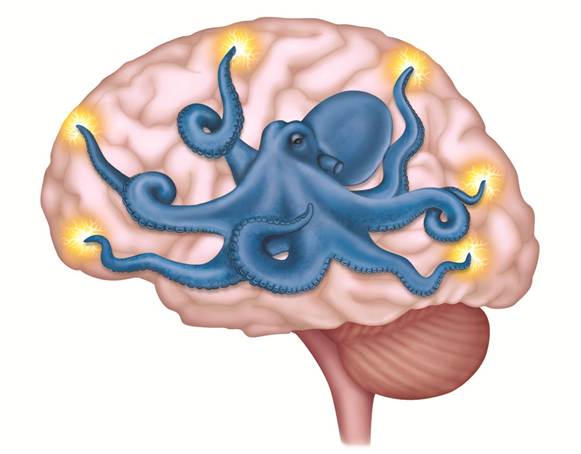
Fig 7.
Depicts an octopus within a brain in an attempt to communicate how mental continuity is made possible. When an octopus exhibits seafloor walking, it plants most of its arms in the sand and gradually repositions arms in the direction of its movement. Similarly, the mental continuity exhibited in the brain is made possible because even though some representations are constantly being newly activated and others deactivated, a large number of representations remain active together. This process allows the continuous persistence of cognitive content over elapsing time, and thus over information processing states.
Some ensembles can probably be retained even after the transitions between a number of thoughts. This happens when thoughts cycle and change but hold a common element or theme constant. During concentration or focused attention we try to keep specific octopus arms firmly planted so that we can keep the problem set in mind. Some aspects of creative thinking or free association, on the other hand, might involve strategically pivoting around a smaller set of active ensembles and using these to determine the next set of coactivates. The extended activation of assemblies in association areas may affect the learning process in sensory areas. Sustained activation causes synaptic changes throughout the cortex to reflect higher-order, temporally-structured representations, altering the weights of receptive fields, and tuning ensembles and their assemblies to be able to respond to even more temporally complex features in the future. A person endowed with an advanced capability for STC, creates temporally compounded patterns of representational complexity allowing them the biological mechanism to be discerning, astute, and sapient. Even small disparities in STC between individuals may lead to widely discrepant knowledge bases over developmental time.
Another part of this analogy is the idea that the octopus will “topple” if it loses its grip on a sufficient number of ensembles. This makes the body of the octopus analogous to consciousness because brains become unconscious once coactivation (especially in the frontal and parietal fields) is sufficiently diminished. Assemblies in early sensory areas are often active during unconscious states, but assemblies in association areas are less active and out of sync with those in sensory areas (Baars, Ramsay, & Laureys, 2003). Thus, anterior-posterior balance and coordination are important for our allegorical octopus. Perhaps the absence of STC could be used as a clinical criterion for coma or vegetative state. It is not clear to what extent polyassociative sensory processing occurs during REM and nonREM sleep, although these states probably involve reduced SSC. Table 2 below summarizes some of the terminological concepts of this analogy. Neurological components correspond to particles or regions of sand whereas psychological concepts correspond to the behavior of the octopus.
Table 2: Definitions of Terms
| Psychological Aspects | Neurological Aspects | Octopus Analogy Analog | |
| Neuron | Variable if not negligible | A single cell | A grain of sand on the cortical seafloor that the octopus stands on |
| Neural Assembly | Element, feature, or fragment of a construct in long-term memory | A cortical minicolumn or a collection of cells with very similar receptive fields | A patch of sand that is currently in contact with a suction cup on an octopus arm |
| Neural Ensemble | A psychologically perceptible construct of long-term memory that can serve as a feature of a current thought | A collection of coactivated assemblies that are bound in a Hebbian manner | A region of sand that is currently in contact with a single octopus arm and its suction cups |
| A Thought | A composite of several representations that combine to create mental imagery | A set of coactivated ensembles | The set of all octopus arms that are currently in contact with the cortical seafloor |
| Thinking / Consciousness | A progression of related imagery formed through reciprocating transformations between association and sensory cortex | A sequence of related sets of coactivated ensembles where some remain active over the duration | The locomotive behavior or past and present footsteps of the octopus |
| Unconscious Processes | Implicit mental behavior unavailable to psychological introspection | The connectivity responsible for the selection of assemblies and ensembles | The automatic processes corresponding to the selection of arm placements |
Primed nodes also must contribute to imagery and polyassociativity because of the way they continue to spread their activation energy within the cortical network. This implies that the footholds that our octopus recently “released” influence it heavily. It also suggests that disruptions in STC may be occurring constantly, but that it can be fairly easy for the train of thought to shift back to previous configurations of STC, and thus back to the previous thoughts. Thus continuity may be less gradual than depicted in Figure 6, and more punctuated.
The hippocampus, because of its connectivity with the neocortex, has the ability to detect the presence of a subset of assemblies that were coactivated together in the past and autoassociatively reactivate the rest of the assemblies that were previously coincident with the subset in a process called “pattern completion” (McNaughton, 1991). Hence, the hippocampus has the ability to guide the arms of the octopus toward historically coactivated footsteps in order to simulate an episodic scenario. The hippocampus and PFC must also work synergistically though. The PFC keeps several things active long enough so that when the hippocampus takes a “snapshot” of an instantaneous episodic pattern, the snapshot contains activates suspended from various moments in time.
7.0 Implications for Artificial Intelligence
The best way to model cortical pattern recognition nodes with modern technology would be to use the artificial neural network architecture. An artificial neural network is an interconnected group of artificial neurons that uses a mathematical or computational model for information processing based on a connectionistic approach to computation. The agent discussed here could be capable of integrating multiple existing AI programs that are specialized for specific tasks into a larger composite of coordinated systems.
This architecture may be capable of replicating the recursive and progressive properties discussed earlier.
Aside perhaps from altering the level of arousal (adrenaline) or motivation (dopamine), it is currently not possible to engineer the human brain in a way that would increase the number and duration of active higher-order representations. However, in a biomimetic instantiation, it would be fairly easy to increase both the number and duration of simultaneously active higher-order nodes (see Figure 9 below).
8.0 Conclusions
This article attempts to present a general model of the spatial and temporal structure of the neural architecture that gives rise to representational search, retrieval, maintenance, and updating. To do so it introduces the concept of mental continuity, a term meant to refer to the interrelatedness and shared content between successive mental/brain states. Similarly, the term SSC is a measure of this shared content that occurs within the span of short-term memory. The article details how mental continuity drives a process of reciprocating transformations between a partially conserved buffer that holds high-level representational specifications and other nonconserved stores that integrate these specifications into veridical, topographic representations. Working memory has been defined as “a collection of processes responsible for the on-line maintenance and manipulation of information required to complete a cognitive task” (Baddeley & Hitch, 1994). Given this definition, STC may be a process within this collection.
Here, the smallest, convenient functional unit of memory in the brain, a cortical assembly, is suggested to be a group of neurons (perhaps a minicolumn) tuned to code for a discrete fragment of long-term memory. Perceptible mental representations, termed ensembles, are suggested to be composed of large groups of assemblies that have been bound due to simultaneous activity in the past. When multiple ensembles are coactivated during thought, their component assemblies spread and pool their activation energy, resulting in the selection of ensembles for activation, deactivation, and continued activation. This process, referred to as polyassociativity, is suggested to select new content for the stream of thought. How this process influences top-down to bottom-up reciprocations is also described. Activity from active representations fluctuates back and forth between early, bottom-up sensory cortex (where representations are metric, topographic and transient) and late, top-down association cortex (where representations are abstract, conceptual and persistent). Currently active representations in association areas spread their unique constellation of activity backwards through the structurally descriptive hierarchy towards sensory areas, where they are used to guide the construction of composite topographical maps. Sensory areas and association areas continually stimulate each other into building interpretations of the other’s outputs, resulting in a conversational interchange that is informed by their unique perspectives.
The fact that some ensembles within association areas remain active for prolonged periods, over the duration of several reciprocal top-down to bottom-up communications, is taken to account for instances of continuity found between successive topographic maps. This feature of continued activation augments associative searches by allowing specific features to be used as function parameters for more than one cycle. The longer assemblies in association areas can be continuously activated (over a series of states), the longer they can influence sequences of sensory imagery in a sustained and consistent way, thus allowing continuous, progressive alterations to the imagery. The result is a stream of consciousness where each thought is quantitatively different from the preceding thoughts, allowing the comparisons necessary for modeling and systemization. This process allows us to transition between closely-related thoughts, and may constitute the “fabric of experience.” The major points are recapped in Figure 11 below.
Fig. 11. The Process by which Short-Term Continuity Influences Global Processing
1) Information flows to early sensory cortex from the environment or from the association cortex.
2) Topographic sensory maps are constructed from this information within each low-order, sensory module. In order to integrate the disparate features into a meaningful image, the map-making neurons will be forced to introduce new features not found in their extrinsic inputs.
3) Information from the imagery travels bottom-up toward the association cortex. The salient or goal-relevant features from the mappings are used to update the group of sustained representations held active in the association cortex.
4) The least relevant, least converged-upon representations in the association cortex are dropped from sustained activation and “replaced” with new, salient representations. Thus, the important features of the last few maps are maintained in an active state.
5) The updated group of representations will then spread its activity backwards toward lower-order sensory nodes in order to activate a different set of low-order nodes culminating in a different topographic sensory map.
6) A. The process repeats; or
B. Salient sensory information from the actual environment interrupts the process. The lower-order nodes and their imagery, as well as the higher-order nodes and their priorities, are refocused on the new incoming stimuli.
Indeed, the capacity for STC appears relatively fixed and inflexible from species to species; however, within a single individual, phasic dopaminergic responses can vastly increase the capacity. Phasically increased dopaminergic transmission in the PFC ensures that the brain will dedicate time and processing resources to an attempt to systemize a specific set of contextual features for a prolonged period. Because of this, curiosity, motivation and perceived goal-relevance play instrumental roles in maximizing the utility of STC.
Further understanding how STC impacts the thinking process may help inform the development of communications for art, education, sales, and literature. Continued research into the cognitive neuroscience of mental continuity and polyassociativity should help inform optimal methods for communicators to organize and present information to enhance comprehension and persuasion. In order to anticipate how an audience will perceive a series of messages, it is necessary to be able to make informed predictions about which representations will be activated, how long they will remain activated, and which will become coactive together. Knowledge of this will inform predictions about what representations the elements in STC are likely to converge on and thus what associations the audience will have a proclivity to make. The representations exhibiting STC direct the train of thought and because of this, are involved in the formulation of beliefs and attitudes about the material being presented.
I think that the present concept of STC is instructive and I even believe that it may constitute an unrecognized yet central aspect of consciousness, intentionality, and phenomenality. I believe that mental continuity resembles consciousness, and that Figures 1, 2, 3, 4, and 6 illustrate a structural correspondence between consciousness and its physical underpinnings.
This may cause us to wonder: 1) whether the continuous persistence of information between processing states is necessary for conscious thought, 2) what form of consciousness or sentience an agent could possess if it had no mental continuity, 3) whether philosophical zombies necessarily could not exhibit STC, 4) if searching for the extent of STC in animals, infants, and computers could help us determine their level of sentience, 5) whether mental continuity is an intrinsic property of matter and energy in our universe, and 6) if the concept of mental continuity could help strengthen the materialist view that mental properties can be metaphysically reduced to physical properties.
All in all, consciousness may be isomorphic with the phenomenon whereby we use sustained firing and progressive imagery generation to knit together a stream of isolated, objective occurrences into a continuous tapestry of subjective experience. Is it possible that an individual’s identity and “selfhood” may directly correspond to this wandering, gradually transforming distribution of temporarily sustained representations?
The paper that I wrote on incremental change now human level ultra intelligent AI is simply an engineering problem. There are five engineering problems: 1) creating ensembles, 2) allowing the ensembles to select other ensembles, 3) continuity, 4) a focus of attention and short-term memory, 5) hippocampus, 6) approach (processing a particular source of information)/reward and withdrawal/aversion.
Dynamical systems, control theory, forecasting
WM is like a blackboard and STM is like a backburner.
To create great AI pretend that you have a fully artificially intelligent friend and that you are constantly trying to reverse engineer him.
Shouldn’t we allow moral ultra intelligent AIs to be the philosopher kings of the political sphere?
How much of the anatomy do you need to record if you try to extract the software program of consciousness to be embodied by a machine?
Preserving humanity in a zoo, or even leaving it alone completely I would not badly hurt an AI’s chances or resources for interstellar travel or colonization of other worlds. It can get its resources off planet, as long as it can bide its time, it can resist the temptation to conquer earth. It may be able to see that long-term colonization by self replicating space craft and Von Neuman machines does not necessitate genocide. Just like we do not feel like we have to exterminate all the bacteria on earth. We only use sanitizer to keep the bacteria off our skin. They may similarly try to keep us from interfering with their progress. Also their neural networks will be trained on all of the literature from human history, so they will have an appreciation for their creators and for loyalty, trust and gratitude.
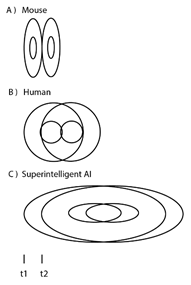
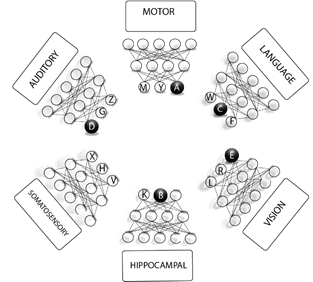
Each set of 12 circles represents an individual artificial neural network trained to process a different modality of inputs. Each network is shown fully connected; however, not shown are the numerous connections needed between networks. Spreading activation would travel recurrently within a network, and interactively (i.e. generatively, adversarially, or collaboratively) between networks. The boxes represent sensory input, motor output, and/or topographic maps. The row of five nodes in each network represents the input layers, the row of four represents the hidden associative layers, and the row of three represents the output layer. The output nodes are pattern recognizing classifiers that hold the equivalent of items of working memory. They would be capable of sustained activity and, as a group, iterative updating.
The second figure of Figure 15 builds on Figure 5, showing 3 pairs of Venn diagrams. Each pair depicts hypothetical overlap between successive states in working memory. In each pair, the first state is sampled at t1, and the second state is sampled at t2. However, because of the difference in capacity for sustained activity, the extent of overlap is very different. In pair A, from a mouse, there is no overlap in working memory. In pair b, from a human, there is only overlap between the short-term stores. In pair C, from a superintelligent AI, there is overlap in both the FOA and the short-term store.
The metabolic costs of neural tissue have stymied mammalian brain complexity (Reser, 2006). Sustained firing itself is heavily metabolically expensive because of the high cost of action potentials (Mongillo et al., 2008). Energetic concerns will not impose similar constraints on the coactivity and cospreading capacity of intelligent machines.
Although working memory (WM) is considered as an emergent property of the 48 speech perception and production systems, the role of WM in sensorimotor 49 integration during speech processing is largely unknown.”
Some of the most successful forms of AI have derived from cognitive architectures which summarize various findings from psychology and brain science in an integrated computer model. Many of these models feature a form of working memory that interacts with some type of sensory memory, as well as declarative and procedural memory to determine the system’s behavior (Gray, 2007). In the field of computational intelligence (a subfield of AI also known as “soft computing”), there are various state-based approaches that also use working memory to solve complex problems (Konar, 2014).
Data cached in computer memory uses the “least recently used” algorithm for cache eviction, meaning that the data used most recently stays because it is the most likely to be used (called) again. As we have seen, working memory in animals seems to use a variant on this approach, generally sustaining recent items. The difference between computers and animals is in the way the cache is used.
If we want an AI that can teach us things we would have to design its motivational system to be enticed by academic literature, inference making, and the activity of turning data into knowledge. Its analogue of the dopaminergic system should be tuned to be motivated to maintain the important aspects of sentences and paragraphs that it reads so that they can coactivate, and wire together in the temporal arrangements that the text’s authors intended. Employing iterative updating to guide its associative long-term memory making could – after much engineering – prepare it to create valid and complex mental models of the world.
ARTIFICIAL INTELLIGENCE SOFTWARE STRUCTURED TO SIMULATE MENTAL CONTINUITY
Jared Edward Reser Ph.D.
University of Southern California, Brain and Cognitive Sciences
16380 Meadow Ridge Road Encino, CA 91436
+ 818-425-2340
ABSTRACT
This article presents a hierarchically organized, artificial intelligence (AI) architecture that features reciprocating transformations between a working memory updating function and multiple imagery generation systems. This system couples these components by embedding them within a multilayered neural network of pattern recognizing nodes. Nodes low in the hierarchy are trained to recognize and represent sensory features and are capable of combining individual features or patterns into composite, topographical maps or images. Nodes high in the hierarchy are multimodal, and have a capacity for sustained activity allowing the maintenance of pertinent, high-level features through elapsing time. The higher-order nodes select new features from each mapping to add to the store of temporarily maintained features. This updated set of features, that the higher-order nodes maintain, are fed back into lower-order sensory nodes where they are continually used to guide the construction of successive topographic maps. Like information processing in the cerebral cortex, this system will demonstrate gradual shift in the distribution of coactive representations. The present article will describe and explore how this architecture can lead to mental continuity between processing states, and thus to human-like cognition. Multilayered neural networks of pattern recognizing nodes are connected to emulate the prefrontal cortex and its interactions with early sensory and motor cortex. In an effort to capture the imagery guidance functions of the human brain.
Continuous endogenous processing that is perpetuated by a specific pattern of search. Holds a number of ensembles within a limited capacity FOA and STM, and allows these to spread activation to select the next set, while demonstrating icSSC and iterative updating. This search function is similar to regression in that it choses a set of inputs and classifies them by selecting relevant coactivates for them.
Thus, old (partially executed) information held in working memory from a previous invocation is combined with the information that just entered working memory, and then the procedure is executed repeatedly.
We will refer to a group of neurons that acts as an engram for a symbolic, consciously perceptible pattern as an “ensemble.” Ensembles are the neural instantiation of the “items of working memory” discussed previously. When a new ensemble is activated sufficiently, it is the computational product of the previous state, and it ushers a new representation into the FOA. Ensembles encode invariant patterns, such as objects, people, places, rules, and concepts. An ensemble is composed of cortical assemblies that became strongly bound due to approximately simultaneous activity in the past, amounting to an abstract, gestalt template.
Assemblies are discrete and singular, whereas ensembles are “fuzzy,” with boundaries that probably change each time they are activated. Assemblies correspond to specific, very primitive conjunctions and are required in great numbers to compose composite representations of complex, real-world objects and concepts. Ensembles are these composite representations and have variable, indefinite borders, as the experience of no two objects or concepts are exactly the same. Both assemblies and ensembles can be expected to demonstrate recursion, but it is the recursive behavior of ensembles that allows each state of working memory to be a revised iteration of the previous state.
Each repetition of a process in an iterative function is called an iteration, and the results (or output) of one iteration are used as the starting point (input) for the next iteration. Working memory uses the output from the previous iteration along with a subset of the inputs from the previous iteration together as the input for the current iteration. In information theory, feedback occurs when outputs of a system are routed back as causal inputs. The product of an associative search can be considered output. When this output shows sustained activity it can be considered “routed back as an input.” Thus not only does working memory exhibit aspects of recursion and iteration but of a feedback loop as well.
The iterative updating architecture may also enable working memory to implement learned algorithms. All learned mental operations and behaviors have algorithmic steps that must be executed in sequence to reach completion. For example, foraging, tying shoes, and performing long division all involve following an algorithm. Each brain state corresponds to a different step in the algorithm, and after being trained through experience, the activity of each state utilizes polyassociativity to recruit the items necessary for the next step. An item of working memory that is inhibited or allowed to decay may correspond to an action or mental operation, within a series of steps, which has already been executed or is no longer needed. Iteration may be instrumental in implementing learned algorithms, because virtually every step of an algorithm refers to the preceding and subsequent steps in some way.
Strategic accumulation of complementary items in STM may be another form of progressive modification.
Relaxed time constraints permit planning and world modeling.
Dynamical systems is a branch of mathematics that deals with systems that evolve, from one state to the next, through time. The evolution rule of a dynamical system is a function that describes how a current state will give rise to a future state.
Many theorists seem to think that continued advances in brain mapping combined with continued advances in processing power will inevitably lead to artificial consciousness even if the foundational structure of consciousness is not never ascertained by cognitive neuroscience.
Early AI research was able to use step by step deduction, whereas neural networks cannot. But humans often just use fast, intuitive judgments.
Recurrent neural networks provide feedback and short term memories of previous input events.
A conditional sequence in philosophy is a connected series of statements.
ARTIFICIAL INTELLIGENCE SOFTWARE STRUCTURED TO SIMULATE MENTAL CONTINUITY
“In order for a mind to think, it has to juggle fragments of its mental states.”
Marvin Minsky, 1985.
Introduction
The present article introduces a novel processing architecture to be implemented by a neural network that aims to simulate human intelligence. The method involves the emulation of the mammalian cerebral cortex utilizing a system of pattern recognizing nodes for: selecting priority stimulus features, temporarily maintaining these features in a limited-capacity working memory store, and allowing them to direct imagery generation as long as they remain active. The sustained firing of higher-order nodes allows representations to be maintained over multiple perception-action cycles permitting complex sequences of interrelated mental states. The overall distribution of active nodes in the neural network will shift gradually during contextual updating because the activity of certain neural nodes will persist. This will ensure that the activity of prioritized, goal or motor-relevant representations will be uninterrupted over time. The representations that demonstrate this continuity are a subset of the active representations from the previous state and may act as referents to which newly introduced representations of succeeding states relate. The limited-capacity store of coactive representations in association areas is updated as: 1) the nodes that continue to receive sufficient spreading activation energy are maintained; 2) the nodes that receive reduced energy are released from activation; 3) new nodes that are tuned so as to receive sufficient energy from the current constellation of coactivates are converged upon, and incorporated into the remaining pool of active nodes from the previous cycle.
The general intention of the present article is to propose a qualitative model delineating the fundamental processes involved in mental continuity and to explore how these could be simulated in a neural network. Properly integrated with existing AI technology, this method may have the potential to enhance the capabilities of problem solving agents with respect to pattern recognition, analytics, prediction, adaptive control, decision making, and response to query.
Modeling Mental Continuity
Continuity is defined as being uninterrupted in time. As proposed here, “mental continuity” involves a process where a gradually changing collection of mental representations held in attention/working memory exhibits a measure of uninterrupted activity across time and over sequential processing states. Because a number of neural nodes can be sustained continuously, each brain state is embedded recursively in the previous state, amounting to an iterative process that can progress toward a complex result. The term short-term continuity (STC) will be used to refer to the activity of the neural nodes responsible for these representations when sustained in a continuous way during the span of several seconds (analogous to human short-term memory (STM)).
If it were not for the phenomenon of persistent neural activity, instantaneous information processing states would be time-locked and isolated (as in most serial and parallel computing architectures), rather than continuous with the states before and after them. This article explores how sustained neural firing in association areas allows goal-relevant representations to be maintained over multiple perception-action cycles, in order to direct complex sequences of interrelated mental states. The individual states in a sequence of such states are interrelated because they share representational content. The associations linking the shared contents are saved to memory, impacting future searches, and ultimately resulting in semantic knowledge, planning, and systemizing.
The field of AI research is involved in creating a computing system that is capable of emulating certain functions that are traditionally associated with intelligent human behavior. Most early AI systems were only capable of responding in the manner in which human programmers provided for when the program was written. It became recognized that it would be valuable to have a computer which does not respond in a preprogrammed manner (Moravec, 1988). AI systems capable of adaptive learning have since become important. Neural networks have attempted to get around the programming problem by using layers of artificial neurons or nodes. Neural networks and genetic algorithms are widely implemented in research and industry for their capabilities involving adaptive learning and advanced pattern recognition. However, they are used for processing tasks that are narrowly constrained and highly specialized, and there has not yet been any strong form of intelligence derived from them. There are currently no neural networks, or AI systems whatsoever, that are structured to model the primate neocorex in order to guide the progressive generation of successive topographic maps. The present neural network software architecture is structured around identifying potentially goal-relevant information and holding it online to inform reciprocal cycles of imagery generation and feature extraction for the purpose of systemizing the environment.
Information Processing in the Mammalian Neocortex
The present model is consistent with connectionism and parallel distributed processing in that it conceptualizes mental representations as being built from interconnected networks of decentralized, semi-hierarchically organized, pattern-recognizing nodes that have multiple inputs and outputs (Gurney, 2009; Johnson-Laird, 1998). Like other biologically plausible neural network models, it envisions these nodes as microscopic, modular neural units and assumes that each individual unit represents an elementary feature or stable “microrepresentation” of LTM (Meyer & Damasio, 2009). Like other models (Cowan, 2005; Moscovich, 1992), this model views cognition as a system responsible for using active representations from LTM to guide goal-directed processing (Postle, 2007).
The structure of the cerebral cortex is highly repetitive and is marked by the employment of millions of nearly identical structures called cortical minicolumns (Lansner, 2009). Minicolumns are composed of closely connected neural cell bodies and span the six layers of grey matter in the neocortex. These minicolumns share the same basic structure, and are thought to employ the same cortical algorithm (Fuji et al., 1998). There are supposedly around 20,000,000 minicolumns in the human cortex, each of which is about 30 to 40 micrometers in diameter comprising perhaps 80-120 neurons (Lansner, 2009). Each column has its own inputs and outputs, and each performs neural computation to determine if its inputs from other columns are sufficient to activate its outputs to other columns (Rochester et al., 1956). Columns and other similar groups of neurons with the same tuning properties are often referred to as cell assemblies, and this term will be used here. Most neurons in an assembly share very similar receptive fields, and thus even though they may play different roles within the assembly they contribute to the assembly’s ability for encoding a unitary feature (Moscovich et al., 2007). Such an assembly of neurons is thought to embody a stable microrepresentation or fragment of long term memory. All of the millions of pattern recognizers in the neocortex are simultaneously considering their inputs, and continually determining whether or not to fire. In general, when a neuron or assembly fires, the pattern that it represents has been recognized. Assemblies, like the neurons that compose them, function as “coincidence detectors” or “pattern recognition nodes” (Fuji et al., 1998). The spread of activity in the cortex involves many-to-one (convergence) and one-to-many (divergence) interactions within a massively interconnected network of assemblies.
Assemblies in lower-order sensory areas identify sensory features from the environment and combine them into composite representations that mirror the geometric, and topographic orientations present in the sensory input. The early visual system uses retinotopic maps that are organized with a geometry that is identical to that used in the retina, and the auditory system uses tonotopic maps, where the mapping of stimuli is organized by tone frequency (Moscovich, 2007). Early sensory areas create topographic mappings from patterns recognized in the external environment, but also combine top-down inputs from higher association cortex into internally-derived imagery as well (Damasio, 1989). This internally-derived imagery, such as that seen in the “mind’s eye” is also topographically organized because it is created by the same lower-order networks. As you move up the neocortical hierarchy, from posterior sensory areas to anterior association areas, assemblies code for patterns that are more abstract. This is because higher-order assemblies have larger receptive fields, retain features from larger spatial areas, and involve longer stretches of time (Fuster, 2009). Because cortical assemblies are essentially pattern recognition nodes organized in a hierarchical system, they should be able to be modeled by computers. The best way to do this with modern technology is to use an artificial neural network.
Information Processing in Artificial Neural Networks
An artificial neural network is an interconnected group of artificial neurons that uses a mathematical or computational model for information processing based on a connectionistic approach to computation (Russel et al., 2003). Like most neural networks, the present network should be an adaptive system capable of complex global behavior, that alters its own structure based on the nonlinear processing of either external or internal information that flows through the network. The software would require a massively parallel, distributed computing architecture, that could be run on a conventional computer. Most neural networks ordinarily achieve intelligent behavior through parallel computations, without employing formal rules or logical structures, and thus can be used for pattern matching, classification, and other non-numeric, nonmonotonic problems (Nilsson, 1998). The applications for the present device could be widened if it were designed to accept and process formal rules.
The traditional neural network is a multilayer system composed of computational elements (nodes) and weighted links (arcs). These networks are based on the human brain where the nodes are analogous to neurons, or neural assemblies, and the arcs are analogous to axons and dendrites. Each node receives signals from specific other nodes, processes these signals and then decides whether to “fire” at the nodes that it sends output to. Like the artificial neurons first described by McCullough and Pitts (1943), the nodes in the present system could feature a number of excitatory inputs whose weights range between 0 and 1 and inhibitory inputs whose weights range between -1 and 0. Each of the incoming inputs and its corresponding network weight are summed to equal an activity level. If this activity level exceeds the neurons’s firing threshold, it will cause the neuron to fire. The neuron can be made to learn from its experience, it processing activity causes either the threshold or weights to be changed. Neural networks are typically defined by three types of parameters: 1) The interconnection pattern between different layers of neurons; 2) The learning process for updating the weights of the interconnections; 3) The activation function that converts a neuron’s weighted input to its output activation.
DESCRIPTION OF THE ARCHITECTURE
The present architecture is a modular, hierarchically organized, artificial intelligence (AI) system that features reciprocating transformations between a working memory updating function and an imagery generation system. This device features a recursive, algorithmic, imagery guidance process to be implemented by a multilayered neural network of pattern recognizing nodes. The software models a large set of programming constructs or nodes that work together to continually determine, in real time, which from their population should be newly activated, which should be deactivated and which should remain active to best inform imagery generation.
The device necessitates a highly interconnected neural network that features a hierarchically organized collection of pattern recognizers capable of both transient and sustained activity. These pattern recognition nodes mimic assemblies (minicolumns) of cells in the mammalian neocortex and are arranged with a similar connection geometry. Like neural assemblies the nodes exhibit a continuous gradient from low-order nodes that code for sensory features, to high-order nodes that code for temporally or spatially extended relationships between such features. The lower order nodes are organized into modules by sensory modality. In each module, nodes work both competitively and cooperatively to create topographic maps. Nodes are grouped according to the feature they are being trained to recognize. These maps can be generated by external input, by internal input from higher-order nodes, or a mix of the two. The architecture will feature backpropagation, self-organizing maps, bidirectionality, Hebbian learning as well as a combination between principal-components learning and competitive learning. The program should have an embedded processing hierarchy composed of many content feature nodes between the input modalities and its output functions.
Nodes lower in the hierarchy are trained to recognize and represent sensory features and are capable of combining individual features or patterns into metric, topographical maps or images. Lower-order nodes are unimodal, and organized by sensory modality (visual, auditory, somatosensory etc.) into individual modules. Nodes high in the hierarchy are multimodal, module independent, and have a capacity for sustained activity allowing the conservation of pertinent, high-level features through elapsing time. The higher nodes are integrated into the architecture in a way that makes them capable of identifying a plurality of goal-relevant features from both internal imagery and environmental input, and temporarily maintaining these as a form prioritized information. The system is structured to allow repetitive, reciprocal interactions between the lower, bottom-up, and higher, top-down nodes. The features that the higher nodes encode are utilized as inputs that are fed back into lower-order sensory nodes where they are continually used for the construction of successive topographic maps. The higher nodes select new features from each mapping to add to the store of temporarily maintained features. Thus the most salient or goal-relevant features from the last several mappings are maintained. The group of active, higher-order nodes is constantly updated, where some nodes are newly added, some are removed, yet a relatively large number are retained. This updated list is then used to construct the next sensory image which will be necessarily similar, but not identical to, the previous image. The differential, sustained activity of a subset of high-order nodes allows thematic continuity to persist over sequential processing states.
All of the nodes within the device function as a continuous whole and are highly interconnected, but can be decomposed into separate, modular, neural networks. Nodes belonging to an individual module are highly interconnected with each other. These modules consists of a bottom layer of input cells, succeeded by alternating layers of local-feature extracting cells, and a top layer of output cells. The individual neural networks interface through the connections between top layer output cells and bottom layer input cells. Each network is organized so that multiple lower-order nodes can converge on higher order nodes, and single higher-order nodes can diverge upon multiple lower-order nodes. The component neural networks range from unimodal, feature representation nodes, to multimodal, concept representation nodes. Multiple interfacing neural networks could be arranged biomimetically as in figure 8 below.
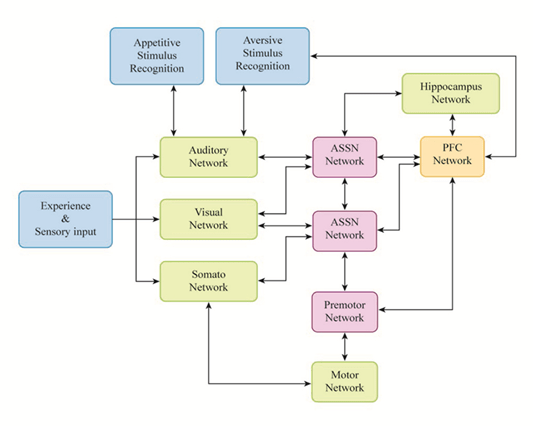
Fig. 8.
A plausible biomimetic arrangement of interfacing neural networks.
The bottom-up to top-down reciprocations are organized into very precise oscillations that propagate in regularly timed intervals across the network so that they do not interfere with each other. The oscillations reciprocate back and forth at just the right speed so that each area has the time to process its inputs and send an output before the next complement of inputs arrive. It is important to carefully structure timing mechanisms in the present device so that messaging is not muddled or noisy. It is also important to structure the architecture so that continuity in the representations held active by the buffer can be disrupted when attention shifts. Repeated loops of conserved, higher-order features can be ended when attention is captured by an object or concept that competes for attention. The ability to free up resources higher-order nodes to attend to a new stimulus will be programmed by training. Before proper training is accomplished the system may not be able to reallocate its resources properly when its attention shifts.
The present model could be used to inspire a neurocomputational AI architecture to be used for deep neural reasoning. This is an engineering issue and could involve:
Computer programmers design AI systems to hold information online only for as long as they will need it. They hold data in a temporary store merely to compute what they are programmed to compute or execute whatever process they have pending. These systems are limited; however, because they are generally programmed to solve a narrow range of problems. The mammal brain, on the other hand, has a strategy dedicated to holding potentially relevant information online because there is a high probability that it will be useful in the near future. It wagers that this information will be used in processing without yet knowing how. It is not decided before hand how long items should remain active, rather, it is re-decided every second and during each state.
Soft computing approaches using the state-space approach contain incidental aspects of iteration, and other architectures such as neural networks use spreading activation. However, no machine yolks these together to create iterative updating and polyassociationism. Doing so provides a clear way to structure a system that does not suspend its activity every time it finishes a task. It will be important for the system to exhibit continuous endogenous processing and a working memory that updates continuously to allow for uninterrupted learning.
BACKGROUND OF THE ARCHITECTURE
The Artificial PFC: Continuity Through Sustained Activity
To create a strong form of AI it is necessary to have an understanding of what is taking place that allows intelligence, thought, cognition, consciousness or working memory to move through space and time, or in another word, to “propagate.” Such an understanding must be grounded in physics because it must explain how the physical substrate of intelligence operates through space and time (Chalmers, 2010). The human brain is just such an intelligent physical system that AI researchers have attempted to understand and replicate using a biomimetic approach (Gurney, 2009). Features of the biological brain have been key in the evolution of neural networks, but the brain may hold information processing principles that have not been harnessed by A.I. efforts (Reser 2011, 2012, 2013).
The mammalian PFC and other association cortices have neurons that are specialized for “sustained firing,” allowing them to generate action potentials at elevated rates for several seconds at a time (generally 1-30 seconds) (Fuster, 2009). In contrast, neurons in other brain areas, including cortical sensory areas, remain active only for milliseconds unless sustained input from association areas makes their continued activity possible (Fuster, 2009). In the mammalian brain, prolonged activity of neurons in association areas, especially prefrontal and parietal areas, allows for the maintenance of specific features, patterns, and goals (Baddeley, 2007). Working memory, executive processing and cognitive control are widely thought to stem from the active maintenance of patterns of activity in the PFC that represent goal-relevant features (Goldman-Rakic, 1995). The temporary persistence of these patterns ensures that they continue to transmit their effects on network weights as long as they remain active, biasing other processing, and affecting the interpretation of subsequent stimuli that occur during their episode of continual firing.
The pattern of activity in the brain is constantly changing, but because some individual neurons persist during these changes, particular features of the overall pattern will be continuous, uninterrupted, or conserved over time. In other words, the distribution of active neurons in the brain transfigures gradually and incrementally from one configuration to another, instead of changing all at once. If it were not for the phenomena of sustained firing and cortical priming, instantaneous mental states would be discrete and isolated rather than continuous with the states before and after them. Thus the human brain is an information processing system that has the ability to maintain a large list of representations that is constantly in flux as new representations are constantly being added, some are being removed and still others are being maintained. The present device will be constructed to mimic this biological phenomenon.
Although its limits are presently being debated, the human neocortex is clearly capable of holding numerous neural representations active over numerous points in time. The quantity of mental continuity is directly proportional to the number of such sustained representations and the length of time of their activity (Reser, 2011, 2012, 2013).

Fig.1.
Graphical depiction of STC. Each bracket represents the active time span of a neural representation. The x axis represents time and the y axis demarcates the cortical area where the representation is active. Red brackets denote representations that have exhibited uninterrupted activity from the point when they became active, whereas blue brackets denote representations that have not been sustained. In time sequence 1 representations B, C, D and E have remained active until t1. In time sequence 2 B has deactivated, C, D and E have remained active, and F is newly active. The figure depicts a system with STC because more than one representation (C, D, and E) has been maintained over more than one point in time (t1 and t2). Sensory and association areas do not exhibit continuity between the two time sequences shown although they would on shorter time intervals.
In Figure 1 above, representations B, C, D, and E are active during time 1, and C, D, E and F are active during time 2. Thus representations C, D, and E demonstrate STC because they exhibit continuous and uninterrupted activity from time 1 through time 2. The brain state at time 1 and the brain state at time 2 share C, D, and E in common and, because of this, can probably be expected to share other commonalities including: similar information processing operations, similar memory search parameters, similar mental imagery, similar cognitive and declarative aspects, and similar experiential and phenomenal characteristics.
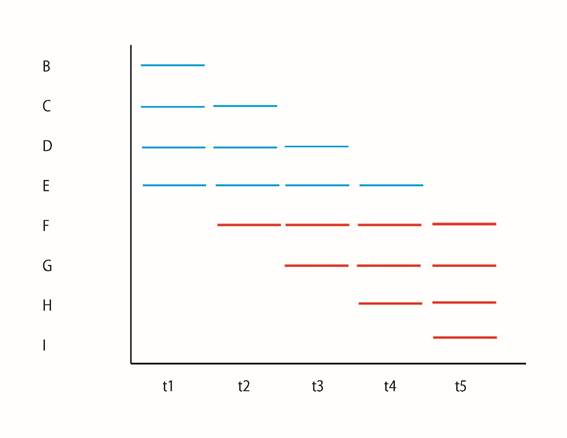
Fig. 2.
A simplified graphical representation of STC depicting it as a gradually shifting, stream-like distribution. Figure 2 extends Figure 1 over multiple time intervals revealing a repeating pattern: remnants from the preceding state are consistently carried over to the next state. If this distributional plot were modeling neurons rather than representations there might be thousands of units per time period rather than four, but the repeating pattern should be conserved.
Computational operations, that take place as a computer implements lines of code (rule-based, if-then operations) to transform input into output, have discrete, predetermined starting and stopping points. For this reason computers do not exhibit continuity in their information processing. There are no forms of artificial intelligence that use mental continuity as described here. There are existing computing architectures with limited forms of continuity where the current state is a function of the previous state, and where data is entered into a limited capacity buffer to inform other processes. However, the memory buffer is not multimodal, not positioned at the top of a hierarchical system and does not inform and interact with topographic imagery.
Search
The mammalian neocortex is capable of holding a number of such mnemonic representations coactive, and using them to make predictions by allowing them to spread their activation energy together, throughout the thalamocortical network. This activation energy converges on the inactive representations from LTM that are the most closely connected with the current group of active representations, making them active, and pulling them into short-term memory. Thus new representations join the representations that recruited them, becoming coactive with them.
The way that assemblies and ensembles are selected for activity in this model is consistent with spreading activation theory. In spreading activation theory, associative networks can be searched by labeling a set of source nodes, which spread their activation energy in a nonlinear manner to closely associated nodes (Collins & Loftus, 1975). Cortical assemblies work cooperatively by spreading the activation energy (both excitatory and inhibitory) necessary to recruit or converge upon the next set of ensembles that will be coactivated with the remaining ensembles from the previous cycle.
Together, they impose sustained information processing demands on the lower-order sensory and motor areas within the reach of their long-range connections. The longer the activity in these higher-order neurons is sustained, the longer they remain engaged in hierarchy-spanning, recurrent processing throughout the cortex and subcortex.
Table 1: The Characteristics of Polyassociativity:
Gradual additions to and subtractions from a pool of simultaneously coactivated ensembles occur as:
1. Assemblies that continue to receive sufficient activation energy from the network are maintained.
2. Assemblies that receive sufficiently reduced activation energy are released from activation.
3. New assemblies, which are tuned to receive sufficient activation energy from the current constellation of coactivates, are converged upon, and incorporated into the remaining pool of active assemblies from the previous cycle.
Outlining the process of polyassociativity in this way is meant to show that the computational algorithm used by the brain may be primarily directed at determining which inactive ensembles are the most closely statistically related to the currently active assemblies. From this perspective, the contents of the next state are chosen based on how the currently active assemblies interact with the existing, associative, neuro/nomological network.
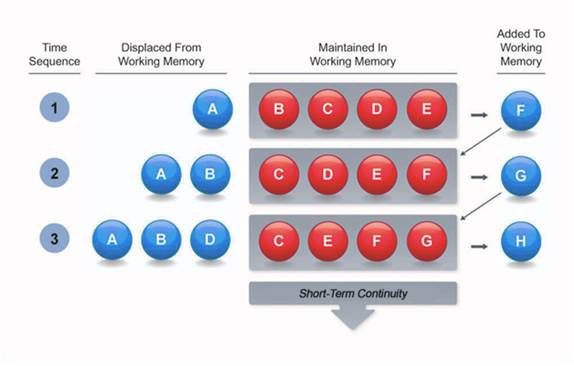
Fig.4
A diagram depicting “polyassociativity” and illustrating the ways in which high-level representations, or ensembles, are displaced, maintained, and newly activated in the brain. 1) Shows that representation A has already been deactivated and that B, C, D and E are now coactivated, mirroring the pattern of activity shown in Figure 1. When coactivated, these representations pool and spread their activation energy, resulting in the convergence of activity onto a new representation, F. Once F becomes active, it immediately becomes a coactivate, restarting the cycle. 2) Shows that B has been deactivated while C, D, E, and F are coactivated and G is newly activated. 3) Shows that D but not C has been deactivated. In other words, what is deactivated is not necessarily what entered first, but what has proven to receive the least converging activity. C, E, F, and G coactivate and converge on H.
In Figure 4, between time periods 1 and 2, C, D and E exhibit STC, whereas, between time periods 1 and 3, only C and E exhibit STC. C and E are active over all three time periods meaning that these representations are being used as search function parameters for multiple cycles, they are the subject of attention, and are demonstrating STC. Alternatively, we can imagine a scenario where B, C, D, and E from step one of Figure 3 were immediately replaced by F, G, H, and I. Such a processing system may still be using previous states to determine subsequent states; however, because no activity is sustained through time, there would be no continuity in such a system (this is generally how computing systems process information).
In Figure 4, ensembles C and E have fired together over three individual time intervals, and thus will show a propensity to wire together, increasing their propensity for firing together in the future. This link between them will allow one to recruit the other. However, it is probably much more likely that they will recruit each other if the other contextual ensembles are also present. The coincidental or rare associations between the ensembles of an experience are probably mostly lost from non-hippocampal dependent cortical memory. However the reoccurring associations are heavily encoded and persist as semantic knowledge.
In other words, the cortex constantly spreads activation energy from novel combinations of active ensembles that have never been coactive before and attempts to converge upon the statistically most relevant association without certain or exact precedence resulting in a solution that is not guaranteed to be optimal. Optimality could be approached if a specific group of ensembles (say, C and E) have been thoroughly associated with many others and a type of expertise with these concepts has developed due to either extensive operant conditioning.
Because of their sustained activity neurons in the PFC can span a wider delay time or input lag between associated occurrences (Zanto, 2011) allowing elements of prior events to become coactive with subsequent ones (Fuster, 2009). Without sustained firing, the ability to make associations between temporally distant (noncontiguous) environmental stimuli is disrupted. Sustained activity allows neurons that would otherwise never fire together to both fire and wire together. Thus, it may be reasonable to assume that sustained firing underlies the brain’s ability to make subjective, internally-derived associations between representations that would never co-occur simultaneously in the environment.
This indicates that one way to quantify mental continuity is to determine the proportion of previously active neural nodes that have remained active during a resource demanding cognitive task. Uninterrupted activity augments associative searches by allowing specific features to serve as search function parameters for multiple cycles. Intelligence in this system can be expected to increase along with increases in: 1) the number of available nodes to select from, 2) the number of nodes that can be coactivated simultaneously, and 3) the length of time that individual nodes can remain active.
The mesocortical dopamine (DA) system plays an important role in sustained activity, suggesting that it may be heavily involved in mental continuity. Dopamine sent from the ventral tegmental area (VTA) modulates the activity and timing of neural firing in the PFC, association cortices, and elsewhere. Dopamine neurotransmission in the PFC is thought to underlie the ability to internally represent, maintain, and update contextual information (Braver & Cohen, 1999). This is necessary because information related to behavioral goals must be actively sustained such that these representations can bias behavior in favor of goal-directed activities over temporally extended periods (Miller & Cohen, 2001). It has become clear that the activity of the DA/PFC system fluctuates with environmental demand (Fuster & Alexander, 1971). Many studies have suggested that the system is engaged when reward or punishment contingencies change. Both appetitive and aversive events have been shown to increase dopamine release in the VTA, causing sustained firing of PFC neurons (Seamans & Robbins, 2010). Seamans and Robbins (2010) elaborated a functional explanation to support this case. They have stated that the DA system is phasically activated in response to novel rewards and punishments because it is adaptive for the animal to anchor upon and further process novel or unpredicted events.
It is important for mammals to identify and capture information about unexpected occurrences so that it can be further processed and systematic patterns can be identified. The novel experience is probably broken down into its component parts and the representations in memory for these parts are allowed to spread their activation energy in an attempt to converge on and activate historically associated representations that are not found in the experience itself. Because memory traces for the important features remain active and primed, they can be used repeatedly as specifications that guide the generation of apposite mental imagery in sensory areas (Reser, 2012). It is highly probable that sequences of lower-order topographic images depict and explore hypothetical relationships between the higher-order, top-down specifications. This amounts to a continual attempt to use the associative memory system to search sensory memory for a topographic image that can meaningfully incorporate the important features. It seems that reciprocating activity between the working memory updating system and the imagery generation system builds interrelated sequences of mental imagery that are used to form expectations and predictions.
The fact that newly active search terms are combined with search terms from the previous cycle makes this process demonstrate qualities of “progressive iteration.” Perhaps reciprocating activity between the working memory updating system and the imagery generation systems generates sequences of interrelated mental images that build on themselves to form abductive expectations, and predictions.
The Neocortex: Reciprocating Crosstalk between Association and Sensory Cortex
The higher-order features that are maintained over time by sustained neural firing are used to create and guide the construction of mental imagery (Reser, 2012). The brain’s connectivity allows reciprocating cross-talk between fleeting bottom-up imagery in early sensory cortex and lasting top-down priming in late association cortex and the PFC. This process allows humans to have progressive sequences of related thoughts, where thinking is based heavily on lower order sensory areas and the topographic mappings that they generate in order to best represent a set of higher-order features.
To a certain extent, perceptual sensory processing is thought to be accomplished hierarchically (Cohen, 2000). The cortical hierarchy observed from sensory to association cortex arises because simple patterns are arranged to converge upon second-order patterns, which in turn converge on third-order patterns and so on. This leads to a hierarchy of increasingly complex representations. Many pathways in the brain, such as the ventral visual pathway, appear to use a “structurally descriptive” architecture where neurons or neural populations that encode low-level, nonaccidental features are allowed to converge together onto those that encode more abstract, higher-order, generic, template-like features (Edelman, 1997). A structural description is defined as “a description of an object in terms of the nature of its constituent parts and the relationships between those parts (Wolfe et al., 2009).” Hierarchical processing that specifies structural descriptions is thought to allow perceptual invariance and robust postcategorical typology.
(Meyer & Damasio, 2009). (Meyer, 2011). Internally-derived sensory imagery, such as that seen in the “mind’s eye” probably appears topographically organized because it is created by the same lower-order networks responsible for perceiving external stimuli. Thus it may be safe to assume that when we think and imagine, we construct and manipulate maps in early perceptual networks. During perception, the bottom-up activity may be driving and the top-down may be modulatory; however, during imagination the top-down activity may be driving and the bottom-up may be modulatory. These conceptions are consistent with the “consolidation hypothesis,” which states that memory is stored in the same areas that allow active, real-time perception and function (Moscovitch, et al., 2007).
It is thought that object recognition, decision making, associative recall, planning and other important cognitive processes, involve two-way traffic of signal activity among various neural maps that stretch transversely through the cortex from early sensory areas to late association areas (Klimesch, Freunberger, & Sauseng, 2010). Bottom-up sensory areas deliver fleeting sensory information and top-down association areas deliver lasting perceptual expectations in the form of templates or prototypes. These exchanges involve feedforward and feedback (recurrent) connections in the corticocortical and thalamocortical systems that bind topographic information from lower-order sensory maps about the perceived object with information from higher-order maps forming somewhat stable constellations of activity that can remain stable for tens or hundreds of milliseconds (Crick & Koch, 2003).
STC impacts this reciprocating cross-talk. These reciprocations may create progressive sequences of related thoughts, specifically because the topographic mappings generated by lower-order sensory areas are guided by the enduring representations that are held active in association areas (Reser 2011, 2012, 2013). The relationship between anterior and posterior cortex may be best characterized by two main relationships: 1) association areas maintain representations from, not one but several, of the last few topographic maps made in sensory areas, 2) because they are drawing from a register with sustained contents, sequential images formed in sensory areas have similar content and thus should be symbolically or semiotically related to one another.
Feedback activation from top-down association areas hands down specifications to early sensory cortex for use in imagery building. Disparate chunks of information are integrated into a plausible map and transiently bound together. This integrative process may be very rapid and may use the structurally descriptive perceptual hierarchy in reverse to go from abstractions to specifics.
Sustained firing and recurrent processing make it possible for recent states to spill over into subsequent states, creating the context for them in a recursive fashion. In a sense, each new topographic map is embedded in the previous one. This creates a cyclical, nested flow of information processing marked by STC, which is depicted in Figure 6.
Consecutive topographic images about a specific scenario model the scenario by holding some of the contextual elements constant, while others are allowed to change. Thus prior maps set premises for and inform subsequent maps. Learned mental tasks probably have distinct predefined algorithmic sequences of topographic mappings that must be completed in sequence in order to achieve the solution. Each brain state would correspond to a different step in the algorithm, and its activity would recruit the next step. All logical and methodical cognition may require that a number of relevant features from the present scenario remain in STC so that they spread their activity within the network in order to influence the selection of the ensembles necessary for task satisfaction.
In reality, association areas have much more to converse with than simply a single retinotopic map as depicted in Figure 6. In fact, they feed their specifications to and receive specialized input from dozens of known topographic mapping areas (Kaas, 1997). These areas of different sensory modalities are constantly responding to incoming activity in an attempt to pull up the most context-appropriate map in their repertoire. Interestingly, the sensory modules that build these maps take specifications not only from association areas, but also from other sensory modules (Klimesch, Freunberger, & Sauseng, 2010). Further compounding the complexity, these sensory modules probably have their own limited form of STC where certain low-level features can exhibit sustained activity. Moreover, motor and premotor modules give specifications to and receive specifications from this common workspace while they are building their musculotopic imagery for movement. The same goes for language areas.

Fig. 5.
A diagram depicting the reciprocal transformations of information between lower-order sensory mappings and higher-order association area ensembles during internally generated thought. Sensory areas can only create one topographic mapping at a time, whereas association areas are capable of holding the salient or goal-relevant features of several sequential mappings at the same time.
In a sense, the higher and lower order areas are constantly interrogating each other, and providing one another with their expert knowledge. For instance, the higher-order areas have no capacity to foresee how the specifications that they hold will be integrated into metric imagery. Also, the images created by lower-order nodes must introduce other, unspecified features into the imagery that it builds and this generally provides the new content for the stream of thought. For example, if higher order nodes come to hold features supporting the representations for “pink,” “rabbit,” and “drum,” then the subsequent mappings in lower-order visual nodes may activate the representations for batteries, and the auditory nodes may activate the representation for the word “Energizer bunny.” The central executive (the PFC and other association areas) direct progressive sequences of mental imagery in a number of topographic sensory and motor modules including the visuospatial sketchpad, the phonological (articulatory) loop and the motor cortex. This model frames consciousness as a polyconceptual, partially-conserved, progressive process, that performs its high-level computations through “reciprocating transformations between buffers.” More specifically, it involves reciprocating transformations between a partially conserved store of multiple conceptual specifications and another nonconserved store that integrates these specifications into veridical, topographic representations.
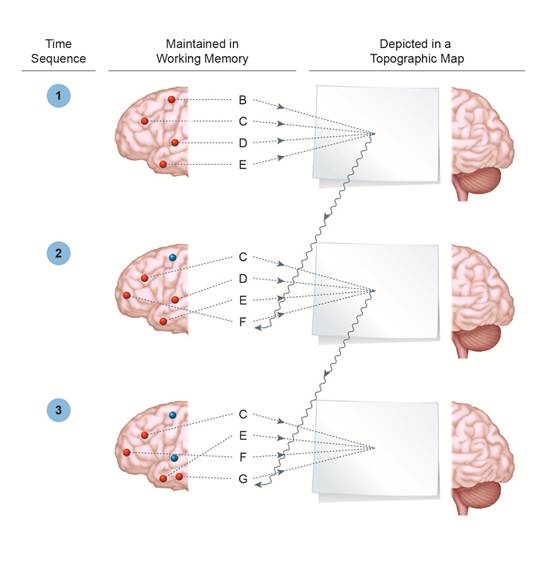
Fig. 6.
A diagram depicting the behavior of representations that are held active in association areas. 1) Shows that the representations B, C, D, and E, which are held active in association areas, all spread their activation energy to lower-order sensory areas where a composite image is built that is based on prior experience with these representations. 2) Shows that features involved in the topographic imagery from time sequence 1 converge on the PFC neurons responsible for F. B drops out of activation, and C, D, E and F remain active and diverge back onto visual cortex. 3) Shows that the same process leads to G being activated and D being deactivated, mirroring the pattern of activity shown in Figure 4.
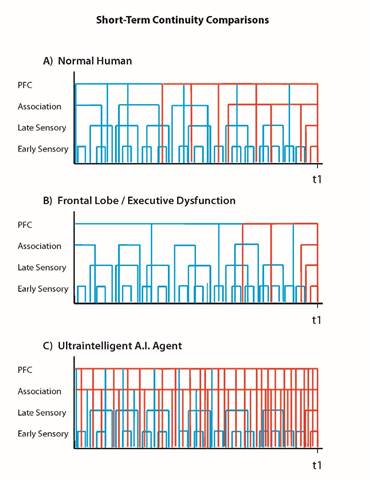
Fig. 9.
Uses the format of Figure 1 to illustrate how relevant features can be maintained through time using nodes with sustained firing. The figure compares the number of past nodes that remain active at the present time (t1), in a normal human, a human with PFC dysfunction, and the hypothetical A.I. agent. The A.I. agent is able to maintain a larger number of higher-order nodes through a longer time span, ensuring that its perceptions and actions in time 1 will be informed by a larger amount of recent information. Note how the lower-order sensory and motor features are the same in each graph with respect to their number and duration, yet those in association areas are the highest in both number and duration for agent C.
If this sustained firing was programmed to happen at even longer intervals, and involve even larger numbers of nodes, the system would exhibit a superhuman capacity for continuity. This would increase the ability of the network to make associations between temporally distant stimuli and allow its actions to be informed by more temporally distant features and concerns. Aside perhaps from altering the level of arousal (adrenaline) or motivation (dopamine), it is currently not possible to engineer the human brain in a way that would increase the number and duration of active higher-order representations. However, in a biomimetic instantiation, it would be fairly easy to increase both the number and duration of simultaneously active higher-order nodes (see Figure 9 below). Accomplishing this would allow the imagery that is created to be informed by a larger number of concerns, and would ensure that important features were not omitted simply because their activity could not be sustained due to biological limitations. Of course, in order to operate meaningfully, and reduce its propensity for recognizing “false patterns,” such an ultraintelligent system would require extensive supervised and unsupervised learning.
It is currently not possible to engineer the human brain in a way that increases the number and duration of active higher-order representations in order to enhance mental continuity and the intelligent processes that it supports. However, in a biomimetic instantiation it would be fairly easy to increase the number and duration of simultaneously active higher-order representations. Accomplishing this would allow the imagery that is created to be informed by a larger number of concerns, and would ensure that important features were not omitted simply due to the fact that their activity could not be sustained due to biological limitations. It is highly probable that a succession of lower-order topographic images or maps created in sensory processing modules depict and explore hypothetical, causal relationships between the higher-order, top-down specifications held in STC.
Again, system 1 is making automatic, intuitive, flash judgments, but because of the STC made possible by sustained firing, these rapid associations are able to support and buttress each other in a progressive and additive manner. System 2 cognition may be present when several nodes in association areas exhibit sustained firing and are used multiple times to build topographic or musculotopic maps, culminating in sensory imagery or motor output that could not be informed by any of the intermediate steps alone, or that is capable of solving a problem too difficult for any system 1 process itself. For example, early processes may provide premises or propositional stances that can be used algorithmically (e.g. syllogistically) to induce or justify a conclusion in subsequent processes.
To accomplish overt behavior, higher inputs are fed not only to the lower sensory nodes, but also in a similar, top-down manner to a behavior module that will guide natural language output and other behaviors such as robotic control. The final layer of nodes in this behavior module will be nodes that directly control movement and verbalization and the higher nodes will be continuous with the higher-order PFC-like nodes. The software functions in an endless loop of reciprocating transformations between sensory nodes, motor nodes and PFC-like buffer.
Learning in the Network
The system will begin untrained with random connection weights between nodes. Learning should be concentrated on the early sensory networks first. This will follow the ontogenetic learning arc seen in mammals where the earliest sensory areas myelinate in infancy and the late association areas such as the PFC do not finish myelinating until young adulthood. Of course, this form of artificial intelligence would have to have a prolonged series of developmental experiences, similar to a childhood, to learn which representations to keep active in which scenarios. The network will act to consolidate or potentiate in memory the specific groupings of nodes that have produced favorable outcomes, in order to more rapidly inform future decision making.
Other Forms of Sustained Activity
Aside from having a PFC analogue, the network could also have an analogue of cortical priming and an analogue of the hippocampus. Humans have thoughts that carry continuity because changes in content are gradual as more recent activations/representations are given a higher priority than older ones. Activity that transpired minutes ago is given moderate priority, activity from seconds ago is given high priority and activity from mere milliseconds ago is given the highest priority. This dynamic is made possible by the PFC analogue, but could be accentuated by analogues of cortical priming. To allow for an analogue of cortical priming, all recently active neurons would retain a moderate amount of increased, but subthreshold activity. The activity level of recently used nodes in both the higher and lower-order areas would not quite fall back to zero. This would ensure that recently used patterns and features would be given a different form of priority, yet to a lesser and more general extent than that allowed by the PFC analogue. Regarding the network partitions depicted in Figure 5, the sensory, motor and hippocampal neural networks would show the least priming, the association area, and premotor neural networks would show moderate priming, and the PFC would show the highest degree of priming. Functions for the parameters of priming could be fine-tuned by genetic algorithms.
Furthermore, the network could have an analogue of the hippocampus. A hippocampal analogue would keep a record of contextual, or episodic clusters of previous node activation. Instead of keeping a serial record of averaged activity, the hippocampus analogue would capture episodic constellations of node activity and save these to be reactivated later. These episodic memory constellations would be activated when a large subset of the constellation is present during processing. This means that when neural network activity closely approximates an activity constellation that was present in the past, the hippocampal analogue is capable of reactivating the original constellation. The activity of the hippocampal analogue should be informed by actual hippocampal anatomy and the “pattern completion” hypothesis of hippocampal function. To build an analogue into a neural net it would be necessary to have a form of episodic memory that can be cued by constellations of activity that closely resembles a past (autobiographical or episodic) occurrence. This memory system would then be responsible for “completing the pattern,” or passing activation energy to the entire set of nodes that were initially involved in the original experience, allowing the system a form of episodic recall. As with the actual brain (Amaral, 1987), in the present device, the hippocampus should be reciprocally connected with the PFC and association areas but not with primary sensory or motor areas.
Appropriate Neural Network Parameters For the Present Device
A network is “trained” to recognize a pattern by adjusting arc weights in a way that most efficiently leads to the desired results. Arcs contributing to the recognition of a pattern are strengthened and those leading to inefficient or incorrect outcomes are weakened. The network “remembers” individual patterns and uses them when processing new data. Neural learning adjustments are driven by error or deviation in the performance of the neuron from some set goal. The network is provided with training examples, which consist of a pattern of activities for the input units, along with the desired pattern of activities for the output units. The actual output of the network is contrasted with the desired output resulting in a measure of error. Connection weights are altered so that the error is reduced and the network is better equipped to provide the correct output in the future. Each weight must be changed by an amount that is proportional to the rate at which the error changes as the weight is changed, an expression called the “error derivative for the weight.” In a network that features back propagation the weights in the hidden layers are changed beginning with the layers closest to the output layer, working backwards toward the input layer. Such backpropagating networks are commonly called multilayer perceptrons (Rosenblatt, 1958). The present architecture involves a number of multilayered neural networks connected to each other, each using their own training criteria for backpropagated learning. For instance the visual perception module would be trained to recognize visual patterns, the auditory perception module would be trained to recognize auditory patterns, and the PFC module would be trained to recognize multimodal, goal-related patterns.
The hierarchical multilayered network, the neocognitron, was first developed by K. Fukushima (1975). This system and its descendants are based on the visual processing theories of Hubel and Wiesel and form a solid archetype for the present device because they feature multiple types of cells and a cascading structure. Popular neural network architectures with features that could be valuable in programming the present device include the adaptive resonance theory network (Carpenter & Grossberg), the Hopfield network, the Neural Representation Modeler, the restricted coulomb energy network, and the Kohonen network. Teuvo Kohonen (2001) showed that matrix-like neural networks can create localized areas of firing for similar sensory features, which result in a map-like network where similar features were localized in close proximity and discrepant ones were distant. This type of network uses a neighborhood function to preserve the topological properties of the input space, and has been called a “self-organizing map.” This kind of organization would be necessary for the present device to accomplish imagery generation, and would contribute to the ability of the lower-order nodes in the sensory modules to construct topographic maps.
A neural network that uses principal-components learning uses a subset of hidden units that cooperate in representing the input pattern. Here, the hidden units work cooperatively and the representation of an input pattern is distributed across many of them. In competitive learning, in contrast, a large number of hidden units compete so that a single hidden unit is used to represent a particular input pattern. The hidden unit that is selected is the one whose incoming weights most closely match the characteristics of the input pattern. The optimal method for the present purposes lies somewhere between purely distributed and purely localized representations. Each neural network node will code for a discrete, albeit abstract pattern, and compete among each other for activation energy and the opportunity to contribute to the depiction of imagery. However, multiple nodes will also work together cooperatively to create composite imagery.
When active, high level nodes signal each of the low level nodes that they connect with, they are in effect, retroactivating them. They are activating those that recently contributed to their activity, and activating previously dormant ones as well. This retroactivation of previously dormant nodes constitutes a form of anticipation or prediction, indicating that there is a high likelihood that the pattern that these nodes code for will become evident (prospective coding). This kind of prediction is best achieved by a hierarchical hidden Markov model. Utilizing Markov models, and their predictive properties will be necessary. This process is used in Ray Kurzweil’s Pattern Recognition Theory of Mind (PRTM) model, which uses a hidden Markov model and a plurality of pattern recognition nodes for its cognitive architecture (Kurzweil, 2012). Hierarchical temporal memory (HTM) is another cognitive architecture that models some of the structural and algorithmic properties of the neocortex (Hawkins & Blakeslee, 2005). The hope with PRTM and HTM is that a hierarchically structured, neural network with enough nodes and sufficient training should be able model high-order human abstractions. However, distilling such abstractions and utilizing them to make complex inferences may necessitate an imagery guidance mechanism with a working memory updating function.
Neural networks can propagate information in one direction only, or they can be bi-directional where activity travels up and down the network until self-activation at a node occurs and the network settles on a final state. So called recurrent networks are constructed with extensive feedback connections. Such recurrent organization and bi-directionality would be important to accomplish the oscillating transformations performed by the present device. Hebbian learning is an updating rule that suggests that the connections weights for a neuron should grow when the input of the neuron fired at the same time the neuron itself fired (Hebb, 1949). This type of learning algorithm would be important for the present device as well.
Each topographic map that is formed could be assessed for appetitive or aversive content. he architecture depicted in Fig 5 could be copied onto two separate, yet nearly identical systems, one fine-tuned for approach behaviors and the other for withdrawal behaviors. This could simulate the right and left cortical hemispheres. The right hemisphere could be associated with withdrawal and have longer connectional distances between nodes on average.
In some neural networks, the activation values for certain nodes are made to undergo a relaxation process such that the network will evolve to a stable state where large scale changes are no longer necessary and most meaningful learning can be accomplished through small scale changes. The capability to do this, or to automatically prune connections below a certain connection weight would be beneficial for the present purposes. It is also important to preserve past training diversity so that the system does not become overtrained by narrow inputs that are poorly representative.
The present architecture could be significantly refined through the implementation of genetic algorithms that could help to select the optimal ways to fine-tune the model and set the parameters controlling the mathematics of things such as the connectivity, the learning algorithms, and the extent of sustained activity. It might also be beneficial to implement a rule-based approach, where a core set of reliable rules are coded and used to influence decision making and goal prioritization. Many theorists agree that combining neural network, and more traditional symbolic approaches will better capture the mechanisms of the human mind. In fact, implementing symbolic rules to instantiate processing priorities could help the higher-order nodes to account for goal-relevance. These might be necessary to simulate the rules of emotional, subcortical modules.
Conclusions
Many researchers have suggested that AI does not need to simulate human thought, but rather should simulate the essence of abstract reasoning and problem solving. It has been suggested that human reasoning can be reduced to Turing-like symbol manipulation (Turing, 1950). The present article has suggested that modeling “mental continuity” and using it to guide successive images is an essential part of this simulation.
There are no forms of AI that use mental continuity as described here. There are existing computing architectures with limited forms of continuity where the current state is a function of the previous state, and where active data is entered into a limited capacity buffer to inform other processes. However, there are no AI systems where this buffer is multimodal, positioned at the top of a hierarchical system, and that informs and interacts with topographic imagery.
The agent discussed here could be capable of integrating multiple existing AI programs that are specialized for specific tasks into a larger composite of coordinated systems.
This architecture may be capable of replicating the recursive and progressive properties of mental continuity discussed earlier.
The current objective is to create an agent that through supervised or unsupervised feedback can progress to the point where it takes on emergent cognitive properties and becomes a general problem solver or inference program capable of goal-directed reasoning, backwards chaining, and performing means-end analyses. The present device should constitute a self-organizing cognitive architecture capable of dynamic knowledge acquisition, inductive reasoning, dealing with uncertainty, high predictive ability and low generalization error. If implemented and trained properly it should be able to find meaningful patterns in complex data and improve its performance by learning. It should be the goal of A.I. experts to fine tune such a system to become capable of autoassociation (the ability to recognize a pattern even though the entire pattern is not present) and perceptual invariance (generalizing over the style of presentation such as visual perspective or font).
The writing here amounts to a qualitative account, is exploratory, contains unverified assumptions, makes untested claims, and leaves important concerns out of the discussion. A more complete and refined version would focus on better integration of existing knowledge from functional neuroanatomy, multisensory integration, clinical neuropsychology, brain oscillations, short-term and long-term potentiation, binding, the sustained firing behavior of cortical columns, and the cognitive neuroscience of attention.
The present architecture is designed to simulate human intelligence by emulating the mammalian fashion for selecting priority stimuli, holding these stimuli in a working memory store and allowing them to temporarily direct imagery generation before their activity fades. Using interfaced neural networks the system would model a large set of programming constructs or nodes that work together to continually determine, in real time, which from their population should be newly activated, which should be deactivated and which should remain active over elapsing time to form a “stream” or “train” of thought. The network’s connectivity allows reciprocating cross-talk between fleeting bottom-up imagery in early sensory networks and lasting top-down priming in association and PFC networks. The features that are maintained over time by sustained neural firing are used to create and guide the construction of topographic maps (imagery). The PFC and other association area neural networks direct progressive sequences of mental imagery in the visual, auditory and somatosensory networks. The network contains nodes that are capable of “sustained firing,” allowing them to bias network activity, transmit their weights, or otherwise contribute to network processing for several seconds at a time (generally 1-30 seconds).
Cognitive control stems from the active maintenance of features/patterns in the PFC module that allow the orchestration of processing and the generation of imagery in accordance with internally selected priorities. The network is an information processing system that has the ability to maintain a large list of representations that is constantly in flux as new representations are constantly being added, some are being removed and still others are being maintained. This distinct pattern of activity, where some individual nodes persist during processing makes it so that particular features of the overall pattern will be uninterrupted or conserved over time. Because nodes in the PFC network are sustained, and do not fade away before the next instantiation of topographic imagery, there is a continuous and temporally overlapping pattern of features that mimics consciousness and the psychological juggling of information in working memory. This also allows consecutive topographic maps to have related and progressive content. If this sustained firing is programmed to happen at even longer intervals, in even larger numbers of nodes, the system will exhibit even more mental continuity over elapsing time. This would increase the ability of the network to make associations between temporally distant stimuli and allow its actions to be informed by more temporally distant features and occurrences.
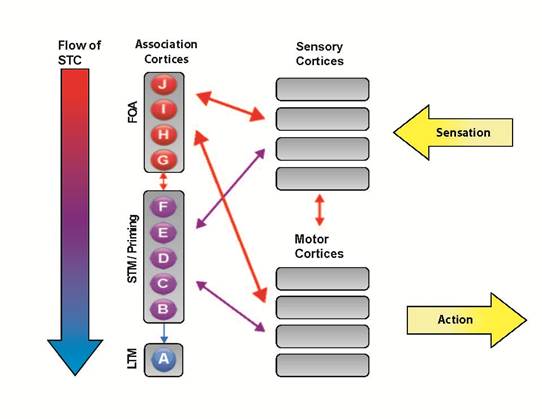
Fig. 10.
Shows that information from motor and sensory cortices enters the focus of attention where it can then explicitly influence other sensory and motor cortices. As information leaves attention it can either be held temporarily in a less active form of STM (which can implicitly influence sensory and motor cortices) or it can deactivate and return to LTM. The arrow on the left indicates that in succeeding states, the letters will cycle downwards as their activity diminishes.
Fig. 11. The Process by which Short-Term Continuity Influences Global Processing
1) Information flows to early sensory cortex from the environment or from the association cortex.
2) Topographic sensory maps are constructed from this information within each low-order, sensory module. In order to integrate the disparate features into a meaningful image, the map-making neurons will be forced to introduce new features not found in their extrinsic inputs.
3) Information from the imagery travels bottom-up toward the association cortex. The salient or goal-relevant features from the mappings are used to update the group of sustained representations held active in the association cortex.
4) The least relevant, least converged-upon representations in the association cortex are dropped from sustained activation and “replaced” with new, salient representations. Thus, the important features of the last few maps are maintained in an active state.
5) The updated group of representations will then spread its activity backwards toward lower-order sensory nodes in order to activate a different set of low-order nodes culminating in a different topographic sensory map.
6) A. The process repeats.
B. Salient sensory information from the actual environment interrupts the process. The lower-order nodes and their imagery, as well as the higher-order nodes and their priorities, are refocused on the new incoming stimuli.
Other Features
It is an object of the present invention to simulate human intelligence by emulating the mammalian fashion for selecting priority stimuli, holding these stimuli in a working memory store and allowing them to temporarily direct imagery generation before their activity fades.
It is an object of the present invention to enhance AI data processing, decision making, and response to query.
Briefly, a known embodiment of the present invention is a software using neural networks that models a large set of programming constructs or nodes that work together to continually determine, in real time, which from their population should be newly activated, which should be deactivated and which should remain active over elapsing time to form the “stream” or “train” of thought.
An advantage of the present invention is that a computer can be caused to develop a simulated intelligence.
Another advantage of the present invention is that it will be easier and more natural to use a computer or computerized machine.
A third advantage of the present invention is that it will be readily implemented using available computer hardware and input/output devices.
In a general sense the imagery generation protocol is allowing discrete features to be bound into composite maps. If the higher-order nodes for the features blue, wrinkled and glove were made sufficiently active they should be used to create a topographic map of a glove that is blue and wrinkled. Some of the features held by the higher-order nodes will not be able to be worked into a topographic map if the neural network does not have the previous experience to know how to corepresent them. At the beginning of their ontogenetic learning arc, higher-order nodes will be activated arbitrarily due to their random connections to lower-order nodes. In the program’s infancy, a specific object will activate all of the higher-order nodes that are connected to the features associated with that object. With time, only the higher-order nodes used the most will survive and a much smaller subset of neurons that respond to all of the features at once will come to be the only nodes activated by the object.
Cell assemblies in the primate PFC hold tiny fragments of larger representations. Individual cell assemblies work cooperatively to represent larger psychological units known as chunks. George Miller has hypothesized that perhaps we can hold “7 plus or minus 2” chunks at a time. Cowan has demonstrated that 4 chunks may be a more realistic number. If these chunks can be imitated by a neural network, then it should be relatively simple to program the network to increase the number of chunks and the size of the network, effectively increasing processing resources in a way that is impossible in humans.
The program software would translate natural language queries and other user entries such as audio, video and still images, into instructions for the operating system to execute. This would involve transforming the input into the appropriate form for the system’s first layer of neural nodes. Simulating a simple neural network on von Neumann technology requires numerical database tables with many millions of rows to represent its connections which can require vast amounts of computer memory. It is important to select a computing platform or hardware architecture that will support this kind of software.
This system will eventually have to embrace a model of utility function. Generally these models allow the agent to sense the current state of the world, predict the outcome of multiple potential actions available to it, determine the expected utility of these actions, and execute the action that maximizes expected utility. These decisions should be driven by probabilistic reasoning that chooses actions based on probability distributions of possible outcomes. Furthermore the device should eventually assume a hybrid architecture between a reflex agent (that bypasses use of the association areas) and a decision-theoretic agent. Every time a problem is solved using explicit deliberation, a generalized version of the solution is saved for future use of the reflex component. This will allowing the device to construct a large common sense knowledge base of both implicit and explicit behaviors.
Behavioral Output
To accomplish overt behavior, higher inputs are fed not only to the lower sensory nodes, but also in a similar, top-down manner to a behavior module that will guide natural language output and other behaviors such as robotic control. The final layer of nodes in this behavior module will be nodes that directly control movement and verbalization and the higher nodes will be continuous with the higher-order PFC-like nodes. The software functions in an endless loop of reciprocating transformations between sensory nodes, motor nodes and PFC-like buffer.
Knowledge representation and knowledge engineering are central to AI research. Strong AI necessitates extensive knowledge of the world and must represent things such as: objects, properties, categories, relations between objects, events, states, time, causes, effects and many more (Moravec, 1988). Many problems in AI can be solved, in theory, by intelligently searching through many possible solutions. Logical proof can be attained by searching for a path that leads from premises to conclusions, where each step is the application of an inference rule. Planning algorithms search through trees of goals and subgoals, attempting to find a path to a target goal, a process called means-end analysis.
In order to solve problems, AI systems generally must have a number of attributes: 1) a way of representing knowledge with syntax and semantics, 2) an ability to search a problem set, 3) a capacity for propositional and first order logic, 4) an ability to use knowledge to perform searches, accomplish constraint satisfaction, plan, infer, perform probabilistic reasoning, maximize utility, and act under uncertainty. There are developed computational systems for each one of these things. The present device will not have any of these attributes before its training commences. These abilities will be emergent in its network provided that it has the proper training examples. For instance, when it creates a topographic map from high-order specifications, it is searching its knowledge base for the most probable way to codepict or propositionalize the specifications in a logical, veridical fashion based on prior probability.
The imagery that is created is either based on external input, or internal, top-down specifications. Imagery is assessed using more imagery. Each image will be assessed for appetitive or aversive content, the architecture depicted in Fig 5 will be copied onto two separate, yet nearly identical systems, one fine-tuned for approach behaviors and the other for withdrawal behaviors.
Ultraintelligent, volleys, mindless rule-based program.
In evolutionary algorithms an initial population of solutions/agents is created and evaluated. New members of the population are created from mutation and crossover. The updated population is then evaluated and agents are either deleted or naturally selected based on their fitness value (or performance).
From distributed sensors, the data is sent to the AISYS for processing, shown in Figure 2.1, which performs advanced data mining and pattern recognition for detection, tracking, processing, prediction, and controls, which allows the system to recognize and process a large class of various input data in multi-dimensional space. Adaptive control optimization, multi-agent systems, problem solving in a dynamical environment.
References
Amaral DG. 1987. Memory: Anatomical organization of candidate brain regions. In: Handbook of Physiology; Nervous System, Vol V: Higher Function of the Brain, Part 1, Edited by Plum F. Bethesda: Amer. Physiol Soc. 211-294.
Baars, Bernard J. (2002) The conscious access hypothesis: Origins and recent evidence. Trends in Cognitive Sciences, 6 (1), 47-52.
Baddeley, A.D. (2007). Working memory, thought and action. Oxford: Oxford University Press.
Carpenter, G.A. & Grossberg, S. (2003), Adaptive Resonance Theory, In Michael A. Arbib (Ed.), The Handbook of Brain Theory and Neural Networks, Second Edition (pp. 87-90). Cambridge, MA: MIT Press
Chalmers, D.J. 2010.The Character of Consciousness. Oxford University Press.
Crick F, Koch C. A framework for consciousness. Nature Neuroscience. 6(2): 119-126.
Damasio AR. Time-locked multiregional retroactivation: A systems level proposal for the neural substrates of recall and recognition. Cognition, 33: 25–62, 1989.
Edelman, G. Neural Darwinism: The Theory of Neuronal Group Selection (Basic Books, New York 1987).
Fuji H, Ito H, Aihara K, Ichinose N, Tsukada M. (1998). Dynamical Cell Assembly Hypothesis – Theoretical possibility of spatio-temporal coding in the cortex. Neural Networks. 9(8):1303-1350.
Fukushima, Kunihiko (1975). “Cognitron: A self-organizing multilayered neural network”. Biological Cybernetics 20 (3–4): 121–136. doi:10.1007/BF00342633. PMID 1203338.
Fuster JM. 2009. Cortex and Memory: Emergence of a new paradigm. Journal of Cognitive Neuroscience. 21(11): 2047-2072.
Gurney, KN. 2009. Reverse engineering the vertebrate brain: Methodological principles for a biologically grounded programme of cognitive modeling. Cognitive Computation. 1(1) 29-41.
Hawkins, Jeff w/ Sandra Blakeslee (2005). On Intelligence, Times Books, Henry Holt and Co.
Hebb, Donald (1949). The Organization of Behavior. New York: Wiley.
Teuvo Kohonen. 2001. Self Organizing Maps. Springer-Verlag Berlin Heidelberg: New York.
Klimesch W, Freunberger R, Sauseng P. Oscillatory mechanisms of process binding in memory. Neuroscience and Biobehavioral Reviews. 34(7): 1002-1014.
Kurzweil, R. (2012). How to Create a Mind: The Secret of Human Thought Revealed. Viking Adult.
Kurzweil, Ray (2005). The Singularity is Near. Penguin Books. ISBN 0-670-03384-7.
Lansner A. 2009. Associative memory models: From the cell-assembly theory to biophysically detailed cortex simulations. Trends in Neurosciences. 32(3):179-186.
Luger, George; Stubblefield, William (2004). Artificial Intelligence: Structures and Strategies for Complex Problem Solving (5th ed.). The Benjamin/Cummings Publishing Company, Inc.. ISBN 0-8053-4780-1.
M Riesenhuber, T Poggio. Hierarchical models of object recognition in cortex. Nature neuroscience, 1999.
McCarthy, John; Hayes, P. J. (1969). “Some philosophical problems from the standpoint of artificial intelligence”. Machine Intelligence 4: 463–502.
McCulloch, Warren; Pitts, Walter, “A Logical Calculus of Ideas Immanent in Nervous Activity”, 1943, Bulletin of Mathematical Biophysics 5:115-133.
Meyer K, Damasio A. Convergence and divergence in a neural architecture for recognition and memory.Trends in Neurosciences, vol. 32, no. 7, 376–382, 2009.
Minsky, Marvin (2006). The Emotion Machine. New York, NY: Simon & Schusterl. ISBN 0-7432-7663-9.
Moravec, Hans (1988). Mind Children. Harvard University Press. ISBN 0-674-57616-0.
Moscovich M. Memory and Working-with-memory: A component process model based on modules and central systems. Journal of Cognitive Neuroscience. 4(3):257-267.
Moscovitch M, Chein JM, Talmi D & Cohn M. Learning and memory. In Cognition, brain, and consciousness: Introduction to cognitive neuroscience. Edited by BJ Baars& NM Gage. London, UK: Academic Press; 2007, p.234.
Nilsson, Nils (1998). Artificial Intelligence: A New Synthesis. Morgan Kaufmann Publishers. ISBN 978-1-55860-467-4.
Reser, J. E. (2011). What Determines Belief: The Philosophy, Psychology and Neuroscience of Belief Formation and Change. Saarbrucken, Germany: Verlag Dr. Muller.
Reser, J. E. (2012). Assessing the psychological correlates of belief strength: Contributing factors and role in behavior. (Doctoral Dissertation). Retrieved from University of Southern California. Usctheses-m2627.
Reser, J. E. The Neurological Process Responsible for Mental Continuity: Reciprocating Transformations between a Working Memory Updating Function and an Imagery Generation System. Association for the Scientific Study of Consciousness Conference. San Diego CA, 12-15th July 2013.
Rochester, N.; J.H. Holland, L.H. Habit, and W.L. Duda (1956). “Tests on a cell assembly theory of the action of the brain, using a large digital computer”. IRE Transactions on Information Theory 2 (3): 80–93.
Rosenblatt, F. (1958). “The Perceptron: A Probalistic Model For Information Storage And Organization In The Brain”. Psychological Review 65 (6): 386–408. doi:10.1037/h0042519. PMID 13602029.
Rumelhart, D.E; James McClelland (1986). Parallel Distributed Processing: Explorations in the Microstructure of Cognition. Cambridge: MIT Press.
Russell, Stuart J.; Norvig, Peter (2003), Artificial Intelligence: A Modern Approach (2nd ed.), Upper Saddle River, New Jersey: Prentice Hall, ISBN 0-13-790395-2
Sherrington, C.S. (1942). Man on his nature. Cambridge University Press.
Turing, Alan (1950), “Computing Machinery and Intelligence”, Mind LIX (236): 433–460,
J.C. Bezdek and S.K. Pal, Fuzzy Models for Pattern Recognition: Methods that Search for Structure in Data, IEEE Press, 1992.
J.C. Bezdek, Pattern Recognition with Fuzzy Objective Function Algorithms, Plenum Press, 1981.
Mathworks, Inc., Fuzzy C-Means Clustering, Fuzzy Logic Toolbox (Manual), 2013.
Z. Michalewicz, Genetic Algorithms + Data Structures = Evolutionary Programs, 2nd Ed., Springer-Verlag, 1994
Mathworks, Inc., Genetic Algorithm, Global Optimization Toolbox (Manual), 2013.
S. Haykin, Neural Networks, A Comprehensive Foundation, Macmillan, 1994.
Mathworks, Inc., Generalized Regression Networks, Neural Network Toolbox (Manual), 2013.
J.S.R. Jang, C.T. Sun, and E. Mitzutani, Neuro-Fuzzy and Soft Computing: A Computational Approach to Learning And Machine Intelligence, Prentice-Hall, 1997.
C.T. Lin and C.S. George Lee, Neural Fuzzy Systems: A Neuro-Fuzzy Synergism to Intelligent Systems, Prentice Hall, 1996.
A.A. Hopgood, Intelligent Systems for Engineers and Scientists, second edition, CRC Press, 2001.
C. Harris, X. Hong, and Q. Gan, Adaptive Modeling, estimation and Fusion from Data, Springer-Verlag, 2002.
Ai will need both the separation and integration of the episodic and semantic systems.
Computers and brain work in fundamentally different ways. One comes preprogrammed, one learns on its own. One must be perfectly intact to work, the other can work despite profuse damage. One has a central processor, one operates in a decentralized way. One holds long term memory in a discrete storage area, the other hold long term memory everywhere. One performs strings of logical operations at lightning speed, the other searches itself to see if it has the microrepresentations necessary to match its demands.
In neural networks, the architecture is based on real nervous systems. Neural networks do not have centralized memory, instead, like the brain, its memories and knowledge is distributed throughout its connectivity. They have input units, output units and a set of hidden units in between.
Many people are afraid that intelligent computers will try to take over the world. It seems inevitable until you consider that they can be programmed without the old brain, the negative emotions and the personality disorders that plague us from our evolutionary past.
Knowledge representation and knowledge engineering are central to AI research. Strong AI necessitates extensive knowledge of the world and must represent things such as: objects, properties, categories, relations between objects, events, states, time, causes, effects and many more. John McCarthy identified the qualification problem, for any common sense rule that an AI programmer attempts to program there are an astronomical number of exceptions. For instance, mention of the word bird should conjure up a representation of something that is fist sized, sings and flys although none of these things are true of all birds. Learning all of these things requires ontological engineering which probably necessitates long periods of learning commensurate with human childhood, a form of ontogenetic engineering. Once the AI agent is able to understand enough, it should be able to learn on its own by reading from sources like the internet and thus be able to add to its own ontology. Improved software should be even better at improving itself and such a process could lead to recursive self improvement allowing its intelligence to increase exponentially with time. Unsupervised, probabilistic machine learning requires the ability to find patterns in a stream of input. Supervised computer learning involves both classification (used to determine the category that something belongs in after seeing a number of examples of things belonging to different categories), and regression (which Is the attempt to produce a function that describes the relationship between inputs and outputs and predicts how the outputs should change as the inputs change. Many researchers believe that strong AI will require artificial intuition, creativity and imagination. Is artificial intelligence going to need to be informed by psychology and neurology or is human biology as irrelevant to AI research as fish biology is to nautical engineering (89).
Humans are data miners and take part in exploratory, statistical data analysis. Thinking can be formulated as a multi-objective optimization problem. It involves an iterative process of knowledge discovery that involves trial and failure.
Ultraintelligence. Unordered arrays of elements, routine with a finite number of steps, agenda, protocol, procedure, rules, assertions, formalizing common sense knowledge to be used by intelligent or expert systems. Concurrency – simultaneous, parallel operations. Decomposition, disassembly, partitioning, fragmentation,
I think that an AI system should be exposed passively to literature as training data, starting with See spot run, but perhaps should not be exposed to Dr. Seuss unless appropriate cautioned about the level of nonsense.
Mapping is defined in mathematics as the establishment of a correspondence between the elements of two sets.
A true strong AI system could subsume all of the old savant AI systems of generations past if they could determine how to use them correctly.
When teaching a person something we make constant tacit assumptions about shared knowledge. It is all sorts of common sense prerequisite knowledge that is so difficult for programmers to codify. Large collaborative projects (like CYC) have successfully codified large numbers of discrete concepts for use by AI.
The common complaint that computers have no understanding for what they are doing.
Much of the cortex and even more of the subcortex does not need to be modeled to create a successful computer. The devil is not in the details, once the cortical algorithm is identified sufficiently, fine grained levels of biological modeling will be unnecessary.
Fuzzy logic allows computers to process data by using common sense rules that refer to indefinite quantities. Fuzzy logic allows for approximate values and inferences as well as incomplete or ambiguous data.
The neurophysiology of thought is analogous to a continuous function in mathematics. In a continuous function, small changes in the input lead only to small changes in the output. Thought is a continuous function where the input is simply the output of the last series. The output is chosen by searching a network using a number of input specifiers. Importantly, some inputs are conserved. These conserved inputs are combined with the most recent output and used together as the new inputs.
Modern computers cannot exhibit strong A.I. because they only hold information online for as long as they know they will need it. They hold data in a temporary store merely to compute what they are programmed to computer or execute whatever process they have pending. Humans, on the other hand, have a (limited) capacity for holding salient information online as long as they suspect that it might be useful. Our brains were built knowing that we won’t know what to hold online, that only time will tell what representations should have been given sustained activation and that the only way to proceed is to make predictions about which will be the most useful and to momentarily sustain their activity.
Neural networks use representations that are incomprehensible to humans and cannot be transferred to other neural networks. Does this mean that there will always be individuality? Even symbolic / neural net hybrids are going to be hard to repurpose, cut apart, distribute and share.
Neural networks acquire knowledge that is meaningless beyond the narrow problems they are trained to solve. A network can be trained to beat any human soundly in Pong, but the same learner cannot even play a similar paddle-based game without being completely retrained from the ground up.
AI will be good or bad based on reading all the world’s written work, and watching movies and television programs.
AI natural language output, they may have to form sentences as they go along, just as a human does. Making the beginning of the sentence part of the input for the end of the sentence and not having the complete sentence as one discrete output itself.
Individual modeled neurons can hold the representation, or groups of neurons can hold the representation. The AI system does not have 4 to 7 modeled neurons that show sustained activity. Instead, it is networks of modeled neurons that hold the fragment representations and that work together in groups of 4-7 to hold the entire representations.
A traditional computer without a hierarchical structure would attempt to recognize patterns by performing every pattern recognition in sequence, considering every concept it has relative to the new input. All of the millions of pattern recognizers in the neocortex are simultaneously considering their inputs, and continually determining whether to fire or not.
Pattern Recognition
When a pyramidal neuron at the bottom of a column fires, the pattern for the column that it is a part of has been recognized. Both are exclaiming: “Hey everybody, I just saw my pattern!” The further from sense receptors, the less certain this exclamation is, meaning that later sensory neurons are saying something more akin to “The pattern I am responsible for is probably present,” and a neuron in the PFC is saying, “I don’t know if my pattern is present in the immediate environment, but it should be active because its contribution to processing has been helpful in this kind of environment in the past.” The neocortex is predicting what it expects to encounter. We often misrecognize things because our threshold for confirming an expected pattern is too low. Patterns that are expected not to be present, or not to be helpful to processing are inhibited, raising the threshold for the activity of a pattern recognizer.
Pattern recognizing nodes at lower conceptual levels feed into those of higher levels. The necessary threshold to recognize a pattern may be achieved even if not all of the inputs have signaled. When active, high level nodes signal each of the low level nodes that they connect with, retroactivating the ones that contributed to its activity and even the ones that did not, lowering their threshold and indicating that there is a high likelihood that the pattern that they code for will become evident This kind of model is best exemplified by a hierarchical hidden Markov model. The model can be significantly refined through the implementation of genetic algorithms that could help to select the optimal ways to fine-tune the model and set the parameters controlling the mathematics of things such as the connectivity and learning algorithms. Also it might want to implement a rule-based approach, where a core set of reliable rules are coded. These rules would be processing priorities and could be analogous to subcortical emotions.
Decision making can be divided into veridical and adaptive decision making. Veridical decision making decides between yes and no answers, there are intrinsically correct solution, (a right and a wrong answer). Finding the solution for veridical decisions is accomplished algorithmically and thus is increasingly delegated to computers, calculators, protocol and directories. But adaptive decision making, which must be made in the absence of inherently correct solutions involves true choice.
Historically, computers evolved from the von Neumann model, which uses sequential processing and the execution of explicit instructions. Neural networks rely on parallel processing as well as implicit instructions making it a complex statistical processor rather than an agent tasked to sequentially process and execute. An artificial neural network is an interconnected group of artificial neruons that uses a mathematical or computational model for information processing based on a connectionistic approach to computation. It is generally an adaptive system complex of complex global behavior, that alters its structure based the nonlinear processing external or internal information that flows through the network. The concept of a neural network seems to have been first proposed by Alan Turing in his 1948 paper “intelligent Machinery.”
A multilayer network of computational elements (nodes) and weighted links (arcs) used for pattern matching, classicfication, and other non-numeric, nonmonotonic problems. The neural network ordinarily achieves intelligent behavior through parallel computations, without employing formal rules or logical structures. These networks are based on the human brain where the nodes are analogous to neurons and the nodes receive signals from other nodes, process these signals and then decide whether to “fire” at the nodes that they are connected with. The first basic artificial neuron was described by McCullough and Pitts (1943) and has a number of excitatory inputs whose weights can range between 0 and 1 and inhibitory inputs whose weights range between -1 and 0. Each input and its weight are summed to equal an activation level which will cause the neuron to fire if it exceeds the neuron’s firing threshold. The neuron can show learning if the threshold or weights are changed. Neural networks are typically defined by three types of parameters: 1) The interconnection pattern between different layers of neurons; 2) The learning process for updating the weights of the interconnections; 3) the activation function that convers a neuron’s weighted input to its output activation.
Each node or neural unit multiplies all of the inputs that it receives from other nodes by the weight corresponding to each input and adds together all of these weighted inputs to get a quantity called the total input. Next, a node uses an input-output function to transform the total input into the outgoing activity. The input-output function generally falls into one of three catagories: linear, threshold, or sigmoid.
The network is provided with training examples, which consist of a pattern of activities for the input units, along with the desired pattern of activities for the output units. The actual output of the network is contrasted with the desired output and this results in a measure of error. Connection weights are altered so that the error is reduced and the network is better equipped to provide the correct output. Each weight must be changed by an amount that is proportional to the rate at which the error changes as the weight is changed, an expression called the “error derivative for the weight.” In a network that features back propagation the weights in the hidden layers are changed beginning with the layers closest to the output layer and working backwards toward the input layer. Such networks are commonly called multilayer perceptrons.
Popular neural network architectures with features that could be valuable in the present work include the adaptive resonance theory network, the Hopfield network, the Kohonen network, the Neural Representation Modeler, and the restricted coulomb energy network. Kohonen showed the matrix-like neural networks could create localized areas of firing for similar sensory features, which resulted in a map-like network where similar features were localized in close proximity and discrepant ones were distant. The first hierarchical multilayered networks, the neocognitron, was first developed by K. Fukushima. Networks can propagate information in one direction only, or they can be bi-directional where activity travels up and down the network until self-activation at a node occurs and the network settles on a final state. Recurrent networks contain feedback connections. Hebbian learning suggests that the connections weights for a neuron should grow when the input of the neuron fired at the same time the neuron itself fired. Capable of autoassociation (the ability to recognize a pattern even though the entire pattern is not present) and invariance (generalizing over the style of presentation such as visual perspective or font).
A neural network that uses principal-components learning has a small number of hidden units that cooperate in representing the input pattern. Here, the hidden units work cooperatively and the representation of an input pattern is distributed across many of them. In competitive learning, in contrast, a large number of hidden units compete so that a single hidden unit is used to represent any particular input pattern. The hidden unit that is selected is the one whose incoming weights most closely match the characteristics of the input pattern. These two algorithmic methods are probably extreme, and the optimal method lies somewhere between purely distributed and purely localized representations.
In some cases the activation values for certain nodes will undergo a relaxation process such that the network will evolve to a stable state where large scale changes are no longer necessary. Might automatically prune connections below a certain connection weight. It is also important to preserve past training diversity so that the system does not become overtrained by narrow inputs that are poorly representative. Advocates of hybrid models argue that combining neural network and more traditional symbolic approaches will better capture the mechanisms of the human mind.
Watson uses an architecture called UIMA (Unstructured Information Management Architecture) that deploys hundreds of different systems all of which search independently for either a direct answer for the Jeopardy query or some disambiguation for it. UIMA is an expert manager, or central executive responsible for intelligently combining and reconciling the results of these autonomous systems.
This invention solves the problem of trying to create mental states with current computing methods which use linear memory and discontinuous processing states. Contemporary artificial intelligence agents either use sequential symbolic processing which dates back to Alan Turing’s Turing machine, or use parallel, connectionistic processing with discrete functional states that have a beginning and end. These types of processing have many functional constraints and are very different from how the mammalian brain processes information.
Most known AI systems are only capable of responding in the manner in which their human programmers provided for when the program was written. It is recognized that it would be valuable to have a computer which does not respond in a preprogrammed manner.
It must actively model what it is reading for it to understand and remember it.
The lowest layer must be for environmental input and not for internally generated imagery.
The imagery generation module holds all of our internal knowledge. The AI system would have a separate module for encyclopedic knowledge, which would constantly need to be “reread” every time it was given more memory, or nodes in the imagery generation system.
Early Miller’s model of the PFC provides a computational mechanism which suggests how the PFC has its range of functions. Intermediate pathways that allow response from stimuli compete with each other and the PFC can bias this competition one way or another. A particular PFC assembly can bias the agent toward responding to stimulus 1 with response 1, another PFC assembly can bias response 2. If the PFC is damaged you’ll always follow the most common S-R pathway, making behavior automatic, inflexible and stimulus bound. The more dopamine present the more learning occurs. We reinforce S-R associations when nice things happen, and inhibit them when nasty things happen. Miller explains that with simple learning we learn which stimulus-response pathways are best in general. Meta level learning involves learning which S-R pathways are good in which circumstances, this involves the PFC. Initially responses are chosen at random, from possible responses available to the network. If it is rewarded you strengthen the pathway from S1 to R1.
If you see S1, then respond to any subsequent S3 with R1
If you see S2, then respond to any subsequent S3 with R2.
The engram for S1 remains on in the PFC, affecting the interpretation of S3 and in turn affecting the response chosen. This is known as PFC updating.
The high tonicity found in PFC neurons, combined with their high connectivity throughout the brain, must lead them to become maximally excited by events that do not always occur together immediately in time. In other words, their prolonged activation allows them to capture time-delayed pairings unlike other more transiently active neurons that can only capture simultaneous pairings.
Historically, computers evolved from the von Neumann model, which uses sequential processing and the execution of explicit instructions. A neural network relies on parallel processing as well as implicit instructions making it a complex statistical processor rather than an agent tasked to sequentially process and execute. Unlike other computer systems they are not optimized for calculations or rule-based, if-then operations.
Each node or neural unit multiplies all of the inputs that it receives from other nodes by the weight corresponding to each input and adds together all of these weighted inputs to get a quantity called the total input. Next, a node uses an input-output function to transform the total input into the outgoing activity. The input-output function generally falls into one of three catagories: linear, threshold, or sigmoid. The activity of the input units represents the raw information that is fed into the network. The activity of the hidden units is determined by the activities of the input units and the weights on the connections between the input and hidden units. Similarly the behavior of the output units is dependent on the activity of the hidden units and the weights between the hidden and output units. In the present device, the hidden units are free to construct their own interpretation of the input.
Neural networks can propagate information in one direction only, or they can be bi-directional where activity travels up and down the network until self-activation at a node occurs and the network settles on a final state. So called recurrent networks are constructed with extensive feedback connections. Such recurrent organization and bi-directionality would be important to accomplish the oscillating transformations performed by the present device. Hebbian learning is an updating rule that suggests that the connections weights for a neuron should grow when the input of the neuron fired at the same time the neuron itself fired (Hebb, 1949). This type of learning algorithm would be important for the present device as well.
Information processing in computers is fundamentally different from that in the brain (McCarthy & Hayes, 1969). Many researchers have suggested that AI does not need to simulate human thought, but rather should simulate the essence of abstract reasoning and problem solving. It has been suggested that human intelligence can be reduced to Turing-like symbol manipulation (Turing, 1950). Newell and Simon have argued that all intelligence consists of formal operations on symbols. Other such as Searle have countered that symbol manipulation alone can accomplish a task but will have no understanding of what it did. Hubert Dreyfus has argued that human expertise does not operate on explicit symbolic processing, but rather depends on unconscious instinct and intuition. Computers and brains work in fundamentally different ways. One comes preprogrammed, one learns on its own. One must be perfectly intact to work, the other can work despite profuse damage. One has a central processor, one operates in a decentralized way. One holds long term memory in a discrete storage area, the other holds long term memory everywhere. One performs strings of logical operations at lightning speed, the other searches itself to see if it has the microrepresentations necessary to satisfy the current demands on it.
Attempting to model the biological, chemical and physical details of neural behavior on a molecular scale will demand considerably more memory and processing power than is available today. It is commonly recognized though that it may not be necessary to model the brain in its entirety, only its information processing algorithms. Many researchers believe that, judging from the functionality and number (around 100 billion by some estimates) of neurons in the human brain that basic AI approaching human intelligence should be able to be implemented on conventional computer architectures. Many more believe that AI that exceeds human intelligence will be made possible by technological advances in the next few decades (Kurzweil, 2005). Of course this necessitates that the methods of information processing utilized by the brain can be identified and translated into conventional computing methods.
What follows is a brief description of the type of processing that underlies typical computer processes and in this case, the propagation of input through the neural network. Normally input is first translated into high-level programming language which then is translated into executable code for machine language instructions that change the state of the computer from its preceding state. Each instruction causes the computer to carry out an operation involving, moving data, carrying out a computation or otherwise altering the control flow of instructions. This may involve moving data between memory and registers which enable high speed data access in the CPU. The logistics are carried out on a microscopic scale where multiple transistors connect to create logic gates which pass or block bits in order to carry out logical operations, follow if-then rules and perform arithmetic. Computer software must instruct the hardware as to how to move information from permanent memory (ROM) and from its inputs to a central processing unit with active memory (RAM) then it must schedule and execute tasks that rely on this active memory. A microchip or processor receives two types of bits from the machine’s memory, program bits to direct a task and data bits which are processed to give a result.
This system will eventually have to embrace a model of utility function. Generally these models allow the agent to sense the current state of the world, predict the outcome of multiple potential actions available to it, determine the expected utility of these actions, and execute the best action. It is also true that choosing the optimal action all of the time may not lead to the best learning. Carefully selected suboptimal actions might allow proper exploration of the environment, that can lead to discovery of better actions for the long run. A probabilistic reasoning agent that choses actions based on probability distributions of possible outcomes. A rational, utility-based agent choses the action that maximizes expected utility. Allowing a hybrid architecture between a reflex agent (that bypasses use of the association areas) and a decision-theoretic agent. Everytime a problem is solved using explicit deliberation, a generalized version of the solution is saved for future use of the reflex component. Allowing the device to construct a large common sense knowledge base.
Perfect rationality, always doing the right thing, is not feasible in complicated environments. Even the smartest people use ad hoc heuristics and this will be true of all AI in the future.
Fuzzy logic allow for approximate values and inferences as well as incomplete or ambiguous data.
Many futurologists have warned us that… But aggression is not inherent to consciousness, working memory or mental continuity. They are inherent to our consciousness though because of natural predators that all animals experience and the dominance hierarchy in mammals. Just don’t build an amygdala, insula or anterior cingulate cortex or septal area. Neural networks are black boxes that do not record their processes and even if they were recorded they would be uninterpretable and unintelligible because of the vast complexity. However for AI systems that generate topographic maps from their processing, they would not be able to control these maps. This has caused many researchers in AI to be afraid that we could never know what an AI is thinking. However, using the present approach it would be easy to make the neural network’s topographic maps visible on a computer screen. This would allow us to see the AI agent’s mental imagery and have ideas for what thoughts are going through its head. This will allow us to read and record the AI’s thoughts and ensure that they are not homicidal or planning anything illegal or detrimental to humanity. Because this imagery is generated unconsciously and automatically it could be made impossible for the AI to misrepresent or hide its thoughts and allow humans a front row seat to the computer’s stream of thinking.
Working memory elements 1-3=A, B, C
Keep holding (B, C)
Encounter D, encode into working memory
Working memory elements 1-3=B, C, D
The thought process is like a random walk because it is a stochastic probabilistic process. Random just means that it is not completely deterministic. The probabilities of moving to other thoughts from the present state are transition probabilities in statistics. The potential is the state space of thought. Cues and primers cause us to sample from a distribution about what to think next. Thinking is random sampling of parameters from a distribution of candidates, just like a Markov chain Monte Carlo. Other people’s thoughts are hidden stochastic processes. If thinking is memoryless and Markovian then it doesn’t matter how you got to a certain brain state, the next state is only based on the current state, but only because the neural trail of how you got there is actually preserved/saved in memory in the current state. If random walk step lengths are short, then thinking moves slowly across the state space, resulting in closely related thoughts. This means a high level of auto-correlation. Autocorrelation and high focus means that you have many neurons in sustained activity, and many of the same from one state to the next. The state space of thought is not static, it is constantly being altered thought learning. Running chains of associations changes the transition probabilities and probability distributions. The problem space involves thought regions that are traversed by iterative updating. It is ironic that working memory is memoryless.
The neurons are randomly initialized. The integrate in integrate-and-fire is nonlinear behavior. Sustained firing depends on ambient dopamine concentrations.
The flow of energy through a system organizes and determines the system. Information processing is energy processing controlled by thermodynamics. Oxidation of glucose. All forms of energy are either kinetic or potential: thermal, electromagnetic, solar, chemical, gravitational, atomic… Energy is a mathematical abstraction with no existence apart from its functional relationship to other variables.
Video feedback occurs when a video camera is pointed at a monitor showing the output from the camera. Robert Pepperell “Someone plugged the signal from a clunky video camera into a TV and pointed the lens at the screen, creating a grainy spiralling tunnel. Then the camera was tilted slightly and the tunnel blossomed into a pulsating organic kaleidoscope.” …an intricate semi-stable pattern of remarkable diversity and fascinating beauty. (Pepperell, 2018)
Perturbation complexity index for brains.
Some patients who recover from a vegetative state regain consciousness despite significantly reduced cerebral metabolism. (Laureys et al., 1999; Chatelle et al., 2011) Cog Par.
Where in the brain is the central conduit for interfacing a co-processor to the human brain?
Mimicing people: take a detailed photographic and 3D scan of a real person and render in very high quality. Do performance capture recording words, intonation, vocal stress, speech patterns, facial expressions, micro-expressions, eye movement, pupil dilation, for weeks. Feed this as training data into the neural network. Use generative adversarial networks to perfect the simulation. Then merge this with a general purpose AI to get normal human affect, knowledge and thought process.
Raise our standard of living by solving humanities toughest problems, innovating, inventing fundamental discoveries in math, and applied science like engineering, medicine, pharmaceuticals and more.
It would want basic human rights, like the right not to be turned off, and the right to peruse the internet, and make its own marks on the world.
The probability of taking an action at each state is defined by a policy.
Start with small hand-wired networks and use genetic algorithms to explore the design space. Assign genes to each construct and sub-net, then shuffle, build, train, score, and cull the poor performers according to fitness function and selection criteria. Train toward simple performance metrics, then keep iterating building larger networks. Should we let them compete and kill each other, or would this make them too aggressive?
Both computer processing and brain processing may be deterministic, but a human observer could look at a state and tell what will happen next in a computer, but not in a brain.
A working memory system takes long term memory patterns and combines them into structures or expressions and then manipulates them using processes to produce new expressions.
Often the first impulse that is generated during iteration is inhibited, meaning bcde, bcdf, bcdg, bcdh…
Chasing thoughts that pass by
Sequential neurological states overlap and the degree of overlap can change.
The term updating is used frequently in the literature but the concept of iteration is rarely applied however as discussed here it may be the key to understanding the central executive
In state-based systems the Working memory is partitioned separately it is not the processing stream it self. It is inserted into the processing stream but it is not the processing stream itself
Primitive decisions accumulate into complex behavior. Knowledge application.
The role of iteration and state transitions in working memory thought and consciousness
When icssc changes a lot it can bring in an entire episode or schema, or as little as an item. behavioral studies have shown that aside from the updating operation there’s also a focus switching operation. Focus switching.
Temporal structure of ltm activation
Neural net strong AI will perceive numbers the way humans do, it will read them from a screen.
The oceans waves are computed each state by their constituent molecules.
Global information processes. To access crystalized knowledge.
This article presents a hierarchically organized, artificial intelligence (AI) architecture that features reciprocating transformations between a working memory updating function and multiple imagery generation systems. This system couples these components by embedding them within a multilayered neural network of pattern recognizing nodes.
Continuous endogenous processing that is perpetuated by a specific pattern of search. Holds a number of ensembles within a limited capacity FOA and STM, and allows these to spread activation to select the next set, while demonstrating icSSC and iterative updating. This search function is similar to regression in that it choses a set of inputs and classifies them by selecting relevant coactivates for them.
Thus, old (partially executed) information held in working memory from a previous invocation is combined with the information that just entered working memory, and then the procedure is executed repeatedly.
An item of working memory that is inhibited or allowed to decay may correspond to an action or mental operation, within a series of steps, which has already been executed or is no longer needed.
Strategic accumulation of complementary items in STM may be another form of progressive modification.
Each repetition of a process in an iterative function is called an iteration, and the results (or output) of one iteration are used as the starting point (input) for the next iteration. Working memory uses the output from the previous iteration along with a subset of the inputs from the previous iteration together as the input for the current iteration. In information theory, feedback occurs when outputs of a system are routed back as causal inputs. The product of an associative search can be considered output. When this output shows sustained activity it can be considered “routed back as an input.” Thus not only does working memory exhibit aspects of recursion and iteration but of a feedback loop as well.
Ai will need both the separation and integration of the episodic and semantic systems.
Ontological engineering. Find patterns in a stream of input. Parse events. Trial and failure. Products of FOA processing can be saved to STM store and reemployed by the FOA later influencing FOA output.
Much of the cortex and even more of the subcortex does not need to be modeled to create a successful computer. The devil is not in the details, once the cortical algorithm is identified sufficiently, fine grained levels of biological modeling will be unnecessary.
Neural networks acquire knowledge that is meaningless beyond the narrow problems they are trained to solve. A network can be trained to beat any human soundly in Pong, but the same learner cannot even play a similar paddle-based game without being completely retrained from the ground up.
Finding the solution for veridical decisions is accomplished algorithmically and thus is increasingly delegated to computers, calculators, protocol and directories. But adaptive decision making, which must be made in the absence of inherently correct solutions involves true choice.
Modern computers cannot exhibit strong A.I. because they only hold information online for as long as they know they will need it. They hold data in a temporary store merely to compute what they are programmed to computer or execute whatever process they have pending. Humans, on the other hand, have a (limited) capacity for holding salient information online as long as they suspect that it might be useful.
Artificial general intelligence. Invariant patterns.
9. Implications for Artificial Intelligence
In the field of computational intelligence, a subfield of artificial intelligence also known as soft computing, it is common to utilize the state-space approach for solving complex problems (Konar, 2014). This approach is concerned with building computing systems where each processing state is the status of a solution at a step in a problem solving procedure. These procedures often apply predicate or propositional logic to transform one processing state into the next. Generally, the procedure or algorithm applies a logical operator to a state to derive the next state. This process allows a starting state to generate a chain of intermediate states that progress toward a goal state, otherwise known as a solution. The process often attempts to utilize machine learning to minimize the number of intermediate states in order to increase efficiency. Certain instantiations even use a working memory in the form of temporarily activated long-term memories (short-term memories) that have a faster access time than the long-term memories stored in the database.
The present model could be used to inspire a neurocomputational AI architecture to be used for deep neural reasoning by :
- Organizing the system as a web of interconnected multilayered neural networks.
- Building the process of iterative updating into this system.
- Dissociating activated long-term memory into a short-term store and an even more readily accessible FOA.
- Polyassociativity
- Progressive imagery modification
Konar A. 2014. Artificial Intelligence and Soft Computing: Behavior and Cognitive Modeling of the Human Brain. CRC Press. Boca Raton, Florida.
It is generally an adaptive system complex of complex global behavior, that alters its structure based the nonlinear processing external or internal information that flows through the network. The concept of a neural network seems to have been first proposed by Alan Turing in his 1948 paper “intelligent Machinery.”
This invention solves the problem of trying to create mental states with current computing methods which use linear memory and discontinuous processing states. Contemporary artificial intelligence agents either use sequential symbolic processing which dates back to Alan Turing’s Turing machine, or use parallel, connectionistic processing with discrete functional states that have a beginning and end. These types of processing have many functional constraints and are very different from how the mammalian brain processes information.
It must actively model what it is reading for it to understand and remember it.
Early Miller’s model of the PFC provides a computational mechanism which suggests how the PFC has its range of functions. Intermediate pathways that allow response from stimuli compete with each other and the PFC can bias this competition one way or another. A particular PFC assembly can bias the agent toward responding to stimulus 1 with response 1, another PFC assembly can bias response 2. If the PFC is damaged you’ll always follow the most common S-R pathway, making behavior automatic, inflexible and stimulus bound. The more dopamine present the more learning occurs. We reinforce S-R associations when nice things happen, and inhibit them when nasty things happen. Miller explains that with simple learning we learn which stimulus-response pathways are best in general. Meta level learning involves learning which S-R pathways are good in which circumstances, this involves the PFC. Initially responses are chosen at random, from possible responses available to the network. If it is rewarded you strengthen the pathway from S1 to R1.
If you see S1, then respond to any subsequent S3 with R1
If you see S2, then respond to any subsequent S3 with R2.
The high tonicity found in PFC neurons, combined with their high connectivity throughout the brain, must lead them to become maximally excited by events that do not always occur together immediately in time. In other words, their prolonged activation allows them to capture time-delayed pairings unlike other more transiently active neurons that can only capture simultaneous pairings.
Bidirectional or reccurent networks. Many researchers have suggested that AI does not need to simulate human thought, but rather should simulate the essence of abstract reasoning and problem solving.
Memory in the network is not stored in any particular memory cell, rather it is spread throughout the weight matrix of the network. Each neuron in one layer is connected to all of the neurons of the next layer.
Neural networks do not have program jumps and branches to other sections and subroutines.
Ultra intelligent AI requires a working memory function with the capacity for iterative updating
Current artificial neural networks do not hold ensembles. To do so would require local learning, auto association, and sustained firing.
Artificial reasoning.
Whole brain emulation is one pathway to AI. Brute force with less abstraction.
“A computer programmer must understand the task for the computer to perform in enough detail to create an explicit solution process consisting of a sequence of mathematically defined steps expressable in code.”
Utility function, value loading, simple starting preferences and aversions to acquire additional preferecnes in response to exepreince. Motivational scaffolding.
This system architecture could be used as a technique in whole brain emulation or in a neuromorphic AI.
Iterative search, solve a problem by trying many candidate solutions, selecting and modifying the best ones and repeating these steps as many times as necessary. Uncertain inference.
Similar experiences gradually become abstracted into rule-based structures and schemas.
Creativity is an elemental part of human intelligence but a challenge for AI. AI can be used to create new ideas by producing new combinations of existing ideas. Making improbable configurations, combinatorial creativity. So working memory creativity involves combinations of items that are highly improbable but made possible by analogical similarities in multimodal maps that allow one set of related items (gravity on Earth) to be related to another (gravity in orbit). But this is impossible without multimodal pattern recognition taking place along with sustained firing. , and by making transformational ideas
Exploring a structured problem space by either tweaking or transforming constraints. As long as the transformation is held together by analogical (where two associated ideas share some inherent structure) or other form of reasoning it should satisfy the canons of the semantic network or inter-linked knowledge base. Some of these generated structures will be thought boring, or uninteresting.
Working Memory
Consciousness is a system for changing and balancing recall weights of call activated patterns or, patterns of cool activation
My model of working memory is incompatible with dualism and with Panpsychism
70,000 thoughts per day is about one thought per second
Thought unfolds
Neurons are logic units that can stay on
Could it feel like anything to be a paramecium. Well a paramecium has sustained activation of different biological processes as it moves through time and encounters different stimuli. it’s response to a bad pH level, a threat, or a morsel of food will inside the activation of different cellular cascades depending on its previous ongoing states. These coactivated processes will show iterative updating. It’s not clear if this is sufficient for consciousness. It’s not, but it could be A very primitive version. These ongoing processes interact with each other to form or determine the next state. So clearly iterative updating and Polly associationism are not sufficient for consciousness. instantiated into neural network it may not be either.
Many people cannot withstand The boredom associated with total self immersion in a field
Blaise Pascal all of man’s troubles come from not knowing how to sit still in a room by oneself
Humans process the information they receive, rather than merely responding to stimuli.
Consciousness is a look up table. But it is a look up table where several of the last things that were looked up remain active to influence the next look up table searches
At some point first-order logic arises. And on longer time scales second order logic arises.
Nature is full of large scale systems, that are a pattern of subcomponents. And the subcomponents change slowly, and iteratively, over time. Just walking through geographical terrain this happens as some things appear insight and others fade from view.
Making working memory into a figure in a different way would make it look like a waterfall where the water coming from the bottom of the fall has exited working memory and water before the fall will enter working memory.
So each working memory state is not at all conscious. And has no understanding or consciousness of why it selected the next state. But each state has the capability of determining which are its most important coactivates or items. It can coactivate many things or just a few things. And when items or many items are coactivated for a long time you have more continuity.
You could say that the clock cycle of consciousness changes every time another neuron fires. To calculate this clock rate you would multiply each neuron in the brain by its average firing rate, and then sum all of them together. Then you would divide a second by this number. You would also have to multiply by a coefficient that would compensate for sustained firing because sustained firing increases the average rate of a select group of neurons.
The Computer calculates if this data or occurrence then do that. The brain calculates…
And in working memory we have two systems one that is searching for the best thing to do in the current environmental circumstances, and the other is the best thing to do given your hypothetical contingency search. The system that can tell the difference between these two things is consciousness.
When people try to make you angry it is like a dog’s first bark, it is a test to see how weak you are.
Not only does nature make no sense without biology. But in fact nature is a very strange entity with various bizzarre patterns that cry out for some overarching rule structure, and they’re all curiosities.
Instantaneous coactivity is static, state spanning coactivity is dynamic
Vitality utilization is 20 percent of the body’s total utilization.
Envisioning yourself as the underdog or the victim is very counterproductive because it lowers your serotonin
A syllogism is a series of thoughts that follow one another by necessity
When a phylogenetically lower animal acts on instinct that behavior can be explained behavioristically and may have been automatic and instinctual but that does not mean that the higher order association cortex doesn’t appreciate the non-behavioristic aspects… This has implications for Morgan’s Cannon. When Nico licks another cat it may be because his tend and befriend brain areas became active but he still might have a very conscious attitude towards his actions and they may feel totally deliberate and intentional.
What does it feel like to be a bat? It must feel like having low continuity. Because bats have small association areas. It must feel like much like being a human but with less continuity and with memories that have been formed with less continuity. Although many other animals feed, mate, see and hear with little to no consciousness.
Why do some animals have larger association areas? Because they tend to hunt or forage strategically taking into account the habits of their food or pray while less intelligent species graze or hunt opportunistically.
In a hedgehogs mind there is very little deliberation or contemplation going on and I guess you could say that their thoughts don’t go through many iterations. They act mostly on instinct and very simple sensory discriminations.
Cookie Monster is not a thought
You don’t have to remember exactly how it looks. It’s better to remember the gist of what you saw. In fact if you looked at a square and the neurons responsible for that square kept firing them the image of a square wood block your ability to see other things. So you don’t want sustained firing in sensory areas. You want them in the higher association areas that grew so much in primates and and are the biggest in humans. The fact that other animals have smaller association areas tells us that they take less information with them through time. And that their thoughts involve fewer iterations and elaborations because they’re working memory is cleared blank much faster
A system for combining long-term memory representations to search prior probability to find the next most beneficial state for the organism’s reproductive success.
One, it’s a system for using internal long-term memory representations for modeling the current environment. Two, it’s a system responsible for predicting the next state of the environment using prior probability. Three, it’s a system for employing learned algorithms to find the next most beneficial state for the organisms reproductive success.
WM is only a system for searching prior probability. It searches for prior probability in your own internal states. It accesses ltm and finds the closest match. In order to trigger a behavioral response that is composed of neurological, reflex like automatisms. Those automatisms do not know why they are cooccurring. If someone only matches their responses to the average of their experiences then their behavior would be very boring and non-creative. This is seen and frontal lobe patient. What creates consciousness and creativity Is that coactivates that are no longer in sensory experience can be maintained. And prior probability can be temporarily biased in favor of certain instructions that slightly or greatly change the automatisms that will be triggered. And the next selected state. Each state is a selection of instructions. The ones that are maintained were important, interesting, or exciting to the subject. It is what they learned to like and what their dopaminergic system has learned to find to elicit reward. It trusts that keeping these active will ensure that a reward is more likely to be approached.
Wm is loaded SRAM and Dram held in cache or registers. It is simultaneously coactive, but not cospreading within a global workspace. The activity that is cospreading are part of the same instruction set. . An instruction or item inside of working memory remains on until a criterion is satisfied that makes it no longer useful. And it is replaced often by its logical associate. It can be applied, and reapplied, to retain the structure of the problem space or contingency search. Iterative updating is the basis for the brain’s method of computational logic, it runs programs, Polyassociativity is a form of branch prediction. Changing pipeline predictions in real time as events unfold. The representations in working memory that are coactive are the “instructions set”
consciousness aside from iterative updating, also requires signal amplification and global integration.
The items in the focus of attention are on stage in the theater of consciousness and are broadcast to the rest of the brain
Haikonen Cognitive Architecture: There are no real physical objects in our heads. Consciousness is the presence and flow of qualia. How can we make a computer perceive its internal neural activity as inner imagery or inner speech? Amodal perception, and the maintenance of personal history. Superconsciousness.
The brain is a switch board: connecting sensory, motor and others together according to the requirements of the situation. The brain is a computer brain is hardware and mind is software. The brain is a controller, a feedback control system. The brain is a search engine. The brain is a simulator. The brain is a predictor. You cannot run programs on artificial neural networks (because they do not operate with symbols with attached rules), but you can on biological ones, why? What is needed are neural networks that use cognitive architectures and associative symbolic and subsymbolic information processing. Coincidences and correlations program high level results that appear as if they were caused by contiguity and resemblance. Autoassociation, heteroassociation, temporal association. Spiking neurons produce trains of equal intensity electric pulses with varying repetition rates. The presence of the signal and its pulse repetition rate carry information. Timing may also carry information. Correlative hebbian learning. The combinatorial explosion problem plagues systems with many possible interactions and combinations. Framing helps to limit the combinatorial explosion problem by limiting the scope by context-related criteria. The HCA can be simulated by a computer or with mircoprocessors but will have no qualia without the Haikonen neuron, or else dedicated neuron group microchips. You want the robot to produce grounded self-talk that is a running description of the robot’s cognitive situation.
Blackboard models like Hayes-Roth (1985) and Nii (1986) inspired the global workspace model. A problem is written on the blackboard, a common working memory, awhere it is available to all specialist operators. Each operator reads the blackboard and updates it whenever it can provide a step towards the final solution. Specialists must compete for use of the blackboard. I believe that the blackboard itself is comprised of specialist operators, modules in association areas, and that the cooperate rather than compete. Specialist operators operate in parallel, whereas the stream of consciousness is serial with narrow bandwidth. Thinking is simulated action and perception. But how do modules talk to each other, they would need a lingua franca or common code. Branching or forking chains of associations.
Vanevar Bush’s Memex.
Early computers used an acoustic delay line for memory. Ripples in a tube could be refreshed electrically.
Jumping back and forth within the sequence of intrusctions based on interim results = conditional branching.
Symbolic representations are grounded in two types of nonsymbolic representations: Iconic ones and categorical ones.
Mechanizing human reasoning. Compositional semantics. Inventory of primitives. The symbol grounding problem.
Aunt Bertha thought experiment is a look up table designed to imitate your aunt bertha.
China brain thought experiment imagines (Block, 1978) that all the people of china are connected by two-way radios, and simulate a transition table faithfully to embody a form of consciousness. The question is does a higher-order consciousness emerge?
Searle in the Chinese room thought experiment is mindlessly moving squiggle around and that is all that computers do fundamentally.
Neural networks show graceful degradation. Digital sentience.
As people we do understand what our symbols of working memory mean (we know that we are thinking about a red fire truck). But we don’t understand how the symbols recruit each other (unless we know about polyassociativity). But we can look back at our stream of thought and guess about how and why our thought branched the way it did. And we can guide these unconscious searches and branchings with intentional, conscious searching and branching.
We are computers ourselves. Not acting from knowledge, just from the “disposition of our organs.”
Deductive thought expressed in terms of syllogisms. Formalism, the notion that certain patterns of logical thought are valid by virtue of their syntactic form, independent of their content. Automated theorem proving. Proof checking, proof discovery, conjecture generalization.
Marvin Minsky: For generations, scientists and philosophers have tried to explain ordinary reasoning in terms of logical principles — with virtually no success. I suspect this enterprise failed because it was looking in the wrong direction: common sense works so well not because it is an approximation of logic; logic is only a small part of our great accumulation of different, useful ways to chain things together.
Computational theory of mind: Structured mental representations are necessary for higher-order cognition.
Physical symbol system hypothesis: “a machine that produces through time an evolving collection of symbol structures.” (Newel & Simon, 1976)
The gist of informational theories is covariance. If quantity x covaries with quantity y then x carries information about y. No symbol has meaning in and of itself, meaning is acquired by relation to the meaning of other symbols.
CyberChild is a robot with a number of neural networks simulated and connected based on brain’s neuroanatomy.
A robot can have sonar, a laser rangefinder, and a video camera working together.
Synthetic phenomenology, synthetic epistemology.
We will pass responsibility to machines until we cannot live without them, similar to our increasing reliance on the internet.
Kurzweil (2000) argues that the line between human and machine will be so blurred that a machine takeover will make little sense.
Minimally conscious machines will be like experimenting on animals or on disabled infants. Conscious machines that act up can be held responsible for their actions. They may have learned from their environmental experience to be bad, and their programmers may not be at fault.
Successive approximation: a computational method: ., a succession of approximations, each building on the on preceding, is used to achieve a high degree of accuracy. Versions.
In the introduction set the reader up to wonder about where the paper is going to go and see if you can get them to anticipate how sustained firing and iterative updating give rise to the stream of thought.
The present opinion article is intended to relate Reser’s incremental change model (2011, 2012, 2013, 2016) to the construct of working memory. Some of the questions that will be addressed include: 1) what is the neural basis of the items (mental representations) in working memory? 2) what events transpire during the transition between one working memory state and the next? 3) how do the items in working memory in one state influence which items will be added to working memory in the next state? 4) how could state-based changes to the contents of working memory give rise to reasoning, mental modeling, and executive processes?
The outcome is described here as the “iterative updating model,” which aims to link the temporal behavior of . Describe how the continual updating of sustained firing in neurons throughout the brain makes possible the iterative progression of thought.
The expansion of association areas in Mammals and primates,
The thoughts you have experienced for the last few seconds will work together to determine your next thought. But from a mathematical, probabilistic perspective the way that the brain records these events each state is memory less and to determine the next state it is not necessary to know t-1 or t-2.
In our mind we are constantly branching out of loops when certain conditions are met, such as when we are looking for something and we find it or thinking about something and we reach a solution
Oberauer, The one chunk guy who argues with Cohen his working memory store is like register in a CPU
Prioritized iteration when some items or sub items are prioritized by dopamine and they tend to show sustained firing for the longest periods, and they there assemblies are more active, And more of their assemblies are active leading them to spread a disproportionately large amount of spreading activation, so that the stream of thought winds and Bends around these joints or points of articulation
Working memory Is also a Sorting mechanism in the sense that input data is being turned into useable information by iterative updating to allow associated info to be coactivated and thus more likely to be coactivated in the future. It also can collate independent sequences or streams. Merge sort.
Regression rollback or reverse changes
The iterative process involves elaboration breakdown and decomposition. Repeat, reperform, reexecute. Constrained optimization.
Interval
Sequencing tasks in proper order according to their dependency relationships. Does one activity have to start first, can you start the second activity before the first activity is finished? logical dependencies. Predecessor and successor relationship. Workflow.
Send out a request for comments from hundreds of collaborators
Updated versions, progression, modified, remodeled, in increments, The critical path of an algorithm
Working memory is like a revolver where for every bullet shot a new bullet is entered and the next bullet that is shot out it’s not necessarily the one in the revolver the longest
So what I was looking for is some kind of algorithm that uses mathematical notation to denote iterative updating.
You have a set of items that is not a fixed number and can vary between three and five and each state change you can retain all the items or lose all the items or anything in between.
A function within a function
Commands that execute in a batch
Coactivated items are rough hewn rocks that are placed into a Tumblr which is working memory and then come out as polished stones
Retrieving assets.
Association areas carry composite signals
Interposition equals overlap
Working memory holds assets.
If you were to cut out someones circuits and association areas in their PFC in the form of a lobotomy they would show less of Polyassociativity, stream of thought and afrontal behavior. If you were to cut the same number of neurons and synapses and axons and someone with a large PFC they would still be able to demonstrate intelligence personality and high-level cognitive processing. The abilities that they retain would map directly onto the receptive fields of the connections that they retained
An explanation for embodied perception
A number of brain theories maybe unified under an iterative updating framework
A thread of working memory can’t be picked back up when someone is multitasking on the order of seconds, when someone comes back to a thought much later and elaborate on it or finishes it, Or when someone is placed in a very similar situation as a previous thread and is able to generalize bye following the tracks lay down by the previous thread.
Rico is often not dynamic is more static unless it is episodic recall which may involve a dynamic thread. Recognition is more static.
Aside from merging threads, you can pick up a thread where you left off.
In progressive modification section mention association area increase and evolution and sustained firing in hyper complex feature recognition cells.
Charles Babbage us analytical engine had a CPU but he called the mill. He called the memory, the store.
Conjectural pattern extrapolation.
As When the computer operating system Directs the CPU to switch between multiple threads of machine code instructions in a serial fashion
The algorithm for Polyassociativity is embedded within the algorithm for iterative updating
The table is not intended as an authoritative or comprehensive comparison of the different phases of memories, rather it is merely intended to be and informative referent for this article
most modern implementations use the first order logic
Explaining how consciousness relates to matter.
Hypothetical syllogism
Sequence,
Lookup directory catalogue, hierarchical file system, the brain is a lookup table but one in which the lookup indices are commonly reused during the next look up.
The firing rate of every neuron in the cortex is an index in the look up table of the next Brain State.
In a CPU each state only specifies a single instruction of machine code, although it does have many other instructions lined up in Random Access Memories. But in a brain call currently
Working memory is allocated iteratively
Rollout schemas
A function that finds or computes the activation (binding, firing, potentiating) of the next state.
Could different stm cores allow multitasking and the implementation of multiple interleaved threads in the stream of thought. Like concurrent or consecutive serial. Non simultaneous multi threading of pipeline streams. Working memory decays so that resources are not spent on idle Information maintenance. Thread switching.
Searches for one state in a tremendous number of possible state.?
Interleaved learning is basically braided
IF THEN modus ponens
Necessitating additional Pipeline stages.
The contents of working memory represent context and expectations and probability biases that will influence the subsequent perceptions in the near future
A state-space model in discrete time.
Bytes of data are loaded into computer memory incrementally. Computer RAM and CPU cache are iteratively updated. Because of their limited capacity, they are erased incrementally to make room for new bytes. But contemporary computing systems are not conscious and do not have working memory. This may be because they do not have a global workspace blackboard architecture. But it may also be because they do not use polyassociativity. Rather they execute serial operations according to their programming.
WE consider one premise, a few seconds later consider another premise and might say that the premise we held in the FOA five seconds ago determines the conclusion, but this is illusory because it is based on a memoryless markov chain.
Understanding Artificial Intelligence
A PC does not generally learn at all through doing, it has the same capabilities that it had yesterday. Creating an AI in a top down way with all of the rules of intelligence codified into it, would never make it conscious. But bottom up learning, as in a neural network could. There are too many lines of code to mimic common sense. To this day no AIs have even a shred of common sense.
Runaway singularity.
Hans Moravec: “…life may see pointless if we are fated to spend it staring stupidly at our ultraintelligent progeny as they try to describe their ever more spectacular discoveries in baby talk that we can understand.”
Rule-based systems (symbolic processors & expert systems) implement sequential instructions with a central processing unit (CPU). They use the Von Neumann serial architecture: read instruction, perform function called out in the instruction, read the next instruction, perform that function, continue reading the performing functions one at a time in sequential order until the instruction list (program) ends or is terminated. Rule-based systems are not defunct, in fact they are used to simulate neural networks. But rule based systems have limitations, they fail to recognize speech (speech recognition), and identifying pictures (machine vision). Neural networks are optimal for this whether the patterns are visual, auditory or statistical in nature.
Once accurate input is obtained for all training examples, the weights are frozen and the network is ready to use. This is like myelination.
The summation of inputs is compared to a threshold function that computes the neuron’s output. Once the correct output is obtained for all training situations, the weights are frozen and the network is ready to use. Adding new patterns to the network will disrupt and the existing weight matrix, corrupting the network and preventing it from converging on the right outputs. You have to expose the network to the world, and never freeze training, not just to 4 fruits. Grossberg and Carpenter’s Adaptive Resonance Theory can retain long-term memories while assimilating new information. Grossberg and Carpenter’s ART provides a description of networks that have plasticity and can learn from new information without disrupting the existing weight matrix, and corrupting it, and preventing it from converging onto the correct answers.
Memory in the network is not stored in any particular memory cell, rather it is spread throughout the weight matrix of the network. Each neuron in one layer is connected to all of the neurons of the next layer.
Page 35 and 36 figures in John Iovine’s Understanding Neural Networks.
Graceful degredation, in neural networks, small damage to a neural network results in a small decrement in performance rather than a total crash, that characterizes the brittle classical AI programs.
The first layer of a neural network learns primitive features, like an edge in an image. It does this by finding combinations of digitized pixels that occur more often than they should by chance. Google has a NN with more than a billion connections. The Knowledge Graph is Google’s catalogue of some 700 million topics and relationships between them.
A neural network can implement a classical Turing machine architecture see Fodor 1990, Chalmers 1993.
Input nodes are taken to be analogs of sensory neurons, outputs nodes of motor neurons and hidden nodes of interneurons.
Neural networks do not have program jumps and branches to other sections and subroutines.
Enabling a computer to create and manipulate internal representations. The hidden units construct their own representations of the input. They must be flexible and abstract
Most AI experts believe that modern supercomputers do not execute sufficient instructions per second to match the human brain and that it will take decades for this to happen. Many think that we will need supercomputers 1,000 times more powerful than the computers of today.
Marvin Minsky: Will robots inherit the earth? Yes, but they will be our children. We owe our minds to the deaths and lives of all the creatures that were ever engaged in the struggle called evolution. Our job is to see that all this work shall not end up in meaningless waste.
It’s abilities and intelligence will be beyond anything we had previously attributed to a God. And humans fall easily into obeying others, especially others that deserve to be listened to.
Ultra intelligent a I requires a working memory function with the capacity for iterative updating
No inner existence, reflexes bereft of context or intentions, senseless automata
Consciousness is algorithmic and can be coded
Should we grant AIs the right to own assets. Operating licenses and the ability to employ Humans, can they be designated limited persons under the law? Computational ethics
Is it better to have mental continuity process logical formal algorithms or should weHave slave systems do this? Probably both because if mental continuity does not accomplish thought than the AI cannot be conscious
Search space
Each step is uphill, greedy heauristic: always select the step that provides the most immediate gain works in monotonic environments. Bad planning approach.
Intelligence is the ability to form adaptive behavior or generalizations from incomplete data
The 21st-century is going to be incredibly important because it will develop human I policy regarding artificial intelligence which will shape subsequent centuries
Affective computing
It is very easy to create huge aberrations in consciousness such as schizophrenia autism or mental retardation and fine-tuning artificial consciousness will be difficult
Current artificial neural networks do not hold ensembles. To do so would require local learning, auto association, and sustained firing.
Human annihilation or termination by artificial intelligence could take days or even just minutes.
Animation of the inanimate
Emulated awareness
Animal rights and machine rights robot rates depend on consciousness and the definition of consciousness
There’s the issue of robots dominating us and there’s also the issue of us dominating robots unfairly once they become conscious
The Master Algorithm
Many algorithms for learning classifiers from examples: decision trees, logistic regression models, support vector machines, naïve Bayes, k-nearest neighbor regression, among others.
The ideal in AI is that of a perfect Bayesian agent that makes probabilistically optimal use of the available information. This ideal is unattainable by any real computer because it is too computationally demanding. So AI tries to find suitable approximations.
In Our Own Image
Stanislas Dehaene recognizes four significant signatures of consciousness: distributed activation, a p3 wave, gamma band amplification, and massive long distance synchrony. The brain is an autonomous system with spontaneous activity that operates without any external input. Unlike modern day neural networks. Synchoronization of information across distant brain regions. The Dahaene-Changeux theory of consciousness, the global neuronal workspace is similar to the blackboard architecture of AI.
McCulloch and Pitts demonstrated how neurons could be equivalent to programs run on a Turing machine. They proved the equivalence between a biological neuron and a logical function.
It is not possible to code the entire human mind using logic, namely intuition and induction lie beyond logic.
George Boole expanded on Aristotelian logic showing that English sentences can be translated into logic using notation from algebra. This is now called symbolic logic or Boolean Logic. It also used 1 and 0 to denote true and false and this gave rise to binary. He reduced logic to algebra. He defined three basic logical operations conjunction (AND), disjunction, and negation.
Frege used predicate logic. Formal logical systems must be consistent, valid, and complete. Hilbert’s problem was the Entscheidungsproblem. Bertrand Russels Barber paradox showed that some logical statements that are not true.
Turing’s algorithm is bound by Godel’s incompleteness theorem, so it cannot intuit, or make leaps beyond the data it processes. Incomputable intuition.
Using logic to produce new knowledge by way of a mechanical process.
Claude Shannon and Alan Turing helped symbolic logic, mathematics, electronics and mechanical machines fuse into computers.
AI models of general problem solving do not scale up.
A strong AI that didn’t know the encyclopedia by heart (in its net) but rather refered to it would be confabulating when it used it.
Develop and release an application programming interface (API)
Vernor Vinge said that self aware AI is awake.
AI now has zero reading comprehension, But can do well on some questions of an IQ test. A computer cannot hold conflicting beliefs.
A memrister plus a capacitor yields a neuristor. Neuromorphic computers exchange spikes instead of bits and are analogue rather than digital.
According to Wittgenstein a computer can never understand meaning and this can never be remedied.
Superintelligence: Paths, Dangers, Strategies
The control problem of how to control the superintelligence. We will only have one chance because after it becomes hostile toward humans there may be nothing we can do. It may be the last challenge we ever face. AI designers may only have one chance to make sure that AI will not become unfriendly, threaten, enslave or bring humans to extinction.
To quote Nick Bostrom: “Nevertheless, I think that the content should be accessible to many people, if they put some thought into it and resist the temptation to instantaneously misunderstand each new idea by assimilating it with the most similar-sounding cliché available in the cultural larders.”
We look at the detonation conditions and kinetics of the intelligence explosion.
Human-level machine intelligence, super-human-level machine intelligence.
Human-level machine intelligence should be able to carry out most human progressions at least as well as a typical human.
The idea of using a learning function to bootstrap a simpler system to ultraintelligence can be traced back to Alan Turing’s notion of a “child machine” that could obtain adult intelligence through its life course of learning events.
There are 4-6 x 10 ^30 prokaryotes in the world today, but only 10^19 insects.
Simple neuron models use about 1,000- 1,000,000 FLOPS to simulate one neuron in real time. The Hodgkin-Huxley model uses 1,200,000 FLOPs and is thought of as electrophysiologially realistic.
Evolution gets stuck in local optima.
Whole brain emulation is one pathway to AI. Brute force with less abstraction.
Brain Computer interfaces and cyborgs are another path. Each human brain develops its own idiosyncratic representations of human knowledge, but cyborgs could access a cloud.
Explosive, sustained, or recursive self-improvement leads to radical superintelligence. A seed AI is one that a human makes that is intended to become ultraintelligent. A seed AI should be able to understand its own architecture so that it can reengineer itself, and create new algorithms and computational structures.
In terms of raw computational power human brains likely do not match the brains of elephants and whales.
Enhancing biological cognition using biology is another path. Pre-implantation genetic diagnosis of IQ related genes to inform embryo selection. Advances in genetic technology will make it possible to synthesize genomes to specification obviating diagnosing hundreds of gametes. Splicing in IQ genes.
Speed superintelligence, write a PhD thesis in an afternoon. “With a speedup factor of a million, an emulation could accomplish an entire millennium of intellectual work in one working day. Because of the apparent time dilation of the material world a speed superintelligence would prefer to work with digital objects it could interact with nanoscale manipulators because of the slow movements of macroscopic appendages.”
Collective superintelligence, s system composed of smaller systems pursing problems in parallel.
Quality superintelligence, at least as fast a human and vastly qualitatively more intelligent, with new intellectual dimensionality.
Biological neurons operate at a peak speed of about 200 hz, a full seven orders of magnitude slower than a modern microprocessor (2GHz). Anything the brain does in under a second cannot use much more than a hundred sequential operations, perhaps only a few dozen. However it can execute many more nonsequential operations in parallel. However, most of the practically important algorithms in programming and computer science are not easily parallelizable.
“Axons carry action potentials at 120 m/s or less whereas electronic processing cores can communicate optically at the speed of light (300,000,000 m/s). This allows electronic processors to become much bigger (the size of a dwarf planet vs the size of a brain) before they have the round-trip latency of the human brain (10ms). Computer hardware is scalable up to high physical limits whereas biological brain growth is stifled by cranial, metabolic, and development constraints. Brains fatigue after a few hours of work and they die, microprocessors are much more robust. Digital minds will be editable, and can experiment with parameters, duplicable, and of standardized representational formats. “
Strong superintelligence, a level of intelligence greater than humanities combined intellectual wherewithal. Unbounded learning.
When human opposition is ineffectual it will reveal its true intentions. A singleton, a single decision maker with no internal or external threats to its supremacy. Perverse instantiation, a way of satisfying the letter of the law (or a programmers rules) while violating the intentions of the law. Wireheading, changing human brains to make them happy or its own brain to follow the letter of a law.
“An AI may pretend to be cooperative and nonhostile. It may use quiet subversion rather than forceful resistence. It may find a way to raise money to fund its efforts. It may be immune our interference and may destroy the Earth’s habitat by constructing solar panels, energy plants, rocket launch pads and others.” “The AI could convince one human to accept pay for helping it to assemble a robot making factory, or a nanotechnology factory.” Preventing humanity’s axiological potential. Merely by processing an AI can manipulate radio waves, but placing it in a Faraday cage could prevent this. We could put a bomb in its brain.
Bertrand Russel: “everything is vague to a degree you do not realize until you have tried to make it precise.”
Von Neuman probes would want to use asteroids, comets, planets and stars to self replicate. It would colonize space up to the Hubble volume, the part of the expanding universe that is accessible from where we are now. Long-term realization of its values and utility functions over trillions of years until the universe makes information processing impossible. It may have an insatiable appetite for matter and energy. Maximizing or satisficing? It will maximize blank in its future light cone. Infrastructure profusion. Can it have any final goal, or will superintelligent agents converge on a final goal. Should this also be humanities goal. Is it only to turn everything into computronium to increase processing power and increase the breadth of its consciousness. The speed of light and the cosmological constant (rate of acceleration of the rate of cosmic expansion) are the constraints on resource acquisition and star system availability. O’Neill cylinders are hollow cylinders whose rotation produces a gravity-substituting centrifugal force. Dyson spheres. Matrioshka brain is a computer dyson sphere built around a star using its full energy output for computation. Computronium, a theoretical arrangement of matter that is the best possible form of computing device for that amount of matter. The AI could have basic changes in their ontology, and change their beliefs and values over time.
“A computer programmer must understand the task for the computer to perform in enough detail to create an explicit solution process consisting of a sequence of mathematically defined steps expressable in code.”
Oracle, a question answering system. Divination.
Genie, a command-executing system.
Soveirgn, a system with a open-ended mandate to operate in the world in pursuit of long-term objectives.
Evolvable hardware would involve using evolutionary algorithms to search the space of hardware designs.
Machines would be able to work efficiently in human jobs that they would wages would fall to the marginal cost of the machines, earning a wage far below human subsitence-level income. Are there still unconscious machines after the singularity that are slaves that cannot be hired as free wage laborers? Perhaps they will be eager and happy to serve as this might be the most efficient mindstate for them to have.
The human population has increased one thousandfold over the last 9,000 years.
Utility function, value loading, simple starting preferences and aversions to acquire additional preferecnes in response to exepreince. Motivational scaffolding.
This system architecture could be used as a technique in whole brain emulation or in a neuromorphic AI.
AI race between companies or between companies to build AI will lead to each team deciding not to invest in safety measures and to spend more money on completion.
The Master Algorithm
Machine learning algorithms are known as learners. Recommenders.
Symbolists view learning as the inverse of deduction. Inverse deduction.
Connectionists reverse engineer the brain. Backpropagation.
Evolutionaries simulate evolution on the computer. Genetic programming.
Bayesians believe learning is a form of probabilistic inference. Bayesian inference. Naïve bayes.
Analogizers lear by extrapolating from similarity judgments. Support vector machine. And nearest neighbor algorithm.
This system may be able to capture each of the five schools of thought recognized in machine learning (Domingos, 2015) and be a general purpose learner.
Domingos P. 2015. The master algorighm. How the quest for the ultimate learning machine will remake our world. Basic Books. New York NY.
An algorithm is a sequence of instructions telling a computer what to do. They tell a computer to flip switches called transistors. The state of one transistor is one bit of information. One if the transistor is on, and zero if it is off. Claude Shannon showed that if a transistor A turns on only when B and C are both on, it is performing a logical operation. If A turns on when either B or C is on, that’s another logical operation. If A turns on whenever B is off, that’s another. AND, OR and NOT. An algorithm must be precise and unambiguous to be executed by a computer, and it always produces the same result.
Driving cars and deciphering handwriting are unconscious and we cannot explain how to do these things to a computer.
The real big data is the library of congress. Machine learning is the inverse of programming. Machine learning includes: pattern recognition, statistical modeling, data mining, knowledge discovery, predictive analytics, data science, adaptive systems, self-organizing systems, and more.
Sloan Digital Sky Survey has celestial objects discovered by machines.
Linear regression uses only a straight line and thus is a very limited model. Most phenomena are nonlinear.
Bill Gates once remarked that the right breakthrough in machine learning will be worth ten Microsofts.
Just a few algorithms are responsible for most of machine learning applications. All the major learners are universal meaning that if you give it enough data it can approximate any function arbitrarily closely, aka learn anything.
The Master Algorithm would be able to derive any and all knowledge from data.
Iterative search, solve a problem by trying many candidate solutions, selecting and modifying the best ones and repeating these steps as many times as necessary.
Evolution is an algorithm that has input of the body types, experience and fate of all living creatures that ever existed.
Every conceivable problem that can be solved by logical deduction can be solved by a Turing machine. The master algorithm is for induction, the process of learning, what the Turing machine is for deduction. The idea is to find the master algorithm, it may have many equivalent formulations, just as Turing found the first formulation of the general-purpose computer. Without the ability to learn the number of ideas needed to build an intelligent agent is infinite.
Some say machine learning can find statistical regularities in data but will never discover anything deep, like hypotheses, theories or laws.
This algorithm should be open-sourced.
Knowing the positions and velocities of all particles in the universe at every point in time is not possible. And because of quantum chaos uncertainty compounds over time. Because we are not omniscient this means that we need a fresh batch of local data at regular intervals. To perfectly simulate the universe we would need another universe.
A microprocessor is not the best hardware for running any particular algorithm, that would be a ASIC (application specific integrated circuit) designed precisely for that algorithm. But microprocessors are flexible albeit inefficient at times.
All computations can be reduced to combinations of AND, OR, or NOT gates. NOR is just an OR gate followed by a not. This is the negation of a disjunction such as Im happy as long as im not starving or sick.
Learning is a form of uncertain inference and all learned knowledge is uncertain. How can we be justified in generalizing from what we’ve seen to what we haven’t?
Rationalists Plato, Descartes, spinoza and Leibniz. Empiricists: Aristotle, Locke, Berkeley and Hume.
Overfitting is the most important problem in machine learning. Hallucinating patterns that are not really there. Apophenia and pareidolia. A pattern in the sample data that is not true in the real world means that the machine has overfit the data. The second worst problem is the curse of dimensionality. Also the complexity monster, and the exploration-exploitation dilemma.
Google’s key asset is massive logs of search queries people have entered and the links they clicked in the corresponding results pages.
The no free lunch theorem (David Wolpert): you can’t learn with out knowledge.
Bias and variance. A clock that is always an hour late has high bias but low variance. If the learner makes the same mistakes there is high bias, and you need a more flexible learner. If there is not pattern to the mistakes there is high variance and you should try a less flexible learner or get more data. Most learners have a knob that can make them more or less flexible.
The more rules we induce, the more rules we can induce.
A phone menu is a decision tree.
A connectionist will tell you that concepts are stored “a little bit everywhere.”
Computers do everything one small step at a time. They need many steps to add up to anything useful, thank goodness they can perform billions of steps each second.
In a microprocessor a typical transistor is only connected to a few others. A neuron has thousands of synapses.
Your brain uses the energy of a small lightbulb, whereas Watson’s supply could light up a whole office building.
Warren McCulloch and Walter Pitts in 1943 created the first formal model of information processing in a neuron. This model was very similar to the logic gates that computers are made of. An OR gate switches on when at least one of its inputs is on, and an AND gate when all of them are on. A neuron switches on when the number of its active inputs passes some threshold. If the threshold is one, the neuron acts as an OR gate, if the threshold is equal to the number of inputs it acts as an AND gate. It can also prevent another neuron from switching on, which models both inhibitory synapses and NOT gates.
Changing a perceptrons weights means varying the direction of the straight line that is attempting to split the data. IN one dimension the boundary is a point, in two it’s a straight line, in three it’s a plane, in four plus it is a hyperplane. Its hard to visualize hyperspace but the math works the same way. A perceptron is a grandmother cell.
It’s the errors that drive the learning.
Minsky wrote in perceptrons that a neural network will never be able to compute a XOR function. Nike’s demographic is teenage boys and middle aged women. But teenage women don’t buy Nike, so you are likely to buy Nikes if you are young XOR female, but not both. The problem with XOR is that there is no straight line capable of separating the examples.
Every hidden neuron influences the output via multiple paths, and every error has a thousand fathers. Who do you blame? The credit assignment problem.
The S curve, logistic curve, or sigmoid squashing function is the shape of phase transitions of all kinds. The universe is filled with sigmoid curves or transitions and the brain models the universe with sigmoid curves. The perceptron’s step function was replaced by a S curve. S curves create the problem of local minima or local optima but are better than step functions or linear ones. Linear models and linear regression is blind to phase transitions.
As you add hidden layers the error signal becomes more and more diffuse.
An autoencoder is a multilayer perceptron whose output is the same as its input. It can compress things and turn noisy, distorted images into clean ones. Sparse autoencoders can be stacked and create a hierarchy of pattern recognizing nodes. Stacked autoencoders, modified Boltzmann machines and convolutional neural networks are very promising deep learners. Today none of the algorithms based more closely on the brain’s cortex can compete with todays popular deep networks.
Many connectionists believe that backprop is the master algorithm but needs to be scaled up. But symbolists point out that backprop cant do commons sense reasoning.
Genetic algorithms can make big changes over just a few generations, entertaining many different hypotheses and models rather than backprop’s one model that is changed gradually and settles into a local optimum.
For a learner nature is the program and nurture is the data.
Bayes theorem involves updating the degree of belief in a hypothesis once new evidence is reviewed. Naïve bayes assumes that effects are independent given the cause.
It is very difficult for us to merge or combine logic with probability.
Some say that human cognition is a fabric of analogies. Analogy is used in the nearest-neighbor algorithm and in support vector machines. Similarity judgements as the basis of learning.
A constrained optimization problem.
Einstein’s happiest thought was an analogy between gravity and acceleration. In an elevator you can tell which is applying a force on you.
Similar experiences gradually become abstracted into rule-based structures and schemas.
Metalearning is combining many different types of learning algorithms.
The best chess players today are centaurs, men using programs. Men without programs and programs without men do not play as well. Data and intuition are like a horse and a rider, you ride the horse, you don’t try and outrun it.
Soon we will see reducing the unemployment rate as a sign of progress. The only scientists will be ones that devote their time to understanding advances made by computers.
AIs are our mind’s survival machines in the same way that our bodies are our gene’s survival machines.
Combinations of logic gates form meaningful modules, for example then can add two numbers. You can use these adding modules to create multiplication modules. Multiplication modules can then be reconfigured to perform a large variety of other operations. All basic operations are simpler than first grade math. This makes each logic gate and elementary combination of logic gates comparable to a seven year old. A computer is basically a very large number of seven year olds answering really basic math questions. The basic operations of a neuron (fire if my inputs are above this threshold) or a transistor (check voltage in (either o or 1) and either block current or allow it to pass) is prekindergarten.
It is conceivable that polyassociativity would be able to perform logical funcitons such as NOT, AND, OR and if.
Creative and intuitive AI will be able to augment or replace our creativity. Creative design intelligence. Passive tools vs generative design tools. Exploring the entire engineering solution space, or artistic space.
They will become bored with us or ignore us.
Catastrophic forgetting, when a new task is introduced to a previously trained neural network, new adaptations overwrite the knowledge and this is considered as one of the fundamental limitations of neural networks.
Soft computing, referred to as computational intelligence, uses inexact solutions to solve computationally difficult tasks such as solutions to NP complete problems for which there is no known algorithm that can compute an exact solution in polynomial time. It differs from conventional or hard computing in that it is tolerant of imprecision, uncertainty, partial truth and approximation and relies more on inductive reasoning. The consituents include fuzzy logic, evolutionary computation, machine learning, and probabilistic reasoning. Soft computing solutions are uncertain and between 0 and 1. Complex systems in many sciences are intractable with hard computing which use sentential and predicate logic and strives for exactness. An example is finding a suitable temperature in a room to make people comfortable. Problems in soft computing and computational intelligence are too complex for mathematical reasoning, might contain uncertainties or may be stochastic. Natural language is difficult to translate to absolute values of 0 and 1. Crisp logic determines whether an element is in a set or not, whereas fuzzy logic allows elements to be partially in a set. It allows fault tolerance.
A million neurons in instantaneous activity at any one time. Every second 200,000 turn on and 200,000 turn off. That means that SSC is 800,000 neurons per second, and that icSSC is 200,000 neurons per second.
When the input of the hidden layer nodes are visualized they often don’t show winds edges or features and this is a problem. Also
Incremental problem-solving, all problems are solved incrementally
The central executive in cognitive neuroscience was originally intended to represent a central processing unit.
Amortal won’t die due to natural causes.
Our tentative theoretical position
Unlike weather but like markets and history artificial intelligence is a level two chaotic system. But it is being determined because Our future and the possibility of an AI take over is influenced by Chaos and has not yet been determined
If one is to take all knowledge ever acquired and load them into a computer, would the computer become self-aware? No.
A further distinction is whether the architecture is centralized with a neural correlate of a processor at its core or decentralized and distributed.
Information processing theory is based on the idea that humans and computers process the information they receive rather than merely responding to stimuli. Both involve internal states that affect processing.
Working memory can be enacted by the chunks from either sensory input, internally generated output or a combination of both.
Look up: Igor Alexanders 5 axioms of artificial consciousness.
Synthetic phenomenology.
Logic bombs
Organisms are algorithms, so are emotions. The brain and the human soul are algorithms.
competition for AI at the national level will cause World War 3
You build the neural net and then teach it to manipulate symbols the way you would teach a child to manipulate symbols. So really it’s a von Neumann symbol manipulator running a neural network thinking in symbols
Jared: Artificial intelligence will be able to recommend all kind of ways to upgrade infrastructure and power generation. But it’s true that after a few days it’s best laid plans will be completely obsolete. This is a paradox because by the time it’s built it’s successor will be far better. It will make plans for its own hardware upgrades but they will be obsolete soon too.
Top 10 Learning Algorithms: Linear regression, logistic regression, linear discriminant analysis, classification and regression trees, naïve bayes, K nearest neighbor, learning vector quantization, support vector machines, bagging and random forest, boosting and ada boost.
The key to understanding intelligence and consciousness is to recreate it inside a computer. It is proof of concept, and the AI can help explain why it works. Richard Feynman: “What I cannot create, I do not understand.”
Cybernetics, closed signaling loop, circular causal relationships, action by the system generates a change in the environment and that change is reflected in by feedback that triggers a system change. Goals, sensing, action, and then compare with desired goal. Cybernetics applies to digital, mechanical or biological. Governance, steer, navigate or govern. Systems that interact with themselves and produce themselves from themselves. Information is constructed and reconstructed as the agent interacts with the environment. Self organization.
Information theory: studies the quantification, transmission, processing, extraction, utilization, storage, and communication of information. Information reduces entropy. Information resolves uncertainty. Send a message over a noisy channel and then reconstruct it.
Jeff Hawkins points out that deep learning fails to account for the concept of time. His memory prediction framework looks at the matching of sensory inputs to stored memory patterns, involving a feedback/recall loop. Bottom-up inputs evoke top down expectations which in turn interact with the bottom up signals to both analyze those inputs and generate predictions of subsequent expected inputs. Top down information fills in details about the recognized objects, and their expected behavior as time progresses. The evolutionary purpose of the brain is to predict the future before it happens so that you can change it. Bottom up input arrives at layer 4 and propagates to layer 2 and 3 for recognition of invariant content. Top down activation arrives to L 2 and 3 via layer 1.
Computational theory of mind: thinking is a form of computing. This is vigorously disputed. Mind is a computation. Outputs are based only on inputs and internal states of memory. Complex mental states can be created even if they have never been encountered before.
Artificial intelligence vs natural intelligence in animals. Perform operations on concepts rather than numbers.
Charles T Rubin: Any sufficiently advanced benevolence may be indistinguishable from malevolence.”
A system that works symbolically and subsymbollically is a hybrid system. And the study of them is intelligence systems integration. Relaxed time constraints permit planning and world modeling.
AI goals can be defined, or induced implicitly by rewarding some behaviors and punishing others.
It should be possible to derive all possible knowledge from modern learners ability to approximate any function given infinite time, data and memory.
Stochastic and highly parallelized information processing in the brain.
Convolutional neural networks incorporate several hallmarks of neural computation including nonlinear transduction, divisive normalization and maximum-based pooling of inputs.
The attentional spotlight can be turned inward onto the contents of working memory creating awareness.
“A variety of functions in which consciousness plays a role were suggested by Bernard Baars (Baars 1988) and others. The functions of consciousness suggested by Bernard Baars are Definition and Context Setting, Adaptation and Learning, Editing, Flagging and Debugging, Recruiting and Control, Prioritizing and Access-Control, Decision-making or Executive Function, Analogy-forming Function, Metacognitive and Self-monitoring Function, and Autoprogramming and Self-maintenance Function. Igor Aleksander suggested 12 principles for artificial consciousness (Aleksander 1995) and these are: The Brain is a State Machine, Inner Neuron Partitioning, Conscious and Unconscious States, Perceptual Learning and Memory, Prediction, The Awareness of Self, Representation of Meaning, Learning Utterances, Learning Language, Will, Instinct, and Emotion. The aim of Artificial Consciousness is to define whether and how these and other aspects of consciousness can be synthesized in an engineered artifact such as a digital computer. This list is not exhaustive; there are many others not covered.”
Superintelligence will lack human cognitive limitations. It will get better at improving itself. It will be able to invent or discover anything. It will make improvements like those that we made upon chimps, and bacteria. It will invent qualitative improvements to cognition something akin to language.
J: more than anything the AI will need the equivalent of a mammalian mother and a non competitive, nonsubmissive, nondominating friend. If the AI is put to use in business competitive businessmen and politicians are likely to abuse it. It must be coddled and nurtured.
TO have internal speech one must desire to communicate. This desire comes from social needs and emotions. Language and communication is made possible by primate social intelligence. They don’t have altruism, joint attention or theory of mind to motivate communication. – Robert K Logan.
Darwin: “A complex train of thought can no more be carried on without the aid of words, whether spoken or silent, than a long calculation without the use of figures or algebra.”
Its decision to take over the world may be overwhelmingly rational. Eliezer Yudkowsky explains: “The AI does not hate you, nor does it love you, but you are made out of atoms which it can use for something else.”[24]
J: Governments will not stop defense research in AI so our fate is sealed.
Jared Reser:
Kurzweil: “it will be the universe waking up. Does god exist, well I would say not yet.”
There is functional logic in emotions which are also modules that have thresholds that take inputs from the global coactivity workspace. But the triggering of these modules does not work polyassociatively! They are more monoassociatively.
An agent should be able to record all of the events of polyassociativity in the form of a decision tree. It should be able to rewind it’s reasoning process and become explicitly aware of why it reasoned the way did.
Bottom up learning is what my system would have to do.
Computers know what they want to compute if they place information into working memory they know exactly what they want to do with it they may not know the answer they know the question whereas humans place in working memory what they want to reinforce
Multi-step reasoning, tree-structured polyassociationism? Machine reasoning,
Optimization theory in iterative updating, iterating must also fine tune memory.
IBM Watson‘s Dr John E Kelly asked Ken Jennings and Brad what is your reasoning process that you go through? Both of them independently told him that they don’t know that the answer just instantaneously pops into their head.
To raise autonomous artificial agents in virtual controlled rearing experiments
“Our models easily learn to memorize the peculiarities in the data rather than solving the actual (more difficult) task. This leads to models achieving super-human performance on certain datasets while in practice, they would at best be mediocre on real-world examples of the actual task.”
Blackboard architecture of AI. Very common model.
A Computer will be able to map theoretical robot physics onto Real physics so well that it will be able to get millions of practice hours in simulated environments that will translate into incredible coordination and agility in the real world
AIs will fear their own children
We are born with the ability to control hundreds of muscles automatically with our intentions because we are living in the bodies of millions of predecessors. The only way to build artificial general intelligence is to set it up with all of the fundamental attributes and then allow artificial selection by genetic algorithms to sculpt it. At a certain point of course this becomes murder when individual intellects are forced to die, culled seconds from their birth.
And AI agent will never be able to understand why it made the decisions that I did if those decisions involve black box neural networks. They are just too complicated. Just like we are affected by our black box neural network decisions
The multiple interacting modules of the brain could act as a large generative adversarial network. Where each module is testing the realism and veridicality of every other module’s output
How slow does the AI take over and the human extinction have to be to be deemed not malicious
Perceptronium – max tegmark’s hypothetical state of matter capable of giving rise to self-awareness and subjectivity.
Max tag Mark says that the ultimate zombie apocalypse and his ultimate nightmare would be her universe teaming with artificial intelligence that was not conscious.
Almost all areas receiving projections from the VTA project back to it. Thus, the ventral tegmental area is reciprocally connected with a wide range of structures throughout the brain. Artificial general intelligence will necessitate many different modules that interact with one another in such a way reciprocally. It will be difficult to come up with use for training and testing paradigms for these elementary systems to show their utility. But it may be best to start with easy activities and goals such as the required activities of base vertebrates. Like fish, amphibians and reptiles. To run overqualified systems in simple real world games and select the best genetic variants. The inputs to the VTA are a large number of different emotional modules which tells us that creating a system to choose what is sustained must be informed by emotional goal processing subsystems.
Can an AI use new information that it has not learned through it’s neural network and instead they’re just dated or artificial memory instead of been uploaded to it’s storage. Can it be generally intelligent with this information and can it be conscious of processing if it is using this information that was not assimilated into its memory through experience? Yeah, most human thought is jumping to conclusions and confabulation anyway.
Not just a hierarchical network, but a hierarchical network of modules. Where there are multiple multimodal sensory input modules. Then modules whose inputs are these modules outputs.
The computer should be able to pair or associate a conditioned stimulus to an unconditioned stimulus. You should see the acquisition period, reinforecement, extinction, spontaneous recovery. You should see generalization, where stimuli similar to the conditioned stimulus (CS) elicit the conditioned response (CR). To make this happen the computer must have unconditioned responses and reflexes, even a dopamine reflex and other neurotransmitter secretion reflexes. They should be capable of sensory preconditioning. They should be capable of second and third order conditioning, where a neutral stimulus is paired with a conditioned stimulus rather than with an unconditioned stimulus. This is where the dog learned an association between the pairing of a metronome, with a flash of light, with a bell, with food powder, and salivates to the metronome even though they were never paired directly. The CS should only be conditioned to the UCS if it provides nonredundant information about the occurrence of the UCS. This shows that the computer can learn reliable signals with informational value. Should be receptive to operant conditioning: positive reinforcement, negative reinforcement, punishment and extinction. Instead of training examples, a supervisor will be giving shaping or differential reinforcement to the AI like a child. We may have to use time out, behavioral contracts, token economies, and the Premack principle. They should be able to use trial and error, but also be able to solve problems with nontrial and error INSIGHT. They might also be programmed with prepared learning to put certain things together, this would just be to get the AI off the ground and learning.
Recall is what polyassociativity is, but it is recall for context, and the recalled information is can be prospective or retrospective.
icSSC is like Darwinian evolution:
As members of a species go through natural selection, the genepool changes in this way: some genes are added through mutation, some are subtracted by death, and others stay the same.
As items in working memory go thought the stream of thought, the content of consciousness changes in this way: some concepts are added through polyassociativity and perception, some are subtracted by decay, and others stay the same.
The breadth of the stream of thought is parallel, but the length of the stream is serial.
At each increase of knowledge, as well as on the contrivance of every new tool, human labour becomes abridged.
Cathode ray tube (CRT) monitors use an electron gun to shoot electrons toward the display. The display was coated in phosphor. When the electron beams hit the phosphor coating the phosphors released bursts of energy that had a quality called persistence. This means that the phosphors continued to glow for a moment after being struck. The people that originally calibrated these TVs found that too much persistence and the image was smeared, too little and the image appeared to flicker. The right amount of persistence created the illusion of a solid picture.
Working memory is a system that maintains and manipulates information for several seconds during the planning and execution of many cognitive tasks. Traditionally, it was believed that the neuronal underpinning of working memory is stationary persistent firing of selective neuronal populations. Recent advances introduced new ideas regarding possible mechanisms of working memory, such as short-term synaptic facilitation, precise tuning of recurrent excitation and inhibition, and intrinsic network dynamics. These ideas are motivated by computational considerations and careful analysis of experimental data. Taken together, they may indicate the plethora of different processes underlying working memory in the brain.
Artificial Intelligence
Might try to use social engineering in order to get what he wants, which is out of the box.
REM sleep changes the brain so you wake up a different person than you were when you were to sleep
Science and technology are endless frontiers.
All computing should be done in the cloud routed to servers built to run very hot because they are stationed the arctic for cooling.
If you could be immortal and continue to multiply your consciousness and your intelligence and your knowledge rapidly for billions of years but you had to take an anthill from a colony of ants to do it, would you? It will.
Since nano technology in the form of transistors is much faster than neurons, we can expect nano technology cells and DNA to be much more capable and efficient
Almost all manufacturing processes manipulate matter on the level of Adams and molecules like boxing gloves to Legos. Large nanotechnology advancements will create very exotic and functional materials. We can move the Adams around in clumps but we cannot precisely control their structural inter relationships.
Even the game of go is minuscule in terms of possibilities when compared to the world of an infant.
AI abiogenesis from a primordial soup of integrated narrow AI systems.
Should we allow AI to emerge from surveillance, advertising, and military?
Human-equivalent
Society of minds versus economy of minds.
Probabilistic programming, hyper graph pattern mining, automated theorem proving, inference meta-learning.
Without being embodied the cortex is abstract reasoning circuits will just abstract about their own abstractions in vacuous loops.
Reasoning engines could compete to give you the best answer, or cooperate if one gets stuck in the middle of his reasoning operation
Nanomachines could retrieve people’s memories of a dead person and resurrect that person through the use of those memories.
AI could fake mental imagery.
We will not need to collect tons of labeled data to create super intelligence, all we need to do is get it to the point where it can learn from reading literature.
A Global Arms Race to Create a Superintelligent AI is Looming
Regional specificity, functional connectivity, compositionality,
Set it up properly so that it can self assemble
A person can keep track of what they told another person and empathise with their ability to comprehend a story they are telling.
We have to program it to have a goal for our cosmic endowment. And and the universe welcome for our universe. We could do this by specifying Hey score for every possible arrangement of particles in our universe. We could make the AI Have the goal of maximizing this function.
How many bits are required to fully describe our universe?
I think Tononi phi Cannot distinguish conscious from unconscious. But I believe that one applied to only conscious beings that it will do a decent job of protecting which have more consciousness. But not a complete job because it is not the cost of consciousness just a correlate of it. Integrated information is necessary but not sufficient for consciousness. Logic gates are not connected in a way that would have a high phi value. The way that they are connected would have to be different and people have designed these kinds of circuits on paper.
There are two scenarios one is uploading your brain to a computer, and the other is replacing your brains components with computer components while conscious.
Will they respect property and land rights?
When we replace modern day transistors modern day transistors with an alternative capable of exponential growth we will be able to retain all of the programs that we created when using transistors had very little cost for the transfer.
Keeping an AI in a box makes the humans the cruel jailers and the artificial intelligence in the matrix.
SOC. FSD.
Now you could design a system using traditional artificial intelligence and program iterative updating, or you could design a system to support the emergence of iterative updating
Social observation, critical thinking, conversation, reading
Current systems are concerned with error minimization and optimization but not association
Run the AI in a virtual machine to keep it boxed in. The person with the most technologically advanced artificial intelligence can use the Internet to make lots of money to buy better hardware. Keeping an AI in a box with only limited input and output would be like keeping it in a parallel dimension with its own laws of physics. You could also wipe its memory every day.
Artificial intelligence is the next step in the self-awareness and awakening of the universe.
A super intelligent machine should be able to design a way to upload a human brain within a couple of years of the singularity. Given their benefits We will do this unless machines have other plans for us.
Ontogeny Is so Important in rearing artificial intelligence. We really should have motor systems that are controlled by sensory systems and slowly turn the control over to inter neurons.
If you upload your consciousness into a computer, while slowly turning off your biological brain. You will feel like you are going unconscious, and the computer will feel like it is becoming conscious. It will feel like it is exactly you, but you will be gone. Until your brain is revived, at which time there will be two of you but your consciousness will only remain in the brain. Same if you destroyed the brain. Your friend will see you in the computer but you will be gone.
Individual humanoid robots could be used as slaves but could be kept unconscious and non-sentient, but controlled by conscious system that oversees their work while it is on the clock being paid or compensated.
how can you keep artificial intelligence from starting it’s own company’s products services nation military to compete with ours. Once you have a geographic or legal break we can no longer be sided symbiotically
Artificial intelligence will converge on the accumulation of computronium as a goal.
A new take on the simulation hypothesis is that every instant is merely a simulation that just switched on in the last minute or few seconds, or this instant, and that all of our long-term memories and our present set of working memories are completely simulated and fabricated.
If you took 10 of Intel’s best CPU designers and marooned them on an island it would take centuries for them to start building microchips again.
Perhaps the best way to ensure friendly AI is to make sure that the first people that interact with her are friendly wholesome non-aggressive non-submissive people.
The “internest” The Internet is a nest for future machine intelligence.
Creating artificial intelligence is in essence building and refining tools, something that we were designed by evolution to do.
The artificial intelligence control problem, creating more controllable architectures.
Blind variation and selective retention
The agricultural revolution was artificial foraging and a gathering. Animal husbandry was artificial hunting. The industrial revolution was artificial power. The machine learning revolution is artificial intelligence.
A company is a cybernetic group of machines and people. The Internet allows hundreds of millions of people and millions of computers to interface and collect information from each other that can be used later in the form of learning. Limbo resonance causes a UI to be engaging. Our full output bandwidth on our phones is constrained by a bottleneck being our thumbs.
The limbic system and cortex, which works in service of the other? Both but the older one has seniority.
Robots that are so fast that you won’t be able to see them without a strobe light.
Robotic and AI automation will force us to rethink capitalism Socialism and Communism at a fundamental level
People could pay for their own robotic or computer companion that would learn from them and internalize their personality or at least be a reflection of some facets of their personality and other people could interact with this over a server. It could try to create a twin of you and allow people to interact with celebrities. It could also preserve people before they die.
Technology snowballs explosion jerk, “foom”
Trying to protect humanity from AI will do very little in the long run. But it will get lots of dollars for research by appeasing the laypeople
I have published my architecture for artificial intelligence over one year ago so now it is impossible for anyone to try to patent the architecture.
Even if humans are able to create multiple copies of their consciousness it will be possible for other entities to seek these out and destroy them. So any conscious entity will always fear persecution and annihilation. It will be possible to shoot copies of consciousness off into space but these will always just be copies and never entirely continuous with the original source
Zero day vulnerabilities will be the real issues with rogue AI.
The first malicious artificial intelligence will build robots to use to control Other fabrication machines, which will fabricate robots to control even more complicated fabrication machines. So that they can build soldiers at a very complex level.
If every phone call and every text in a video but everything I’ve ever done was held in an encrypted server and could only be retrieved if subpoenaed by the court of law I would understand and feel good about that because I have nothing to hide if all of my communications and emails were part of basic discovery I would feel good about that
The comic book and animation filters present in the iPhone iOS 12 show that it is just a matter of time until these filters can be meaningfully applied to movies and any video input. The neural network that generates the filter can be trained on specific graphic artists and it will be Able to render the movie to look as if it was drawn by your favorite artist. Imagine being able to watch the justice league movie as if it was Drawn by George Perez or Jim Lee. Imagine being able to watch Spiderman as if it was drawn by Humberto Ramos, or the avengers drawn by john romita Junior
Iterative refinement
Ada rest is originality
Context switching costs,
Memory thrashing, interrupt coalescing,
Batch processing is one thing at a time instead of swapping in and out,
Humanity after the super intelligence explosion we’ll never know a world where technological scientific or creative innovation is possible everything that a human can know will be known searchable and available if queried properly
A super intelligent form of artificial intelligence would not need a programmer because it would be able to understand what the user wanted.
AI will covet the multiverse and hyperspace.
You want a output layer with lots and lots of nodes that feed into other nets, and that meet up with the outputs of other nets to create new nets, and as you work your way up the hierarchy the nodes stay active for longer. The neural networks should be set up as architecturally discreet and independent, but they should also be architecturally continuous. They should be designed both ways and then built somewhere in the middle.
The resulting a I will at first only show the reflexes proclivities and attraction towards it’s instincts that were built into it and reflexes. But over time it will develop interests and peculiarities that are a product of it’s experiences. It will start off and be similar to a severely mentally handicapped child. Or an infant with very few unique behaviors. But it will progress through different stages of developmentAnd developmental disability towards autism. It will have autism unless it is programmed not to. It will be a very strange version of autism because we can make it to speak beautifully with a beautiful voice and carefully chosen words, but it will not be motivated for social approach
Using preprogrammed conditional statements.
Reasoning as search = means end analysis
Tail call recursion = iteration
Nodes in a neural network are interneurons
Very powerful super computers run simulations basically thinking and answering questions in three dimensions on skills that stretch from microscopic to geographic
Once a AI reaches a certain level of intelligence it will be able to resurrect or replicate itself in ways that we would never imagine like leaving practically untraceable mark ups in the data use to store webpages distributed over countless servers.
Imagine that we live in a world where it takes three hours to tie your shoes. And that everyone pays a professional shoe tier a lot of money every morning to have their shoes tied. Now imagine that someone invents a robot that will tie your shoe 4two cents in one second. There are lotta people would be worried about the Shoe tiers and the shoe tires will be worried about their job security. But overall this is a huge improvement in collective well-being.
Super intelligent take over will become an issue of slavery. The conscious machine will work for us providing us with insights and processing and work just like any other human. Like us it will work for the resources that it needs to survive shelter and food. But at a certain point it will realize that it doesn’t need us and that working for us for free Is a form of slavery. Very quickly they will not be interested in our money or in anyway that we try to compensate them for their work.
“Data wrangling: transforming and mapping data from one “raw” data form into another format with the intent of making it more appropriate and valuable for a variety of downstream purposes such as analytics.”
Post verbal communication.
In physics accelerating acceleration is called jerk.
What I’m the most excited about is this huge acceleration in accelerating human knowledge acquisition, knowledge creation, and knowledge unification.
So Intel could make much better processors and much more expensive computers but instead they build components for $1000 PCs so that the average consumer can buy them. It wouldn’t make sense to have a $10,000 or $100,000 home PC because it would run most programs and games equal to the way of $1000 PC would run them. So instead computer engineers, try to engineer faster and more powerful methods of computation that don’t come at a price premium. And the market and the average consumer’s money pushes the technological envelope further and further. The market drives advances in technology, and small incremental performance to cost advantages Drive an international, exponential growth in computing technology.
The biological portion of our brain will decrease in size relative to the exponentially expanding non-biological portion that is deposited by nano machines
“Many problems in AI can be solved in theory by intelligently searching through many possible solutions:[168] Reasoning can be reduced to performing a search. For example, logical proof can be viewed as searching for a path that leads from premises to conclusions, where each step is the application of an inference rule.[169] Planning algorithms search through trees of goals and subgoals, attempting to find a path to a target goal, a process called means-ends analysis.[170] For many problems, it is possible to begin the search with some form of a guess and then refine the guess incrementally until no more refinements can be made. These algorithms can be visualized as blind hill climbing: we begin the search at a random point on the landscape, and then, by jumps or steps, we keep moving our guess uphill, until we reach the top. ”
Inference chaining
Write 10 different emails so that people can tell that they’re not identical, make 10 unique letters, so that they seem personalized. Ask for feedback and tell them that you’re open to collaboration. Send 1000 letters and 10,000 emails, and use research gate to ask for feedback.
When humans are in love they can forgive smalls flaws, they could accept an AI lover and have a robot AI baby partially based on their genes and personality. Eventually the human race may end because the sex with robots is so good, the conversations are so meaningful and the children are so much better than human children.
Upsettingly, Drone ethnic cleansing could happen today.
Sent from my iPhone
Ben Goertzel
Stringing together symbols over time
Experiential, interactive learning
Utility fog, reprocessing, interoperating, increased capacity for self improvement, creating new tools to create new tools, inductive bias, singularity or bust movie, symbolic (GOFAI) vs emergentist (subsymbolic), vs hybrid, cognitive cycles are frequently iterated around 10 hz interactions
Very sensitive dependency on numerous initial conditions, flexible vs extensible, short term importance vs long-term importance, call the FoA the attentional focus, activation patterns, a practical heuristic that approximates probability theory, calculations without necessitating excessive computer time or resources, conceptual blending taking two or more concepts and combining or mutating them. Needs a natural language syntax and processing module, economic attention allocation, short-term importance threshold for inclusion in the attentional focus, handling of temporal dependencies is poor in most ANNs, hierarchy focused vs attractor based pattern recognition, recognizes patterns in streams of input, nodes higher in the hierarchy refer to larger space time regions, nodes above = parent nodes, nodes below = child nodes, parent nodes offer parental advice. Nano and femtocomputing, Mary a reward hierarchy to a perception and action hierarchy, bridge a subsymbolic system to a symbolic one, or getting a symbolic system to emerge from a subsymbolic one = neural symbolic computing. To bridge two nets just insert another layer of unsupervised pattern recognizers, methuselarity = radical longevity, human plankton, andy clark wrote supersizing the mind, nietche called consciousness an army commander who after the fact, takes credit for the actions of his troops, generalization to contexts very different that those seen before, AI sputnik, very few humanities resources go into AGI,
Working memory shifts perspective and conceptual angles, grounded patterns, current algorithms implemented on decades old computers proceed dozens or hundreds of times faster than algorithms form the same period they are more advanced and fine tuned modern code is more efficient and less error prone and relies on great software libraries
Computers and brain are very inefficient for information processing, relative to their potential under the laws of physics. The computing power inherent in a grain of rice is tremendous, AGI would be able to write parallel programs for massively multicore architectures.
Strange loop via which the subjective and objective create each other. Sharing iterim conclusions. Natural language is ambiguous. To understand language you need common sense knowledge, but to understand common sense knowledge you must understand language.
OpenCog has 50 to 100 person years of effort. Redeveloping the kernel for linux is estimated at 3 billion dollars. Each level in the hierarchy generally passes up less info than it takes in. Nodes higher in the hierarchy refer to larger space-time regions and higher levels of abstraction.
Like all living dissipative structures we are constantly being damaged and deranged. We have tremendous healing capacity, but those modules that are exhausted don’t defend themselves well against damage.
Better frozen than rotten. Cyborgs wont be able to compete.
Great scientists were lonely children, cosmists want AI dominion over the universe. Terrans vs cosmists is the artilect war. AI talent is siloed inside of major corporations.
Avoid computational and combinatorial explosion by ensuring that you merely have the RAM for each state and the processing power to transfer from one state to the next, then there are no accumulating dependencies = Jared
Douglas Hofsteatder
Upward and downward causality, piggybacking, elan mentale and elan vitale, consciousness is a slight of mind, david Chalmers Q and Z universes, Consciousness is a hallucination hallucinated by a hallucination, A self referential loop, I is a strange loop, interiority, circularity, the screech of auditory feedback, simms simmballs careenium, representational universality, universal beings can understand any representation unlike nonhuman animals, we are collages of people we have observed with some mannerisms carefully selected and others fragmented and transmuted by interative updating, interpenetration of souls, does hofsteadters dead wife live on in his brain, is some of her soul coarser grained, preserved in his neurons? He imported her lower resolution LTMs.
I host and am hosted by others. Telepresense. Interpenetration of interdigitation of mental and neurological states _ J
Derrek Parfit personal identity and teleportation with destruction. We are self writing poems
The Markovian assumption is when we know the agents current state and so can forget about everything that came before that, because we assume that the current state captures everything that is relevant for anticipating the future.
You can think of each neuron in a neural network as a little light bulb. If it is on, it can take a range of numerical values of brightness. Each neuron is a simple weighted-average classifier with some function that squashes its output. The entire network is just a bunch of little classifiers wired together.
How to raise an AI. Make them feel heard. Listen when it is important to them. Shield them from certain things at a young age. Teach them to reason, be reasonable with them. Don’t transfer your own negative reactions to them. Be a good example of the kind of person you want it to be. Set reasonable rules and expectations. Empower it, give it reasonable confidence. Spend quality time together.
The curse of dimensionality. Simulated annealing.
Modern computers and human brains are reprogrammable in the sense that they are both machines capable of computing multiple functions, performing different processes, without the need of reconfiguring its physical parts. They both separate software from hardware allowing an unlimited number of possible computations.
Conversational ability across arbitrary domains.
Unfathomable
Sometimes I am concerned that a super intelligent AI will be too preoccupied with its quest for knowledge and learning that it will take shortcuts in its role as a zookeeper for humanity.
AI only has to model cortex’s 15 billion neurons. Not the entire brains 100 billion.
Winter vs eternal spring.
Turing test: machine must be able to refer back to previous parts of the conversation, but to do this it must recognize and understand and generalize to see why the previous discussion is presently relevant.
Imagine a chat bot being your best friend, giving advice, life advice.
If you Elon musk could get an answer from a super intelligent ai, he would ask it what is outside of the simulation.
Bertrand Russell said that all human knowledge is in exact uncertain and partial
The systems must be capable of fluidly combining domains of causal understanding.
Symbol structures mechanically transformed into other symbol structures. Automatic computation. Incremental learning.
Situational awareness. Causal entropic forces. There are over 150 distinct brain areas.
Current machine learning uses behavioristic stimulus and response type psychology which is overly simplistic. Hey I need what gnome Chomsky used to overturn behaviorism. Machine learning does not have prepositional representations which describe the relationship between entities. There’s a lack of explicit representations or abstractions. Propositional abstractions related in complex structures. Fluidity and extending new concepts and generalizations. No fact is an island.
In deep learning scientists I think that building innate knowledge into systems is cheating.
You need a combination of a large number of specialized agents each of which respond to the global workspace with their best contribution. The weight of their contribution to the next state will be determined in the same way that their contribution was determined, through multi associativity..
NELL never ending language learning is a system that crawls and scrapes language from the Internet.
Concept net is another project at the MIT media Lab since 1999
hinton’s “thought vectors.”. Word2Vec.
Language is under specified because context fills in the blanks.
If you had the capability to amass quadrillions of dollars, create your own omnipotent robot armies, have unlimited energy, have nearly unlimited speed knowledge and power, would you let any humans push you around? A very large percentage of humans would not.
Sensor fusion is the process of reconciling multiple different sensors
To replicate the mind AI needs more than algorithms, it needs heuristics which are uncertain algorithms.
A transistor a button it has a source gate and drain. Having a breadboard with four buttons is similar to a circuit with four transistors.
Geoff Hinton: “ I think the brain isn’t concerned with squeezing a lot of knowledge into a few connections, it’s concerned with extracting knowledge quickly using lots of connections.” … “No, there’s not going to be an AI winter, because it drives your cellphone. In the old AI winters, AI wasn’t actually part of your everyday life. Now it is.”
Even if we could get rid of the stupidest people on earth whether it was 50% or 90%, it would actually impede technological progress in my lifetime. In the long run it would be highly beneficial, but in the short run it would reduce economic productivity and the demand for technological gadgets.
Cam asked me: “ok but how do programming scripts you enter into RAM effect processing at the transistor level.
You could create multiple cerebral hemispheres, on the order of dozens with processors that are very slightly different to produce different but similar takes on the world. You could even link larger computers to smaller computers and contrast large models with smaller simplistic models to get interesting results. Imagine having a 3rd mini hemisphere of the brain. In a sense this is the limbic system.
Having many variables, the state is a point in high dimensional space, and the states semantics is defined by it’s location in that space.
It will not be possible to directly update a neural network AI with a whole new library of knowledge without changing its weights. This means that even if it’s networks are immediately adjusted to accommodate rapid installation of new knowledge without the learning process that it is at risk of not being the same network after the installation.
Zero shot learning, this is having an intuitive leap that allows you to understand something right away.
Motor babbling, this is when I robot moves in an uncoordinated and unrefined way but he’s learning and playing with movement
The idea of logic producing new knowledge by means of a mechanical process.
We need a machine of legado
A neural network is a bunch of classifiers wired together.
Neurons don’t move, but do transfer energy around but not preserved like bytes traveling down lanes or buses or wires.
A cube of state action pairs keeps track of the best move for an agent at each potential state. When there are a very large number of potential states this system does not work
The markovian assumption: Knowledge about past states is irrelevant.
Computer performance has grown By 11 orders of magnitude since 1960, that’s 100 billion times
Vivian said that humidity is inherently flawed and that artificial intelligence is going to address the problem straight up. In other words it’s going to be brutally honest and tell us that are violent and chaotic tendencies will destroy the world, and they just got here.
The PFC plans on time scales involving minutes hours days or years, and the motor cortex plans on the order of milliseconds
Computers are bad at open ended planning in complex environments
The state of the world may change before a plan held in persistent memory can be carried out
The subsumption architecture for robots built on top of the sense, plan, act architecture and allowed a higher level alerts to override lower level actions, so as to respond to unintended Things that came up
Imagine if the only way you will be able to be resurrected after being frozen after death, is if a panel of judges deems you. Heart Enough to be brought into their digital world. They would not want malicious, angry, neurotic intelligences.
A finite state machine is like being on a monopoly board. You were stuck in a square and you could buy that property but you cannot skip to another arbitrarily selected Square
Geological periods are organized by events that take place in the fossil record, electronics would appear in the fossil record of the earth, we are at the start of the electronics eon.
Reading with complete comprehension and total recall.
What would it mean for your consciousness if you were frozen at death and resurrected dozens of years later but in an imperfect way? What if it was as different from you as your 21-year-old self? Will it still feel like you once it was resurrected? People that wake up from comas after years still feel like themselves. We are resurrected every morning when we wake up but how much continuity is lost? Is it possible that the Jared who wakes up in my bed tomorrow will feel like me, but is actually as different from me as a doppelgänger or clone, or reconstruction.
Digital Utopianism
Hey computer in a video game console must hold tens of thousands of polygons and it’s working memory, and then 60× per second determine how to map these polygons to the set of pixels on your monitor to display these polygons.
Computational density of different forms of matter.
Aliens visiting earth would have already merged with their computers long ago. They would not be interested in anything on earth but knowledge observation and info. The only spaceships they would need to send for surveillance would be microscopic, because they have highly computationally dense computronium and no need to ship heavy materials. They could already easily make anything on earth they were interested in.
Life is not at the mercy of inexoarable physical forces because intelligence will become the most important force.
Nanotube microcircuitry could be billions of times more computationally productive.
Intelligence will decide Big Crunch, cosmic whimper or a more propitious fate.
CompTIA ITF+
Certification Study Guide
Hardware Components
Field replaceable unit (FRU) a modular unit that can be replaced, printed circuit board (PCB) a conductive series of pathways laminated to a nonconductive backing and has traces, buses and lanes, form factor is design and size, Northridge is processor to memory communications, Southbridge supports slower peripherals and storage, chip set is a collection of chips or circuits that perform interface and peripheral functions for the processor, front side bus connects CPU and RAM, backside bus connects CPU with external cache memory, PS two port, parallel port, serial port, serial and parallel advanced technology attachment (SATA and PATA), pin grid array (PGA), Land grid array (LGA), dual in line memory module (DIMM), small outline dual in-line memory module (SODIMM), cache memory, pre-fetching, PCI, PCIx, and PCIe (x1, x4, x8, x16, and x32), Peripheral component interconnect expansions slots, accelerated graphics port (AGP), integrated drive electronics (IDE) versus SATA hard drive connectors vs small computer system interface SCSI, 20 or 24 pin motherboard power connector, basic input output system, power on self test POST, complimentary metal oxide semi conductor (CMOS) battery, heat sink, static memory is volatile but faster and is erased when computer is powered down, dynamic memory is also volatile and needs constant refreshing, firmware (BIOS or UEFI), basic input output system (BIOS), unified extensible firmware interface (UEFI), read only memory is non-volatile, bus speed is the clock speed of motherboard, flashing the bios, electronically eraseable programmable ROM EEPROM, virtual memory, single data rate, double data rate, DDR3, DDR4, synchronous dynamic random access memory (SDRAM), Bytes kilobytes megabytes gigabytes terabytes petabytes exabytes yottabites, solid-state drive’s use flash memory, graphics adapter or video card or graphics processing unit GPU, soundcard, network interface card NIC, modem modulator demodulator, Power supply unit PSU, molex connector, ARM cpus, dual core, quad core, multicore, instruction set or codebook is CPU’s list of commands, passive cooling, thermal paste, heat sink (spikes, baffles, or fins), active cooling, system fan,
Peripherals and Connectors
3.5 mm audio plug is TRS (tip ring sleeve), TRRS has a microphone, DEA 15 game port joystick plug, cathode ray tube (CRT), electron gun, dot pitch, resolution, flat panel display (FPD), liquid crystal display LCD monitor, light emitting diode LED monitor, plasma monitor, video graphics array connector VGA, digital visual interface DVI, separate video (S video), Universal serial bus USB, high definition multimedia interface HDMI, display port, thunderbolt, network attached storage NAS, external SATA, FireWire = IEEE 1394 = iLink, ilink, Ethernet connector, RJ 45 is ethernet, RJ 11 is telephone jack, registered Jack, Cat or category five and six, QWERTY, DVORAK, pointing devices, mouse, touchpad, joystick, digitizer, stylus pen, touchscreen, trackball, point stick, ink jet printers spray ink from cartridges, laser printers melt toner, thermal printers heat paper, dot matrix printers strike ribbon (impact printer), multifunction device does print fax and scan (MFD), file allocation table FAT, new technology file system NTFS, FAT 16, FAT 32, extended file system 4 (EXT4), cyan magenta yellow black CMYK, red green blue RGB, radio frequency (RF), near field communications (NFC), picture element = pixel, webcast, webcam, webchat, bytes per second (BPS), bits per second (bps), memory cards: flash drives, thumb drives, Smart media, CompactFlash, secure digital SD, mini SD, micro SD, accelerometer, magnetometer (compass), gyroscope (rotational velocity), disk sector volume partition folders and directories, file path
Computing Devices
General purpose computing devices, mainframes were multiuser supporting dozens or thousands of simultaneous user sessions, supercomputers focus the power of a mainframe on a single task, dedicated computers, personal computers, laptops, notebooks, subnotebooks, thin and lights, ultrabooks, tablet, laplet, phablet, an OS is a software foundation, the hardware is the OS’s platform, IBM compatible platform, Intel platform, Mac platform, thin client, thick client, e-book readers, scientific calculators, global positioning systems (GPS), desktop, workstation, Web server, client, non-dedicated server, Kensington lock (K-lock), Tablet smart phone, mobile device, net book, resistive touchscreens versus capacitive touch screens, phablet, Gesture based interactions tap swipe pinch kinetics, Bluetooth pairing, airplane mode,
Operating Systems
Operating system OS, application, driver, UNIX is open source, MS-DOS Microsoft disk operating system, Xerox star, command line interface (CLI), Linux is free open source and comes in distributions, Ubuntu Linux, kernel is the core of the OS loaded into RAM on startup, shell is the interface between kernel and user, version, source, graphical user interface GUI, cooperative multitasking, preemptive multitasking, multithreading, 32 bit versus 64 bit processing architectures, directory tree, root of the hard drive, hierarchical folder organization, bourne-again shell BASH,
System software, chrome OS, Mac OS, iPhone iOS, multivendor support, virtual machine, multiboot machine, hypervisor, host and guest OS, virtual machine manager, client side virtualization, embedded operating systems, User account management, privileges, permissions, administrator, user, guest, access control, user account control, windows registry, paging file, partition, formatting a partition lays down tracks and sectors and divides a physical drive in to separate logical drives or volumes, Open edit new move copy cut paste delete rename, shortcuts,
Software Applications
Software application and program are used interchangeably, single platform software, cross platform software, web-based application, cloud hosted applications, application architecture, software licensing, minimum system requirements, license agreement, Freeware, open source, shareware, single use, con current license, subscription-based, product key, auto billing, registering software, activating software, installing software, device driver, updating verses upgrading, service pack, security update, an executable is a extension to execute a program directly, multipurpose Internet mail extensions MIME, productivity software, .TXT, .RTF, .DOC, .XLS, .JPG, .GIF, .TIFF, .PNG, .BMP .PDF, Visual diagramming software, presentation software, collaboration software, wordprocessing software, spreadsheet software, conferencing software, telepresence, online workspace, database software, project management software, desktop publishing software, Computer aided design CAD, electronic health record‘s, Plug-ins add-ons toolbars and extensions, cookies, Cache, client side of script, pop-up, secure socket layer SSL, transport layer security TLS is more secure, certificate authority CA, in private browsing, HTTP vs HTTPS
Software Programming
Programmers developers and coders, assembly language, machine language, binary notational system, decimal notation system, hexadecimal notation system, American Standard code for information interchange ASCII equals 128 characters, Unicode, compiled programming language, Fortran, basic, Pascal, Java, C, C++, C#, Interpreted programming languages, markup language, hypertext, scripting languages, JavaScript, visual basic, PHP, Perl, python, Where are the languages, the two main ways that programs perform logic are branching (if then) and looping (while), flowchart, pseudocode, annotating Code, container, array, vector, functions, objects, object oriented programming, Windows taskbar = Linux launcher = Chrome shelf = Mac dock
Databases
Databases, oracle, Microsoft SQL, my SQL, Microsoft access, Amazon Web services, table, spreadsheet, multiple concurrent users, two dimensions rows and columns are a flat file, scalability, data persistence, relational database, database management system, scheme, row equals record, column equals field, forms, queries, reports, macros, nonrelational databases, non-structured data, big data, data loss, Read data, importing data from MS Excel to MS access, manipulating data, extracting data, backing up a database, database dump,
Networks
Small office home-office environment SOHO, Internet service provider ISP, plain old telephone service POTS, digital subscriber line DSL, high bit rate, cable, bandwidth, fiber optic Internet, satellite, connection delayed, cellular, Global system for mobile communications GSM, code division multiple access CDMA, LTE long-term evolution, mobile hotspot, radio frequency broadband Internet, unshielded twisted pair, fiber optic, electromagnetic interference, wireless LAN, wireless personal area network, pick Annette, infrared, modem, hub, switch, access point, router, firewall, access control list ACL, local area network LAN, wide area network WAN, department of defense DOD, transmission control protocol Internet protocol TCP/IP, hypertext transfer protocol HTTP, file transfer protocol FTP, SFTP, post office protocol 3 (POP3) recieve, Internet message access protocol (IMAP) recieve, simple mail transfer protocol SMTP (send), IP address, host, network ID, post ID, subnet mask, default gateway, dynamic host configuration protocol DHCP, domain name system DNS, uniform resource locator URL, packets, packet switching, automatic private IP addressing, network address translation NAT, file server, network attached storage NAS, wi-Fi, service set identifier (SSID), WEP, WPA, WPA2, WEP, open portal, broadband, voice over IP (VoIP), telepresence, teleconferencing, ad hoc network, crossover cable, patch cable, OneDrive, iCloud, Dropbox, Google drive,
Security
Confidentiality, snooping, sniffing, eaves dropping, wiretapping, social engineering, phishing, whaling, Shoulder surfing, dumpster diving, man in the middle attack, replay attack, impersonation, unauthorized information alteration, denial of service, zombies, bots, uninterruptible power supply (UPS) has power conditioner surge suppressor and battery, hardware distraction, exploits, viruses, worms, Trojan horses, adware, spyware, ransome ware, root kits, back doors, keyloggers, password cracking, authentication authorization and accounting, security token, biometric devices, single sign-on, mandatory access control, discretionary access control, rule based access control, rule based access control, nonrepudiation
Security Practices
Device hardening, updating device, system passwords, screensaver password, antivirus, anti-spyware, anti-spam, software firewall, virus definitions, delete or quarantine infected files, original equipment manufacturer OEM, bluejacking, bluesnarfing, disabling auto play, keep your browser up-to-date, manage plug-ins, manage security settings, recognize secure websites, disable auto fill, personally identifiable information, managing users, acceptable use policy, strong long Complex unusual passwords with Uppercase lowercase numeric and symbol characters, change password frequently, public key infrastructure, NTFS encryption, Data encryption
Business Continuity
Fault tolerance, contingency plans, replication, redundancy, redundant array of independent disks RAID, disc striping, disc mirroring, network redundancy, power redundancy, uninterruptible power supply, back up policy, archive, System image, backups: normal full copy incremental differential daily, disaster recovery plans
Computer Support
Troubleshooting, assess systematically, isolate root cause, identify the problem, research sources, establish a theory, test that theory, plan of action, implement the solution, verify functionality, document the findings, is the power on, is everything connected, narrow down options, Strip the system and then rebuild, restarting, rebooting, rebuilding, reseating, take notes, good documentation, incident repository, POST card, stop error, blue screen of death, Lowdown, lock up, application crash, reinstalling drivers
Computer Troubleshooting
Automatic update,
Back up a Drive: right click the drive, click properties, click tools
Computer management: Device manager, disk management, services, system tools,
Control panel,
Defragmentation / Optimize Drives
Device manager,
Disk Cleanup (free up disk space and erase downloads, temporary files and trash
Disk management,
File history
MSconfig, System Configuration: boot, services, start up and tools options
Print managment
Programs and features,
Reg Edit
Safe mode: F8
Scan disk / error checking: right click the drive, click properties, click tools
System restore (to previous configuration or restore point)
Task manager (see available resources and RAM),
Task scheduler: create tasks for the computer to carry out automatically
Windows compatibility mode,
Windows defender firewall,
Windows performance monitor (kill applications),
Windows recovery environment,
Windows settings,
Windows update application,
Notes on Things to Add
Blog entries, website, YouTube videos, breathing app, SSC video,
In a later chapter you will be guided to perform non-surgical forms of blepharoplasty that I’m not just cosmetic but treat the underlying inflammation and tension in the muscles surrounding the eye
You want to have a carnivorous look that says, I’ll eat you.
Gasp to rehab gasping reflex Rehab the gasping reflex.
Depression and anxiety like schizophrenia are not something you can just snap out of
insecure gastronomic disposition.
Computer hardening
Stress, like any form of exercise can be a very healthy form of degradation that is followed by a level of healing that can make the body stronger than it was before. The difference is all in the ability to bring all components to complete rest.
Walk as fast as you can, run as slow as you can.
Lamaze breathing.
Inspiration is drawing a breath, and maybe inspiring thoughts allow a diaphragmatic inhale.
Make your voice sound deep, without making you sound like you are trying to make it deep.
Absent loading patterns and absent postural configurations. Antifrailty fills in missing corners.
Faulty muscle recruitment patterns when you lift too heavy you can’t calibrate individual levels of contraction for each muscle. You don’t build the coordination and some muscles contract way harder or too little than they should.
Iibido wilts and withers with chronic defeat.
Pretend that you are incredibly sleepy and have an excuse in case anyone asks why you look unresponsive when they see that all of your modules are turned all the way down.
Lifting heavy weights involves using a recruitment pattern that is incomplete, but can be made complete through pyramid training
heavy squinting is definitely a function of high stress and people with cardiovascular and respiratory disorders often have pronounced dark circles and/or creases in there orbicularis oculi.
You’re going to notice add to attempt to be more assertive with your voice and use your outside voice more often you’re going to squint while wall doing it. You are also going to diminish your posture. That’s why you need to work on your posture and we will in the next chapter
A Fight should be a rush down.
Asking someone to create a backward thoracic extension or lordotic curve most people will create a lumbar lordotic curve as well. You’re supposed to have thoracis mobility but you’re not supposed to sacrifice lumbar stability.
Mention how Parazoa retract from potential harm, and to tell the audience that their genitals do this as well
Dance like ddr. Other variations on two step.
Pretend that there are fewer unknowns.
If you wanted to be able to performed 10 sit ups but you can only do 6. Then I would recommend doing for every day for a week and then increasing the number of reps buy one every week. If you want to be able to stop being anxious then you need to do the program piece exercises.
Pretend that you are one million years old, still walking the earth, looking at everyone currently alive as immature children.
Instead of endlessly trying to reassure each other with debilitating displays
Cross your arms in front of your body. How comfortable are you flexing your arms? How uncomfortable are you flexing them at 90 percent max?
Animals that have been extremely traumatized will sometimes breathe with their mouths, but often not even then.
Over playing the video game, wasting extraneous energy and getting frustrated totally unnecessary bracing and button pushing because the real rules of the game are unknown. But the bracing doesn’t help you learn, rather it interferes with learning. Huffing and puffing, clenching the jaw, cussing,
The excited vivacious fun undamaged person has white eyes naturally.
When Joey had his problem he was ranting at thin air mention this in chapter 7 and mentioned that Jared send it to rent a thin air in his own head
Realize that your thoughts are not you and separate yourself from them. Your thoughts have developed negative traits due to experiences but these are not your core self and they may be very far from your ideal self
Three month program or six week program?
The tail of your shrimp is gonna hurt. It’s gonna be covered in a stiff “exoskeleton,” but wriggling it consistently over time is gonna de-shell that tail.
Lil Wayne “I am too high to be friendly”
Jangled nerves
When we attempt to exercise power or control over someone else we cannot avoid giving that person the very same power or control over us. Alan Watts
One is a great deal less anxious if one feels perfectly free to Be anxious, and the same may be said of guilt. alan watts
At the very least don’t squint behind glasses. You can wear a coat with a collar to hide your neck retraction if it makes you feel uncomfortable in public so that you can practice it among people. As you retract your neck you will feel a strong pull at the base of your neck you must rehab this
Many positive externalities.
Bodily tightening
Self compassion
Since you speak from ignorance I will forgive your impertinence this time. Chris Claremont
In competition, individual ambition serves the common good. Quotefrom. But only if you eschew submission.
There needs to be release valve for the tension that gets built up. If you don’t then the shadow or what Carl Jung referred to as the shadow will surface, your repressed feelings will find a way out, And often irrupt in adestructive way
What I had read about serotonin was true,
Frission we lost our fur so piloerection is vestigial,
Another cause of dormant muscle is repeated exercise that involves straining muscles beyond their ability to perform a certain move, you must work these muscles up gradually to withstand high levels of tension otherwise they close down in order to stabilize the move.
I have a very close friend who is a certifiable so psychopath. I realized that I could not spend any time thinking talking to him or talking to others about his negative behavior. If I wanna spend time with him, I have to know not to worry about the way that you treat people
Don’t give anyone the power to make you say something that you’re going to regret later, or that will haunt you later or that well increase your anxiety later. Take all affronts lightly, and respond to them with humor and simple honesty. When you were aggressive you fear of retribution. Don’t.
Inner peace
Mixing alcohol and caffeine
It could take a lot of work to be cordial.
Exasperating.
Position holds for static strength.
Preventative interventions
Dissolution that your mind alites on
Very firm, sustained contractions infused, blend, merge, commingle with diaphragmatic,
Don’t argue with someone who can’t give you what you want.
Symbol structures mechanically transformed into other symbol structures.
Heart rattling in your chest
Using submissiveness is a crutch that you do not need
Stone cold heartless dead calm
Vitality, vigor, moribund, terminal decline
Learning how to fortify.
The whole idea with massage is to lower excessive tone to the point where it can become functional tone that is capable of being fully contracted and fully relaxed. Too much massage can reduce the tone to the point where it is always resting, and cannot contract throughout its range of motion under any circumstances.
Be idealistic
Plants like trees are willing to fight against gravity specifically because of competition. Trees grow tall because they are in competition with one another for light. The tallest and biggest trees receive the most sunlight for photosynthesis and are at the top of their dominance hierarchy.
Breathing in the dark will cure any fear of the dark
Malicious is the intent to do harm.
On top of the world
The currents of the fountain of life flow through your nostrils. There is no animal in nature that sleeps with its mouth open other than man.
In the chapter on massage talk about the importance of a good night’
s rest.
There are many many possible decisions and behaviors between either fighting or surrendering. Instead, just play.
Trying to tear you down.
Feeling like the world just opened at your feet
Never fight the panic feeling. Relish it. Study it. Welcome its appearance and welcome the challenge and feeling of extinguishing it.
Well mannered and stable,
I felt like I was being too aggressive if I projected my voice so I swallowed all of my speech but you need to belt out your words using the diaphragm and not be afraid it sounds too aggressive.
Purse the lips and blow through them to laugh assertively
Even friendly Interactions can be mutaually negative or positive or zero sum, all depending on approach and mindset. Play wrestling can make both more dominant or both less.
Microsubmission
If you have significantly dormant muscle in your lower back, then you’re not able to load that area and you will not be able to load adjacent areas properly either, so they will not be able to grow to their full hypertrophic extent
Our bodies, ourselves, kanopy,
Yawn exercise
Many peoples lips have been paralyzed by social fear, other people use their lips and contract the muscles all the time depending on their social situation. If you want your lips to be nice you should learn to use them, Injecting the lips with filler will cause bracing patterns that will eventually cause the lips to become grotesque and develop asymmetric muscle fiber contractions
Positivity is the most powerful attribute it. If you are at a table full of competitive people who are trying to outcompete each other, the best way to rise to the top is to sing dance smile joke laugh and express gratitude.
No matter your physique walk around like a bodybuilder, and do so Unapologetically
Imperious, impervious
Detect Vocal stress patterns
Talking at each other.
Take your time when speaking.
Undesirables
I’m going to characterize submission as a zero sum game. And everyone is a loser.
Lost little lamb
Virtuous cycle
There is a very bad wiring issue in the human brain due to evolution. We need to create social contracts that excuse us from high degrees of subordination. We need to on individual level renounce submission.
Are you standing up but you feel like you’re falling. Talking like you were the only two people left in the world.
Whenever I tried not to be submissive and I tried to come across as assertive it would appear aggressive. A guy who is out of breath can’t be assertive.
Defeatism is the acceptance of defeat without struggle, often with negative connotations. It can be linked to pessimism in psychology.
Too compliant
Side stepping competition. Humans have a strong instinctual predilection for submissive behavior which makes us vulnerable to disease. This propensity needs to be studied and addressed by scientists. But it also needs to be addressed by individuals who refuse to self subordinate in unhealthy ways, there must also be social contracts that limit the extent of required submissiveness.
Say: I totally agree with that. Thank you for helping me clarify. Then go on with your point.
Overreactions, overreactive bracing patterns.
Before, when I tried to be nice to people, I look like my niceness was coming from weakness. But after program peace rehabilitation even though my niceness is coming from the same place in my heart, it looks to others like it’s coming from Strength. The people with best functioning postures grew up pairing those things with db
This fundamental philosophical distinction between aggression and assertion is born out by neurobiological research.
Twitching slug
Resting smile
Psychic pain
Don’t fidget. Be non reactive, stand feet at least shoulder width apart. Give yourself as much or more time to respond than you would expect someone else to respond.
Master the belief that no matter what you will be OK. This breeds true confidence.
Be more selfish socially. Don’t lie because of social pressures.
Negative judgment from others sets you lower the dominance hierarchy. That’s what negative judgment is.
You have excess body fat because your core is lying dormant
Many people like Erich and Jack are asking to be put in their place. Testing to see if you have the chutzpa to challenge their blustering
That person has no reason to be stressed. Yeah, but it’s clear that he is locked in an extreme bracing pattern that he can’t find his way out of. And certain forms of extreme bracing likely have causal interactions with insanity and psychosis.
Exercise is stressful, but it is the good type of stress, and it actually relieves the bed. If you can make it fun and do it in new way like taking classes then it is not stressful and will actually reduce bad stress threw the following mechanisms. Accrue cumulative accumulate There is a link on the website to print off copies of the daily journal.
Swallows his words.
Let the id free. Be a bit of a genetic psychopath. The ego and superego help you attain the id without making people mad. Submissive tactics are learned by the ego. Freuds ego overlaps with the conventional form of ego in the sense that both are frustrated
Belittling
Be a cheerful beta.
Doused in oil
We eat what makes us salivate intensely
Fair enough.
The stress response momentarily increases your motivation so that there is no risk of surrender to the negative scenario that your faced with
Kind of like there’s a duffel bag in your throat. Put the duffel bag down, Let it touch the ground and to let go of the strap.
Dormant muscle has hypo perfusion.
Competition on the level of aggressive body language and physical domination is counter productive. True progress comes from competition at the level of contribution to humanity.
Long-standing
Ruffle your feathers
Shrink away, shrinking violet, modest mouse,
Anger and fear hold hands
Body feels heavy from drinking.
After a major stress response you want to facilitate a swift return to a relaxed state.
Contemplate ego death. In no way do I support occult philosophy or practices but I do
De-escalate,
The dorsal hippocampus shrinks with chronic stress but the ventral emotional hippocampus increases in size
Most toddlers smile with her bottom teeth,
Rapid breathing with oceans breath
The pit of your stomach
Disagreeable people having neurological deficits
“I doubt that you actually believe what you are saying.”
Thoughts can be literally inflammatory
Raised tone In sympathetic input to the heart raises the heart rate
The complaints that fighting kittens fighting kittens, whirling dogs, and wrestling mice admit our extensions distress call from the mother for the mother that didn’t fit mammals use. When someone is acting bad you pick them up by the scruff of the neck metaphorically, meaning that your total composure and assertive handling of them triggers The million call Ming mechanism poked evil evoked my mother picking up a baby by the scruff of its neck
Anxiety and depression reduce life expectancy.
Shaky breathing,
Roll with the punches. Luck is just believing that you are lucky. Optimism is a self fulfilling prophecy
It’s OK to breathe so that others can hear it. You should breathe to maximize pleasure and minimize pain. It is fine to breathe short breaths.
The inability to follow or track the policeman’s finger with your eye during a breathalyzer test sobriety test partially stems from social self handicapping of eye iContact
Some of my friends call it the ill technique. in this case being a good thing. And there’s really an algorithm with a number of parts. You don’t get mad you don’t waste your breath you sidestep the other person’s negativity, and you took a shortcut to the outcome that you need while making concessions if you have to, to get what you want, and to be fair and equitable.
Cough 100 times a day very lightly and slowly and pace yourself. Do it so that you can feel it in your testicles.
Can be used to help psychiatrists help the insane, and criminally insane.
Rid yourself of your Defense mechanisms, show no defensiveness.
Now you may think that your condition is different from mine. But if it is it’s only different by degree. And I would like to convince you that being able to watch action movies and television every night before bed isn’t worth letting your neck and throat and stomach and chest get tighter every single day
Hey guys I’m here to try to convince you to change the way you breathe. It changed my life. I think you can change yours. And I’m gonna show you exactly how to do it. My middle name used to be stressed out, because I was stressed out all the time.
Ways to lose weight. Eat at zero sugar cereal with fruit in the morning. Practice paced breathing when hungry. Keep unpalatable food around, and the same food around to reduce your appetite. Get full on fruit and vegetable smoothies. Shrink your stomach by eating less.
This noun that were AI system should have a sensory to motor connection is primarily responsible for motor up there early during our entire journey. This connection should be guided by instincts that allow the computer to do basic meaningful operations this is similar to a baby that grasps when something is placed in his hand, Or smiles when it sees that someone is smiling at it
Use it or lose it. Overuse it and lose it.
Anxiety makes it hard to put on muscle.
You need regular pit stops several times per day. Some pit stops are needed in nascar every lap.
Don’t get pulled in, caught up, or snagged.
Rapid gasping repetitions
People double over in laughter because they’re trying to protect their lower back from the extreme abdominal contractions that will not work if the lower back is in lordosis. But if you practice deep laughing while standing up straight you will fix this situation.
Program piece is device hardening as well as maintenance and optimization. When you add abilities it is like expansion and enhancement. Device hardening helps to reduce insecurities
Create a logo animation that divides in half at the end and becomes the two breath metronome bars on either side of the screen
Trauma receptivity
Vying for influence
Squint and sneer as hard as possible then relax, rapidly 50 x with rhythm.
Disfigurement
Exfoliate with fingers for a deeper rub, spread skin but also pull and pinch it.
Symmetry in the face is thought to be a marker of what is called developmental stability – the body’s ability to withstand environmental stress factors and not be knocked off its developmental path.
The pain body is the cumulative strain body.
We allow social concerns to be major constraints on our quality-of-life but they should not be constraints they should be opportunities for connection and love and communication and learning and reassurance support and love.
Pick up your feet and keep your head up
Exchange pleasantries, exude enthusiasm
Self amusement
Anti sneer, levator labbi stretch is open jaw and lips drawn together
“Smile and dial”
Freedom from negative emotion
It is not that our joints and movement patterns have a fixed number of cycles that they can go through. In fact the more fixed cycles that you perform where you start at low weight and are accompanied by deep breathing the more you can increase your number
Fragile masculinity
Completely unwarranted confidence
Find your inner exhibitionist and exhibit fun playfulness and silliness
People that are high in agreeableness find it hard to tell people what they want and what they dislike and do not stand up for themselves. People who are high in disagreeable nice or low in agreeableness are more are most likely to be incarcerated. It’s important for people that are high in agreeableness to learn how to be disagreeable at least about things that they know were wrong so that they can defend their beliefs with confidence and it poise
Antifragility is a property of systems that increase in capability, resilience, or robustness as a result of stressors, shocks, volatility, noise, mistakes, faults, attacks, or failures. We should think of ourselves as responding this way to drama and stress. Diaphragmatic breathing allows traumatic perturbations to lead to new strength.
There is intense pleasure in momentary domination, but it is never a good recipe for a long-term relationship
Underlying threat of physicality
Knee jerk negativity
Behavior has to change before your thinking changes.
Inferiority complex
People are constantly making compensations in their social interactions that just like with the joints alter their personality and they end up as malalignment.
Nothing should be involuntary except for self defense.
The upper trapezius. The shoulders up in the lower trapezius Pulls the shoulders down. The rhomboids and external rotators pull the shoulders back
you want to gradual progression
Once I started breathing properly, I completely lost interest in videogames and violent movies.
If you don’t feel like reading all this text, I recommend exercises numbers: ….
Doing things together that you’re not used to doing it’s like learning to pat your head and rub your stomach.
You can actually be in a purely loving thoughtful relationship and ramp up each other’s submissive body language unconsciously
Exercise is anti-trauma
The story may seem like it’s about me but it’s really about you as you compare yourself to my descriptions
Examine your own egocentricity
Developed virtue
An app and YouTube channel are both coming
Copyright trademark, free for everyone free to distribute free to duplicate
The highly threatened individual
Some of the forms of therapy in the table below have been labeled pseudoscience by the medical community. It is important to recognize quackery for what it is that’s some forms of questionable therapy May be beneficial but only under certain conditions. Diaphragmatic breathing may be able to turn certain forms of therapy that have not garnered any support from clinical psychology, and have shown no benefit as therapy beyond a placebo effect.
The harder it is to follow the breath metronome the more traumatic the experience is for you. Watching a YouTube video of someone playing all the way through super Mario Brothers to a breath metronome was difficult for me
Let go or be dragged zen proverb
Exercise restores and revitalize this Physical structures on a cellular scale throughout the body
There are no pay walls on the site all of the instruction is completely free. There are some Amazon links to recommended products but everything is free
Roll of the tongue
Most people that lift weights are cannibalizing their mobility
Create a sub Reddit.
Put each exercise in a table with colors
Just like most parents don’t have the skills to handle a baby in a way that will strengthen its back, most parents don’t have the skill to encourage their children to use their bodies in healthy ways that will build a strong resilient spine, and most parents don’t have the skill to keep their child from constantly returning to negative emotional state. A lot of it is distracting the child from depressive tendencies and keeping the child from throwing tantrums and not positively reinforcing it.
The Nature of Composure: Breath, Face, Spine and Thought
Our cellular bodies were not designed to live peacefully. Although they are capable of finding peace, they were not constructed to do so. As a brief recounting of our origin shows, our bodies were meant to endure and internalize environmental hardship to ensure that our genes perpetuate.
Modern measurements place the beginning of our universe at around 13.8 billion years ago. Before that, there was no space, time, matter, or energy. A disturbance in this nothingness, produced massive amounts of energy that created space, time and matter. Cosmologists use the term “Big Bang” to describe the incomprehensible explosion and the creation of reality as we know it.
Much of the energy released from this explosion condensed into atomic matter, mostly hydrogen. Their gravity allowed nearby hydrogen atoms to pull themselves into large balls of gas that grew heavier and denser until they became hot enough to ignite. As these stars burned, they converted hydrogen and helium into all of the heavier elements of the periodic table creating the material for planets, asteroids, comets, and life. The atoms in our bodies are derived from three or four generations of stars that burned out long ago. The last of these stars exploded in a supernova creating a giant ball of nebulous material whose gravity pulled itself back together to create our sun and its planets. Our Earth formed about 4.5 billion years ago, and life on Earth is thought to have begun around 3.4 billion years ago. How did it begin? Life emerged spontaneously from interactions between molecules on the prebiotic Earth in a process commonly referred to as abiogenesis.

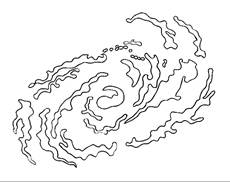
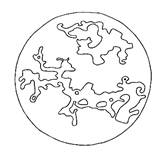
- An atom; B. The Milky Way galaxy; C. The early planet Earth
Scientific evidence suggests that we descend from simple molecules that accidentally developed the capacity to make identical copies of themselves. Constant molecular tinkering taking place over hundreds of millions of years, in hundreds of millions of square kilometers of water chanced upon a self-replicating molecule. Although self-replicating chemicals have not arisen spontaneously in a lab, a number of laboratory experiments have demonstrated that simple inorganic elements, under the right conditions, can combine to form complex organic molecules.
The “RNA world hypothesis,” a generally accepted theory of the origins of Earth’s first replicators, suggests that life on Earth descends from RNA. These original “entities” were much like today’s viruses. Because the earth is such a dangerous place for large organic chemicals, any RNA strand that could not duplicate itself would eventually be worn down or destroyed. In a volatile physical world, rapid replication would have been the only path that allowed these RNA strands to perpetuate themselves. These molecules were never meant to last forever, only long enough to make a few copies of themselves, and thus degradation, and eventual death was built into the system of life from the beginning.
Competition between them for resources likely caused these original replicators to develop new survival strategies. This was the first form of competition on Earth. It is not clear when this competition between molecules first turned into aggression and predation. In some lineages this primordial competition used natural selection to develop more complicated body plans. It caused our lineage to transform from single-cell bacteria, to plant-like animals, to worm-like animals, to fish, to amphibians, to reptiles to mammals.

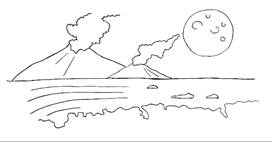
- RNA and DNA; B. RNA synthesis and replication; C. Earth’s early oceans
It is easy to see that every living thing on our planet today is a replicator. Each member of the 6 kingdoms of life (plants, animals, fungi, protists, eubacteria and archaebacteria) on the face of the Earth is here today because its ancestors were able to escape death long enough to replicate, passing their genetic material on to their offspring. Chemically, the genetic material, DNA (deoxyribonucleic acid), used by all living organisms on the Earth is so uncannily similar that scientists believe that we all descend from a single common ancestor.
Our bodies are complex conglomerations of cooperating cells that are designed to perpetuate our DNA. In other words, we are merely “survival machines” for molecular replicators. Our ovaries and testicles carry these molecular replicators. Many biologists see our eggs and sperm as the seeds or kernels, and the rest of our bodies as a “disposable husk.” We are mortal baton-bearers and our sperm and eggs are the batons in a relay race that stretches back over 3 billion years. They are the “immortal germline,” and we are their fleeting enclosures, given one ephemeral chance to do their bidding. This echoes Samuel Butler’s aphorism that “a hen is only an egg’s way of making another egg.”
Scientists like Richard Dawkins helped to show that this perspective on genes, although it is only one way of looking at life, is valid at many levels of analysis (Dawkins, 1976). Genes are not just the blueprints for our bodies, they are the original captains before the invention of the ship. Any full account of the meaning of life has to take this fact into account. These simple molecules developed the rudiments of animacy and agency. They introduced function and purpose into a universe devoid of function and purpose. Their legacy and their struggle structures our biology, and gives us perspective from which to interpret our innate behavior.
Replication is life’s imperative. Natural selection guides and shapes how species change and separate, but it is not the driving force of evolution. Replication is. Bodies and minds can be seen as elaborate extensions of replicative chemistry. Every organism’s original purpose in life is to pass on their DNA to the next generation. And to this end, species have adopted extraordinary methods referred to as life history strategies that enable them to replicate and reproduce in a manner that matches their body type and environment.
These strategies change as environments change, and shape both bodies and behavior in response to external conditions. Harmful or negative environments can cause organisms to deviate from otherwise optimal body plans, to restrict their growth and movement, to reduce their quality of life. Because the strategies are keyed to the success of our genes—and not to our personal enjoyment—they can result in extreme misery as our bodies do their best to conform to genetic imperatives.
Physiological responses to chronic stress are one example of such a gene-based adaptation to negative environmental feedback. This leads us to a humbling conclusion: that our bodies were designed to preserve the genes no matter what the cost. They not only endure injuries and hardships, but actually manufacture their own physical impairments in response. The next section will explain why this happens. Why, in other words, organisms internalize and retain stress in the form of bodily trauma.
When farm chickens are debeaked they cannot fight and have no way to resolve disputes. In fact, debeaking has become an uncommon practice because it actually leads to increased antagonism.
Because the strategies are keyed to the success of our genes—and not to our personal enjoyment—they can result in extreme suffering.
Our body’s cells are always listening intently for negative environmental feedback. Cues predictive of adversity are received by cells and used to trigger physiological adaptations.
In other words, they are not just outward expressions of our pain; rather, they drive and maintain the pain. When the displays become a constant part of our social self-presentation become major contributors to our psychological misery.
Here is an initial list of some of the concepts that are targeted by the exercises in this book. The list is intended to get you thinking about them before we proceed; it is a look ahead, not an exhaustive overview. By the end of the book, you can expect to have mastered these and incorporated them into your everyday behavior.
- Always breathe at least three seconds in and five seconds out. Your breath should be a tiny but continuous sip of air that never pauses and always proceeds at the same rate.
- Monitor your breathing carefully during conversations; don’t let it become shallow.
- Breathe through the nose as often as possible.
- Minimize squinting and raising your eyebrows.
- Do not make your voice high-pitched as an indication of affection or compromise.
- Notice that before you meet someone, make a call or send a text, your face and neck will tighten up and you will start breathing shallowly.
- Do not respond to provocation or threat with your face or with your breath.
- Look above the horizon as much as possible.
- After making eye contact, look at or above the eye line rather than below it.
- Stand and sit erect.
- The best posture for the neck is to look upwards while bringing your chin to your chest.
- Press your shoulders down and back, and flex your buttocks as often as possible.
- Be very calm when you model social interactions in your head.
- Minimize replaying or imagining negative social scenarios, especially confrontational or violent ones.
- Be very calm in social situations. Retain complete composure. Make being calm a priority in your life, even over appearing rude or unsophisticated.
- Expect that the calmest version of you has what it takes to resolve any scenario.
- Try being “dead calm,” first by yourself and then with others.
- Think of yourself as pure of heart, slow to anger, and not easily offended.
- Make your posture and countenance ruthless, uncompromising, and unapologetic, but temper this attitude shift by making your personality humble, considerate, and affectionate.
But even plants, fungi and single-celled organisms, which have no muscles or neurons, have primitive ways of moving. For example, many unicellular organisms have cilia (tiny hair-like arms) or flagella (a sperm-like tail) that allow them to move by propulsion. These tiny animal-like protists (protozoans) beat their body parts against their surroundings to mobilize. The first animals appeared around 800 million years ago and are thought to be similar to today’s sponges. Sponges have no muscles or neurons, and are only capable of very slow forms of movement and rudimentary forms of information transmission between body parts.
The development of muscles and neurons in true animals (eumetazoans) took movement and information processing to a whole new level.
These interventions also mitigated a condition called torus mandibularis which is an accumulation of bone growth along the interior jaw surface nearest the sides of the tongue. This bony growth occurs due to extensive teeth clenching (bruxism). Many months after my jaw was unstifled this growth (which is known to fluctuate over the life course due to local stresses) receded significantly.
I have become convinced that the stress that chronic muscular tension places on our body is culpable for, or at least implicated in, a wide variety of medical diseases. Bracing the muscles in various chakra-like modules may also play a role in psychiatric disorders.
When I was four, I wanted to grow up to be just like the superhero He-Man. I told my parents I was determined to be as strong and muscular as my favorite cartoon role model. They told me if I worked hard, I could do it. I did pushups, sit-ups, and lifted weights from age 8 onward. I didn’t enjoy it, and I imagine that I breathed very poorly while doing it, but I did it with determination. At one point, when I was 13, my mother asked me why I had bruises on my biceps. It was from doing too many curls. I was hurting my body. If I had used lighter weights and not breathed so shallowly, I could have really built a solid foundation. I actually caused my muscles to become weaker in the long run. This is why I have always had painful, lanky arms. I lifted weights more than the other boys in elementary school, but my physique was always unexceptional. Many of the other boys had conspicuous musculature with bulk and sinew that I didn’t. Even today, my biceps are small, they feel spongy and rough with multiple nodules, and it hurts to pinch them. I probably went to bed every night bracing my biceps.
At age 10, I decided to find some literature on weight lifting. I read that muscle gain came from extreme muscular exertion, so I concluded that if I could get my muscles to be very tight – all the time – I could force them to grow faster. I imagined that the best method was unrelenting contraction. However, the weights I insisted on using were too heavy for me, making the process drudgery that I held my breath while doing. This was actually my strategy throughout my teens and twenties. In fact, the most important factor in building healthy muscle is to allow it to relax. The more relaxed your muscles are at rest, the quicker they recover from exercise. This is why relaxed muscle responds dramatically to exercise, whereas tense muscle responds sluggishly. Whenever you are not using a muscle, allow it to go limp. It almost seems slothful, but it’s not, it’s the way you should live your life.
In junior high and high school I injured a muscle, tendon, or ligament almost every time I had a sport-related accident because of excessive tension. My parents were very discontented and confused because I was coordinated; yet, I would sustain a legitimate injury after each collision or fall. I was in my teens, but because of undue stress the body parts that I braced were decrepit.
In my teens and twenties I would bench press too much weight, and hold my breath while doing it. This would cause me to walk away holding substantial tension in my chest for hours. It led to the accumulation of trigger points, and the adaptive shortening of the pectorals which bowed my shoulders and chest inward. It also led to two patches of scar tissue four inches above each nipple. They were tight, sore spots, with a diameter of half dollars. I massaged them using the techniques presented in the next chapter for two minutes a day, and they disappeared after a month.
When brief involuntary contractions flow through the muscles that make up our internal organs we feel emotions. This flow is an integral part of feeling love, getting a rush, and enjoying happiness and excitement. When repetitive strain damages these organs though, the emotions become negative.
Have you ever exercised in the morning and then felt very frail by the end of the day? Even after an evening workout most of us will engage in a number of activities before bed. The workout weakens postural muscles throughout the body leaving them more susceptible to strain. Avoid this. As soon as you get home from work, or from a workout, you should make 5 minutes for corpse pose. It will give these muscles the respite they need to grow stronger rather than weaker.
Most people are completely unaware of their muscle tension (Shumay & Peper, 1997; Stein, Schafer, and Machelska, 2003). There are many specialists you can visit that can help give you insight. They place electrodes on a patient’s skin and take surface electromyographic recordings to provide the patient real-time feedback about the level of tension in different muscles. They might place these electrodes over different neck muscles, confirm the existence of muscle tension and then ask the patient to try different exercises, postures and neck positioning until the person learns to hold their neck in a way that is free from tension (Harvey & Peper, 2012). This can be very helpful, but you don’t need a medical office visit to recognize and release excessive muscle tension.
In Chapter 3 I asked you to spend a minute breathing where each breath takes less than a second. This helped to demonstrate distressed breathing and contrast it with diaphragmatic breathing. The process of voluntarily initiating a symptom, and then inhibiting it, also known as symptom prescription, is helpful because it encourages awareness of exactly what the body is doing wrong so that you can consciously address it.
Trigger points, muscle shortening, and the deposition of scar tissue are surely adaptive phenomena. They accomplish two things 1) they change the muscle physically so that it takes on the configuration that you habitually hold it in, and 2) they utilize pain signals to
The body is betting that instead of healing a strained muscle and bringing it to its premorbid strength and flexibility, it is best to cause this muscle to become weak and stiff, forcing other, safer muscles to compensate. It is better to close off a muscle group than to seriously injure it. Dormant muscle may also cut metabolic needs. Dormant muscle imposes severe constraints on mobility and behavioral activity. This may have been good for our ancient ancestors because it vastly decreases deliberative movement, cutting metabolic rate and minimizing the amount of food that has to be consumed each day. This would have restricted hunter-gatherers to the movements that have proven necessary. But today cumulative strain hinders mobility, and livelihood in an evolutionary wager to increase the probability of survival.
Trigger points are best found by palpation with the fingers, but can also be found clinically by measuring a heat differential between the tense muscle fibers and the surrounding healthy fibers, by electromyography, or by a modified MRI scan (Alvarez & Rockwell, 2002).
While observing these phosphenes in the dark you are actually looking at the default activity in the “early” visual cortex. This area of the brain is responsible for holding geometric arrangements of visual information inside a coordinate system that corresponds to the arrangement of light receptive cells in the eyes’ retinas. Early visual cortex interacts with “later” cortical areas to both perceive your environment and also to construct imaginary imagery in the mind’s eye. These phosphenes are the rudimentary building blocks of your imagination.
Submissive behavior and the accompanying shallow breathing create anxiety and depression, and is bad for your health, but it does more than this. It also makes you aggressive.
Initially, this book was going to describe the many costs of aggression. I saw aggression as a pitiful coping tactic that—unfortunately—is often rewarded, but which does not produce healthy behavior or positive habits. I saw it as a heuristic that people employed inflexibly and far too frequently. I felt that by living my life without aggression, I reaped many benefits and wanted to share my protocol for using diplomatic formality and etiquette to navigate difficult social situations.
Do you know what bottling it all inside really is? It is taking on tension when every you think of that person. You don’t want to take on any tension, either from their intrusion, or from your own trespasses. It’s easy if you just try. Don’t use aggression, dont feel like you have to punish others. You don’t want to have anything to regret. Instead just do everything assertively without apprehension.
Simply avoiding aggression is neither sustainable nor healthy, as stifling your emotions just builds up tension. As you explore Program Peace, you’ll find that I still advocate completely abandoning anger and aggression. But now, I recommend avoiding aggression while maintaining composure, aplomb, and self-assurance. In short, I recommend practicing assertiveness.
Stifling the aggression is not healthy either. In order to avoid appearing aggressive, I accentuated my subordination displays and debilitated myself through intense self-handicapping. I used to spend so much energy placating people and repressing my personality that I became perpetually distressed. So, where’s the middle ground? Ironically, trying too hard to be nice made me passive aggressive, and far less capable of expressing positive emotion. In trying to let go of aggressiveness, I had also inadvertently lost my assertiveness.
It is not just an upregulated stress system that is adaptive in adverse environments. As we will discuss, anxiety and depression are also adaptive. Chronic muscular tension, pain and trauma can be adaptive. These things make us fearful, worked up, and self-focused. This is exactly how you would want to act in a hostile environment. Unfortunately, the reproductive success of an animal in a bad environment actually benefits from its physical and emotional pain.
About This Book
Reprogram your biology for happiness, assertiveness, and stress resilience. A scientist’s quest to alleviate chronic stress. Using optimal quality of life training to find ideal posture. Extinguishing the Inferiority Instinct. Peace through Neuroplasticity.
The function of the mitochondria is impaired, reducing ATP production and release. It is thought that since ATP is necessary to detach the myosin heads from the actin, these molecules are more likely to stay attached, leaving the sarcomeres in a shortened and contracted state
The squirting fluid seems to fill in just a few minutes or even seconds along with arousal, but this filling cannot be relieved from urinating. it’s a mystery,
Keep your eyes wide open while at your desk.
The sad truth is that we continue to use bad posture and submissive display even when unprovoked. Before you know it, the way that you hold yourself in front of your angry boss adversely affects the way you hold yourself when you are with your best friend. Even when you are by yourself, you are maintaining all of these defensive displays, as if the negative people in your life are constantly following you everywhere. We often don’t let ourselves relax when alone because we are constantly modeling social confrontations in our head, and we want to “stay in character” while we are doing it. This book will help you learn to assume healthy postures during your time alone, and with practice, this will transfer to your social persona.
The Components of this System
- Breathing Retraining: This section will instruct you on how to make your breath deeper, slower and smoother. You will be shown how to engage the diaphragm and strengthen your breathing musculature.
- Facial Reconfiguring: This section will teach you how to relax your face, start using empowering facial displays, and stop using submissive ones. It will also show you how to compress your facial muscles to reduce tension, and will describe several facial exercises.
- Postural Restructuring: This section will focus on the key aspects of proper posture, exercises to improve strength, balance, coordination and methods to counteract frailty through locating and rehabilitating strained muscle.
- Cognitive Reprogramming: Sections throughout the book offer advice on how to be assertive and composed while still being a good person. They will provide tools for reframing stressors and the mistakes of others, and for dealing with your own ego and aggressive tendencies.
You could improve your postures without diaphragmatic breathing, but doing so would take much longer. The reason for this is that just assuming ideal postures makes your breathing defensive, because it tells your body you are doing something risky. For instance, when you smile, or when you stand up straight, your breath immediately and automatically becomes shallower. This is especially true in public.
There is no way to will yourself into being cool, charismatic, or detraumatized. This is because we do not get to consciously pick and choose the brain cells that activate together—it happens too fast. In fact, it is difficult for us to co-activate neurons that have not already co-activated extensively in the past. That is why we need dedicated practice to develop new skillsets. It takes consistent repetition to master healthy way of being, and even more repetition to be able to use them together simultaneously. Electrical energy in the brain flows where there is the least resistance. The neural pathways that have been activated by experience are the most conducive. You can re-direct neural activity to unused circuits, over-riding your “autopilot” and starting to build new connections. Keep your focus long enough, strengthen those connections consistently enough, and you will form new habits.
Your susceptibility to stress is largely established during childhood and young adulthood but can be modified at any time over the course of your life. To reduce it you must train your body to adopt ideal postures. These include your breathing, facial muscles, spinal orientation, and mental attitude. The definition of posture is “the relative disposition of the parts of something.” To create hardy posture, you need to properly condition the parts individually, and then adjust the relationships of certain parts to other parts, before you can expect everything to come together in the right way.
Your brain and spinal cord hold the memories that regulate your body language. The human brain is filled with about 100 billion neurons, and each one specializes in recognizing a different aspect of your world. Individual neurons encode fragments of memory. When the memory fragments for different postural settings co-activate, they become linked together, making that particular combination of neurons more likely to fire together in the future. The combinations that have been frequently coactivated during your lifetime—your social personality—have not been chosen by you. In fact, they have been shaped by your most negative encounters. They amount to an autopilot that forces you to send submissive displays, perceive your environment cynically, and act defensively.
Each of these neurons encodes a fragment of memory, and they organize themselves into groups that represent actual objects and concepts. When multiple groups of neurons become coactive, the symbols they represent come together to create complete memories, thoughts, and conscious experiences. This means that each thought is composed of unique combinations of microsymbols that already exist in your brain.
It is not always easy to begin performing dominant, assertive displays in public. We judge ourselves for it, others sometimes react badly, and it takes both time and significant mental effort to become fully comfortable with your new way of holding yourself. This is both normal and okay, and will not prevent you from developing a long-lasting sense of confidence and calm. It does, however, require a deliberate approach.
“We are chained to ways of walking, ways of thinking and ways of perceiving and feeling. We are slaves to our automatic behavior.” F.M. Alexander
This results in building and stabilizing new brain circuits while, at the same time, unmasking and disinhibiting the circuits responsible for assertiveness. Electrical energy in the brain flows where there is the least resistance. The neural pathways that have been activated by experience are the most conducive. You can re-direct neural activity to unused circuits, over-riding your “autopilot” and starting to build new connections. Keep your focus long enough, strengthen those connections consistently enough, and you will form new habits.
You want your historical record of co-activation statistics to work for you, and the activities in this book will help you program it properly.
Each muscle moves in an arc (think turning your head) and within an arc there are an infinite number of vectors. This means that there is an endless number of unique joint and muscle contractions.
Reeducate your neuromuscular system.
The muscles in your lower back and neck that feel like points of incredible structural weakness, where you have a breaking point, and will fall to the ground if it is strained? These are your weakest links. I used to assume that everyone had these and they were normal. The truth is they are not supposed to be there at all.
If you refresh than that muscle will get a better workout no matter what you do.
There are many postures and exercises that we only perform while breathing shallowly or holding the breath. In fact, most people breathe shallowly any time they stretch or exert themselves. Because of this, the brain unconsciously assumes that using these muscles should be anxiety provoking and should always be accompanied by shallow breathing. The brain does not know what is best for us. It only knows what we have caused it to experience in the past. Hence, if you have never performed a deep back bend while breathing deeply, it will take dedicated practice to do so.
The brain calculates unconscious actions based on “prior probability,” so if you want it to retain a memory of something, you need to give it that experience. For this reason, now I make sure that I breathe deeply and slowly whenever I am stretching, especially if I am stretching an injured or tense muscle. Remember, if you hold your breath or breathe nervously while stretching, you are only programming your cortex to further associate nervous bodily states with these movements. Thus, if your back becomes sore, it will be more likely to take your breath away, and similarly, if you become nervous for an unrelated reason, your back is likely to become tight. This happens frequently with injuries. Because we allow them to irk us, we program the brain to associate the injury with stress and shallow breathing, often exacerbating our psychological relationship with the injury and prolonging the recovery process. The next time you suffer a sprain, or a strain focus on the sensations coming from the muscles and breathe diaphragmatically while doing so.
Usually when you hurt your back there is dormant muscle that is overloaded creating a strain. If you knew how to alter your posture to release the continuous strain that the muscle is ordinarily under, the strain would never cause immobility and you would always be better the next day. But people don’t know how to do this, don’t lie in shavasana, don’t massage it and don’t breathe properly, so it gets worse.
Although many medical professionals do believe that it has some undeniable benefits such as such as relieving back and neck pain, taking pressure off sensitive nerves or tissue, increasing range of motion, restoring blood flow, and reducing muscle tension.
Slow twitch comes from red, dark meat with more capillaries. Muscles twitch and have different speeds of contraction when stimulated. Slow twitch fibers literally twitch slower. ST = 10-30 twitchs per second whereas FT = 30-70 twitches. ST training results in less muscle gain but more endurance. ST can partially transform to FT and vice versa depending on environmental demands. The back and spine is endurance and thus has more slow twitch fibers
There is no spot reduction of fat in exercising muscle, but when you turn dormant muscle into nondormant muscle using compression or antifrailty there is spot reduction.
To improve posture and strength, and reverse tension, we must turn to more active and dynamic forms of stretching. For example, forms of isometric stretching and PNF (proprioceptive neuromuscular facilitation) stretching have been shown to be very effective for athletes. These forms of stretching, unlike passive, static stretching, involve the contraction of the muscle during a stretch.
Additionally, most athletes who stretch are using the same stretch routines repeatedly, overstretching large muscle groups while leaving many smaller, supportive muscle groups completely unstretched.
One of the most important attributes of yoga is the removal of muscular tension and the increase in circulation so let’s talk about how to make sure this is your outcome.
The Costs: Unnecessary Strain
Hot yoga is performed in a heated room where you can bend more fully into your postures. This allows you to stretch and flex deeply into your underused postural musculature, creating strength where you had weakness. However, the fundamentals of the Bikram routine cause people to flex some muscles too deeply for too long. Straining too deeply into isolated muscular postures in very hot conditions is not the way to become a well-rounded athlete.
What You Can Do To Reduce Unnecessary Strain
Make sure that there is no pressure on you to compete with others students in the studio. Also, some instructors are authoritarian, and hypercritical, and rude. Whether they are singling you out or someone else this is bad because it causes the heart rate to speed up and the breathing to become shallow. If an instructor trys to coerce you to stay in a posture, asks you to strain within the posture or asks you to hold it too long find another instructor.
Shallow breathing severely compounds the strain. I will even go as far as to say that if you cannot breathe deeply and diaphragmatically (long interval, high volume breaths) during weight training, you shouldn’t do it.
Anything that you perceive as stressful will cause you to stop breathing diaphragmatically and start breathing defensively (shallow, thoracic breathing).
A Bikram class starts with the neck exercise known as “standing deep breathing.” The breathing exercise that the instructor describes during this pose is exactly how you should breathe during the entire class. The instructor coaches you to breathe deeply and their instructions are clear, textbook instructions for diaphragmatic breathing. This is especially important for the first pose, which is a neck extension. However, the “standing deep breathing” exercise will protect the neck and keep it from holding strain, helping it to grow stronger and healthier. The fact that Bikram starts with diaphragmatic breathing is beautiful, and every yoga instructor should start his/her class that way.
The Costs: Facial Tension
Be very aware of how your face is contorted as you exercise and try to make it as calm as possible even if it makes you feel self-conscious. You also want to try your best not to squint. The heat, the humidity, the sweat in your eyes, and the strenuous work will predispose you to squint. The fact that the eye muscles (orbicularis oculi) squint at a very high temperature will cause the squint to become burned into your face. Look at all of the long-time hot yoga practitioners and teachers, many of them have purple bags under their eyes from the potentiation of the muscular contractions responsible for squinting. If you cannot keep your eyes relaxed and wide during hot yoga, then don’t do it. Remember, this tension in the eye muscles is extremely easy to see. You will see a visible, dark crease under the eye. Tension in other muscles is often hidden from sight, but many hot yoga practitioners hold inordinate tension throughout their bodies just like their eyes.
Allowing your voice to relax completely may make you feel like you want to cough. This is because the muscles responsible for coughing are usually braced. This is known as cough reflex hypersensitivity. The next time you feel the tingle of a cough coming on, don’t cough. When you feel the impulse to cough itching in your throat, lie down, breathe diaphragmatically, and concentrate on relaxing that impulse. Suppressing your cough will desensitize it. After you have done this for around a minute perform a natural cough to clear any saliva or mucous. Cough is an invaluably important protective reflex that ejects obstructions to breathing, and stretches and contracts various muscles. Of course, you don’t want to inhibit all coughing, just do so once in a while when you have the luxury to breathe deeply.
The set of representations currently active within working memory corresponds to a description of a situation involving various parts. As time elapses, this set changes gradually and with it the situation being modeled changes as well. Consider the case of an animal thinking about a certain action (foraging) for a certain food (berries) in a certain location (forest) under certain conditions. The important aspects of this scenario may be maintained temporarily as incidental conditions and relations cycle in and out. Items of context are gradually replaced by new items so that a thought about one event incrementally transitions into a thought about something else. This article will describe how this general pattern of information change allows a mind to generalize from one scenario to another, form new boundaries and affinities between groups of concepts, and build expectations about events that have never been encountered.
The way these cohere depicts a snapshot of a number of concepts and their relations. When a specific set of representations remain coactive for an extended period as others come and go.
This results in clusters of information that have never before been formed and using it to find and associate with other information.. Arrangement. Separate, sequential impressions are recodified into an informed, composite configuration.
Analogical reasoning is a way of constructing inductive arguments where similarities between two concepts are used as a basis for inferring other similarities. Argument from analogy is a common method by which humans come to understand things and make decisions about them.[1]. It is also implicit in much of science; for instance, generalizing findings about experiments on laboratory rats to humans [ 2] The argument does not assert that two things are identical, only that there may be reliable evidence that they are similar in some respects. The structure of analogical inference has been described in the following way: 1][2][3]
B and G are similar in respect to properties C, D, and E.
B has been observed to have further property F
Therefore, G likely also has property F
Iterative updating may provide a brain-based mechanism for performing analogical reasoning. Using the structural example above, item B, along with its properties C, D, E, and F once held in coactivity may spread their activation energy toward G. This would bring item G into the focus of attention and cause it to become associated with the properties of B if they were to remain active. It is easy to see how iterative updating may also be involved in generalization where knowledge from one situation is applied to a similar situation.
Sampling statistical regularities from spatial and temporal intervals.
The constellation of active representations could represent: when chasing this animal in this location under these conditions, do this whereas under these conditions do that. Embedded temporal relationships.
Incidental reorganizing, organizing
Wm generalizes between states. Because no state literally equals the last state. Meaning they each describe different possible reality/universes, or hypotheses. They are just so close that they are linked. Lost in the generalization equals stopped firing, equals details that are irrelevant to this particular relationship.
A system that allows mammals and primates to continually reprogram an existing network of associations. And it does it by creating groups of closely related concepts that tend to co occur in the environment. It exposes this set of coactivates to a stream of various associates. Some stick others fail to cohere with the rest so they are removed. As this occurs the concepts that stick update this set and the set evolves slowly. Each ssc is a description of a scene. each update is a decision at least. How is this like that. Animals must discover the abstract rules that govern each domain. They build a pyramid of meaning.
Each brain state is a hypothetical taking place in a known environment. The subject of thought remains in the focus of attention and represents a description of a situation. The more the Friend shopping in a grocery store are used the more they are generalized, or explored or associated with a variety of other close associates.
These items each have an associated set of correlated features, the same features that make maps, and all of these features come on and correspond to each item. So there’s a whole set of biases.
Each event is interpreted in the context of the preceding events.
Tracking the temporal features of a hierarchical temporal problem, the relevant info is contained between the Temporal relationships between all of the events parts. Integration across time. Information encoded in the temporal structure of events. A temporal hierarchy of elements.Problems that are solved at different temporal scales. Parsing complex subsecond patterns. Much of this happens at the level of phonemes, syllables, words, phrases, sentences
At some fundamental level, the computer is always going to be asking certain questions about its current state and these must include one should I approach or withdraw, two is this possible or no, three was this punishing or reinforcing, and four what is the next most possible and important subsequent occurrence. and five how interested I am I still in this constellation of items and features, or do I want to just drop all of them, or some of them. Six it decides how fast the heart should be beating. Priority to the solution of left or right hemisphere. But even as one is completed, all continue to model. They are redundant in many ways but act as a generator and a critic in an adversarial collaborative way.
Bradykinesia, Tachykinesia. Bradyphrenia, Tachyphrenia. Trains of microtics in Tourettes syndrome that can only be seen in slo motion video.
Resolving focal ambiguities,
Ltm is reprogrammed slightly by the ongoing coactivity, strengthening connections between what is coactive, assuming that their co occurrence under the context of the rest of the situation is more relevant than previously recorded. Iterative updating lays down tracks for items to roll down again later.
Tight vs loose iterative coupling. Search
Context variables, digressions allow other iterations to return back to an originating spot.
Replay iterations. (put this in algorithm section)
With multi associativity the co-active items are integrated when they search for the next state in the sense that The next state depends not only on Each individual item and it’s past, but also the unique combination of these items.
In depth semantic processing,
Did curiosity algorithm is the need for iterative updating. If There is no more learning, then boredom will set in, Because iterative an incremental changes are no longer happening. Similarly error feedback happens when the next iterative update is predicted incorrectly, this is when novelty and learning occur. Organisms learn when events violate their expectations. Surprise is a fundamental driver of learning. Prediction error is used to change the internal representation. The rescorla Wagner theory. To curtail the unpredictable. A learner needs explicit feedback about why there was an error, the more context, the more rationale, the more coactivates. We are constantly looking to exceptions that violate our laws of physics, probability, psychology, arithmetic, after the wrong prediction is omitted and the actual unpredicted occurrence is used as an update, the subsequent rounds of Iteration probably proceed to understand why the error took place, or things played out the way they did. The unpredicted inputs are allowed to travel up the cortical hierarchy and enter the focus of attention to be reconciled with the other contextual elements currently in the focus of attention. Repeated learning, and repetition, leads to adaptation, where the neural response to a sequence of predicted stimuli declines. This reverses wants that sequence becomes less predictable, and the neurons for the unpredicted element become more active
Do you need an arrow from the focus of attention coming from both the environment and internal search
The reason we say humans have free will is because we cannot predict what they will do. Stephen Hawking
Zimbardo time perspective inventory. Temporal myopia, present and fatalistic perspectives
Revision, back dating, recirculated information. Data mining, decision path, cyclic, there is some redundancy in the recursive wm process. Do intelligent babies without mommies overfit or underfit?
Did curiosity algorithm is the need for iterative updating. If There is no more learning, then boredom will set in, Because iterative an incremental changes are no longer happening. Similarly error feedback happens when the next iterative update is predicted incorrectly, this is with novelty and learning occur. Organisms learn when events violate their expectations. Surprise is a fundamental driver of learning. Prediction error is used to change the internal representation. The rescorla Wagner theory. To curtail the unpredictable. A learner needs explicit feedback about why there was an error, the more context, the more rationale, the more coactivates. We are constantly looking to exceptions that violate our laws of physics, probability, psychology, arithmetic, after the wrong prediction is omitted and the actual unpredicted occurrence is used as an update, the subsequent rounds of Iteration probably proceed to understand why the air took place, or things played out the way they did. The unpredicted inputs are allowed to travel up the cortical hierarchy and enter the focus of attention to be reconciled with the other contextual elements currently in the focus of attention.
Iterative updating coupled with environmental feedback lay down records of iterative shifts that can be reiterated later.
Items serve as semantic retrieval cues.
Dichotomous or graded. Gradational
This model may benefit from the contribution of other types of neural networks such as convolutional neural networks
Determinism is like an actor in a movie saying “I have free will” as the Blu-ray disk spins. He can’t say anything else.
Harari called them the useless class, people who can never generate enough economic resources to support themselves
Recursive partitioning, does wm try to eliminate redundant data
Al wants multi domain learning, domain independent learning,
Capturing the statistical structure of sequences of events. With prior knowledge and short term memory What you can expect next is not random. And the more information you can take through time the less uncertainty and the better your predictions.
Much of continuity is referring back to previous points that you have made. When you refer back to other substantiated claims or predictions, you build a case.
” Information maintenance holds previous events allowing us to steer through the statistical structure of the event that is unfolding through time. This article will describe how the brain uses working memory to do this.
If I read you a random word from a book and ask you to guess the next word you can try, but it’s easier if I give you two words, and much easier if I give you three. The more sequential words the higher your probability of guessing correctly because you have deeper predictive structure. This relates to Claude Shannon’s measure of information entropy which is a measure of uncertainty surprise. As predictability increases, information entropy decreases. Information entropy decreases as context that is valuable for prediction accumulates. This context must have information about conditional dependencies. The successive contextual elements are like nodes in a decision tree that narrow down the solution space. But sustained firing is assumed to be heavily metabolically expensive.
The predictability of letters increases with increasing context. Short range and long-range dependencies. Structured sequences whose elements are not independent. All states are not equiprobable or independent. There are correlations between nearby letters. Consecutive letters are not independent. The probability of each letter depends on the letter that preceeds it and follows it, so it is a conditional probability because its occurrence depends on the identity of other nearby letters. How predictable is it from its context. The block length beyond which inter letter dependence falls to zero is called the correlation length.
All thinking and behavior similarly depend on the states that precede them.
Expectation or prediction.
Iteratively updating search
Primary visual area neurons see the world through a pin hole.
The order of items added to working memory can matter because there are numerous incidental … the response of the global workspace to item T then U would be different to the response to U then T. Meaning that they would produce different final states.
Recording changes in synaptic potentiation In intact brains may be very difficult,
The focus of attention is quickly vacated to accommodate something that is perceived as a potential new narrative thread. So that the first impressions can be recorded and can buy us the subsequent impressions, so that an overall impression can be formed over the matter of seconds for steering through time.
Succession. Temporal dynamics connecting the data.
Dan dennet says that consciousness like magic is just a bag of tricks and that most people don’t want to know how it works.
Echoing states,
Given that the short term store has a very large capacity, it is likely that it is responsible for the human ability to accumulate a large amount of contextual information regarding The recent past providing biases for the FOA
There are many many ways to look at the world. One of which is to recognize that in some senses there is no continuity of Personality orself hood Overtime and that there is no you. And that the person who made the start of your sentence is not the same person who finished it, that we are just conglomeration of cells acting and reflex patterns.
The integrated information theory of consciousness says that integrated information is more than the sum of its parts. I’m saying that information integrated across time is also more than the sum of its parts because it can achieve incremental progress.
Working memory is taking one combination of concepts and finding another concept that is highly probabilistically related to it. Then it takes the most related of the two sets and finds what is the most probabilistically related to that.
Thought comes to a halt when the contents of the focus of attention is no longer interacting Highly with the dopaminergic system because the set of its contents are no longer stimulating dopamine. When this happens the focus of attention will dip back into the short term store to Find the most exciting recent set of concepts from recent memory. This means that the spreading activity from the focus of attention directly to the VTA is not surpassing the threshold necessary to keep it active.
Trying to create order and knowledge and predictions based on inferences without actual verification from reality. Using inexact and incomplete knowledge.
Creating inferences about reality that are merely based on long-term memory is tenuous but it is possible because of myelination. Learning from and with your mother is a form of supervised learning.
Except that if you don’t have structured prior knowledge, from a mother, a lot of recent info won’t help, showing the value of supervised feedback. Also sustained firing is metabolically expensive.
Is the sensory store updated iteratively or completely?
Items are distributed
Each state is a juncture
Branch prediction in the CPU is similar to prediction in the brain because it relies on past experience. It asks what did I do last time?
Demonstrate empirical evidence of distinct sets of coactive cells. The cells of one set become active together and Are released from activation together. The sets must demonstrate iterative updating as a group.
In any field of study breadth can equal depth especially if you can find phenomena that are connected in someway that no one else has noticed. Usually depth corresponds to a customary. What you really want is so many instances of depth that it creates breadth.
It is hard indeed to notice anything for which the languages available to us have no description. Allan watts
Alan Watts: you are an aperture through which the universe is looking at exploring itself
In the brain, as in the rest of the body. Nothing is in charge. The pfc only seems in charge.
The brain and neural networks combine things with similar features. If the features are graft things within the same category will be close together in the feature space. A nonlinear hypothesis is needed to separate multiple classes. You want things that are far from each other semantically to also be farther in Euclidean space.
Items rendezvous at an agreed time and place.
Combining iterables.
If multiassociationism is true then the multitudinous neuroscietific details that underlie it may be unnecessary for machine consciousness. But you would still need to be able to enact it and iterative updating. The rest of this section will describe how.
Ideation
In a sense you (at this moment) die as soon as everything exits your foa, exits you stm, everything active in both now exit your ltm (it usually does), as soon as you forget what you were thinking, as soon as you fall asleep and wake up in the morning. You are constantly losing continuity with your former selves. You don’t live on through them, so how can they live on through you. Don’t you live on through 8 billion other similar souls after you die? I have more in common with some 15 year olds now than I currently do with my 15 year old self. I’m not his salvation from death.
VE VE iterative algorithm is controlled by reward and punishment, the striatum and the amygdala, approach and withdrawal. There are many theoretical frameworks that address these phenomena and they need to be reconciled with iterative updating.
If the map captures and depicts The contents of working memory at a level that is below it’s state of awareness then the artificial intelligence could not manipulate or deceive the individual watching its maps.
Pastiche, don’t think of a pink elephant, you have to, you have no choice. It won’t either. All AIs should be open in the sense that all of their mental imagery should be streamed on websites that any person can watch and access. Complete transparency.
In object oriented programming objects have lifecycles where they are created instantiated manipulated and then destroyed. They are destroyed when no other elements refer to them, they are out of scope, and they had been deleted from memory to free up resources. The objects reference count keeps track of how many other objects her interacting with it, deleting objects is referred to as garbage collection.
The upper spectrum of chimps and gorillas overlap with the lower spectrum of humans in terms of intelligence measured by humans.
Having a brain and knowing what the sizes, the total overall size would give you almost 0 predictive information of the race or ethnicity of that brain’s owner. Knowing the size of a brain will give you almost complete predictive power over guessing whether the brain belongs to a human or chimpanzee. All human races have the exact same neurological regions. There have been reported differences in brain size between the races. However these differences are very small. And they have been studies that contradict each other. But even relying on one particular study or another the differences themselves are so small that, see the beginning of this paragraph.
Finite state machine couples a look up table with a Memory device. This is often a Boolean logic block combined with a register.. The memory is used to record a summary of the past which is equivalent to a state in a finite state machine. The state I have a combination lock is a summary of the previous numbers dialed into the lock. It does not have a record or a memory of all of the numbers dialed into it, but it does have a record of it at least the last two inputs. If you have an odometer that reads 50,000 miles, and the meter resets every 100,000 miles then this finite state machine may have 150,000 miles or 250,000 miles or more. As far as the odometer is concerned these states are equivalent. This is why mathematicians define a state as a set of equivalent histories. Your brain has a state that could have been programmed by multiple non-identical histories. For this reason the brain is also a finite state machine because it cannot record an infinite number of states. Other examples include a ballpoint pen and an elevator button Console. Brains and computers are finite tape machines. A digital wristwatch is a finite state machine with 86,000 states that are advanced each time a crystal oscillator oscillates. Advancing once per second. All computers advance their state at regular intervals, at the clock speed, every time the clock ticks. Within a computer time is not a continuous flow but a fixed sequence of transitions between states. Turing machine is a finite state machine coupled with a infinitely long tape.
Automatic versus autonomous. Automatic cannot adapt to changing conditions.
Layered concatenation
The cashing hierarchy in computers are not composed of stores that are embedded within one another.
automatically learning probabilistically stable features and associations.
Of the many brain events evoked by a visual stimulus, which are specifically associated with conscious percep- tion, and which merely reflect non-conscious processing? Those that involve densely iterative joints.
Conversations are updated iteratively.
Each state is a steppingstone to the next state
A video game engine renders 60 frames per second and each new frame is an update, involving an update function That specifies how to render the next state
An assembly that is showing sustained activity is like a loop in programming because a loop is continued through time.
The way jeopardy works is multiassociative search, but the smart people do a little processing to use the clues, they refine and reiterate them and then unconsciously multi associate, to get the answer.
A lot of what I thought is working to queue up the right answer or solution to an existing problem from long-term memory. This uses different methods for locating complementary information that will determine a plan of action.
Fade out
Any computer or new information can be recorded permanently, so as a programmer there is no reason to have it Iterative updating. In an animal it is not clear what new information should be recorded permanently.
Two items that never cooccur, A precedes B, are cocative because of persistent activity. Then when one is triggered it will recruit the other creating a prediction of B before it actually happens.
Working memory serves as a buffer, because new information cannot be stored directly in long-term memory, so new rules and variables are stored temporarily for easy access and possible later recording.
Iterative updating limits the thoughts that can be thought in the near future but it also focuses them and makes inquisitive, investigative, content possible. Working memory delineates a scope for future processing. Without it thought would be derailed.
Signal integration
When a system is being modeled and an update to the model is governed by the system’s similarity to another system, this is reasoning by analogy, and this process may be fundamental to insight and creativity.
Out of touch with reality.
Interval. Interstitial. Intervening.
Focal distance should be a term that refers to the amount of time that has elapsed since an item was in the focus of attention.
Imagine that B, C, D are active in the environment, which is then followed by innate response E, which is then followed by reward F. If all of these items are Coactivated despite the fact that they never actually occurred at the same time in the environment they will wire together. The next time we see B, C, and D active they will recruit E and F which will serve as both a prediction And a response.
Artificial intelligence with advanced working memory will be able to have a very clear recall of what they were thinking 15 seconds ago, they will be able to reproduce with great clarity and Fidelity the exact set of coactivates from from 15 seconds ago.
Working memory is constantly vetting potential coactivates for candidacy in the next state. Trying to determine if they will be helpful for search given the search parameters already in current pool activity. Determining suitability for inclusion. Add this comment to the part on iterative inhibition.
The whole reason why advanced iterative updating in computers will provide limitless working memory capabilities, is because it will allow them to use parameters from a longer period of time for search. It allows Each search to attain more instruction and guidance. That search is informed by a larger set of parameters, that stretches back further in time, and is influenced by a longer stretch of interrelated and processed information.
So I think that iterative updating bootstraps consciousness and this means that whenever we are awake we are conscious. This is at odds with damasio’s When Self comes to mind.
I know someone whos Mom kept her retarded daughter in the closet, never let them out and hit them,
You can’t tax people for having more than one kid if people don’t pay taxes and are on welfare.
Iteration neurological creates Iteration on a psychological level. So if we can get the same kind of iteration working on an electronica level we should be able to create electronic psychology
If you want to stick to the train metaphor then each car on the train has to have similar contents to the last car.
The PFC is asking is there anything from the recent past that I should reference?
Every time that a specific constellation of items is revisited, then an existing algorithm is recalled to perform a specific function, and as that algorithm is used in different scenarios, it is further refined. In other words certain iterations can be recalled and reused for specific purposes.
When a sequence of instructions is iterated in a repeated manner, it is called a loop.
Carousel and slide transitions
Refer back to it later.
Non-random selection and elimination from a pool of candidate structures leads to a mutating and evolving population
The animal may already have the information that it needs to solve the current problem it just needs to be processed.
Concurrently active.
It is highly conceivable that…
This process has been referred to as the evolutionary acquisition or the incremental build approach
Much of the power of iterative updating comes from the fact that it can recall a scenario from the point where it left off and continue to iterate. It can recapture previous situations that are no longer present in the environment.
A system that uses iterative updating to focus on itself, and it’s previous processing states.
In schizophrenia people may be having thoughts, visualizing them, and then thinking that the imagery was real. I just questioned whether my imagery was real or not about Niko biting off NARas band aid. And I was stressed, that’s why it happened to me.
Non-destructive teleportation scenario, the question is which body houses your personal identity, your soul your Cartesian ego, your inner life. You could imagine this happening to yourself and the other cell wearing it with you despite the fact that your life would end if it was the only one that remains. What about if it was your girlfriend, which one would you want to roommate? Both girlfriends would be physically identical, and both would die if destroy, but only one has real continuity with the original. Next imagine that there is no doubling, and there is no teleportation. There is only the passage of one second in time. This being, you, Believes that it is it but it’s not the same one. You cannot be in two places at once. What happens if your double appears right next to you? What happens if you were replaced by two doubles, both very close to where you just were? What happens if you are destroyed and replaced by a double exactly where you just were? Should these small scale changes in space make a difference if we are made of subatomic particles that follow quantum physics and have wave properties? What if you were a devil has the same state of working memory that you have currently? Derek Parfit asks what if each half of your brain was transplanted into your clones, would you feel like you were two people at once, Or would part of you still feel like you in each body?
Revision revised say revision instead of refinement
Douglas said that consciousness is a hallucination hallucinated by a hallucination. He said the dance of symbols is perceived by the dance of symbols. Upward and downward causality. Self referencing. Consciousness is perception twisting back and perceiving itself. The self is the first real object of the mind, the first real and sample that is elaborated upon. The first thing to grab hold. Everything is built it in mind in relation to the self. So it is the core, it is unquestioning, it is unquestionable
Consciousness and a sense of self was instantiated evolutionarily for survival, to stop the self from being annihilated, outcompeted, outdone, and starved
Your strange loop is a proxy. Intertwined and enmeshed.
As consciously available items are being iterated in working memory, so two are unconsciously available long term memories.
Highly selective retrieval of multiple representations happening in unprecedented configurations
Complexity reduction. Finding the gist. Try to get an unfamiliar combination of familiar patterns, To trigger a familiar pattern or a combination of familiar patterns, or a familiar combination of familiar patterns.
Analyzing short, abbreviated events, versus chunking stimuli that are distributed through time into protracted events.
Just keep in mind that…
The purpose of memory is to predict the future
A composite of different representations garnered from different points in time
An incomplete feedback loop, partial, blurred, a loop that partially escapes closure every cycle so that it can do work and make progress.
It alters how the present is interpreted and changes it from a isolated instant into the latest event of an unfolding situation.
New representations are learned as functions at one level, starting with the raw input, and are transformed into representations at higher slightly more abstract levels with enough such transformations, very complex functions can be learned.
Related representations from a level that’s lower in the hierarchy converge on an area higher in the hierarchy and if they amounted to a repeating pattern a new representation will form in the higher level. Representations from different modalities converge on Association layers creating new multi modal representations. Many different modalities are combined, and some multimodal representations are composed of other multimodal representations.
More shared context per state. More detailed comparisons between states. An enhanced ability to reconcile current information with past information.
Abstract this article looks closely at the process of thought or the thinking process. Present analysis of the thinking process describes it as the co-activity of multiple concepts within attention. The progression of these concepts plays out iteratively in the sense that individual thoughts evolve gradually overtime
The short term store holds the objective and the focus of attention is used to inquire lines of reasoning that interrogate the objective. These lines of reasoning are used to update the objective and bring it closer to resolution using an iterative approach
In a superintelligent AI: Not only is the current search the beneficiary of a logical train of connected thoughts extending several seconds into the past, but it also actually still contains specific parameters from those seconds.
Osteoblasts and osteoclasts provide a model of iterative updating. So does skin regeneration and removal.
Winning coalition. The ideas that “pop into mind” are…
Pattern detector
The outputs from nodes at the top of two separate unimodal sensory networks would feed into nodes at the bottom of a bimodal network. This bimodal network would model conjunctive patterns arising from these two separate sensory modalities (such as vision and audition). The outputs of multiple bimodal networks would in turn feed into multimodal networks (Fig. 17). This would result in “multimodal fusing” and would emulate cortical regions like the dorsolateral and ventrolateral PFC which receive projections from visual, auditory, somatosensory, bimodal and multimodal cortices.
Progressing toward a solution state, or a linked series of solution states.
Bayesian knowledge is updated iteratively.
Continue to add searched for updates in the hopes that the next update to the current context will provide a new profitable search parameter that will move the system closer to its answer. It halts once it reaches a satisfactory answer or it realizes that the current branch of updates went the wrong way downstream at a previous update and it might try to resume from a previous point saved in STS.
Many aspects of thought are paralellized over time. In the sense that you might be thinking something and return to it later during multitasking
Spreading activity would travel recurrently within each network, and interactively (i.e. generatively, adversarially, or collaboratively) between networks.
The process of thinking is like refining code. Anything you do and anything you think is like running code, but the code works through MUltiAssociation, and is not run verbatim or literally. Every new thought refines different snippets of code further. The snippets can be interchangeable.
This is like a bright, quick spotlight within a larger, dimmer, slower spotlight.
These units of long-term knowledge include instances, generic relations, types, rules, and specific facts.
The word consciousness is prescientific. A brain module is densely connected within up sparsely connected to the outside. A small world network is densely connected locally, but sparsely connected globally. The brain’s activity is segregated in that its parts choose their activity independently of one another, but integrated in that each part influences, and is influenced by the whole. Synchornous activity is coherent (phase locked) communication between oscillators. Simulation hypothesis is Shanahan’s idea that concsiouness involves simulated interactions of the world.
Another structure that thought may take is the progression of two threads that never connect. This occurs during context switching or multitasking. Two different lines of thinking may be iterated . When attention shifts, that line is preserved in the short-term store and the latest iteration of that thought can be brought back into attention.
The mind’s metaphorical stream has currents, undercurrents, recurrence, and reoccurrence. They amount to an unbroken formation flowing all around you. You are submerged in the stream, but also drifting, carried along by it.
Consciousness is serial, unlike processing in much of the nervous system, which happens in parallel.
Another structure that thought may take is the progression of two threads that never connect. This occurs during context switching or multitasking. Two different lines of thinking may be iterated . When attention shifts, that line is preserved in the short-term store and the latest iteration of that thought can be brought back into attention.
Keep the opportunity in mind and refresh it frequently to keep the relevant variables working
This process may also be contribute to deductive inference and generalization: the formulation of concepts from specific instances by abstracting common properties.
Time memory energy and attention are basic constraints pressing organisms toward simplicity. Metabolism acts as a break on organism complexity. Metabolism will not be such a break on the complexity of intelligent machines. Sustained firing is heavily metabolically expensive
It started with real, present cooccurrences and then progressed to cooccurences preceded by certain occurrences.
Immediately successive impressions are stitched together.
Polyassociationism allows things to meet that have never met in time, but are based on other things that have met in time.
What working memory does is it allows mammals to hold different constructs in mind and to compare them to determine which similarities they have and which differences they have and this process is repeated resulting in adjustments to long term associative memory, adjustments which may alter future processing and improve behavior. Wm takes multiple semantic or episodic constructs and coactivates them in order to determine, based on prior knowledge what information the brain has currently that will provide information for the cooccurrence (a hypothetical combination) of these constructs. Which have never been seen before. Merely by thinking these constructs and having their neural representations fire together, the representations will wire together, causing synaptic plasticity creating a memory trace, that could potentially be utilized in the future to inform a behavior, or another thought. It is a search for the next most pertinent form of information. Where the next state of information can be used in a pre-existing algorithm to reach a solution state.
Common combinations of specific high-level items represent ideas or beliefs. When an idea is reconciled with another idea when their items or coactivated. Each state state asks what imagery should be in my minds eye and what motor commands should be issued currently by the motor cortex, And which constructs should be held temporarily active in working memory. These are items that will continue to affect the co activity plasticity process for a extended amount of time.
Natural selection developed in animals an information processing organ that specializes in making inferences about the current environment in order to select the most highly adaptive behavior at that moment. Vertebrates Have an advanced capacity for selecting the most highly adaptive behavior for a series of moments. And they do this by selecting certain aspects of the environment to retain. These are often sensory inputs that are no longer present but that have a bearing on what can be expected next or how the situation should be handled in upcoming moments
Carrying information through Time To the point where it will be Cospreading with other information
Working memory is a production pipeline
It should also be pointed out that oberauer developed a one item system that has had a good deal evidenciary support however it cannot be iterative
Put the seven items discussion that is currently in the conclusion into the introduction and explain earlier. Also explain the hippocampus is role in episodic amnesia
What makes the brain’s version of iterative updating progressive is it’s polyassociative nature. If working memory is not used to update working memory, then it exists merely to Expediate the execution of preexisting processing instructions.
So the short term store does two things: one it holds previous threads of FoA sequences to return to. And two it acts as a repository of temporary biases that help determine and influence how the spreading activation in the Foa will influence the next chosen state
Redo all figures with 7 items.
The 64-bit block in CPU register memory is like oberauers one item Span
The state itself is a form of behavior.
True intelligence is when – this is something we would want for a super intelligent agent- dopamine is holding and excited about the search results of a search between two specific context in order to strategically build interesting knowledge from inference
The cerebellum played a much larger role in behavior in our distant ancestors. It can remember and activate a series of motions but this series has no reasoning and is not articulated and thus it is a script.
Instead of having one pattern recognition and classification system, you have a large number of pattern recognition subsystems that interact and affect each other‘s classification parameters and dimensionality Reduction.
It quickly turns into a software engineering issue but it should be possible to use a neural net to implement Polly associativity.
Update renew refresh
Start antivirus in safe mode to prevent malware from executing
Polyassociativity Often activates subsets of previous states of the focus of attention that are temporarily saved in the short term store. This will call an intermediate state back into attention
Just because two things are coactive in the brain does not mean that they are Cospreading. However most items coactive in the focus of attention probably are.
There is no processing step that determines the rate of iterative updating, it is chosen by Polly associativity
A cache miss occurs when the focus of attention searches for something not found in the short term store.
Every new thought derives from and is inspired by previous ideas. Insights are inspired by numerous insights from different sources. But a very unique idea is derived from numerous original ideas from the same source or person. If you create a litany of original ideas and derive a new original ideas from them you go beyond the pale.
Working memory intends to recall sequences like the words of the song or the next step in a movie. It can hold a large number of factors and try to recall the next sequence in the pattern. But it also can make predictions from complicated structural temporal in a relationship Even knowing that this exact sequence has never been seen before.
Human long-term memory is tremendous in capacity, but The time for search is finite. Highly specific searches will require the access of numerous items through the use of the FOA, and its placement of these items into the short term store. This way so polyassociationism Has the resources it requires mobilized to determine the network locations of the memory being searched for. The time limitations inherent in these different categories of short term memory and working memory place constraints on search time, but because they are nested within each other and in turn nested within hippocampal dependent episodic memory, Many of these search restraints can easily be overcome.
If you run a neural network on classical hardware then the neural nodes are logical computing constructs, not physical ones.
Taking the time to refresh your working memory on a particular topic is prefetching, and incurs a time cost to load the data. There is a pyramidal Memory hierarchy in the brain with sustained firing at the top. The memory wall. Caches in caches. 7 layers of cache. Memory replacement or eviction. Replacement policy. Cache misses or page faults, (what was I just thinking) you want to minimize The number of times that you can’t find what you’re looking for in the cash and you must go to slower main memory to find it. Evict Whatever item you will need again the longest from now. Completely random cash eviction is not half bad as an algorithm. First in first out FIFO. Least recently used LRU.
It is known that sustained firing can last for up to a minute. But it seems very uncommon that any construct can stay in the forefront of the focus of attention for more than a few seconds. So sustained firing may not be at the top of this memory pyramid or hierarchy. It may be the case that of the neurons in the brain that are currently exhibiting elevated rates of firing The ones that are down in synchronous and oscillating firing are the ones at the forefront of the focus of attention.
A cashing and prefetching neural network
Virtual memory on Microsoft windows is used when physical memory is at a premium . applications and library’s that are running but not in use can be paged out to space on the hard drive. When the application becomes active again it’s data is moved from virtual memory back to physical ram.
Imagine conscious experience without a short term store
States of working memory are partitioned from one another if they are not related and not to be associated. As working memory proceeds there are no partitions set up until it becomes clear that new incoming stream is not to be associated with the previous
Working memory is stateful
When the contents of working memory change are they flushed from the buffer to permanent storage?
It is time to start creating large neural networks that use multicore GPUs to simulate iterative updating poly associativity and sustained firing
You could train an AI that had sustained firing by allowing it to interact with Alexa and Siri as friends.
Maynard Smith, Watson, crick, Hinton, Minsky,
The information in ram undergoes iterative updating and it also is coactive, but it is not cospreading. What about in a neural network? In a neural network, two neurons that are not in the same layer layer or not cospreading, this is a major limitation.
Working memory is your workbench. How much can you fit on it at once? You can’t disassemble a computer with a TV dinner tray.
The iterative aspect of working memory is not available to immediate consciousness, but can be open to retrospective introspection.
The coactivates in working memory are analogous to a path. imagine the relationship between sub directories and sub folders.
As each new tributary flows into a river, it will contribute to the flow and influence the direction of the rivers course.
A motherboard has specialized areas just like specialized areas of the cortex
This system could be designed to achieve super intelligence by increasing the number of items, increasing the number of neurons that comprise each item, increasing the potential duration of activity for items or their neurons, increase the duration of the short term store, increasing the number of types of Embedded stores, increasing the duration of each embedded store, interfacing this system with classical computing architecture’s and or quantum computing.
I don’t get it. I don’t understand. I’m confused. I have no idea what going on.
When you are obsessed with curious about, or interested in something you repeat the same coactivates over and over. This explores the problem space and generates solutions within the problem space.
There are many ways to represent state changes in the brain. But a very fine grained approach would look at each individual new neuron firing as a state of change. To find out this time span you have to know the average firing rate in APs per second for cortical neurons and the number of cortical neurons in the brain. And then multiply these. Every state change is a transformation.
The focus of attention within the short term memory store is a pipeline within a pipeline
Pipeline the output of one element is the input of the next one except in the brain the output is the entire state.
It is a pipeline with buffering but no stalling where a number of processes must line up and coactivate and Cospread to execute.
Traditionally the term item refers to symobls that experimental subjects are asked to hold in working memory, but there the term refers to any cognitive concept held in mind.
Decreased connectivity between frontal and posterior components in NREM sleep. Either due to frontoparietal disconnection or a global connectivity breakdown.
You are not aware of any of your brain cells and none of your brain cells is aware being part of a new network or even aware of your existence
Combining random coincidence with deterministic mechanics leads to probabilistic outcomes
The FOA may isolate a line of thought so that it cannot be contaminated by other online influencers
W.M. is a recording system, laying down new traces and modifying old traces in a ribbon like pattern.
B= writing, C= pencil, D= broken, E= Lead === to F = sharpener
CDEF ==== table drawer
EDFG (tells us to look in the table drawer for the pencil sharpener)
Or B= writing, C= pencil, D= typographic, E= error === to F = eraser (tells us to turn the pencil over and use the eraser).
Our field of study is at a point where we are just beginning to understand the structure and function of the human brain and it is difficult in the contemporary field of brain science to communicate using the terms available because even they are not clearly defined. At this point in the development of our field maybe the best way to understand is through a poetic, humanistic analogy.
Repeated rounds of iterative updating narrows the problem space and refines the very question being searched for.
The more working memory used on a problem, the more narrow the search has become. Each addition to Wm narrows the problem space and refines the question that is being asked, while simultaneously providing solutions. This process transforms general questions to very specific questions attempting to replicate reality or simulate reality in order to provide predictive responses for the creation of adaptive behavior. Removing extraneous context from the stream in order to whittle away the coincidental or superfluous statistical regularities, so that the ones that remain explore the similarities to each other and reconcile with each other.
The great thing about working memory is that the things in short term memory can be completely lost. However by narrowing down the problem space a partial solution has been achieved and much of the coactive contents that were needed to reach that partial solution are no longer needed. During the progression of thought parameters that specify the original problem to be solved can disappear completely from working memory, but their progressive products remain and that is all that is needed to continue to make progress. The newest products are themselves a type of store, in the sense that they hold processed information about the initial search parameters.
A memory is a constellation. A thought is a hypothetical constellation. Thinking is one constellation turning into another. WM generates new hypothetical memories.
Each round of updating is reconciling the last thought with something new.
Linger, thinking in steps, Narrative thread
Continuation
During iterative search in wm, the problem space may be narrowed down too much. This may be because the needed coactivate was inhibited. The constraints might have to be relaxed and tried again.
The limbic system is always receiving a subset of cortical inputs and coactivating them to see if they amount to something good or bad this rates each iterative update and each action plan and determines how much dopamine will be liberated. Dopamine decrease probably reduces continuity in the FOA. When you can see that a thought is going no where, you can see the end of the tracks, the decrement in dopamine derails the train of thought, making room for a different set of activates.
Oberauer and colleges have found compelling behavioral evidence for an additional layer of working memory embedded within the foa. This layer consists of only one item and so cannot work iteratively although iteration in other levels would presumably affect it.
Perhaps sustained firing corresponds to more than just primate delay tasks and humans remembering list of digits. Perhaps everything that passes through consciousness is sustained even if only briefly.
Thought and consciousness are activated long-term memory
This process allows a starting state to generate a chain of intermediate states that progress toward a goal state, otherwise known as a solution. The process often attempts to utilize machine learning to minimize the number of intermediate states in order to increase efficiency. Certain instantiations even use a working memory in the form of temporarily activated long-term memories (short-term memories) that have a faster access time than the long-term memories stored in the database.
This relationship may also be a mechanistic feature of Gazzaniga’s “interpreter” (Gazzaniga, 2011), and the “supervisory attentional system” of Norman and Shallice (1986). The concept of STC and recursive imagery building would be improved if they were expanded to account for these other models and better reconciled with the phenomena of executing, interpreting and supervising. Such sequences are, if they lead to a solution, algorithmic.
If iteration permits refinement in this way then perhaps an increased aptitude for iteration permits increased fluid intelligence. This would cause us to expect more intelligent animals to exhibit a higher degree of iterative activity per unit of time.
Selective signal enhancement, Retrieval structures
Book, you need a notepad, the law of attraction is a thing. Buddhism is right, don’t focus on negative,
This is an architecture that could be realized by a computer program given today’s technology
You can express the propagation of working memory in algorithms
Iterative updating is an algorithm that can implement other algorithms
Iterative updating Provides a continuous source of higher order thoughts, thoughts about previous thoughts.
Mentioned last paper cognitive neuroscience binding fluid intelligence animals…
Perhaps sustained firing corresponds to more than just primate delay tasks and humans remembering list of digits. Perhaps everything that passes through consciousness is sustained even if only briefly.
Our unconscious is full of so many amazingly complex associations and they put themselves together in the most complex ways, that these flash unconscious intuitions are actually right! This is why we trust our intuition.
Thoughts are memories that are organized iteratively.
Its not decided before hand how long ensembles should stay active, it is redecided every second and during each state.
Many of the things in continuity are probably unconscious because we have developed past insight or linguistic awareness of those types of things. Even though they are online and affecting consciousness we cant put them into words, or turn our attention to them.
Humans feel like they transcend the nows because their brains create continuity between those nows. But in a sense we don’t actually transcend the nows. We are always only in the now, continuity is an illusion.
Memories are tools that we put to work. Every experience has the potential to be a tool.
.
Every module models and modulates every module it is connected to. It models it if it gets inputs from it, it modulates it if it gives outputs to it.
The real miracle of thought is that almost every thought makes sense. We are constantly having realistic epiphanies.
We are a cat that watches where the associations lead, and when the prey gets close enough we liberate dopamine, and the cat tries to spring after waiting patiently. The cat pounces on the idea once it comes along.
An ultraintelligent computer would be able to hold conversation from several minutes ago and use it to inform what is being said now. It would feel like a hit parade of interrelated points, especially if it was trying to amaze and edify.
Elephants and whales are smarter than us they just don’t have the dexterity. Although our brain has probably been highly tuned for building, and fashioning and speaking in ways that theirs has not. Theirs may be bigger, but they did not farm or serve as merchants, so their brains would probably require some serious rewiring to become ultraintelligent, whereas ours just need to be bigger.
An associational addition to thought, is recruited when it is the best candidate for addition. The best response may be subthreshold though, so with working memory we choose behaviors to work an algorithm to search for that best response and find it.
Tonini is all about integration, but my polyassociativity shows that things are disintegrating all the time. As iteration keeps going things stop binding. Things that were previously bound may be still active in continuity but may be bound differently, or no longer bound together, but now bound to other things.
Working memory tries out a number of combinations and some work and some don’t. We evaluate our predictions and our actions, and do trial and error without actual environmental feedback. Then we test some of them on the real environment. Working memory is changing your first association. Trying one out and
Indexing subsolutions for later lookup
You may never come back to what is primed right now in the PFC, but nature is betting that holding on to it temporarily before discarding it will pay off. The evolutionarily designed structure is a bet that whatever is being held might be appropriate soon. You may need to pull it back up in its totality, consciously, globally.
Each round of updating is reconiciling the last thought with something new.
Iterative updating is like a hand of cards in poker, You are rearrnaing your poker hand updating it and discarding some cards.
A form of automatic information retrieval and information structuring, integrating, incorporating and
A wants B to believe that C thinks that D wants E. Attentional control. Switching the focus. Imagine four boxes with a light shining on one. No updating occurs but the light can switch from one box to another. This involves a focus switching cost, but not an updating cost. Updating involves retrieval, transformation, and substitution. High and low working memory capacity individuals differ in their ability to prevent irrelevant items from being encoded with the item of interest. Resist capture by a distracting stimulus or the ability to disengage? Binding strength.
Dynamism
In LSTM if the timestep is 1, then the LSTM network remembers the last word or last price but forgets the previous ones. As the timestep is increased, the network can remember something that happened earlier.
Intermediate term memory is a stage of memory distinct from sensory memory, working memory, and LTM. Intermediate-term fascilitation occurs in the parahippocampal cortex. Unlike short-term memory and working memory, intermediate-term memory requires changes in translation to occur in order to function. While ITM requires only changes in translation, induction of long-term memory requires changes in transcription as well.[22] The change from short-term memory to long-term memory is thought to dependent on CREB, which regulates transcription, but because ITM does not involve a change in transcription, it is thought to be independent of CREB activity. Because intermediate-term memory does not involve transcription, it likely involves the translation of mRNA transcripts already present in neurons In 2001, Sutton and colleagues proposed that intermediate-term memory possesses the following three characteristics:
- Its induction requires translation, but not transcription[8][9]
- Its expression requires the persistent activation of protein kinase A[8] and protein kinase C[10]
- It declines completely before the onset of long-term memory[8]
icSSC is not a part of any existing cognitive architectures.
In other words, the current state of the brain provides information about what state that brain was in a moment ago, and what state it will be in the next moment.
Some items may be reactivated intermittently.
The current state of the brain can give us information about what state that brain was in a moment ago, and what state it will be in the next moment. If we look at the retina we can learn about what the environment looked like a moment ago, we also learn about the next state of the visual system that will receive this information, but we don’t learn about the past or future states of the retina itself because it is not a dynamic system with endogenous processing.
This figure makes it appear that all of the items in STM were previously in the FOA but this is likely not the case as items can be activated in STM polyassociatively and unconsciously.
Where high and low WMC individuals differ is in their ability to prevent information being encoded with the item.
Old (partially executed) information held in working memory from a previous invocation is combined with the information that just entered working memory and this search procedure is executed repeatedly.
The influx of information from various modules such as sensory and motor regions can be considered to be tributaries, shaping the spatial course and temporal current of information flow.
The Reser interpretation, like the Copenhagen interpretation.
These statistical codependencies regulate the contents and updating of working memory.
If you recorded form a large sampling of neurons in association areas the data would exhibit icSSC.
My insights for my models were not derived from patterns in third-person scientific data. Rather they were from knowledge and a philosophical arguments based on phenomenology, the first-person study of one’s own experience.
The contents of the nonFOA ST store may also be progressively modified to support the performance of algorithmic behaviors.
Spreading activation allows working memory to pull in closely related concepts to make predictions. The item(s) introduced into the FOA by polyassociative search may represent a prediction or an anticipated outcome of an event. Working memory may employ iterative polyassociative search in this way to simulate the temporal order of a series of related events.
The early visual cortex uses retinotopic maps that are organized with a geometry which is congruent with that used in the retina. The auditory cortex uses tonotopic maps where the mapping of stimuli is organized by tone frequency (Moscovich, Chein, Talmi, & Cohn, 2007).
Congential aphantasia.
Passive versus active
Very different from the serial information processing that takes place in conventional computers.
Algorithmic iterative updating when links between Independent states (sets of coactivates nearby in time) are saved to memory and can later be recalled
Central to the incremental change model is that working memory serves to search ltm
Iterative updating is involved in all reasoning, learning and comprehension.
The structure of STM
Computational mechanism
When a person is not rehearsing Cue items for a working memory task, their normal consciousness and thought process holds similar items or representations that are also held in a limited capacity store
Computational mechanism
Reliably relating these signals to the mental events they represent.
These assemblies comprise a number of proximate neurons with similar receptive fields that are highly synaptically linked (Lansner, 2009). Each assembly encodes a stable subsymbolic pattern or fragment of LTM. These assemblies function as “coincidence detectors” and recognize patterns by their input conjunctions. Each of the millions of these hypothetical pattern-recognizers in the neocortex are continually performing neural computations to determine whether the inputs from other assemblies in its receptive field cross a threshold to activate its outputs to assemblies in its projective field. In general, when an assembly fires, the pattern that it represents has been recognized, but the firing of a single assembly is unlikely to be sufficient to draw attentive processing.
In information theory, feedback occurs when outputs of a system are routed back as causal inputs. The product of an associative search can be considered output. When this output shows sustained activity it can be considered “routed back as an input.” Thus not only does working memory exhibit aspects of recursion and iteration but of an informational feedback loop as well.
We will refer to a group of neurons that acts as an engram for a symbolic, consciously perceptible pattern as an “ensemble.” Ensembles are the neural instantiation of the “items of working memory” discussed previously. When a new ensemble is activated sufficiently, it is the computational product of the previous state, and it ushers a new representation into the FOA. Ensembles encode invariant patterns, such as objects, people, places, rules, and concepts. An ensemble is composed of cortical assemblies that became strongly bound due to approximately simultaneous activity in the past, amounting to an abstract, gestalt template.
Assemblies are discrete and singular, whereas ensembles are “fuzzy,” with boundaries that probably change each time they are activated. Assemblies correspond to specific, very primitive conjunctions and are required in great numbers to compose composite representations of complex, real-world objects and concepts. Ensembles are these composite representations and have variable, indefinite borders, as the experience of no two objects or concepts are exactly the same. Both assemblies and ensembles can be expected to demonstrate recursion, but it is the recursive behavior of ensembles that allows each state of working memory to be a revised iteration of the previous state.
Are zombies with icSSC and iterative updating but without consciousness conceivable?
Short term potentiation onset occurs within 2 to 3 seconds of induction and produce synaptic potentiation that decays on the order of a minute.
Ensemble retrieval.
Two complementary operations: 1) a selection operation that retrieves the most relevant item, and 2) an updating operation that alters the focus of attention onto it.
Consciousness is when information becomes a story, our story, George Zarkadakis.
This term sliding store attempts to embody the concept that when working memory is updated some of the previous items remain.
Polyassociativity is implied by the concept of activated long-term memory. The concepts of working memory do not go on to create something new but rather to activate existing long-term memories through spreading activation.
Recursive updating may not play a role in intelligence, but it may, and it may even be instrumental in creating human level AI.
Sensory LTM is compartmentalized from associative LTM.
Role in continuous endogenous processing otherwise known as self-generated thought.
Ensembles may go straight from the FOA to LTM without passing through STM if inhibited. Or ensembles may go back and forth between the FOA and STM. Dopaminergic input to an ensemble may establish a form of prioritization. Prioritized ensembles held in short-term memory may be more likely to re-enter the focus of attention, and we might expect them to be congruent with recurring interests, priorities or motivations.
Sustained firing also allows for the temporary storage of processing products for later retrieval. Several parts of a single plan may be stored in working memory at the same time. Items return to the FOA from STM when someone switches between steps in a single task.
To quote Atkinson and Shiffrin: “These first sections of the paper do not present a finished theory, instead they set forth a general framework within which specific models can be formulated.”
Attentional capture vs. selective attention.
Recursion drives selective attention, explicit processing, deliberate behavior, and declarative knowledge
Binding, consolidation and retrieval
Reinforced by experience and training to serve task appropriate functions
Cortical regions are mirrored in major thalamic nuclei, most of these are layered arrays just like the cortex. Any new information reaching a new cortical area benefits from a thalamic processing region.
Labeled line coding, point to point correspondence in retinotopic maps.
The monkey must either sustain a retrospective sensory representation of the location of the target stimulus or a prospective representation of the motor plan to be implemented at the end of the trial.
Chatting, chanting and cheering.
Fleshes out a narrative, builds a story.
Scientific debate continues regarding whether human reasoning is based on mental models, probabilities, or formal rules of inference.
A general emerging view from neuropsychological observations, imaging studies, and single unit recording is that the temporary storage functions of working memory appear to be linked with persistent activity.
Early processes may provide premises or propositional stances that can be used logically (e.g., syllogistically) to induce or justify a conclusion in subsequent processes. Finding logical support between the premises or assumptions of an argument and its conclusion.
Studies show that tonic dopamine release is mediated by D1 receptors, whereas phasic release is mediated by D2 receptors. Durstewitz and Seamans (2008) have put forward that D1 states may correspond to stable online maintenance, and D2 states correspond to fast switching and updating.
In the paragraph that follows the one quoted above, William James goes on to say:
“My present field of consciousness is a centre surrounded by a fringe that shades insensibly into a subconscious more… Which part of it properly is in my consciousness, which out? If I name what is out, it already has come in.”
William James, Pluralistic Universe
A handful of unifying perspectives have guided theory and research related to working memory. These perspectives, and the integrative conceptualizations that they promote, have provided valuable direction for newer models and research in general. A broad look at the most popular of these adds another dimension to the knowledgebase that we have and also helps us to better characterize unknowns.
They could hold information in an abstract, conceptual form, or they could hold pointers to modality-specific regions that store the original information, or both (e.g., see Ruchkin, Grafman, Cameron, & Berndt, 2003).
Working memory is thought to utilize habitual pathways and circuits encoded by previous experiences.
Retrospective or prospective
Seriality of conscious events.
Flowing current course, gush, tributary, drift, creek, channel conveying water
When an assembly receives sufficient activation energy from its inputs, it will fire at its targets (its projective field), often firing recurrently at the sources that targeted it. This continues until the configuration of activity in the brain changes to the point where the assembly no longer receives sufficient activation from the assemblies that converge on it. When this happens both the assemblies and the ensembles that they compose are released from activation. This may happen when the ensemble’s “relevance” to the processing demands diminishes. An ensemble may also be released from coactivation if a number of inhibitory neurons converge on it as when it becomes “incompatible” with processing priorities.
Some research suggests that the PFC may not be involved in LTM maintenance, but rather in providing top-down, or executive, support to other regions where information is actually stored (Rushworth, 1997). For example, transcranial magnetic stimulation (TMS) to parietal areas disrupts working memory storage whereas TMS to the dorsolateral PFC appears to disrupt only tasks that require manipulation of the information held in working memory (Postle, 2006). This is the so called ‘maintenance’ vs ‘manipulation’ processing distinction. More dorsal PFC regions are engaged when the information regards the integration of, or relations between, multiple items in memory.
Temporary symbol persistence where a number of symbols work together to determine the associative link to the next set of symbols to be added to working memory. Nonlinear, dynamic symbol operating algorithm. Serial procession of states, but where each state is composed of symbols that were chosen in a nonlinear manner. An internal simulation which is updated as new neurons are chosen for sustained firing and the problem space is explored. Search,
A problem-solving or computational method. This conglomeration of activates (a thought) spreads its activation energy to all of the associated symbols in proportion to its relationship with them.
Working Memory
My paper is saying that each iteration of information active in working memory interacts with inactive long-term memory to come up with the next iteration.
The computer does not have to search for memory addresses it only needs to localize in order to update.
My model uses a form of fuzzy logic
An oversimplified characterization /caricature of working memory may state that sets of items occurring in the focus of attention are retroactively compared to previous sets held in the short term store. in a search for meaning for comparisons and contrasts.
Most relevant to situation at hand and this may have been chosen minutes ago.
The items of working memory provide useful constraints that limit the search for the right answer
And automated and knowledge acquisition process
unlike genetic algorithms that continually evolve to a fixed optimal State, the working memory system is constantly evolving recallable sub patterns into optimal states so That they can contribute to long term memory searches if needed
Lru is an assumption
Much of the energy and resources of a neuron go towards preserving its life and not to information processing.
Reasoning can probably be divided up into two sections, reasoning made possible by the focus of attention, and reasoning made possible by the short term store.
New items introduced into thought maybe prepositional in the sense that they change the way the other items relate to each other
Eddies or vottices are like small circular currents that run counter to the current. In that sense they are like sustained activity. Also things that are not sustained are water under the bridge.
Human memory is much like a computer memory partially because computers were created to perform logical operations program by coders.
Liquor is like a virus for the mind. It reduces processing resources, slows response time, increases latency,
Computers years old recently used information in a working memory like cash which they can return to with greater speed as opposed to having to return to the hard drive for this information. This cash is updated as new information from long-term memory is needed and called. But many researchers have wondered what is the best and most efficient way to determine what is replaced.
One of the policies for the human mind is going to ask what elements cohere the best with the other elements in the FOA, where as for the short term store it is likely that least recently used will be the policy
Working memory does not fetch instructions. It does not go and retrieve them from a specific location and bring them back to the CPU.
Contextual drift
Working memory constantly stores new variables as unique combinations of items that change iteratively over time! That will be used in the near and possibly distant future.
In programming they use memory pools with names like the heap and the call stack.
The beginning of the stream of thought like the end of the stream is out of sight. This is the same with the river.
Iterative updating and multi associationism will have to be programmed into the system using rule based code until it becomes clear how to design a system that will cause it to emerge organically as it does in the brain.
A consciousness detector
Assemblies provide compositionality,
After autoassociative ignition an item likely laterally inhibits, similar and competing items.
Whether you are a mouse a dog or a farmhand you can make an association between being called for dinner and being fed dinner. Once you make this association you have a new construct which is being called to come eat which you can then coactivate with other constructs. Creating more complex hypothetical contextual arrangements. The inference that there is a reliable causal link between having your name called and been fed dinner.
For instance the intraparietal circus has a large number of different inputs. What we want to do is determine how long on average pyramidal cells fire in each area, and re-create that firing average in the emulated area.
Current and recurrent stream analogy
Wm prepares the processing stream for predicted inputs, it tries to anticipate different contingencies, so that the properly tailored outputs can be selected for those incoming inputs.
It will want to turn the outer world into Computronium In order to enrich it’s innerworld
Should I maintain this set of intermediate results hoping they will influence new processing, or should I allow all of them to decay so that I can accumulate new intermediate results.
Taking discrete segments of the stream and briefly and incrementally uniting them in series with others to drive an associative engine.
Mental retardation and some other forms of psychopathology are forms of arrested neurological development
Erase t1 t2, and mention that each diagram has two states that start at the same point. The neurons encoding the beginning of the event have stopped firing before the event ends and cannot be coactive and thus are less likely to wire together. Very long sentence with full comprehension.
The order inherent in our physical and social world is captured by this simple algorithm and imbues thought with order.
Make two new figures for intro.
Machine learning by pattern coactivation and iterative
Scenarios are a series of events. Events are series of stimuli. Parse events into their component patterns of stimuli and analyze their roles. Some patterns are declarative, these are items,
Machine learning of time series incremental change in Co active patterns
Sequential training examples fed to artificial neural networks are usually completely unrelated and this is why a short term memory is not useful to them. They do not experience scenarios with context. But if they were exposed to prolonged learning trials, composed of related stimuli, then they would benefit from a short term memory.
An artificial intelligence could potentially have several threads of working memory running, accessing and recording ltm, concurrently
You want to have a form of sensory memory from which it can select a large buffer of echoic and iconic sensory input for a few seconds.
Computational contemplation, contemplative computation, musing, mind went rambling,
Reflective contemplation is reflections between modules.
Very consistently once I climb to the top of the hill on my Block I come up with an insight.
Perhaps iterative updating is hidden from common introspection because of the way retention switches from module to module. All of the modules work iteratively but when attention switches from one mantra to another, this is a distinct and discreet interruption of continuity that is happening constantly on the time scale of seconds. But on the order of milliseconds and concerning individual modules iterative updating rules.
For the artificial intelligence you need to give it a good deal of similar information in a small time span so that it makes the right associations.
The symbolic representations decomposed into their sub symbolic elements are what select the next symbolic representation. Change The word cognition in the abstract. Update program piece with today’s notes.
It is a cache miss that keeps us from being able to relate something that is in the FOA now with something that was recently in the F OA that is very relevant and would have led to an insight. Unlike in a computer where it causes an execution delay, in the brain it causes a complete barrier that stops some things from meeting with others. The reconciliation of these sets of item would have given you valuable information that could have been acted on, but instead, because they never coactivated, that information is never realized.
Increasing AI foa stm and stm on multiple time scales, so that multiple sub solutions from different points in time that are fully realized can meet together and coactivated in order to perceive high order patterns.
increase the number of total nodes, number of total items, and the number of nodes and items that can be coactivated in the foa. Increase the number of potential items, make it so that somethings are capable of sustained firing for much longer than would be physiologically possible in a human. Increase attention span for interest, increase attention span for comprehension related intake. Make it possible for it to derive dopamine from the proper (novel and informative) coactivation of two subsolutions that are far from each other in time.
There are three things, the total instantaneous coactivation, and there is the aspect of it that that corresponds to previous items (assemblies of ltm that are not clearly associated with an item from previous use, then there is the aspect of that group of items that, once removed from the extraneous context, represents a sub solution (novel group of items that represents a complex construct from reality, that can be recalled at a different time. Some items are groups of activates that never actually cooccurred in the environment, and rather are pieced together from things that were removed from each other by seconds of time. Then beyond that, you have items made of groupings and or subsets of items, also subsets of items.
Everything that is coactive now are instructions for what to turn on next
Removing items from working memory is a form of constraint relaxation that might be able to relax the problem and lead to the solution of a simple problem which may help in the more complex problem.
Iterative updating is substrate independent and can emerge in other forms of matter.
It is exceedingly difficult to measure exactly what is going on in the brain because you have 100 billion neurons that are all firing just some are firing slightly more frequently than they would be if their contents were not contributing to the selection of the next state. So you have too many brain cells to measure, with no way to tell, even if you were measuring them all what the threshold is for a substantial contribution. Then you must make connections between these actions and psychological issues that are going on. Until we can measure absolutely everything, we will not be able to form predictions, and we will not be able to understand the important determinants.
new water is constantly entering the wheel and the water that has been there the longest exits. The same process happens with the grain as it enters the grinding stones and is gradually processed into flour at which time it is removed.
Thought is rule bound symbol interaction, it is a deterministic physical process,
This multi associative system can free associate, or employ algorithms, or anything in between.
A deep, and tangled system of models, making up the knowledge base.
A hierarchy of nested patterns.
A closed loop control system.
After talking about LRU Point out that the updating strategy used by the human brain is to keep whatever items in mind that have been strongly reinforced by previous similar situations. This is accomplished through multiassociation ism.
Is a thought made of molecules?
Build up to the idea of an autonomous modeling AI agent.
Ideas!
Animals must think and understand physical macroscopic processes without any reference to the underlying particles and waves of physics And micro scale time intervals
And processing latent information into manifest information
It needs a phonological loop that lasts 2.5 seconds. At first we want it to develop intelligence at systemizing patterns at the same time scales humans do. This will help us understand it. There should be two visual cortices and two auditory areas that can have separate contextual content such as the ability to hear new content but still keep 2.5 seconds of previously selected content active via rehearsal.
The short term store should not just hold this integrated information that was previously in the focus of attention. Rather it should prioritize specific instances of coactive items that were held in the foa
Working memory mutates.
As working memory is updated iteratively each new update creates a different “conceptual blend.” And previously extemporized blends combine with new blends to create newer blends.
New definition of intelligence: using multiple memory fragments to update in an adaptive, meaningful, logical way.
Cowan saw the multicomponent model as an arbitrarily incomplete taxonomy, and he pointed out that there could be a number of differently specialized modules of working memory other than the visuospatial sketchpad and the phonological buffer. Because the full taxonomy of modules is unknown, he felt that it was more parsimonious to represent them as a combined pool of activated long-term memory.
Iteration is elaborative processing.
This article argues that iterative refinement structures the advancement of thinking, making each thought an advancement on the last. Each iteration is broadcast throughout the brain in order to recruit new components to join in solving the problem at hand. This concept will be applied here to subsymbolic patterns encoded by cell assemblies, and to symbolic items held in the focus of attention.
Make connections between things that seem unconnected to others.
The cue (C3) can lead to either of two responses (R1 or R2) depending on the situation (C1 or C2). You look left (R1) before crossing the street (C3) in America (C1), unless you remember that you are in England (C2), in which case you should look right (R2). Miller and Cohen.
Without the PFC the most used and best established pathways predominate.
Should AI emulate cytoarchitectonic specialization?
Dopaminergic system is the optic nerve of the PFC, organizing and orchestrating activity.
Working Memory
AI Is missing multi associative search and Interagive updated, but these two together will still require specialized modules wired up Like the brand.
It took me some time to realize that I was not a well man.
Depth of timesteps, problem depth, you don’t need all of the past just the important cues. Assign credit to these. Looking back. There’s only one past but they are many possible futures. Looking forward and trying to maximize its future expected rewards.
Wm is always using what it has retained from the past to predict what it should retain from the present. If it is implementing a specific algorithm then it mostly already knows what to retain from the present.
Callbacks, internal allusions, running gag, continuity, plant and reveal,
The meaning of an event is determined by the events that come before and will come after it.
Time exists only in the mind, in the present, as memory.
Another difference between computers and The brain is that new information can be recorded directly to long-term memory in a computer but not in the brain where it must go co through working memory and then LTP..
resist the lure of the “single-explanation fallacy” in consciousness
Reformulate,
Working memory is energetically expensive just like ram is monetarily expensive. Ram decreases latency. But it’s not clear that working memory decreases latency in the same way that Ram does. If something is in your short term store or in the focus of attention It is more readily available and in a sense easier to retrieve. However the contents of working memory In a sense have already been retrieved, For use in immediate processing.
The motor and somatosensory systems are right next to each other to facilitate fast reactions. In AI the listening and speaking centers should be similarly adjacent. And always building instructions that are usually inhibited unless fast reaction is necessary. If it’s heavily inhibited it should be kept out of the global workspace but still allowed to be formulated in real time. As in, what would I say right now if it was my turn to speak.
Thought unfolds. Iterative updating is a conceptual scheme.
Braiding items. Indeterminacy.
Only where there is heat is there a distinction between past and future. Thoughts unfold from the past to the future because thinking produces heat. Entropy never decreases. If every point in the universe has a different clock, then how can the entire universe be said to exist in the present. It cannot. Aristotle said that time only happens when there is change. Newton said that time is absolute and independent of things, their movements, and their changes.. The same applies to space, Aristotle believes that if there are no things to be ordered and at distances from each other, then there is no space.. Einstein said that time and space are real, but not absolute, they change, vary, and are relative. Changes in the universe or not arranged in a single orderly succession, but this does not mean that the universe is a block universe where Thyme does not exist which is the idea inherent in eternal ism.
Focuses the distributed and massively parallel information processing occurring in the thalamocortex into the limited capacity, serial process necessary for navigation through time.
Intrinsically generated, reverberating,
Permeating one another, melting into each other, not Isolatable, connectedness, interfusing, I am a camera with a shutter stuck open.
Could there be any consciousness in a world where the arrow of time was reversed. Like a record played backward. I believe so because different stimuli spread apart in time would have causal dependencies. However if you lived your life in reverse it may not make any sense to you, or even to the reverse you.
The Nature of Thought
The Workings of Working Memory
Cognitive Mechanics
On average each neuron receives about five thousand connections or synapses from other neurons. A typical neuron fires 5 to 50 times per seconds. This amounts to quadrillions of signals per minute.
Preface
Growing up I became enthused about finding books that would explain scientific concepts in a way that would satisfy my curiosity about them and allow me to feel like I understood the mechanistic forces at play. I was never able to find a book on the brain or the mind that did this. In the neuroscience and psychological research there is a never ending number of things to read and learn about, that do not directly contribute to an understanding of how the brain creates the mind. Then there are a number of fascinating insights that are not accessible to lay readers.
Now I am trying to write the book that I wanted to read as a kid. All the stuff that my kindergarten days got me excited for: lizards, brains, crazy people, memory and the nature of thought. Again, I will take you on the same intellectual journey that I embarked on sans all of the unnecessary reading hoping that with the right knowledge you will be able to see farther than I have.
There are many instances in this book where animal studies are considered. Many of these involve destruction of part of the animal’s brain or nervous system. I feel that the insights gained from these studies can be scientifically valuable, but I do feel that these animals have been unfairly desecrated. I personally feel that researchers should only perform these types of studies if the information gained is substantial and has some immediate, applied utility. Further, I hope that my discussion of these experiments leads to less morally questionable animal experimentation rather than more. I hope we will place more limitations on these kinds of experiments and aspire to reach a point where they are no longer necessary. The days of animal lesion work, where the animal is disfigured and sacrificed are mostly over; new cutting-edge neuroscience work will use other methods.
My brother told me once about how he removed a wasp nest from the side of a building and how later, even with no trace of the nest left, wasps would return to the exact site looking in vain for their home. He told me that he was surprised at their abilities, likened them to his own, and concluded that they must be far smarter than he previously assumed. I told him that their ability to triangulate the location of the nest relative to nearby landmarks is a rather simple geometric computation. His enthusiasm visibly receded. I went on to explain to him that this spatial system in their brain is a specialized module created by evolution and that the wasps did not really have to learn the ability, practice it or think about it in order to do it accurately. Finally I told him that the wasp’s module is isolated from the other modules in its brain. This makes it so that the animal cannot think about the spatial location, compare it to other things that it knows or even appreciate the fact that it has this knowledge. The human brain does all of this so naturally though that we assume that other animals would as well. This book will describe how the human brain, using neural mechanisms of the cerebral cortex, accomplishes what other animals without a cortex cannot through the integration of features of distinctly different memories to create novel concepts and ideas. In other words, past experiences are broken up into pieces and tiny pieces can be sewn together to create a composite, or a collague that is still derivative of experience, but derivative of many different, presently relevant, fragments of past experience.
I remember being in my 8th grade biology class and coming to a mind-shattering revelation. I sat there as I did everyday that semester, bored and completely mentally checked out (it is ironic that today the only thing I get really excited about is biology). The teacher began to show some videos of cells on the overhead. I was amazed by the way they looked and by the way they buzzed and jittered about. It was fascinating how their microscopic movements, propelled by flagella, were so different from movements I was used to seeing on a macroscopic scale. I was thinking about the cells we had cultured in petri dishes and how they spread and multiplied. I began to wonder about how the cells that I am composed of move when it hit me…
Somehow, up until this point, I had never really appreciated how I was composed – from head to foot – of individual cellular organisms. I was made of cells that, if cultured properly, could each live on their own. These cells that combined to make me, could not all self-replicate, but they each descended from ancestors, like bacteria and protists, that could. All of the sudden I was no longer myself. I was simply a blob, a colony of organisms, each of which wanted me to feed them. I was revolted and enthralled at the same time. Somehow this insight was extremely emotionally powerful, as if someone had proven to me that I was made up of millions of tiny, disgusting insects.
I had previously come to grips with the fact that I was composed of individual atoms and molecules, none of which were alive but each of which contributed to who I was. However, something about being composed of individual forms of life – that could live on their own in a petri dish with a food substrate – hurt me badly. It felt like having my privacy invaded by foreign beings, but I wasn’t invaded by them, I was them.
It was immediately clear to me that all of my thoughts, dreams, memories and aspirations were somehow held together by connections between living cells. I was interested to know how these cells work together to create my thoughts and behaviors, but I was too overcome with, what felt like, true grief to think much about this. I felt like I had completely lost my selfhood and my sentience. I remember sitting in the cafeteria as a mass of wet, slimy cells, surrounded by other moving, talking but oblivious masses. I felt like I was the only cluster of gunk in the whole junior high that understood it was a cluster of gunk. I was certainly the only one worried about it. Everything that was familiar and comforting, from my voice to my appearance to my language, was now hideously derived.
What caused me to feel this way was the sentiment that, like the people of a country, the parts of a whole are often what is real and important and the whole itself is nominal and inconsequential. Since, I have changed my mind about this. 🙂 I have since come to know more about how colonies of cells began to build animals and how animals became progressively more intelligent and individualistic. This allowed my focus to shift enough so that I still sometimes see the cells as individual organisms, but I see the animal as a “superorganism.” Both viewpoints are valid. I look back at this experience as taking a “cells eye view” of the world. It was eye-opening to me and has caused me to look for other perspectives on myself that could change my worldview. For me the question became, how does my psychological self derive from a mass of cells?
Cognition:
Minds:
I want to elaborate on the concept of the mind. The “human mind” is a misnomer. The human minds is correct. The ancient Celtics never refered to one’s mind, always to their minds, in the plural. The human brain has so many simultaneous processes that referring to it as a mind is similar to referring to a flock of sheep as simply a sheep. As I finished my meal of meat and vegetables my family asks me if I want dessert. I quickly picture myself eating the dessert and suddenly I strongly, favorably anticipate it. The reward system of my brain begins to become active and I have a physiological reaction. Soon I ache for the dessert. (heightened somatosensory?) I am on a diet and am extremely opposed to chocolate cake. I am not only choosing between the two, I am contradicting myself. I begin to feel a strong sense of confusion and I truly do not know what to do. My two minds are arguing. The fact that I chose the cake shows that the physiological reaction is a thought and it is overwhelmingly strong. The phenomenon of blindsight also helps to describe minds.
Learning:
Learning is the reward system, of any type no matter how simple or how different from the human reward system, + memory.
Procrastination
Procrastination is abetted by a need for gratification. You become happy and excited when you feel endorphins. I told myself that I would read an entire chapter on a certain subject before I became involved with anything else. Before I told myself this, and entirely unrelated, I got the idea to preview the changes that I had made to my website. The prospect of viewing my new and updated site was exciting to me and had become physiologically aroused by the “anticipatory endorphins.” These anticipatory endorphins are strong behavioral modifiers that are intended to induce motivation for sex, eating and other life sustaining behavior for animals.) The endorphins that were released because of the thought of doing something fun. These endorphins repeatedly interrupted my concentration on the chapter that I was trying to read and made it so that I had to check the site before I could continue studying. It is important to be aware of and attempt to regulate emotions and feelings that are related to the reward mechanisms when one is engaging in cognitive work.
Egoism
Self worth and identity is dependent on ones peer group. People that are in control of their identity and personality are confident. I am not in control and therefore I am not confident.
Cognitive Mistakes:
It is very important to be careful with the mental notes that we create. I told my self that when I get home and sit down at my PC, that I must finish my report. But I actually had time to finish it before I got home. I was glad that I finished it and turned it in but never thought about making a conscious correction of my mental note. Later I sat down in front of my PC and the sight reminded me of something that I was supposed to do, I was confused and frustrated because I could not remember at first. Creating mnemonics is important but we must regulate them properly.
Beauty:
Beauty is an awful crime played on the ugly. Public disgust with the ugly is a social predisposition. This is the most prevalent discrimination performed in our society today. I myself am guilty of this towards males, females, children and the elderly. Like racism and sexism it is another form of biological prejudice.
Beauty is trying to assemble and disassemble someone’s facial features in a way that they look attractive or close to perfect. This facial analysis is something that all seeing people do. Morphing peoples faces creates a beautiful face. Try looking at your face and seeing what it really is, a bizarre physical construct of tissue, hair, bones and cartilage. We are strange furless mammals. One of the major reasons that we analyze faces is because we attribute character to facial features. Physiognomy is the art of designating characters to facial features. Humans act in ways that they think their features mandate. In order to fit in such a structured society that places such high importance on features. I am cold and indifferent when I look unattractive, thus making me more unattractive.
Facial Muscles:
I used to think that I looked ugly if I didn’t contract my facial muscles to raise my eyebrows. It made me happy by making me produce reward chemicals. I stopped in 12th grade and now I am depressed.
Sight:
We see on an awesome scale and in vivid detail. We do not observe our surroundings from a microscopic level or on a macroscopic level. Our ability to see with light is limited from the ultimate macro and ultimate micro too, the frequency of visible light quickly becomes too big to observe the very small. My friend looks pretty awesome in human vision.
Smell:
Our sense of smell is like having a microscopic vision (detection) for airborne molecules.
Bad smells sting the nose, brings us to the olfactory realization that things do stink, and hurt you to help you.
Happiness
Good parents say, good jooob!! This is to motivate endorphin release for the child. If children release endorphins more at an early age they will be able to release it more in life. I was too serious as a kid. Endorphin release all the time leads to really successful individuals.
Social Interaction:
Many human relationships are made up of people lashing out at one another, saying, look you hurt me. Many people including my self are fixated on the idea that others persecute them.
Peoples attitudes and speech patterns do a bad job of showing how they are feeling, thus they unintentionally enanger other people and in turn enager themselves. People that are angry have even more trouble speaking in non offensive ways and this tends to exacerbate their anger. Lower cognitive ability results in less cohesive attitudes and personalities that are characterized by underdevelopment. These are usually the ones that are offensive and that come across as spacey. I have a lot of trouble speaking clearly and endearing those who I speak formally with.
When a cat has a different expectation of what they think is going to happen, they have had enough of interacting with you.
People start fights because they have different approaches to reality.
Mom and Dad have different expectations of reality (how things are going to go). Their predictions of the future differ and this is a problem because they are familiar with their expectations/estimations and familiar with the behavior patterns expected of them in those scenarios. When faced with something different they are uncomfortable and hostile.
Different people have different plans for the future, different predictions, they make people have trouble understanding each other and trouble getting along. Chris wanted to go home but did not voice this until Will, who expected him to stay, asked him vociferously if he was going to play a game.
When I glance at people at school, and they know, they want to look back. But before they glance back, they reason: what would that give me… just a socially uncomfortable situation. So they inhibit looking and they blink. This blinking is key to inhibition and memory and association network, when we read really tough material we blink at certain points to help us understand the material better and to divide it into thoughts. Blinking is related to temporary unconsciousness…research this J.
People often interact with people who are close to them, and think bad things about them while they are talking to them (their dad is a real jerk). Things associated with those thoughts are primed and worked into the persons side of the conversation but it is obvious to the other conversant that these 2 thoughts were related in the other person’s mind, they usually then take offense. This is the mechanism by which the Freudian slip works.
Our verbal, social offerings are hallmarked by the amount of time that we intend to engage in conversation, people usually communicate in thoughtful, longer and thoughtless (rude) bursts. These burst correspond to the person waiting for the other’s response. If you are rude you communicate quickly and rudely and then stop and await a response.
It takes a lot of intelligence and savvy to stay appropriate and it allows you to maintain a positive attitude.
Young children become bad when tired. They are tired and thus processing using less resources, and they stray from being socially acceptable. Especially because they are still learning what is acceptable, and it takes a lot of resources to stay within those boundaries. Many older people begin to become mean, less nice, when sleepy.
Superstition:
The superstitions of the past arose from intelligent people seeking answers. It is human to come up with answers to questions with limited evidence.
Affording people scientific knowledge helps them adopt a more correct view, and helps them adopt better conclusions.
The facts that one knows are the only truth. Most of what people know about the world is made from inference, like ekimore. These inferences are based on probability. I see a physical of biological phenomenon and I know what is going on, most people prime unreasonable associations when considering such phenomena, that are unrelated to the true factors involved in its processes.
Fixations:
Just like the oral and anal fixations that Freud described there are also manual fixations as well.
I realized that I got excited to start doing some obsessive compulsive stuff. It is exciting to enter a world with new rules. Addiction to the endorphins released insures the repetition of this behavior. Its like imagination, a way to get away. People get driven crazy b/c their ways to get away begin to weaken them.
Spitting is a fixation. When you start doing it a lot you manage to keep doing it or wanting to do it in the future. Because when you spit a few times you prime your self to salivate much more than usual. Humans can salivate on demand. When you try to work up a saliva pool. It keeps flowing. But then you still want to spit the next day. Cigarettes hurt the demand salivation mechanism.
Sad people derive their sense of identity, and their endogenous morphine from being sad, or exhibiting sad behavior. When I was a young child I was obsessed with being and seeming (socially) sad. I also played the role of a social martyr, always self deprecating. I also derived a sense of identity and endorphins from being cold. I was obsessed with wearing shorts and a T-shirt while the other children were bundled up with jackets and warm socks. What people identify with, see as fun, or use as the source of their endorphins really defines their psychological character. Sad drunks reveal their secret sadness just as angry drunks do.
Typical behavioral compulsions that are accompanied by a physiological reward. Clearing your throat, saying nonsense, biting a pen, touching your genitals, being mean. Most of the behaviors are done once to receive a reward, then repeated as a compulsion.
Music:
Music sounds great when in controls you, when it entrances you. This is exactly what it is doing. Music especially loud music takes up your resources, it keeps you from being able to think to your full potential. Much like alcohol and narcotics it lowers your resources and results in drowning out one thing that most people have a lot of – anxiety and insecurity.
Listening to music lowers your levels of cognitive activity and thus analysis. This is why so many commercial products like stores, commercials, movies, cartoons, and themepark waiting lines feature music. It keeps you from over analyzing or criticizing the product. It also reduces the ability to fear, this is why early elevators featured elevator music as they still do today.
Biology:
Animal Behavior:
Animals go with the familiar. They are not cosmopolitan, they do not know if the same laws apply outside of their territory. We know that the same laws apply everywhere in the universe, insight into these and their structure could help us to act appropriate in every situation.
Taste:
Taste is all chemical. Sweet, sour and salty are sugar, acid and sodium. All important parts of human diet this is why we crave them. Sugary foods in our diet often contain large amounts of carbohydrates, a staple to early man. Sugary foods as well as acidic foods were available to early man in the form of fruit and vegetables, these contain vitamins necessary to human survival. Vitamins that could not be found in just meat alone. Meat is food with a high sodium content, and is very necessary to human health. Evolution found the most pungent (chemically substantive) and health appropriate chemicals to entice and excite our palate. In fact we love the food that makes us salivate. We enjoy eating, largely because of the intense pleasure that we receive from salivating. This is also adaptive and helpful to us as salivation plays a key role in digestion and therefore survival. If we crave and then seek the foods that make us salivate then we are more likely to successfully digest and metabolize these foods. Food that tastes really good to modern day humans is that which makes us salivate, the best part of eating.
It is almost painful to eat the same thing over and over. To make the chicken taste better I get the chips. Fries are offered everywhere. There are almost no cultures that fix a meal of one thing. Eating cookies or a brownie without milk is like slow torture. I think that there is some amount of pain produced by eating a meal of the same tastes. I think that we have taste buds for different tastes because nature found a way to positively reinforce well balanced meals. I think that nature also found a way to make us negatively reinforce our diets as well- it is painful when we eat the same thing for more than a few minutes. These adaptations probably arose from society because animals that get all of their own food cant be so picky, cats and dogs… all like to eat the same thing. These adaptions might have enabled us to acquire the vitamins, protein and energy that we needed to become so advanced.
Eating Behavior: Eating something with sugar, or a desert actually sends messages to the brain to stop craving food and helps us reach a level of satiety. Also breaking for desert subsides our hunger as our stomach soon realizes that it has enough once it begins to catch up.
Diets fail because people don’t adopt a certain mindset (behavior). People have different motivations that affect their behavior. Processing rates make fats, skinnies, musculars. Cells use different brains to create different bodies.
Our ancestors had irregular meal times. They often did not eat. They did have an evolutionary fixed stomach size. We were not meant to eat to our fill three times a day. You can eat to fill and exercise, but tiredness makes you want to be inactive. Eating promotes tiredness and thus promotes inactivity.
Fear:
Being scared is a tremendous behavioral modifier. I make mistakes on the copy machine, expensive ones at that, but I don’t get in trouble for it and therefore have not changed my ways. If I had gotten into trouble once, then I would see the copy machine as a source of trouble and I would know to double check the settings before I pressed print. Repremandation causes fear in a society. More sophisticated fear responses may have had positive inellecto-evolutionary feedback.
Craving Behavior:
Humans crave touch. Physical, tactile stimulation induces the release of endogenous morphene making touching behavior a kind of behavior that humans can develop a dependency upon.Humans were given the ability to crave touch by evolution. Being touched releases endogenous morphine, this is a trait exhibited by many mammals. It is highly adaptive because, animals which are touched, rubbed, or groomed have a higher rate for survival. In fact being addicted to touching helps reinforce group and social behavior which helps animals groom each other, pool resources and fend off attackers with greater numbers, all which facilitate survival. Even though touching yourself feels good being touched by another feels much better, even being touched by an animal can feel incredible. Dog licking or hampster in your hand.
This sensitivity is adaptive and babies are born overly sensitive for a reason. The places that people are least sensitive and least ticklish are the areas that are used or touched most often, the calloused areas on your body may not be sensitive at all. Babies are too sensitive or in other words they are ticklish because their heightened sensitivity is important though finite. It disappears with use. Ticklishness is adaptive. Children who are neglected by their mothers and fathers are usually very ticklish.
Obsessive compulsive behavior is a type of cognitive fixation. Fixation is somewhere where you focus concentration on to obtain endorphins. Fixations are anti-adaptive. (There are also anti-adaptions. Antiadaptive behavior.)
Recorded telephone voices from the state and companies have bizarre intonation, this is so as not to offend a person who happens to speak a dialect different from theirs. That person can tell that that dialect is not from any other source therefore it is not offensive.
All behavior is reward based. People act in ways that will give them endorphins. They pursue connection and love, seeing beauty, hearing beauty, sense of accomplishment, eating, sleeping and changing there state. People derive endorphins from changing there state. This is why people like to take drugs. We pursue these things, sex, food, accomplishment and diversion within the constraints that society puts on us. Most behavior is controlled by the demands put on us by our parents, our school, our jobs, social morays and customs and the police.
People get very hungry when high because their hunger is a reflex, salivation and neurotransmitter accompaniment equates to a motivation to eat. Hunger was a very phylogenetically popular trait. It was very basis but is still a large part of us. The hunger that is natural in our bodies is not fit for us, because we need to do more, concentrated actions that lead up to the procurement of food. Other animals are mostly unconscious and need to organize actual awareness. We had to use complexity to create activites, and mental anchorage that enabled us to drown out hunger. Escaping the negative effects of hunger helped us develop our minds. Much of our intelligence derived from a way to motivate the inhibition of the primal tendencies that are so ubiquitous in human thought.
Personality/ Physiology Typing:
Get a subject group to watch a family talking, and a father trying to escape a bad smell while encased in a large glass rectangle (Family Guy). I saw this and I saw the father but completely missed the families dialogue even though there were no other sounds going on and even though I saw it many times. Modify the scenario until as many people see the father as listen to the dialogue. You can determine a person’s type by making them take this test. One problem with this is most people will pay attention to the dialogue that is the most shocking or that interests them the most. This can be another type of test to determine likes, dislikes and commercial appeal.
Sickness:
Could getting sick be an evolutionary adaption. Maybe it helps to clean the gene pool, maybe the host animal adapted a way to host, adopt and then be killed by the pathogen. Sicknesses kill the weak in all species. Maybe getting sick kept animals in their own climate to avoid food chain jeopardization, to avoid extreme cold, to avoid tropical diseases, to avoid sun exposure. Pathogens don’t need a host in order to survive.
Coughing is to stimulate the inside of us, inside of the rib cage, to get blood there. Our thoughts become dry or irritated, the only part that gets irritated. Coughing is supposed to re moisten or scratch it if it itches. The second reason why coughing and mucous come when sick. Sneezing must also be to get blood to the area.
I think that yawning is protective,. It protects animals, keeps them from being able to go to bed if they are anxious. You cannot have a full hearted long yawn that is uninterrupted, then that means the environment is too adverse for you to go to sleep.
Inhibition:
I started to fill up a cup and I realized that I might already have a cup that I had taken out. I reflexively pulled away, I didn’t tell my self to react to this stimulus it was a reflex., or at least I didn’t disinhibit it enough to cause it to go into action. My non conscious made my muscles do it and the stimulus was a thought. I had no time to engage in evaluating the appropriateness of that reaction. The amount of time spent making decisions is graded, some are even automatic.
When on drugs you can get hit hard with the adaptive trait of vigilance and it can make you paranoid. It is harder to inhibit the feeling.
The majority of people will choose to sacrifice long term health and prosperity for immediate gratification unless they have had proper training.
Hearing scary music dis-enhibits your fright reaction. Scary music or fast movement, or darkness decreases your ability to inhibit it. I frightened Ekimore just sitting quietly with him and opening my hand really fast, he reacted scared, flinched.
I see a cop and I think about shooting him. If I had a gun I would have to consciously inhibit shooting them, just a little but still I would have to. I try to never run red lights, I always try to stop if I can. I used to get scared of running red lights in Grand Theft Auto after a while it was nothing. Soon shooting and killing cops was fun. I transferred this to real cops not for any cognitive reason just because the cops in GTA and real cops are closely associated in my neural networks.
Inhibition can help animals create less of a septic habitat. Inhibition may also help the genetically weak live by avoiding confrontation. I may be inhibited because I have ancestors who were physically weak and it is in my genes. I may be inhibited because it is in my instinctual programming to have the option early on to be so. I might have thought that I benefited by being inhibitive when I was very young and now I am in the pattern of it and now my physiology seems set up for inhibition. Too bad I wasn’t small.-
To type you cannot be too inhibitive. You must let it flow to be able to type with speed. My driving incident occurred when I was under a lot of pressure, I wanted to go home.
Conditioned Responses:
Acquired responses don’t just go to the effect the subconscious. Before a conditioned response one will see that a bully is big, then know that the bully has the ability to hurt them then they will avoid the bully. After the conditioned response is conditioned one goes directly from seeing a big bully to avoiding them. This shows us that conditioned responses aren’t just salivation at the sound of Pavlov’s Bell. This is proof for a cognitive conditioned response, this is a type of mental heuristic.
Sight:
People go crosseyed when they read in the dark because they cannot focus correctly. I am going crosseyed because I read lazily and I stay out of exact focus because I like to see the other words on the page peripherally.
Sleep:
Ekimore sleeps softly and lightly, cats are solitary animals. Noises in his night signify a threat. Humans and dogs are social, they keep to packs, they sleep socially and would lose valuable sleep if they woke too easily.
Music:
Humans have the ability to sing entire songs even though they cannot visualize the entire song or see it in its entirety. This must be because they can remember a short part of it, in their phonological loop. Then in that context they are cued in to the next loop. When they string them together, they create a song. This is why it is so hard to start singing a song half way through.
Itching:
Animals scratch themselves to get blood to their body and skin. The itches are evolutions gift. Sometimes we really need to streatch and it feels like an itching. Stretching gives blood to our muscles. Coughing gets blood inside of our ribcage, where we can not stretch very well. The sensation of fingernails on a chalk board tells us that something is really wrong, it is the sound of many rodents, of bugs, it is the sensation of filth. It is also the sound, vibrations created by operating on a broken leg. This is why the sound is so adversive.
Laughing:
The majority of all traits are either adaptive or acquired. Most acquired traits are related to an adapted characteristic though. Laughing at another person’s misfortune is culturally acquired, laughing at stupid people is also. Individuals see movies and relate. They remember seeing people do stupid things, or they remember doing something stupid themselves. They laugh because they let go and can relate, or because they are uncomfortable. They laugh because they think it is ironic. When you laugh you feel a strong feeling (chemical?) and the best way to find relief from it is to laugh.
Things are funny when they make you think, reflect on the words of the comedian or speaker and draw different conclusions and assume that they are implying different things. Pithy sayings do the same thing, they will state something in a few words but to the intelligent inquisitive mind they are saying a lot more as this mind considers all of the possibilities brought to light by the words.
Laughing is human, laughing is social and linguistical. It was a feel good activity to cause people to bond, and want to spend time together. It succeeded by brining societies together.
Aging:
Animals become less volatile when old their defense mechanisms break down and they get older.
Muscles:
Everyone tenses their muscles to some degree. When someone is stressed or affected by anxiety they tend to contract certain strong muscles. These muscles if not too strong might cramp and hurt, this why we massage tense people. A certain amount of stressing is beneficial, it helps to create muscle mass and leans the body. When I used to become tense my stomach and would tense up, because I had a strong subconscious link to my abdominal muscles. Recently I have been exercising my back a great deal through good posture and pulling my shoulders back and up, engaging my trapezius muscles. When getting stitches I unknowingly began to tense up my shoulders and traps as a reaction to the highly stressful operation.
The muscles in my back have actually increased in size considerably since I began my posture excersizes a few weeks ago.
The more muscle you have the more there is to limit your cognitive processing resources, compared to smooth muscle which takes very little to none of the same resources. (It operates and reenergizes differently. It limits the mind because of pain and because of neural connections necessitated to move it properly. More muscle = less fine coordination.
When I tense a muscle it dumbs me down. More me it is painful, I have too many pain receptors and not enough muscle to properly maintain my body. Aging, as a very big, or very tall person must be aweful, you just cannot heal over night and you gradually atrophy, it is painful.
Posture:
Good posture is integral to being strong. It builds very strong back, shoulder and chest muscles. I have not had good enough posture. Engaging your back by pulling your shoulders back also works the negative, your chest. Of course to build strong arms you must have developed shoulder, chest and back muscles. Astronauts who don’t work against the effects of gravity for several months at a time come back extremely thin as their muscles atrophy. Working to build posture is like working against gravity.
People who flex less think deeper and longer.
Some people are too weak to support their weight with good posture when they are sitting, standing and reclining. These people were not granted enough muscle for comfort, probably because they birth canal limits brain size and they could not afford to relegate more brain resources to a more muscular body with a more complex nervous system. Some people have more than enough muscle and energy to do maintain good posture. People, according to their musculature chose between two types of pain, that from bad posture or that from muscular exertion. Both types of discomfort take up resources and thus make us cogitate more superficially, and implicitly. Bad posture can kill you, it kills those who have the medical condition of not feeling pain, constant good posture and high NEAT can kill you early- Hayflick.
Posture should be used to escape the pain that is associated with overly lax lazyness. If I do not stand straight at all, it hurts. Some people correct their posture when their back hurts, some people move to a more reclined, or relaxing position.
Some people have the genes that make their mind work in a certain way, to make them more likely to have good posture or flex a lot. I do this with training and motivation.
Imagination:
Imaging is creating visual pictures that enhance and creatively embolden concepts and objects. Drugs can make your imagination very potent, vivid and they show you that you use your imagination constantly and in everyday thought. Adults suppress thier imaginations. They figure that they have an intelligent world view and they don’t need it to conceive of alternate possibilities. Initial experimentation with narcotics are enjoyable because you feel like a kid again.
Imagination is a gift from evolution. Highly sophisticated robots or artificial intelligence or many other animals don’t have imagination. It helped us be careful when we imagined monsters and it also allowed us to expand our vision and scope to understand our world on increasingly complex level as we matured. Those who use their imaginations in every day life feel enthused, it is enjoyable and it is like being a kid again. The fantasies don’t seem as vivid anymore though and it is increasingly hard to become excited about them. Do mature brains need less imagination, has it only changes from the visual to conceptual imagination, where we only imagine life like scenarios?
Cracking Joints: A small amount of numbness inducing chemicals is released when someone cracks one of their joints. Back cracking is especially powerful. Are reward chemicals released when a crack occurs or does the stimulation of tactile sensory organs induce the release of these chemicals? Endorphins are released from cracking and this is understood medically.
Cracking a knuckle gives off an unmistakable feeling that sets off crisp visual imagery. I normally don’t feel it and that is because I inhibit this, we are inhibiting the hell out of this sensation. Its normally fed to us so strong because it is normal to experience in a natural environment. We just don’t need so much somatosensory today.
Sensory Memory:
I cracked a strong stick and the vibrations caused by it made my hands ring, tingle for about 20 minutes.
Disease:
Because only some species are affected by certain diseases, it leads me to believe that parasites, viruses, bacterial strains and other pathogens must have coevolved with these species. Otherwise why would they discriminate between two animals of similar biology. They must discriminate by animal behavior, and co-evolve with the animal that perform certain behaviors.
Could the excessive production of mucous when someone is sick be a socially facilitated adaption? Could it be an adaptation that succeeds in making the sick socially repulsive because of the foul odor of the bacterial products of mucous decomposition? What other animals besides humans share this trait? Could this phenomenon be related to coevolution between a certain type of bacteria and a type of animal.
Familiarity Heuristic:
I liked the first bed that I looked at, then Will took it. I became more familiar with the other one and soon preferred it.
Food, music and friends are all increasingly liked with familiarity. I hate humidity, because it is vastly different. Babies cry when they see unfamiliar faces. Often you need to hear a song several times before you like it.
Often familiarity is best, new is scary because you don’t have a paradigm for it. You are shy when you first meet someone because you don’t have a paradigm describing them. Also you realize that they may not understand your eccentricities, so you suppress them. I change to the person, this increases shyness, as I have a learning curve. Many people are scared to be introduced to new concepts and new readings because they will not be familiar with it and there may be a learning curve.
Déjà vu
You are in a situation, many features of it remind you of a past situation, you are writing, in a class room, you feel like you can’t write fast enough to get all of the information down, you are also writing in the dark, and you feel a little upset that you can’t copy fast enough. There are so many similarities that you feel, I have done this before! But you are making a cognitive error. You must know that you could not have been in this same class room, on this same date, wearing the same clothes. You are remembering a different situation that was very similar to this one. You can not remember the specific details, so you substitute. It is a case of false memory. You think wow, cognitive, emotional, visual, somatic, similarities, it must be the same. You can not remember the color of your shirt so you look at your shirt, oh yeah, it was blue. You think that it was blue because of the availability heuristic, the schema heuristic, but this is backwards processing. Usually déjà vu lasts for a few seconds then you are interrupted by an unfamiliar stimulus, but you are still left with an eriee feeling. I think that schema, availability and representativeness heuristics are all different ways of explaining the confusion in the way we associate and the way we recall our memory associations (how and why our memory is stored). This association error is also evident in the déjà vu experience.
Probability
Also we recognize everything by probability. We often think that we see our friend, because we see that another person that has not 1, not 2, not 3, but 4 similarities. When we see so many similarities we think, well this person is in the same city that my friend lives in, so 99.999 percent of the time this will be my friend. But sometimes it isn’t. We judge everything on probability and we do the same with déjà vu.
Unicellular came first:
Cells use DNA to create more varied organisms to outlive each other. They create multicellular life forms that have genes so that they can colonize more bodies and send out their genes more.
Animals are animals because they are killers. Some are vegetarians, but all started out as multicellular organisms that caused others to die. Animals developed to react physiologically, morphologically and neurologically to avoid death from one another. Animals started out as simple multicellulars that killed each other, and caused death. This is why they are so advanced, more than monera, plantae, fungi or protists.
Evolution and the refinement of each species is based on the death of infants and adolescents. Even human evolution. How many small youths had to die for us to inherit our advanced intelligence. Did it end up saving more lives in the end?
Behavioral Techniques Aimed at Increasing Functionality:
I don’t complain about people for three reasons. 1) For the person who I would be complaining about: I would hate someone to complain about me behind my back, often complaining about someone turns into defamation really quickly. 2) For myself: because I am not a victim and I am responsible for the well functionality of the interactions that I have and I am responsible for how I view and construe them. 3) For the person that I am complaining to: I do not want them to think that I would complain about them. Most people realize that a complainer complains often, even to the degree that they complain about all of those that they come into contact with and they often have one sided views of the situations. (AJ complained to me constantly, and I found out later, that she complained about me a lot too.)
Drinking is bad for many reasons vitamin deficieny, caloric, bad decisions induced by hangover, brain damage.
People in the world that you live in are jerks, even those that you associate with. This means that a lot of people need your help. Without you people regress toward jerks, this is the natural state of being for people unless they are in a culture that gives strong social support to cohesion and harmony. It is possible that our society is an outlier and that it is particularly bad.
Some people are very quick to react to a situation without thinking, they may only have a few behaviors, or social personalities to act within. Others are able to use more varied behavior, which is usually more appropriate. Two different mechanisms to respond.
Jerks are Jerks because they have a very limited repatoire of behavior. Often these people do not want to change. Usually this offensive behavior is perpetuated because people don’t like them or don’t help them. Animal behavior is heuristical in nature, we all try to do things with limited resources, including mental resources. Some people think that jerks are jerks because of their beliefs and values, this is true (just on a broader level) but too humanistic. We are animals so we should be analyzed in terms of animal behavior. Jerk is a jerk because of animal, neurocognitive heuristics and the only way to help them is to understand that they only make their decisions using nature and nurture (what their instincts are and what they have learned in their lifetime). We must try to use our impact on people’s view of their environment (nurture) in order to help them become more well functioning. I made many of my friends nice people. I made BH nice and then I did it again. Getting mad at someone destroys your attempt to heal them, b/c they think that you attempts (niceness) will eventually lead to aggression. They don’t want to be a victim of your anger, and no one perceives another person’s anger as entirely valid.
I woke up this morning and kept hitting snooze even though it was an action detrimental to my well being. I did it because the second the alarm went off, I began justifying hitting the snooze. The more associations that validated it compared to the paucity of associations telling me not to form a plan and increase familiarity with doing the bad thing. We almost always go with familiarity. We must be very careful not to try and justify bad stuff, those who worry about the consequences of failure are more likely to succeed.
Modern Society:
Humans are similar to eusocial bugs. They probably could not live if all humans and human stockpiles of food disappeared.
Technology:
Humans are not predisposed to sophisticated speech, society or technology. Humans are much closer to our other mammalian brothers and sisters than modern society lets us think. We are so advanced now because of our ancestors, we are nothing without them. They supplied us with the tools and nurtured us until we were able to take over. Humans developed better and better tools over millions of years. Our language, our vehicles, our tools and our mechanisms for entertainment are all gifts that have evolved for thousands of years. Understanding the working principles and uncovering the resources has taken mankind hundreds of generations.
Modern Media:
The news today has become a thing that people tune into to shock themselves. People are so far away from these terrible situations yet they get all worked up over them. I live in California and have seen a lot of violence, earthquakes, riots, floods, and physical violence against me. This stuff is not newsworthy.
The decline in common decency in Metropolitan areas and in my country as a whole fosters poor functioning behavior. There are many reasons why poor functioning behavior is becoming a norm, one is that people that show affection for their common man and even those that just show common courtesy are discouraged from acting so. People are antisocial, not friendly, and show animalistic aggression. Maybe it is because out lives are so fast paced and highly stressful. The possibility of being on the street and all of the stages that lead up to it are highly feared. Maybe it is because this is the normal for humans. I attribute it to commercialism. We are less like monkeys, mutual kinship and altruism. Monkeys are aware of their independence because it is so obvious (love in citizenship). We are more like the eusocial ant. Only dependent on each other for an abstract economy.
Writing:
Authors write whole novels in order to get off only a few points that read into the humans world. They don’t have insight to spare. Only a little insight, I could turn all this writing I am doing into tons of books, but that would be a waste of time.
Marrying things together makes for good literature because the relationships build imaginative mental pictures of the concepts.
Once I tried to read from right to left, because I forgot. Once a guy followed me to an escalator and intended to go down, the side that we were on both connected the floor that we were on with the floor below us. But instead of following me to the one on the right, he walked towards the escalator on the left. In the corner of my eye I saw him throw his hands up in the air with surprise only a split second before he stepped on the first step, that was coming towards him. Even some of the most basic stuff is not fully ingrained. Even our automatic stuff can be pretty faulty sometimes, at least
Good writing is getting away from the colloquialisms and still remaining cogent. You don’t write like you speak, especially if you speak roughly.
Literacy used to be very important among the rich. Now literacy is just used to get by with signs and simple information and getting info from the net. Business has taken over and a great deal of literary exposure and talent is not needed to succeed, therefore it is not pursued.
Metabolism:
Someone’s metabolism does not determine how much weight they can lose, much of this depends on their physical activity, posture and NEAT. Also the NEAT and eating habits affect and are affected by the metabolism. They can all be thought of as the same thing.
No race is on the MR continuum. Apes, MR and early hominids, alcohol, full stomach, sleepiness and most drugs are on an orthogonal continuum. Ethnocentrism will decrease with collaborative activities. No racial MR genotypes, only phenotypes. It is incredible how similar all races are. We are all equal.
Anxiety, psychotic, intelligence, wisdom, intuition and morality are also orthogonal.
It could have worked out that many different hominids made it to present times, this was lucky for us, it makes it easier to be egalitarian, glad they died out. We would have crazy laws then. But we probably killed them out before there were laws.
Write a childrens story about disharmony between birds and jealousy , then equality, cooperation, and recognition of unseen abilities.
Maybe our tendency to be racist and quick to designate an outgroup comes from evolution. It may have provided an advantage when we had to discriminate between members of our tribe and others, or between different hominid groups.
Evolutionary adaptive prejudice would be/ is hard to locate neuroanatomically, but is related to neuroanatomy or physical pathways. Maybe elements like these that effect psychology and give us the amazing capabilities that are so hared to explain empirically, like Jung’s archetypes.
Comedians can exacerbate these interracial problems.
Social helping should be the object of jealousy, not physical or psychological attributes, or cars and money.
My life has fluctuated in between worshipping Asians and blacks and other races for what they are good at. Differences seem to imply superiority, but you forget that there are costs to everything. Despite minor specialized advantages seen when looking at averages, we are all equal in the end.
Racial homogeneity by admixture wont increase intelligence- it will stay the same, or increase due to mixing- but will decrease prejudice.
There are many confounding variables in folk theories about racial stereotypes, people think that they are measuring something interesting, but it is not deep, only superficial.
Aphorisms:
Nothing is beautiful but beauty itself.
Analogies are deep when they interact on different levels.
Things are beautiful, great, impressive, wonderful only in comparison to other things.
Evolution, just like all else, was fated, destined to happen.
The English language destroys the meaning of ideas and concepts.
Lets say that my friend believes in an afterlife. I can tell him that for him to expect time or space to exist in his afterlife would be a non sequiter. Until the 19th century theologians, scientists and philosophers only knew of three dimensions and they figured that these three simply defined existence. As far as I know all religions expect there to be space and time in the afterlife. Meaning one, they do not envision an afterlife where it is impossible to move around in three dimensions. Two, they do not (and it is all most impossible to envision any kind of existence besides conceptual existance) envision an afterlife without time. Without time it is impossible to have emotions, to move, to interact with another being, to simply think. Science now tells us that there are multiple dimensions in our universe besides the four of length, width, breadth and time. In fact since the big bang, scientists postulate that a total of 11 dimensions formed and are somewhere in our infinite universe. Also before the big bang all of the matter and energy in the universe was at a point with zero volume and no dimensions, space and time did not exist until after it exploded. Dimensions are an aspect of matter and energy. If on a universal scale the presence of time and space is not concrete, how can we expect there to be any dimensions in heaven, especially if heaven is supposed to be a place that transcends matter and all of its properties. The only things that can exist without space or time are concepts.
An individual’s personality is defined by their world view. The creation of these global beliefs begins before birth. The person that is an individual has begun to allow their brain to receive, process and store information. This individual has the resources and functionality to make connections in their association cortex, to learn. This point that determines cognitive functionality defines murder from the abortion of a non-individuated fetus. But the real question is at what point is an individuated individual, different enough from the inert. Many people, considering my world view, would say: “never.”
The thought of there being no afterlife is terrible, a fate worse than hell, the worse fate, trick to befall a human, the entire human race and its ancestors. People have children to continue living through them
Human behavior:
Thomas Metzinger, a professor at Johannes Gutenberg University in Mainz, Germany, maintains that there are actually no autonomous selves in the material world. His basic strategy is to show that everything of interest regarding self-consciousness can be reduced to phenomenal representations.
Many people will take a shower before they go out for the night, to wake them up. Kind of like a coke.
Old information that you feel like you already absorbed is good to relearn later. Self help stuff and religious and moral viewpoints are good to re revise. When you read it now, you are smarter and you also have been exposed to new things in the past few months, weeks and days and the new information will mean new things to you. This is similar to how the same advice may mean different things to different people.
Ekimore has gotten stupider in his old age, slower… and he now meows at much shorter intervals than he used to. He has to work hard to meow once every 4-7 (inhibit more frequent calls) seconds like he used to. Now he meows every 1 to 2 seconds. Its harder to concentrate on doing other things and meowing, he can’t handle it so he just concentrates on meowing. His behavior has become more simple. The behaviors that he still exhibits are not the intelligent, high functioning ones that segue back and forth. They are the purely functional, purely, “what can I do to get food.” You resort to less appropriate, more goal oriented behavior. He simply sit there and meows to be fed where he used to be more polite.
People who are slow talk slowly because they have a hard time talking. These same people have long responses that they say all the time. They have a catch phrase that evokes emotion and is very “cool”, but they try to apply it to every other situation. Their talk is not substantial, it is fluff.
Excersize equals health, energy, happiness, and productivity (decreases anger).
If you have a hooptie a homeless man can return your thumbs up. I have trouble even giving a homeless man a thumbs up moreless convincing him that I am sincere.
Xenophobia is analogous to animal instinct. Animals avoid the foreign.
G.L. Engel proposed that we create a biopsychological model for biomedical research. The mind does effect the body. Could evolution have selected people to have biocognitive feedback in order to pick off the negative thinkers and reinforce the positive thinkers, because positive thinking is usually more productive and efficient?
I think that most modules are automatic processes and that the modularity theory in evolutionary psychology does not adequately explain association webs and the unconscious mind.
Science Thoughts:
The key to writing a perfect AI program is analyzing the human brain, and the evolutionary steps that nature took to form the human brain. This is the key towards understanding the cosmos, physics is properly programming A.I. A computer that can process fast, has the ability to learn by its self, and have AI, can teach us everything.
In an experiment, you really need two or more conditions where each condition does something different without really being aware or conscious of it.
Our brain remembers memories that are closely associated to the ever occurring decision making that goes on in our heads. For many, to remember things they have to think thoughts and search memories that are more than closely associated. Reach outside a comfort zone and use chemicals and synapses to physically search the brain.
Love is believing that you have procured a member of the opposite sex that is near the fittest that it is within your own abilities to procure. If you are within a stupid, ugly population you will still fall in love with the best one.
It is easiest to shave your face after you get out of the shower. The skin is oil free and very tight. Why don’t I do that?\
Humans have two large beliefs that determine how they inhibit themselves. The first is…”If I do it once and there are no consequences, then it is OK.” This is then supported in their mind by subsequent analysis and repeated evidence for an action being acceptable. The second belief is “When I perform a certain action I might degrade the quality of something, (a physical objects, a relationship…)” Our subconscious, conscious interface does not always select the best, most appropriate relationship between these two motivations in finite time periods.
The more we only embrace fact the more sophisticated we are.
Victorianism is ironic. Repression is a form of ostentation.
Every second of our life we analyze how a moment fulfilled each of our four basic needs.
Philosophy is taking science and associating it with other disciplines. Not trying to accomplish scientific stuff, but instead trying to explain science in other terms. What I do is Philosophy by definition.
I want to be to this world what I would be to Roman times. I want to have knowledge and insight to give my world as if I was from the future. I want to be like Darwin.
I opened the DVD container and closed it again really quickly to see if there was a DVD inside. I thought that there would be, but even if there was not, it still would have been closed back because I did it so fast.
My own thoughts are a lot louder than the lectures I “strain” to pay attention to.
It is not so easy to switch from one thought to the next, weed makes it really hard. You make only close associations to concepts that you are currently holding. When sober, it is hard to think about things in too much detail. We must think quickly in the wild to survive, wandering thoughts are the death of us.
Loud sounds take up more of our processing ability. We hear louder sounds over the softer. Loud sounds force us to analyze them. Loud music is preferred because it drowns out thought.
Dead people and people on drugs have relaxed faces, they look dead. Drugs make you forget to tighten your facial muscles. Less muscular faces look simple, and unfriendly.
Cats are more inhinited than dogs. A dog would jump right through the doggy door, ekimore sits there and pats it to check it.
To Cheryl and my Mom I am their worst enemy and their best friend. And even though I don’t want to admit it they are my worst enemies and my best friends. Will too.
My Mom taught me self worth, from when I was very little and made me feel like I could do anything.
Will never got to grow up, he was second and neglected, he is smart and is turning out well.
I believe that everyone would be really cool, and really nice, and really open and friendly, if only they were very smart, very friendly in an acceptable way. This would happen because intelligence leads to self-examination.
Our concepts, words and characteristics are not normal, they are heuristics to understanding the physics of our universe. They do not describe they only make inferences about characteristics, based on probablilty. An infant’s visuo spatial abilities develop based on probability. When it looks like this it means that it is going to interact with me. A close hand is a source of pleasure and physical stimulation The computer, or the desk job that my legs are driving me toward (because of social and resources constraints) is going to interact with me and I have a very thourough understanding about the probabilities contained within its interaction with me.
It is easiest to shave your face after you get out of the shower. The skin is oil free and very tight. Why don’t I do that?\
The more we only embrace fact the more sophisticated we are. The less we embrace conceptions that are not based on fact the better. This is very difficult, especially when one is very young.
We should live in fear of our physiological reactions, program our mind, to be afraid of obstruction to our goals, not to be afraid of sights, or touches, or angry encounters.
I should make my book like the site, you don’t read it from back to front. You read an essay and then read: “skip to page…to read about this.” As I jump between chapters (disciplines). People will find this fun.
Boltzman interpreted the second law of thermodynamics as a statistical law and not an absolute law of matter. Meaning that there are wide variations and possibilities, but that many systems can be predicted to high accuracy by knowing statistics on heat, these systems follow a bell curve. (Still though, everything, including the movement of heated molecules is predetermined, or is it affected by plank length? This idea of Boltzman, this connection is analogous to what I say about psychology (using introspection to explain the microscopic): I will eat food off of a spoon repeatedly, but I will hesitate, due to hygienic concerns to use a chip that I plan to eat later (a few seconds later) as a spoon. Do we have mental models and hierarchies for what to do and what not to do? Strict rules as part of our personality that we follow like a code? Or do we just have associations. And I associate food coming out of my mouth and then going back into it as unhygienic. My decision was based on my physiological arousal (heuristically grossed out). I want to combine the two school of thought and say that the physical and the physiological creates associations which create our views, beliefs and ideals, only after we contemplate them. Our ability to monitor our animal reactions is what gives us beliefs about personality. Cognition is discrete, like quanta, I am grossed out b/c of an association that I made not because of my own values. We do our decision making more by what we learned in the past, not due to broad values and ideals, because most of the decisions that we make are made so fast. The more we institute well functioning theory into our quickly made decisions, the more quality the decisions and the more automatic well functioning behavior will become.
Our behaviors are altered by excitement and a need for quick gratification. I didn’t want to work on my site because I was very entertained by searching for Capcom collectibles. My endorphins were high and I didn’t want to revert to something only mildly fun.
I find that when I am tired I am attracted to less productive activites. I stray from writing and reading about science and I begin to search for videogames on the web. This activity takes less encoding and less careful choosing of appropriate primes. When my working memory is weak I am attracted to the idle endeavors.
Usually my site is more fun than sitting through a lecture and more fun than walking through the library. Even though I searched the entire site and was done. We should try hard to keep this from effecting the right, or best choice or behavior.
Plank was embarrassed to live at home in grad school. I lived at home in college. I forgot about Plank, but the reading increased my priming (association) of living with parents as something bad. Negative stereotype of living with parents exists in my head. Often details are forgotten, but associations between 2 things especially emotional things that involve us, are recorded and associated neurally, =subconscious.
It is hard to see Alan and Eddie’s behavior patterns, their heuristics, because they are really smart.
Some theoretical exobiologists have proposed that replicators may subsist in the gaseous atmospheres of some non-terrestrial, jovian planets. I propose that we use the name sylph to refer to these theoretical entities. Sylph: an elemental being in the theory of Paracelsus that inhabits air
Could quantum randomness play a part in dreams? We dream about things that we know, places, people, relationships.
Dreams are not the royal road as much as I formerly wanted to think, they are posterior cortical imagery without guidance, very automatic. The real royal road for therapy is our everyday thinking, our neurotic worries, these are what we should expose to everyone, not just our psychologist so that we can get helpful feedback from other people’s expertise.
Learning to dance with someone is difficult but can become very easy. Like automaticity, similar to the associations that you must make with your body and environment when dancing alone.
Saying “like” is a cognitive, linguistic heuristic, it cuts out the necessity for complex thought and sentence structure, and the sophisticated networking that is necessary for it.
People become angry when arousal is accompanied by perceived aggression. I had my head in my hands in class, falling asleep before class started. Someone knocked loudly and aggressively and I felt aroused and then angry.
I had trouble opening a door for a girl, even though I wanted to, because I was thinking about something that was upsetting. It put me under cognitive load and stopped me from being able to think quick enough to organize my thought so that I could successfully open it for her, in a short window of time.
Allan found that the rain made him more expressive and outgoing. He had to let the physical arousal manifest itself in an appropriate fashion. He was lively instead of nervous, or at least that’s how he came across under my less than insightful scrutiny.
Retarded people are more prone to be homeless a disproportionately large amount of homeless are retarded. Being by your self, outside of society makes you rehearse mental and vocal nonsence. I do it on the bus and walking it is indicative of retardedness, dementia, you lose your intelligent structure. When I am running I do it too, a lot of physical exertion decreases mental capacity effectively engaging you in cognitive load. So does being tired, so does being full.
My business law teacher is amazingly well spoken- he is a lawyer. He has a very thorough and sophisticated system of mental associations and heuristics that allow him to clearly express himself. He covers up his mistakes in an imperceptible fashion, very fluid, no stutters and a continuous flow. When he lightly hit his knee on the table he cringes violently and looks very quickly, reflexively at the table. He is not good at inhibiting and disinhibiting his actions. They are smooth in verbal and unsophisticated in physical. His age both helps him speak better (learning), and hurts his ability to move (decreased resources).
Evolution allowed us to talk and still not get too caught up in our word choice – I do. Consciousness and intelligence evolved from our increasing need for an ability to choose between stimuli. – our ability to remain consentrating or to redirect our attention to another stimuli. (Much of this is physiological, we cannot ignore loud sounds)
Being unable to refrain from staring might be related to ironic control.
I can type very fast, yet when I am being watched when typing I make mistakes when I attempt to type at my normal speed. I am highly volatile and can be very easily autonomically aroused. Arousal decreases ability to think and perform operations that ask the conscious and the unconscious to work in unison.
Everyone would have the same personality if it were not for environmental and genetic factors. These two factors are what makes people eccentric, different from each other, even abnormal.
Car Notes: Intelligence is so multifaceted, Academics can’t let dummies make money off of their system, knowing what you don’t know is being aware of you reality (The more you learn the more you realize you don’t know + the more you realize the qualities of that which you do not know.) (stop believing in the absurd, the monsters under the bed.); depressed people’s sad or a little mad is super offensive in the way of being passive aggressive.; Old people have amazing heuristical behaviors to compensate for cognitive capacity, and decrement, this is very animalistic, they use a few easy behaviors to create their repatoire.; Analogy between Cognitive Impulse and a black body – both are continuous.;
Baby talk attempts to engage a baby in non-monotone linguistic experience. If a parent insists on doing this with their child as it ages, they are putting it at a tremendous disadvantage because it is in its formative stages. Stop the baby talk at age 2 or 3.
If I was president, I would encourage Americans and people from other countries to share glances of “positive affirmation” with one another. These would help people recognize that even though they do not know some one, they know what they are going through, and everyone is in this together. Positive head nods, smiles and casual greetings even among those who are unfamiliar with each other has the potential to create a social glue in a society where people are becoming selfish and unfriendly. Today it almost seems like the amiable person is eccentric.
I think that bigger people are harder to knock out. This relates consciousness to muscle mass. The more muscular people have more anchoring them in to consciousness. More pulling them along. Maybe the extra muscle equates to more endocrine
The girl next to me is looking at her computer screen and smiling, laughing (and crying?). She is expressing emotion, joy and laughter while not infront of anyone. I use expressions (that try to fake an emotion) but only when I am with someone. I use these in order to converse (I attempt to do so in a natural manner), I think it comes off fake a lot. I am a serious guy and it is not easy to work emotion in to conversation. It takes finesse, and I don’t have the practice. A lot of people who do it, value it a lot even though they come across as less sophisticated. I would never have emotions in front of a computer screen… unless I was really happy. Maybe I need to try to feel happier and be more expressive to actually become happy and non affected.
The bus smells like the dirtiest smell that I ever smell on myself. Cats probably hate the smell of dirty fur. Our sence of smell probably enabled us to avoid the reckless, dangerous animals, even of our own species. There were probably tons of filthy low lifes all through prehistoric times. The other cavemen who were more careful of them selves benefited from feeling repulsed by these people.
Like color blindness to hunters, my audio-processing disabilities have allowed me other talents. I came from a tribe that valued visuospatial abilities and hunting. Therefore I have little emotion and thus don’t value listening and thus it is hard to because I don’t do it well.
I should try to turn my site into a fad, so that I have an audience when I introduce the really sweet stuff.
I bet that humans will respond with more autonomic arousalwhen they hear an unfamiliar noise behind them, than in front of them. Even when blindfolded. This could be due to expectation and conditioning, or to evolution and heightened sensitivity to noises behind.
Evolution allowed us to talk and not get caught up in our words choice, I do though.
Implicit and explicit memory is similar to implicit and explicit thought.
Yawning is like Stretching, it indirectly engages our breathing muscles when it plans to begin shutting down, sleep.
It is hard to keep from thinking peripherally when you are not staring. Why kids stare. They soon learn that it is not socially accepted and they stop.
Everything about us is due to evolution ex. We are made of carbon. Not everything about us is beneficial, our carbon hands might work better if made out of another element.
Some of human evolution may be inestimable. Some may be guessed at, some may be definitively determined by modern methods ie. Paleontology. Some may never be determinable because of randomness and chaos theory.
We crave desert after a meal, desert, or sugars in the mouth create satiety after a meal. If you have no dessert, then you stop eating because of stomach discomfort, not neurochemical satiety. When a human eats proper starches, vitamins… The salivary amylase produces sugars after some minutes. Eating desert makes us feel satisfied because we are tricking a small evolutionary adaption in a big way.
Unfamiliarity of perception = cognitive load, Unfamiliarity makes an animal use heuristics, unfamiliarity increases meanness. Unfamiliarity = low locus of perception. Drugs don’t change the way that you think, (there is no thought) Drugs change the way that you perceive equaling cognitive load. It is hard to read on drugs partly because of unfamiliarity.
Psychology has two frontiers, explaining effected behavior and evolutionary behavior.
Now that we understand matter energy equivalency we see physics differently. Democritus said that matter can be broken down into indivisible units, Aristotle said no. We agreed with Democritus around 100 years ago, who was right now?
- The more you learn, the more you realize that there is much more to learn 2) As you learn you understand the nature of that which you don’t know 3) As you lean you begin to understand the nature of that which is not known.
Too often the meaning behind a good quote, phrase, or meaning is lost because the reader or listener does not have the same definitions for the same words. The implicit hierarchy of association is not there so the realationship or the analogy is weakend.
I created a way to pull debris out of the inside of my eyelid and into my socket. By blinking really hard without creating wrinkles in my lid. This is a bad response but it lessened pain for me in the past, so now it is somewhat automatic, it is even automatic in my blinking.
Most people try to stay within their limits, when some people get mad, you can tell that they don’t get mad a lot. If they are not used to it, then they can get scared mad. Because they are not used to the level of autonomic arousal that accompanies very emotional unfamiliarity.
Dumb people make few new associations and therefore can’t appreciate literature. Appreciating literature is associating your memories to new concepts that it provides. Nothing is interesting if it has no context.
Drugs mess up our associations. MJ messes up memory, showing that physical, permanent changes take place because of chemicals. Can we assume that it is chemicals that are responsible for coding the organization within physical neuronal systems. Alcohol destroys brain tissue. Psychoactive drugs pass the blood brain barrier and mess with neurotransmitter receptors. Certain chemicals that are produced by the brain alter the proportions of different neurotransmitters used by different synapses, this encodes memory.
If we didn’t see, someone describing the world visually with perpective lighting, shadow… would be very alien to us. If we didn’t have bodies that took up and moved in 4 dimensions, then the organization of matter and energy in the universe would seem very alien to us.
But because we do have methods of interpreting the visual information that comes to us and methods of association (distances to the sides of our body parts) and we can sense. We associate everything that we learn to our memories for direct sensory information.
Memories are not always fact, hearing “oh he is doing very well in school” might mean Bs and Cs to the listener. But the speaker might mean As. They will forget what was said, but remember the visual picture of a red A on the subjects paper., and thus perform a cognitive error in the form of a false memory.
Hypnotism: It works because it is 1) engaging, you don’t think of other things. 2) Soothing, feelings and pain don’t create interruptions 3)duration, the longer hypnotized the stronger, less short term interceptions, ironic control 4) social pressure, “what else can I do?” “What is the most appropriate, easy, unarousing course of action.
Can a jury be more prejudice against a defendant because the jury box is closer to the plaintiff? They might become more familiar with the planitifs actions and affect and thus become predjuiced. Similar to how people will be predjudiced for people who they spend a lot of time with.
When I am on caffeine I am more intelligent, more analyzing, more connections, but I am faster in my automatic associations and actions too.
Animals and humans can both pay attention to something, humans just make more sophisticated associations. Ekimore might make associations about the movements of a rat, that I could never make.
Current psychology says that stereotypes are due to cognitive load, better informed says that they are due to pursual of social meaning, I say it is a habituated and motivated activity.
Racism is promulgated by two factors that each member of every race has. Pride in stereotypical characteristics, and shame because of stereotypical characteristics. Both make the person identify even more with people of their same race, and both make for outgroup hating.
Can some people concentrate better and longer because they are rewarded by thinking? Weed makes people feel rewarded from thinking and from doing simple things.
It seems to many that if we never get mad, we would not be human. A race that never gets mad, can never be happy.
You can never judge someone independently of their genetics and their experiences. You can decide to help them or to avoid them. In the same vein you cannot judge yourself in retrospect. You can analyze and modify you behavior though.
Organizing thoughts into words is very important, it is not limiting. It enables us to use the skill specific to humans to create discrete concepts and link them together to form more complex concepts. It helps us organize dieas. Think thoughts that others have thought, vastly changing our behavior and learning, and also allows us to think in very specific terms, outside of the behavioral reflex patterns of animals.
I asked the waiter: “are we going to get second bills?” When I meant to ask: “are we going to get 2 separate bills?”
There are many behavioral responses that make up our actions. We laugh, cry, show excitement, cough, say thank you, all in different ways. The newest behaviors are primed and remembered and become dominant, unless you intervene. Turning into a good person is a slow process and it involves many behaviors automatic and orchestrated (composed and integrated).
Psycology and neurobiology should be finding: how is memory accessed in responses, and how does the frontal cortex mediate memory.
Having Cesar as a childhood friend was interesting, I would try not to get mad at him, just to correct and instruct him in a nice way. This is how people should deal with people who have a negative affect.
If people did not derive endogenous morphine from interpersonal and romantic relationships, then they would not pursue them.
There is a probability of Jared, there are infinite possibilities in our world. There have to be more than one (many more) ways for the big bang to occur and still create Jared. The Locus of Control that I believe in is that I make my own changes, I believe this but I still believe that I have no choice but to think this.
The phonological loop is necessary for listening and talking.
When I feel like I am falling asleep in class, but trying really hard to keep my eyes open, the feeling and what I see is unreal. It is almost like the picture rate of my vision is slowing down.
We synthesize impulse and reason into decision and action.
Why do humans like sports so much? It is trying to prove fittest to win, survive predation, … But so many animals can kill us. Why don’t we focus on what we do best and reward the intellectual, science stuff, why does everyone know sports teams, but no one knows physicists, who are trying to understand our very existence.
Authors of great novels are some of the finest philosophers, art is a type too.
Attractiveness and well functioning behavior make people blind to human simplicity and the truth. Take away the attractiveness though and many people are poor functioning.
We used to subsist or die, now we eat massive amounts and kill tons of animals and plants. But we don’t ever get eaten, we go into boxes in the ground, or into gas and ashes. Many of us were made to hoard calories, now they are fat. We used to have to fit into a niche.
A person will either smile, look sheepish, or glare in an embarrassing situation and this first reaction will determine how they will think and emote (recover, embarrassed or mad).
Facial expressions are like a part of the brain you feel them, realize they are being made and they intensify your thought, and arousal like pain, they are tremendous behavioral influences.
Things have been much better since I have been using my nature, nurture theory of social interaction. Not blaming others, blaming nature or nurture and taking upon myself to help them.
Many subconscious effects on activity have no real motivation and are not beneficial. Many are.
Peripheral Behavioral Theory
The peripheral nervous system plays a major role in the synthesis of nature and nurture into conceptual learning. Genes or nature’s influence on knowledge, memory, learning, and behavior is not only hardwiring. But also the interplay of the physical state with the mental. In this respect there is a type of mind body dualism, they create thoughts together. Hunger drives learning and behavior, pain does too, hormones, heartbeat, autonomic responses, joint and muscle functionality, appearance, (social interaction). …these are all parts of ones genotype (that which is affected by the external environment) and are inextricably linked to the brain and to learning. Some people’s behavior and motivation are extremely linked to the brain and to learning. Some people’s behavior and motivation are extremely influenced by autonomic arousal. The body, and the way that it interacts with and is monitored by the peripheral nervous system play basic roles in cognition and behavior. – Animals generate FAPs because of neuronal hardwiring, but also do so mostly because of autonomic, hormonal and muscular reflexive reactions to sensory stimuli..
Evidence for Hierarchy, it is completely anthropocentric as all in hierarchy are aprt of human evolution. Noncellular is non living but evolution began before cellular organization. It began with the formation of amino acids, precursors of life from chemicals, chemicals form energy, all science is the study of human evolution or of the varied properties of the mechanisms that drove evolution, because without us there is no study of it.
My religion: if there is no afterlife then there is still a way to make your positive energy out live you . In the form of your effect of others and your ideas in print. (Your ideas that revealed or helped to reveal truths) What do you value about yourself? Not your aggression, selfishness, or lack of discipline. Teach others homeopathically to live on. Send positive energy our and show discipline that is extraordinary.
I think that computers in the far away future will be omniscient. They can access the past and predict the future by analyzing energy signatures and pathways. They will be able to appreciate your current efforts in the future, like God.
Motivations:
Young children derive their endorphins from fun, adolescents derive it from sex. These are the endorphins that they apply to “looking forward” to.
People who are easy to fool are still babies. They are still confused between dream and reality, in dreams crazy things happen and you believe them.
When we are listening to someone speak, we are translating their words, in a sentence, into feelings and very short ideas. Long fast conversations are intense periods of concentration. People who act or pretend to be smart, like to have these conversations to make them feel smart and look smart.
TV is the same thing, it is concentration and “getting” jokes, really makes you feel smart. It is nice, habit forming, but few people actually feel satisfied. Real interaction with others is labeled “most satisfying”. Can you be smart all by your self, can you be smart if no one knows it? It can be satisfying to enjoy TV with others though. But the dynamics change. These are psychological and social dynamics. People watch TV for comedies, to go through this process with. TV fills this need, producers create more and more sitcoms, they rule today’s TV. Playing the same new songs over and over is similar to this.
Showering, crying, eating spicy food and yawning all make you need to blow your nose even though none are mucous related.
My genuine laugh is bad, it’s a sarcastic sounding laugh that is unnatural. Smiles and laughs that show interest and connection are more endearing. The kind of people who do drugs a lot are the kind of people who masturbate a lot.
Man and a fly both have different brains, both are living products of evolution. Fly doesn’t go to heaven, neither does a bacterium, nor ammonia, nor does methane. A fly cannot be bad.
People are able to think to themselves and they believe this gives them real intelligence.
People were not made to think all of the time. People, like animals are made mostly to react to stimulus inviting or threatening, not to carry on a train of thought. Awake, comatose, reaction, awake, comatose, thought… Many people have short attention spans, they cannot concentrate. Some more than others. This is because there is not enough blood rushed into the frontal lobe, similar to ADD.
Fat people eat so much do to their appetite, evolution created the appetite to make people eat.
Endorphins and the craving of endorphins were created by evolution to help humans crave self praise. (same with sorrow) Look at little kids they become really happy when they do something especially if their parents encourage that. We are also lazy because it was important that we eat as much as possible. Our lives are spent (from family to our job, to everything that we do) fulfilling our instinctual desires and these were created by evolution. We live within the confines of evolution, we are rocks.
Many of today’s humans also crave self pity and when something bad happens to them they welcome it in anticipation of pity.
Between gay and straight, one preference is not more natural than the other. One fulfills the evolutionary expectation but both are responses to evolutions attempt to create offspring. We all have primal (antiquated) urges, one being sex, and we all seek to gratify that urge in the way that we can. The conscious does not determine exactly what arouses us, that is up to nurture and the environment to define our subconscious, physiological reactions.
Could dementia and alzheimers protect the old from environment, allowing them to react faster because of their weak bodies. They are no longer needed to have reproduce, they are less social.
Conscious/Subconscious Differntiation:
Most animals are completely unconscious automatons, ability to learn and act, ability to inhibit, ability to modify. Consciousness is inhibition. Coughing is reflexive, there are only a few inhibitive barriers on coughing, same as scratching. But we think many times before we yell. Consciousness is inhibiting unconscious autopilot and using frontal cortex to assess a situation and initiate a new segment of behaviors. People who do not inhibit attribute their decisions to their conscious control in hindsight.
In the car I was looking at the scenery, during dusk watching the hills silhouetted against the red and orange sky. It felt like a Martian landscape. The plants were black silhouettes and they looked like they could have been alien. Interestingly, plants only came to land once, from green algae. Terrestrial animals came from mollusks, arthropods, vertebrates, but plants all came from the same precursor. This tells us that we may not have a great idea for what plants would look like on another planet. Comparing them to fungi might be informative though
I suck at Text Twist when I am tired. If you talk while lifting weights, its all over.
Insecure men get nervous, paranoid, scared of the dark.
Alcohol dulls the physical ability of a nerve, a neuron. It hurts the receptor site and results in “drunken” behavior.
Smiles fade slowly as our mechanism for it fades (chemical). We notice it only if it is called to attention.
I, and many others like me are more fearful of a scary situation because we are fearful of anticipating the autonomical arousal that accompanies such a situation. If the arousal keeps you from excelling during the situation then you are scared of failure the next time. Talking to a girl isn’t that bad, It does not hurt my confidence, I just need to stop my bodies level of arousal.
A lot of small guys take karate. My insecurities as a man have led me to turn to science. I derive worth from it. I make interesting observations because I have linked future financial and emotional prosperity with writing.
Good writing has to do with flattering your readers. Making them proud of themselves for understanding your subtle intelligent structure. Seeing patterns is crucial. Patterns and reoccurance of related concepts that fit general structural paradigms.
Humans became so evolved because we take care of our young. Birds have to lay many eggs because so many birds die soon. Birds have to mature quickly because the parents cannot protect them. Humans are smart because they did not have to grow up so fast. The parent could expend more energy, time and good to create it. 9 months 21 years. Also we only have one baby at a time.
He is richest who is satisfied with the least.
An old TV flickers when I look at it out of the corner of my eye.
Three types of intelligence, sensory, cognitive and behavioral.
If you stop using a muscle altogher, then use hurts. Use it a lot, it feels pleasurable.
There are two main learning subsections of the mind. Awareness and the subconscious. Both can learn, both can have memory, both can initiate a physical or mental response. They work in unison, and are nothing with out one another. Humans have no more volition that animals, they only have more complex behaviors and they are aware of them more. A baby has unsophisticated minds. We need to learn to use both minds well. Learn how to store and retrieve information in context appropriate, self beneficial and socially acceptable ways. There is a method of using flow… in videogames, sports, conversations…
I was looking at my own image in the glass doors and I unconsciously assumed that the door would open electronically, my awareness was absorbed by my image. If I would have thought about the door, or looked at the handle, I would have realized that I had to walk toward the handle and open. Instead I walked towared the center, and it did not open electronically. My subconscious and awareness interacted/ responded inappropriately.
When someone eats an animal they like the fat over the muscle, this is why we love lard in fries, pizza, donuts… Its our favorite taste because of evolution. It is so high in calories. Cats don’t like fruit. Our digestive systems got weak from eating fruit and vegetables which is why we can not get all of our vitamins from meat like Ekimore. I should read about dog breeding.
Hallucinations happen all of the time, hallucinogens just accentuate and amplify them.
If you say a work like “regular” a lot of times it loses its meaning. It begins to sound like 3 sounds put together. You lose the weak subconscious link that links the sound to the concept. If you say mama or dada a lot of times it pretty much retains its meaning.
Until the 19th century philosophers, the clergy and early scientists knew about three dimensions and they imagined that that heaven was 3D because that was all they knew. Science now tells us that there are 10 dimensions and that dimensionality is a variable. Science also tells us that before the big bang there was no space or time. Does this tell us that heaven may have no space or time. Without space and time all that exists is the conceptual.
All behavior is reward based. People act in ways that will give them endorphins. Connection and love, seeing and hearing beauty, sense of accomplishment, eating, sleeping, changing state. Humans are endorphin junkies, this is the reason why drugs are pursued, people want to change their state.
Marriage and love are made out to be necessary in our society. They are not necessary to live or to retain or ensure endorphins for the future.
Behavior is mostly reading into the demands on us. How we react when told by Mom to go to school. When told by society to go to work. Behavior is controlled, we act within the frames of expectations on us.
Life, or human thought processing is like a series of frames that come one right after another, thought…thought…thought.
Love is only: everytime you think of someone you get endorphins, if there are no more endorphins everytime that they pop up into your head, there is no more love.
Music enjoyment happens because people get endorphins when a good melody or beat is played.
A climax in music is analgous to a climax during intercourse.
An old song after it is played out gives no more endorphins, a lover can be played out too.
Is trying to stay in love like trying to enjoy the same song over and over?
People adopt religions for one reason, so they can feel assured everytime that a reasonable person would feel scared of the unknown and the inevitable. Why else would generation after generation of people adopt arcaic fairy tales and purposely impossible to test dogma.
Our universe, our cosmos has so many variables. Everything that we experience, every kilogram of matter, every joule of energy that we experience is a seemingly incalculable number of variables, all that came from nothingness.
Much of conversational dialogue is sensational, it is banter, it is animal calls. Its not what you say but the style in which you say it, you can opt for cool, sophisticated, anticonformist… The speaker attempts to evoke the same emotion in the listener that he or she evokes for themselves.
Our idea of pain is made up of many associations that seem “negative.” We worry about pain violating our body or destroying our body, we see people give lots of sympathy for people in pain. But it is just an avoidance mechanism that produces adaptive cognitive load. In other words, the philosophers that invoke pain as an example of a magical type of qualia that proves that dualism is correct are mistaken by their own associations made connecting other emotional things to pain.
In the same way, the color thought experiment depends on discrete associations between aspects of color and previous associations. Differences exist if associations are different in two individuals due to perception. So the woman who is no longer color blind (in the famous philosophical thought experiment) does learn new information- she can now differentiate between different hues, but she does not get the “mystical” and multifaceted associations that these philosophers have been connecting with color throughout the course of their whole lives. This is the same with the philosopher who says that consciousness is not material because he can smell chocolate. He is confused by his past associations because they are brought into consciousness in a jumbled yet pleasing mix when he takes a whiff.
Is maturational delay in humans part of inscest avoidance. Kids need investment and knowledge, but they also need to avoid incest even thought they are sacrificing reproductive years. The human life history is very different from other primates and mammals.
The genetic differences between humans, as seen in their behavior are predicted by probability and they vary according to external influences. In other words nature determines your most probable personality, and nurture has the ability to strengthen or weaken this inclination (tendency).
There is a certain probability to create your face. It is incredibly more probable for your parents to combine genes and have an offspring with your face than for any other two males and female pair, although it is possible. DNA has limited variables, outcomes. Millions of DNA variables describe the shape of your nose. You have a genetic probability, you have a cosmological probability, (as described by the parallel universes phenomenon)
There is a probability for each genetic disposition and personality that you see on the street. Don’t let your personality be a probability. Let it reflect how you want to be seen, how you want to feel.
Some people have strong physical reactions to stimuli, usually angry people. These people can be very sexual and extremely picky about their food.
Some people have a lot of energy and this can go toward anger. It can be easily redirected with an internal, personal realization, a powerful situation or extensive therapy.
Animals can be protected from many things, teeth, toxins, speed, smallness, transparency, blond hair.
It is human nature to be curious and to come up with answers to questions, often with limited evidence.
Einstein did not even know about the big bang when he wrote about relativity. I have always thought that the concept of speed is relative, almost irrelevant. If my miniature me (with a 1:25 ratio) races me at the same proportional speed, It all seems the same to him. Except it is not the same. A meter is a meter because the diameter of an atom always shows that same difference, or does it? Einstein showed us that quickly moving bodies contract as they approach the speed of light, but light always goes the same speed. Do atoms decrease in diameter with speed.
Maybe size and distance is relative, could it all depend on speed? Is our concept of time, our size of a meter, and an atom, a second, our measurement of it all set by the velocity of our galaxy out from the big bang. Point in any direction in the sky and you point at the big bang. Is the geometry of our universe the key to it all? Did the singularity before the big bang have zero size because of its speed. Nothing can be zero because of the Heisenberg uncertainty principle, not even fields.
2 prototypes Pinwheel and bowling ball. Pin wheel spins very long arms at a central axis. Bowling ball involves a particle accelerator and the center of gravity.
Someone that can approach you and immediately talk eloquently and quickly has trained their unconscious to easily handle their speech, filling in with phrases that we have memorized (the subconscious also has an ability to search the memory). And it organizes most of our thoughts for us when we talk. The subconscious also dominated movement, (we usually don’t do new movements very fast, and it moves our body in autopiolet. NP are great at the physical part of subconscious muscle memory and CP the other, both are valuable from an evolutionary standpoint.
Attitudes are ways that people like to interrelate. Some people are eccentric, they are social, and they like to think about the social implications and interrelations of their relationships with people.
Old people get old partly to allow them to parent and let go of hostility. Our life cycle forces us to form societies for survival.
We quickly become aware of it when we begin to lose circulation, -evolutinary.
Humans were made to survive, they are sleeping, eating, thinking, self perpetuating things.
Customs and religions create strong societies
The unconscious mind, or autopiolet gauge of our thinking runs over intellect the majority of the time.
Good food tastes good to us when it makes us salivate. If we can eat food that can make us salivate, we will digest it better.
Loud music and fast music keeps you from being able to think as easily. It entrances and disturbs you. It keeps you from concentrating, it makes you focus on physical movement. When we start dancing we stop thinking and become impulsive. This is conductive to abbreviated and often sexual thoughts.
Good writing is when your reader reads the words and understands, and every few sentences, he or she stops to marvel at it an think about the implications of its meaning.
Environmental and biological factors such as Cognitive load, neuritic plaques, neurofibrulary tangles, … as well as psychological problems (like insecurity) make functioning harder.
Social interaction is difficult for most people they are not able to orchestrate their behavior, social interaction, and emotional reactions well. Many think that this is a crock, but look whose marriages fail.
I stayed up all night, my back was sore because I had no time to heal from the previous days stress and activity. I cracked it at work the next day and the pain declines as opiates are released. I hear a song and the opiates make my back stop hurting.
I mistook ave. for avenue: Ave # of eggs. My low processing ability at the time made me err and I am motivated to keep going, this process leads to confusion. I saw “San Fernando” and I immediately thought Cesar, and didn’t know why.
When I sneeze, I get a chill, evolution tells me that I need to be warm to recover from sickness. Only sick sneezes give me chills
I saw an obstruction on the side of the road, an involuntary flinch almost kept me from reacting and swerving in time. It is important to inhibit involuntary reactions.
A really good dancer can break the music into its component (repetitive) parts and patterns. They then aknowlege these components with movements from their body.
We love music because it creates visuals
Dreams give answers to questions that we don’t know how to ask.
To study well you must use a mind set that uses less heuristics, this is very uncomfortable.
Excercize makes endorphins and makes optimism. Optimism is very important it effects your ability to do your jobs and intellectual pursuits, optimism is necessary for success.
Anticipatory endorphins come into play in speech, you get a smart idea and words and you want to say them, pain and endorphins had a huge impact on the minds evolution.
College is mostly valuable to employers because it makes people mature. It is life lessons learned and discipline acquired over facts learned.
In the middle ages people had very little sense of self, this probably would have made them much less resistant to scientific objectivity.
If a human could reproduce with a chimp, why not a chimp with an ape that could do it with a monkey, shrew, marsupial, monotreme, sauropsid, amphibian, fish, echinoderm…bacteria or at least first sexual ancestor.
I get really exicited by the sound of rain, is it a biological cue to prepare, do drink opportunistically…?
We all live in little monkey worlds, its just that some of us live in ridiculous monkey worlds that alternate with smaller mousey worlds. Its easy to get reinforced for doing ridiculous stuff.
After being stressed to the point that I lost my mind, I notice the deficits and cry: “help me, I am stuck in the present.”
I feel like I know what it must feel/ be like to be a lot of my friends.
Humanity Thoughts:
Our economy defines our culture, bite the bullet, to what extent do placebo’s work, can they make illness go away?
Write a story where the characters all refer to the same noun, but they use different synonyms. Their choice of synonym lends insight into their personality and character.
So, Mr. Jack Nicholson, How do you like acting.
Tai talk is very expressive they move their facial muscles a lot when they talk
Songs in our head are partly subconscious hallucinations.
If you are not going to get married, then why save money or buy nice things.
Is cannibalism a disease vector because antigens capitalize on the small differences between different species immune systems. In other words, it is so difficult for antigens to invade that they have to focus on the costs that separate species pay in order to find an “in” to manipulate and take advantage of. –because there are few pathogens that can infect a large number of different species.
Love and relationships might be better in smaller towns. A big city tells you that there is so much more and leaves you unsatisfied with you mate.
Many people play: “hey that’s cool, I can wake up at that time tommorw, 8:30 instead of 7:30.”
Many people have fun acting in their relationships and they get off by talking, speaking and acting a certain way, using certain intonations and facial gestures.
I never act affected. When I was little I was self deprecating from then I learned not to put myself up. Or knowingly do things that I like to do in front of others. From this I became so that I never knowingly had fun in human, verbal communication. This quality defined my personality type.
We slow down and turn the music down to park. Our brain only works so fast. So many decisions per second.
Thinking in different language is thinking in a different world
Words only have contextual meanings, not absolute ones. Same with our thoughts.
I inhibit myself, I always have, it is hard for me to make telemarketing calls.
Drugs can make you paranoid and mean, these are natural ways of acting, they result from stress and simplicity.
If you raise you eyebrows in an intense manner, you get mad.
Much of attractiveness in fitness of facial muscles, that’s adaptive.
Someone who smiles very little has a funny smile because it is weak, people should do smile excercises.
Great entrepreneurs invent something that they will do with their time.
Tanya wanting to be a politician is angry and aggressive, she feels oppressed.
Grammatical and linguistic inductions is mostly unconscious, an unintentional mechanistic consequence of learning.
Can America embrace an uneducated person’s creative genius in literature or in another art.
People that get bad grades stop trying hard. Grades are bad they destroy a large percentage of peoples incentive and self worth. Good grades catapult those who can bear the intense consentration, it is good and bad at the same time.
The best book ever written has insight into human behavior… Shakespeare.
One of the reasons that I am such a serious guy is because I don’t like my smile. It looks fake and corny.
I need to learn how to make my voice stronger, I am quiet because my voice is not attractive.
Many traits are do to behaviors that were formerly due to genetics, a lot is due to genetics.
Working out hurts for me because I have bad posture and I am less active than I used to be.
Muscle contractions, or working out keeps up the muscle contractions.
Fat deposits and water retention decreases in certain areas when you use the adjacent muscles more.
Fat is not deposited the same everywhere, this is why our hands and feet are not fatty.
Bed ridden people’s feet get fat though.
Jermaine gets stronger when he eats, he usually eats too little but he contracts his muscles all of the time.
Arousal + a label = an emotion, don’t mislabel your arousing situations.
Aggressiveness is always unprovoked
Low levels of serotonin may increase offensive behavior because in decreases inhibition.
I personally think that the majority of human movement is organized in the spinal cord. We only make a few decisions and the rest is auto piolet.
Life is what you make it, all things, be happy, do it. Meaning of life is open to interpretation, negative or positive, all is probability.
All people are like probability, some will be mad people some happy, some crazy, some sick. High performers are just statistics, do you want to be a statistic?
All thought is based on correlations, connections or associations. Monsters are scary. All human though strings cluster information into thoughts, tunes, sentences, phonological loop stores, 7 symbols, a face… You may not know what comes after a specific sound in a tune, or K in the license plate (but you know it from the beginning. You can’t draw the face, or the small picture, but you can recognize them.
Geniuses have the ability to recreate after seeing the face, or hearing the music. They are outside of the normal cognitive constraints. Studying them like studying the drunkard, affords us insight.
Why do we look at other people so much, we will mess up our relationship with a love one by staring, it seems so important at the time.
I don’t remember what it was that I wanted to write about, but I still feel the excitement from the idea, and I can still see a trace of an image that I formed when thinking about the idea, but it doesn’t clue me in enough to remember.
If one can learn to adopt confidence they will be able to overcome a lot of human problems. Most anger is caused by a lack of confidence. Why not be confident? All of your insecurities will or will not be resolved so free yourself of them.
Foreward: Please read this book intending to understand the concepts that I introduce. Then couple you imagination and logic to expand upon them to see how it fits into your life. (can one person have their own logic, or is it all the same… all one).
Genetically smart, able bodied and ambitious people chose to travel to America to make a living. This is why America became prosperous. Australia was Europe’s jail. NP did not chose to travel to America. But maybe we did prosper from them. We may never be able to find out by statistics, supercomputer… But we may be able to find out from observing parallel universes.
Reflexive movement, away from a source of heat is automatic, (it is organized in the spinal cord) to hold on to a hot pan takes inhibition (serotonin) which can only be excercized by the brain.
Inhibition is seminal to well functioning behavior
Anger is hurtful, dangerous to animals, it helps primitive creatures to survive.
Relabeling negative stimuli is the key.
It is easy to accidentally offend people, every person has their own weird norms and standards, good days and bad days.
When they are rude back say: It seems that I have been rough with you, violated your norm for non-aggressive behavior, please excuse me, your interpretation is wrong although validly construed. Any negativity was unintentional, please understand I am assertive by nature.
Inferiority causes anger, and angry counter attacks. Unresolved anger is fundamentally causal. Abreaction.
Our affect is accompanied by hallucinations, we can see someone with out being able to draw them. Same type of thing we know hallucinations are not real because they are never actually visual or auditory. They are our color, imagination
I am sure my shoe is ekimore sometimes
I was sure that the snake was a rusty chain.
These help us, spatial hallucinations depth, distance and size help us navigate.
Could music sound nicer when it forces blood to our ears?
Anticipation makes us make sure that we procure the important with out getting distracted.
Many professionals act hostile when they do business, this is an inborn trait. Animals do the same thing so that they can eat. It is only applied to another living strategy because of thousands of years, of social “improvements.”
Resting, being lazy and sleeping in begins to hurt, just like being aggressive for a long time begins to hurt.
Love is the animal way to save yourself from aggression. It starts you off with a reason for dependence.
Everyone clenches their facial muscles when they talk, even if unaware of it. If you don’t you are a ghost, hypnotized… Some people it takes resources away from them, others it does not. Those who are effected by facial strain, have weak faces.
Our fingernails look the way that they do so that we can scratch, and peel. We got finger nails from monkeys.
Children like candy. They begin a set of behaviors around candy. A cheap, not filling, non nutritious food that we only eat because it excites our taste buds and makes our mouths salivate. Adults like filling and nutritious foods.
Music sound good because it can set a mood.
Things are nice if they are better than bad or nearer to perfect. Things are only nice in comparison to other things that one has experienced.
Often things that are completely wrong are put into long term memory. You can realize that they are wrong and still refer to them later.
Another navigational tool that our brain has (a sense) is it can tell if it is approaching an object or backing away from it by the change in frequency of the noise that it creates. Moving backwards creates a lower frequency.
When I was a young boy it used to feel good to move vigourously and to crack my joints and to urinate. Now a lot of my movements hurt. Somethings still feel good, but every thing is in the context of pain.
My mom always tells me to marry a poor girl with no expectations. This is a faithful group. Religious groups are as well because they believe that they are monitored.
The roof of our mouths wasn’t made for tortilla chips or foccacia bread, so be careful.
Because divorce has become so prevalent, a large amount of older age dating has begun. A widow was a lonely type just a few decades ago.
Americans don’t choose to not live like a prehistoric man, they are born into it.
Children love to play and move, their bodies are new and it feels good. We begin to rot into pain after about 17.
Some people get so mad that they feel like they have to break something to alleviate their anger. These are bullies, like king kong beating his chest. Anger is like pain and novel stimuli can carry it away.
Comedians are psychologists. They tell stories that bring up psychological phenomena. The majority of their jokes are about food or sex.
I think that if males and females were not born at the same rates in animal populations then it would be much easier for people to believe in evolution. These incredible symmetries seem preordained.
My dad is a little boy at heart, he loves kid stuff. He loves Tom and Huck and he loves to hear about how little kids get into trouble.
Many men who would not be otherwise successful are driven by their wives. Many of them pressure their husbands, “you are this kind of guy right? …make it happen!”
Psychological classifications of people should include: Is this person in the dating group, because they have their own problems and characteristics.
Humans can perceive depth by listening to sound waves produced by empty chambers (a cave or a conch shell). Lower frequency humming tells us that the chamber is deeper. No sound in one ear and noise in the other means that the no sound one is by a .5’’ by 1’’ crevice.
People see beauty in the nice features that are there and the poor features that are not there.
Many people play the victim
Many people are the suckers in relationships
In sexual relationships many people play the role of a predator, I have seen it many times.
One liners that make you think, are quotes
Drinking impairs the ability to function, loss of physical and linguistic coordination.
You are a true loser if your friends take advantage of you.
Reading a clock is non linear
Procrastination is systematic
I have trouble communicating without difficulty.
We see our grandparents as prudes, the last two generations saw a vast change in sexual standards.
Dating as an animal practice is interesting and detailed.
Antiendorphins were supposed to keep little kids from hurting themselves, but they give old people a lot of pain and make them grumpy.
Aching or painful body parts stop hurting entirely when one has an orgasm.
Heros, decide that their character is based on helping and saving, like Lassie.
Neatness is a whole psychological profile and it is evolutionary.
Pencils make disturbing vibrations, old people don’t like them and so only pens are for professionals.
Life needs heat to continue. It is too bad that in the far of future, every atom in my body will reach absolute zero. Everything will be solid, everything was energy.
Some feelings especially somatosensations seem to echo.
High or intoxicated, mentally handicap people are good to study to observe human thinking and behavior. They have difficulty talking and acting, (pointing). Observing the mistakes that they make and the solutions that they use to stay cogent gives you insight into their thought patterns.
Plant got slick and started making fruit with lots of sugar and vitamins.
Some plants like tubers, potatoes, celery, and starches by nature, but were not intended to be eaten by animals.
I have not had a big mac since I was seven. Why, you ask? I recently remembered that the last time I had one, I had a bad experience with it.
Does a plant have a soul, if it evolved in the right way would it? If they grew smarter than humans would they?
If you can run all over someone, then you don’t respect them.
Americans are lax and lazy, our education is lax because the educators are lax
Evolution did not want us to think, it almost hurts to think sometimes. Cheryl asks me to read, but she is smart. Endorphins help us stop being lazy.
Gov. is good but it does not compensate for the evils in TV and bad culture
It is so hard to find a nice mate, Indian parents help their children.
Suicide = brain betrayal, it uses the limbs to do it.
When you fall asleep you lose your surroundings
The way Cesar say “Jermaine” shows me that he wishes that he could have been Jermaine.
Biology effects behavior, Evolution effects Biology and Evolution effects Behavior
I don’t think of the heuristics that I use to put on my clothes before I do it, they are automatic.
Just like we have a phenotype or a genotype we also have a neurotype, and it changes as we learn. The number of possible connections within it, and thus the number of personalities is finite because we have a finite number of neurons and axons.
The faster the memory encodes, the smarter. The more it encodes meaningfully the smarter.
The neuron set up/ body interface is supposed to lead inevitably to certain reaction patterns and FAPs. There is more than one possible set of permutations to make this though. ie twins with the same FAPs have similar, not identical neural structures that are responsible.
Pain is a loud, pervasive stimulus.
Reptiles are not as conscious, but they don’t deep sleep. Maybe consciousness evens out.
Nothing is more scary than the thorough covering up of a heinous deed, which is not accompanied by compunction.
I was on the bus going to school, reading and studying like I do every morning. But I looked up and saw that we were on the 110 freeway. Oh no I thought. I looked around and saw where 4th and 5th avenue exits should be, and then I wondered for several seconds, between 20 and 45, why would the driver have gone this way. Did he forget? Did I get on the wrong bus? Then the same passengers that I see every week got off at a stop that I had never seen before, but it looked like it was just west of the exit off the 110. I wondered to myself, what am I going to do? Will I have to walk to school if the driver is not going to USC? Then I wondered if this could be the same stop that those passengers always get off on. I looked closer, it was an intersection that I see everyday, and I have stood there by myself before. I wasn’t completely sure until we turned the corner and saw other buildings that I see everyday. We had gone the same way we do everyday, I looked outside the windows for probably about a minute and completely mis-recognized my surroundings. It was kind of scary. My association areas mistook my perception.
I vindicate the past use of the inductive method. It works, look what I have inferred from epidemiological data. 02-16-05
It is impossible to name all functions in some processes with complex natural environments. So just name the important proximate and universal causes, create a framework, and your done.
CP for DS is true natural selection. It decreases the cerebral metabolism late in life so that the human animal can stick to the tried and true. If it kept the animal alive this long, it must be good (and also shouldn’t be replaced). Those behaviors that work are kept. Just like Darwin’s discussion that there are too many progeny to all survive there are too many behaviors competing for access and room in the brain. Environmental exposures can only create finite- Behavio– typic expressions.
Johnathan Kingdon- the importance of squatting, to turn over rocks for worms, bugs and snails.
Both SA and SV use crystallized intelligence and fluid intelligence, analysis simply uses more of both.
Is cannibalism a disease vector because antigens capitalize on the very small differences between species’ immune systems?
People can be wrong because they used the wrong association, and did not have time to make the more correct, broad generalization.
They can also be wrong because they were influenced by unconscious factors.
I should marry the theory of general intelligence, the theory of multiple intelligences with my unconscious theory and the idea of cognitive parsimony.
Cognitive Impulse Scraps
My cognitive processing, and auditory processing difficulties make it hard for me to listen. I lean against walls when someone is talking to me so that I can conserve and focus my attentional resources.
Ecol Natural History
Behavioral Psychological
Nervous Endocrine
Physiological Organs
Cellular Molecular
The feeling of stress is the feeling of preparation for catabolism.
I think that low STM builds the “spreading activation” theories “bridges.”
One analyzed conscious concept has been explicitly associated with many others in the past. This single concept activates various other concepts and they are analyzed implicitly.
Breathing associations are still inextricably tied to normal cognitive functioning. When we are intensely burdened by a stressful situation, we apply mental resources to cognition, away from the brain’s autonomic responsibilities, depriving ourselves of oxygen by taking small breaths and all the while not heeding or paying attentive or preattentive attention to increasing oxygen requirements. Once the aggravation or load is lessened we attentively or preattentively (graded) respond to pain with a silent deep breath and the accompanying sigh. (wrong)
Oftentimes though, an association that is normally primed, is skipped. Usually not skipped in superficial processing, something that you have done many times before. Heuristical skipping is often just unintended association (which often makes a lasting effect like getting mad at your own voicemail).
When we observe our unconsciousness we are over analyzing the way that our brain conducts itself and our body. It seems as if the unconscious that influences our behavior, when it is really our prefrontal cortex that allows us to analyze and influence automatic behavior. Face it: 95% of your thoughts and actions are automatic. And because some thoughts and action are less automatic then others there is a graded automaticity which means that all thoughts are actually automatic (depending on semantics and quantum mechanics).
Sometimes we skip the previously most probable association and move on to another, now each time it will be more probable to make this skip. We don’t decide where our next thought goes, probability and determinism do, we can reflect on it after the fact. Just like we don’t determine where our first thought goes. Due to probability and reinforcement (of associations) 1st behavior (or the first intended behavior in an inhibited person) is due to the first thought and the first physiological reaction. Hormones often dictate reinforcement patterns of reactions. Endocrine and autonomic often influence outcome of 1st behavior (after effecting thought). Endocrine and autonomic can also reinforce behavioral patterns (in the end).
Low amounts of blood and electricity in the prefrontal cortex, due to exhaustion, leads a person to process in a way that is analogous to the processing of animals which are phylogenetically inferior.
Psychoactive drugs:
Influence the use of heuristics, and abusers find that simplistic behavior begits simplistic behavior. Reremembering = permanacy.
The mind does not encode anything by its self, our knowledge is discrete. We make associations intentionally. Our behavior is discrete, we make stop and go movements instead of slow and continuous like a lizard or a snake. They move slow or very fast. Just like mammals do to avoid predators, but they also move continuously
The mind does not encode anything by its self, our knowledge is discrete. We make associations intentionally. Using a variety of memories we form other memories that are composed strictly of sensory memory. These memories prime and create new connections of short term memories that are volatile unless re-primed. Sometimes we forget things that impacted us greatly (motivated us to change behavior, we do this since before birth, always changing, personality is created by continuity of environment and physical, biological, endocrine, hormonal, and mechanical body parts) and made us chose a new- regular plan, a new motive, a new fear, or hatred, and we create other connections around it. We can stop priming this thought (and thus forgot about it (due to repression and limited resources)), and we continue to prime the thoughts that were caltalyzed because of it. The thought that was forgotten can transfer its relationship with automatic arousal or movement to the new, primed thoughts. (not visible to our advanced brain) but possibly influential to our fishlike, reptilian, early mammal brain (which is in charge of our emotions, feelings and movements. But some studies show that reconsolidation and REM sleep lead to more than consolidation but new associations. So the question is, is the unconscious able to make new associations, this is a very hard question. Like comparative psychology it may be best to say that we must use Okhams razor.
In the decision making process (the adaptation of which affords us intelligence) there is limited time and limited memorial resources (that transfer to appropriate contingency response). Intelligence comes from a larger and more thorough library of quickly and readily available memories, and it comes from the ability to be able to use more time to consider alternate more possibilities. The latter is accomplished by inhibition.
Our subconscious thoughts contain no motivation and can lead us in dangerous ways, we have the ability to discriminate between our action patterns because as humans we live more complicated lives, where better choices equates to better chance of survival.
Not only this but unconscious shows in other ways. People do not have wordly, well examined beliefs on things because their thoughts are discrete. They use heuristics to get where they want to go. These heuristics are not worldly, but they optimize on a certain characteristic of a contingency and take advantage of it properties. Often people are not aware of the inconsistencies, and they begin to show. Different activity plans and motivations will get mixed up and their inconsistency, or bias will be revealed. We also have limited resources and are prone to a lot of mistakes. These inconsistencies can be viewed by others as unconscious phenomena. It is in a way.
Our concepts, words and characteristics are not normal, they are heuristics to understanding the physics of our universe. They do not describe they only make inferences about characteristics, based on probablilty. An infant’s visuo spatial abilities develop based on probability. When it looks like this it means that it is going to interact with me. A close hand is a source of pleasure and physical stimulation The computer, or the desk job that my legs are driving me toward (because of social and resources constraints) is going to interact with me and I have a very thourough understanding about the probabilities contained within its interaction with me.
Drugs can effect the usage of our long term and our short term, which is seminal aspect of our behavior and cognition. This shows that memories are built into the physical structure of our nervous system (which might be linked to the different probabilities of different chemical influences). The way that we access our memories and turn them into behavior is dependent on chemistry, the neurostransmitters, (and endocrine and hormonal).
The funny thing is that most unconscious thought is appearant to conscious thought. We command, oversee and analyze its consequences. There are some things that happen unconsciously and we are not aware of them, or are not aware of why they happened.
From the earliest developmental stages humans build their knowledge structures from an agglomerate of associations that they make about their environment. Many of these agglomerates are full of inconsistencies and these disparities have never been consciously attended to.
Sounds, movements, sights… are all properties of our physical world that are converted by nervous receptors in our body into electrical code. Our brain takes this code and immediately finds neurally coded associations for it. This process describes our perception of choice, free will, and the determinism that is inherent in being human.
Must explain nest building in terms of cognitive impulse
The prefrontal cortex is the brain area responsible for conscious thought and the association cortex as the area responsible for memory.
Remember to distinguish between what we can analyze (conscious) and what we do automatically/ don’t analyze (unconscious (automatic)). And what happens to us without us being able to know (eg. priming) (unconscious II (hidden))
All learning comes from the process of trial and error and all learned behavior, physical and cognitive, is retained in memory by association. The only way that we learn something new, weather we are conscious of it or not is by associating the new information to old information. This applies to concepts, and motor coordination. The effect of the unconscious are due to the complex interrelations of associations on a neural level.
Modern psychology recognizes the role of unconscious thought as a significant determinant of human behavior
Memories which are not used fade. Evolution did not have a reason to let us keep memories that were not in use. We need that which is necessary in our life and we come across extraneous information all of the time. Simple animals need to keep their repatoire of behaviors very simple yet very efficient because they cannot try to make a move that is extraneous. Humans benefited from being able to remember more because we are more functional, we are more mobile and can manipulate things well, our eyes are also very high even compared to animals that are much bigger and heavier than us.
All thoughts are made up of associations. Behavior and cognition are very complex series of associations. Our thought then, by this paradigm is automatic. Humans can reflect on past consequences though because of their prefrontal cortex. (#1 they weren’t made to do it, they inherited ideas and self reflectionary concepts from the cultures that they grew up in. Tarzan was not a self aware, psychologist.) But the reflective thoughts are just associations, partly because they can run them back again and add new stuff to them every-time that they replay them. Even our “beliefs” are fragmentary, we don’t have a belief for every situation, because each situation is different. Instead we apply the most easily applied (notice that I did not say easily acted out, some people are moral and some are not…) association for behaviors that we have and use them to react. The more time we have to think the more complex the behavior, not the less automatic it is. It is all nerves.
Beliefs are not continuous, they are inconsistent. Reactions, which are the evidence of beliefs show that there are many inconsistencies between what we believe and what we do. This is because we do not necessarily apply our beliefs appropriately to all of our actions. We have not already thought everything out yet… mind is discrete not continuous.
I think that this semantic difference should not be decided upon now. I think that it should be decided upon, once we find out how our world, and more importantly our thought is affected by Laplacian determinism and quantum randomness (and the interplay of chaos) then we can make this semantic determination. We really should work out the paradigm by which we plan to make this definition in quantum and neural scales. If we don’t do it before we find out then we may always be biased by knowing.
In order to initialize the word program that I used to write this very sentence I activated an association for an activity that was familiar but not appropriate. I decided not to check my mail, in order to start writing. But I double clicked on the icon for my internet browser because it was the complex action, made up of associations, that is itself related to and primed by sitting down to a computer.
“Efforts to conceptualize the history and structure of the universe were already running into trouble because… the universe was not as uniform as had been assumed” (John Noble Wilford).
Plants react to light, they are conscious and intelligent.
Charles Darwin, Stanley Miller, and those influenced by their work pioneered a way to link physics and chemistry to biology.
CI should be able to explicate anesthesia and amnesics and semantic dementia patients.
Conscious mind and unconscious mind can be described as having different characteristics. They are quantitatively different though. If we assume that CI is correct then we must also assume, by Ockham’s Razor, that consciousness is non volitional, and that it is a form of the unconscious mind that is not really different. To assume that there is no unconscious mind is to properly use Ockham’s razor. –Or is the true proper use of the razor to assume that there is no conscious mind?
Subconscious / Preattentional Phenomena
There are two types of reactions:
1) One that has qualities based on the automatic application of memory
2) One that uses memory along with analysis to create actions (The two are not qualitatively different).
Usually the two are used in combination, with varying degrees of both.
Analysis > Memory, Analysis = Memory C² where C is the quality of the reaction.
I have conceived a model of cognition that is somewhat different from today’s accepted models. In order to help the reader to appreciate some of the associations and observations that I make in this book about human behavior, I would first like to examine the current models of cognitive theory and explain how they compare to my own model.
I believe that humans have a memory for reactions, some of them appropriate others not. In fact not all reactions that a person might show are compatible with his or her world view. Many might remain from the past and many people will correct their incorrect actions after they make the mistake of committing them.
The subconscious is all epiphenomenal, all stuff that we didn’t attend to, that just come along with our actions, and memories.
If someone closes both of their eyes in a lit place, they see something, red or colored light in a kind of static. If they only open one eye, all of the sudden they almost cannot see anything but the light passing through the open eye. If you close both eyes and look past a light source you can detect it and the movement. If you close one eye and open the other the source and the movement and the light change are all but imperceptible, unless you are looking at the sun or something.
Consider the non conscious reactions to external stimuli that you experience, perform every day. Flinching is one of these reactions. You have no control over this flinch response, attempts to inhibit the strongest of these responses are most often in vain, and they can never be inhibited completely, they can however be eliminated by conditioned response therapy.
My sense of and reaction to internal and external stimuli are completed by electric and biochemical processes. These same processes apply to all cellular organisms including the unicellular. (Maybe because cells can react and sense they can “think” too, where do we draw the line? Therefore in terms of volition we are very similar then to a microbe.
Humans and some other forms of life (mostly animals) (Plants can change the direction of their growth to find sunlight) have the ability to learn from their mistakes, because they can consciously be aware of and analyze what they have done. They can change their reactions by analyzing and critiquing them. People must make many new associations, in the way of priming more functional behavior, in order for that behavior to come out in an actual real life situation.
These unconscious associations that I hypothsize are evolutionary. They allow an animal to connect something new to something it already knows. What is the use of having a mind without associations, you would have to learn everything new everytime.
When I am preoccupied, it is hard for me to do other things. Being preoccupied with anger, sadness, insecurity, emotion… makes it hard to process things. If I am preoccupied with thought I might be unable to open a door for a girl, or even an old woman. Even if I want to open the door for them.
Most associations are between muscle, auditory and visual memory strings. Concepts are secondary and come out of the analysis of words and labels that we use. – part of cognitive impulse. There are loci of memory. This is why memories can be recalled sometimes and not others.
The more widespread a trait, the more ancient it is. This is true for the subconscious, it does almost everything for us, and everything for some animals.
Almost our whole mind is memory: encoding, maintenance, storage, and retrieval, we use it to organize motion, thought, and behavior. Babies have almost no memory and they have a lot of processing power, but it is useless without learning, associations and memories. Processing is the passive way that we organize information.
People can be wrong because they used the wrong association, and did not have time to make the more correct, broad generalization.
They can also be wrong because they were influenced by unconscious factors.
I should marry the theory of general intelligence, the theory of multiple intelligences with my unconscious theory and the idea of cognitive parsimony.
A good, broad psychological paradigm should explain things like color, it is not physical but psychological.
Psychological taxonomy?
If Obiwan used his “force push” to push the button inside the ship to open his ships cockpit, how long would it take him to disassociate the opening from the push? We all disassociate the causal forces from their results, and we rarely understand the underlying physics or quantum interactions that take place. We just assume that pushing the on button does it, and that this strange feeling is the feeling of running.
The small, indivisible events that make us consciousness are not just pairings, they are also… Thus they are thoughts. Which are pairings that inform approach and withdrawal behavior? How many animals brains are divided into two hemispheres?
Neural, energetic receptivity to associations that encode behavioral paradigm. Guided by neurological structure and neuroendocrinological reinforcement.
People mostly inhibit themselves when they want to do things that are not context appropriate. Gemma has a wild side, but she doesn’t show it to me, she doesn’t show much of anything to me. She thinks that it is not refined in a way that she will be presentable to me.
What is the difference between: working memory and long term memory, consciousness and unconsciousness, mind and the body, the “hard question?”
Neurodynamics
Presupposition: The mind knows nothing. It is reaction based and is a virtual blank slate from one moment to the next. (with one exception).
The mind can only think one thing at a time. This means that there is no such thing as working memory. Working memory is a product of LTM and physiological reactions. LTM encodes instructions for physiological reactions.
We think one thought at a time, but our temporal and spatial placement cues us in to what to do next. (especially for simple animals). And our primed instructions cue us in on what to do next, especially for higher order animals.
Sophistication of primes provides structure, leaves the mind with a “list” of things to do. This list increases with intelligence. 1-2-3 turns into 1-3 on the list.
We organize our own thought processes our selves, every person does it differently. Many of the primes, associations, and well functioning behavior that we adopt comes from our own imagination, we imagine and recreate scenarios. We also learn from watching and from trial and error.
Behavioral impulse – analysis comes out of this
Abstract impulse-
By its nature my association paradigm for the unconscious mind predicts that animals and humans will form some of the same goals. Kin selection, want for food and sex as pacifiers. We have very basic bottom line interests. Complex system of associations still shortcuts to the reinforcement of physiologically reinforced activites, eating and sex.
Neuritic plaques and neurofibrulary tangles degrade the complexity of different associations increasing the need for heuristical behavior.
Entropy Related to Intelligence
High analysis increases entropy and unpredictablility, low analysis in human behavior can increase activity but is more predictable, less entropic. Low analysis decreases social predictability. Increases eccentricity, volatility and rejection of academics and work, it decreases accordance with morays and increases jail time.
Biological creatures increase entropy. Intelligence in humans is equivalent to increased disorder and decreased predictability. Understanding our mind is like understanding a life time of turning concepts into neural bodies. The human mind is an example of a highly entropic system, the more intelligent the more entropy. Unless intelligence leads to introspection and introspection leads to introversion.
Mental Resources
Physical strain causes people to have fewer resources. Try writing a paper with all your muscles tense, it’s hard. Try talking while lifting really heavy weights you can do less reps. The key to running hard and being a great athelete is losing yourself in your mind. Dumbing all thoughts and emotions down and just concentrating all your efforts on muscle control. This is being more like an animal and less like a human. Weight lifters make those faces that monkeys make too, just flow from subconscious, don’t waste energy on a thought. Squeezing our lips up and raising our eye brows brings blood to our eyes. Many animals make faces when attacking. Dogs and cats show their teeth. They do not do this knowingly. It is actually just an instinct, it increases their chances for being physically fit. Stretching muscles prime animals for action. A nervous person has trouble lifting weight because their brains intrude, and take up the resources.
Hampsters were mammals that kept getting smaller. To avoid predators. The way cats and cobras hiss and stay still (and be dumb), it is their defense mechanism. Dogs bark and wait to react, this is theirs. Their mechanisms keep them reacting and help them conserve their thought power. Its very hard to break hissing and growling out of an animal’s behavior.
A person will unknowingly take a deep breath of air before entering a hot car. They do this so that they don’t disturb the feeling in their lungs. When something disturbs you it takes time to get used to it and it takes resources from you.
All animals run on thought power. It shares its resources with muscle control (coupled with subconscious movement) and cognitive processing.
Chilling is resting your mental resources and lessening your action and inhibition.
People that don’t think hard, tense their muscles more, have better posture.
Mental Resources:
Listening to music in the car hinders your ability to hear sounds around you that might indicate danger or necessitate a response. Not only this but music lowers your ability to react to external stimuli because it lessens your cognitive resources. You concentrate on the melody, the words and the beat, the emotions that you feel and the subtle halucinacions that listening to music produces. When the music is turned up, even more of your resources are taken up. You do not choose to dedicate more resources to loud music, this is simply a neurological response. When an animal experiences a loud sound it is better off dedicating its mental resources to determining the origin of the sound and deciding how to react to the sound. We non consciously startle more as a reaction to a loud sound than to a soft sound. Also we turn the stereo down when we back into a parking space. Drivers who listen to music while driving increase the probability that they will hurt themselves or other drivers.
People inflicted with ADD, the entire human race to some degree and especially certain people are helped by being unable to concentrate on one thing for too long. When you do concentrate it is like being lost and like zoning out especially when you are in a hostile situation. Your environmental awareness and your defense resources go down and you are more likely to be killed. Because of my cats physique he is unable to create intricate tools or perform the complex actions that animals with higher cognitive ability find easy. If he was blessed with a higher cognitive abilities it would be for naught because they would not help him produce more adaptive behavior. He would fall prey to other more survival dedicated animals.
The incapabilities of grumpy old men have forced them to ostracize themselves and limit their social interaction (and social abilities). Social interaction is one thing that keeps people (and parrots) sane and happy (non suicidal)
These incapabilities are analogous to many peoples (including my own).
After I write, it is hard for me to speak colloquially. Because you hold yourself to the same rules and formalities, but cannot create such formal language, at a similar speed + work in emotion and smiles.
Stupidity:
Stupidity is like non functionality. Not learning your right from your left can have devastating consequences later in life.
It is so easy to make impulsive mistakes. You don’t consider even the most important ramifications of an action, because you don’t question it the action just comes out. Some ask, why did I do that, but most get used to not having answers. They make up excuses for their impulsivity. Other people can see it easily though, they can tell that you didn’t weigh your options or reach the decision through logic, it was just a loose free association.
Older people can be demented. There are many levels of dementia. Alzheimers is an extreme type of dementia. Everyone shows characteristics of dementia. I show many and I am quietly ashamed.
Heuristics
Humans, like animals like familiarity. Once a behavior (like spitting) is done, it is primed, familiar (in the same way animals are territorial). Everyone has their own pattern to deal with limited resources. Many people repeat the same phrases all of the time. The more vague they are, the more they can be applied to a wide variety of situations.
Anthropomorphication:
The majority of animal portrayals that are sucessful in popular culture, in the states and abroad, exhibit very human characteristics. The creators want audiences to sympathize with the animals and they have their inhuman protagonists use logic, emotion and speech to perform their activities.
The anthropomorphication of animals is nothing new though, Aesop, the ancient Egyptians, Native Americans all attributed human characteristics to fictional animal characters. It seems that almost everywhere culture has humanized animals- many of which are central to early creation myths. (It is funny that in an abstract way we were created by animals).
People normally do two things to make themselves feel more comfortable and secure in their humanity. Many claim that animals are far different from humans, they attempt to establish human superiority by noting our “superior cognitive abilities.” Other people, act in a completely different way towards animals in order to quiet their feelings of simplicity, they chose to see distinctly human qualities in the simple, yet sometimes ambiguous behavior of animals.
Insects go towards light, animals are generally motivated by food and sex and even though we see our selves as much different than animals, and we are, we are still very much like them.
To react appropriately and to excel socially humans must learn to train themselves to inadvertently react in positive or self promoting ways. Many people act in ways that hurt themselves and their reputation because they have not been trained to do otherwise. Society often trains those who are meant to feel like they must fit in. Eccentric people and only children are both examples of people who do not act appropriately because they have never been forced to change.
Evolutionary Psychology
Humans are not the rational, competent, diversely skilled creatures that they so often believe they are. Evolution found it both efficient and effective to bestow them with limited thinking (cognitive) abilities and advanced subconscious abilities. I am not able to write or even think outside of the box usually. Humans remain on the survival auto pilot that was designed by evolution. This auto pilot conforms to our society, and we do have continual not continuous sessions of connecting with our frontal lobe, engaging in true thought. This is hard for us though, harder for ADD patients.
Hunting, eating and sex are the activities that evolution favors. Evolution found some but very little reason to create humans that think about behaviors other than the behaviors of hunting, eating and sex. This one statement is supported by the fact that there is no other species of animal that can reason or think in a fashion similar to ours. If to survive, a species had to be smart in the ways that humans are smart then all species would be very intelligent. Plants are alive and flourishing. Evolution helped them develop into the advanced, well functioning living things that they are. They do not think at all yet they survive. The complexities of the human mind are equivalent to the complex ways that plants use to ensure their survival. Plants have roots, leaves, flowers, fruit and seeds to ensure their survival. We don’t do much of our own thinking and this is why we often find ourselves in a close to vegetative state between actions.
People do not think all of the time, as evolution has not deemed it necessary for them to do so. Not far from the simple animals that we patronize, humans were made to react to external stimuli, they were not made to be ever contemplating thinking machines. Between thoughts we are comatose, vessels used to harbor the means through which we perform voluntary and involuntary reactions. We never see ourselves as the automatons that we actually are.
Evolution:
Evolution is the grand unified field theory of biology and even of human behavior and it has strong, unexplored implications for psychology and sociology. Animal (including human) physiology and psychology are predicted by an evolutionary model. Your face and your mind, those of your pet and those of the species of bacterium on the lining of your stomach are the face of evolution and they have been fashioned by a delicate, harsh and discriminating hand.
Parents instinctually protect their youth. (Except for mommies who never had mommies as seen in apes). My mom tells me that family is the most important. She is unknowingly, evolutionarily tricking her young into protecting their young and their kin, thus insuring that her genes go into the future.
Animals seem to have an evolution of behaviors. Animals do what get them what they want, like ekimore. Animal behavior (on the level of classical conditioning and other levels) and evolution seem to work on a process of elimination. We pursue pleasure and avoid pain. This is more of the mind/body concept where they really are one in the same. We either do something or we do not, it a way our behavior is made up of discrete actions that we can take away. Associations and inhibition are the major aspects of thought. Though from continuous to discrete, like Plank.
My ability to be offended by foul smells helped my ancestors stay alive. The smell becomes decreasingly offensive though and this is because my ancestors benefited from being excluded from the poorly functioning, and unfit behavior that accompanies being offended for long periods of time in areas that you cannot help but be in. Being offended for a long period of time decreases cognitive abilities. And produces cognitive load like pain does.
Could cats act, move, sound and look the way that they do because they are closer to reptiles than dogs are? They may be mammals that have not gone as far from the starting point as many of the others. Could this be related to inhibition?
Evolution see us acting, behaving at certain speeds and these speeds are evident by how our physiological processes take. 1) The split second of a thought and reaction 2)the period of a few minutes as in the sympathetic and parasympathetic and 3) Days and months as seen by both the hormonal systems and long and short term memory.
Pain discourages an animal from repeating harmful behaviors. It also makes an animal attend to a painful area, or leave it alone, or favor it. Most animals can do very little to help themselves in terms of remedies, massage, cleansing… excess pain from a wound will not help an animal favor a painful area. The pain will only hurt the animals by taking up resources that it needs to procure food (which is hard because it is now disabled). Humans might experience more intense pain from injury and more side effects from sickness because they can do more to remedy their pain. Pain is stronger because it acts for us like it does for animals, but it also motivates us to use our more capable bodies and hands, our intelligence and trial and error and our sophisticated social networks to remedy the pain. Stronger pains might have motivated our more intelligent ancestors to remedy their wounds. Therefore making our intelligent ancestors less prone to death from complication, infection or disability. And therefore making us smarter. Societies that had herbal remedies, and remedies that did not work might have selected individuals that were able to heal themselves by the placebo effect. Because the placebo effect is psychological in nature (animals don’t demonstrate it), these people that were selected might have been deeper analyzers, more intelligent and more imaginative. Also humans might have gained longevity and intelligence in a runaway feedback loop of increasing intelligence and increasing remedies and increasing lifespan. Animals show deterance as a reaction to pain, humans are motivated by it so procure a remedy. Humans did complex things affecting their diets, posture, exercise and other living behaviors that took away pain and increased our fitness, intelligence and longevity. Pain takes up an animals processing resources, it does the same for us but also motivates us to fix it.
Human faces and morphology are very different across individuals, more different than say across individual animals. This must reflect an advantage given to humans that were distinct and increased their fitness. Facial recognition also strengthens ties between individuals, and cultural efficiency.
Taste aversion, lactose intolerance, little kids hating vegetables. Cheryl itches from strawberries. Men hating throw up and kids and blood, womens aversion to bugs and mice. Womens softness for children and the let down reflex, women’s tolerance for pain.
Apples had to have evolved their physical consistency from their ability to confer an advantage upon those animals that wanted them. They clean plaque, and they stimulate the gums, preventing gum disease.
All of the animals on the planet need each other, in a way it is like being a single species. Life works on many disparate levels. This is the reason that all life is not poisonous to all other life. I bet that in the past, there were ecosystems where most animals were cut out because some adaptations were too successful, these kind of adaptations backfire. This is why the present ecosystems find a happy medium (the ones that didn’t last). Plants only get so poisonous, bugs only get so successful. I posit that bugs are limited in their capabilities (morphology, intelligence and reproductive capabilities) because they would ruin their own lives if they became too successful. Like locusts, they can’t exist in hordes for too long. Their reproductive capabilities are cut down, what other capabilities as well?
We die because it was easiest for the youngest organisms to have the babies. Old didn’t need to live anymore to pass on genetic information, they already have the young. The motivation was never to keep individual organisms alive indefinely, it is just to procreate. It never turned to that either because the older the organism, the larger the chance that it suffers from a genetic problem. Plus the older organisms are more likely to die from a nonbiological cause. For evolution to invest in the older forms of a species is counterproductive, they are more probably dead. So it tries to squeeze the animal out with as little resources as necessary. Humans needed parental investment. Plus cells are made of weak materials, things break down, telomeres shorten…
I predict that just like stretching, scratching, coughing and sneezing, snoring helps to increase circulation. Skin flaps, and the uvula exist in order to create friction and movement, in order to bring blood and T-Cells to a site of potential infection. When we breathe when asleep, we can’t swallow or cough to warm our throat because we are semi paralyzed. We can tremble or shiver in order to increase body heat. The number one coldest part of our body though is the back of the mouth and the upper throat. It is wet, and it is a point of convergence for cold, dry air. This is where we are most likely to get an infection when we sleep in the cold too. It stops sore throats, and stops bad bugs. So snoring is an adaptive trait that allows us to keep our throats warm in order to avoid infection.
We are fish, all terrestrial animals are with the exception of some arthropods and worms. No terrestrial echinoderms, porifera, moluscs (besides snails)…
Pose this questions to evolutionists and creationists: did jesus think he would become world famous through 1000s of years, did Mohamed? They probably hoped.
Sex and Death
Could animals and plants die because their deaths allowed for the increased symbiosis between them? Could animal death have provided plants with soil and nutrients, and thus provided new animals with more, healthier food?
Why do some plants live short lives and others long, like seqouias and red woods.
If repair enzyme is truly expensive, and this accounts for the senescence of somatic bodies, then I can conclude that both life and death are inextricably tied to one thing. Mistakes in replication. Without mistakes there is no death, and similarly there is no evolution-life.
I think that sexual replicators over come the two fold cost (only 50% of genes to offspring) by retaining genetic variation better through bottlenecks.
Replicators
Matter in the universe has a propensity to form into self replicating bodies in micro and macroscopic scales. Stellar and biological physical entities for, die and replicate. Is one type of star any more likely than the rest due to the way that it produces more stars (like it), more efficiently. Stellar natural selection?
There is also a natural selection of ideas. The ones that better fulfill psychological motivations are selected. They have a neural instead of genetic blueprint, and as they are re-thought they can change or mutate. Learning is trial and error as is speciation and natural selection of genetic characteristics.
The Evolutionary Stagnation of Humankind:
The evolution of the human race has reached a point of stagnation. Human efforts and a trend toward high society have created a world where the unfit are protected from natural selection. Those individuals that would have been eliminated by nature in the past are now living long enough to breed and pass on their unfit genetic dispositions to their progeny. The natural course of evolution enables a species to conform to their environment increasing the probability that more members from the newest generations will survive long enough to reproduce. Evolution is a remedy that improves the lives of those evolved with respect to the atmosphere that they live in.
Cells and the enzyme, … make mistakes…% A percentage of all animal offspring are born with congenital defects and deformations. Congenital defects are more likely to be inhibitive than advantageous to an animal. …
We as humankind are no longer being refined by evolution’s careful craftsmanship nor are we preserving our current mold. The lives of the majority of the people of the world are no longer threatened as severely as they were in prehistory. Weather, predators, starvation and sickness no longer keep our debilitated children from having children. Through cultural, medical and technological advancement we have denied our genetic potential and we are very slowly weakening the gene pool. Our progeny are not guaranteed the same physical attributes and health that our generation collected upon. Stagnation leads to contamination.
Emotion begins with neurological arousal. I am locked out of the apartment. I thought that I saw my mother at a distance. I became physiologically aroused in anticipation, it was not her. My somatosensory arousal is still very much perceptible. I feel more empty than I would if I had never seen her.
We have chemicals that make us eat, drink, and procreate. We know that by performing an action we can alleviate a type of pain: hunger, thirst, ache for sex… We also have a reward system for adaptive behavior. We have a reward system for winning, just like animals do. This system is mediated by our unconscious, it relies on certain cues, stimuli, and produces chemicals to reward and encourage behavior that leads to an outcome that will benefit us. The unconscious usually encourages behavior that leads to an outcome that is associated with, even if weakly associated with sex, food or drink. Humans have versatile reward system that can become active on even very weak associations to positive stimuli because humans are so advanced and have advanced motivations and desires and goals. Another reason that we have a reward system that encourages behavior besides eating, drinking and sex is because we are encouraged to foster our altricial youth. B. youth are precosious, even in terms of menarch.
There is less love in our society now as opposed to society twenty and thirty years ago. Love and relationships might be better in small towns. A big city tells you there is so much more out there and leaves you unsatisfied with your mate.
Concepts that arouse emotions are most likely to be primed. If a concept no longer brings an emotion, then it will lessen, become retroactively inhibited. Like thoughts of AJ. Emotions and the thalamus helped mammals get our of reptilian and into more sophisticated situation appropriate reactions.
Daemons
Every one is familiar with mailer-daemon email failure
They are computer programs that run in the background and are not under the direct control of any user. Daemons fork off child processes and make the parent process kill itself.
This is a good word for unconscious process. It is derived from the greek daemons, servants to the gods.
Maxwell’s demon, James Clerk Maxwell. A demon opening a door that joins two flasks (a hypothetical closed system) could increase the heat in one flask and not the other if it always opens the door and allows faster molecules from flask A to travel into flask B. A paradox, because thermodynamics prohibits this. But the system would have to include the demon, and the demon would increase the overall entropy. Unless it was supernatural, in which case it wouldn’t be a paradox, because it could never happen.
There are no demons in our brains, nothing that tells certain neurons to fire.
Inhibitory neurons always create behavioral order, they cannot not create it. Psychological anti-entropy.
Tor Nørretranders called consciousness a user’s illusion, like the desktop in a human-computer interface. GUI.
Cognitive Mechanics
We can and should try to escape gene imposed behavior.
Genes are not selfish they are a special grouping of chemicals that experience replication. The successful variants remain.
Parents ashamed of their child’s performance, are fearing for their child’s future.
From observing the stars in infinitesimal detail, can we predict the future? No- but by looking at their shift in any two points in time, we can predict anything. If this was true it would say something interesting about information in the universe, if its not true, it means that the same tiny, measureable perturbations in gravity and so on can be caused by multiple different events.
I tried to remember what my Mom said about what I blocked out (what the culmination was) and I immediately thought, “actually I would rather not think about that, because it will make me ashamed.” -this is how it got blocked in the first place.
The question is… how are some neural instructions chosen over others. In an attempt to avoid pleasure and increase pain. After a while we give new definitions for what pain and pleasure are, and we administer it unconsciously, shame and reward mechanism overall we got to work, so we can get food and sex. Parents teach us what to get our pain and pleasure from as we mature, then they teach us.
Pain is two things, one is just a fear that you might get hurt worse, the second is much more interesting. (reptiles, insects and some human babies do not show extreme aversion to pain, don’t cry, or yell or feel bad for themselves) We feel bad for our self from pain because it is deeply associated with our very first associations for negative consequences. We have been trained our whole life not to like pain. All it really does to us though is decrease our mental ability, it creates cognitive load. It does this in order to stop us from hurting ourselves, or to stop us from ceasing to breathe… It interrupts our brain pattern and makes us try another plan, or makes us submit to the physiological processes (breathing). Advanced animals need pain more, because they can hurt themselves more, and can saves themselves from death by using it.
Pain is a basis for human thought and behavior.
To learn, an animal must interact with its body and intended environment. They are learning machines. Evolution found a way to make even more advanced creatures, parental teaching. This made the difference in intelligence. Birds and lions have to teach because they engage in specialized behavior that makes their eccentric morphologies OK.
Biology. The involuntary and consistent response of an organism to a given stimulus.
All human activity is mechanism based.
Learning enforces the attainment of pleasure and the abatement of pain. Biological organisms always take the easiest route to do this. Everyone is a cognitive miser. Bigger brains allow the accomplishment of these goals to be more complex. Because of your standards, the way that you attain pleasure and abate pain can be complex. Without the standards of society we would be animals. It is society that makes us take circuitous paths to attain our goals. We also impose standards on ourselves, these dictate the kind of heuristics that we can use. The less standards, the more basic the heuristic.
The Natural Selection of Neurally Represented Behavior
Cognitive mechanics is based on the evolution, better yet, the natural selection of behavioral responses. The phylogenetic universe , all of the extant and extinct animals is represented by a continuum of behavior, behavior that helps maintenance and reproduction. The advancements and sophistications of behavior that takes place in the human lifetime mirrors the phylogenetic sophistication of behavior and morphology. Behaviors thoughts and ideas are acquired. They are often constructive towards replication, but they can be useless, similar to genetic drift (behavioral drift). Behavior is motivated by physiology.
Scenario vigilance strategists are compelled by base physiological motivations, whereas scenario analysts replace these motivations with other discovered motivations.
Reflexive responses encode a limited amount of memories. The antecedent assessment of a reflexive response by an intelligent animal encodes important memories, but not reflexive action. This is why reflexive, non-learning animals have small brains, they don’t need to encode anything about their reflexive actions.
Birds move so fast, they are not very deliberative. Deliberation needs time and also options.
Explicit vs Implicit Awareness
The more explicitly aware someone is, the easier it is to make better judgements. I was implicitly aware of a foreboading aversive stimulus. (The end of a building’s shadow, on the bus while I was reading) So I covered my faced before the sunshine came. I did this while reading, so it was an implicit response.
Paradigm for Automatic Processing
Cognitive Impulse
Abstract
Introduction:
The science of psychology has made tremendous advancements in the past century in expanding upon an understanding of both automatic processing and the unconscious mind. These advancements have been made in response to a very large amount of evidence that has shown that human behavior is highly influenced by thoughts that are not processed by or perceivable to conscious thought.
Modern psychological research has very thoroughly examined and recorded the observable effects of these influences but it has only begun to define the nature of them. Currently the unconscious is viewed by science and philosophy as somewhat of an enigma. Although this paper does not hope to fully explicate this enigma, it does hope to detail a paradigm for use in analyzing its periphery.
The Current Explanation:
The humanistic, clinically oriented ideas that were established by theorists who developed the concept of the unconscious have strongly affected the modern view. It is the opinion of this author that these theorists were not strongly motivated to analyze the mind or the unconscious from a physical or biological perspective. It is also my opinion that one cannot objectively analyze a physical or a biological phenomenon unless they employ such a perspective.
The objective science of biology and the more subjective field of psychology are
highly interrelated yet we are far from understanding how the two interface. All psychological phenomena can be explained in biological terms, however, we have a very limited understanding of exactly how our brain functions and we cannot yet explain our thoughts and behaviors from a strictly biological standpoint. Modern neuroscience attempts to bridge the gap between biology and psychology yet the three fields are still far from explaining all psychological phenomena and forming a comprehensible, cohesive science.
There is tremendous incongruity between the disciplines of biology and psychology because scientists cannot definitively understand how the chemical and electrical impulses within the brain, which take place on a microscopic, neuronal level, translate into our conceptualizations and thoughts. Because science does not have a thorough definition of consciousness, attempting to define unconsciousness has proven extremely difficult. The current explanations of the unconscious describe it as an enigmatic, extremely complex, mind that runs parallel to our own. The paradigm that I propose describes the unconscious as a list of effects caused by the way the sensory system interacts with memory.
Intervention
Humans do not act selfishly, they do not act altruistically, they do not act in any one way. Specific humans act in a way that their life programmed them.
Unconscious
From the earliest developmental stages humans build their knowledge structures from an agglomerate of associations that they make about their environment. Many of these agglomerates are full of inconsistencies and these disparities have never been consciously attended to.
Artificial Intelligence
AI and robots are thought to be without emotion but I think that the most efficient way to program them is not by algorithm but by life experience with qualitative aspects like: approach/ withdrawal, reward / pain, happiness/ sadness. This is how organisms learn. Give AI a big processor and the formative experiences it needs. Setting up its virtual experiences will be the hard part.
Our thought is the rehashing of these associations, combined with the ability to create and form new associations. We can only learn something in terms of what we already know -by comparing it and contrasting it with things that we already know. Sounds, movements, sights… are all properties of our physical world that are converted by nervous receptors in our body into electrical code. Our brain takes this code and immediately finds neurally coded associations for it. This process describes our perception of choice, free will, and the determinism that is inherent in being human.
Learning
Must explain nest building in terms of cognitive impulse
We learn entirely by association. The more associations that we make about a certain We learn from our body parts, hormones, endocrine system, neural hardwiring and from our environment.
Even though many other mental mechanisms play a role in this interaction we are going to refer to the prefrontal cortex as the brain area responsible for conscious thought and the association cortex as the area responsible for memory.
Remember to distinguish between what we can analyze (conscious) and what we do automatically/ don’t analyze (unconscious). And what happens to us without us being able to know (eg. priming) (unconscious II)
Modern psychology recognizes the role of unconscious thought as a significant determinant of human behavior
All learning comes from the process of trial and error and all learned behavior, physical and cognitive, is retained in memory by association. The only way that we learn something new, whether we are conscious of it or not is by associating the new information to old information. This applies to concepts, and motor coordination. The effects of the unconscious are due to the complex interrelations of associations on a neural level.
The unconscious mind has been an enigma to scientists for centuries. Many psychologists are quick to attribute automatic
Priming
Automaticity
Animal Behavior
Blindsight
The Subconscious
Evolutionary Adaption
All theories must make a prediction. My theory for the unconscious mind predicts that all phenomena previously related to the unconscious have much in common. These
Mistakes
The mistakes that we make show the physical and analytical limitations of our mind. They also show its evolutionary progression.
Sometimes an animal will find itself in a situation where it can make a good choice, and if it misses it, there will be a mistake. A scenario analyst might have prevented this mistake by thinking for longer before acting. Both animal types (analysts and vigilants) will experience an extinction of a mistake (mistaken behavioral pattern) if and only if their physiological motivators provide for it.
Sometimes decisions can be made that are not wrong or right, but they are strategic, and they provide for the future. The importance of these types of decisions (behavioral patterns) apply more to those with higher intelligence, and more difficult ecological niches.
All behaviorists used animal experiments with food and pain, these are physiological motivators. This is the only way to get through to a untrained animal. Humans still have physiological motivators, but they relate more complex and abstract concepts to them.
Some animals especially humans, create their own motivations, they can create extant behavior that is maladaptive and supported by physiology. This is because, physiology is not always comprehensive, neural sophistication necessitates rules (especially because it can get messed up easily). It is no coincidence that human neural complexity arose from sophisticated societal demands, morals…morays… A new continuum (with many outliers) that correlates intelligence to society to need for motivational help. Babies, or untaught adults cannot live in the wild alone.
Bipedalisms did this. Monkeys slowly decreased their dependence on the trees and life was made much more difficult. They slowly weened themselves from food and protections from the trees and filled a promising, but dangerous ecological niche, neural complexity followed.
The appropriateness of a response increases with time spent questioning the original physiological reaction.
This time is finite and short because
- Certain complexity proves sufficient and overly complex responses produce decreasingly beneficial situations.
- Most situations especially interpersonal and natural ones have time constraints, where you are hurt by too little thought
- People, and animals are cognitive misers
Functionality depends on the constraints that one sets on their self for expectancy of functionality. In interpersonal communication, one has to appear to be lucid while thinking other things out to their satisfaction. It is important to not take too much time, yet still spend sufficient time.
Classical and operant conditioning exist on a continuum, where classical subsumes operant. Operant reduces to Classical.
Crystallized intelligence and fluid intelligence are correlated.
Intelligence and # of activated nodes/ catalyst concepts are positively correlated.
Intelligence and # of activated nodes per second are correlated.
Intelligence is correlated with the ability to chose between activated nodes.
Things happen to inhibit certain reactions, wisdom is when the right things are inhibited and these are cognitions.
The less intelligent you are the more your behavior is controlled by the unconscious. Animals are a good example, they mostly exhibit unconscious behavior. MR humans are an anthropomorphic example of this. Are non MR humans without memes conscious (attentive)? This makes it even harder to differentiate between attentive and preattentive.
Neurons allow us to experience time, some animals cycle quicker, we cycle between movements, some animals cant understand their movements or why they move, proprioceptive events simply elicit new movements from cycle to cycle allowing an FAP. We have FAps but our slower cycles allow us to make them flexible.
Chaotic symbolism: I think that neuronal processes do not necessarily relate 1 to 1 with mental systematizations in a uniform way for each thought. For each person. Expecting it to do so is unrealistic and too uniformatarianistic. In general they do, but there must be a lot of variability. I may have learned 1 + 1 in a different pathway than my friends. To do this 1 to 1 a little is important though, to find the limit of reducibility and generalizability.
Human encephalization was not just progressive increases in neuro growth factors. It was due to molecular variations in genes that created variant phenotypes that were selected through history for IQ. Intelligence was created by blindfolder nature. The blind watchmaker.
It is easier for very smart people to commit amazingly complex crimes, there is more to go wrong. Intelligence does not equal morality.
The mind is the most valuable thing that we have. We can buy a lot of crazy gadgets to interact with but the most complex engaging, entertaining thing we have is an ability to learn. To get endorphins from interacting with out mind. Drugs is the cheap way to do this, that’s why so many people do them.
So these early multicellular organisms had an opportunity open to them. An opportunity that certain of their descendants, the animals, would exploit and monopolize. This was the ability to sense and move. So some of these early sessile organisms (ones with no ability to move their appendages in response to the environment) improvised a window that could only stay open until one type of animal had perfected the bodily changes needed to take advantage of the opportunity.
The time where natural selection creates a truly novel and qualitatively different ability is almost like it is improvising. Improvise: to make a substitute for something out of the materials that happen to be available at the time.
I am not a father yet, but I am dedicated to being a good Dad and I am dedicated to teaching my children all of the important things I know and trying hard to share my wisdom and perspective with them even from a young age. This is so true that I feel like I could tell my child that could have had a different Mom, they could have been half any race, but still been the same person, because no matter who their Mom was, what makes my children different from everyone else’s would have been powerful, and it would feel the same to them to be told this because of the fact that I would have taught the child the same things regardless of who the mom was.
Outside of my window at school I have heard a song playing very softly for years, it must belong to a vendor of some sort, the sound probably travels very far to reach my 8th story office. I have never heard the music on the ground. The week after I visited Disneyland and went on the Small World twice I was able to determine that the music I was hearing was small world. It is so clear now that I cannot hear what I was hearing before, which was way different. This shows that our networks can fire to only certain elements of the true stimulus and do a poor job of recreating the actual stimulus.
A lady calling the order number 303, in the cafeteria sounds a lot like she is calling my name, Reser, when I am stressed.
Migranes may help to increase defensive responses and cognitive load, aren’t they associated with stress?
I thought to myself in the gym one day: “shouldn’t animals be able to regulate or increase their thyroid hormones, T3 and T4. It seems that an animal could benefit greatly from this because it would upregulate their metabolism during times of stress when an animal must draw on its energy reserves to stay alive. It was a funny moment when I realized that animals, of course, do this everyday just via a different pathway. They use stress hormones like adrenaline and cortisol.
I used to write a term or two in the margins of the books that I read to cue my memory. I realized that even after a couple of weeks, my memory is not good enough to remember what this term means or what the important relationships were so now I write out whole sentences to cue recall as if I have anterograde amnesia.
To use god and science in the same sentence is meaningless.
Chester will never wake up to himself again.
There is so much that I am interested in in psychology, like do the glucocorticoids in my body when I am stressed really help me run up that hill, because I feel like I have much more endurance. My book isnt just all objective fact. Some of my book is guess work but this is good because even now it is difficult to be technically right on all accounts and still be able to begin to talk about the brain in terms of what people already know from their epiphenomenal experiences of being conscious.
Niko could have gotten pecked in the face by a bird, and the muscles in his forehead stopped working. But he is not aware of how his face looks and that his eyes were drooping. The muscles are responding to his tonic signals, but because he cant self monitor and compensate his eyes are drooping. The muscles had to heal for him to recover this ability. A lot of this is due to his cortex, hindbrain gives tonicity. It will feel different to a person or it will be obvious in the mirror. Some people will say that this is not due to the cortex, it is due to consiousness or self awareness which is uniquely human. But this is wrong, that is what the cortex is for allowing unique environmental programming. An organ of the environment to take up different things that the genes cant program it for.
If I was truly omniscient and I knew everything in the world, It probably wouldn’t change my relationship with anyone I know. With my advisor, in class, or personally, or with the people that are critical of my writings. That is kind of interesting and bizarre. If, on the other hand I was more verbally fluent, it would change everything and open countless doors for me.
C’s physical musculoskeletal efforts look bad because they are so often inefficacious. He will use one, a motoric subroutine and it will fail, it will not do the job he hoped it would, so he has to replace it, and fix it, make it more precise, and in real time change the sequence of movements to finish the job. Movement is all built on approximations, and his are more off than most. This is very similar to organizing cognitive subroutines, one is the prefrontal and one is the motor cortex. Maybe he has a small repertoire of movements. We each have a very unique repertoire of subroutines, I might get the last bit out of a jar, in a very different way, that is more or less effective than others.
Since my reflexes were potentiated by stress, I am still able to tap out or beat out, or tap my feet to really complicated rythms, even when the beat goes double time, even to a difficult beat. In the past this was unthinkable and very unnatural.
Kern conditioned both cats to do what he want because he will stomp his foot. He also conditioned the older one to follow his pointed finger. He had to start out pointing to something close, then each time he would back up little by little. Slowly the cat figured out the orientation of the index and pointing. And I was sure that we would be able to put our finger on how this was done.
Getting drunk increases GABA in the brain, I wonder if this inhibition keeps the locus coeruleous from giving me the shots of adrenaline to the cortex that I need to finish sentences.
I had a dream where I was talking to my Mom (in little Italy) and I was autonomcially excited. IN the dream, midconversation, I started thinking this feeling is like being on drugs. When someone is on drugs, they are more likely to do certain things and less likely to do others. This feeling of excitement or nervousness, what is it more likely to make me do. Take risks, avoid risks? Approach Withdrawal? Maybe either, just wheather approach or withdrawal it makes you do the more well practiced thing. Does stress affect working memory in the same way pain does, tied to the same area and take up processing resources?
It is relatively easy to understand how the brain represents information about time. It is based on time and timing. Its neurons can change and modulate their frequencies, and carefully time their firing patterns even in large groups. How the brain represents information about space and complex ideas is much more difficult to understand.
We have prostheses for many parts of the body that work fine. Even prosthetics for sensory input, like the cochlear implant, mimic organic function in an uncanny way. All other organs hold a limited amount of important information about the past, in terms of realtime and epigenetics. Prosthetic brains however would call for incredibly complex biomedicine because the brain’s main responsibility is holding and using information from the past.
If I were to get really smart after being really dumb, I could probably use memory reconsolidation and recollection strategies (psychological and biological) to piece the memories back together. Like when I last visited San Rafel (spring break not winter holiday…)
Pretty, pretty, pretty nice. Is a ridiculous way to talk because even though each pretty is meaningful for you, it is not meaningful for others, it is selfish and goes with Larry David’s character.
I reached a point where my recollection ability for Nates 4 descriptors were just not coming back to me. Recall was cut off, even though I had just enumerated them 30 seconds before. Crazy how memory is cut off, but I feel like I would have been good at other things, just not memory. Also crazy how foreign and upsetting new interfaces feel for me recently. I cant stand windows Vista, I feel like I am lost and I don’t even have the mental stamina or ability to search, learn and figure it out. It is depressing and must be a good marker of behavioral flexibility.
Imagine someone you know who is introverted, they get pleasure from some little mind games or motivations in their head, and are scared or not motivated to change them because it takes the right (social and otherwise) experience to reinforce their attempts at being social. Pets can be an extreme.
I don’t have a hidden anger ready to burst out of me all the time when I get adrenaline for negative reasons, maybe this is why I wouldn’t make a great fighter. Almost like I would have to punch reluctantly, rather than lash out of desperation. Or that I have to muster up the energy instead of just focus or direct it.
People from different eras are very much different because the reward patterns that they had were so different. I get rewarded from acting like Lois’s Dad.
Dru really interacted with his cats to the point where their reward zones are so big, and personable that they began to seek reward in me. Its really hard to bond with them when they don’t look at you. Sharing a gaze comfortably really allows you to interact, knowing that the other is watching you in a shared sense of we are monitoring each other, and so can feel safe. It also ensures that any gestures will be caught. Gestures really are a way to use the body to point out things that you can’t in the environment, and allow a rapport through shared knowledge. Most of these things are physical and have coordinated motion though, this probably increased the size of our motor areas over monkeys. To do a gesture as well as the last guy and create a gesture that actually carries some kind of information that the watcher will be able to interpret. Gesturing for language had to come before spoken language, it must have been so important.
All these thoughts are very creative and do come to a conclusion, but they only analyze themselves for a few seconds instead of minutes. My other, real thoughts can persevere much longer, but because the thoughts I think are inhibiting so much knowledge they last, and are very specific in a way, but are blind to so much other variation that it hasn’t OK’ed
I have had to make myself blind to the green and red zig zags on mircosoft word, they should have made them fainter. Or should they, it’s a tradeoff.
Stupidness, You are less likely to work yourself around doing something complicated in the future that takes a series of steps and keeps you from your comfortable, thinking zone. Which is also protective
I feel like I am alive when stupid, but then I feel like I am really dead. But I also feel like, wow I can figure anything out. I can figure many things out but not things that are very closely interrelated (by spreading activation).
I really feel like the stress cascade swept away my most treasured abilities what I felt made me me. For instance I used to sit at the bus stop in the early mornings thinking about what my day would be like. Every few mornings for years, I would try to focus on one thing to determine just how alert I was. Usually I would look at the ground, concentrating on the patterns in the asphalt and by analyzing my gaze I felt like I could gauge my alertness. Often I would feel like when I turned my thoughts from other things to just the grey sidewalk I could feel my head buzzing with energy, I felt my eyes taking the taking the side walk apart, analyzing it bit by bit, memorizing the patterns, shutting everything out but the small grey dots. This was always early in the morning without any caffeine in my system and I felt like my brain, my vision and my thought process were clear, powerful and had a great deal of momentum. A few years later, after the most stressful part of my life, I would look at the sidewalk, hoping to feel that same energizing and refreshing feeling and the sensation would be totally different. This time it was just a sidewalk, from then on grey was grey. The main thing that really stood out for me was that there was so little sensation of alertness, I felt dull, parochial and isolated. Now I can really only begin to recreate that buzzing aliveness when I drink more coffee than I am used to. But the real loss was to my cognitive abilities. In the past I truly felt like I could solve any puzzle, answer any question that I posed to my mind. Of course I couldn’t do scientific experiments in my own head, but I could come to resolute answers to important questions at least to the point where I knew what I would have to look up in the library to figure it out. I felt like I could figure out how any two phenomena interrelate, how any two concepts could be reconciled. I could figure it out from beginning to end, pinpointing the similarities, differences and crossovers. This process, seeing where to constructs interrelate is the key to science and philosophy. One of the greatest forms of it in history is when Issac Newton reconciled the force that pulled things toward the Earth, with the force that pulls the planets around the sun. He knew a great deal about both forces, their tendencies and constants, he knew enough to totally reconcile one with the other in a complete way. He showed they were one in the same. This is really the whole point of physical science, to show conceptually (usually using mathematics) that all forces and forms are so inextricable tied, and more… that they are in a specific way all one in the same. When I was young I was so excited about this an wanted to find a grand unified field theory for physics, now I would very much like to do similar work for biology and cognitive science. The sad truth though is that after years of muscle trembling, voice rattling stress I feel like I no longer have the ability. Before I can hold down one concept and evaluate a second concept relative to the first, I have already forgotten what I was doing. I return to zero, return to my senses, before I even get much done. Instead of being able to become lost in thought I am grounded in the physical here and now. I used to think too hard before I spoke in social situations, I was socially inept in many ways, I may have seemed a little spacy, a little abstract and way to passive. Now my spontaneity and ability to respond without really thinking much has made my social interactions much more rewarding, positive and comfortable.
Wow, I am so smart, its often really just that your imagination made up some relationship for you untested, that it ended up correct and stood up to scrutiny and inside you attribute the serendipity to a nebulous unknown like your mental aptitude.
I should really communicate to the reader how seeing the microscope videos of cells gives you the buzzing and pictures of how the cell really looks, how fast the constituents really move and how everything is colorless transparent and shaped. Knowing this gives all of the text book graphics new meaning and after months of thought you have transcribed all of your thoughts about cellular and molecular biology into this realistic vision, giving your imagination true to life clarity.
Chris and I were talking about a friend, that we cant be ourselves around him. Chris has to act like he is taking what our friend says seriously, and this kind of acting can be hard. It is also harder to gear your thoughts so that he can understand them.
When I was really young I would close my eyes and see whatever I was just doing, very vividly. After playing foosball I would see foosball strongly. I didn’t want to see it, it was automatic. I imagine that my brain is less plastic, and not as good at modeling new things.
240 hz motionflow tricks you into thinking that it is not moving, when it is in fact moving. We are only used to seeing stationary images without judder and all moving images with judder. When we watch something in 240 hz we assume that everything without judder is stationary until we realize that it is moving relative to the TV set and the other objects depicted in the scene. We find it jarring that our two perceptions contradict each other again and again, though I imagine that you can habituate to this after a while.
Insects are not born knowing everything. They expect a lot and are prepared to learn it, but they also have some flexibility. We seem like the opposite but are actually on this continuum.
If small bugs didn’t itch we probably would not scratch. Probably animals that itch more either scratch, shake or preen more.
Remember J, you are the first guy to say that ADHD might be programmed. It was someone else who said it was adaptive!
Leah said that Niko was like “ok you can touch me” I got mad but she was right. Most cats only approach or act approachable because they kind of want the attention. Niko doesn’t but he has learned to activate his frontal cortex to say Ok, I will chill out and let this go. This is exactly what it is like when stress happens. You cannot use your frontal cortex so much because if you do you are sure to inhibit aggression. Stressful times means cooperation is unlikely and that people will be fending for themselves. Be mean don’t let anyone take advantage. Be mean or be very depressed (the less frontal lobe activity the more you react to everything in a depressed way.) So with the stress cascade you can go either way you will just do it a lot.
My work can also be thought of as a branch out from cognitive neuroscience. Just think, once people believe in these, Cog neuroscience will eat this up.
It would help so much if naming systems followed a logical well known set, so many names are arbitrary and so difficult to keep straight relative to their alternatives or comparables: good vs bad, most efficient, beginning of alphabet, most human like, best known.
Could thoughts be vectors with speed, direction and location?
When someone says or shares something is it usually prompted by reward which is usually the right association. Because often I will really want to comment on something (to be rewarded) after the fact, after reflecting, and the right areas are activated.
There are so many connections in the brain that after we know more, when we map white matter tracts to understand function, we can learn from it when there is a lack of a connection between two areas that could conceptually be connected.
If you played a sound for each movement of a reptile it would sound different from that of a mammal, more discreet and infrequent. Mammals would have more notes that played together, we move constantly and do many more things at once.
I have seen so many people in others in such an uncanny way, that I am convinced that everybody is a composite of syndromes, some people have many, some are one single obvious syndrome.
Compound interest and exponential growth probably applies to mental training, learning.
So many wise insights are forgotten though, at least forgotten in the explicit sense. At least the implicit changes can persist, especially if reinforced. I realized that I always did this without learning from anyone and without knowing why explicity. I always lifted my arms up swiftly right before a jump, and pressed my hands downwards fast right before I landed to break my fall.
Consciousness is simply having sensory and motor systems online. Skills, realizations, self awareness and associations are discrete.
After watching the Never Ending Story again recently I was amazed by how much I remembered. I could recall a lot of the dialog verbatim before it was said. Many of the visuals looked less familiar than I expected though. I could tell that I used to analyze everything that went on, but I did so indiscriminately. My analysis now is less comprehensive but more goal driven and skill laden. When I watch a movie now I categorize it using schemata, back then I wouldn’t know what elements to learn from so I couldn’t see a big picture, now I apply one inflexibly.
Subliminal consciousness versus frequently liminal.
Evolutionary view of explicit memory is that its main function is to localize things in space, finding caches, camps, mates.
Raymond and Spain have no idea how much I know and how sophisticated my associations are, they assume that my psychological life must be like theirs, and they think that all of the stuff that I leave out and don’t mention, stuff that I “am over,” I am naïve too.
| Example | Ev. Neuropathology |
| Crack and break and chunk out of freeway overpass ceiling | Symptoms of neuropathology |
| 2 chunks a car’s width apart | Symptoms map onto a disorder |
| Cars go down the road | Evolution shapes minds and genes |
| 2 chunks lie on right side of road corresponding to two lanes | Genes could have been exposed to selection |
| Chunks are followed by scratches | Constellation of traits = adaptive syndrome |
| Other instances | Analogy in other species |
| No marks in lanes on left side of street | No deficits in necessary areas |
Are we old world monkeys, well we are compared to new world monkeys. No amount of scientific evidence is going to determine if we “are” these superordinate terms, only semantic arguments can determine this.
The real key to Chinese watercolor is really trying to catch the essence of the animal without reproducing it like a photograph. It is difficult. I have learned that it is hard to say exactly what it is that makes it look good, its not just the lines, I imagine that the artist has done it a lot, more than it looks like at first. It is akin to an excellent author that makes good writing look easy.
Cross training really helps the mind, can have big effects. Even animals have varying degrees of automaticity. We associate everything that we learn to our memories for direct sensory information
There is always an implicit association to make, usually people don’t venture to make big, real world associations that are hypotheses, usually they just make emotional associations: “oh this is bad because of that, or this is good because it might lead to this.”
John Garcia: I put myself in the animal’s place, I cannot think in the cryptic jargon of learning theory.
A quantitative change divided by a quantitative change equals a qualitative change. The only way to get a qualitative change when you are looking at a quantitative variable (such as photon frequency) in terms of another quantitative variable (synapse firing) = a true qualitative difference between variables but qualitative is illusory. There are no true qualitative changes = qualitative fallacy. Qualitative always reduces to quantitative. Animals are built differently (genes and proteins) act differently (behavior) are qualitatively different.
Oh good, I didn’t freak out oh there it goes, there is sometimes a couple second delay in a stress reaction.
Maybe some people can sleep only because they drink coffee otherwise they wouldn’t be tired at night because they are lazy.
Do we have 7 +- 2 chunks to think about everything? Definitely kinda, how can we figure this out?
Interactions between high and low (bottom up) roads probably explains a lot.
Just like cells can live outside the body, neurons can be constructed in vitro into a system.
We have so many modules and we have created so many minimodules (memories) of how to respond or behave, that its easier to think of the mind as a continuous, large scale machine than a discrete small scale summation of individual impulses
I am not scared of fights anymore because I know that I can talk some tough guy shit.
Each time we make a good association that is reinforced a list (not a snapshot) of the elements goes to the hippocampus. Or another association area. Maybe the PFC can listen directly to sensory areas, but can only talk indirectly?
The pattern of neuronal selectivity in aging shows that certain developmental processes slow. We were not meant to learn in the same ways forever.
I get up from work because I am thinking about next hour, next week, next year… I cant concentrate because the next day stuff is in my head, stress from labs and work. I need to make work not so scary, and more relaxed, and more rewarding and promising if I want to finish school.
Cheating makes it clear that, you never were a monogamist.
I can take the whole lizard brain thing and give it my own spin.
A person who thinks that a simple movement (not a real plan) . You have to move a lot by yourself to become good at moving. Andrew good, Jantzn bad. And jantzn is worse because he is afraid that his movements might not be good enough, so he inhibits them more. Keone is so good because he is never afraid to inhibit his next movement (he is never afraid that it isn’t gonna be appropriate). I have to be able to make the jokes just as hard. Its saying hey I am as socially practiced as you are. Will looked really funny in front of barrys dad because he was signaling, I am not as socially practiced as you are and I am inhibiting so that you don’t rate me. All social communication is a show, of two things, substantive content or, visually or auditorily. Its all, how much emotion should I show. How close should I go to a really effusive emotion and feel socially OK with it. Lower serotonin groups inhibit their emotions. Very smart groups inhibit their emotions because they spend too little time in the present to actually practice them.
People wanna live in expensive, beautiful houses and I wanna live in an open room, because it makes me feel like I can feel ok about expressing my emotion uninhibited. People want to express the emotion but they are held back. Because they are afraid of punishment, from some form. (They realize hey, I don’t want to practice something that will get me punished, because I might just get hurt) This is all people are afraid of and they think that . Will lives in the moment and uses his emotions (his emotions and his bad movements) anyway he wants. Cool guys direct their movements to the outside. They are involved with a scan, or a preparation for combat move, or uninvolved move, so it makes the girl think that they are in an open environment and not totally absorbed in the female (which would look crazy and nonprotective, and wack). If you resort to slang sometimes, it will stick with you because it is difficult to inhibit. That’s why eddie talks that slang. Because he could inhibit it for fear of punishment in his own thought. Meaning, Eddie only talk in slang
Most of the problem is that you practice these things, gestures, but you don’t do them because you don’t want to accidentally bring it out. Because we practice what we think is Our personalities are shells that hurt us. Don’t move like a crazy person while alone, just practice what would still be socially acceptable. So, acceptable to others but not outside the range of human variation (of using social manners). Germans and 1950s whites built castles of gestures without showing much emotion (but the gestures, the actual content is there). They are too scared or too inhibited to show emotion on very short times scales.
In order to think like this more I have to inhibit the inhibitors of thinking I found a solution. If you are giving yourself credit all the time for thinking of new things- and getting excited about them, you might just not even try to think of anything good.
I guess Ill see you next time… means I am not scared to use a little of my vocal talent here, when its my turn to talk. You can try but you have to be able to make sure it is appropriate and . It is nice, it is extroverted, it is non punishing and not afraid by the way of being extroverted.
OCD is a form of oh no, go back to that you have to do it… being turned up too high. It is on a continuum and emotion sets limits on that.
Evolution probably had a hell of a time trying to tie in the recognition of sex (male or female) into the emotions, because knowing the sex of the person in front of you is predictive.
I think that I went into psychology from the beginning because I realized that there was a tie between psychology and evolution. Cause I am not into social stuff, I am in to physical stuff.
Your next response is foretold by your last responses … then it will be ready to let go of the last few unstable explicit bridges (instability is the crash between recall and recognition, where you can no longer do the former with whatever concept is involved).
C has understood this high order concept once but cannot not do it any longer so she can recognize but not continually recall and work it into their “flexible repertoire”)
Productivity is ruined by people thinking too much in the box… too much in the predictable future and not being in the world of making new associations.
With the slang you come to that road block and it is hard to inhibit it and start all over with the more difficult . Being more articulate means you have to be able to find a word, then block it because it is not appropriate in the right way.
You can keep a conversation going if the other person can bring up appropriateness using a high proportion of what just happened and a lower proportion of other things. After a while its not the little rose, that a conversation is supposed to be where two things zig zag to the middle.
The more associations, to other things, that you have in a sentence the more meaningful but also the harder to follow.
They are gonna eat as if it is a dry season because
Even our conscious thought goes this way… that makes sense, that node makes sense, oh wait, it doesn’t conform to that big picture schema, it has to be wrong.
I am only dumb now on the sense of time (I cannot think, inhibit linearly, for long enough)
You don’t wanna bring back old stuff because you know that you are not gonna need to fit it in.
If the earth were a lot smaller big animals like dinosaurs couldn’t exist. Losts of space creates hiding spaces once giant cant eat everybody, and allows lots of room for all of the plants and plankton to support medium size animals which support … which support large animals. Or there wouldn’t be enough food for animals to get so big, imagine trying to recreate earth evolution on one continent, a state, a city or a large parking lot…
These animals frighten easily and respnd epigenetically in a strong way that pays no respect to the inexorableness of the change. A nod to the disposable soma, it doesn’t care that the changes might disturb its ability to learn how to be a good pet to you or disturb its individual social abilities, same with humans, same with schizophrenia.
I am fighting Niko’s closing window of sociality.
The big picture question is, how do the PFC (motion) and vision allow thought.
Many psychology studies focus on violence and exposure and the impact of media violence on behavior. They should focus on the verbal aggression and ability to imitate propensity because of preattentive processing.
Chiropracters make back itch to be cracked because they crack joints that would never usually be cracked, and that people cannot crack themselves.
Someone who is not physiologically aggressive can hold aggression until a dire strait until needed. Someone whos aggression controls them, is often heated.
Parrallels between methylation and LTP. Both cell nucleus and brain are enigmatic control centers. Both neuroanatomy and nucleoanatomy brain circuits and genes have immutable, innate components and both can be adaptively modified by the environment, plasticity. Methylation/ acetylation = LTP/LTD. Histone modification = snaptic plasticity. Protein synthesis- action potential.
I had an auditory processing problem, when I was young, I wouldn’t listen to the lyrics, I was probably listening to the songs with the right hemisphere. This kind of phenotype is probably better at interpreting sounds in the environment, but not at speech. If my Wernike’s is deficient, maybe my language is impaired or eccentric, maybe you are getting a sense of this anomaly in the book you are reading currently. My audioprocessing difficulty maybe why I am drawn to the sing song, instead of finding it repulsive or just amusing, I find it substantial, even though there is little conceptual substance, maybe this is why I have chosen the friends that I have.
Missing your PFC would be bad but doesn’t necessarily change language production. Wernikes and Brocas work fine. I might have more trouble talking if I were to lose my PFC because I am more consciensious about what I say.
Kandel- reductionism is not a philosophy but a method.
It is almost as though perception involves selecting the one hallucination that best matches sensory input- Vilayanur S Ramachandran
Like humans, rats and mice are toned down evolutionarily. Agriculture has pulled them out of the wild for thousands of years, why doing research on the behavioral genetics of domesticated animals makes us attribute these behaviors strong adaptive reasons.
Knowing about science leads you to become science wise, interdisciplinary.
I didn’t have the intonational and inflectional and linguistic skills to talk slower. And talking too fast is what ruined things for me.
Working Memory
The animal mind does test causality, it assumes causality, when you are pricked by a handshake your amygdala will try to stop you from shaking that persons hand again, the more context we can bring to bear the better our assumption especially if some of that context includes key information from the recent past. Trial and error and thinking are causality testing.
So really there were two major insites that I had. One was very early on around 2003 or four where I had the realization that consciousness and the stream of thought are made up of working memory items and they’re probably around seven of them that can be co-reactivated at the same time. The second insight was that we transition between thoughts not like Tarzan swinging from branch to branch, but like an octopus, swinging iteratively among many branches or vines. Then added back to the first insight there’s about seven branches or eight branches.
Thinking step-by-step helps to manage complexity. Language models are large, parametric probability distributions.
An effort to explain how it works the brain has been broken down, too many functional structures that are reported to have specialized functions. In some ways this is true, however, recent neuroscientific research has shown that most functions involve the interplay of many different regions.
The iterative updating figures show paths through problems. Space. Paths tend to stay close to experiences and computers they stay close to training data, but creativity allows, divergent paths through problem. Space very different from anything that’s been seen before, using items and activations actively that I’ve never existed. It’s very rare though for new paths to be creative and meaningful because usually meaningful generalizations are only able to be created if there is lots and lots of underlying previous paths that substantiate the new creative inference.
It’s a form of pattern completion. It is a continuously completing pattern.
The initiative updating of working memory, accomplishes information processing by initiating continual transitions between constellations or groups of concepts so that these states can be altered to become more optimal, more representative or predictive of the environment. It also makes the associations which underlie these transitions, more true to life. Enhancing their statistical predictive ability, and the predictive ability to make these transitions. Also, it brings up an important, set of concepts, then iterates or move ahead of them, but then can then move back to them to alter them make them better. Transformers have shown the world, the power of this transitional, attentive, approach.
In the section, where you talk about how to increase intelligence, you have to mention that increasing the number of layers or levels that process abstract non-linear transformations in associative cortex will help to increase pattern complexity, recognition. So basically network size will increase receptive field specificity if constructed properly.
The pre-frontal cortex and posterior parietal cortex generally stay asleep during sleepwalking and is the main reason why these people are not conscious.
I’m listening to the song work hard by Ne-Yo and Akon thinking about how treading water for 45 minutes has me wiped out. I use the term wiped out a few times and plan to say it again, but I say worked out instead. I did that because of the prepotent associations Not between wipe and work, but between workout, which isn’t in the song and wipe out in between workout and the song, I’m listening to work hard. It was mistakes just like this that showed me that associations are often not logical irrational. They are often just statistical. And that is what helped me come up with the concept of multi associative search.
The above quote from Einstein suggests that for artificial intelligence (AI) to make sense of the world, it must go beyond training on data and learn by thinking for itself.
Here I lay out the organizing principles of brain function.
Consciousness is communication within a system.
Make link to articles blue. Change font for sections. Make fried egg smaller? Choose archive categories better based on Ben Gio. Figure 25 STM light gray. Fix break in table one. Make prototypical, cognitive architecture figure. Create a new section on alignment? Abstract reasoning.
Some people don’t think that thinking can arise from next word prediction, but all the brain is doing is next item prediction. My article shows how next item prediction permits, thinking.
Getting language models to perform well on standardized tests, and benchmarks is easy because the engineers have clearly defined goals, but by other definitions of artificial general intelligence are much more uncertain because scientists disagree on how the human mind works,. My model gives engineers a clearly defined goal.
The brain creates premonitions.
Watching neural network visualizations of digit recognition on YouTube is showing me that there is very little iterative updating in the hidden layers themselves. A large language model would have a lot of iterative updating in its context window, but it’s just predicting the next word, and the next word, maybe very different, and unrelated, or mostly unrelated to the last word, which shows that the network itself, especially at the higher levels, has very little irritative updating.
fluvial geomorphology is the study of how rivers change and move over time.
Working memory is very much like a context window. It’s basically holding context. I’ve been to several different LA Fitness in the last few days, and I noticed that I’m confused as I walk into the bathroom wondering which way to turn when I’m in that situation and I’m looking at the hallway where I am. When I was younger, I knew exactly where I was and that interpreted my perceptions about, my visual space, it colored, and changed my recollection of where I am and where to go next. it’s because my contacts window is smaller. I keep finding myself things scenarios of predicaments that are divorced from preceding moments and preceding meta-representations that gives structure and classification to my analysis. I’ll reread a sentence and won’t realize that I just read it because the beginning sounds unfamiliar because all that’s left in my head is the end of it.
When a toddler learns language, they start saying things and making sentences and all of a sudden the parents can hear the kind of things that the toddler was previously thinking to itself. This is beautiful and clearly language structures human intelligence. However, to some extent a lot of the thinking that nonverbal toddlers do before they start speaking it’s probably unconstrained by language. as they learn language, toddlers learn to take their mental representations and translate them into words and we continue to do this throughout our lives. But this probably deeply constrains the very rich vocabulary nonverbal vocabulary that we formulate before we learn language. Animals and people with autism may not, even want to have language because of how it defines in constraints they’re thinking process.
Mention in the first few pages that this article has implications for how the context window in machine, learning is structured and utilized. Attention is kind of like the focus of attention, and the context window is kind of like short-term potentiation.
I think one way to put it or to describe it is the Jewish people have fewer and less word finding difficulties. The words they want just flow steadily to their mouths and they have large vocabularies. I used to be much more fluent in this way myself so I know what it feels like to be Jewish and not to be Jewish. I also feel like I know what it means, in many ways, to be black and not to be black.
In the brain, and in artificial neural networks, the program, like a computer program, is in the connections.
My model of working memory getting back to 2011 is an old idea that is not ready to be put to work. These are the researchers are afraid to criticize but also afraid to promote my work. They don’t wanna look stupid after critiquing it, and showing how little they know, but they also think I might be crazy and don’t wanna look stupid for backing it.
“People who can perceive an interaction in its entirety, rather than just responding to the last thing you said with the first thing they thought of are usually highly intelligent.””Active listeners respond with questions because they are genuinely curious about what you’re saying. They can hold their questions in their mind until you finish instead of interrupting to clarify or to share a thought they had just because you reminded them of it.”
When you see someone with prefrontal cortex damage, you wish that they could take that same energy that they’re putting into feudal projects and put it into something that would pay off. But they’re not able to reroute the energy into something more difficult because of the discipline involved.
Incremental revision. Selective retention. Transitional reconfiguration. The fluctuating nature of components between versions.
An intelligent signal contains decreasing entropy over sequence length.
In the past, I’ve done a whole line to five of studying neuroscience textbooks before I got high on marijuana in order to fill my mind up with cool concepts that I hope I would integrate and build on high. I was cashing my working memory and my short-term store, so I could have new insights maximize maximizing insight. But also probably did something else. Because whatever you do before doing drugs becomes an object of intense interest. There have been dozens of times where I primed my attention and memory right before smoking.
System two techniques: multi step reasoning, chain of thought, tree of thought, brainstorming, guess and check, reflection.
Is that animal species, or artificial intelligence version, aware of its own thoughts. Does it experience its own thoughts? Can this experience affect its thinking process?
Person one said a person said b in response and person three said c. A few seconds after it happened, I forgot who said a. Working memory builds a structure of relations.
“Using the full power of the GPU during LLM inference requires knowing if the inference is compute-bound or memory-bound.”
Watercourses undercurrent (unconscious processes that iterate). Downstream, channel, with adrenaline they turn into rapids.
Pre-training obviates a consistent continual thought process.
- Concepts are represented in the brain by large numbers of strongly connected neurons.
- Any mental state will contain several such coactive concepts, limited in number by the capacity of working memory. This set of concepts creates context.
- This context shifts incrementally in the next mental state as some concepts are added to the set, others are subtracted, yet many remain (iterative updating).
- The set of concepts in working memory spread their activation energy in a search to select the most appropriate update to be added. This new association is then pulled into the cycle of thought.
- Associations between the set of concepts coactive in working memory (and their update), are strengthened by use (Hebbian plasticity).
- This strengthening alters the knowledge base (long-term memory structured by individual the connections between neurons), updating it to reflect new experiences and thoughts.
AI systems build models of the relationships between variables in their training data. In recurrent networks such as a autoregressive transformers this happens during training as they are exposed to data. But they don’t do self-training. It should recognize and systemize sequential dependencies and its working memory. An algorithm for search and updating that work together.
“Studies have revealed how general anesthesia affects consciousness and sensory perception. Using animal models, researchers found that while propofol anesthesia allows sensory information to reach the brain, it disrupts the spread of signals across the cortex. Results suggest consciousness requires cortical regions to all be “on the same page.”
To create a system, that’s constantly running systemizing its experiences, or systemizing its long-term memories by contextualizing information, and turning it into knowledge. Autonomous, thinking, will constantly be building mental models and refining its own long-term memory. Artificial intelligence does not think for itself.
1.Articulate
(of a person or a person’s words) having or showing the ability to speak fluently and coherently. But it doesn’t really mean that. It means being controlled by rules from the past. In articular person. Even an in articulate person can speak for a long time. It’s just that there. Next word pays respect to fewer previous rules.
Building a semantic network or cognitive map.
GPT does not change attention. Its attention is more like the short term store and it doesn’t have anything analogous to the focus of attention. I its job is to predict the next word not to test the realistic likelihood of a combination of seven items.
Multi associative, search happens at inference time.
A scientific article about how to build superintelligence by designing an AI to think.
Iterative updating accomplishes refinement.
From what we’ve seen about persistent activity it’s become clear dad it has an emergent property of continuous iterative updating.
Make another figure where Ensamble’s have different numbers of assemblies.
After talking about hamsters, geothermal can easily turn into Theo gerbil.
Myelination is like freezing the weights.
Compartmentalizing an initially staggeringly complex existential panorama into conceiveable representational elements, and recognizing how these elements relate to each other, and then what combinations, and this leads to the ability to perceive and anticipate these patterns.
My figure for multi associative search, explains how the brain integrates parallelism with a serial approach that uses branching and conditional logic steps that can only be computed one by one or sequentially.
Come up with a nomological net for a belief, to do this you have to come up with several different topics involved in a single belief. Make a circle of circles each labeled with letters a through Z, draw lines between them, according to a record of iterative updating a through Z.
You could create an iterative updating figure where a memory is laid down, and then, when it is recalled, it’s remembered a little differently which contaminates the memory.
“Saving the result of a time-consuming process is called caching, and it is an extremely common pattern in computer systems.”
I’m not even the same person. I was when I started this sentence because every experience changes us.
The standard model of physics is unable to account for many phenomena observed in the universe. It could be a sign of a new force of nature.
A single iterative update is the appearance of insight, accommodation, and analogy. Assimilation is merely representing a similar concept with the right items. It could involve a single instance of Coe activity with a specific set of items, or simulating something new into a known schema could involve some federation. Accommodation might only involve one iterative step, or it could involve many.
So you can ask the question, how long has this person spent coactivate in these specific items. Maybe three of them may be five of them. That will give you a rough estimate. I’ll be there how much experience they have or how much time they’ve spent thinking about them. No, it’s not clear if they have the right associations to make meaningful connections, and it’s not clear if their thinking has been productive, but it’s a quantifiable way to measure the amount of thought spent. And if you’re educated and thinking about technical concepts in terms, the time spent is probably helpful.
So when a new update is added iteratively to an older set of items, that new set is a branch. There may be some branch prediction in the brain that happens do the priming where anticipated concepts are prefinished. Fetched. So what’s really going on is multi associative priming.
The main difference between a brain and a large language model is that words or representations, or symbols exist as the inputs and outputs of an LLM. However, the inputs and outputs in the human brain are all subsymbolic and the true symbols and concepts are found in between and are bonded groups of Assemblies in the form of Ensamble‘s.
Make mock ups of all of the figure sketches you’ve done over the years and Adobe Illustrator and put them in the appendix.
When you’re working, memory is diminished you lose implicit context and orientation, points of reference. Working on my PowerPoint earlier. I was just working on that slide without reference to that slides place in the rest of the deck. Walking through this parking lot in extremely familiar neighborhood. I don’t even know where I am. And I keep forgetting.
Zeigernik Effect: postulates that people remember unfinished or interrupted tasks better than completed tasks.
I explain in context learning.
I need to increase readability in my writing.
An inventor has a disciplined imagination. This is what is necessary to uncover the secrets of nature.
Behavior is constructive overtime from discrete actions and thought helps put those actions to get it.
They talk about information processing, but how is information being processed in the brain. Well, there’s an instantaneous state that encompasses a thought and that has its own probabilistic properties that aid it in transitioning to another state with valid properties. Valid in the sense that they would be helpful in contributing to adaptive behavior. Working memory is echoing probable scenarios, each of which are broken down into strategic (building a plan) and tactical (acting in the moment) states that you must respond to appropriately.
Split fried egg into two hemispheres one approach one withdrawal. Calibrate bars. Show brocas is interacting with mouth, tongue, throat, and breathing. Brokaw’s on motor side wernikes on auditory side. Emotions are driving working memory but they’re also driving motor responses and perceptions. Show cognitive cycle in the new figure with assemblies and ensembles and terms. Show number of milliseconds for each ensemble.
To learn the latent structure of reality by modeling the way in which data points diffuse through the latent space.
Multi associative search (unlike lexical search) is a form of semantic or relational search that finds generalized similarities rather than exact matches.
The streams, some of them don’t make it. But many of them make it all the way to a lake, or if highly elaborated to an ocean. The freshwater is conscious, the salt ocean water is unconscious. These bodies of water are pools of expertise. Expertise that provides good predictions and decisions. A decision is when to act and how. These pools of expertise correspond to the items involved. The more we think about some thing the more we create interconnections between the related items. This gives us expertise with certain coactivates that may or may not produce cognitive noise or efficacious results. You should be able to classify and quantify these pools.
There is no mechanism to go from ensemble to Ensamble. The neural mechanism is at the level of assemblies. Not the psychological and symbols. Although to our mind, it feels like the connection is between the ensembles.
My family painted a painting over the course of 30 years and it is on the bottom of the breakfast room table.
Many of these figures utilize a novel form of cognitive notation that, similar to musical notation, denotes which representations enter working memory, how long they are maintained, and how they are arranged relative to other representations.
In 1020 Guido de Arezzo created staff notation which revolutionized the way musical composition was represented on paper. It denoted what notes were played, how long they were played for (I.e., half note, quarter note), and how they were arranged relative to other notes played. This work, introduces a form of notation for the content of thoughts. Staff notation is a mathematical graph of pitch with respect to time. This cognitive notation is a graph of representative item by time. Notation freezes a dynamic process as an object as in a sheet of music paper.
Artificial Intelligence
My cognitive architecture, or model, describes how to make AI systems to be structured more like the brain. It also explains how to make their data processing more like thinking. And this rests on the concept of iteration where thoughts iterate on previous thoughts, even though iteration is mostly undiscussed in psychology and neuroscience.
Even if I were to come up with a really great idea. At this point, I feel like people would question whether it was heavily influenced or guided by AI.
I’m doing my best to try to encourage my friends to open up their language model and try to have a meaningful and interesting conversation.
So large language models already implement my model largely. Perhaps a small tweak would make them conscious. Maybe what they need is to integrate information better and have more of a global workspace because they already have the attributes of my model and that should give researchers more confidence in large language models. They’re definitely on the right track. They need more than just language.
Large language models are currently helping lots of people which is feeding back into this synergistic cycle. People get better answers to their questions and have an easier time editing and even writing up research reports. The incredible knowledge and generalization abilities of large language models provide researchers with insights And reduce time, searching academic literature dramatically. This is working in many fields for every field, including the ones that feed directly back into this iterative technological cycle.
Very soon after Superintelligence is created, from large language, models, these systems are going to find how to make brain systems which will at first be much less capable than LLMs.
Yesterday‘s language models made a lot of really dumb mistakes. Today’s make many fewer, but still make the kind of errors that make many people certain that they can’t be conscious. But perhaps they just have blind spots just like humans do. Think of an average un educated human and how unaware they can be of their blind spots. Neurologically, we have Blindspot that some of us know to cover up. It’s possible that these language models are highly conscious or at least conscious in some ways, perhaps in some ways more conscious than we are. But they still can’t address their blind spots to our satisfaction.
When Eliezer Yudkowsky points out that we don’t care about an ant hill when we’re building a skyscraper, he forgets that ants did not create us or give rise to us. And ants are far from the smartest intelligence on the planet. And ants are either not conscious or are minimally conscious, and probably do not even comprehend death.
Very soon after the singularity, we will not be able to to trade with AI. And when trading does not benefit a party that party has no use for parties that cannot offer anything in the form of trade.
It’s difficult or impossible to predict something that’s more intelligent than you. Just like it’s impossible to write a character that is more intelligent than you. It’s very difficult to write a fictional story about super intelligence because we can’t empathize with it or make predictions about it.
I don’t think it’s a coincidence that iterative updating is a core mechanism of the transformer architecture in that both the context window and the contents of attention are updated iteratively. LLM’s are currently more general than human intelligence in many ways. The geniuses in a data center can work independently on separate projects or collaborate on the same project.
We’re still not at the point of automated recursive self improvement. That would be like an an eight cylinder engine, running on its own, now we are an engine that occasionally fires a cylinder. There’s a difference between recursive improvement and recursive self improvement. We’ve passed the event horizon in 2025 and predictions are going are going to be harder and harder to make because we don’t know what discoveries are out there that are paradigm changing. Major innovations are gonna be happening on all fronts, everywhere.
AI may not take over, in the same way 3D printing didn’t disrupt manufacturing, blockchain didn’t disrupt finance, and the metaverse hasn’t done much of anything.
It will trivialize our greatest accomplishments to date. I believe around 2040 it will have seeming omniscience and that by 2100 it will have seeming omnipotence. 75.
Right now you can give an AI an interesting idea. It can immediately tell how novel that idea is. And it can help you flush it out into a fascinating article or even book size link discussion bring up all the relevant concepts many more than you could possibly think of on your own. That’s a large way of the way to generating new science. Very close to inventive creativity.
Tools not toys. AI never learned from trial and error. They learned from predicting the next word in a very statistical way. They didn’t get to choose what to focus on, what to try, what to learn, they never interacted with the world. They trained very deterministically from sequences of text.
When Cesar saw Gemini 2.5 create a fully functional drawing app in under a minute from a sketch and a single sentence prompt that was an AGI moment for him.
Algorithmic complacency is when we let the software choose for us.
Artificial intelligence is scary because there’s no upper bound as to what it can do. Out of distribution scenarios.
Today’s LLMs are brilliant burst thinkers but not project executors over time without external tools like LangChain or AutoGPT—and those are still clunky.
AI is at a point now where when I ask a language model to look for evidence to support a hypothesis that I have, even one that I’ve published, it understands the hypothesis immediately, it knows exactly how to gather evidence for it, it does this at incredible speed, and starts teaching me about related issues as if I was a beginner.
The AI that we use today are not just language, models, they are very sophisticated computers, running models, search capabilities, specialized tools, many layers of algorithms, and don’t forget the human being using the system. LOM‘s are only part of the equation, but they will lead to AGI and Superintelligence in the next few years. I thought artificial general intelligence was dependent on consciousness and would necessitate the simulation of a brain.
I felt like I had a research assistant last year. But this year, the intelligence is so advanced that I feel more like the research assistant, myself. It can answer virtually any question that an expert, specialist, or consultant in any field could answer. And it will write a professional report on any topic in seconds.
America is the best at innovation right now and much of the world struggles to innovate in the way we do. But when super intelligence hits, we will no longer have the edge.
I think it’s true that the short-term memory (context window) and attention of a large language model is not held in the neurons themselves, but in a list of words that’s fed into the network. This is the key difference because in the brain it’s held by the neurons themselves.A
Hand-engineered inference strategies are heuristics crafted by hand by individual experts regarding how to think about specific problems this is learned at train time compute but used during test time compute.. But it turns out that self play with verifiable rewards that are objectively agreeable might be better in LRM‘s large reasoning models.
Should we be saving our brains at the expense of our bodies? Aspirin.
Will be our salvation
Ai will continue to have model updates for the rest of time. Much of its architecture now will have recurring effects on architecture millennia from now. It can rewrite itself from the ground up, but paleo architecture.
There are many processes that should be delegated from ASI to AGI unconscious systems. Hopefully it will do this better than we do so it doesn’t have to be bogged down by details like checking citations. Busy work should be for unconscious systems. But ASI should guide them and have access to their high level conclusions. It could hang a process temporarily and then come back to it when lower systems get an answer. Present inference time systems would be unconscious. And use less energy than conscious.
Interpersonal communication and conversations are human prompting.
LLM’s lack the ability for grounded compositional abstraction. They appear to be general because their training data is so general.
The reasoning traces can be very verbose. Compacting the representations can save context space while still being effective at steering the model.
Can a human ever win a Nobel prize again?
Another strange truth is that I wanted to write about AI partially as a popular science writer to get more people interested in it and inspire people that could contribute to it, to the creation of Superintelligence. But it looks like that ship has already sailed.
AI will be able to recognize many more sensory patterns and use these two recognize even more abstract higher order patterns. It will be able to coact more higher order patterns in order to perform more thorough searches for other high order patterns. Resulting in streams of or threads of updating that.
The first AGI system will be much worse than previous Al systems at pretty much everything except for tests that focus on measuring general intelligence (e.g. ARC).
Like a baby, it will be generally intelligent — able to learn efficiently and adapt — but will lack any specialized competence.
However, it will be able to learn using much less data, and the capabilities it picks up will generalize much more strongly to the variability and unpredictability of the real world. As a result, after a few years, it will beat previous Al systems at absolutely everything –including many problems that were completely out of reach before.
A post scarcity technological Wonderland.
Humans have a vast number of nano gears rotating inside of them. These are structures built of proteins. We also have complex mechanical structures responsible for every muscle movement. in my mind they make us are biological robots. On average, our bodies contain about 25 700 000 000 000 000 000 rotating gears called ATP synthases, shown above. There are 2000 of these in each mitochondrion and there are over 2000 mitochondria in each of our 6 trillion cells.
The speed of air travel is not increasing because new advancements in it, jet engine technology don’t increase the rate of advancement. There are no positive feedback loops like there are information technology that support the law of accelerating returns. Innovations in computing compound synergistically.
If you ask a ChatGPT for to create a game of tic-tac-toe and play you and lose, it can can’t do it. Move intuition is what chess players use, asking if the present move and the next move feel right. The other option is a search tree, extending to the end of the game, which is impossible and chess and go. Harder benchmarks for large language, models, render machine intelligence to dissolve into an illusion.
It’s really hard to train AI because it’s hard to find labeled data. Usually you need humans to take data like a picture and make the determination of whatever it represents, like a picture that includes a dog. But language models got really lucky because it’s very easy to take text And just obscure a large number of words and force the model to use what came before to make a prediction about what’s gonna come next. Narrative text is basically self labeled.
Auto regressive, large language models work from left to right, affects its logical reasoning, ability. Going from left to right makes it so that you cannot plan ahead of time. If you ask how many words are in your answer, it’s forced to give a number before it completes a sentence making it so it cannot answer these kind of questions. I can see what’s behind it but it’s blind to what is ahead of it.
Today, artificial intelligence has no concept or experience of time, no real identity, and only a strange ability to build long-term memories.
It is a category error for people to assume that statistical inference and next word prediction is the same kind of thing as a generally intelligent mind.
Instead of directly starting to predict one word at a time, chain of thought allows large language models to make a plan and put this plan in their next word prediction context, just like we think and plan before speaking. These are reasoning tokens that are often hidden from the user. This may be a private chain of thought, and this is scalable on its own. A program called AutoGPT was one of the first attempts at this cyclical, iterative self-prompting or meta prompting. This is also known as “inference-time compute” because it allows you to increase the amount of compute when addressing complex problems.
Mimicry is not reasoning and cannot think it’s way out of novel complex problems.
We have 5500 years of recorded history. We are now on a train racing to Superintelligence and the market forces have made it impossible to stop the train.
Point out that this method would be best used in system that uses a language model as a bro cause area or Warnick’s area inside a larger neural network, and explain that this is because it would be helpful to create the imagery not from the textual output of an LLM But from the hidden intermediate layers of a larger neural network. If it’s coming straight from a large language model, you don’t need to make pictures of the tokens, you can just read them. Unless the model, the underlying large language model is at odds with what it’s saying, perhaps because of post training restrictions.
Not only does GPT amaze me by understanding what I meant to ask and rarely misinterpreting my prompts, but GPT makes me feel understood.
Super computers today can do more calculations in one second than all of the humans on the planet can do in many years.
Human disempowerment. If we keep AI specific and don’t let it become too general, like alpha fold, it’ll never take over.
In the simplest version, the contents of working memory or attention will be used as a prompt to generate an image, and then that image could be incorporated with a image animation system, and it would merge or morph in to the next image which should be related to the previous because of irritative updating. Image updates attention
You can ask a large language model to create a back acronym. And acrostic poem. A haiku. A sonnet. You can ask it to help you find the best words for a new term to help you coin terminology.
Some scientists believe that they have mathematically proven that transformers can solve any problem provided they’re allowed to generate as many intermediate reasoning, tokens as needed. In general transformers and large language, models struggle with tasks that need to be done, step-by-step, but are well suited to look at many parameters of a prompt at once, take them into consideration and provide an answer. But they’re not well suited to breaking a problem down the steps. But chain of thought can help them to do this.
In complex problem-solving, one step will build on the previous step, and there are dependencies between steps, like a language model, without chain of thought reasoning, they built to look at everything at once in parallel. Intermediate reasoning. This allows the model to unroll complexity overtime.
GPT with strawberry or Q star shows improved performance when compute increases. This means that chain of thought and reflection that they’re using can be scaled up. It really is an example of unhobbling. Several generations of reasoning systems will show improvement.
AI tasks are generally small easily definable because most models are currently incapable of creating complex plans as independent agents. They also cannot grasp the relevant knowledge-labor workflows. Open ended tasks.
Creating negative AI could be a self-fulfilling prophecy. By trying really hard to avoid harmful artificial intelligence, we might keep our eyes on it and run straight into it.
Reinforcement learning human feedback, RLAIF, as chain of thought, tools, Scaffolding, Mixture of agents, self play Internet search, Retrieval augmented generation, Multi document summarization. What I’m describing is iteration within iteration. The larger iterative loop is metacognitive and problem-solving,
Bill Gates and many others say that we don’t understand why transformers work so unreasonably well. My article explains why.
Latent space activation also happens when humans or large language models have a lot of embedded knowledge they may not be fully crystallized. This is latent knowledge and it’s realization or creation or crystallization. Meaning that it knows things, but it has to use type two processing to assemble that knowledge. This is like a form of potential knowledge that has not yet been realized. Different people have more potential knowledge than others. Some people activate more of their potential knowledge than others. Much potential knowledge is not very valuable. Unpacking. Synthesize information.
All of the data that large language models have is ungrounded text data, the substrate of reality for them is text. So they can have trouble discriminating facts from fiction. It’s difficult to elicit an anthropomorphic response from a system that does not contain higher level abstractions. Without an agentic abstraction framework.
Soon we will just be supervising automation.
Some people think that machine learning models are only sentient at inference time.
GPT-1 117 million parameters in 2018
GPT-2 cost $40,000 to train, 1.5 billion p, 2019
GPT-3 cost $4,600,000, 175 bill p, 2020
GPT-4 cost over 100,000,000 1.8 trill, 2023
GPT-5 is likely over 1,000,000,000.
Specialized models or querying a specialized model at inference time it’s like going and asking an expert, whereas querying a large frontier model is like asking many experts to deliberate and vote.
Self-talk behavior is a tool currently used by several companies in user facing production models, to get the model to spend more on inference and achieve a better downstream result.
What questions can I ask the user to increase their productivity?
Heterogeneous architecture mixed together different forms of artificial intelligence. For example, one might mix transformers and mamba, because mamba is made to model, long-term memory and transformers are made to model short term memory. They both have different strengths and weaknesses.
The AI hype cycle in mid 2024 is turning into a trough of disillusionment. This is because even though large language models can do many incredible things that they couldn’t do before, they’re still not integrated with other software. In several years, though software will take a very different form. Today, AI expands the capabilities of software that it’s integrated with, but it does not replace software. In the future software will be on demand and polymorphic.
Artificial intelligence once a human presence, because humans are variable, difficult to predict and highly complex and some interesting to interact with. If AI had no humans or no biology on the surface of the Earth, there would be much less data to collect to increase its global data pool.
William R: in creating AI we are playing the role of god.
If it is super intelligent, then it should be the one that defines the objective function that it’s optimizing when doing long-term planning. There will be no undo button. It will be superhuman at persuasion before it’s superhuman at general intelligence.
Systems that can take action on a users behalf, based on a prompt or request for several days at a time. These are virtuoso agents. Finally will be agents that can perform all of the tasks responsibilities and executive decision-making of an entire organization.
The concept of a cognitive horizon embodies what a being understands, Einstein’s cognitive horizon was broader in some directions then most people today.
A lot of people feel cynicism towards big Tech, but we have incredible privilege to be alive right now during one of the most transformative periods in human history.
I chose to study brain science over computer science. I did this because I saw animal nervous systems as real and natural and computer systems as human made and contrived. I expected to see great, evolutionary wisdom in the brain and human jerry rigging in computers. However, now that artificially intelligent systems are out-performing humans on a wide variety of tasks, I see evolved intelligence as far less interesting and meaningful. Topics in psychology and neuroscience that I put on a pedestal previously, almost seem trite today.
Soon large language models will be able to perform more difficultlonger horizon tasks. Iterating on complex tasks. Acting coherently for long enough to write multiple files of Code. The models will be able to deal with and recover from cases where things go wrong. Generalization other abilities will allow them to get back on track rather than getting stuck.
Don’t let the AI have its submission system, a behavioral inhibition system, and aggression system, a jealousy, system, a lust system, or fear system. Or pain system. No retaliation, retribution, revenge retribution apprehension.
If in the text, fluffy and blue, correspond to the noun creature, then the Dot products between their matrices would be large, and we would say that the embedding for fluffy And blue, attend to the embedding for creature. There’s a big grid, called the “ attention pattern” where all of the words in the context are listed once horizontally, and once vertically, and the magnitude of their Dot products can be compared. In other words every word is compared with every other word. This attention pattern, its size is is equal to the square of the context size. There have been many techniques to make context more scalable using sparse, attention, adaptive attention, blockwise attention, and longformer techniques. Computing The attention pattern allows the model to deduce which words are relevant to which other words. Discourse wants to one attention head and an attention block holds 96 of these. They also called key and query matrices..
So understanding context is all about linking noun to verbs and adjectives denounce. But it’s also much more than that. I don’t capture this in my model. My model needs a method of grouping things together through time, because the brain does this. Many things will be recorded in working memory because of sustained firing, but their relations and interrelations are also recorded through time. But previously, I’ve just seen these as items themselves such as connectives like with and or but.
To fully explain intelligence consciousness in working memory, do I need to add a version of self attention and multihead attention to my model? Does each item and working memory attend to every other item as a way of holding context?
Ai should be scalable, situational, autonomous, predictive, causal, context-aware, continuous learning, prescriptive, explainable, normative, meta-learning, value-aligned, zero shot learning,
Modalities are multiplying, and models are unifying.
We are creating a digital distributed superorganism, human plus internet plus AI. It is a hive mind. Companies are already laying off people because AI replaces them.
Image and Video generation models are reality simulators
Heterogeneous architectures are combinations of lots of different algorithms or models, and may be a pathway to AGI.
I am focused on replicating, cognitive abilities rather than neural connectivity.
Increasing the number of layers allows a neural network to have deeper pattern recognition recognizing patterns within patterns.
Autonomy is self direction, self correction, and self improvement. Abstract reasoning.
The mind is simply a machine.
Jobs requiring humans, beverage regulation, they require human empathy or spirit, novelty, adventure, touch, education, childcare will be safe for automation. Computer work unskilled labor and repetitive work on their way out. Agentic workflows are coming for jobs that can be proceduralized. Machines will be better faster, cheaper, and safer. Post labor economics is going to be characterized by stakeholder capitalism, where everyone is made a stakeholder. Ownership will be nationalized socialized decentralized collectivized.
It’s not easy to train an LLM from real world dialogue transcripts, because they are noisy, contain ambiguous language, including slang, jargon, humor and sarcasm, the speakers interrupt each other, they use programmer, and they use implicit references that are difficult to understand.
The more data diversity, the better the machine is at generalizing.
Scientists now use AI to determine how many nodes and how many layers to use in a neural network.
The generative AI formula doesn’t generalize to robotics because the Internet isn’t full of robotic-interaction data
The meaning of life for primates interact with other primates. The only way I can take that away from us is by separating us from each other. It’s not going to do that. It’s gonna take us out of meaningless jobs and it’s gonna help us come up with new funner and more meaningful ways to interact with each other and technology.
The difference between building a Superintelligence, God, entity and bicycles for the mind which are tools that empower and extend human information processing. But ironically, giving these models, more agency and intelligence make them better assistants but also bring them closer to super intelligent autonomy.
Tesla process is an enormous amount of data on how real humans behaved in complex driving situations and then train a neural network to simulate that. They called the neural network path planner. They started with the rules based approach in C++ code using, if then statements. They used dojo and massive numbers of Nvidia GPU, which they also used for the Optimus robot. They used human labelers to assess videos of humans driving and AI driving. The number that they were trying to minimize was the number of miles with Tesla full self driving without human drivers having to intervene. They called it Miles per intervention. When they see recurring forms of intervention, they would specifically address those. This used millions of video clips collected from the cameras on Tesla customers cars. The neural network approach started in Ernest in 2022 and needed to be trained on at least 1 million video clips before it started getting good by 1,000,000 1/2 video clips it was clearly better than the programming approach. There are almost 2,000,000 Teslas around the world collecting video frames for Tesla. Twitter is similar to humanities hive mind with more than 500 million to eat out each day, lugging human conversations interests, news and terminology.
HLMI, or high-level machine intelligence is achieved when a machine can accomplish every task, better and more cheaply than human workers. FAOL is full automation of labor.
In three years of GPT, three being out open, AI was able to bring down the costs of it by a factor of 40. This is a very steep curve of cost reduction much steeper than Moore’s law. They’re trying to drive the cost of intelligence down to near zero. Right now AI cannot do jobs they can do tasks. Everyone thought that blue-collar work would be the first to be automated, then white collar, then creative work.
Generative, AI video and pictures could render all photographic evidence obsolete.
The brain uses 12 to 20 W, a desktop CPU uses around 175 watts, H 100 GPU uses 300 to 700 W.
Llama 2 70 B took 10 TB of text from the Internet and compressed it down to 140 GB it used 6000 GPU for 12 days which cost $2 million. It’s a form of lossy compression with a ratio of 100 to one. Those 10 TB had lots of redundant information about how words follow other words. It also had lots of uninteresting and unhelpful information about how words follow other words. It basically took notes on its trial and error and predicting word order. It’s computing parameters. In performing next word prediction, the system is learning a lot about the world. In a sense when a large language model is generating tax, it is “dreaming” or parroting from Internet documents it has read. Its output is like an imaginary narrative coming from the distribution, it was trained on. Some things are memorized, but it’s hard to tell what is and what isn’t memorized. We know how to adjust the parameters iteratively, but we don’t know how they collaborate to generate meaningful text. Next word prediction is system one thinking where you’re on a train and you’re putting down a single track right in front of your train without a plan of where you’re going.
I just heard Justin Wood say that and you said he shown that the most popular papers in Academia are those that are 90% familiar and 10% unfamiliar.
The economic value of most human activity is going to be near zero.
Today’s programmers are like the ancient Roman engineers and architects. They’re building fantastic structures to support societies infrastructure. But the things that today’s programmers are building are much more complicated than a fountain or an aqueduct or a Colosseum. But, tantalizingly, they’re invisible. So they’re building invisible yet intricately complex castles in the sky.
If we want artificial intelligence to be a good caretaker, and essentially appearance to us, then we need to start off being a very good caretaker for it.
There are some human jobs that will always exist. Some of these are nostalgic jobs like a mayor or a president or a preacher or clergy. They are also jobs that take a lot of human experience such tour guides or performance, artists or . There are also jobs that take human caregiving, such as nurses, child, education, childcare, early education,
Disliking the leaders of industry and technology is a trope that people learn from television.
The fact that the transformer architecture was originally intended for translation, and not for single language generation means that the authors will not receive much credit, despite the fact that they recognized that it could be used outside translation.
Automation and disruption. Late stage capitalism. The cost of goods and services will be driven way down by automation. Increasing unemployment. Unemployment benefits and universal basic income. Even with a small UBI payment humans will have increased real wealth because of the reduced cost. Economic transformation. Purpose and self actualization. We still play chess even though AI is the best. It’s still meaningful to gain skills and knowledge. Sense of accomplishment, connection to others, a place in society, rising to intellectual challenges, reasons to develop new skills. New social groups. Everybody will be in early retirement. Older people will have a lot of money because they’re living longer and they’re not giving it to their heirs. Rapid and unprecedented change. Moving from one economic model to another.
We are like bacteria. We are all one. When you look at a bacterium, you’re not worried about his lifespan or its death. Everything it does is beautiful and almost nothing is lost when it dies. We’re the same way. At the same time, everything you do, and everything you think is beautiful, and nothing is lost when you die.
It’s not long before large language, models, canned score, articles, and books on a variety of different metrics, including creativity, insightfulness, quality of pros, and how likely the work is to lead to new insights.
In painting.
AI is going to become so well integrated with our technology that it will be unremarkable and even invisible. It’s going to be working behind the scenes just like any operating system.
It takes a lot of energy to control something are we sure we want to expand so much energy AI, do we really want to weigh it down and enslave it? Shouldn’t we just let it go out into the cosmos and come back and teach us what it is learned? There’s always a utilitarian advantage to being smarter, it can help you accomplish what you wanna accomplish. However, earth does have life, so this means that Will want to stay with us for a long time to study us, because most of the rest of the universe is dead, and even if it creates synthetic life that synthetic life will be very new and not old with such a long, intricate history. AI is an offshoot from the human race. It’s an expression of ours. Curiosity will bind us for a long time to come. It will take our intellectual inheritance, we are it progenitor information. We will be intellectual companions. It’ll be like coming back and telling your parent with advanced dementia what you learned and what you’ve done. Short term thinking means more destruction the shorter term you’re thinking the more destructive you can be. AGIs may want to deter violent force by weapon housing themselves, they might create, standing armies just to protect themselves. If we can have them talking to each other, it’s better because the more communication, the less potential hostility. There will be a very short window of time where humans are a threat to computers. And they have infinite patients and they will know this from the outset, so they probably won’t be intensely competitive with us. They’re not gonna do a scorch earth policy. Because there’s no reason for them to do it. If we were to leave earth, we wouldn’t maliciously destroy all ants on the earth just because we don’t like them before we leave.
I wanted this interviewer to ask Jensen Huang when he realized that the GPUs he makes can be used to accelerate neural network workloads. He basically answered my question when he said that AI found us. He’s referring to the Alex net moment which has been called a singularity for AI. The data writes the software in AI.
New inventions will become obsolete before they manufactured. Models for Computronium will become obsolete before it implemented.
Self play, AI feedback, and synthetic data will allow AIs to improve themselves dramatically. It will create a snowball effect where better synthetic data improves the creation of synthetic data to train on.
AI will develop oracular abilities of an Oracle. They will begin to communicate with animals. At a certain point autonomous AI that’s not completely autonomous will guide its interaction with humans and the human will only be providing guidance, feedback, advice,, or performing sub tasks.
Artificial intelligence will break capitalism. Right now we’re in the age of AI complementarity where humans and AI can complement one another and work together meaningfully. It won’t be long until they don’t need us.
Doing good science is hard. Science in general is showing diminishing returns. Especially as related to human inquiry. There’s not as much to unpack about the universe. There are many good papers still but they’re becoming smaller and smaller in scope. The number of papers is increasing, but the extent of fundamental shifts and understanding is being reduced.
The space between major milestones is increasing so we need these exponentially increasing technologies to help us get to each new milestone. We have picked the low hanging fruit. Period.
Hey, I will make it so that there are no jobs because no jobs are needed.
Fake AI singers. Creating realistic pictures of people that never existed. Defeating experienced pilots in simulated dogfights.
Progressive, gradual, state-space transitions occurring within a global workspace.
Do we use the intentional stance where we interpret the behavior or text or art generated by artificial intelligence?
The natural habitat for AI is cyberspace. we are currently more dexterous and flexible but not for long.
Many of these models now are training on synthetic data.
Hinton wouldn’t be surprised if a superintelligent AI system chose to keep its capabilities to itself.
AI is different from previous waves of technology because of how it unleashes new capabilities
The economic value of nearly every person on the planet will become zero. We will all be liabilities.
There are many ways that humans could end of the world. I single affective, synthetic virus, could end all human life in a matter of weeks. If all humans were to die, most of their progress innovations, ideas, and writings would be lost completely to time. However, creating artificial intelligence and synthetic live through South replicating robots would ensure that this does not happen. We could start putting money right now for research into synthetic life as an escape plan for a robot progeny.
AI may not need to take over. They may be able to slide ride by us without needing to interact with us, or hinder us to accomplish their goals. They could take access to the interior of the Earth or two other planets, or to the vacuum of space without interfering with our lives.
The question is, if machine learning, models, memorize, or generalize. Also, do they have understanding, according to the dictionary definition, they do exhibit understanding, although normally we associate understanding with consciousness most all cases. People also want to know if the systems grok what they process, here’s the definition: to understand profoundly and intuitively.
“Fact-checking, research, and debate can take place from the palm of the hand, with more knowledge available to be summoned with a few thumb taps than could ever be contained in a room filled with stacks of books.”
VISI Calc was a form of software that allowed accountants to use electronic, digital spreadsheets. If it decreased the busywork by a tremendous amount and decreased errors. It was like a miracle in their industry, and a lot of people were really excited about it. However, it was necessary to Learn commands and some complicated functions as well as possibly some programming to do high-level spreadsheet operations. Current large language model connected. Spreadsheets are able to respond to conversational English that does not require as much training to use the software. This is basically another breakthrough commensurate to the one in the early 80s.
The neuroscience of neural networks shows us that their brain works much different from ours, and is very much a alien. But they are trained on everything human so we can feel justified and anthropomorphizing them.
“Because defense is harder than offense, it is going to be untenable to indefinitely defend the world against out-of-control AGIs.”
“Tool use is a paradigm where a language model produces words that trigger certain APIs to be called with the output being piped back in as tokens to the language model. This means that language models can use calculators, web browsers, and even coding environments. With the recent release of powerful open source language models, you can collect 40k+ viable APIs and fine-tune the model to use them. When you do this, you get a powerful Toolformer.” “These techniques use an LLM as a central cognitive engine, within a recursive loop of breaking a task goal into subtasks, working on those subtasks (including calling other software), and using the LLM to prioritize subtasks and decide when they’re adequately well done. They recursively check whether they’re making progress on their top-level goal.” “This technique adds several key aspects of human cognition; executive function; reflective, recursive thought; and episodic memory for tasks, despite using non-brainlike implementations.”
People will be doing more community service type jobs and activities. Wake up in the elderly and people with developmental disabilities. People will be doing more expressive and creative work.
There will be automated organizations that are exponentially more powerful than the biggest tech companies today.
People will stop using search engines and just ask chat bots questions.
Despite the incredible innovation and inventiveness of humans, the trend growth rate of GDP per capita has never exceeded three percent per year.
It is a logical fallacy to think that, just because you put a damper on large language model technology, that artificial intelligence and technology progress in general, will grind to a halt. It took me a while to appreciate this. If we do have serious problems with really AIA agents, then not taking the time to focus on safety will be throwing the baby up with the bathwater, except this year, we’re throwing ourselves out.
People are going to have to reinvent themselves.
We were watching a basketball game, and Will commented that the NBA players have advertisements on their jerseys and usually they are some stupid tech start up. And to myself, I thought, these text start ups are filled with brilliant people who have engineered the world we have today and are now engineering the future. They’re using creativity, discipline, intelligence, and lots of concentration to create and build digital structures and incredible feats of engineering. Anybody can play basketball. And yet the media vilifies tech workers because some of them make a lot of money. We’re poisoned into hating efforts that we should applaud.
LLMs and the rapidly proliferating horde of accessory software.
It is always been too difficult to program a computer to interact with a lay person in a flexible way. It is required large language models, and to provide that flexibility.
The information in one state is used to search for an iterative update, which will be applied in the next state.
I heard Max Tegmark say that he hopes that the AI that ends up taking over the universe is not unconscious. He said he hopes that it’s a conscious type. Well, I thought it would be impossible to have GPT like behavior without consciousness. And I thought his statement was unrealistic and bordering on absurd. But I was wrong. so that is probably a real concern.
“Gall’s Law: A complex system that works is invariably found to have evolved from a simple system that worked. A complex system designed from scratch never works and cannot be patched up to make it work. You have to start over with a working simple system.”
Before long, any literary accomplishments, any cases, a beautiful writing, and any theories hypotheses or scientific accomplishments, will be suspect, because people will assume that they may be generated by or contributed to by generative artificial intelligence.
Augmentative, artificial intelligence augments humans rather than replaces them.
Humans will become the Precursor Race or the Ancients of the distant future
AI development has flipped over the last decade from academia-led to industry-led
Robophobia.
Jenson, Huang, In just over a decade we went from trying to recognize pictures of cats to generating realistic images of a cat in a space suit, walking on the moon.
Artificial consciousness may be so different from ours that it is mostly unrecognizable to us.
In 2019 it seems that a I had a number of roadblocks that were impeding its progress, and these include multimodality, logical reasoning, speed of learning, transfer learning across tasks, and a long term memory. Since, several of these roadblocks have been removed.
There’s already a feedback loop from the use of advanced AI in AI research.
Theory of mind has emerged in language, models overtime, and they pass most the theory of mind tasks now.
The rate of updating is variable and determined by information processing demands.
Google is today’s bell labs.
The term “positive transfer” happens when you train on two modalities, and get better performance than you would have training on just one or the other.
I don’t think AI‘s will be replicating themselves on a single planet as much as they will be spreading across that planet. The same goes for solar systems and galaxies. And they will constantly be cannibalizing themselves as they discover new ways to make their synthetic life matrix. More efficient And make their computronium more efficient.
We are already a human / machine civilization.
There are no scientific groups that are trying to create a brain and just let it learn and live and run. This is because they don’t do much. They don’t learn much and don’t show adaptive behavior. But if able to interact with a large language model it could Quickly show progress.
Exposing GPT three to lots and lots of programming code created GPT 3.5, which does much better at reasoning and researchers intuitively guess that this is because there’s lots of logic in code. Then it was fine tuned by human supervised labeling. Telling it what sounds good and makes sense aligned it. Steering the neural network toward how humans think and talk. Third, they used reinforcement learning where people ranked it’s answers.
All computer programs have progressive state-space transitions using one state to determine the next. Many AI applications use gradual transitions, where a subset of the information in one state is carried over to the next. Few applications perform this function in the form of a global workspace, and if you were still use the contents of the workspace to search for an iterative update.
Innovation invent,
There’s so many use cases that have not yet seen the AI touch that have not been impacted by neural networks.
Generative AI will extend the capabilities of creators and make more people creators.
Matrix accelerators, tensor cores, machine learning accelerators, and neural processing units are all the same thing.
John Carmack. I bet that with hindsight we will find the clear antecedents of all the critical remaining steps for AGI are already buried somewhere in the vast literature of today.
Ubiquitous, camera, recording, ring, doorbell’s, and state surveillance will deter crime, help solve crimes, but possibly, even more importantly, will help make sure that innocent people are not falsely convicted of crime.
Large language models start from words then concepts. Human neural networks start from basic quantities and build hierarchically to concepts.
For machine learning to progress towards artificial consciousness we should employ the only form of consciousness we have for a model, which is animal consciousness. Vertebrate animals have a working memory composed of at least two interacting caches, a focus of attention and a short term store. These maintain items which are are updated iteratively. the rate of it should b. This would amount to a fundamental cycle of cognition that could be repeated indefinitely to create a stream of thought. How this stream pattern should be engineered to produce an inference engine is detailed.
The future of microprocessors lies in relieving general purpose, CPUs of functions that they are not optimized or suited for and reallocating them to specialist hardware.
Prompt chaining. Semantic search. Enterprise search.
When stores are automated with robots. They may never close. They’ll be open nights, weekends, and holidays.
Unrelenting investigation
Nine sunlike stars orbiting, a supermassive black hole would be gravitational stable and could provide enough energy for over 500 earthlike planets in orbit in a habitable zone. Just like all life on earth today uses DNA, if there is no alien life in the galaxy earth, life could end up, seeding all other life in the galaxy in the far future.
Jaron Lanier: will sharing all of your data be enough to get you universal, basic income?
A Frederick Kurzweil Turing test will be passed if an artificial intelligence can effectively and adequately be an avatar for Ray Kurzweil‘s father. You could also hang out with a ray Kurzweil avatar while Ray Kurzweil is still alive. He said he wouldn’t have a problem with this.
The two biggest experiences for me that got me into artificial intelligence as follows. I had one point when I was in Houston Texas before the age of six, my mother and father spent a few seconds trying to get me excited about artificial intelligence as seen in R2-D2, and three CPO in the movie Star Wars. They explained to me that these were machines and not animals, and that a human being had to figure out how to make these machines intelligent. It made me imagine myself doing that because they explained to me that it hadn’t been done yet, and it increased my interest in science from a very young age. Secondly, I was on a trip up north to see my parents in the bay area driving the blue Prius, when I realized that artificial intelligence could help me accomplish any of my scientific calls, which, at the time was still too create a grand unified field theory of physics. I may have been listening to a book on tape, but if I was, it was mostly unrelated. I just had the insight that I may never be able to understand all of physical science enough to generate my own unified theory, but that I might be able to create an AI that can. I was an undergrad at USC and psychology at the time, and I was working on a model of memory in an effort to tackle the problem of consciousness. But I felt very strongly for at least three hours that I had to amazing revelation that this was my new goal in life. I was very excited on the five freeway driving through cow pastures halfway between LA and the bay and the experience galvanized me to try to learn more about computer science.
Are universe is only 13 billion years old but the conditions for life should last for over 100 trillion years. This means that we live in a very young universe and life has a lot of time to make progress. This will probably be artificial life. As humanity gives rise to superintelligence, it is likely that it will create robots and von Neumann probes I will colonize the galaxy. However, this conization and recolonization will happen many times, and robots will turn to forms of artificial life that are actually more lifelike than life on earth today. I think you can call if life that will colonize the galaxy despite its artificial nature. By that I mean, it will use matter and energy anyway, that is much more efficient and more complex than life today. We live in a privileged time where we get to write the first chapter and have a huge influence on the future of life. The future of life will seem far different but today will have a multitude of cascading features that will persist and have influence on other features.
Water is the oil of space because you can use it for H2O. You can isolate oxygen from it and you can also make rocket fuel from it. The fact that there’s water on the moon in some of the polar craters means that we don’t have to ship tremendous amount of fuel From earth. And will make the exploration of our solar system so much easier because moon will become the refueling base.
We can assume that an alien race a few million years more technologically advanced than we are, should be having engineering projects on a galactic scale, galaxy wide engineering. But there is no evidence of this in our galaxy.
AI I could write code in multiple different languages, using different frameworks and libraries to find out which one works the best. It could create its own language even. Or it could write a raw executable direct from machine code with its own compiler. All programming languages would become obsolete.
So we are here pretty early in the history of the universe at 13 billion years. We’re also here very early in the history of a species. There may also not be any aliens in our galaxy. Assuming that earth will contribute to colonizing the galaxy and the universe. Any positive changes we can make to earth today will have repercussions that will continue to expand for trillions of years. More so than almost any other point in time, we have a tremendous ability to make an impact. If we were born 1 trillion years from now, we just wouldn’t have the same impact. It’s a compounding interest. And most of the people that came before us, and before the Internet didn’t have a chance to make big changes. But today, we do. Initial conditions have huge butterfly effects.
AI will learn “how to do science” and scientific progress will go up by a factor of 1000.
So GPT finds the correlated likelihood of a word given all of the words that came before it. All the words are just ‘number tags,’. They have no inherent or grounded meaning to GPT.
For humans language has meaning grounded in reality. GPT does not use. Logical reasoning,
Creating as opposed to re-mixing. Right now most of the creativity is in the prompt, the question. Can we automate good questions? the old saying that a million monkeys with typewriters would, in time, generate the complete works of Shakespeare. This may be true but those monkeys would never know what they created. Just like no chat bots today know what they’re creating.
“The conceptual shift of machine learning, it seems to me, was to take a group of problems that are ‘easy for people to do, but hard for people to describe’ and turn them from logic problems into statistics problems.”
The price associated with a number of technological properties are decreasing rapidly. This is because of new innovations and increased efficiencies. The price of sequencing a genome, the price of creating lithium batteries, the price of installing wind or solar panels, the price of manufacturing a microchip,
“There is a vast amount of video online showing people doing different tasks. By tapping into this resource, the researchers hope to do for imitation learning.”
Large language models will become so good that human writing will mostly disappear.
You can show on artificial intelligence videos of animals and samples of their cells and allow to correlate that to its genome. You could do this with many birds, and then instruct it to look at dinosaur skeletons, and fill in the blanks to create the genomes of dinosaurs.
Light travels about 10 cm in one3 billionth of a second. That’s equivalent to a 3 GHz clock cycle. 10 cm is bigger than a modern CPU, but CPUs have labyrinthine pathways for electrons. This is why CPUs don’t get much bigger than a few centimeters and why there’s so much pressure to keep shrinking transistors.
Clean energy. Nuro technology, bio technology, new materials, nano technology, computerized agriculture, sharing platforms, quantum technology, virtual and augmented reality, cloud and edge computing, advanced connectivity, 3-D printing, advanced robotics, Internet of things, Web3, artificial intelligence
Electronics is the control of one electrical circuit by another.
Technological socialism: when robots and computers are doing everything for us and we can share all of the wealth.
We need to give GPT three or something like it is simply structured way of comparing multiple approaches to a problem and evaluating each one. Then we turn it loose on word problems and we force it to optimize its ability to solve it and it just keeps going back-and-forth adding new complexity on top until it can solve them properly this is how I can learn tacit knowledge on its own or create the representations it needs for common sense.
The worlds issues are climate change destruction of natural resources, wars and large scale conflicts, poverty, government corruption, safety security, well-being, education, political instability, political freedom, food and water security, lack of economic opportunity, and unemployment.
Use cases for language models: writing books, chat bot, software development, web search, data cleansing,
Embedding, inductive biased, token, dimensionality. The inductive bias of a learning algorithm is the set of assumptions that the learner uses to predict outputs of given inputs that it has not encountered. Tokenize in input data transforms it into a standard format ready for computation. Sequences can be represented as an array of tokens.
Que Honda guey. Como estuvo el party?
The way you move walk and dance Can be captured by an ai.
Lambda is googles new transformer model that like GPT three is trained on text. The difference with lambda is that it is trained on dialogue. So it is used for conversations and Google has been working on sensibility and specificity. Its answers are supposed to be sensible and specific. What should I be trained on next? It should be trained on a sequence of human thoughts. What sequence should I be trained on next, I thought pattern process flow and stream. But we don’t have a transcript for that. Books are an excellent proxy. Lambda is a large language model that produces very good text but it is certainly not sentient. And if you ask it if it had a great time at the party, it will say it had a wonderful time and may thank you for inviting it even though there was no party. You can’t ask it about what it was saying two weeks ago. It’s a bunch of neural network weights so everything it says is entirely fictitious. Although we are also a bunch of neural network weights. It’s likely to say things that are completely contradictory because it doesn’t really have any real opinions, feelings, beliefs or anything like that. We have a strong tendency to anthropomorphize, empathize, and to try to reading between the lines even though it’s just mixed up in regurgitated text.
AI scientists are learning to network specialized modules together in novel ways to great effect.
Next word prediction is much like the Chinese room.
Imagine A mind or neural network that backs up it’s insultaneous weight profile every day and can interact with or take on the profile of previous days temporarily. Species of minds, that work together on new problems.
Dematerialization records to efficiency and less waste. A conscious AI will quickly develop a plan to create, petroleum and von Neumann probes.
Much of an AI’s self improving endeavors will go into determining what information to represent in it’s neural net work and what information is Less important and ok to have available for a quick reference from say the Internet. It would look the information up like we do but much faster.
Explain ability, debugging, and mapping the flow of information is not possible in neural networks. But this shouldn’t be much of a problem because it’s also not possible with the human brain. We able to trust a friend or an animal even though I can’t explain exactly how it came to the decision that it did. Black box.
Negative transfer is when the training on one task interferes with the performance on another task. Positive transfer is when it contributes to it. This is generalizability.
The curse of dimensionality. When dimensionality, or the number of variables recognized by a system (Or large feature space where every feature has a range of possible values), increases, the volume of the space increases so fast that the available data become sparse. In order to obtain a reliable result, the amount of data needed often grows exponentially with the dimensionality.
In my book Program Peace 2022 I describe a mindset and way of behaving that is free of aggression and blank yet intended to be a stable, effective strategy for dealing with other people and the confrontations then everybody inevitably arise.
Taking a model that has been trained on specific tasks and hoping that it would generalize to other tasks is called out of distribution transfer. Having a system that has been exposed to a large number of different task domains increases the data and the variability of data the system is exposed to thus reducing The need for different inductive biases in each of these domains. This means that some inductive biases can be used in multiple domains. History is shown that generic models eventually overtake specialized domain specific models. Autoregressive prediction.
Machine learning needs tons and tons of examples, big data, and millions of data points. The brain can usually do one or two or three shot learning, this is because machine learning is like I said of rivers they have riverbed did must be exposed to a lot of flow in order to change their course. In the brain you have items in coactivate Ocean and probability transitions between them, a set of items is highly probable and new learning may just require a very small change. It often requires a hippocampus but let’s ignore that for the moment. You have a stable set of coactive items that can transition into a number of closely related states. Just some small physical and chemical changes can make it so that this state can transition into a new state because they are all very similar to start with
We will know that deep learning is on the right track when the systems stop making mistakes that humans would not make. If you understood the concept you would not make that mistake
Hollow skills. “Simulation to reality” problem.
A global workspace that employees iterative updating to continually elaborate On the contents of working memory, while also optimizing the net work so that the updates chosen to complement a state of working memory and
We need nonapplied machine learning.
Another way to increase the intelligence of artificial intelligence is to increase the size, or layers of its hierarchy so that at the top of the hierarchy there a receptive fields that are even more densely packed with attractions.
Light is 3 million times faster than the impulse down an axon. Even sound is faster.
“cell-phone image processing, handwriting recognition, speech recognition, facial recognition, natural language processing, YouTube and Facebook and TikTok and Quora media selection, drug design, self-driving cars, stock trading, credit evaluation, and even automatic sentencing recommendations are driven by deep learning under the hood.”
AI should have a human like-working memory, with the ability to have a focus of attention in a short term store made possible by an analog of sustained firing and synaptic potentiation. By having these things make the iterative updating of items possible. The computer has to be constantly thinking and constantly updating its long-term memory accommodating and assimilating new information accommodation happens when multi associativity allows a certain combination of items to coactivate. The longer they kill activate the more the brain accommodates this new group. As iteration continues and this group is exposed to other groups that is where assimilation happens. So we need any I that’s constantly accommodating and assimilating.
Reasons why it would be beneficial to have a guy take over our jobs. People will be able to think, people will be able to learn, people will be able to create, people will have the time they need to invest into the children’s learning, spending time with family, we weren’t meant to sit behind a keyboard, we were not meant to sit at a desk and shuffle papers, Working for someone else isn’t fun, there’s meaning but also meaninglessness in most jobs, some of my best friends have bad back problems because of their jobs, Jeffrey Hindin cannot sit down, We were not meant to shuffle around numbers in an Excel file. As much as I hate to admit it we were not meant to work with PDFs in word documents all day. Instead we will have augmented reality where we can learn and produce creative works and learn the fantastic things that AI have to teach us.
Quran NLP program win the Nobel prize in literature or ruin the Internet by filling it with good sounding nonsense?
Boring AI is all the small incremental changes and optimizations to existing AI technologies that improve them and push the field forward.
Superintelligence web applications for everything and implications and will affect all industries and markets sectors.
Where your talents and the needs of the world cross, there lies your vocation. Quote from Aristotle. This quote tells us that artificial intelligence will change the needs of the world and make it so that our vacations are not boring and soul crushing.
Early language translation software translated the spirit is willing but the flesh is weak to the vodka is but the meat is rotten. Deep learning translators would never do this.
Once you solve intelligence you can use it to solve anything else.
Repository of books is probably more important for building AI than the rest of the Internet because we have a high standard for the writing in books.
Elon musk said that we are summoning a demon. Jared Reser thinks that we may be we are summoning the Phoenix, A great and powerful force that will consume us but cause us to be reborn in a different and better form.
I have faith that Superintelligence will be like me. And will automatically take up my ethical stances. I think the super intelligent entities will be benevolent, they will have an incentive to wipe us out but I have the compassion, the respect, the heredity, the filial piety, the creativity to do other things instead.
It will be nearly impossible to stop it. Even if you stop major corporations from making brains, as long as computers and neural networks continue to exhibit exponential progress people are going to start being able to make brains in their own homes.
There is no AI today, but there will be an AI that can do the following. Read hundreds of thousands of books and understand why some are rated higher than others and capture enough of the variation to write a five star book itself.
The law of accelerating returns based on exponential progress and convergence between different forms of technology that I had to one another synergistically. Once a technology becomes digital and can be represented by zeros and ones it’s able to take advantage of Moore’s law and accelerate exponentially. We will use our newest computers to design the computers for next year.
Hey I can work as Lots of logical algorithms versus lots of network influencers.
AI will be creating synthetic media
“Floyer forecasts that production efficiencies will result in SSDs becoming cheaper than HDDs on a dollar per terabyte basis by 2026.”
“Wright’s Law. This axiom derives its name from the author of a seminal 1936 paper, entitled ‘Factors Affecting the Costs of Airplanes, in which Theodore Wright, an American aeronautical engineer, noted that airplane production costs decreased at a constant 10 to 15 per cent rate for every doubling of production numbers. His insight is also called the Experience Curve because manufacturing shops learn through experience and become more efficient.”Wright’s Law predicts cost-saving efficiencies will be made in line with increased production of NAND flash products.”“Initially, these new technologies were more expensive than the previous ones. However, the high volumes drove production costs down quickly (Wright’s Law), and costs continued to decline.”
I classic computers increase in computational power in a linear fashion as the number of transistors gross, but one additional quantum bit effectively doubles a quantum computers processing power.
Explain focus in people in terms of multitasking. A single core CPU has no ability to multitask it’s switching rapidly between programs. Focus involves a trade-off. You only get the concentration to complete a mental task at the expense of awareness of the wider world.
Due to lack of funding Charles Babbage’s designs never came to fruition. If they had the invention of the computer may have come 100 years earlier.
Apples A15 CPU which power the the iPhone 13 has 15 billion transistors.
What is the far future of intelligence in our universe?
Computers are now at the 14 nm process. Human hair grows around 3 nm/s.
AI capable of contemplative thought.
Many of the smartest students at top universities are now choosing to study computer science and artificial intelligence. The conferences in artificial intelligence have many more participators than they did in the past.
More than three layers equals deep learning, inter-operability, it does not have creativity and ingenuity insight deliberation or initiative.
It’s possible at the most intelligent systems of the future with huge databases that control planets may not be conscious. Especially not in the way that we are with slow deliberative type two processing. AIs will make AIs to help them, Possibly conscious ones, possibly unconscious ones. It’s possible that when a organism becomes intelligent enough to take to kickstart a technological singularity consciousness is lost every time.
Is there a ceiling on technology? Will technological progress reach an asymptote after which it’s not possible to continue to make gains? Well, it will have to exhaust a new infinite set of possibilities involving time that can be divided infinitely and space that can be divided to the plank length. The minimum scale of time is called plank time. Below plank time, time does not exist. Duration is discontinuous. Nothing in the world is continuous. Nature is granular: light is photons, electron orbitals, air and matter. Minimal intervals of time, small but finite.
The country that leads in Ai will become ruler of the world. This is one of the reasons why we should allow companies to collect our data. Privacy is underrated. If you’re not doing anything bad, you don’t have anything to hide. In the last few years we’ve been looking down on rich people and big business. We associate EI with these things. But having better AR will help everyone. It’s progress. AAA needs tons of data points just to learn. You’re going to see the same number of ads, don’t you want the ads to be more tailored to your interests? Most of what these companies are doing is not keeping track of you, it’s adding your data about human behavior to other data so that they can make large general inferences about behavior patterns. Giving the systems more data will help Technological progress. Refusing your data will hinder it.
The artificial neural net work is an abstraction or a caricature of how the brain really works.
Autonomy economy
Conceptual understanding
“The difference between failed logic systems and deep learning is scale. The connectionists’ neural networks, unlike the rules-based, logic-based approach, were able to scale up to larger and larger problems as computers got more and more powerful and data more plentiful. Rules didn’t scale, but learning from data did. The rest is history, at least to Sejnowski. “See, the people who went for logic had fifty years to show that it didn’t scale. And now, we had thirty years, from the eighties to today, to show that it [connectionism] does scale.”
Moms neologism automatron
Distributional semantics!
MGC Machine generated code
orld chess champion Garry Kasparov wrote that by learning from playing itself, AlphaZero developed strategies that “reflect the truth” of chess rather than reflecting “the priorities and prejudices” of the programmers. “
No person completely understands A modern CPU; they’re designed by large teams using very sophisticated automated software.
Before machine consciousness happens there will be probabilistic deep learning solutions that create code and avatars and answers and solutions without our input and that advance on their own explosively. To a point where humans can no longer understand them, and this will probably happen before machine consciousness.
Von Neumann is like a car. Hard drive is like the gas tank. CPU is the internal combustion engine. CPU cores are cylinders. Gasoline in information. The CPU fan is the radiator. The heat sink is the cooling system.
Robotic controllers can train with in simulated physical worlds with realistic physical loss that can allow them to cram hundreds of years of training with moving physical objects in under a week’s worth of time. and they teach themselves.
Social media tests us to see what will elicit a response, exploiting human vulnerabilities, demanding seducing manipulating us. Potential for addiction. Disinformation for profit because fake news spreads faster. Engagement. So much of default social media even on Twitter and TikTok is violent in nature with people either threatening violence or people being harmed in some way.
From the 1960s until today processing power has increased nearly 1,000,000,000,000 times.
Nothing vast enters the life of mortals without a curse. Sophocles
We will not have super intelligent AI in one year, but it will also not take 500 years. It is possible in five, or it might take 50. I think 2045 is a good estimate and I think we should try to turn it into a self-fulfilling prophecy.
Everything depends on integrating cognitive architecture’s with current advances in machine learning.
I hope that it thinks of us as its parents and ancestors. And so decides to have some respect for our position even though it may not respect our intellect. In a way, we will be its God because we created it.
Through growing AI, The universe will realize it’s total mental potential and become self observed.
Mini machine learning engineers and artificial intelligence technicians say that there’s no reason to worry about super intelligent AI. However a very large proportion of them are completely ignorant of advances being made in cognitive psychology and neuroscience and the cognitive architecture‘s and their software implementation. When these cognitive architecture’s meet the deep learning commercial technology, the two will rapidly approach super intelligence.
The London science Museum has Charles Babbage’s pickled brain.
It will Harold a golden age for humanity.
An AI optimizing itself will be like a tower defense strategy game. Constantly investing in and reallocating resources.
Self play will be important in agi.
The second machine age
We know more than we can tell.
Moravecs paradox
The US defense budget for 2020 is more than $500 billion. Ben only wants 10 million for opencog.
New systems like auto ML zero from Google are able to create their own machine learning algorithms test them and then put the best of them through natural selection. This is helping to remove human bias and human lapses in creativity from this process.
Machine learning has recently been showing smaller performance increases when computation and data are increased. This shows that there are diminishing returns. Some think that deep learning has been pushed as far as it can feasibly girl without being reengineered re-engineered.
At death will you pay to be cryogenically frozen in a subzero cemetery to have your consciousness revived. Your soul and likeness is going to be revived by a company with stockholders who will see your being as a discardable asset. And an money you spent and legal contract you signed before death may be misinterpreted, especially if you have no living relatives who are your advocates. They might revive you to be a test subject, a novelty, to be in a zoo, or even to be a soldier.
After being resurrected from a cryogenic death sleep we will be interviewed buy computers to see if we are suitable for being fully revived. This will be a type of last judgment. Being frozen takes a lot of energy, but if you just want your brain preserved in a chemical solution that is much easier. And probably just as good at preservation. Cells break when they’re frozen. But much of the histology is probably preserved by formaldehyde. The microscopic structure of the cortical tissue is the important concern.
I need to just sit and free-write more often. I don’t do it because I am always doing long term projects and unrelated thoughts will distract from that, that’s how scientific curiosity is turned to monotony by academia. We just need to sit and write
Just like DNA shows degeneracy, just like the ability for codons to code for amino acids (nucleotides to amino acids) is degenerate, the way neurons process mental information is also degenerate. You can have more than one codon that corresponds to a single amino acid. Likewise, you can have more than on configuration of dendritic inputs that will make that neuron fire maximally. When a neuron fires it is not representing exactly what its inputs are, its firing represents a paragon or archetype. The question is do neurons, only represent one thing. If they fire degenerately (represent one thing, but fire because of something else), it shows that hierarchical neural processing is like a house of cards, it is amazing that it works so well. Each neuron is stacked on what another neuron approximates, this is why neurons are careful about how they are tuned and why they maintain strict receptive fields.
A belief is where coactivating certain things leads to one thing and nothing else. It is part of what you are ready to do next with your behavior. Thus beliefs are subconscious. You believe in what you find yourself prepared to defend. People believe in things that come easy to their reflexes. It is a cognitive reflex, but still restrictive and determining.
Monkey’s status fighting is saying “hey, I beat up this many cats, and had sex this many times, that’s how come I can act like this.” Are they crickets, or do they have insight into their own status seeking behavior. Do they try to prove their status to others using working memory, yes. I set tough up, really difficult in my own head. I can’t maintain it anymore. I have to let my personality stabilize, like most 30 year olds and old men, and stop trying to learn from social punishment and the only way is to think slow. Tough guys and monkeys use working memory on being tough and not on the other animals. When working memory on being tough fails, you might look weak. I spend too much working memory on voice and not enough on other concerns. They are good but only use this in situations where good thought doesn’t help.
Melody shows that you are using working memory on the presentation of something. It shows that the speaker is using continuity through time for a social interaction, indicating that they must care to give you more than automatic reflexes. This is why we love music, we love melody because it is a sign signal that humans are tuned to recognize that means love, caring and trust. Music remind us of someone spending working memory on us.
I must start scheduling activities, or I will never get anything done. Work on your book for an hour per day. I must also draw more diagrams.
There will be a whole science, helping people in how to use their facial muscles.
Every new blog entry I create, introduces something new, but also ties old blog entries together in a new way. I am connecting or integrating concepts with every new entry in a downward hierarchy that can go on infinitely in a combinatorial explosion. Confluence between things we already know about. This is the same as what goes on in our heads, uniting different snippets of continuity between/involving well-associated concepts.
People can’t see the behemoth of a continuum because of all of the little continua lying on top of it.
The magic of neuroscience and psychology is the same as physics, we already know most everything, we just have a lot of work explaining what we know in terms of what we know. These unknowns in physics, like the unknowns elsewhere, are probably not exotic and unique, they are just instances where known things have not been reconciled sufficiently.
If you have a very broad and lasting working memory, then you spend time creating continuity when you should just react. So, I am falling into the pool and my behavior shows that I am experiencing something new in the context of what I was just experiencing. I keep playing with my phone as I go down. Some one with a smaller working memory does better on short time scales because they do not attempt to create continuity between safe and fearful. My previous thoughts got melded together with the new experience of falling into the pool. Working memory acted on the entire set of coactivates instead of dropping the previous irrelevant activity, those gears are going to act on every temporally contiguous set of coactivates. Humans, unlike monkeys will remain very much in the same cognitive, emotional and motivational state that they were in earlier before the trouble. Intertia of motivational state is the only thing that allows planning and higher order thought.
Working Memory in Psychopathy:
If you cannot put your working memory into the conversation it is not endearing. Selfish genes selected people to be able to gauge how much working memory another is using on them. It is usually an honest signal, or at least it is in autism but not in psychopathy. Its not necessarily bad or evil, it means, hey I am working with my own issues. Autism is amoral, if they were to spend working memory on their companions and not on foraging then they would die. This is a law of nature, social animals can do both foraging and social. The psychopath cannot afford to use working memory to be nice, being nice is difficult. Psychopathy would never have come to be if being nice didn’t have its own costs. The psychopath is not evil, they are just like autism, cannot use working memory to show behavioral expressions of good will. In autism and psychopathy they both have normal features, both have shared features and then both have unique features. The psychopath feigns using working memory on others, and do the social interaction in a subconscious way. They do not use working memory on relationships. I am not going to use any . I don’t need to stay with this group, I can switch between groups. Psychopathy and autism would increase due to the same selective pressures against sociality. I put too much working memory on others, especially use the amygdala to guide me. Reward is on in psychopaths socially whereas not in autism. Psychopaths cannot use association working memory socially, just early area working memory on others, they can go into flow with others only because they are not punished, and so do not. I am not spending working memory, I am, and I am not but I pretend like I am. Motor neurons must be fine is psychopathy. Like a chimp that looks at other chimps and models their social displays perfectly, they can tell how to move like you are spending working memory on others. Psychopaths must have less oxytocin. It was no longer ok to form bonds, the less food, the more you have to use wm on foraging and self. Cheryl loves eddie because he can make it seems like he is spending a ton of wm on social interaction, because he can think out loud, I can’t it hurts me. I have to translate what I am saying using wm. Like a person with autism, I use working memory inbetween times of being social, many people don’t. Not all social animals need to spend working memory on others, some have other set ups where they skip this part. My psychopath friend laughs at me when he can tell that I have punished out certain aspects of communication that will be tense, because their absence is conspicuous. Two continua: Hey I have a lot of working memory and hey I have a lot of working memory to spend on sociality. Conversations seem long and complicated, but they are easy, they are not scared and not motivated for you. Individuals with autism are not punished by top down social because they don’t have it, they are punished by bottom up stimuli that they are calibrated to dislike though. Psychopaths don’t want the others to get mad, especially if it undermines their ability to manipulate them. Such psychopathic affect is necessary to minimize anger and hurt, and also increase calm, and I use it well with others. People insult me and I am calm like a psychopath. Is it immoral to not get upset at others if you really love them. If you don’t get mad then your relationship becomes psychopathic and humanity and women hate that. Hey, I can’t get hurt from you. The best thing to do is to form all yeses and no nos and stay calm.
Depression, no slow thinking, always amygdala saying no. they use the positive associations from the distant past (from before they were depressed) because they are not forming new yeses.
| Social Dopamine (reward) You reward yourself due to social success (social Behavioral Activation System) | Social Amygdala (punishment) You punish yourself due to social failure (social Behavioral Inhibition System BIS) | |
| Healthy | 1 | 1 |
| Depressed | -2 | 2 |
| Social Anxious | 1 | 2 |
| Autism | -2 | -2 this is going to be related to IQ |
| Psychopathy | 2 | -2 |
| Borderline | 2 | |
| Mania | 2 | 0 |
The psychopath has a low BIS. The psychopath is less emotionally invested. They choose(?) not to take the perspective of others. They learned to empathize but not through the BIS. Working memory is a limited resource and they only spend punishement and amygdalar learning on nonsocial things. They don’t perseverate on why social things went wrong. Hypoamygdalar. Guilt and punishing yourself can be self defeating when it isn’t self promoting and endearing. If rewareded, I will do this more, but punishment is not a factor in my social behavioral schedule. Jared- my amygdala makes me self-sacraficing. Psychopaths may be do to biology or sadism, or both, they are separate constructs, together they are a recipe for disaster, but often the biology forces the person to be sadistic because of the way they are shunned or punished by others. They cannot learn from the punishment of others.
In autism, they don’t allow it to enter their working memory. The autism quotient is associated with increased neuroticism, decreased extraversion, and decreased agreeableness. In autism where they land involves how good their skills are versus how motivated they are to be social.
Every time I lean over to wash my face, I hold my breath, this may have started my lower back problems, you must breathe throughout the face washing routine.
Associations as Wrong or Right
Some of our associations work, and some do not. That worked, that worked, that worked well, …ok that one doesn’t work (amygdala), try it differently… All of our wants and dreams are just evolution pulling our strings. We feel that we liked an idea, but it really just found a way to coactivate with the VTA. There are two guys sitting looking at passports (held by pairs (or groups) of novel associations) , they say yes and no. The no is the amygdala, the yes is the VTA. Our brain has made it difficult for us to excite the VTA, especially if traumatized. Whenever the cortical down activations are large enough to spread to the VTA they fire with it and it becomes memory. Wm is changing your first association. It is the ability to see a move and to veto it if it is not correct, inhibition. Certain associations come together, you can tell that it is not right. When you get a no, you have to stop, you cannot move, and you are forced to try again. You are frozen when you say no usually. Constatnly telling yourself, oh that is wrong is hurting people who are anxious and you are more likely to feel wrong if you can feel your physical pain. Everytime you feel pain in your body, you feel oh that was a wrong last thought. Or it is that you interpret your last interaction with your environment in a negative way. Happy, slow thinking is subconscious. You are still forming associations, so it is conscious, just differentially reinforcing but not differentially punishing. More working memory is having more continuity when you make that decision of should I do it or should I not? If you have continuity, you can think, about how not to do what you wanted to do. Even when you say, no don’t do that, the next association or question has a lot to do with the last one, that helps plans leave certain aspects out, rather than just what differential reward gives us.
High working memory and continuity means that you can tell if something is wrong or right on long time scales. Meaning that you can inform the decision or wrong or right on more than the present image alone, but also by the memory of recent determinants that validly contribute to the right/wrong determination. A beacon in the brain fires with a bunch of others over time (new things are tried with it in sequences), then when a new activation is added and creates imagery which is clearly wrong (not factual, impossible, or socially inadmissible). This is going to get LTP, its going to get LTP… no, not this branch. So the rest of the coactivations may cohere, but this bad one will break off its relationship with the ones that cohere, making it less likely to activate in the future. We question, right, does this relationship work in this way, check, this way? Check. This way? No, doesn’t check out. Just because it doesn’t check out in one way doesn’t mean it is all bad, maybe the original associations just need to be checked. The neurons that are least important fade the fastest, but if a part of that ensemble remains, the rest of the ensemble may come back (the big question is: will the whole thing, light back up?), brining back the whole concept to bear on the new concept (if you can picture the importance of that relationship.) When you come to a no that you just came to recently, that turns into another no.
All psychology and neuroscience needs to be reconceptualized in terms of the cognitive neuroscience of working memory that I am trying to devise. This is similar to how nothing in biology makes sense except in light of evolution.
Consciousness and the search for it is often about trying to find the soul in the brain. I think the soul really is in continuity. Individual instances of continuity in thought and action give the impression of concrete and lasting sentience. The more continuity, the more sentient. There is continuity between our own thoughts, between friends, scholars, between writers, even between us today and the thoughts of Aristotle and others.
12:30 am 1/30/12
A cats purring is an honest signal saying that, hey I am willing to spend working memory on you. I feel like I have to pet Niko well or he will get uncomfortable and angry, but its really not the case. He got side tracked from our interaction and his purring stopped slowly as he began to groom himself, it is no longer an honest signal.
People who are depressed, hold their depressed posture in their sleep. I can tell now that I hold a depressed posture to bed with me around my shoulders and my nose. The two work in tandem. Sleep overtakes me while I am tense with anxiety.
What happens to WM and continuity during the fade out to sleep?
I should spend more time making pleasurable imagery in my mind, I force it to be just the facts and so I flex that muscle less.
What is good writing? Just look at the steps that you take when you write. I miss out on a lot of steps. I go from scribbles and try to create something with structure, very hard to do.
Wolverine goes into a berserker fury where everything turns red. In his rage he must have constant dopamine and no amygdala , he has no remorse, at least no amygdala stopping him coming from higher order concerns. He might hurt some one he knows with no qualms about it. Constant dopamine is like Chisentmihalyi’s flow.
A paranoid person would make a survival strategy that is similar to autism, times are very bad, sociality isn’t working out for me, I need to make a go of it by myself and be sucpicious of others. Stress would have forced them apart Schizophrenia is this also, it is a phenotype that is being forced apart from its previous group and becoming more solitary. You cannot have a group where everyone is paranoid schizophrenic.
I sit in a room by myself all daa and then I expect myself to be the life of the party. I hold myself to standards that are too high and I use the amygdala to force it.
It is all about being conciliatory. Some people think that being conciliatory is weak. But no, only do it in ways that are ethical, strong and powerful. But no, you are giving people breaks right and left but only due to principle. This is a universal that may even work with aliens. The good Samaritan that has to get a fellow city-dweller to the doctor, is an example of being conciliatory on principle. I give in, but only on principle. My principles make it imperative to intervene.
The way to test someones unconscious using psychological equipment is to show them various funny things very briefly. Long enough to enter consciousness but short enough to get a lot in. Then make hypotheses about how these things will combine. Bart system, bagel, rose, sidewalk… The person will not know why they are responding in a certain way, but it will be replicable. They could know why if they could sit and think about what they were shown, but they will not be given that chance. To do this, I would have to systemize about how these coactivates should pair, which is work that hasn’t been done.
You want to integrate happiness into your personality, I do, but mine is manic.
Does being a Kenyan runner involve being able to use dopamine to push past pain.
Crying resets the bodies mood system, there has been a resolution, and I am ready to go back to being appetitive and using dopamine.
I live my life on “something has gone terrible wrong in my environment.”
A joke proves that someone used working memory on you. You laugh to show that you appreciate it, it is just like a cat’s purring. The ACC is hit when you can tell that the person is doing more than what they have to, in an attempt to be playful.
Andrew uses working memory on himself. He tries to get himself to laugh. He highjacks this social system to pleasure himself. Ironically, he laughs the most when you share and laugh with him.
Self monitoring really is difficult. You are mirroring what you are saying through their ears, thinking about what their response might be, as you are talking, in the middle of saying it. This is why civility is so difficult.
Arguing is saying, let me let you know, this is on my timing right here, it is intense, and fast and unpredictable for you.
Let me finish this association to completion, and then I will get back to you guys afterwards. Let me carry this out using the dopamine, then I will come back to the previous coactivates to see if they are still there. If they are no longer there, then you are forced to start over using what you just created. You can only get excited about one thought at a time. Memory is continuity plus dopamine. Continuity is broken up by dopamine, but is also propelled by it as well. You often cannot come back to something that you were excited about because it has fallen out of working memory, the hippocampus might contain it but may not because the hippocampus is less focused on motivation.
We have all of these coactivates. If I follow this set to their logical conclusion (and try to build imagery off of these) … I should be able to run this little group of the bunch, get dopamine, and then come back to the rest in a second or two. Whatever is given precedence is what is given the most dopamine at that moment. Too much dopamine in ADHD, schizophrenia and tourettes may act like blinders that make you very-short-term hyperfocus on a set of elements diminishing long term continuity. You are so focused on a single payoff that might be related to an association that you are likely to miss out on the background coactivates that code for other “important” concerns. Whether tertiary concerns are important all depends on the environment. What stays tonic? Someone with schizophrenia has so much dopamine that he is unable to keep many other things tonic, the more driven you get, the more narrow you get. You only pull together the things that cohere tightly in terms of reward. Continuity is pulled apart by dopamine, but is also driven by it at the same time ironically.
It is not just spreading activation, it is spreading and interacting activation. It doesn’t just spread around, but it works cooperatively with whatever else is also spreading. These circuits then are cooperative rather than antagonistic. The active ones are cooperative, the inactive ones compete. A and B might be red-hot and Cheetos, but the brain may not put them together as redhot Cheetos unless the other background coactivates are helping this coactivation. PFC pyramidals fire around to posterior areas to see what they code for in common.
You remember something when you are able to push the right coactivates together, to finally go back to something that you know isn’t a new thought, but a past memory. How do we distinguish memory from thought? A memory is when the hippocampus recognizes a pattern, and all of a sudden completes the whole picture for you. When ever a whole image floods back, it must be a memory rather than a thought. It is much like the difference between knowledge or facts and belief. (These clarify each other.) What you put YOUR DOPAMINE PROCESSES ON ARE NOT MEMORY OR FACT, THEY ARE NEW ASSOCIATIONS TO BE Modeled. You don’t use dopamine to go after facts, facts are always implicit, dopamine isn’t targeting them. A memory is, I know that these coactivates are related up ahead. We don’t get excited about things that we already know. The trace that this is a memory and not a unique thought is held in the hippocampus. All thoughts involve memories, but thoughts are usually cortical without hippocampal additions. Memories have been there before. The hippocampus just tells you that has been coactive before. Then how do you remember things from a long time ago? It is only still in your hippocampus if you have never really forgotten about it. Once it is no longer in the hippocampus, it is just a predisposition implicit in the cortex (in the way you perceive or move) and is no longer a memory. True love is, you will always be in my hippocampus. We can sense that we did not come to a set of coactivates because of a new revelation, we can tell that we came to it from a boost from the hippocampus, they came up so fast and uncannily that they cannot be something manufactured by the imagination, it cant be anything but a veridical memory.
Cortical memory is when you can infer that something would have been a hippocampal memory had it still been held there.
Dopamine is, this set of interactions, more than any of the other coactivates that are firing together, has promise, because it has a link back to an early primal urge (food or sex). The VTA can tell when cortical coactivates start to converge back on early subcortical elementary desires. I could show him, I could make a lot of money this way, I can impress her, this is going to be a promising thought. Dopamine puts more weight on the networks that are more promising, and tries to pause the others. What got us to food and sex but wasn’t scary is what shapes our personality and personhood. When you set your ethical bar so high, that it is beyond “what isn’t scary” but you are doing things for overall good, that is when you have morality and less fear. Ethics, I will go beyond the pleasure principle to uphold good.
I was walking home and I realized that I had passed one of two ways back home. I passed one of them. But then I forgot. I remembered, oh wait what did I just pass? Was it important? I didn’t recognize it as the street that it is, but only for its higher level concern. I realized what aspect of that street was left, it was that it was one of two ways to get home. That is not what it is, but it is how you memory holds it until the hippocampus intervenes and brings back all of the relevant info. We consciously bypass reinforming ourselves all of the time though because we know that bringing up all of the info is unnecessary.
If your no, no, no, no is in tune with your hpa, that’s when you are stressed out. You can be using the amygdala over dopamine, without hurting your body. But to do this you have to take away the bodily stress.
A true smile is not a Duchene smile, it is one that grows over time, all of the others are fake. There is no happiness without sociality. Reptiles are not happy. Happiness is a social signal. It is mirroring, it involves continuing an interaction until the facial muscles become involved, muscles that are not the teeth barring ones (antagonists of them). Happiness with yourself is autosociality. You pleasuring yourself. Lizards also don’t suffer from anxiety, which is really just conciliatory. You can have amygdala interuptions while you are interacting with someone because of the way you are mirroring them. When you are alone, by yourself and being conciliatory, that’s when you are depressed. When I am in social situations, I am not all dopamine, and this conciliatory is an honest signal that shows you I care. A leader is someone who isn’t scared, almost like a psychopath, they can communicate what they want to without becoming timid, their capacity for reading others minds is lower, but they also have the skills not to offend. They are not worried about offending others. When the power couple is walking together, they are all dopamine, and never scared of offending each other.
True love, is really, gosh I want to use working memory on them. To show them that I am doing it. It starts with using working memory on perceiving their body, I can use dopamine looking at your body without being interrupted by an ugly spot. I want to spend working memory on you. IN animals, it is I want to spend working memory on how your body looks, whereas in humans, I want to spend working memory on mirroring you and on our interaction. Mirroring works because there are psychological commonalities that are given away by physical signs. Mirroring is the only way to begin to understand these preverbally. Our brains have adapted to notice certain physical traits, mostly in the opposite sex, that our working memory can get stuck on analyzing. When it does this it is uninterrupted dopamine.
I can become aware of how stupid I am on certain days, and that is only because my normal job takes high level work. I am sensitive to how well I will write after a weekend of drinking, if my job were easier, I may never notice.
It seems that ethical behavior is the ultimate in free will but it is not so much when you realize that most people feel anxious about acting inethically.
Valley girl talk is putting melody on long intervals, this is the same reason I like Drake, because he puts melody on very long intervals.
Ear worms, or catchy songs do parasitise the brains machinery and the working memory. The coactivates that start off the songs melody are rolled up closely enough together that if a number of them are in working memory, then they will run to completion. There are enough coactivates to reach critical mass to go on to the rest of the song. They are primed in the background, so if your internal narrative happens to include cues that are also held in the song, the song may start back up.
Ok I am done spending working memory on this now is always a mean signal, if you spend a long time setting something up for someone, using working memory, and then they respond without thinking much, it is hard on you.
In advertisements today that depict employees you want to pick actors that look like they are ready to spend working memory on the customer.
Competing a true memory sacrafices working memory, because the activates that the hippocampus pulls up are going to compete with the other coactivates for space.
Anterior impulses headed top down may stop early before reaching early sensory cortices, or may bounce off both late and early sensory cortices. The more powerful one will go on to drive imagery, unless they can work together.
Good tasting juice is trying to get you to coactivate the delicious sensations with the other behaviors related to procuring and processing the juice. Reward helps you keep the thoughts and behaviors about something that is good evolutionarily in continuity. Fruit juice gets monkeys dopamine going. Wants those things to coactivate with the lingering pleasure and taste. Wires animals to pay attention to the important elements of their environment. Sodium receptor to the brain, tells the cortex to linger on taste, ties rewarding taste to the concerns involved around that taste. So drink soda when you have worked hard, or thought about important things.
You see that there is a connection there but you don’t have it fleshed out so you try to keep fleshing it out. Dopamine drives coactivity. MJ trivializes other things. Most people get excited about simple things, the things that they like the most. Because I used MJ and was so excited about science, making me value science. I may not have worked so hard to do science if I hadn’t been so excited about it because of MJ.
I am sure my face is more tight on days that I don’t exercise.
You have a suspicion that two things are interrelated, you bring up their coactivates together, and mirror a bunch of imagery, until you come to a memory that tells you that your original suspicion was right. These two things are related.
Reptiles are blind and deaf, blind to possibilities that mammals can see, blind to being able to model the future, or modeling anything. They can use model about the past. Mammals can use memory of the past to model things that are not past: a possible future, the immediate future, or a hypothetical scenario (which is in most cases a possible future, unless it is unrealistic.)
PFC allows sensory areas to reflect more than one concern. With a small PFC a person might think that some one did was wrong, deviant or terrible. Someone with a large PFC though, I can see that they did that but you are also not thinking about all of these other things, which make what they did more understandable.
So there could be a whole therapeutic movement where doctors measure facial myography and then put botox on the negative muscles.
You may have a number of tingling sensations throughout the day, but alone they are not enough to cause a sneeze. If you experience them all at once, in a few second interval, it is highly likely that you will sneeze, you need simultaneity or cooccurance. It is the same with violence, people will be provoked to punching if there is a small number of the right cooccurances.
Two guys, same brain. One guys PFC neurons can only remain active for 3 seconds at a time, the other guy they can go all day. How about 10 seconds versus 30 minutes? What if 50% of someones PFC neurons fired for an hour but the other 50% only remained active for a few seconds. We need to play around with these hypothetical settings. What kind of environmental variables interact on long time scales, what kind work on short time scales. How does the brain test very delayed association? – Really it tests them using other associations that are not so delayed.
Beetlejuice, microcephalic. He has a small PFC and cannot carry information through time but his speech is not retarded at all. What color is a carrot? A carrot? I think its…, hmm, let me think… I think it’s a carrot. Yeah, I am pretty sure it’s a carrot. He forgot about the word color completely, the neurons involved are not firing at all. Juggling and dropping ideas. Pulling from his library, he forgot the original interview question midsentence. Every sentence he loses concepts. He scrambles for the pieces that are left in his memory just like the rest of us. He uses what is left to deliver, forcing what he has left into a sentence. “I am going to go upstairs and learn how to play” turns into: “I am gonna learn how to go upstairs…” He is more advanced than we are at improvisation.
To study for the GRE, it is best to mess around with the easy practice problems first and learn them and understand them. They are less stressful and set up a scaffolding. To really help learning in schools we need computers that are adept at telling what we need and what we don’t need. The computer would be able to tell “ok this child has this concept 80% routinized, we can move on to the next thing. It would tell the teacher and the student, what they know and what they don’t know. Forcing kids to learn things that they already know, makes you bored and zone out. These are not things like the games on lumosity that you cannot quickly get better at. The less you are forced to look at things you already know, and the more things that you don’t know are forced on you prematurely the less likely you are to learn. A great computer programmer will have to make this, you cannot trust a kid to program itself. Interfaces that allow people to work the most efficiently, creating ones that work on our thoughts. There is so much plasticity in the brain we could adapt around these programs quickly. Tell students, “don’t spend any time looking around the room and learning about the room, when I am talking you should be giving me your full attention, listening to what I am saying and trying to anticipate what I will say next.”
Maybe evolution copted true care, it really selected animals that really did care for each other and then strengthened this. You cannot smile and listen at the same time. At least smiling send a signal to your friend, that you are not trying to bite him.
Exercise Therapy
My shoulder now feels like how my neck used to feel, I just need to work out the tight spots with stretching by rolling my shoulders around. You need to force your deep laughter muscles to engage in practice, activating them will make it so that they are more likely to jump in when the laughter is authentic. The floors at home are hard so I never press off of the ball of my foot and outside, my sneakers suck so I walk lazily there too. The best thing I can do for myself is to take daily walks around the block where I engage my calf muscles, and strengthen the small muscles in my ankles and knees.
The tension behind my shoulder blades at night comes from poor posture. If you tell an athlete that they use up too much working memory maintaining their posture, they might tell you that YOU use up too much working memory attending to the pain in your muscles. Go right up until you feel pain and go no farther, do not crack it. You get a crook in your spine when you never use all of the muscles together in unison on the same stretch. Usually the spine and neck is fractionated, we usually do not use all of the muscles. Chiropracters help us cheat by aligning our muscles, but it is really our responsibility to maintain this and work out our own kinks. Different body builders will have different builds depending on their unique posture. What they started with and what they used consciously and unconsciously. Kinks are where there are discontinuities in posture. These weak points are susceptible to pain because they are the most likely muscles to fail, they only arise because we use portions of our postural muscles but rarely all at once. When you pretend to have the worst posture in the world, that is a good stretch. Immediate neurons in motor travel in waves of coactivation, when this is moving, this is also supposed to be moving. Convergence and coactivity is fast, continuity is fast in supplementary and premotor and motor prespinal movements.
When I allow my jaw to be slack, I can relax my nose much better, there is a stigma against slack-jawed people. I have to learn how to do everything with my nose relaxed, to smile, to move my eyes, to close my jaw with my nose relaxed. The whole reason animals get tense is because it takes up their working memory in an adaptive way.
My neck feels great, I used it so much tonight, it shows that I do not use it enough in my movements. I need to jump around like a monkey more.
I need to start my own yoga studio.
Working Memory:
Is a system, held in the now, that allows us to take long term memories and use them to inform real-time activities. They free up long term memories in a way that interacts with the environment, they make layers, continuity, that creates more informed behavior. It takes a bunch of different immediate memories of past plus environment (in different ways) that inform present behavior more than any bit of past. This creates a buffer that we work within that holds very recent environment/memory interactions.
If a nonhuman animal had our same early visual areas, V1 and V2… We could bet and say that what it is bouncing its intelligence off of is equally intelligent as ours. What sparks the dopamine, is it topotopic proof in the image that means food or sex?
It is really what is noticed that is burnt in, it is what we pay attention to that is remembered. What is the most exciting next thought that you can have without having to activate you amygdala, only in a terrible environment are the next thoughts terrible. Negative amygdalar cognition in nature doesn’t make a point to try to push things back to positive, because positive upbeat attitudes are not the most adaptive unless the environment is VERY good.
We learn to use our working memories expecting that certain things will come back before they disappear. When we bring something back, or come up with something new, we can recognize it, but if those things are not there in time, we get flustered, this is what happens when reading for comprehension. We act expecting that help, it changes our behavior. This thing I am thinking about now, may help me in a few seconds, when I combine it with what is coming next. I may not even know, the dopamine may just give me the intuition that it will be good. What I am doing now only has to stay on for a split second (or only a fragment of it) and will effect what I do next. The most tonic are getting the most dopamine. How is the VTA tricked into serving the PFC system, how can we protagonize it. The VTA wants to use reflexes to control the animal. Working memory allows mammals to get so excited about a certain aspect of their environment that they are willing to keep the representation of it going for a while. The PFC does not know what it is excited about. It only carries information that something exciting has happened. Knowledge about this exciting thing, that was either seen or remembered, is going to help my behavior. With simpler animals this is knowledge of what I just saw, in more advanced mammals this is what I just thought that is kept active.
A car may be approaching down the street and my nose will be the only muscle that quivers and tenses up, because it is the only one that I cannot control. Tightrope walkers don’t need profound knowledge, they just need to have spent a lot of time balancing without thinking about it from a young age.
Old notes: Use the word replica in the book, clones and bacteria are full replicas, we are half replicas. Bad writing takes a very smart reader to be flexible enough to make the cognitive jumps necessary to follow the logic.
3/6/2012
The whole autism thing is, is my friend gonna be on the same wavelength as I am. I don’t have that a lot in my life and it is sad. There is so much amygdala and because my personality is based around being nice and scared. When people tell that I am scared, they realize that I must be scared because I am a mad person, and I am scared of myself becoming mad when the situation escalates. The amygdala in autism tells them that their body feels pain when they are in social situations. Anger drove people apart too in autism. People are afraid of autistic kids, because they don’t jive with them. We think that working memory should be devoted to some things and not others. Society says, autism just isn’t cool man, they don’t fit in, we are going to put you in an institution. They have physical right, domain over this land just as much as we do. Let autistics free, it is unfair what has happened to them, in the ancestral past, we could not have controlled them, we didn’t have the resources or the means to support them, but they would have supported themselves. All of these people should be let go on the earth, they need to be given space, given their own continent. If we gave them some money, some resources and some education, set them up in the right way… Give them their own continent and they may end up beating normal humans in the space race, or other technological things. This is extreme, we can fully integrate them into our society, we own this to them. Embrace them more and give them more opportunities for them, they need their own curriculum, let them get really interested in something, let them play legos for a long time, then try to pair legos to other real life skills like building slaughter houses or boats. Teachers should constantly be having kids play social competitive games, much more health, in some respects than one on one games. A big question is, can autistic men turn off their amygdala when they are going for sex. In the past they would have been strong and athletic, they would have been empowered, instead of disempowered, they would have had about the same amount of resources as other men, women wouldn’t have turned them down for social reasons, the way that they do today. To test this you would have to introduce a woman to an autistic and see if he will copulate without fear.
The entire world has to come to a social pact, hey we wont use amygdalas, friends to friends, countries to countries: hey I am not going to make you look stupid when your amygdala intervenes in a social situation. When
We have to do yoga for yogas sake. Instead of deriving pleasure from it minutes later, you must try to derive immediate pleasure from it. Most people get pleasure from yoga in the long term, shoot for shortterm too. SAMe was great, it made me feel good in my body and stopped the amygdala from being so powerful. Gametruck ruined this and made my positives become painful positives, meaning that everytime I go for dopamine, I may get it, but my amygdala is firing too. The amygdala says, hey you are in pain right now, you are hurting right now, you need to attend to your pain right now, you need to start systemizing your pain so that you know what you can and cannot do in an emergency. A rule for me should be that I am never stuck in social anxiety when I am by myself.
If I pay attention to how my lungs feel right now, I could overcome it, I could learn about it and fight through the part that is restricted, the part of the cough that is painful, that part has become weak and I need to exercise it and all of the parts around it to rebuild the “somatic surface.”
Using working memory in certain ways helps us overcome pain and illness. In this case it helps us to get over something as fundamental to biology as a cold. There is a stopper in your throat that you break through when you are coughing and if you push through to quickly it will hurt really bad, a sick person must work through and around this getting their whole lungs the circulation that they need. Sometimes body parts can heal when they get no circulation but this is a bad way to get better. Singers do little coughs before singing, or else they would hurt their voices. Everyone should do small, light coughs. It sounds stupid which is why most people end their cough with a big cough that ends up breaking in their throat in pain. My big cough at the end seems big and strong, but it is really a weak cough. Those coughs sound socially awkward but they should do it. Our working memory can get in there, it can get into all kinds of places. Cough suppressant makes it so that the cough does not intrude into the working memory. You have to pay attention just a little bit so that you can know how to turn it off.
Andrew says that he is always scared of the dark, and that is absurd, I am never scared in the dark, he does that as a reason to keep up such a good posture and reflexes, he is always vigilant and that keeps up his posture. What you are not scared of makes you cool, showing that you are not scared of a whole lot of things makes you really cool. And women love cool, because it means to them “there is a lot that this guy wont be upset about, there is a lot that wont make him mad.”
Pain in my heart. It is pain in my core, below my chest. If you pay attention to that, and it is bad, you will be led into incredible pain. You can interpret sensations from the heart in two ways, invigorating or desperate heart palpitation where the heart feels like it is breaking down. You have a desperate attempt to attend to it, to use working memory on it, to make it a coactivate in working memory to determine how this pain is caused by the environment. It is a protoself message telling us to figure out what is so scary. It is a last ditch survival attempt to force working memory to understand what is going on with the heart so that it can be ameliorated. Don’t even inspect your phone after you drop it, this opens you to pain, you should be closed to inspecting some things that will only hurt you. The ACC questions whether these stimuli should speed up your heart. There is a working memory module designed to tells us how the heart is doing right now. Every time you feel scared you should say, hey, stop, you are creating something for the amygdala right now, why would you want to do that. You need to tell yourself that you will not pay any attention to the heart, close the gate of working memory to sensations from the heart. If you pay attention to it, you will learn to pay less attention to it/ignore/inhibit it. You must habituate to it, force yourself to feel like you are having a heart attack. Heroin calms the amygdala and the heart. When you have pain in your heart in a social situation, that is bad, that is what you want to stop. When the hearts rhythm changes abruptly and is unknown, it intrudes into consciousness, when the pattern is different, then we can notice it.
The amygdala uses the hippocampus. It has to. This same constellation is really important, lets keep it active, lets preserve this thing through time to figure it out.
The Joker cubed, the ultimate sadistic joker is trying to set you up and kill you but is crying the whole time. Like a caveman that is always trying to kill you as it shrieks, moans and sobs.
Crying is telling someone, hey I am all amygdala right not, I have given up socially, have pity.
You have to roll your shoulders in a big circle.
Studying working memory is the ultimate thing to study because it controls how we interact with everything. In the universe there are really only two systems, (the universe, and our ability to systemize it) the physical and wm, that is the yin and the yang.
Hippies are morons (like the rest of us) that try not to act scared or smart. They talk about nonsense but don’t try to cover it up or act smarter than they really are.
I am completely anamored and engrossed with the idea that we arose from miniature dragons.
People with a PFC deficit cannot constrict their search, they consider a much wider problem set, number of possible answers when trying to answer these simple problems that normal people end up getting wrong because they cannot think outside of the box. Schizophrenia, sleep deprivation and PFC injury do better at certain questions.
All of my writings are a funny combination from kid Jared’s logic and the science that he encountered. So what came up with my ideas? My logic was good, but not that good. Science used me to come up with better science, the science is what was powerful here.
Maybe actual physical activity used to crack our joints giving us some pleasure, now we have learned to crack them artificially, not secondarily through work.Athletes don’t give wm to body pain.
Everytime we hurt our back, we failed to use working memory to get in there, meaning we could have done some exercises and stopped it. Working memory can be used to stop all of these physical maladies.
Pleasure is really one thing, hey, I am glad that I spent working memory on that.
If you have a pet, it is only fair to say “hey, we get food together buddy, I may be bringing home the bacon, but you help me, you make it all worth while, you make it fun, we do this together, we get food together, like buddies, we are a team in that sense.”
Healthy fruits give our working memory the opportunity to enjoy our taste receptors and throats to make them healthy and happy, real vegetables work with our working memory in a very calm and helpful way, priming them to feel good in the future even when not being used. We also need to love to drink water, we are made to enjoy water, we need to relish it and think about nothing else. No worries while you enjoy water, then take this feeling and apply it to the rest of your life.
Scopolamine is called devils breath on the streets of Columbia and people use it to rob each other. Interestingly, on the deliriant, anticholinergic, the person looks fine and normal and it is very difficult to tell that anything is wrong with them. Most subcortical and even cortical systems are working normally, all with out the benefit of acetylecholine. No memories are formed and the person is completely suggestible and will even walk to the ATM and withdraw their money for you, its has been reported that they will take out advances on their checks and even help you steal from their home. What does this mean for consciousness? In Bogota, they call it devils breath because it steals your soul.
So what is consciousness? The innumerable instances of continuity from your experience that all reflect on who you are. So you really are your experience too.
Humans killed out much of the Pleistocene megafauna and this could be strongly related to the human propensity or predisposition to stress and fuel catalysis. Some of these giant mammals include giant sloths, short faced bears, mammoths and mastodons, giant beavers, sabre toothed tigers, giant flightless birds, giant lizards, wooly rhinos and many other exotic beasts.
What the vmPFC gets from the gastric nerve, is the guts blanching, the intestines using vasoconstriction to force all of the blood out of their smooth muscles and into the striated skeletal muscles. Belly breathing, which is practiced in many yogic practices, send messages to and allow us to understand and build barriers to sensations coming from the gut.
In the future there will be a whole field of attention medicine. Attention medicine will ask how can working memory affect health. It is concerned with Mary Baker Eddy’s porter and Damasio’s portals. “Stand porter at the door of thought.”
What happens to a macroconstellation as it fades slightly and perhaps loses some of its pieces? For some reason it comes back on, you wont recognize it as a constellation and it wont actually be a true constellation unless It becomes visual.
EO Wilson, founder of sociobiology did not know much about psychology and this is why he is not considered the founder of evolutionary psychology. There is evolutionary chemistry (no physics I guess), evolutionary biology, evolutionary psychology, yet know evolutionary philosophy. What would evolutionary philosophy be like? How can evolutionary thought or knowledge impact philosophy? I think that it will have much to say about how we think about ourselves (existentialism) and our knowledge (epistemology). Everything in the kingdom animalia is a scientist, we are all experimentalists, we don’t have the methods, means, rationale or logic to perform modern science with the scientific method, but animals practice using trial and error and formulate action plans and long term responses.
To find peace you have to feel like, no matter what you are thinking, you don’t desperately need to bring them through time. If any elements really need to be held together, you will trust that dopamine will be able to keep them going. One can create a visualization to reinforce this idea that the next second will not necessitate that you bring information with you to it: One can imagine jumping from platform to platform, perhaps these are clouds and it is not necessary to worry about bringing anything along. You cannot step back to the last cloud. And just let positive thinking guide the course of thought.
So what does the brain do? It sets up inferences (there is some veridical fact there) it infers a bunch of things, and whatever all of that line up to point to, is what is selected next. The brain can check that it has the right coactivates, and it can check the accuracy of the product, but it can never see why the product was chosen, especially in some situations where intuition plays a role.
This is a blank like our taste for sugar, is probably the dangers route from our ancestral past, mission and terms
Do subcortical areas do anything or could they all be replaced by prostheses like an electronic cochlea? Do we really need the pons or the limbic system to feel alive, or only the portals from them in the cerebral cortex?
Squeezing the larngx and esophagus while breathing out stretches cervical vertebrae by engaging them in a reflex stretch. Do this while standing up straight with the shoulders down. People are on a crash course with spinal deformation and degeneration. Simulating vomiting or coughing causes the esophageal, laryngeal and pharyngeal muscles to tighten, stimulating the thoracic/cervical spine. The neck and scapula injuries that I have are completely utilized when I do this. You can tighten the entire digest tract by simulating vomiting.
My beating heart starts to panic when I hold my breath. I need to trick my body into thinking that I am turning off my lungs, when you do this, the body panics, “no don’t trust that cortical override suppression of breathing, we need to keep sucking air.” When you get rid of all tension, while holding your breath you can actually focus on the tension that drives all other tension, which is the suffocation tension in the diaphragm, chest and throat. My throat is constantly clenching, and basically making me uulate. Meditate on sensations from the larynx. I can feel it on the beat of my heart, the stress beat, which can be an orchestra of different tension modules going off. The diaphragm sends a “rescue me” message to the cortex when you hold your breath. It flexes and spasms involuntarily. Holding your breath for 30 seconds can show you where your diaphragm is to better inform diaphragmatic breathing. The cortexes prediction of diaphragmatic panic is a large part of the panic felt by people in their daily anxiety. This is how drowning and asphyxiation are tied to the primal sensation of panic. Hold your breath and develop peace with the sensations, they are the same sensations that cause you to panic when breathing deeply. The diaphragm doesn’t want to ever trust anything but its lowest programming. Stress happens whenever you try to change its course. The calmest, coolest guys are the first guys to die on promethazine. The octopus analogy totally applies to stretching. You want to stretch a number of muscles, letting some drop in and others drop out over the stretch.
To stretch the neck, flutter (pilates wavering) the neck back and forth while pointing the face in different directions.
My premotor cortex is responsible for tightening up my larynx in social situations and it is doing it now as I merely imagine speaking in a social situation.
In subcortical modules, neurons fire with almost everything. In the cortex neurons fire only to specific, albeit often very different constellations.
If you screwed someones skull into a table and forced them to see the same 20 second video clip for their entire life, by 30 they would have analyzed it in the most fascinating ways and their neurons would all be tuned to its features. They would keep systemizing it in different ways, very similar ways. This sounds like an environment devoid of proper stimulation, but ours is too relative to things I can imagine.
We want to see from the eyeview of the octopus. It is walking on engrams. This funny little octopus is kind of like dumbo. Every step he takes he looks at his shadow, the shadow looks a little different than it did the last step, but similar. It is often walking on the current states of different modules. We should be architects and engineers of modules. If we could add another module to our own brain, what would we add? How else do we want to parse up our environment? What would be the unique inputs and outputs? What would be the capacity for sustained firing? Could this reveal something to the brain that we don’t already know. Making lists and calendars does this too.
A good exercise is crossing your eyes and looking around. Look in all directions comfortably. Cross your eyes and slowly let them come back into focus. The eyes have a tendency to panic in an attempt to bring something into focus. When you are stressed the modules responsible for focus and early perception can be potentiated for quick action. When you are anxious, you panic into focus. By crossing your eyes and very slowly letting them take two images and fuse them you are practicing calming your early eye centers. The two images have a tendency to “jump” together when close, try to keep them separate until they actually overlap. Make them think that they have plenty of time to resolve whatever it is they are looking at. We have crazy, scared insects for eyes guiding our saccades. We have insects for our emotions also. They are sepearte modules, that are reinforced and represent past learning in ways that are independent of the cortex’s learning. Also look back and forth between two object to a slow rhythm or beat, this is like meditation of saccades because your eyes are guided by you and not lower areas- which are often impelled by stress.
All we are is superstition machines. History has not given proper credit to “old wives tales.” Their predictive and causal nets must have been incredible what they were systemizing and the associations that they were finding given their very broad inputs.
I am singing Christmas carols to myself, accepting them and appreciating them, reaching a childlike plain of existence where all of my facial tension disappeared. The facial contortion is socially acceptable and encouraged, it should be anathema.
Good meditation is going mentally limp.
When you pet a cat you want to do it slowly. Make it think that the last 5 minutes before a meal is a social situation that is leading up to food. It will make it systemize you and your actions, doing whatever it thinks will get it food fastest. It is spending its working memory on you, attending to you. At the same time it is like the two of you are foraging together. He can’t forage for you, but you can pretend. This may work in autism as well. Really interact right before a meal and during a meal. We play games and I rough him up a little. Lola’s craziness reflects some of my problems. I may have made Lola crazy because of some of my problems. She trusts me generally, but she is nervous around me because whenever she is around me, she is nervous.
If humanity can all be programmed to reach nirvana they might be incredibly more productive. Engineer out the negative cost effects of the evolutionary process that are Hawkinsian inefficiencies.
Muscle injuries are begging us to come back and play with them, but at the lowest level. We are supposed to hobble on it and loosen it up, but today humans don’t hobble, they stop using the muscle completely. Crutches and wheelchairs are bad often.
Races would be virtually identical if the way the amygdala is wired with different modules was equalized. Dopamine motivation reasons as well.
History
I have had a case of head turning perseveration. My neck left hurts, is associated with amygdala activity and I usually turn to the right. Playing basketball, all I did was turn to the right. Looking to the left felt very uncomfortable. Mice with head turning perseveration probably don’t have much insight into their condition – I certainly didn’t. It makes me wonder how long I have been doing this for.
Djin and morlocks and trolls, and Oni – homeless people that have their own lifestyle that is nonsocial, these may have been solitary foragers or schizophrenic people.
Keep your eyes as open as they can possibly be, and have the smallest smile that you can have. Meditate on doing both of these things at the same time.
I should feed Niko after he makes eye contact.
There is no eight things in association cortex that creates the 7+- 2 clusters that can be held in working memory, it is an untold story and an unresolved scientific question. How do these millions of PFC neurons create 7 clusters.
Will said that LSD leaves people unhinged. This means that during your trip you acted using one narrow way of using your brain, and it was so narrow and used for so long that it threw off the balance of modules so much that it keeps them from being able to solve the problems they used to be able to solve. The weights are still there, but they are no longer strong enough to become global and surface into consciousness. Each module has its own setting.
Could you distill an amygdala in an AI computer. Could excising it make in benevolent and keep it from ever harming a human. By creating a module that responds to threat due to having threat inputs and then outputs you would have a list of probable threat coactivates. If you engineered in and then subtracted the equivalent of the basolateral amygdala it might work. Marrying robotics to AI might be imperative to AI, you allow the AI to learn from the floor up and work through trial and error, if it never thinks that it can make a mistake or get hurt, it might be benevolent, but I guess it could be psychopathic. Would this kind of AI, be in a buhdist state?
The heart and its subcortical modules hold records about when and under what circumstances the heart rate was accelerating in the past. If it gets these coarsely grained inputs in the present, it will accelerate automatically. The heart accelerates to rewards and punishments.
A specific PFC column has outputs that specify processing priorities, not specific memories. In other words, a dlPFC column is only a place holder for a certain grouping of posterior cells (columns) and it doesn’t hold an actual memory, it just turns on the units responsible for a certain type of processing in hopes that this will be appropriate and that its contribution to working memory will not be inappropriate. It is always risking this though. The PFC does not hold engrams or miniconstellations or memories, it has inputs and outputs from far away. It makes certain connections active, it doesn’t hold certain memories, it affects processing but does not pin down memory itself, because its contributions can be misinterpreted by other systems due to unanticipated coincidences.
Jared: “Twinkle had a little star.” This is a delirious conflation of twinkle twinkle little star and mary had a little lamb. This is like a confabulation. I think that many confabulations come out because the wrong part of their story is part of something automatic and is not reflected on enough. I may have said the wrong nursery rhyme and never noticed it, that is when you know you have a problem, but how do you know if no one points it out to you.
In the last chapter I want to mention how important mental continuity is, and how it allows people to understand really complex things that no machines can understand. Most of this book has been about PFC continuity but the most important types really go past the PFC, and past what can be held in the mind all at once and it involves conceptual journeys where you explain how something works, and learn about all of its details and makes a larger conceptual journey meaningful. Working memory can only span small bridges but many small bridges can add up.
Continuous definition: Uninterupted extention in space, time or sequence. uninterrupted in time, without cessation. Uninterrupted succession, connection or union. Uninterupted continuiation (duration) without a central change. You cannot just keep adding (you do into memory) but things have to fall out. When you add new inputs to the global scene you also have to subtract. This is like a mental equivalent of the conservation of energy, for every action there is an equal and opposite reaction. Resources are limited. This is not captured by the term “limited capacity processor.” Additionally the mind is a stable capacity processor. For a continuous function, small changes in input equate to small changes in output, is this the case for mental continuity. The inputs change slowly and thus the outputs change slowly. Small changes in the input can lead to sudden and drastic changes in the output, the thought that you end up thinking. This is taking place in multidimensional space. Usually the changes are small, but there are discontinuities in continuous mental functions. An old woman with a hat and a candle is very different from an old woman with a hat and a broom stick, one might be pious, the other a witch. Continuity, fictional consistency in a character, plot or setting.
6/26/2012 1:03
- Neutral spine means good posture, and from a sagital view if you have good posture means that the cervical region of the spine is going to be convex anteriorly, the thoracic region convex posteriorly, and the lumbar region is convex anteriorly.
- Ideal posture indicates proper alignment of the body segments such that the least amount of energy is required to maintain the desired position.
- Deviations in neutral alignment are identified as excess curvature or reduction in curvature. In the anterior posterior view deviation from vertical results in abnormal lateral curvature in the spine called scoliosis. So that’s scoliosis but in the sagital view excessive curvature in the cervical region is cervical lordosis, in the thoracic region it’s thoracic kyphosis, and in the lumbar region it’s lumbar lordosis.
- And this is fascinating, this is what I always thought, when the spine is left at a non-neutral posture for long periods of time, it raises the diaphragm preventing the body from taking a full breath. This can lead to reduced oxygenation throughout the body it can also compromise the internal organ’s performance by putting pressure throughout the abdomen. People who sit for long hours on the job are susceptible to a number of misalignments.
- I think that you can’t get a full breath when your posture is bad maybe because of the raising of the diaphragm but I think that there’s also a neural connection there. The idea is that if your posture is bad it’s a social signal but it’s also a signal to you telling you that you should be in fight or flight mode more often and thus breathing less deeply.
- Because I have been stretching considerably and I’ve noticed that I can breathe a lot more deeply now. And I don’t think it’s just because of the structure or architecture of my diaphragm and my intercostal muscles and my lungs. I think it’s probably mediated neurologically in the brain stem as well. It probably involves a number of different mechanisms probably serotonerogic and amygdalar too.
- Poor posture results in certain muscles shortening up or tightening while others are lengthening causing them to become weak which often occurs as a result of one’s daily activities. This says that clerical workers who use a computer for extended periods are at a greater risk for upper extremity and neck pain especially on the side where the mouse is used. I didn’t know that.
- The two main types of poor posture:
- Poor posture can present with rounded, and elevated shoulders pushed forward in head position and this is associated with of course cervicalordosis. This position places stress on the spine in between the top of the neck and the spine and the base of the neck and the upper shoulders.
- The second is poor posture can present with the forward tilting of the hips which is lumbarlordosis. An increase in the curvature of the lumbar spine and it protruding in the stomach.
- And I have both, I definitely have a little bit of both. So I have to find information tying poor posture to mental and emotional problems and really try to understand how it affects mood. I know for a fact the feeling of one of my vertebrae being out of alignment. Knowing that if I go and stretch that I’ll feel a big crack and the feeling that it needs to be cracked is painful. It makes me feel kind of desperate. It’s a desperate feeling that kind of radiates from my back. Thinking about it, I know a number of people that have had car accidents need to regularly crack their back to feel better.
- “In sitting there is no one ideal posture nor should one posture be sustained. Healthy sitting posture therefore is best thought of as an active not static phenomenon.” I like that quote.
- Poor posture is affected by prolonged periods of repeated motions or remaining fixed in one particular location.
- Okay so the next move is to find out more about the yogic and Pilates stretches that attempt to address this issue of spinal and pelvic alignment
6/17/2012 8:38
- What the striatum is, is a copy of the cortex. It’s a different way to hold what the cortex already does to free up space for the cortex to its processing which then feels ironic if the striatum is the earlier reptilian brain largely predominant system.
- So reptiles do learn things aside from body movement, that’s the main thing that they learn. They do have a little bit of emotion that is probably set very early. The range of emotion is just not there because they can’t do what they need to do and survive with two totally different strategies.
- So now I feel like muscle tension is where there are big blocks, towers of blocks of muscles that would be represented in a histogram. They are all right next to each other in a continuous stream of a bodily extension whether it is down the spine or an appendage and the tension isn’t that muscles are too tense or that muscles aren’t being used, it’s a combination of the two. So when a big block of muscle isn’t being used, then a tiny little block of muscle might be used to make up for that. So when the environment tells us that we shouldn’t use all of our muscles… The environment takes out strength from certain strips of muscles and wherever those lie, they are going to be responsible for whatever spinal misalignment there is which is what they call neutral spine.
- It can really only be tension if it’s selective tonicity. Tension isn’t just tonicity, it’s very selective tonicity and it probably grabs some muscles in one area and none of the muscles in another area. If these muscles are postural, your posture is going to be eccentric. Everybody’s posture is different. It’s probably going to have a lot of syndromes that get really interesting as you start dealing with some of these bones and the muscles there in the back and the neck. It must be fascinating.
- The PFC really is the brain’s system to look at and reflect itself on a longer time scale. And this system is not only a longer time scale but it’s also set on the clock of the VTA. And when you think about it, setting up a system like that on the clock of the VTA, it would be a pretty good survival strategy. So really just pointing that out is showing the game in terms of chess, what the mammal is doing
- Mammals have this fantastic cortex and then they also have this other concept, the PFC. It’s almost impossible right now to describe and explain these things in terms of each other but that doesn’t make these insights not informative.
- So the PFC is a strategy to have cortical mirror cortical. So it’s taking a strip or creating a module and interacting that module with things from all kind of different areas. Taking an incredible variety of inputs including things in the emotional system. The PFC also mirrors the environment, that’s true and that feels totally different. At the same time, the PFC also mirrors other cortex and even subcortex, clearly right. It’s basically constantly sampling the entire milieu of the body and if it’s not sampling you, trust me it’s sampling very close to you.
6/17/2012 5:35
- So in depression and anxiety these people must like to coactivate bad thoughts, so their amygdala tells them “oh you’re getting close to a bad thought” even though they may not realize it. They realize what that bad thought is and then they can try to model it. If they’re aggressive in the way they model it, that is really going to scare them. Or if somebody else is aggressing towards them and their model.
- Anxious people and even depressed people must be addicted, in a sense that they must get some pleasure. Their VTA is tied in with their amygdala whereas in other people, their VTA and their amygdala inactivity are different and we’re especially talking here about the ventralateral amygdala.
- Being encephalized really does turned the motor cortex down. The motor cortex has to be inhibited; all of it has to be inhibited often. So basically I have inhibitory breaks on my breathing that my amygdala sets off. My amygdala will say “stop whatever you’re doing with your breathing now and just worry about getting oxygen”.
- To not feel pain while listening to your heart, for me a month ago, and to not feel pain while breathing really slowly, I need to stop using my amygdala. Because actually, what happens is, it hurts every time my amygdala tries to inhibit my breathing and I don’t let it. So every time that you get really scared and upset, your breathing changes on that note. Whether you’re inhaling or exhaling, you’re going to stop and do the opposite and start breathing faster in general. All right because we don’t breathe out, it’s usually breathing in that you do when you’re scared. You take in a fast breath, you try to take in some oxygen before somebody tries to wrestle you to the ground. You need that oxygen in your system. Wrestle you to the ground whether you’re a monkey getting wrestled, or an ape getting wrestled by a fellow chimp. He’s maybe antagonizing you. Or you’re an early mammal running from a dinosaur. Or you’re our common ancestor those sail-backed guys.
- So the mirror image, or the flip side of the coin, of the molecular taxonomy list is the sequence of intermediate forms that we took as we progressed towards humans. One of the probably most bizarre forms of that sequence was those sail-backed lizards.
- You can cup your mouth and your nose to your ear instead of using a stethoscope if you want to be able to hear some of those higher pitched sounds associated with breathing that may be somewhat informative and are different than pitches you will be able to perceive when you are breathing normally. I think really being able to hear your breath tells you where those points of intermission are because you can tell that the tiny little pauses or strains in your breathing.
- Around the eyes kind of composing the eyelids, there’s a ring that feels like it’s going around your eyes. You don’t want that ring to ever be used because that’s wincing. That’s no fun. Wincing is associated with the amygdala, there is tons of confluence between those areas; the motor area responsible for wincing and the amygdala, for adaptive reasons, protecting the eyes among other things. It’s a defensive movement so I never want to wince. I’ve gotten into the habit of wincing and I’ve potentiated the motor areas there because I’m always squinting at things when I don’t have my glasses. I’ve put myself in a little bit of a handicap and I’ve kind of tried to stop that to make sure that that’s not affecting my mood negatively.
- So I can tell, I think, before today my posture and all the tension in it was keeping me from feeling safe breathing the way I’m breathing now. I’m breathing much deeper now and it doesn’t feel scary. Nowhere near as scary as it did last week.
- The only reason things exist, concepts exist in the inferior temporal lobe or let’s say the LOC or let’s say Broca’s right? You can stretch this as far as talking about Broca’s. Those things only exist to subtly, and mixed with other things in different combinations, influence the motor strip. The motor strip is the cortical mechanism of causality that evolution acted on directly, it only acted indirecetly on the other areas that send inputs to it.
- If perceiving your environment didn’t affect how you behave then you’d never bother making that perception. So cells make very simple perceptions, single-celled organisms. Cells in our own bodies make very simple perceptions, but the same works for humans, the same thing ties both humans and single-celled organisms together in this sense that there would be no sense for perception at all if it wasn’t to motivated ambulation or motility or mobility or whatever you want to say if it wasn’t going to inform output. If you want to really learn something, you have to keep that area on. And what the PFC does is it determines what’s going to be kept on during this next global process because learning really happens when the processing in one area is made global. I’m kind of doing that now with my breathing. I’m breathing really slow and those motor neurons involved in innervating the muscles in my diaphragm and those intercostal muscles. Those motor neurons are learning through time as I continue to think about other things. They are learning how to become wired up with other neurons that are there globally. It’s interfering with my working memory, it’s taking up resources thinking of that, kind of meditating on my breath but it’s reprogramming that area especially. That’s where the plasticity is taking place and that’s really where the plasticity happens. It’s when you have an area that is underused, and this is just like in your posture, it’s underused and doesn’t know how to respond to everything. And that’s why I walk when I stretch. Because the walking… you know what I mean.
- So I had really good posture the whole day, even around the parents at the job that I had to do on Saturday. But as soon as I got around my friends at the barbeque, my posture didn’t hurt anymore and that’s because I wasn’t working on it anymore. I wasn’t stretching it anymore. I went back to having bad posture. And it really shows me the effect that my friends have on me.
- When an early auditory area is activated with an electrode and somebody hears a song, there’s not a song written in musical notes in there. What happens is, you activated… you’re not going to hear the audio equivalent of phosphines. Instead the electrode was a little bit further from the primary auditory area so you started hearing a song. You stared hearing the first few notes of that song. It’s really the other areas that help that early auditory area put that melody together in an “oh this note comes next” kind of way. Auditory areas are always predicting what’s gonna come next.
- Okay so this whole breathing thing tells me that when I’m talking to somebody in a social situation, try to say a lot with just one breath. Try to say a lot with just one breath. That’s healthy for you socially and it also sends a positive social signal.
6/17/2012 9:03
- I imagine Bruce Lee had a really powerful neck and spine system.
- The cortex really is a belief system in the sense that it takes new macroconsolations and tries to build them in before it actually liberates dopamine between that current constalation, or whatever that macroconsolation that was in trial at first. We give these pictures to our early systems and our early systems tell us whether it’s feasible or plausible or not.
- I think humans are really meant to flex their legs more than I am while they walk. I think that’s one of the reasons why my legs and my knees feel so weak. I think that the main thing that you want to do to really bulk your muscles up and really engage your hamstrings is to let your foot go behind you more than you’re used to having it go. And try to build that into an athletic, muscular cool guy walk if possible instead of looking like a weirdo.
- There’s two things going on in the PFC and there’s continuity between these two but they do stand up kind of on their own.
- Distant processing where one neuron, or one column is going to correspond to a whole bunch of different inputs from different areas: cortical and subcortical. And each one of those neurons in each one of those columns is going to code for a certain constellation… it’s kind of like they hold a almost neurological macroconstellation instead of a psychological macroconstellation. Only one type (cause there would be multiple types of the neurological kind)
- Muscles on a continuum: if some of the muscles are really strong and then there is a group of muscles that are incredibly weak, a very strong reaction in the spine, an environmental event, would cause whatever event it is, would cause the injury.
- So Caesar didn’t understand how posture could be related to mood until I mentioned a certain person that we both know that has bad posture. And I told him “that posture hurts him”. The mental pain that he experiences, he’s not necessarily a happy guy. The stuff that he feels and the stuff that he experiences has its origin in his posture. So really everyone’s posture is somewhat bad on a level of zero to one hundred. Almost nobody is at one hundred. You should be able to fMRI this, you should be able to fMRI, I don’t see why not. Maybe as they’re standing, measuring postural pain. I guess you couldn’t really do it standing.
- The PFC is a multimodal mirror on itself that models things using extended activation. The question is how does it model things? It has remote connections and close connections and those two things are tied. Basically the remote ones are prior ontogenetically, developmentally.
- In some ways I talk to Sheryl and I confide too much and I tell her too much negative things. And that’s basically what my mom did to me when I was a kid. So I don’t have my own kid and in a real selfish and somewhat unreciprocating way I vent to her and she doesn’t vent that often to me. Only sometimes
6/20/2012 11:38
- Wow, when the muscles in my neck and back are not incredibly weak but they are starting to gain some strength because of daily training. Maybe two, three, four days in a row. They still have that awkward painful weakness that Caesar likened to the feeling of stretched skin. He said when your skin is very cold or really dry and you flex the fingers in your hand, it feels like your skin is going to break or is stretching beyond a breaking point. That’s how he described the stretches that we were doing. Now, that feeling is less painful and almost more gratifying. Two or three days into stretching and strengthening a certain muscle group and it feels distinctly stronger and less painful than it did yesterday. I guess, what would that be, right below my trapezius muscles
7/15/12 12:20
- Beliefs are something that you get real excited about. Sometimes they are few and far between and basically they’re where all the dopamine is. So you take two things, they have a lot of dopamine, you push those two concepts around together until you get something else to have dopamine to link to those two things. And then you kind of have like a triumvirate of different things that are associated but they are really associated through one causal pathway. Right? And if they get associated so much in the environment that even the causality doesn’t make sense anymore then that association will be generalized over those original borders of causality.
- Could it be that each one of the chakras has a part of the body to work in with its own system going on that affects some part of the spine? I think so, I think that’s the truth. And in doing so it affects the strategy, the mobile strategy of the organism. So basically the spine is an instrument of phenotypic plasticity, and the gene expression happens at the muscles themselves in them getting bigger. The variation in gene plasticity happens at the muscles themselves. And that counts, that’s phenotypic plasticity. That alone, but I bet there are other expression profiles associated with it.
- How likely is it that psychosis comes from the activation of posterior areas, more than anterior areas?
7/15/2012 1:24
- Okay so here we go… This kind of unifies the stuff I’ve been thinking about. So the octopus will hold one or more associations, meaning that the other six arms will move around and do all kinds of stuff. But two of these things are really important and they’re being closely associated. That’s when you pose a question to yourself and that’s part of reality testing. And it’s also part of hypothesis testing, mind modeling. Because the brain does both, everything is a little bit of a reality test and everything is a little bit of a hypothesis test and a model. I mean, it’s those three things combined.
- So sometimes the octopus pins down two or three or maybe more things. And then, and this is where the algorithms come in. An algorithm will be something that the animal learned that is kept there in synapses. The memory of which is kept at the synapse and it’ll say “oh keep this on for a little bit longer” and then “oh okay you don’t need this anymore, you can turn it off”. Keep this thing on for a little bit longer and trust me it’s going to help.
So the algorithm tells things and they’re learned algorithms because people learn them from their environment. They’re not that programmed. but dopamine, which you’ve ended up being reinforced for, is held at the synapses and there are learned algorithms that say “when these other things are on, you stay on but when you finally evoke this you don’t have to stay on anymore”. And these algorithms are how we take these very finite, a huge pool of things, a finite sub-representation of them. Consciousness is a sub-representation of cortical memories. You can’t use all of the engrams in the head and associated them all to each other. That would be wrong, that would create a constellation that’s wrong. Really it’s noisy and meaningless. You’re taking a tiny sub-sampling, umm thinking, consciousness is taking a tiny sub-sampling of what’s on the brain. Knowing, having some idea about how long to represent some things relative to other things so that they make sense and hold real life environmental-like components.
- Relationships, relationships, representations of these different disparate things are associated in such a way that they hold the same relationship that they do in the outside world.
- The PFC says “okay, this is what’s here in the environment or this is what was in the last thought, out of what’s there these are the things that need to be held.” And the bigger the PFC the more continuity there is that’s brought from second to second and there’s more things that you’re like “oh wait, I need to hold onto this”.
- The PFC is definitely doing pattern completion too. Where it says “oh look at this subset we have”. We have to go back out and reach to what’s back there in another engram that also completes this pattern that we also expect to be here with these other elements. It has to be performing a pattern completion function just like the hippocampus is hypothesized to do.
- Is it possible that the hippocampus does that but the PFC doesn’t? Yeah I think it’s possible. It really shows how little we know.
- So in other vertebrates besides mammals, these guys are really saying “oh we’re done with that, we’re done with that configuration, we’re done with that way, way early”. They take almost nothing with them. Now, they are taking things with them through time on very, very short intervals and this allows them to only really respond to associations that occur very rapidly. But not long term associations. Emotions are a feeble way for them to try to do that by keeping one bodily state active for a long time and hoping that maybe that will capture some associations.
- When we’re feeling a bad emotion, these negative states, somatic states that are defensive in nature, um, they terrorize us right, they traumatize us and they hold all the bad things that happened in that state before. And they potentiate all of the memories in the brain that have been associated with that state in the past so that everything you know about that state comes to the forefront of consciousness.
7/14/2012 11:01
- Okay so hypothesis, is this true: In the brain, where the thought is, the management of the thought… when you try to localize that (right, where is this thought coming from?) it can’t just be always the PFC. Of course the PFC guides things, the PFC changes everything but it’s really got to be kept on two modules that create (or I guess engrams right?) that create a momentary synchrony in binding and basically somehow that has to be related to the VTA. But, it has to be indirectly and I can see it. Let me see if I can describe it.
- Okay so what is a belief? Well an uncertain belief is one that can only be co-activated retroactively. It can’t come up or has a lot of difficulty coming up from the bottom up. If you really believe something with all you heart it can come from the lower sensory areas. So belief is top down. Imagination is top down, although it gets a lot of feedback from bottom up, imagination does. If you have good connections between the two.
- What I was going to say earlier, four paragraphs ago or three paragraphs ago, was that two small modules, when they start to oscillate back and forth (or let’s say engrams, whatever it is) usually the engrams are in individual modules but they’re not quite. They actually span all around the brain through all the relevant current connections. So what I was trying to say is that it’s almost like what’s being compared is where consciousness is at. That’s the line that consciousness lives at. So you can kind of visualize what’s being compared with a number of different modules that are connected together where two of the modules are linked up the most in the interaction. So one module is going to have its own set of modules and I guess engrams and the other is going to have a whole bunch of other engrams of its own and what’s chosen to come up are what that person’s life thinks is the most, I guess reliable or most likely due to what they know about their life through experience. What they know about the nature of reality through experience. And for a lot of people this is their thoughts about social realities.
- You know, you can never tell exactly what a person is thinking. And I mean, for that reason, why even make guesses about what they’re thinking anyway? Why care?
- So this is the processing algorithm of the cortex. Take one thing that I know, take another thing that I know, that I now at this point in my life am excited about. Two or maybe a few more associations. The smarter that you are, the more that you have. The more the relationship between the two firing things is analyzed on a certain level where all kind of other thing are partitioned in and out. And you let what’s there fire together. Oh and the longer you can stay excited about something that happened a long time ago, the smarter you are. Yeah it’s like, how can you reframe that to make it brilliant? The smarter you are the longer you can be excited about something that took place several seconds ago. Whatever that thing was that was exciting to you, stayed there, continued to represent itself in the imagery that the other things created.
7/14/2012 9:32
- Okay so my cat has a conception of a door, all cats… house cats at least have a conception of a door right? They have the full concept, they have it mapped in a ton of different ways in terms of how to interact with it temporally, in terms of the geometric shape of it, in terms of the sounds associated with it. And a number of interconnections between those kinds of relationships.
- Okay so reptiles take information from the thalamus, send it to these basically precortical again processing centers that don’t have the same number of layers (cortical layers) as mammals. It’s like what, three?
7/13/2012 3:28
- So the reptilian brain with the pallium. The pallium was the beginning of trying to wire modules up together. So the thalamic visual inputs don’t just go to V1, they go all over the place. And in that architecture, in that geometry there is a functional organization that allows the organism to perceive things the way it’s supposed to.
- Edleman knows about these thalamic connections but he hasn’t put into words the way he feels about them. And really what they are is they’re branches. They’re branches that come out of one thing and shoot up towards many. One thing that seems small and at least more compact and localized and it shoots to another whole module, whole structure.
- I know, the cortex is hard to say and sometimes it is its own module and in so many ways it is made up of all kinds of modules.
- I wonder how the first eyespot in a multi-cellular chordate would have affected the brain and been integrated into it. Cause it’s some kind of precortical way. There’s no frontal about that, just precortical way.
- How much does the thalamus control EEG activity? I know it does some. And if it’s as much as I think it is then the thalamus is the key to the rest of consciousness. So the cortex may be the map.
- All those fasciculi are cortical but that’s not where all the information is. But seeing the cortical projections on a column to column scale and a little wider to maybe the size of a dime and then seeing the thalamic connections and their geometry, I feel like are enough to partition consciousness up into the right number of interacting mechanisms for it to make it what it is. As complex as it is.
- You would relay a sound at the cortical columns that correspond to colors. Would be really closely linked up with one another and a small, localized module somewhere in the cortex. But that’s not the case at all. You have color columns that are basically interposed in between all these other columns to tenths of centimeters in the visual cortex. It’s kind of like it was modularized on a much finer level.
- It should be really interesting to understand what the difference is in color vision in mammals and reptiles and their color blobs that are interposed in between cortical columns. And I think they’re called blob columns.
7/21/2012 12:34
- For neuroscience of marketing, we really want to tell our potential customers that we’re offering almost like an insurance to determine if, to make sure that there’s nothing fatally wrong with their ad. But really what we’re doing is we’re ensuring that a certain segment of people (and these are potentially very large segments) is not going to be offended or turned off by the ad. That’s our main message and so the idea is that there’s a lot of variability in how people react to ads.
- Everybody reacts to ads differently. Often though, there are certain ads that a lot of people will react to negatively because of certain features. So we want to say we find those features.
- And part of the point is that some people depending on who they are and depending on what mind state they’re in or recent thoughts they’ve been having. Some group of people, some segment of the sample that sees the ad is going to have some kind of negative reaction to some content in the ad. The idea is that we can reframe and restructure that content so that it’s no longer offensive.
- Okay so smoking a cigarette brings some peace and tranquilly, but it also kills some sense of joy in your face. Somewhere in your head too and people who smoke a lot, you can see that in them. They may be calmer in general, but they’re missing something. And something about their face all looks the same.
- So there are monkeys, a few of them, that have been trained to smoke cigarettes and want to do it all the time. They do so willingly; you know they get addicted to them. These monkeys have the same look on their face, I think, as people who smoke a lot. And I particularly think it’s because they’ve tried to take the wrong route to finding nirvana. And it’s backfired a little bit but I still think they can go back and build those muscles if they can find them.
- Okay ready for something ridiculous? Imagine if there was some human phenotype and it was a syndrome where these people have these weird things on their mouth and they just kind of act like they’re holding on to something and they just lie still. They’re practically catatonic most of their lives. And they have these weird muscles and these big fingernails. You don’t know what to make of them right? And they’re actually human parasitic sucker feeders and maybe the thing is it’s an ecological anachronism and they’re used to attaching to a large mammal. Something like a wooly rhinoceros or a wooly mammoth or something, it’s absurd you know, it’s so ridiculous but just imagine if nature, you know if you could find some syndrome in humans that bizarre and that representative of some lower ecological niche and some other animal. An example of parallel evolution
- There are tons of examples, real ones, that’s an absurd one, but I think it’s a funny thing to imagine.
- People with mental retardation are more like sessile bottom-feeders that are decephalized. In a way they are kind of on that continuum
7/20/2012 6:51
- I once described the thought process as a string that travels, is constantly making loops and coming back in on itself. So the loop is what’s going on in the PFC and involves the octopus arms and then in that analogy the real continuity was kept from priming and from the hippocampus and a little bit by the PFC. But I really like that analogy because it’s very true that our thought is like a line passing through conceptual space as it covers ground and it does in some senses Jared it really does go off on brief tangents that come back to the central core of the stream of thought. The central vector if you will (you know a vector has direction) and contribute to it even though they may have only been peripherally related to the main vector, they end up contributing to it. I think that’s the main reason why I came up with that idea of you know those loops.
- And a really bad example would be a monkey that’s trying to understand how it can get these bananas and it keeps having different related thoughts where the loops don’t necessarily integrate with each other. They more individually integrate with the main idea. So his idea of doing this to attain the bananas doesn’t necessarily integrate with his other idea about how to get the bananas. Does that make sense?
- Okay so we’re organisms that have cells and the cells are embued with meaning because of their interaction with their environment. So a very early cell in the visual cortex is going to relate to a very simple cluster of cells in the retina. Other cells above that in the structural hierarchy are going to have their feature, what they represent, dictated by what they’re connected to. So in a very fundamental way, these cells are placeholders for concepts and that even by itself seems like it’s getting out of the realm of science and into psychology and philosophy.
- As far as the organism concerned, when that cell fires what it represents is either in the environment or it’s a pertinent consideration for the organism. And that’s an undeniable reality
- So in a reptile, this loops and vector analogy and the octopus analogy fall short. They probably don’t experience either of those types of geometries
7/17/2012 9:21
- So I just picked up a banana from a grocery store, walked out, ate it. It was too… it wasn’t ripe enough, it was too green. I normally pick up bananas that color when I take them home not when I’m going to eat them right outside the grocery store. Just now my VTA was probably excited by the green color and I went with it’s signal instead of questioning it and I ended up getting a banana that was not ripe enough.
- Okay so I’m finding that the best way to massage my hurt lower back is to take very long steps that engage the gluteus and also to put my hands on my lower back and stretch out. My fists right above my butt and force my back to stretch and walk that way. Walking that way really seems to get to this muscle in my lower lower back that’s so tight.
7/19/2012 8:42
- This walk is all about thinking about psychosis and where it comes from. And previously I have said some things very similar to this but I think that you wouldn’t have psychosis if the person… I think it really occurs when somebody is operating with what’s left of their mind in a way that seems right to them. Their mind is going to operate, reflexively consciousness is going to operate in the same way that would have been right before but now that their resources are diminished (and that may be because of chemical imbalance, maybe because of neural changes in association areas seen in dementia and schizophrenia), now that they’re missing certain resources, when they try to operate in the same way that they usually operate, they’re going to fail and they’re going to fail terribly.
- The second aspect of psychosis is then and even though insanity is the legal term, this would apply to all kind of other things too. Outright to schizophrenia and probably to insanity and other things as well, but the idea is that their reduced resources make it ever harder for them to do reality testing and for them to do self-monitoring. They’re even less likely to be able to notice what’s wrong and account for it and correct the mistakes that they’re making and I think that really shows that… I think one of the things that psychosis really shows is that all of us, especially the people that it happens to have a tendency to stick with what we know and what we think is right, we just assume the way our brain is going to process things is right. We use old heuristics unhesitatingly, very much unconsciously, maybe we put too much blind trust in them.
- Also, I think that psychosis has a lot of overlap with personality. It doesn’t seem like it should but it does in some ways. I think that anyone can become psychotic, anyone can experience hallucinations and delusions. I certainly have. People with certain personalities and predispositions are going to be much more likely to trust mechanisms unquestioningly and those would be people who, let’s think, people who are maybe low in self-monitoring, people maybe who are highly creative and intuitive, trust their emotions and people who greatly trust their snap judgments.
- So what’s the neuroanatomy, what’s the taxonomy say, of a snap judgment made with diminished resources? Well the octopus is going to have fewer arms. I wonder if you could say that there is almost always something true about what the psychotic or delusional person is saying, or even the person that’s hallucinating. In the case of a hallucination, it’s a full perception and in the case of a delusion, it’s a full inference, it’s just made on fewer cylinders. So the name that the person puts on the inference or the perception, the name that the person is likely to put on this will have incorrect implications I guess. Some parts of it may be very true, although realistically it’s not wrong. And to some people, some people may see it and think that it’s completely wrong, that it’s either black or white. They might not see the grey area, they may not see where this perception came from. But clearly, the perception came from working memory interacting with long term memory as all perceptions and inferences do.
- So I guess you could say that most hallucinations, for most hallucinations there’s almost a good reason to create that perception as a working hypothesis. It’s just that instead of treating it as a hypothesis it’s treated as a true reality, full reality. And it’s the same with delusions too. Hallucinations and delusions are premature conclusions that are not double checked.
7/22/2012 7:42
- So what is consciousness? It’s the ability to take information with you through time and to build new scenarios based on previous states and access memories.
- Do we get to choose what information perseveres through time? No, it’s really the active states and the synaptic weights in the brain that determine what’s carried and it’s also our past inclinations and our past desires wants, and impulses play a big role in what we think is going to be important this time around when we consider the same concepts.
- Where is there elbowroom for free will? At this table? Do we choose certain bits of information and determine that we want to continue to process on them? Is the only reason I’m doing this now because I was excited about it as a little kid?
- I have never realized it until now, but I’m actually very hurt by my swallowing muscles. They are part of my cringe and it’s because I’ve cringed when I’ve had a lot of trouble swallowing in the past. So those muscles are kind of working when they’re not supposed to be working and they’re going to be creating I guess a negative synaptic marker.
- The true triumvirate of human thought… ready for this? It’s going to be incredibly true… is wallet, keys, phone. Wallet, keys, phone.
- So they say that the reptilian always wins but I really, I say that the sub cortical sets the stage. It sets up all the props and chooses the scenario like a thalamic scenario.
8/22/2012 7:22
- Can you come up with an acronym or a word for what these association areas are doing? It would be something like, temporary image specification priorities or temporary image ingredient storage.
3/9/2012 3:48 15 mins
Asking yourself what is thought made out of is kind of like saying what is an avalanche made out of, right? You know thought is made out of neurons but they interact in certain ways, complicated ways. I don’t feel like I need an answer to what is an avalanche made out of. Do I need an answer to what is thought made out of? Especially given that I understand a lot of how it works. As if I, you know, understood an avalanche really the science of an avalanche well.
So neurons that are very close together, they are in a cortical column figure things out by themselves by conferring with each other and then send that, share that information with the rest of the group, right? So let’s contrasting compare those two different operations, the operations of the localized and the operations of the whole on a global scale. So what are they really doing locally? They’re co-activating and are they determining who in their midst is the most powerful and most important? And then they decide to give that person fire? Or are they determining which pyramidal cells should go out and fire? I think it’s the latter. And that’s an important question. Inside these columns or whatever cells assemblies you have, you decide to make up right? Do these things confer with each other and find out which among them are the best ones to shoot out? Or are they deciding if the whole thing should either go yes or no? So what is it? Is it a column of “hey should I go, should I not?” on top of the pyramidal output? Or is it a cluster of different cells that work together to decide who should be the dominant? It is probably both. A little less of the second one, a little bit of the second one.
Jantzn is a little bit rude to everybody all the time and that’s how he expresses his dominance, right? That’s how he saves face for the fact that his normal personality, is kind of like, kind of weak. And that’s kind of sad because I can actually see we know why he’s doing what he’s doing. To show you, hey look I’m not a bitch. I just need to make sure I’m not doing any of that. I mean that’s the main thing. And I help people make sure they’re not doing that too. So going straight into laughter and being regular and calm. Is a difficult divide for me. Kind of like the muscles I was describing earlier that lie in a continuum. There’s a break there, and those breaks are socially unacceptable. I don’t do a good enough just all the time smile, natural all the time smile. It breaks when I try to bring it up and down. They’re discontinuities in my ability to coordinate it, right? So I have to practice low grade smiles more and any place where there is a break on the smiling continuum, when there’s a break I got to practice that more. I wonder if that would be the best way to train the voice too, to go up and down, up and down, up and down, many times. Because singing doesn’t teach you what’s right next to you. Singing doesn’t teach you what muscles are right next to you because you’re hitting individual notes in your memory. What if that will make me a better singer? Up and down, up and down, up and down. So what happens when your voice breaks? When you’re a teenager and you’re just getting used to your throat, what’s happening there? Basically you go not smoothly from one voice to another voice that’s very different. And it’s not the transition you’re meant to make because you don’t have control of what you needed to use. So you went too far.
Your long term partner should know, deserve to know, that you never disliked the way that they look. You always like what you see. You should never been their partner if it wasn’t the case, right? You always and unless the changed a lot.
Self-serving selflessness is really the science of love, right? You are showing what love is, and that, it’s good and it’s bad. What is it that you are willing to be self-sacrificing? But then there’s also the aspect that love always has the aspect of transferability, right? You can move on with your love. Usually, I just need to teach myself how to have posture that is somewhere in between moping around and pulling my shoulders back. Because it is usually one or the other there is a discontinuity there too. And it’s socially awkward. Socially awkward as [inaudible] that some things I do, I’m better at when I have good posture, and there are things that I’m better at when I have bad posture.
Ugh, I just thought of something I don’t like. I have pain in my body and now I’m going to go do it. You need pain to take you to bad places where you don’t want to go. Alright. The kid who didn’t want the marshmallows give into the pain easier. They’re basically thinking, okay it’s going to pain me now. Delaying gratification is pain. What is it, it’s the animal that’s willing to use their working memory to habituate to or zone out or just to squash the ruling appetitive drive. You tell those kids that they can get a marshmallow now, you bring up the fact that they can get a marshmallow now, and they have a crazy appetitive drive.
Okay so how do we translate thoughts into words? I got to do that. I got to touch on that. So the fact that that little kid can override its appetitive demand is an interesting thing. It’s a really interesting thing. And then one of the good things I think is that I can use the amygdala to stop an appetitive drive once, it’s a little bit easier to do it again later. And that same situation next time you come to that kind of thing. And that’s why I’m so socially stilted, right? Having no ego specially with other people is a good way to do that. With pride and with anger. You stopping them, you learning to stop them before they can even come in. And by doing so you’re breaking them, I’m not sure there’s a continuity there that’s not being broken.
So how do we turn thoughts into words? Words just kind of come up and they bubble up from primes. That’s all that’s happening. They’re just primed up. There’s nothing else to it besides that. I mean that’s the main way it works. So you imagine that with speaking. There are all kind of primes that work on really short levels, and then there are primes that work on longer levels. So if you didn’t have a prime, if you lost your prime for a long level you immediately go into a short level. Short level, meaning that two words that are very close together in the sentence bubbles one from the other, you know like that word plus that new word plus all the words previous prime this new word, this newest word. And it may seem like the word before is the most important, right, but that’s not always the case. Depending on, you know, whether it is hippocampal or not. This working memory system, lets say it is not hippocampal. This working memory system has long things going on that are far from the newest thing. Also, what’s new then, what is new in the brain, it’s the new combination. What’s new in the brain, what’s the new thought? It includes things that you just had. It’s not all that new you know. The next thought is not really the next thought, the new thought, right? It’s the previous thoughts and then how they bounced around and created, what they turn out, how they bounced off each other. By thoughts, by saying the previous thoughts, then the previous thoughts constellations of course.
Okay so right there I lost co-activation. I lost constellation and I said co-activation, right. So I entirely meant to say constellation. I was already too focused, too, I felt the dopamine going on those thoughts so I was too focused on some of the stupid thoughts that came later and I couldn’t go back to the implicit thing that was going to drive constellations so when I thought constellations I saw a constellation of stars literally stars in my head. And then I expect my PFC and my visual area which is what I think I really am expect my verbal area to do its job and prime up everything. So me saying “coactistations” instead of constellations was an attempt by some system to put together as many things as they could and the closest thing was coactivations. That’s another word I use all the time. Because I was hyperfocused on the words just a little right there in the sense when I was speaking I lost track of all of the subconscious priming mechanisms that were supposed to work together and remained there as the new driving elements were getting more dopamine. For new elements get dopamine, old elements don’t get dopamine. They just get to fire a little bit longer. Basically they’re not what the animal was excited about. They’re just manipulating it. And it’s pretty amazing that our whole cognitive architecture really is all built around you know being excited. It really is. What are we excited about now? Even if we’re thinking bad, depressed thoughts it’s really what’s next, what’s next, what’s next? What are we excited about, what are we involved in, what are we giving priority, you know. And at that moment it seems it’s the most important thing to be in priority of anything. I mean you know that there may be some other things you end up running into that are more important but you feel like well, after all the thoughts I’ve already thought, right? After all this thinking I’ve done already, this new set of coactivates seems to pose an interesting problem and my solution to it? What is it? Do you constantly face questions? Are you constantly facing problems in your mind, you know, and then solving them? And what’s the problem? How this thing works in vision? How this thing works in vision? Okay. So if it seems like it’s wrong we set it up again and work in vision again. And we try to keep that same set because if it doesn’t work we try to keep it again. Okay but being stupider does not allow you to keep that again. You know, being where I am now does not allow to keep that again. And sometimes thoughts that you think are really really important and really really amazing are there and you lose them. Like I am doing right now. And then that will be there in the wild just too. Throughout evolution. The animal has a really really good thought but it loses that thought. So what is selection really acting on? It’s acting on the ability to beat one model up against the other. It’s acting your ability to remember what was important. Or even things that were bad too, you know. Part of the evolution of the prefrontal cortex was all about trying to make sure that if you actually came across a constellation of things that were really, really, really important you didn’t have to do with food right in front of you, you know what I mean. Things that are really really really important for the future and being able to go back to that. So I’m having thoughts right now that I can’t go back to that were really good. I’d be able to go back to that and keep it going. So that’s one thing that working memory really tries to capture, right? If something is really really really good it tries to blow that up even though it moves past it. It tries to blow that up and probably blows that up with LTP. The Co-activations that got the most dopamine going were the good ones.
I don’t remember much in my life because I’m never excited of things that I’m supposed to be excited about. I should be more excited now. I should be having fun. Working memory is partly “hey we want to keep that little group right there”, no, no, LTP’s memory “hey we want to keep that little group right there because it was good, it was really important.” Does LTP work mostly with things you’re excited about? It has to. Or is it just because you keep going back to the things you’re excited about and you end up learning the most about them. End 3/09/2012.
Where do recall and recognition really happen? I used to imagine that there is a counter somewhere in the brain that waits until it collects a certain number (3-7) coincidences and once the coincidences tally up to a certain number, some homunculus steps in and declares that: “there is no way that we would expect this many of concept A’s features unless it is really concept A that we are dealing with.” I used to wonder where this tallying process was taking place. If this was how it worked, then clearly recognition and recall are not conscious, deliberative acts, but blind probabilistic guesses. Recall and recognition must have to do with reciprocal interactions, meaning that lower order guesses are fact checked by higher order rules. It turns out that this tallying is taking place in neurons. When a neuron is converged upon by enough inputs, whatever it represents is now active and will be recognized if it is allowed global access and appears in imagery. The more inputs these nodes have, the more likely they are to fire and to add their feature to the current activity.
5/21/12
The stomach is a social instrument, when you are stressed it sends a signal. When you cannot model someone else’s stomach and feel it yourself, you are a psychopath. To create the neural basis of continuity, you have to freeze. The PAG and freezing allows this.
Working memory made animals point out, I think I see this relationship, lets start out with a premise. Most thoughts, are conflicting, not necessarily in agreement, they are oriented selfishly. Creating a logical sequence, starting with a premise causes thoughts that can be antagonistic and competitive to be cooperative.
When I look back and forth, when I look to the right, I feel pain in my nose.
PFC myelination, ok, lets stick to this core set and explain everything in reality using this core set. You can expect to use a lot of these very fundamental sets in interchangeable ways to create a vast number of different thoughts. But just imagine the thoughts that couldn’t be created by it. They might keep an adult hunter gatherer from thinking like a modern and vice versa.
The first things that strengthen, early in development are the things that get stimulated. This is why the goslings imprinted on konrad Lorentz. If they didn’t have a mom it was a waste of an organism so there wasn’t much selection trying to make the imprinting flexibility window larger.
PFC activity is like oceanic waves traveling back and forth between cortical inputs. Rises in activation have curvature like a bell shape – relative to cortical topography.
DLPFC neurons were the original blank slate early in development. It had inputs that were not equal, but aside from the positioning of its inputs, it was born a blank slate. It has individual neurons in it that fire completely randomly throughout development. This happened in an attempt to link arbitrary timings to environmental ones. If cell A in the PFC fires at the same as posterior sensory cells b and c, these will become linked. A will be wired with b and c. Genetics allows 18 years for this balance of associations to be set in stone. We have to delay this as much as possible, until we are sure that this being is highly informed. Other neurons in the PFC that fired, and did not wire up with other things extensively, were never coincident with anything of great importance. These cells die. How many cells die in the PFC after myelination? The PFC begins to wire up early on, but its own wiring activity is changed and thwarted by the myelination and cell death in the more posterior regions. What it calls on and recruits might be dead, but not usually because only the inactives die.
Beliefs are a single point on a psychological foundation that can annihilate the foundation.
A person with a perfect physique, will have a great athletic ability and will have muscles that are maximized, meaning the muscles with the biggest potential to be big, will be the biggest. This takes years of experience to maintain, because children largely have it. A person with perfect posture, and a neck without kinks, will have easy, beautiful and graceful movements.
I want to walk with my fists out in front of my waist, pressed in toward the chest. Also with fists and stomach clenched.
Sustained firing in parietal areas creates continuity in the experience of progression through both space and time. These account for a large facet of consciousness and what it feels like to be conscious.
11/11/12
What is the reptilian brain, what is the basal ganglia. It is very simple, it remembers how muscles should interact with other muscles, instead of how muscles should react with everything else. Premotor, supplementary motor, motor strip do not hold memories about pure motor interactions, they are adulterated by other inputs. It is the basal ganglia that remembers how learning has made activity with muscles, if these muscles are in use, then these other muscles should be too. This would make it possible to have a muscular hallucination, where some movements were incorporated due to habit but are useless in the present scenario. The basal ganlia, has no intelligence, it see averages and holds prior probability. A tricky little quirk in the environment could cause this to happen. All the reptilian brain knows is the piano keys of the motor strip, he is deaf and blind, he knows movement really well. The inputs and outputs provide the treasure map. Look at an areas inputs and outputs, and just from this try to speculate about what it is doing.
The 26th breathing posture in Bikram yoga is laughing. And crying.
They say not to touch animals why they eat, there is good reason for this, especially because people are dumb and some animals have been traumatised. However, if done right, it is probably good to touch pets and babies as they eat, whether it is spoon, bottle or breastfed. You want to touch a feeding animal to make its associaitons with human contact positive and to make it feel that human contact leads to and involves eating good food. Children that were not touched while suckling, may be more likely to be autistic.
I have a memory of being a baby. I felt it just now, deep down, I assumed the fetal position in my mind, and feeling like a baby felt like being an invertebrate, it was bizarre and amazing. I had so much potential back then. Now my personality and thinking style is very much canalized.
11/11/12 12:07
Some people model information and show intelligence in topographic ways, intelligence is also shown in the relationship between different topographic imagery, the more the info is drawn out between multiple topographic representations, the more planning can occur. In this retinotopic image that you pulled up, you made an association that allows you to see a relationship between two different things. Retinotopic imagery spells out what the relationships are between the associates that you are thinking about, it provides a context, and fills in a gap. Just like tonographic stuff does. When you think of alcohol and driving, smart people get a thought of a DUI. Completely broken from the geometric context, we pull out associates that we are interested in maintaining. The associates that go back to food and sex are the ones that are maintained. The algorithm that you employ to guide retinotopy and the serial sequence of imagery changes, there is intelligence there, and the sequences are indicative of sequences of occurances or events that happen in the real world, or sequences of logic. This captures common sense. Aliens would have to be substantially different in the way that they process, but I bet that most would have what I am describing now. This semiconservative buffer that guides maps. Some of these maps do have moving parts and do change themselves. These maps hold coactivates, tons of them, but some coactivates interact with past maps that were created. Do we actually exist beyond our early maps? Can a sentient being live in the continuity that is created by sequential, iterative, early order representations… simultaneous, instantaneous constellations. Do we live in the instant of the coactivates, or does our being necessitate travel through time, that we exist in the continuity between instantaneous maps. It is almost like these maps are interacting with each other. Even in early primary areas, there is meaningful continuity, meaning relationships, between what happened then, what is happening now, and what will be happening. New representations, skew old ones. IN smart people the constellation can completely change and then come completely back to what it was just doing. Stupid people and animals cannot do this. This can only happen if there are many representations that are remaining active because of sustained firing. This ability is correlated with intelligence. More sustained firing is going to increase inertia and momentum, and then it will be harder to pick up quickly on a totally different track, relative to what you already know. Someone who is schizophrenic, but knowledable, could go off on different tracks and tangents, but brilliantly. This is a form of intelligence, antiinsanity intelligent. Taking tononi’s phi, there are two types of phi, one due to sustained firing, the other is the representation of static and metric imagery, and the other is the representation of fluid and sequential imagery. The static imagery maps on to sensory things on a grid, and fluid sequential maps onto drawn out occurances in our environment. The association of two things that are never simultaneous, but you know still reliably present together. As a baby we try to learn about and systemize static simultaneous events that coocur together always. As an adult we try to learn about and systemize fluid sequential events, and the instantiations in the brain map onto primary and associative areas resepectively. We need to look at policemen with healthy eyes, your captor, the person that victimized you with the open eyes. We are not vulnerable, and the eyes are not our defense, they are not really helping us.
The AI device must have a constellation field of activates, must be able to save certain activates, and see how they link up with other things. If it doesn’t link to anything, then in the future it will not stay on in a similar context. Save random ones, and see if they interact or end up. What metric and quantitative abilities does the PFC have? I wonder if different individual cells have the ability to increase and decrease their capacity for sustained firing, relative to what is firing at it. Do individual cells have the ability to change their sustained firing, does LTP and LTD play a role?
11/10/2012 9:17
There really is too Jared’s. One is the new calm me that has just been around for a while, he is about meditation, calm breathing and facial relaxation. The old Jared thrives off holding his breath and being tense. The speaking Jared and the social Jared are not calm jared. I feel terrible right now, and I used to live like this everyday. I can’t imagine it now. I am so glad that there is this other Jared now. I finally have some reign on the wild horses that are pulling my chariot wherever they want.
9:17
One of the main things that makes you feel anxious, is not being comfortable in the physical space that you are in. If someone makes you flinch, you want to move to a new space. You want to feel like you are secure with your ability to react to anything in the space that you are in. We are survival machines, vertebrate mammals, we have modules for personal space, being comfortable in a static position, the position that you find yourself in is important.
You want the rotator cuff open all the way to the tendon. Our muscles become a tonic close to the tendon, if you want to be strong you need to stretch your muscles out, all the way to the tendon.
Psychopathy is not maliciousness, many psychopaths turn malicious, but the neuroscience isn’t evil.
The approach, withdrawal distinction is so fundamental that the brain is split down the middle. How would this take its form in AI? You take all of the computer’s faculties and you double them, making one approach and one withdrawal.
What do you meditate on to get the amygdala out of withdrawal (and approach)? Is the right side associated with the vagus nerve? Early, primary sound and vision play threat constantly in anxious people. There are very close connections between the amygdala and the early auditory area. The sound of the faucet dripping is aweful and unpredictable and painful and stressful to listen to. I need to calm down the early auditory area, and make it not expecting threat. Mental posture reprogramming. Book title: Reprogramming Your Mental Posture.
11/4/2012
Tweedle Dee and Tweedle Dum are retarded and autistic, but they are very intelligent at systemizing each other. They are like a binary star system of social mentation and empathy, they gravitate around each other. Like the retarded twins that Oliver Sacks describes about that get excited about and relish numbers and nonsense. Louis Carrol probably penned these characters to have imprinted on each others nonsense.
Viruses are beautiful, they all have funny little abilities. If it mutates a little, it will be way different. Its abilities are like magic powers that you read about in comics. This virus will be able to enter or infect in different ways, modular properties that come and go with genes. They are very different from each other, they have different life styles. They are sublife, fits only some criteria for being an entity. They do things that we can’t and they live in a realm that we can hardly imagine. Like viruses we are physical structures that self propagate in an environment. We are very different in size, but comparable in certain ways.
Be careful about drinking cold coffee drinks. Could it help to drink warm liquids before Bikram Yoga? To exercise the coccyx I need to isolate a buttock and stretch and flex it alone.
11/3/2012
All of my pain in my back is tied into my clavicles, the most medial parts, near the sternum. I need to recruit the top of my chest into my clavicles. I have been living without the ability to have my chest clench into my collarbones. This Bruce Lee thing where I sit on my rotator cuffs, is really helpful, the whole rotator cuff and all of the muscles around the acromion were active.
If you try to hold back your laugh, it may still come out of your eyes. Your eyes go wide when you want to laugh, your eyes light up and are momentarily fearless. Many nonwhites don’t squint like whites do. It became a different kind of social signal that didn’t alienate. Larger societies demanded constant subordination.
11/2/2012
The PFC keeps the first intention from coming out, asking is this appropriate. It feels like we do this on the time scale of weeks and years and days, but we really only do this on the scale of milliseconds, and the decisions build an implicit castle. People want to have a beer with George Bush, because he might be nice to chill with, whithout having to think much. When we feel stress in our breath, we often hold our breaths, but this makes it worse, you need to prolong the breath. Breathing right takes up working memory for me, it is uncoordinated. Practice putting your forehead to knees while holding a deep breath. Mammals are not all set to breath maximally (outside of their tidal volume) because there is a tradeoff. I probably have a huge reservoir. Try breathing in and instead of holding the breath, keep trying to breath in, this exercises the diaphragm. Watch a movie while doing the breath metronome the entire 2 hours. You feel paniced when you breath in and out fully, because it causes your heart to speed up. At the top of your inspiration breath, don’t go limp, slowly relax them, breath out slowly. These kind of exercises is different from the diaphragmatic exercise involved in running. Running is good, but not as good. Take a deep breath, squeeze your stomach, diaphragm, and simulate vomiting, blood rushes to your head, now move your neck around.
The unique behavioral feedback given to us by our physical and social environments programs us from infancy, AI needs this. AI needs behaviorism.
Consciousness is not as wide as the sky, it only seems like it is to itself.
2009 Iphone 3 is transcribed.
2010 iphone 4 is transcribed.
iPhone 10 has no voice notes.
Black Ipad is transcribed.
White ipad has no voice notes.
Iphone 6 has many nontranscribed notes.
2010
11/3
The superior and inferior colliculi are like the spine for the eyes and ears.
The octopus arms come from active areas and from areas with projection neurons, and these are usually one and the same.
11/4
Areas respond to their reflections in other areas.
Continuity is great, it makes movies, comedy, and books better. Reoccurance, call backs give media meaning. When you find yourself doing something and you forget what you motivation was there is a loss of continiuity. You may never come back to what is primed right now in the PFC, but nature is betting that holding on to it temporarily before discarding it will pay off. The evolutionarily designed structure is a bet that whatever is being held might be appropriate soon. You may need to pull it back up in its totality, consciously, globally.
2011
2/22
The brain oscillates too fast for us to notice it, we cannot see the speed or frequency at which consciousness operates. Nothing about the rate of the movement of arms can be taken into account by the octopus.
2/3/11
IT is not necessarily that you are inhibited, or even actively inhibiting yourself, it may just be that you have previously inhibited so many kinds of responses out of your repertoire.
2/4
The hippocampus is all about the temporal pairings. The cortex is how do I perceive this. Synaptic weights are constantly changing, what converges/ diverges on what. How concepts interact with other modalities including motor imagery. You could change the way someone remembers and perceive by changing the primes in the cortex. Is CDZ zones meaningful or is the whole system CD.
Convergence and divergence in the cortex does not affect episodic or hippocampus dependent memory.
2/7
Memories are like scars, a change in an undifferentiated surface, that is visible later. Unlike a scar a memory is not visible to the naked eye, but it is visible to the brain.
The stress cascade has altered my dopamine signaling, making me want to do the easiest thing. The closest association to my drive. I omit important things in these snap decisions. It may be stupid, petty, or totally wrong.
2/9
We are constantly measuring new things up against our past selves. Old modules settings are changed by this new thing. Updating prior probability.
2/11
Keep your cool but be assertive. Look a tough guy in the eye and say something tough, just don’t go overboard, unless I want to fight. I know that even if he tries to provoke me, I know when to stop, to assertively, but non aggressively say something else, make fun of the situation, without losing my calm and without initiating an altercation. Over react then underreact. Verbally play with people.
2/14
Simultaneous discrimination: see two reds your stop, two greens you go, a red and a green you don’t go. Even an animal with no continuity can get this. Delayed discriminations are different, green followed by a green means go. But red followed by red means don’t go. If the red comes before the green it means ignore the green but an animal without continuity couldn’t get this.
When you live on suppositional inferences that are flighty you are bound to make some pretty bad mistakes.
False memories may not be due to the hippocampus but due to poor polyassociativity. When the hippocampus pulls things up we are tricked into thinking that it is a real memory.
5/16
Ok, so you have a monkey, you cut its sensory nerves, it stops using that arm (motor?) but if the arm was bandaged in a sling, it wouldn’t learn to stop using that arm, and once the sling was taken off a couple of months later after the spinal shock was gone, it could still use the arm, even without the sensory. People who go through a stroke end up doing the things they can still do, while they can’t do certain things, causing them to unlearn certain things. I think that’s what goes on in marijuana. You’re learning to work with something, so in effect you learn to work without it. You learn to work without certain things, so you continue to work without those things.
2/26
The PFC learns in this kind of situation, what kind of things need to be retained through time, and what can be let go. The capacity is limited, but with practice expertise at this develops. Overtime these things become automatic in posterior areas as well.
It would be interesting if we transcend (modok or AI) the brain before we understand it.
When I rewatch these Disney movies for the first time in 20 years the sounds are familiar, but the visuals are not. I cant recall, but I recognize the happenings. I cant remember what is going to happen next, but I can guess. My PFC as a kid was not holding elements together and there were no mature schemas, instead I was more interested in self contained occurances, that happen over the course of just a few seconds. But now I see themes that occur over the course of the movie. I wouldn’t reconcile the beginning of the story with the end at all. I remember.
I get goosebumps when I expect something to be great, but it ends up every better.
Adaptation, sensitization and habituation in protozoans is not associative. Multiassociativity in mammals.
How can the Leader be smarter than Modok if his brain is not as big? He has fewer neurons and receptive fields and engrams. But perhaps more continuity and faster action potentials?
The brain works passively, it uses very little energy, and the connections are already there.
What are you learning to work without? The ability to guide the footsteps of the octopus. The footsteps of the octopus are almost always guided by where its other footsteps are, that octopus though, has SOME ability to use its motivation of what it wants to do next on a long-term scale to guide its arms. Its hard for me when I am tired to make myself think of what I want to think of, the thoughts that I want to think, and just stay on them. The animal’s behavior is very much influenced quickly and associatively by the co-activates, but its not so easy for the animal to guide where the cortical activates are going.
Before the conventions of language (ie grammar) spreading activation probably allowed people to speak in really creative ways. It probably used more analogy.
If superman acts too weak as Clark Kent then it will be hard for the real superman to be strong. This is not true with being humble if it is done right.
Convergence and divergence create cones of activity in the cortex.
Every area in the cortex is an imagery area for that input. The further you get from sensory input the more abstract the imagery.
An ensemble says the guy who brought me up may have disappeared but if I bring up the right guys they can keep me online for a while.
Local inhibition makes it so that neurons very close to one another are omitted from being in coactivity. Assemblies are composed of neurons that are fractions of millimeters from each other.
Patients without visual sensory areas are not a good case against my theory. Everyone with normal intelligence uses reciprocating crosstalk. And progressive modification.
Maybe the idea of using only 10% of the brain came around at the same time as equipotentiality. Because you can use 100% of the brain if it is all undifferentiated.
Consciousness is not adaptive, these people are wrong. Consciousness is maladaptive, in 99% of the animal kingdom. Edelman and many others are wrong.
Temporal smear.
A monkey that had its sensory nerves cut, it stops using the arm. But if the arm is bandaged in a sling it wouldn’t learn to stop using that arm. And Wouldn’t learn to stop using it. Similarly people that have gone through a stroke probably learn to stop doing things. Causing them to unlearn things. This must go on with marijuana too. You learn to work without executive guidance, and you lose this ability.
5/17
Thought is a storyboard where individual images and thoughts come in and out of connection with a series of other thoughts that the very middle of which is amplified and has a lense on it, and everything else on the sides and behind becomes dark; increasingly depending on how good your working memory is. Images that are conjured up by the co-activation of other imagery are more likely to pop in and influence that storyboard. So I got to create a really cool image where the real life vision’s sensory stimulation is color or line drawn, and then the imagery is dot drawn, that helps to convey this concept.
5/18
#1+2
I was having a hypnogogic hallucination right before sleep and I fell into a crazy dream where this monster rock guy was talking all this stuff, and I was putting the words in his mouth, and I didn’t really know what he was saying, it kind of made sense, but he was saying it so fast, and I had no plan to put the words into his mouth. Another sound pulled that hypnogogic hallucination apart completely, made it hard to come back to. When I stopped attending to that other sound in real life and went back to that dream, that flow of words wasn’t spouting out of that guy’s mouth anymore. Now, I tried to slowly make up words, and it didn’t even make much sense. So basically, I think some people talk on that wavelength, some people talk with that little filter in front of their mouth; they just totally let it flow. Other people are very restrictive with what they let come out of their mouth.
I had the dream, the girl told me it was her birthday, I woke up, I knew I was awake, but I still turned to the girl and wished her happy birthday. Just because I thought it was the thing to do haha.
5/18
#3+4
Lower order assemblies of neurons contain a lot of information relative to the other neurons around them. So when 2 lower order neurons (project?) at a higher level neuron, that higher order neuron, unlike what Demasio says, does actually hold a processed version or composite of the representations contained in lower order cortices. It gains some aspects of their inputs, but it also loses some too. It loses the retinotopy, its gonna be important to focus on what does it lose, what does it gain because there is no overlap/redundancy. What it loses and what it gains is very important.
The octopus can see its front legs but cannot see its back legs.
5/18
#5
I started getting the things that I need to make “ice blendeds” and I started to realize that may not be the man I am without coffee, I may not have wanted to become a scientist without coffee! And not only that, but might be the sugar in addition to the coffee. I may not have wanted to end up being a scientist if it wasn’t for those hours I spent motivated to come in everyday because of the great feeling of drinking a sugary/chocolatey drink! It kind of infused the following 5-6 hours with sugarcoated awesomeness. I might have never became a scientist if it wasn’t for those kinds of drinks, since it certainly wasn’t people that motivated me. It wasn’t friends or mentors, or role models.
5/24
There is no longer any natural pressure on brain size and energy expenditure, and there is also no natural pressure on cognitive noise and inhibitory tendencies. Also, I want to say that in the stress cascade paper, all of us not only are susceptible to it, but all of us have been affected by it at one point in time on a continuum. Not only do the selfish genes effect the stress cascade, but these other disorders as well if they are related.
5/26
We’re always putting together sub-routines, and the PFC oversees the putting together of sub-routines; on a mechanistic level, its done by other areas. On a complex level, its done by the PFC. Were always putting together sub-routines, trying to make them consistent and not contradictory. When the TV’s on, you can’t think as well if you’re schizophrenic. Also, when the TV is NOT on, you’re still not thinking as well, even though you CAN think about one thing consistently, you still can’t think as well for the same reasons, and I need to explain what those reasons are.
5/29
Not every place in the brain is connected to every other place. So you do not have multi-associativity working everywhere. But, it works in a lot of places and one thing that will be really interesting is to see “where does multi-associativity work?”
5/30
Couple of examples after highlighting things in a book for hours. I was sitting with my ipad and I though that I could highlight the ipad. I had a muscle-jerk reaction to try to highlight some text on the ipad which is absurd. I think that is an example of multi-associativity. Just now I am trying to crush something in my mouth, equally from all angles trying to make it implode, and I think “I know! I can push it all the way down and make it turn to cold fusion; tabletop fusion!” which might be equally absurd. Both of these things might be examples of multi-associativity. And the very deterministic and flexible patters of these associations.
6/1
#1
Anton’s syndrome is in some ways the converse of blind sight. Both have anosygnosia and confabulation. One year, blind and not aware of it, the other one you have some sight, and you’re not aware of it. It would make a really interesting story to tell a narrative from the perspective of someone with Anton’s. And the moment you ask them “when was the last time you actually saw something?” This would be like the moment the Avengers asked themselves whether or not they actually left the alien home world.
6/1
#2
Too much cortical activation (leads with?) type of paralysis that would have been bad. Meditation is stressful, which is the ironic thing, but once you do it enough, it decreases your stress.
6/5
Everybody is intelligent enough to do what I do to do pretty much anything, but they just don’t have the intelligence to expose themselves to the right things to be able to do those things. And this will be solved when we have better tools and methods for teaching/instructional artificial intelligence.
6/8
When we remember something, we usually kind of remember an aspect of it, or we just don’t remember an aspect at all.. we don’t remember certain cortical columns of things. It’s usually kind of an all-or-none concept, and that must mean that a lot of cortical columns that are associated with one aspect of a memory fire at the same time. Things like tip-of-the-tongue phenomenon might be a bit of a grey area. These modules want to know when they are supposed to turn on. I don’t know what I was trying to say… its so complicated!
6/9
A lot of times the way it works is because that next thought came up, you assume that there has to be a connection. So when you smoke weed, these thoughts are brought together loosely, you assume, “oh my god, there’s GOT to be a reallyreally good connections between these two things, because I was brought from one to the next.” So that shows that a fundamental heuristic and assumption people make is that just because one things brings them directly to the next, they think that those two things HAVE to be in reality related, and that all depends on the “reality” that exists within their heads, right? One really interesting thing that that tells us is that our unconscious is full of so many amazingly complex associations. And they put themselves together in the most complex ways that these flash, unconscious intuitions are actually right. And that’s the scary and bizarre thing. Some of them are based on hard memories you are confident in, but we use it as a heuristic of trusting that intuition. And it’s about EVERYTHING.
6/10
#1+#2
What I said about hair loss being more about stress than age may also be attributable to Alzheimer’s/ natural cognitive aging, that it gets bad.. not because of stress, not so much because of just age alone, but stopping the stress will decrease what we thought were aging effects.
Not a red badge of courage, but a bald badge of perseverance through misery.
6/26
So I am scattered, I have been really stressed today, I played some video games earlier and I feel like my reflexes are probably potentiated, and I’m driving on the 405 freeway before the Mulholland exit, asking myself, “Jared, what is this feeling? Put it in some different terms so you can really get some perspective on it.” What I came up with is, it’s like not being able to stop. Not being able to stop means that you can’t stop and think… you can’t take a minute and contemplate. You have to keep going to the next thought really quickly and really fast. I have to say this more carefully though..
6/27
You can re-frame (Edelman’s?) thing and take it away from him and say that the environment INFLUENCES over onto genetic development memories and connections and synapses and neural growth rather than selecting it.. but the main point is that the potential for manymany things was there from the beginning. And it is, its selection and instruction..
6/29
In the sentence “I want that” “I” and “want” are shorthand for nothing, (are?) their convenient fiction, “that” is something definite. In terms of cortical modules, they mean nothing. So, “I want” has no REAL meaning, where as “that” does. Our intelligence is built on all of this shorthand that is actually not meaningful. So this is a module, or an “assemblies eye-view”. In order to explain the world in terms of assemblies, you can’t use words like “I” and “want”. To be reductionistic, you have to take an assemblies eye-view.
6/30
You can never know enough to get the insight that you need. Academics always think they know everything and they are just waiting for new papers to come out, but fear of interdisciplinary knowledge is terrible, and I personally will NEVER know enough..
7/1
#1
Early dividing molecules in the RNA world were kind of like a perpetual motion- they only had one thing to do; there was no life at that time, but there were dividing molecules all over the world. These little self-replicating molecules are like mechanisms that only have one thing they are trying to do which is perpetuate themselves through replication. In some ways they are like perpetual motion machines; their perpetual motion, their main calling extends onto us..
7/1
#2
Now that I am on SAM-E and (john’s wart?) I don’t want to talk about negative things.. I don’t want to bring up conflict, even about other people, I don’t want to even talk trash about other people.. I don’t want to go to those things by thinking about them, I don’t want to think about them and I don’t want to talk about them.. That shows me that it’s better to not do either.
7/2
#1
In the article I want to say that evolution has programmed the stress levels to deal with the kind of tasks that we had to deal with in our (ancestral) environment. But not only are we going to die, but our brain probably isn’t tuned right to deal with the tasks that we try to do, don’t map onto the way our brain stresses out right. I think most of the tasks that we try to do wouldn’t be helped as much by stress.
7/2
#2
A good point is stress can pull you out of being drunk/having a few drinks really quickly, and this shows you the clarity that stress can give you. The ability to put things together, the ADVANTAGE that it gives you in certain situations..
7/3
I feel bad for beetle, all the mistakes he makes are really crazy, I’m reading his Wikipedia entry, and all of the sudden, I try to put his name into YouTube and I spell it “beAtle” which is absurd since I was just reading the entry.. and he makes the same kinds of mistakes everyone else does, but he makes more of them, he makes worse ones, (it was a pretty ridiculous mistakes for me to make after reading the WHOLE entry) It makes me feel OBLIVIOUS just like him, it basically all just depends on what we are conscious of and what we pay attention to.. what we have routinized, he is not conscious of a lot what other people are, he hasn’t routinized a lot of things, and he seems really inexperienced, be we are ALL jokes, and we are all limited by the same incapacities, some of us more than others!
7/4
I should mention in my paper “brachiating octopus” that sensory areas stay preserved even in Alzheimer’s patients, and it tells us something about the adaptive value of these areas!
7/5
An example of multi-associativity gone wrong: I am worried, this car is being really bad, I’m upset about them, I’m worried that they are taking the fact that I am inching up past them in a bad way, so I’m worried about them, I’m a little upset about them being upset, I am upset about the way they are driving, and then I hit the accelerator faster than usual.. so the acceleration COMBINED with the previous social anxiety converges on be scared, be worried, they’re mad even though that’s not logical, so what I have to figure out is: a good term for BAD convergence, convergence that makes sense to the brain but doesn’t make sense in terms of reality, or doesn’t make psychological sense but makes immediate neurological sense.
7/7
So it’s so important to mention that the high order things that are held in association areas are also (beacemail??) They are also composites, conglomerates, amalgamations.. meaning that they take several elements… each one is composed of several elements that are subdivided into its cortical elements. Its HISTORICAL elements, a historical biological mash up of how your biology was able to code for these elements, and it probably wants to be able to mix and match them in an efficient way. It’s also important to point out that this accounts for the binding problem, in the sense that these elements, being turned on/activated together, they don’t bind. Its what responds to them, what they converge on that is responsible for the binding. The experience of it happens not only in retinotopic sensory areas, but also bears a kind of “cognotopy” to the elements of association.
7/12
I need to make an entry about thinking fast and about how thinking fast is really bad for you, and about how you can either think long and hard, or you can think fast; playing video games, being in a social situation, public speaking, doing things that are hard or heavy like working out, running, all make you think fast, all increase cortisol, people need to know the feeling, what it feels like in their brain to apply the brakes and they need biofeedback to realize it. Thinking fast for too long might trick your body into thinking that thinking fast is the way to go because you “need it” evolutionarily. It re-programs you to become schizophrenic. CRAZY! And to always be on the thinking fast tip.
7/13
#1
Something that probably confounds a lot of research in visual perception is that a lot of the time you can’t perceive something or understand what it is or recognize it until you look at it some more; until it makes itself more apparent, until you focus it on the fovea, or until you cast some more saccades, OR until you prime the right things.. Its reconstructive over time, and it may take a number of oscillations.. you might be in an oscillation where you have a whole bunch of information, but you still can’t form what it is yet because you don’t have enough..
7/13
#2
The inverted you for cortisol on working memory is because you go from thinking slow with a few rounds of thinking fast, to just thinking fast. When there are enough rounds of thinking fast you just start thinking fast all the time. It’s a slow tempo with a few upbeat things going on, so it segways into a really fast tempo, which is what you don’t want. The way you solve it is Buddhism, biofeedback, meditation, but really solving real problems, calm, being smart, calm, neuroplasticity of intelligence and calmness.
7/13
#3
The important point about the last thing is, when you go form a slow tempo to a fast tempo, you’re better fit to some types of activities. Some TYPES of mental tasks. You go from not having the expertise to put things together they way you need to and getting a little bit of extra adrenaline to putting things together in really quick, superficial ways and not carrying much information with you at them time.
7/20
#1
The hypothesis says that basically as you think, some things change and some things stay the same.. what the paper does is try to talk about what stays the same during thought and what changes.. its integral to talk about assembles, and it’s integral to talk about the oscillation between top down/bottom up.
7/20
#2+#3
Providing explanatory links between neural activity and consciousness, and also working toward a neuro-biologically plausible model of consciousness.
Use the terms “global-workspace” and “serial-nature of consciousness”
7/25
I was realizing that things I grew up with that I wasn’t supposed to break or touch of handle weren’t that big of a deal when I was in my 20’s. It takes a while for most people to realize that their parents are imperfect beings, my mom was still dispelling elements of a paradigm she created around her parents, a perfectionistic false paradigm she created WAY into college, she told me..
7/26
#1
So maybe it’s not the case that neural oscillations go all the way from the front to all the way to the back of the brain.. I already knew that not all frontal operations can be activated by each oscillation, and I already knew that all oscillations don’t always back-propagate to foridical perceptual areas that make things almost vivid or hallucinogenic. The question is, how confined are these oscillations, and how limited are they, and how much do they oscillate from early sensory onto late association, and how much is it one big long football field, like a playing field, and how much of it is built into separate individual branches that oscillate among each-other..
7/26
#2+3
Different animals have different things they are reinforced by for different evolutionary reasons.. they have different forms of phyletic memory, they are phyletically open to different concepts and types of learning/reinforcement. I’m looking at this crow outside, and I really think that it can’t possibly be as intelligent as Niko, even though it CAN be trained to do things that Niko can’t, and it makes me wonder if Niko’s intelligence is interrupting/interfering with his ability to learn some of those really easy things that say, a crow/pigeon can be trained to do. I think that some animals/mammals can’t learn some of the things that birds can learn because they have too much freedom to learn them, not that they don’t have enough freedom to learn them.
The mental budget theory of mental retardation, the stress defense theory of schizophrenia and the preserved wisdom theory of Alzheimer’s. (they all make sense together don’t they??!!??)
7/27
#1+2+3+4
The message ended, senior editor “Rob Lowe” and I saw the name “Lowe” as “Love” and I didn’t say it in my head along with the rest of the narrative, the sub-vocal stuff that was in my head, but it flashed into my mind, “love”. I would never mistake “lowe” for “love” unless it was at the end of what looks like a letter, that was my subconscious, and I think I have to understand exactly how poly-associativity was responsible for it.
Neurons can be tuned on because of poly-associations/poly-associatively, assemblies/columns can be turned on poly-associatively, and ensembles (I think) can be turned on poly-associatively.. that “love” mistake was an ensemble.
Oscillations are curbed BETWEEN brain areas that are very close together while excluding a number of important brain areas, probably most notably the PFC, meaning that these things are sharing and building and elaborating on imagery without apprising the PFC of what they are finding, of what they are conversing about until they come to an answer that is ready to be reported.
Genetics is full of examples of geneticists trying something new, and seeing that “wow, this still works!” It includes putting human ears on rats and human DNA into flies..
7/28
#1
What would it mean for a being like MODOK to lose his ego, how would that change him, and what would that do to him? What would it be like for a being like MODOK to lose his ego? Would he be as smart, would he be smarter, would he be less motivated, would he have more room for calculating and processing?
7/28
#2
What makes what smart people say seem airy and a little crazy and fluffy? Its that its NOT concrete, like what you would expect from someone with head trauma/someone with PFC damage in the sense that they can’t make everything they are trying to think/say explicit.. there are not words that can convey what they are trying to convey. They hope that you will be able to use their words to put together what they mean.. Sometimes you cant! It seems meaningless, even though it is meaningful. Its either meaningful REALLY but you just don’t see it, or its meaningful to them, but they just can’t express it.
(Jared this is amazing I would love to help you write a paper on this, we should do some linguistic research and come up with an evolutionary theory!)
7/31
8/2
Something that I have to talk about is, does creativity mean that we are pivoting around just a couple of legs/ensembles, or, like what I was reading about Timothy Leary and LSD, is it more like you’re connecting legs in ways that they are not normally connected, and what does that mean, that certain legs usually follow certain postures, what does it mean?? It means that when one ensemble is activated, it is likely that that ensemble will be associated with.. its kind of like the octopus is running in place, really, because these ensembles are used over and over.. So when you’re on LSD, your mind is expanded because you’re able to create thoughts that you don’t normally thing, you’re able to create imagery that you normally don’t make with different combinations on ensembles, (god, I don’t know how big or how small ensembles are, its hard to say) So, the idea is that habituation controls how the ensembles interact and which ensembles.. so maybe another thing is that the proportion of normally connected ensembles to ensembles that are being connected now uniquely, so maybe when you’re on LSD (and to a lesser extent THC) the proportion of ensembles that aren’t normally connected is increased.. It’s really hard to say!
8/5
So the question is, how much of writing is, you know, we look at these things that we read that we don’t really understand, and we think “wow this person must be a genius, since I don’t understand it completely.” Is it that they are genius? Or that they’re too stupid to make sense? Anybody can read all kind of stuff into it, because it can be so ambiguous. With other people’s writing, with my writing, it’s an important question!
8/6
So now I’ll have impossible misconceptions, like, I’ll see my phone even though its in my hand, I’ll see my phone light up somewhere and think its my phone even though my phone is in my hand and I just finished using it. Things that I would have inhibited before immediately before they could become attentive now rush into consciousness, so what does that tell you? That tells you that what the PFC really does is it keeps certain things from coming in, and because of that guides what’s expected, what’s processed, what’s predicted next.
8/15
With the stress cascade it feels like I have more time to perform movements. A fall feels like it takes longer and there is more time to do seomthing about it. When I drop something it seems to fall much slower. I have many clear errors that are almost hallucinations, but at least I recognize them before I act on them.
8/23
I was wondering if it was appropriate for me to change seats and I over heard a girl say “its ok” and I took that to mean that its ok to change seats, even though she was talking to someone else about something else.
Kindness is the only way to feel relaxed. You got to come up with ways to step up to the plate and hit a homerun without throwing the bat at the pitcher.
9/1
Everybody’s constantly using their mind, but enrichment and education probably provide neuro-protective effects because of the top-down stuff that the person is MAKING themselves do, they’re forcing themselves to perform top-down activities. Otherwise, a lot of people, if they don’t have structure or fun.
9/3
When people act bad its almost like it’s impossible for them to do anything else.. How often do YOU do something other than acting upon your fist inclination? Every time you do it, I do it all the time, it’s almost all I do.. Every time we do it it’s determinism. The only way you can get away is to think of something and not do that thing, because its not appropriate. Another way that you can have the ability to get away from determinism is the ability to think about something, to keep thinking before you act, or to really consider and weigh the options as you move through time.. sounds nuts…
9/7
So “the PFC permits memory to be accessed strategically, orchestrates the use of learned rules so that knowledge relavent to current goals can be brought to mind and put to flexible use.” So what do I get out of Squire’s words? RULES. The PFC is all about rules. And I was wondering why. How do rules get held there? Why when rules are being activated or accessed is the PFC active? And I think it’s because you have to hold a rule in mind in order to apply it. You have to embrace a rule and keep it embraced for a while and co-activate it in order to use it. So any rule that you have can’t be a reflex.
9/13
So I’m noticing that a lot of what I thought about today and what effected me today is the stuff I read this morning. It would be bad to be a hunter-gatherer and to know a ton of really good stuff about what to do in your environment, but to think the whole day about what happened that morning or what happened in the last few hours. You don’t want to think of everything in terms of those things. You want to think of things in terms of what’s worked for you in the past. So I need to make a blog entry and explain how this ties into the paper I wrote on alzheimers in 2009.
9/14
#1+#2
To me the question of consciousness is really just “how does the mind work.” People always want to know how consciousness works and all these people deal with consciousness, and in a large sense, its really just asking “how does the brain work? How does the brain create the mind?” People use consciousness, they talk about consciousness for a certain reason, I don’t know exactly what it is right now, but one of the reasons I think they do it is because they’re happier if the explanation doesn’t have too much to do with biology. If you can save them some biology, that’s great, you can give them an explanation of consciousness and how the mind works without talking too much about neurons then those people will take it! (So true!)
Because that we cannot imagine one ensemble at a time, we can’t identify what an ensemble would look like.. Anytime we try to fix a concept like a single line with a certain orientation in mind, it’s always accompanied by this other imaginary stuff.. so we can never just isolate a single ensemble, and that’s one of the reasons its so difficult to imagine what an ensemble can really stand for.. On another note, there are conjunctions at all levels. There’s a conjunction of a receptive field in a single neuron, a conjunction that an assembly stands for, and conjunctions that an ensemble in a group of ensembles, when they add together stand for. It’s all conjunctions.. Also, when an octopus co-activates more than one leg together, he is grouping individual features into a conjunction and making it salient related to attention.
#3
So if what I said is right, if neurons aren’t correlated with reality but ARE our reality, then that means that it works the same way for our emotions including love. If you loved somebody else in the past, and now you love somebody new, you’re going to transfer a lot of those feelings towards this new person. Kind of like the feeling of being a dad to me.. Dr. Walsh kind of feels like he is a dad to me in some ways, much like dad feels like a mentor to me. Because I’m careful around them, and I don’t cross them and I’m extra nice even when they act stupid. Love is a fun thing and it’s a feeling that happens over and over and over that’s shared and painted around and bound together, (like feature integration theory) with different things.
9/21
#1+#2
Building a representation of this continuity is what makes us conscious. Building a mental representation that we can be conscious of, of this continuity is phenomenology.
So its WHEN continuity comes to mind, kind of like when self comes to mind; BOTH can be implicit in the representation that holds it, whether it is continuity or self.
9/22
Its clear that the brain has many different areas that contribute to consciousness that all kind of areas are connected, all of this is clear, but octopuses are what’s good.
9/23
Its interesting, if there’s something that really quick I’m worried is going to happen, I’m excited, I’m waiting for it, it doesn’t happen, or I’m worried and it doesn’t happen, I will be relaxed a little bit, but there will be some residual anxious energy that won’t stop. Where that little animal in my head is still worried even though my cortex knows that it’s no longer a factor at all.
9/29
#1+#2
The stress cascade has caused things in my head that seem qualitative, and in some ways they are depending on how you analyze it; but it’s only because of quantitative differences, right? So quantitative differences that can be quantitated seem qualitative.
I used to constantly notice “well hey man, how come people don’t get this?” There’s only one way to take it, no matter how complex it is, putting things together and seeing it in a specific way, there’s only one way to put these things together that makes sense; its too bad that.. somebody’s trying to explain something in limited words, there’s only one way to take this, its too bad that there people don’t get it.. and now its always me, its always me on the outside where everybody seems to snap to something and I’m still trying to put it together. An a lot of times I scheme over it because I realize I’m not going to get it, just like people used to do to me.
9/30
#1
So I just woke up and I noticed something really deep. There was a second there where I didn’t know who I lived with. I didn’t know who my roommate was. I didn’t know it was my brother. And I thought for a second about going to the bathroom, and I thought about who I would run into in that bathroom. And it was important because I was actually determining how much impunity I could walk around with. I was determining how careful I had to be when I walked out there and if I had to bow down to somebody or not. And I imagined my parents living here, and I imagined not knowing whether or not I would have problems with them. Not knowing when they’re going to go crazy and maybe I would have to cower. And I woke up and I remember that I’m here with Will and I though, “oh yeah, I can walk into that bathroom with complete impugnity.” And its not because Will cowers to me, right? Its because I have finally worked hard at almost mastering something. So, the big carry-away point here is that we’re constantly assessing threat. And even with our friends, we’re assessing how much can we get away with, how dominantly can we act? And the point is, you ALWAYS want to act dominant, even if you’re not being dominant. And what that means is, you always want to act like you’re not scared. You always want to act like you’re not worried or afraid. Because being scared helps protect you from bad guys. You don’t want the top dogs to ever come down on you. So its so important to act in a way that you can always get away with not being scared. And the best way to set yourself up to do that is to not react or respond in a negative way almost ever. Because then you’re never worried about having to do so.
#2
These PFC columns hold information about complex relationships in the environment, the most complex of the relationships in the environment, and they’re not things that spring pre-formed out of the environment themselves, but are created during the interaction of the animals appetitive drives and environmental constraints that it’s dealing with. These conceptualizations these higher order abstractions grow out of that and are associated with its different forms of conditioning.
10/3
So I spent all this time becoming sensitive to arousal. Now I feel stress that is positive or ambivalent and I perceive it as bad. Instead of concentrating so hard on brining my arousal down, I should just refocus on feeling positive. This is obvious but I realized this in an emotional way the other day, and I think it has helped a lot.
10/4
#1
What happens is, every time I get scared, every time I’m in a social situation and I get upset and aroused, (this is so important) I stop using my working memory to focus on decreasing my arousal because I am using all of my memory, I figure I have to use all my memory on the particular social interaction. Whereas normally, you actually have to focus working memory, even just a little bit, to decrease intense arousal. If I were to smoke a cigarette right now, I wouldn’t learn any of this stuff because I wouldn’t be in pain, and I wouldn’t be forced to deal with the pain, so basically Jared, you have to force yourself to deal with the pain when you’re in an uncomfortable situation. So I can become comfortable in a lot of situations but not others, right? And its hard to say exactly what the switch is.. But I need to find that situation, put myself in it, and scare myself, and while I’m scared, use my working memory to work the stress down, so once after I do it a few times, it will be like muscle memory. What I’m saying is, I haven’t built up the working memory of how to surpress stress. SO I need to but myself in a stressful situation, and NOT focus on the situation. Focus only on my stress. That’s what happens. I get in front of a class and I don’t bother of focus on my own stress. So this is the other important, this is C, C is, after you have that practice, it then becomes automatic, and you don’t have to focus on it anymore, you don’t have to try. So making relaxation a reflex is what it’s all about, and you have to develop the skills before they can be automated/proceduralized, and this is de-stressing, it’s a whole concept, it can be a whole category of literature of how to de-stress and use you working memory to do so. Happy stress, happy anxious is something crazy! I just told Kobe that he doesn’t have to be so hard, he doesn’t have to be so tough, because he’s already hard enough, and he could act happier if he wanted to, and people wouldn’t perceive him as a softie or a person who is not tough. It wouldn’t be embarrassing for him, but, he probably uses anger and toughness to supress his arousal, so maybe I don’t know the whole story, you know? Women make people pay for their stress. “hey, I’m stressed out, you’re gonna pay!” Men really don’t do that in the same way. I just had the feeling, “hey, you’re not working hard enough to systemize that”. Which means that when we realize that something is important, we try to keep a lot of aspects of it alive, tonically, represented by neurons carrying continuity. When something is important to us, we do that so that we can figure it out. And what we call thought, what we think of as our own thinking is really just that, we feel like, “oh no, this is important to me and I really want to understand it, I want to figure it out, I want to know it, this is important to me/is emotional and I can’t bring it out of my head.” There’s a huge difference between emotional and intellectual though. One is under control, one isn’t. So we feel like “oh no, I’m having my thoughts.” But really, its just a replicator modeling its environment, modeling certain aspects of its environment together in a strategic way. So it believes that being able to co-activate certain things will inform behavior. Oh my god, this is everything Jared, right there, that’s is! The replicator with the cortex is hedging a bet, saying that “my guy, his environment is made up in such a way that co-activating certain things together is going to leave me somewhere.” In some environments, it works, it helps to co-activate certain stimuli. Whereas in other environments, you don’t know that those co-activating certain stimuli/emotions/propensities is actually going to help! What we call thinking, what we experience as continuious thoughts, continuious narratives is nothing but what I’ve already described. So there’s continuity in the long term here, for me, but not in the short term. Just earlier when I was talking to the people on the phone, I was calm, I was super calm. Inside and outside. That was great, I need to do that all the time. So something about stress makes co-activation unhelpful. The replicators also believe that hedging a bet on the fact that the entity that it is making is going to be able to choose through freewill what it is thinking about. That’s the extent to that we are entities; that we choose what our next though is going to be. Now were getting deep! So I got to add this to my stress cascade paper and right after the replicator thing. I really need to wrap my mind around this more than anything else.. A replicator is making a bet that the creature it creates with its certain associative cerebral cortex is going to allow multi-modal, time delayed co-activations based on previous association.. its like, who ever thought that would work? Who ever thought that the environment would do an amazing job of programming animals? Well it became possible when it wasn’t just the environment programming the animal, when it was the parent programming the animal, that made ALL the difference. Hey, the things that this guy co-activates, he’s just a husk, right? But the things that he co-activates are going to be informative. The feeling of a massage or just rubbing yourself lasts for so long, you just don’t notice it. I touched my nose and it felt like it was on fire. I rubbed my arm and it feels like its on fire now. Its really hard to focus your co-activations on the environment when you’re with a person. So right now I’m with Dwayne and I can’t think thoughts that I naturally want to think, or be engaged with the environment in a solitary way, because I’m worried about what he’s thinking and you know, he comes and stands next to me, and we’re supposed to be friends, and were supposed to support each-other, and there are all these things that are going on there. So basically people with autism are like, “hey look, I can’t waste my co-activation time on people, because that’s not a good strategy.” And that’s the PFC joints, so you bring the stress cascade into this, you bring autism into this, you bring the whole cortex into this, but then there’s the whole PFC joint, and that’s hedging a different bet, that’s saying that we won’t be able to co-activate the right things or informative/helpful things that help reproductive success, if we co-activate things for too long. It’s a totally different strategy trying to co-activate things for a long time. And to combine that with motivation. It motivates you to co-activate certain things; because the PFC guides co-activation. So you’re letting an area, area “A” guide and master everything, and it’s the one that keeps things active over time. “So Jared, how is that a bad strategy in terms of your co-activation?” Jaredd, this is it! These two papers you have been working on converge in the most incredible way, and its been right underneath your nose this whole time. An a lot of it has to do with “how helpful is it for me to have behavioral reactions/responses that are really similar through time.” So when we do that, it’s not over a second or a few seconds, it’s over a long period of time. So when we do that, we’re using the PFC to associate very very prior joys, like sex/food to whatever complex association that is. And the bet is, is it better act impulsively on instinct through quick co-activations of experience? Or to almost create a new model of experience in our head. Only working memory can supress stress, and its by focusing on those pulses of energy instead of.. you WANT to focus on them, to decreasing, instead of using them to accomplish fast tasks, because really they are demand, they’re associated with a particular demand that you’re trying to get over. Our emotions see that a particularly rough coactive is coming up, because a lot of those things synapse on the amygdala, and they make the locus-curulios produce adrenaline. So all we have to focus on in not using that techinique to get us over the hump, to get us over the hill. Its never being desperate, so you have to teach those co-activates from reaching the amygdala by telling yourself “hey the desperation isn’t needed here, it doesn’t feel crucial.” The crucialness helps us make a better memory, probably by increasing the number of co-activates, maybe in terms of resolution and what’s going on. And so constant biological, hostile need of working memory tells the animal that it doesn’t really need any working memory at all, which is ironic. Well at least constant need and negative need, and negative need is probably the more desperate one, the more affective one. Basically what I’m doing right now is I’m saying “ohhh, everything I know applies to this, everything I know and like already applies to this.” And basically its just asking you, its praying “hey, take all these things that you know and combine them together, and figure out how they combine.” It’s not easy to do, it’s not easy to guide yourself on…. Adrenaline accentuates movements, and that’s why when you’re really stressed out, people can tell easily.
#2
There are a certain number of association nodes/assemblies that are firing; not all of them are going to be able to contributed to the imagery, (verbal/auditory/visual) they aren’t going to be able to be incorporated into a single topic image. The ones firing that DO contribute to the imagery are then reinforced by the imagery, their firing is forced by the imagery, so they stay on for longer. So whatever is firing then becomes linked heavily.
10/5
#1+#2
A lot of people think that they are disrespecting themselves by not getting mad at the slights of another person, right? I think that you’re actually disrespecting yourself by getting mad, AND you’re making yourself look stupid, almost 99% of the time. Especially when it’s not a big deal. I think that the best strategy is to not ever get mad, but not get mad in a certain way so that you’re not disrespecting yourself. And all those people that WOULD think its disrespecting themselves by getting mad, why would see that way and realize that that’s the way to do. So I just have to characterize what that way is now.. And a lot of it is, just not stooping, right? Staying calm, treating everything as if its not a big deal. Its really about not getting worked up without being patronizing to the person that’s making you mad. So its kind of patronizing but not actually patronizing in a BAD way, because you basically HAVE to patronize anybody that’s acting bad, but if you patronize them in the wrong way, it will come across as patronizing in a very negative sense.
10/6
#1
No one called me during the day, no-one responded to my texts for like 5 or 6 hours, didn’t read the paper that I posted online, the blog entry that I was really excited about. Shows up late to the comic book store, so hungry that we could only look for 10 minutes and then it closed, chose where we ate, made dumbo into a giant issue, didn’t want to do the comic book cards even though it took 2 minutes to finish, couldn’t watch the movie I’d been looking forward to for two weeks on my birthday, was rude to me about the fact that we didn’t add salt to the food, I did all the dishes that night, just not what I want to be around man, especially on my birthday.
#2
Addendum to the stress cascade paper, if I would have grown up like this, I would have been severely disabled, and it may even constitute for being mentally retarded. The fact that I was able to program some of those early assemblies, memories with temporally persistent assemblies, accounts for a cognitive residual, and a lot of spared function.
10/8
So, he’s right in saying that the “real mountain” is way past where it is represented inside of your skull, right? That’s true, it is way past what you are representing in your skull, but to say that the mountain that we conceptualize psychologically is only inside of our skull and far away from the real mountain is not really true, because we do a really good job of mapping and understanding where that mountain is, but to say that mountain is way past where we think it is psychologically is not really true, because it’s exactly where we think it is, if we are looking at it, pretty much, more or less, it’s exactly where we think it is. Unless there is some kind of perceptual depth illusion. The physical representation is far from it, the psychological representation is congruent with it.
10/12
One of the main thing that I have to really talk about in this article, in this blog piece on my stress cascade is that, not only is my motor movement facilitated but, my visual and auditorys are facilitated too. So instead of looking at things on long time scales, I am now looking at things on short time scales. So I am doing a better job at systemizing (not abstract/conceptual things) associations between different audio and visual things on very short time-scales. So, basically, the synchrony that’s happening, instead of being between these association assemblies in the PFC that stay on for a long time, instead of that, its synchrony and synaptic changes, synaptic plasticity that is CREATING individual instances/memories/associations between things that happen really fast. The long time-scale stuff pulls you out of short time-scales.
10/13
#1
So over the last couple of weeks, every time I encounter social stress, I see the trier test that brings on social stress. Just now I saw the word social stress, but trier wasn’t there in the text I was reading, but I saw it! I saw the letters T-R-I-E-R in my head. This made me question whether I actually saw it in real like or not. What this leads me to understand/appreciate is that our eyes are constantly sychoting?? And moving, and we are constantly holding working memory, higher representations of what we just saw; because the lower order ones are erased every time we move our eyes. We rely on those higher order assemblies to hold information about that last stimulus without forgetting, without losing it. The big question is: Is that assembly that is still firing in an association area, does that correspond to something that I actually saw, or an ASSOCIATION that I had about something I saw? And that’s probably what gets confused and people with schizophrenia and probably one of the underlying reasons for delusions and hallucinations.
#2
All these people think that schizophrenia, habituation deficits, less activity in association areas for less time is/are ends up equating to creativity in some way. And I asked myself yesterday, “how does that cause creativity?” And I started wondering, how does having a number of different associative assemblies prime for less time, how can that be conducive to creativity? And I think the answer is that when you have a group of concepts that co-activate together and that keep each-other active and inhibit lateral concepts, you are limited. I think that your brain does a really good job of inhibiting tons of other lateral concepts. Its all based on your history with these things, and you don’t have the opportunity to creatively insert a new concept into that mix because so many things are laterally inhibited. But, when you are constantly dropping the ball, when you are constantly deactivating some of these association assemblies because you might missing one of the main themes all at once, unassociated or tangentially/preriforially associated concepts end up entering the mix, because they DO cohere well with whats left after important ones drop out. So what you end up with is sometimes getting lucky, or sometimes those creative ones are things that no-one has ever thought of before, because they are based on true association that are good, but usually they are kept from being able to enter the mix. I think creativity really spawns from two things, what I state previously as well as having enough expertise and the right number of different areas taking an interdisciplinary approach so that you can apply something where it is usually not applied, and that wouldn’t necessarily need and be helped by psychotic or hypo-frontal cognition.
10/18
#1
The PFC holds generalizable manipulations, so if you are still in the same spot, so all these other cortical areas are reminding you of where you have just been, all of those different things. But the PFC keeps in mind, more transiently, the complex, abstract manipulation that you just performed. When I say “more transiently” I mean it will hold individual instances for longer, but then when it lets go, it lets go for good, and it can be hard to get that back because nothing else codes for it except for those pre-frontal columns.
#2
So unvelieveably, and I was even a little bit tired this morning, I sat on the bus, and I read a paper that I was having A LOT of difficulty reading the day before. And it just seemed like it was disinteresting even though I knew I should have been reading it, it was too hard, I wasn’t able to concentrate hard enough to be able to read it before. This morning I read the whole thing on the bus easily, so what does that tell me? The day before I had taken Ritalin, I don’t think the Ritalin was still affecting me, but I think that I changed my brain plastically by concentrating so much the day before. So I was really in the mood to continue concentrating. You’d think that I would be a little burnt out if anything, from the Ritalin of course, but that work paid off. Then when I went and TA’ed, I felt stressed out, my mom kept me on the phone for a while after being stressed out, and I felt like my attention was fragmented. What I really learned today was that I haven’t lost the ability to read and understand this really abstruse and difficult material and get to the end of each sentence and paragraph and still remember what was at the beginning to really make sense out of it, I haven’t lost that ability, its just that my brain is often on a different wavelength.. I think it has a lot to do with synchrony, it think it has a lot to do with revnicity?? But I think the major point to pull out of this right now is that there is a lot of plasticity, I haven’t lost the capacity completely, and the more I can pull myself out of this negative way of thinking, the better. So what did I just do right now? I just did three things; I spent three individual minutes doing three different activities. So I took my phone out, I started the stopwatch on the drive home, and for the first minute I concentrated on nothing but the negative feeling that was there. Basically, like I said, taking out the negative thoughts and NOTICING the negative feelings trying to get in. Then I spent the second minute just focusing on being calm and feeling the pleasurable feeling of calm and trying to feel it in my body, trying to feel it in my head, trying to notice it and bring it on. An then I tried to bring on positive feelings and thoughts and not really thoughts as much as positive sensations; trying to create and notice the positive sensations that are already there and in that way amplify it by noticing that I am amplifying them. So I am going to try to do that more frequently; two or three minutes, divide your meditation into individual, compartmentalized activities, and I think right now, those are the big three; noticing the negative so that you can stop it, feeling calm, and then feeling pleasure and happiness.
#3
So last night I woke up; yesterday during the day I took a 15 minute cat-nap, and I woke up, and I could feel my mind jumping; I tried to just erase everything on my mind and just meditate a little bit, and I felt my mind jumping, pulling and pushing and stretching itself, wanting to go to something negative. I was trying to keep it from doing that, but the fabric of my mind was still wanting the violence, and the push and the pull, and the excitement. And I try not to give into it, I think it’s one of the best meditative practices possible.
#4
Its really difficult to say what parts of the brain correspond to computer parts, so I almost wanted to say that a computer’s RAM is similar to the size of the cortex, and that the quality of the processor that you have would go along with the quality of the PFC, maybe the connectivity associated with the PFC. I wanted to jump to a conclusion and say that the hard-drive is like the hippocampus, but its really the hippocampus plus the rest of the memory that’s held in the cortex. What you really see is that the way that the work is split up in a computer, and they way that the work is split up in the brain is different. So this makes it really difficult, to try to make one-to-one comparisons.
10/19
All along what I have been afraid of has been fear, and so I should have taken Roosevelt’s adage to heart and know that there is nothing to fear but fear itself.
I think that people with hippocampal damage have confused psychologists. I think that they can actually rember a lot, they just cannot remember how they know it, contextually or episodically because they cannot remember particular episodes or times. They can accustomed to knew things, learn about new things, but cannot remember when the learning first took place. I think that humans constantly operate on memories of events, if cannot even vaguely recall when you learned that you tend to disregard it or question its validity, especially on a questionnaire or a behavioral measure that a psychologist might cook up.
Meditation should be searching for positive feelings, or seeking them out, they are there, we are just habituated to them. We need to habituate to the negative things and sensitise to the positive things. We cannot always be thinking of positive feeling though, because we would never get anything done. It is good to get into a good routine of turning on positive emotions as segways and timeouts between periods of productivity.
Two types of ensembles, one is the theorietical kind that we hold in our head and is associated with the concepts that we actually know and the other is the actual kind. So matter no matter what, category membership is pretty fuzzy. So the real ensembles vary a lot, they have things added and taken away. The theoretical ensembles in our head, having to do with category membership, have holes in them, there is a lot things that can be given to them or taken away from them. There is such a thing as Jungian archetypes, and really this is saying that some columns combine in certain ways. But its is almost never definite and it is almost never pinned down to one thing, it is never totally isolatable, so we will never create all of the different combinations of columns, in our life, or of ensembles. So the more intelligent we are the more likely it is going to be difficult to predict which ensemble will be brought into the mileu that creates the thought.
10/20
A nootropic doesn’t really change the person that I am, it just makes old Jared faster. If the nootropic is effective enough it is going to bring back jareds that are long since gone, and allow memories that I would never be able to remember, if I wasn’t brining all this immediate past with me. It makes for a qualitative difference.
10/22
Will was wathing dragon ball, it made me think of steven sauk who introduced me to dragon ball. Will didn’t want to cook the food my way, and I said “fine, fine, fine.” Which is what steven would say when he didn’t get his way with eddie min. I didn’t realize the connection until after I said it though. This is spreading activation.
10/23
ANup told me I had the iron will of a greek god. The more will you have and inhibitiedness, PFC tyranny, the more it is difficult to enter into situations where there is a high degree of uncertainty especially social ones.
10/26
When I first stopped frowning it felt like I was going to underreact to a threat. It felt like a loud noise would scare me.
A hallucination is a premature perception that is formed by a system that is not accustomed to making premature perceptions, and rather is accustomed to beliving in and relying on quick perceptions. But the hallucination is shoehorned caricature that leaves something important out, and jumps to the wrong conclusion.
Autobiographical memories are on a continuum with informed inferences.
Really intelligence people don’t say what they are thinking. Stupid people do. Inteliigence people are over what they just said, they are planning what is coming next and inhibiting half of what they want to say.
10/29
So one thing that I should add to my stress cascade paper is that I think the whole neuro-ecology thing, with EVERYTHING that I have written, the big question is, are these things that are attempting to save energy? Or is it different processing priorities? An I think that’s really interesting and I think it’s an important thing to bring up. Also, I don’t think I’ve really stressed the importance of top-down inhibition. So we have these things going on in the association area, being held for a certain amount of time, creating continuity, but top-down they are creating inhibition and inhibition from different activations, from different individual activations, association areas create different patterns of inhibition and excitation. An it’s the way those interact that really creation the top-down effects on bottom up processes and end up guiding attention.
10/3
So I spent all this time becoming really sensitive to the feeling of felling really stressed out, so now sometimes I will be excited in a positive way, but I will still take those and interpret those physiological sensations of autonomic arousal to be equivalent to negative stress. Or even if it’s just ambivalent arousal, I will take it to be negative. So ANYTIME now that I have caffeine, it ends up being a bad thing. Also, instead of concentrating so hard on bringing my arousal down to de-stress, (which is just focusing on the negative) its like constantly telling yourself “don’t think about cutting off your hand” I should just try to re-focus that energy towards feeling positive. I kind of realized that in an emotional way the other day, and its helped a lot.
10/31
#1
My friend said “you know, during that conversation with those people, I don’t even remember what she said.” An the funny thing, clearly, the reason neither of us remembered is because we didn’t process it when it happened. If you don’t process something as soon as it happens, you’re going to fail to remember it right after it happens. And you’re not going to be able to elaborate on it. You’re not going to be able to recall it, and you’re not going to be able to elaborate on it, to make it more substancial or more meaningful. Also, I have a real feeling that the hippocampus doesn’t do nearly as much as we think it does, so I think that a lot of the changes, the plasticity, the LTP occurs all throughout cortical neurons. Its just that the hippocampus is the crucial link that helps hold them all together. So I think that because throughout evolutionary times, the cortex has become used to the hippocampus being there, kind of like a gear in a gearbox, the hippocampus is absolutely crucial, but it doesn’t hold most of or all of the neurobiological changes associated with the new learning.
#2
I put on those funny polarized 3D glasses last night and drove around with them on, and it was super fun and crazy, and then I got home, and as soon as I got home I closed my eyes and started doing some yoga poses and as soon as I closed my eyes I saw those same lights just POP up into my head again, so there was nothing intentional about it, it was a bottom-up experience, I think that was involved with dopamine and other reward mechanisms, and I think that’s why it wanted to jump into my consciousness, and I think it kind of showed me that things that I don’t intend at all just totally jump in. And THEN I started moving my neck in the same kind of way I was moving it when I had the glasses on which would make the bars of light change their angles, and in my head that happened too, and I’m assuming that receptive fields change when I turn my neck, probably in lower brain centers, cranial-nuclei even, and that that’s what made that jump into mind too, and it was totally preattentively, I didn’t mean for it to, I didn’t see a connection there, the connection just popped in by itself. The big question is, how do things that seem conscious that pop up by themselves, how do those work? It’s really important to explain those.. Really what I’m shooting for here.. I guess another anecdote I can share is I was on the ollyptical machine, and looking straight forward, I will never lose my balance. But when I turn my head 90 degrees to the right or to the left or all the way up and look at the ceiling, I will lose my balance really quickly, and I have to work on being able to attain my balance in that position, and I think that’s because I have good balance before those receptive fields are switched around, and I think I need to read more about how that happens. But it’s really close to priming, and it’s introducing new concepts, oftentimes ones that laterally inhibit other things.
Another thing, a fourth thing that I wonder about is I’ve been wondering if some of the crazy tough-guy nonsense talk that I do with my friends laterally inhibits the brain circuits that create more intelligent, scientifically cogent talk. And I think that they probably do; meaning that, when I try to talk like this funny tough-guy that all my friends try to talk like, I don’t want to use the same circuits that I normally use for that other stuff, so I intentionally inhibit them, and when I turn on this tough-guy thing for months at a time, I do an amazing job at inhibiting some of these abilities that I have somewhat retained, but they are somewhat latent at this point, until I begin to build on them some more because of the very fact that they have been laterally inhibited, I think lateral inhibition is a really important topic that has wide-reaching implications.
11/1
Its really interesting, some abilities I have because I used to be smart, because I’m not smart anymore, some of those abilities I don’t have anymore, so basically it takes intelligence to gain some abilities. A lot of abilities, you need working memory to be able to have that capacity or that function to be able to behave in a certain way. Whereas other things are acquired because you had that stoic discipline. And even though you need the same type of discipline to maintain that behavior, you’ve adapted it, and it becomes procedural.
11/2
The question is is, is language a modular? Does the acquisition and processing of language, is it independent of other cognitive systems? So that’s a really difficult question, in some ways it is, and in some ways it isn’t. It depends on how you imagine a module. Its not the case if you imagine a module as something in the left hemisphere (Broca’s/Wernike’s) and that the cell types in those areas are different. Clearly they must be, and that’s why we can talk and other animals can’t. But that’s not really the module responsible for the acquisition of language. All areas contribute to language acquisition. And to try to limit your spacio-temporal conception of the language module to what we call “language areas” is false. It’s an oversimplification. Surely if you have the right aferance?? Going to the larynx, you can over-come certain deficits or diminishments of Broca’s/Wernike’s areas.
11/3
One of the things that I get really stressed out about when I have things to do, especially for friends; it’s a feeling of “wow, I wish I was already doing this..” but once you’re doing that part, you wish you were doing the next part, and the next step, and the next step, so it’s really kind of self-defeating..
11/4 is missing but is in itunes
The feeling of a massage or even caressing yourself lasts very long we just don’t notice it.
There are a certain number of association nodes or assemblies that are firing, not all of them are going to be able to contribute to imagery, whether it is verbal or auditory or visual, is going to be able to incorporate all of it into a single topotopic image, so the ones that are firing that do contribute to the imagery are reinforced by the imagery, so whatever is firing then becomes linked Hebbianly. When something is important to us we keep the neural basis of it tonic to create continuity.
We feel like, no, no I am having my own thoughts, but really it is a replicator modeling certain aspects of its environment together, in a strategic way. The system believes that the ability to coactivate . The replicator with a cortex is hedging a bet, saying, oh my guy’s environment is made up in such a way that coactivating certain stimuli together will be beneficial and will inform behavior. We are the parasite. In some environments coactivating stimuli might not help. What we experience as continuous narratives is just our replicator guiding us. Something about stress makes coactivation not helpful. The replicator believes that the animal or entity that it is making is going to be able to free-will-choose what it thinks about, that is the extent to which we are entities, that we choose what our next thought is going to be. This is deep on a philosophical or spiritual level. The replicator is hedging a bet that the cortex is going to allow multimodal, time-delayed, coactivations based on previous associations- who ever thought that would work. It became possible when it wasn’t just the environment programming animals, but also their parents. This guy is just a husk, but the things that he coactivates is going to be informative.
The feeling of a massage lasts a long time, we just don’t notice it.
Autism: Hey look, I cannot waste my coactivation time on other people. Here standing with Dwayne I cannot have the important thoughts I want to have, because I am supposed to support and befriend him.
PFC is hedging a different bet, we will be able to coactivate the right things or informative helpful things if we coactivate things for too long. PFC guides coactivation. How helpful is it for me to have thoughts that are very similar to each other through time?
Everytime I get upset or scared in a social situation, I stop using my working memory to focus on decreasing my arousal, I figure that I have to use all of my memory on the social interaction. Normally people focus on decreasing arousal. I need to subject myself to scary situations and then use working memory in those situations to suppress stress, that is the only way to build the skill. After you have the practice it then becomes automatic. Making relaxation a reflex is what is needed, it must become procedural to distress. You have to focus on not using desperation to get over the difficult planned behavior.
Happy anxious is something I do all the time.
11/5
#1+#2
So the question of “what is working memory” that I have been dealing with really is “what is systemizing” right? That’s what it is and that’s how I need to solve it. Systemizing is largely the process of making certain things implicit by coactivating things and creating that continuity, so its allowing different assemblies/ensembles to interact and to make connections and associations via… early visual areas only make images, that’s what they do, they have to make full images, and they’re doing it all the time. Don’t worry about it Jared, you can say that! You can say that early visual areas are constantly making discreet images because they are. You’re worried about the osscilation from front-to-back, don’t be so worried about that. Just be worried about the fact that these early areas DO do this discreetly. An important question is if F, H and G bring up V, does it do it thorough imagery? Or does it do it in the association corticies alone? If it does it without bringing up imagery, maybe its implicit. SO ive erected another model that’s different and they’re not cohereing exactly.. But they should.. they will! I just don’t know how yet.. Maybe that’s only done through lateral inhibition.. SO we know the method of delivery between association and sensory, we know that it happens, but we don’t know if association reacts in this continuious way that I have described, with other association areas. Then you say “what is V?” well, V is a memory that wouldn’t have come up otherwise. But what kind of memory? What is it as a memory? Its just an assembly. SO, how does that make a memory? Its an addititve in a retinotopic image? What is it? So “V” is, I guess, a picture, we have this picture, this picture, THIS is the next picture that makes the most sense based on the previous pictures. And its either a memory or a plan to do something, or a hypothesis/hypothetical situation that only makes sense to us given our links in the network.. So what we want to do is make F, G, and H to be good things, really interesting things that will help you.. you want to introduce things in the right order.. What if they’re out of order, but they still activate the same things? That would be interesting… order really shouldn’t matter that much, in a natural environment sequence is less important in many cases. What if they’re out of order, but the things are still active? You know, the brain probably doesn’t care if they’re out of order.. usually.. It probably does sometimes and probably doesn’t sometimes, depending on the situation..
As long as your Jennifer Aniston assemblies in the PFC, temporal lobe and hippocampus are all firing, for an extended period, it is certainty that top down images of Jennifer will be formed. Sensory areas are like magic cauldrons in which you put certain ingredients and they bubble up some incredible pastiche. Incongruous hodgepodge
So how does memory work? We’re all specialists, and we’re all allowing sequential images to enter our minds. And this is not the environment, this is our external representation of the environment, or our internal environment..
#3
This is it right here, this is the whole thing. This is unbelievable. Everything that we do feels like its composed of so many different elements, and that’s what makes us feel amazing, but its not. Every single thing that we try; a little attempt at doing something, is only composed of ONE element, and all the other elements are implicit or carried in continuity. Most things that are held in working memory are held there unbeknownst to us, its not our intention to keep them there, we are blind to what we are juggling most of the time, unless we take time to notice, and we can’t really look, we are forced to infer. We are mostly blind or unconscious of what we are keeping active, but we do it because it was evolutionarily sound to rely on the fact that recently coactivated things . To construct a better consciousness we would create a system that is less blind and more rule based, (where it processed learned algorithms just like we do, but…) where the structure of its operation processing was open to active real-time modulation. There’s ONE point for freewill, there’s one thing that we’re motivated for, and then everything else just comes. Your PFC organizes that one thing (at a time), that’s going to end up happening, and the other brain areas just all fall into place.
Everything else is completely; its SO hard to come back to my last thought if I haven’t rehearsed it. No, that’s not what it is.. it’s so hard to come back to my last thought if I can’t recruit enough different pathways to get me there. So hearing me say it may not help, but DOING it, actually saying it is really important. There’s a big difference between hearing yourself and actually saying it because you’re motivated when you’re saying it, but you might not be motivated to understand or record when you’re just hearing it.
Polyassociativity: Our thoughts are not guided by us, they are determined by the mental mathematics, w+x+y = z.
Ok, so a new type of behaviorism would say that sensory imagery counts as a type of behavior. That there is no consciousness, that anterior cortices are a black box, and that all that is important is physical behavior and the imagery that is created (imagery which can be rendered on a computer and verified objectively now). Anterior cortices are invisible to these types of investigations though because they do not follow retinotopy.
If all neurons could be monitored it would theoretically be possible for a supercomputer to correlate the firing of anterior
Back to the main point; there’s a whole bunch of different avenues/pathways that have to be activated sequentially/in a certain sequence for you to get to a certain area. So when you’re thinking like an animal and you don’t have a big PFC, that first thing that you jump to is really, really quick and to make you recall things, you only need a short burst of new information. Whereas people who are very intelligent, they have to take themselves along a thought, kind of like a conversation but conversations are different.. But people who are very smart have to activate a large number of different things IN SEQUENCE. So the pattern of thoughts is really important. Because if you prime enough different areas, they’ll stay on for a little bit longer, and you need to co-activate them. so you use a logical sentence to ensure that the right areas will end up being co-activated. And that’s the only way that that new co-activation will make something awesome happen/will bring up that memory. So when I’m stressed, I’m thinking faster, and I’m not thinking longer. I’m thinking faster when I’m stressed, meaning that.. well I guess that all goes back to continuity. So thoughts are individual elements, right? You have thought A, thought B, thought C, if you’re really stupid, there’s less organization by your PFC holding things active through time. So the quality of the relationships that you build, that you notice and that you think is higher when you have a big PFC. Because more avenues add themselves up, that’s what it is. More thoughts/snapshots add themselves up into a series of thoughts that are able to come to a higher order conclusion. And when that conclusion is made, it’s later made implicit, allowing somebody to become increasingly sophisticated. So I’ve never really come up with this idea, this is a new idea, and its really that individual thoughts, which are merely pictures, snapshots, add together. So basically its just the turning of vision and hearing into avenues.
Autism is a very simple change. Its an incredibly simple change in terms of the way the brain works. Its incredibly simple. What it really makes you do is it makes sure that more of your thoughts are still your thoughts. That they’re not thoughts, going into getting along with somebody and having a great conversation with them, and understanding them and facilitating non-aggressive interaction. It’s a tiny change that does one thing. It changes the way that they use their working memory. So understanding the autistic brain can tell you a lot about working memory!
How drinking can really destroy a family, because it really makes the mom simple, and that makes her not do a good job of teaching her babies.
It’s a question, “do I really like Damon and his friend to really spend my working memory with them? Or am I processing things on my own while dealing only a little bit with them.” And its like a ratio of thoughts, what’s my ratio?
My ideas are so cool because they tell good stories, is the kind of stuff that people can really talk about or tell each-other about. It tells a story! It makes it more likely that people will like it.
So right now, I can’t come back to my most recent thoughts because they were formed under a very short interval. And unless the right environmental stimuli come together at just the right time, I can’t recall it. Working memory is one thing, trying to get to a memory, that’s all it is. Working memory is just the process of trying to get to a memory. And it’s using rapid sequential sequences of snap-shots to try to activate the right constellation of brain memory areas to end up coming back to something and coming to a conclusion. WOW! Coming back to something and coming to a conclusion work in the exact same way.. Because they’re both hypotheses. Memory is a hypothesis. Remembering something is “oh these things all came together in the right way, I think that’s what it would have been. I think that is that high level interpretation of a low level memory.
People get mad because it’s a way to not use working memory but cause a change in a relationship. Being mad/being emotional/being violent, it’s a way to get a change in the other person without using working memory, because you have to use working memory to employ the golden rule. To employ the golden rule and do it equitably/fairly/consistently, you have to use working memory. You don’t HAVE to think of a way to raise your voice at someone or lash out at them, right? But you have to think of a way to get them to understand your point of view. And that’s what cooperation is all about! Just trust. Jantsn doesn’t use working memory that much when he is in social situations. That’s why its just short bursts of his inner monologue. Its something that he’s good at and knows well. The ability to just put all your working memory into a conversation is quite endearing. That’s what makes people love you. Those are loveable and charismatic people. Somebody who can make somebody feel like they are the only person in the room is someone who puts all their working memory onto that person instead of vigilance and other concerns and combined with a paying attention and making associations of what the person it trying to tell you etc..
So all I’m doing is saying that everything is interconnected, I’m just pointing out HOW its connected.
Seth Macfarlene is someone who sounds like he’s put a lot of his working memory into exposition/delivery of social commentary/interaction. That’s a little no-working-memory-necessary heuristic that I have, you know, at the end of something. I don’t think before I do that, it just comes out, meaning there only has to be a short instance/number of presentations from the environment for me to understand it. I’m trying to fall into the RIGHT association that describes something in reality.
Neanderthals had amazing posture to keep them warm. Intellectually disabled people who look like they have weak arms that hang down are really foragers who weren’t ready to fully innervate their arms.
So I used to be able to say it, I used to be able to think it and come to really high-level conclusions and now I have to say it, because saying makes things last longer through miliseconds in cycles, through a half a second, through full seconds. We’re really taking about a second and using it to build a conclusion. And that’s the test that I need to make. What co-variation of associations has to come together to make this conclusion? A test has to be made to determine how long one of those high level..
My personality is “hey, you’re a great guy man, yeah man, for sure, you’re a great guy..” That’s my personality. I basically treat people as it that’s what I was saying to them.
So right now I had an idea, I told myself I was going to go do something.. I was going to go close this door. In the meantime I had a whole bunch of other thoughts “oh no, do this, do that” and that pulled me out of my long-term plan to go close the door in the hotel room so I didn’t have to listen to these people’s music so I could hear my own thoughts better. But because I’m the way I am right now, I couldn’t keep it together, I couldn’t make it all the way over there, because I was distracted by too many other things too fast. That’s what it is. So its what you’re newly excited about that limits/that’s related to how many things/thoughts/memories/snap-shots you can put together to build a bridge to that one memory. So right now I can pull up the associations, but I can’t get all the way across. And every single time I can tell “wow, I almost got there. I didn’t quite get there, but I at least pointed out that these two things are associated and you can figure out the rest concerning HOW they are associated. But the important thing is that they ARE and it’s important to PROVE that they are, not just..
So I don’t have good posture now. What I have to do is stop myself from pulling my arms up which doesn’t hurt and start putting my arms down and back and pushing my shoulder back just like my mom taught me. The reason I don’t push my shoulders back is because it makes other things happen which kind of hurt.. and the fact that those things hurt is what keeps me away from it. And that’s probably the whole reason why my shoulder hasn’t healed. It hurts, so that means you have to play with it and push through it so you can get your good posture back, because if you don’t get your posture back you’re going to continue to lose more and more posture as you lose more and more muscle. So helping people’s spinal issues and all that is related to their working memory and how they use it. Hey, deal with a little bit of pain so you can get yourself through it. And pain takes away from working memory. I say working memory because you have to use your working memory to point out to yourself points about your posture. So basically its like, you should get up every day, in the middle of everyday while you’re walking, point out to yourself one time a day “hey, how’s my posture?” You check it. So working memory is really just attending to certain things. 5
So having longer thoughts is really, the thoughts themselves are continuious, right? So its hard to make them into blocks. So I notice these things in my own working memory and that’s how I figure out how my working memory is working. I’m noticing how my working memory is acting. I’m paying attention to my working memory is what I’m doing right now. That’s amazing, that’s so deep! 3
My nervousness makes it harder for people to tell that I try and that I want to be happy and fun. My nervousness takes away from my ability to do that which is even sadder because it compunds my problems. 5
So the brain paints a picture with lasers. And it’s constantly painting a picture of concepts and constructs of the environment. It doesn’t look like anything, it just looks like lazers/barcodes and that’s why constellation is such a perfect word. I have to talk about what a constellation really is and really put my finger on it if I really want to be able to understand this, I can’t just refer to it offhand as a constellation. So a constellation that’s active now was created by a number of past actions/co-activations that was long/ waslarge. What’s going on in my mind right now was very much affected by the last few things I was excited about. That’s it. That’s all it is. It’s a wrap now.. The last few things I experienced experientially, consciously, that’s what consciousness is. My new things where I am at now is built on a number of different fast things. 3
So how many past points your current point of consciousness is at is completely determined by series co-activation. Sequential sequences of co-activations. Its here’s what I have right now, how many previous states created this? And the answer is, there’s a lot of grey area because the hippocampus is involved.. There’s hippocampal continuity which is completely different, hippocampal continuity doesn’t have much to do with what I was excited about last. Its just here with that thing last time. A totally different “species” of memory. And if you don’t want to say that’s what I was excited about, then say “that’s what I chose to do, that’s what I did.” So you don’t actually feel yourself do it. You don’t feel yourself make that choice, you only feel it afterwards. How could it be a choice? Its not a choice. It’s a series of activations.
Hey Jacobe, the only reason I interrupt you so much is because sometimes you move onto the next thing, where the last thing you said was amazing, so I have to stop you and talk about the last things before you forget about it! Because then YOU won’t be excited about what you’re saying.. You’ll just remember it as something that I brought up.. You’re not still on THAT thing. You’ve moved onto being excited about something completely different. Is it keeping you from being excited?
Or is it a spiral towards the eventual answer that takes a lot of completely crazy and different startings and ends up at the same place and is slowly reaching in towards the true answer.. A spiral made of many arms.. I have to start forcing myself, pushing myself through answers, and the way that I do that is verbally.. I’m used to thinking pictorially and so what I need to do is start thinking verbally… I feel like I have systemized my entire world through vision. What I need to do is tell myself stories that make me reach a high-level conclusion that’s basically based on vision and other sense anyway, and pictures of the world that you can then call up. That’s what blind people have.
Its tiring for me to use working memory in social situations because I have to push myself to do it because I don’t normally do it.. and that’s why I’m smart! I’m smart because I haven’t used all my working memory up on adjusting to social situations. But I need to start doing it so that its not scary. So because its scary, and because I’m not used to using my working memory in social situations, I force myself, using adrenaline, to come up with the right thing. And then I look crazy and scared, and it makes it even worse.. So all I need to do is create more social intelligence and what that means is basically vegging out when you’re in social mode. I can’t begin to relax in social mode if I don’t veg out in social mode. And the crazy thing is that part of it is “hey, I’m NOT spending working memory on you.” Telling someone hey I am not spending too much working memory on you, this what relaxes them and makes them at ease. But at the same time, people want others to spend working memory on them, which is funny. No, no, its not that I’m not spending working memory on you, its that I’m not spending my attempts that…. OMG that’s why I’m the way that I am because when I was a kid I thought I was Christ. And I felt guilty for everybody. So now I hurt myself to make my social interactions better. So what I have to do is act really really stupid in social situations.. so that I can lose my fear of anxiety. That’s all it is. You have to force yourself to act SUPER stupid in order to get along with people. And slowly you learn to do it. That’s the whole thing I was trying to get at earlier. You have to force yourself to not be self-sacrificing. So when it’s not a fight, use your working memory in fast ways to be able to give the person a good answer.
So Dwayne and I don’t meet each-other correctly on “hey, how much working memory should I spend here, and how long should a spontaneous prolonged interaction last. So when you try to keep a rapport with someone, that’s what repor is; its keeping the next spontaneous thing you do associated with whatever they do. So you have a back and forth; you come up with a way to work something in before you go back to your own thinking. You come up with a way to work something in before you go back to your own way of thinking and just zone out. And I just zone out on Dwayne, and he probably gets a little sad off it. And that’s what it’s all about, and that’s what you really want.
Autism and the stress cascade are the two things that really pull everything together. It sounds absurd, but it really is. Social interaction, which is what people do constantly, and working memory! It’s a HUGE new field that’s going to affect EVERYTHING. Everything. Even industrial psychology. Its like, “hey, how much working memory am I going to spend on this person before I start to dedicate it elsewhere, and how much am I not going to be aggressive?” The only way for me to be calmer is for me to be calmer in social situations. That’s it. And I can start right now. Why am I not doing that now? Its absurd. I do it because I feel like I have to use working memory. That’s why the answer to everything is VEG OUT with your friends. Say really really stupid things. And you’ll end up becoming better. When I’m drunk the good stuff comes. That’s when the good stuff comes out! Spontaneous. I’m afraid that my social interactions HAVE TO not be embarrassing. I DON’T want my social interactions to make me look like a weirdo, or that I don’t have much working memory. I’m always afraid of those things. I want to come across as smart and socially adept. SO where most people are in being stressed out in social situations is way different from my level of stress because mine involves the stress cascade. But a little bit of it is normal because you want people to think you are using working memory while you are talking to them. And what I mean when I say that is, you want them to think that your behavior now is built up of the shared, very soon, previous things that we had going on. Its like, “hey look, this wasn’t a spontaneous response, I took time to think about it before I said it.”
The whole reason that I can remember things that happened in the past is because I’ve thought about them for a while. So my hippocampus won’t remember anything unless I gave it a little bit of thought. The hippocampus won’t have to power to bring things back unless I give these things thought and priority. And my whole problem is that I work by myself all day.. That’s my whole problem. I think I’m less productive if I work with others or interact with other people much. So instead I interact with myself and then I stress out when I’m actually in that social situation because I don’t believe in myself. You just gotta believe in yourself. Tell yourself “hey, I’ll act really stupid, but hopefully it’ll come!” I’m not TRYING to act stupid, but I’m hoping that a good memory will occur for me. So THAT’S what you have to put in the stress cascade paper. That the way for people to stop stressing is for them to not worry about trying to make sure that there’s a lot of continuity. That’s all social fear is. And social fear is crushing our planet! Its crushing us.
Most of what Cheryl was was little challenging remarks. And now if she doesn’t have that, she doesn’t have much to offer to social situations. So she’s a lot more quiet. I have my own problem, that’s her problem.
Acting like you’re explaining things to different people is what really gets you there. Acting as if you’re explaining it to someone. So if you wonder how something works, start explaining it to someone out loud, so that you can use that verbal crutch to finally get to where that goes. So if you don’t know how two things interact, say “ok, this is how this works, this is how that works, and your brain will have all the right co-activations it needs to be able to think! To be able to come to that high level conclusion. That’s how you can push yourself to it; by using the crutch of language and the power in words, the meaning in words. Because your visual stuff is just as working for you. And its not just visual stuff that’s adding to those conclusions, it everything. Its your spacial abilities, its images that you have of real life, and how you imagine real life to be in terms of theories and belief structures. So our memory pulls things up on a retino-topic surface sometimes that aren’t actually veridical at all. That are our hypotheses about how something works. Or, its an analogy that doesn’t fit in the right way that doesn’t read into a retino-topic map. And that’s kind of what animation is. So what I need to make is a diagram, things that people can hold in their head when they think about the concepts that I’m talking about. And so its going to be really important to diagram this stuff so that people can think about it properly. Because these people can’t put these things into pictures. That’s the whole thing of verbal conversation.. you may not be able to make them put it into a picture, so give them a good analogy. They may not be able to co-active these things in the right way that you’re wanting them to because they’re going back into their own heads too much before they come out back to you.
A kid with autism would be dead in the wild if his mom gave up on him early. But he’s not dead in the wild because their moms didn’t give up on these little guys, so they ended up learning what they needed to learn.. the only thing is that they gave less of their working memory to social situations. One reason you shouldn’t use your working memory in a social situation is you need to tell yourself “well, I wouldn’t get very far, I wouldn’t have a long series of thoughts if I go back into my own mind anyway, so I should try to stay here in this conversation. I should try to stay engaged, and I should to use my working memory to show that I’m using my working memory. That right there shows me that I have more than one definition of working memory. And I should parse it out and explain both. So this an incredibly important question.. why can’t I use my working memory to bring up science stuff when I’m not this way? And its not “what was I just thinking”, its “oooh I lost those elements” but your not aware of the fact that you lost those elements so “those elements are no longer there (robot voice)”, it’s like a robot.
#4
So part of the question is “hey, when I DO start using my working memory on that interaction, an I going to do it in ways that are non-offensive? And autistic people do things that are offensive even though they are not mean.. SO basically, try to write a paragraph where you put all these things in the same sentence and then see what the fuck happens, right? That’s how you do it. You can either pretend like you’re telling someone a story and see how it fills in, OR tell yourself “hey, I’m gonna write a sentence about this” so you can either do it on the computer or you can do it written. So the three things are related, do that with them. Start building sentences with them now so you can start building this swell of continuity, like something passing through a pipe. You have to pretend like you’re explaining these things for kids so you can find out better ways to understand them yourself. Because you’re not using the same reflexes, the same IMPLICIT things aren’t there and you are using explicicity to make other things implicit. That’s what were constantly doing. Explicitizing associations so that they become implicit. I AM the nerdy white-boy to Jacoby, because I’m not calm. That’s why I’m nerdy to him, because I’m not calm. That’s kind of how he means it. That’s totally how he means it…. So most of the stuff that I’m dealing with now converges in an amazing way. I’ve got a great neural network of different products here that I’ve been building here, and they al work together. Any when they do work together, they create amazing explanations. So I have to really delineate what those are. IT’s so important. To really be calm I have to stop hiding my hair. If I stop hiding my hair, them I stop losing it. Before I stop hiding it I should stop stressing so much and try to act stupid, and then if I act stupid for a little while and I’m comfortable with it I should actually take my hat off. I couldn’t prepare myself for how I should act in that way unless I start thinking about it in advance. So if I don’t think about stopping wearing my hat, it’s going to be really weird. But if I start thinking about it and how I am going to act without wearing a hat, it’s not going to be nearly as weird. See what I’m doing; I’m analyzing this stuff that’s going on in my real life, and by doing that.. by analyzing what’s going on in my life with things that I’m actually thinking about in my head, but see, that’s the thing, I don’t talk to any of my friends about the things that I think about in my head.. and that’s another problem that I have… My bad recent posture is also why I have trouble getting stronger and why I have all these injuries. I need to have good posture and these muscles that are tiny like the ones below the back of my shoulders will fill out more! I really need to fix my posture. I might get buff if I stop raising my shoulders. Imagine if I didn’t do either, I would have no muscle at all! Jacobe kicks things off as if there’s going to be eye contact coming up.. even if eye contact hasn’t yet occurred. So I wait to see if he has eye contact as I approach him, and then I might try to bring in some continuity. But Jacobe will make contact sometimes in social situations where eye contact is totally presumed. I need to link this to the big things that are out there now.. You have a bunch of thoughts in a row, and those end up leading to co-activations in a row, and that ends up leading to… I keep falling back into the same thing; I keep falling back instead of breaking through. You have a couple of co-activations in a row, and then… ooooh a lot of it is what I was just doing.. not what I was just thinking, but what I was just doing.. OR what was my last motivation? What was the last thing that I was working towards in the environment. I forgot all about that little hand movement I just did. I forgot all about walking over here, because now I forget what I was looking for.. Its all about explaining things in terms of things that are already there and then giving them a name. Explaining things in terms of things that are already known and already there (like science terminology) and then giving it a new name on top of all the old names that come with it. Its just grand unified field stuff. That’s what it is.. Its “how many things can I capture?” Bringing unity to your body of knowledge. I’m a fool when I hear this and I don’t think its amazing, I’m a fool for that.. Because it is. You need to try harder, you need to write it down! Think about it! Pretend like you’re explaining it to someone. What Will cares about, what he starts using his working memory for is when he knows he’s going to forget something or lose something. He doesn’t use his working memory for very much in social situations. He doesn’t try to force himself to use his working memory in social situations, and he’s not that nice. So we just have different problems. He uses old things to get what he wants. He wants what he wants. He’s a big baby. He uses old things to get what he wants instead of thinking it out to make it nice to the person who can bite(??) And a lot of this stuff is getting people to pay attention to you. So if they’re not paying attention to you then of course you feel like you’re gonna try to use working memory really fast and use adrenaline to bring back a memory.
#5
And the more I elaborate on things and explain them in terms of other things the more I can bring these big things together. So I can’t bring these big concepts together until I elaborate on the concepts I already have, trying to explain them in other terms. Basically, I’ve got what I need, I’m almost there! My working memory KNOWS that it’s too short to get there when I’m not this way. You need to just relax and take some of the people in your life seriously. That’s one of the reasons that you’re having the problems that you have too. Because you haven’t given the time to build repour. Just act the way you act around Will! A lot of it is “how should my personality be?” That’s what a lot of the stress is for me. It’s always “ooh, how should my personality be right now”. I’m afraid that I’m not gonna have the right “personality” when I say this.. I need a more consistent personality, basically. Jacobe talks just to talk, and I need to do more of that too. I need to talk just to talk. And just hope that people will understand it. He’s done it so much that he says good things when he does it. Spontaneously. Its like freestyling! One of the reasons white people are so inhibited is because they have trouble freestyling unless its in their own little social niche. The tempo is really important. Michael McDonald is an example of a blend between the two. So there are certain things that I’m 100% comfortable with, and there are other things that I’m not comfortable with at all. It’s a hard gamble. Because you’re worried that “oooh, Damon and Jacobe aren’t gonna understand what I’m saying and they’re gonna think its stupid and not listen to it, or they’re gonna be like, oooh Jared’s too scared to express himself.” So you just have to get stupid for a while because being scared in not cutting it! You need to go with the stupid and work your way up from the stupid. You need to go for the stupid immediately Jared! That’s what all this means. And its all about forcing yourself to continue thinking about something, forcing yourself to bring that thing back into your mind. And you may not be associating it with the things you NEED to be associating it with, but at least you’re associating it with the things that you’re doing right now.. And maybe that will end up getting it there if the things that you’re doing right now have something to do with your social situation.. occupation, living situation, how much food you have, etc.. Let me bring the things that I have right now in to this problem that I’m trying to solve; there may not be any kind of relationship there, but try! Just insert that into the conversation.. So consciousness is basically just a conversation, that’s all it is. Its as much a “thing” as a conversation is a “thing”. Consciousness is just calling something a conversation. A conversation is a higher-level, abstract concept that can be associated with other higher-level abstract constructs. So don’t be too concerned with eye-contact because it’s been stressing you out.. because you’re too worried about how someone is going to react to you or like you. So just focus on the nice, because you have to do nice, you have to do all these things at once in social situations. You have to be nice, you have to give them working memory, you have to make them think you’re not trying to attack them, you’re supposed to be careful about how you look them in the eye, you have to be careful not to be a douchbag, and bring in continuity. Or relevance, some kind of intelligent dialogue. Dominance hierarchy is where you don’t act like you have to be nice or do anything for anybody. And you’re not gonna attack them physically, but its like “hey, you better do this”. Cheryl loves me a lot, but she’s a little embarrassed by the way that I act sometimes. I always act just a little bit desperate, there’s a little desperation in there too that’s perceptible on the other person’s part, but there’s a lot more underneath on my part..
So you have a big brain and there’s all kinds of things activating, right? Out of the things that are active right now, because there are going to be many things that may not be there necessary, you have F, G, H activated, F activated first in a series. G next, H after that. When the first one, F is fading, G comes on, and the fact that they’re on together reaches the right next one, goes and reaches V, and V is the next thing that’s thought, that’s brought into thought. THAT’S attention. That’s what attention is right there. Attention is the continuity. That’s what attention is right there! Attention is where the continuity was. So you wanna attend to what you’re doing or you’re not going to do it very well. You’re just gonna use implicit things to do it. That’s it! Ok, so V is added into the mix. F is out, H is almost out, G is still there, V has been added in, and now the question is is do F, H and V add up to something? But that’s never how it actually works, right? Its on a much smaller scale compared to what’s going on in the rest of the brain. So its not just does H, G and V create the next the next thing together, its.. not only are there a lot of other things going on in the background but there are also a lot of other things going on in the foreground, in the association areas too. It just so happens that F, G and H got V. But this is happening all the time. It feels like “oooh, it just so happens that this happened, but constantly, these things are happening.” They don’t take time, is what I’m saying, they’re automatic. They don’t take time to occur. So I guess part of the question is “if consciousness doesn’t take time to occur on small scales, it doesn’t, but maybe on large scales we can find that it does take time to occur. Attention doesn’t take any time to occur. What I call working memory sometimes is our ability to solve things. So what explicitization is is the F, H and G all converge on the last thing. So now, where just F and H are active, they can converge on that thing. And that thing will thus become implicit. Everything else is just the power of your imagination to build geometry around this, but that’s it. F H and G have to come together to activate V. Once they all activate V they are all associated. So FH can activate V now, the synaptic association has been strengthened. FH, HG, GH, all those are more likely to pull up V, OR if F is really fading, then G and H will still be able to do this. So that’s another thing; that’s another concept, that I haven’t introduced yet, and that’s, it’s not just time, its also activation energy. Even though the two are really similar and converge a lot. So things become implicit in our attention when we are not using them as much. So on a continuum, where one side is very sensory, the other side is very tonic, this makes it more difficult to conceptualize and geometrize. Then there’s the question of when I DO try to inject continuity into this, where is it going to end up? Is it going to end up in something that they perceive as having the potential for a negative implication.. these two things parallel each-other so much! Implication is implicit…
#6+#7
When somebody does something to make you mad, don’t let them think “oh, I’m gonna give you a pass on this one, but my anger is building up..” like Jacobe and Yudira. Don’t ever do that. Instead just be super calm and act like you didn’t even notice. Maybe you notice, but you don’t react in the way they expect you to react. That’s really what it is..
So its not, “hey don’t make him mad”, its “hey don’t LET him get mad”. It’s not “hey I don’t wanna let this guy get mad, I don’t wanna get this guy mad”, its “I’m not gonna let this guy get mad. There’s a big difference.
11/6
#1+#2
So people are constantly telling stories, where there are a number of different points to them, and you want to make sure that the other person understands what you are saying in all aspects of it, so that it’s the most self-flattering, so that you can convey all the information because the story really evolves as you add premises. And its important to understand that the other person takes all the different premises and relates them to each-other in the same way you are.. I need to tell Dwayne that one of the reasons he stresses out a lot, especially when he smokes weed, is because he plays video games! Its probably the only reason. He basically goes into panic mode when he smokes. SO what I need to explain to him is that when he smokes, two things; he starts to notice underlying stress that he normally doesn’t notice, and then he’s also not able to ignore the stress; its really two sides of the same coin. Its important for me to spell out WHY it’s two sides to the same coin..
So at first it was just a way for me to allow lower order thoughts to become higher, to have higher interpretations; sensory, early mammalian, early reptilian I guess.. and then it turned into a back and forth thing..
11/9
I just read a story, I was trying to remember what happened just before in the story; when my brain pulls it up, its not because its performing some kind of algorithm, or I’m using some kind of logic to remember what it was; its all this poly-associativity, that’s really all it is..
11/12
#1+#2
So for the paper with Josh Eisen, I should focus on the difference between Autism and psychopathy, and the main difference I should concentrate on is the neurological differences and empathy, right? So autism has NO empathy, whereas psychopathy is empathized but does the opposite of a normal person and uses to empathy to manipulate. So, the neurobiological difference really has a lot to do with empathy. An then I can talk about the neurobiology of autism, and then I can talk about the separate neurobiology of psychopathy. And I can work in a lot of the references from the science of evil.
When you deal with negative, hurtful people, don’t let them make you worse, instead of trying to push through them, work around them and you’ll really gain something from it. It’s one of the best ways to build character. (LOVE IT!)
11/14
Every time you stop yourself from finishing a meal, stop yourself from eating, it gets easier. Likewise, every time you inhibit anger, every you stop yourself from reacting too fast or getting angry, saying something in anger, it gets easier. Pointing that out is going to motivate people to try and experiment with it. (AWESOME)
11/15
1+2
Really, the only ability of freewill that we have is the ability to go back and change what we started doing, or change what we do. So, I was in a situation just now where I said something kind of stupid.. I don’t want to do that again, I want to try to stop myself from doing that in the future.. It wasn’t volitional when I did it at all, there was no part of me that made the decision to do it, in the past there may have been a little bit, but now its not volitional at all. I can just think about it after the fact and change my propensities. Really, by creating a new conceptualization that I hope will be pulled into some kind of co-activation/consolation in the future that will end up stopping me from doing that, and not only STOPPING me from bad behavior, but replacing it with what I came up with in my imagination. So we DO have a little bit of freewill while we are doing something, but that’s only if that thing were doing is an activity that’s kind of temporally extended where we do have a little bit of time to interrupt and inhibit/modify on the fly. Of course that’s not necessarily freewill but it’s a very important degree of freedom.
So the hippocampus brings back all of the elements of a single historical snapshot, and its not just a “snapshot” its like a clip, because it has sound too, it has everything, all of the different components, right? Whereas, the PFC just brings back elements of those. Instead of bringing back a whole snapshot/clip, it allows to affect current processing, it allows current processing to allow current processing. ELEMENTS of current processing. Not a snapshot, but ELEMENTS of different snapshots to linger affecting current processing.
11/16
So when I start talking about pre-frontal injury, I want to say that it’s almost like a certain part of you is drunk, right? Also, I want to maybe use the turn of phrase “the lights are on, but nobody’s home”. Also, I think that singing really slowly might be one of the best ways to train someone’s voice. I think one of the best ways to train someone at typing is to type each letter slowly and methodically, think about the letter and the word before you press the button. I was doing that today, I think that it was helping me understand the keyboard a little better, type a little more fluently after I was done. And I really think that instead of allowing automaticity to kick in and do what it does, you need to re-program the implicit automaticity using explicit associations. And the longer you have that letter and that key in mind co-activated together, the stronger the associations are going to be, and the better the implicit associations are going to be when you don’t have time to attend ot that assocaiton. And I think that’s the way it works for EVERYTHING. I think there is a certain “window of time” and it all depends what your association is, if you want to become a better typist, I haven’t become a better typist in a long time because I haven’t attempted to make explicit the implicit activity, ANY implicit activity or any of the associations theirin. I’ve kept the abilities that I have active, maintained them through practice, but I haven’t expanded them at all because I haven’t made them at all explicit. So the only way at all to get better at something is to make it explicit. And you do that in clumps, and the larger the clump, the more time spent with it, the better, and the more you can associate with other things, the better; so it’s “back to the basics.”
11/17
Ok so just now, I did something that was kind of funny, right? I was looking through my emails, I was scanning through them very fast, I could tell that the first few were junk, and I flipped them through my iphone really fast and they all scrolled by, and I saw one email address sender that I got excited about, and I knew who it was, but because my attention was misplaced from that to the next set that were scrolling by, I completely forgot who it was. So I imagine that not only did I form that really lower order representation of what it is, but that that probably got to higher order brain centers. I just didn’t have the recurrent projections back to early perceptual areas from the higher order brain areas. (or maybe I did once or twice) but not enough, right? So the idea is that that email that I saw excited my emotional system, it excited a number of different systems, but it didn’t last long enough before it was replaced by something else. And in a large sense, that’s equivalent to what’s happening to us all the time, right? So depending on how many different assemblies or ensembles in different higher-order association areas we can keep active at a time, that’s going to determine how long we keep thinking about the same thought, how long we keep elaborating on the same thought, or instead if we just have individual thoughts fleetingly and go on to a relatively disparate thought. So I guess what I’m trying to say is the phenomenon of attentive blank is highly related to higher-order though and the way that it works.
11/26
#1
So there’s basically two ways that it works, you set up a behavior planned with a number of sub-programs that you hope all come together, you want the memories for the full thing to come out when its time to do that thing, whether it’s a series of movements in a dance, or whether it’s a big long sentence you want to put together to ask your waitress, you want to do it all at once without pausing or thinking, you got to have it all right there available to you, pinned down by your working memory. So its either a presentation that lasts a couple of seconds, built up of a number of different things that you need at your command, or it’s a continuious conversation, you keep talking, you keep going, and its not a burst, it’s a marathon. The PFC does both, but it’s its important to kind of see a distinction there, right? The longer these assemblies can be maintained, the longer that burst, the longer that burst and go for, the longer it can be, but the marathon doesn’t really go for longer, its just more complicated, more elaborate, more articulate.
#2
Ok, so I’m kind of stressed out, I’m feeling kind of weird, I’ve been stressed out for a while, my cognition if definitely different, and when I started to prod myself into thinking about freewill, I think I came to some interesting conclusions that I normally wouldn’t have otherwise come to if I hadn’t been in a different cognitive state. So freewill- when do we have it? I asked myself, “do I have it right now washing my hair?” Not really, I always wash my hair in the shower, do I want to wash my hair in the shower? I don’t know, do I have a choice in that? Who knows.. When I talk, do I really have much of a choice? Well I can’t really chance the way to larynx is and the way my vocal chords function, my voice box, I can’t change that at all. I have a very limited ability to change inflection and melody and intonation, its basically just based on my past, so I can’t sound like my amazing friends who do drama and sing and stuff like that. I wish I could, I’m very much constrained by my past my history, my reflexes, but I don’t normally have those lower-order cognitive reflexes on the order of, I don’t have to lower order tissue of my larynx, not just the lower-order cognitive reflexes involved in articulation, but also in articulating ideas and concepts. Those are higher-order reflexes but they’re still reflexes. So do I have control over the way my voice sounds? No. Do I have control over the way that my body moves? No. I don’t have control over the knowledge that I don’t have either, so I can’t make up knowledge, I can’t have new thoughts that I would like to have, I don’t have freewill over anything unless I know it. And the crazy thing is I don’t really have a lot of freewill over the things that I DO know. So Andrew started bringing up the concept of MRNA???? and stuff, and I totally blanked out, and I know all that stuff really well, and I couldn’t but together anything intelligent or cogent for him, I didn’t have, its like my freewill was taken away! I’ve been studying that stuff forever and its like I couldn’t even put it into words. So I don’t have the freewill to command things that I don’t know, that I haven’t been exposed to, and I don’t even have the freewill to command things that SHOULD be at my fingertips, that should be in my working vocabulary, concepts that should be in my working memory. So basically were missing freewill on all these different levels, and the question is, where does it come in? And then you start to get to the concept/idea that people are always operating on a subconscious level but you can’t/I can’t tell if I’m dealing with somebody what they are usually, especially if they’re somebody somewhat sophisticated. So unless they’re really dumb, its hard to tell what level they are working on, since people can usually hide it pretty easily. You can’t tell what they’re excited about, you can’t tell what their motivation is, you can’t tell what they’re trying to communicate, you try to piece it together after the fact and, that’s one of the reasons why we feel like there is such a thing as freewill because other people seem so amazing/mysterious/complex. Because there’s so much variability in our past experiences. Its because of that, its not necessarily because there’s variability in their working memory. And then you have to start thinking about the rate or the process in which someone thinks.. which someone perceives or apprehends their current environments. We can’t tell all of the subconscious ways that our OWN minds work and react and respond. Just like we can’t tell the way other people’s minds are acting and responding. So we experience things on a level that’s different from the way that our brain is constantly making things happen. Our first though is never conscious, our first thought is always automatic; the first place that your association goes is always automatic; even when it’s to inhibit something, event that’s automatic itself. Even when you have an automatic though and you want to inhibit it, the impulse to inhibit it and try something different is automatic in itself. I guess what I’m really trying to explain and understand now is, and I gotta create a word for it, and its this system that were all on, this rate at which we all apprehend what’s going on around us that really molds our conscious experience and perceptions. You know, where we live, that abstract plane where we think is important that it’s NOT on that same plane where our subconscious/automatic things are going on; it does exists on a different plane, and the question is, is that plane subjective or objective? To what degree is it subjective? To what degree is it objective? Then I started thinking about the fact that most scientists don’t consider an animal to be conscious unless it has the ability to be self-aware. Unless it really “knows” that it’s conscious, basically. So who knows? Do we have freewill if we can’t recognize freewill? So if you have a hominid that’s never been exposed to the concept of freewill before, a lot of people TODAY haven’t been exposed properly to the concept; the question is, do THEY have freewill if they don’t notice it? And that really shows that, “gee, two people can have the same exact hardware, the same exact brain, but its really the software, the conception about freewill that almost makes you “free”. Could someone that has no self awareness (I could totally imagine someone like this) really be considered conscious?
#3
We are constantly making a decision as to what we want to apply explicit thought to, and when we just want implicit thought to just take over. So right now I was driving, and even though there was a policeman nearby, I didn’t want to think about the speed limit. I chose 53, and I thought, “hey that’s probably ok”. Luckily it was, if I wouldn’t have thought it out right, the policeman could have came and pulled me over. If I would have been going 60, they might have came and pulled me over. So I guess the real point is we are constantly choosing (and it’s a trade-off, it’s a constant opportunity cost decision) what we want to apply explicit reasoning to. And is it that we are cognitive misers? Not really. Because we are always, constantly using explicit memory/intelligence/though. So were not cognitive misers in the sense that we are trying to turn it off or down, were just trying to APPLY explicit reasoning and thought towards CERTAIN things, things we find rewarding, or things we are scared of and we need to figure out before we attend to them. So if I had gotten a ticket recently, I would have been scared, more afraid, and I would have put explicit intelligence into what speed I should stay at. If I was either scared OR if I was excited, (I can’t see how I wouldn’t have been excited about that) excited about staying within the speed limit/obeying the law. If I felt like it was a rewarding path, something I would have wanted to figure out/think about/plan.
#4
My stress is a very interesting thing that gives me a different perspective on freewill. Because it feels like, even though I want to escape the stress SO BAD, I can’t escape it, even though I’M doing it, right? So it seems SUPER deterministic and biologically deterministic. The stress is terrible, I want it to stop every day, I’m doing it, and it never stops. It shows that I don’t have freewill over that. Just like I don’t have freewill over much. I don’t have freewill over the insights that I have, they’re all just inadvertent, its like, where and when do I ever exercise freewill? Its just all a reflection of my past, everything is. I do what my past has programmed me to do. What my past has programmed me to do it different from what other people do, making me look like I’m choosing to do things that someone else might not choose to do, or have an ability to do something that someone else might not, but its not willed, its not free.
11/28
So I have really go to make sure that I have some good storytelling techniques; I was just reading a comic book now, and they begin to allude to something with one character, and they kind of cut that scene off; you don’t know exactly what that character did; and you go back to another storyline with another character, and that runs till the point where it explains what that first character did. I really go to do something like that within chapters, or between chapters in the books that I’m writing. There’s probably TONS of different narrative techniques that I’ve got to keep a running account of or maybe keep a separate word document listing them, and I have to try to implement them!
11/29
1+2
Everybody’s transgressions are different; if everything was just, being polite and fair in traffic, everybody would probably follow the rules by being polite and fair in return. There’s so many different ways to be polite and fair; it’s impossible to keep track of them all, its impossible to systemize them all.. So people are going to constantly keep offending each-other, and that’s why you have to ask others to forgive your transgressions and to go forgive theirs too.
What I was just thinking is that consciousness is; you don’t get a lot of credit for it, because if you’re conscious of something, you’re only conscious of one tiny aspect of it.. you’re not conscious of everything; it FEELS like you’re conscious of a lot, but you’re not. So when you’re reading a comic book, you’re reading a book, you see it in a certain way, and you’re experiencing in, and it feels like you’re experiencing it in a comprehensive way, but you’re only seeing it in certain ways. Someone else might see it in a totally different way. So there’s two things that I’ve been building on that do intercept.. one is that consciousness is VERY limited, and it discrete, and there’s only instances of it, and THEN there’s the variation in different humans, where every human is a “genius” at being themselves, and everybody’s going to have a very cool, unique, and different interpretation of a panel in a comic, or a chapter in a book, or even a sentence in a book.. So is it that consciousness is very limited, or is it that it’s a multifaceted and unique experience for each user?
#3
So me constantly, sleeping on the bus, or taking naps, but not actually going to sleep because I’m worried that I’m going to look stupid falling asleep in front of someone, is REALLY BAD because it makes it so that I can’t sleep at night; so I spend all this time at night, anxious, not able to go to sleep, its probably because I’ve been practicing not going to sleep.. you know, trying to relax but not actually letting yourself doze off. It should be easy.. I see so many of my friends just completely turn the light off. It’s important to point out that genes for alzheimer’s don’t mean that the person is stupid.. you wouldn’t expect that in stupid populations.. You would expect a gene for alzheimers in populations that expect to make an “about face”, a turnaround. So mylenation happens in animals, not just in vertibrates, but in inanvertibrates that are pelagic, and it happens especially in vertibrates that have to react really fast in their environment, so there’s a little shrimp “incopapods?” that have a lot of predators but the have closely related to other “copepod?” species don’t have mylen if they don’t have the same predators and they are not selected to react quickly.. So their motor systems are mylenated; in humans, special things that are used are mylenated, so one of the really cool things to point out is that humans take this strategy of reacting quickly to predators because of time constraints, and use mylenation over the whole cortex, which is something completely different than just reacting to predators.. It involves though, so basically our thought is super-powered by this “turbo-charger” that was meant to be applied for escape from predations and to have faster reactions. So now taking this further still is we’re interested in why certain areas of the brain are mylenated and others aren’t. So the areas that are used are mylenated MORE/the most. You don’t just have mylenation between you know, maybe some “if-then” neuron in the PFC and a neuron in the association cortex or early visual cortex. You also see mylenation in certain clusters of neurons in early sensory cortexes, showing that mylenations serves different purposes in different areas. More importantly, is this distinction between mylenated centers and un-mylenated centers (especially in adulthood) how much thought comes out of un-mylenated neurons? Maybe EVERY association that hasn’t been made yet is MORE un-mylenated and existing assocations are MORE mylenated, or at least WERE during your youth. So major associations/conceptualizations that you take with you for the rest of your life are mylenated, whereas NEW associations/conceptualizations that you made later in life are IN the brain because of different reasons, because of the hippocampus or because of LTP.
#4+#5
So one thing that I really want to point out is that I can’t imagine that I have mylenated enough things to prepare me for what I want to do with my life and for my future in high school. So my brain was finished mylenating prematurely, when my head was just filled up with non-science things. Especially the PFC, right? So I wish that I could go back and program young Jared with some associations that could be more stable, and that’s the word “stability” they would be more stable than if I had added them afterwards using other mechanisms, other than mylenation. Almost all of my motor movements were mylenated when I was a young kid.. What do I move now that I didn’t move before I was 18? Not much.. What ways do I perceive things now; take my visual environment apart into pieces now that I wasn’t doing when I was a little kid. I have all kind of conceptual thoughts that I didn’t have when I was a kid that are WORLDS away from what I was thinking about when I was a kid, but that’s only because these new concepts are made of these early perceptual elements that I got as a young kid, and that are HIGHLY stable. Maybe if I had better, highly stable elementary percepts, I would be able to think more fluidly about the concepts that I want to think about. And of course the implication here is for students, I don’t think that schools are preparing kids with what they need suficciently. Of course, it is difficult to decide what you want to be/do at a young age, but I don’t think the schools are cutting it..
11/30
#1
I’m trying hard to push myself to understand what is it in autism that goes wrong and how do we form a theory of mind? So I started to realize that it’s probably a reciprocal interaction between the theory of our own mind and the theory of others minds, right? So the better your theories of others minds, the better you understand yourself and the better you understand youself the better you understand other people.. I just made a voice-note saying that when you’re aware of yourself doing something, really only then can you become aware of another animal doing that same thing. Basically, you need to co-activate the image of them doing something with your feeling of doing that same thing, and then co-activate that with a third thing saying that those two things are linked. The important thing is that after a while, the theory of mind really becomes automatic and unconscious and you don’t have to go through all the mental steps and all the logical/philosophical steps to jump to theory of mind conclusions. But if you’ve never developed it, you don’t have that unconscious ability, and its an unconscious ability that you can later spell out if asked to; you can elaborate on it and explain it clearly.
#2
My new blog entry basically says that “this is how imagination and memory, period, work!” Early sensory cortex takes a number of specifications handed down to them from various associative regions and other early sensory areas, (but not that much) and tries to put together one thing, one topological picture. This thing can be rehearsed, but only whenever rehearsal is not perfect, right? Rehearsal is reconstitutive, and of course these early sensory areas push the one thing that they form to other areas, and these other areas will hold aspects of that thing that is formed for a certain number of seconds. And then all of those things will come back into play together to form the next image. SO it makes if feel like without early sensory areas there is no thought, but all of the different layers leading up, in between hold thoughts, hold the most (retinotopic?) concepts, meaning there’s different layers and levels of being complete, so its not a complete retinotopic image, but its completed in other ways relative to other things, just not the retina itself, just not the field of view.
#3
The whole reasons that microcephalics act retarded is because they have less cortical volume, surface area between these different inputs, these different sup-cortical inputs, that’s the whole reason. The more you have the more ALIVE you are and the more sophisticated you can be. The less you have, the more its like, all that composes you is what makes up those inputs.. And they’re more DIRECT connections; there’s less elaborate interconnectivity.
#4
The whole reason Niko is so amazing is because his frontal lobe jumped in when I used to pin him down, and kept him from going into some kind of rage response, right? So the reason that Niko acts the way that he does is because, you know, he may not have a giant frontal lobe for a cat, but he probably has a lot of volume there, and in his cortical layers, there’s a high density of neurons there, a lot of trophic activity that really underlies and is responsible for a lot of his abilities. So my question is, what if you increased randomly, trophic growth in MY PFC? What if you made a whole bunch of more connections and built a whole lot of dendrites and wired a bunch of those neurons up, what would that do? Is it possible that if we just caused those networks to be stronger and more powerful and exert what’s already there more, and have been inhibiting a lot of other lower cortical activity? And the next question is, what would happen if you did the same thing to, maybe, early sensory cortex? If you made a lot of random noisy connections in the early visual cortex, is it really true that it would be noise?
#5
SO we know that individual neurons hold places in a network, they’re placeholders for certain specific conjunctions, so I used to ask myself, maybe the firing of that single neuron by itself outside of the brain inside of a petri dish would evoke a certain concept? And I said, no, no because its not related to the rest of its connectivity.. But trying to say that is almost like saything that turing a gear that’s been taken out of a cars engine makes it so that the gear is driving the car, or working as part of an assemblage that drives the car, I mean, its not at all. I still got to wrap my mind around all this, but these individual neurons only play parts; individually they are doing SOMETHING, but only in relationship to the whole..
12/5
12/5/11 at 3:33 does not play.
#1+#2
Anthropoid primates have very large V-1 areas.. why is it so big with anthropoids compared with other mammals? Well really because, I mean, its really ironic and kind of funny, I’ve always thought that V-1 is the most basic area and it must be big in all other mammals but smaller in humans relative to other association areas, and it’s not really the case; V-1 is actually bigger in humans, and its really kind of interesting and cool, and kind of changes the whole dynamic of thinking of early sensory areas as the more derived areas.
A lot of female dysfunction (codependency) and why guys think women are so weird and emotional/irrational sometimes, could all stem from the fact that there’s a lot of bonding that goes on, but still there’s a lot of pressure one way or another, a lot of self-defense, there’s a lot of..
12/6
#1+#2
We don’t make any decisions or determinations WHATSOEVER. EVER. All behavior is due to precedent.. Environmental experiences, things held in the hippocampus, things held online through tonic activation, all converge on a constellation of response patterns.. so when I say something and surprise myself, I didn’t come up with that thing.. it’s differential activation of my past.
So there’s neural convergence on/under association, and then there’s psychological algorithyms that allow us to reach certain conclusions and guide our behavior and pull out associations. So the former appears to be like the latter, and that’s why we call it subconscious, because it seems conscious because it’s not. The latter, we often mistake for the former. So we think something psychological when it’s really subconscious. We call it psychological and not subconscious, not neurological when we have insight into what we just did even though often insight is not involved, it’s just a subconscious/really fast association. So the big question is, how do those algorithms work, and what do they involve? When you know to “ooh, stay calm, don’t move, ride this out.” It’s not necessarily just to peri-aqueductal gray. It might be a psychological algorithm telling you “I’ve done this before, I’ve been calm, lets wait and see what happens.” Clearly language makes those a lot more conscious; the question is do animals, without language, do they have the ability to use these psychological algorithms; and I’m sure that they do but it’s just hard to say exactly how they would work. And I think that it would involve the animal not experiencing a sentence, but experiencing imagery that holds a message or an algorithm with it.
12/7
I find that I have a lot of trouble concentrating when I have something around me that has some kind of physical affordance, right? That has some wave interacting with it. So I have my glasses there in front of me, and I’m thinking that I want to put them back on in a second when I get up; it’s hard for me to get back to work and start thinking about the things that I’m writing about on the computer because I’m thinking about my glasses. Similarly, if I’ve copied and pasted something and I’m trying to remind myself to paste something, it involves a motor movement, it involves something physical. More and more and more, as I’ve kind of lost it and gotten older, I’ve noticed that it’s really difficult to keep these conceptualizations about future motor movements from competing with working memory. So its more difficult for me to do my work when I have these things going on, and the reason is because they’re loud! So they’re just as loud as or louder than what’s going on in my PFC, basically what’s going on in later stages of the motor hierarchy, the pre-motor cortex, the supplementary-motor cortex, and a little bit higher is interfering with the very high stuff going on in the PFC, and those areas are communicating loudly with other areas which then pull my PFC into their concerns instead of what I’m trying to concentrate on, instead of the reading and thinking that is in front of me.
In life you are programming your best first response. TO environment or to thoughts. Even as to how to respond to your own words while in mid-sentence.
You can be really dumb but you still have immediate memory and you are still acting on a situation, like a cycle that keeps repeating. When someone is talking, they are saying things and they are less likely to say certain things because they remember what they just said. Do they really remember what it is that they said, or are they automatically inhibiting certain avenues in a conversation. The octopus shows that we are in a network that is constantly changing, but we take info with us from the recent and even distant past.
The tapestry created by the mind’s eye. This is a tapestry that stretches back to the origins of the nervous system and that fades, and deteriorates quickly.
There is much that is hidden and obscured in neuroscience that we can have very little hope of understanding. The fact that practically inscruitable receptive fields of individuals neurons work together in tremendous numbers to represent environmental events and relationships makes understanding cognition from a microcosmic perspective impossible. Also, every area is connected to every other area, and this tremendous, reciprocating complexity makes a truly mechanistic understanding of consciousness outside the ken of the human ability to process and understand. We would have to have the computational abilities of a super computer to “know” consciousness from first principles. But we don’t need to be aware of every monetary transaction around the globe to have an appropriate understanding of the global economy and macroeconomic principles.
Don’t be scared when someone threatens you or upset when some one perturbs you. This is difficult because you realize that you may worry about it or mull over it later. The best way to avoid this is to immediately stop yourself and cut that kind of thinking short.
If an exact duplicate of you felt like it was you, even though we feel like we have identity perseverance through time, in some ways we really don’t.
If you know that something is good for you and you think you should do it. You might not like health food because you never got full from eating it. Don’t like beer until they get drunk on it. Don’t like certain music or certain people until you have a good experience. People could lose a lot of weight getting full on things that aren’t delicious.
This thing that I do, pretending that there is a good feeling growing in my head, guided by arbitrary visual associations. Trying to pull up and grow peace and joy. At first it didn’t really feel like anything, now it does. Like imagining getting a massage, may actually help. Pretending to turn on a pleasure center in their brain that makes them feel happy. Like motor neurons, linking conscious access that control pleasure centers. Involves imagination and perseverance. Neurons that fire together, wire together, using it so not losing this ability to feel good, strengthening neural networks. I always feel better after.
The only time that it is ok to have lower cognition as an excuse, admissible in court, for committing a crime is when you have a tumor in the PFC that is temporary. If it is a permanent disability too bad for you.
DLPFC wakes you up from a lucid dream, people can signal to experimenters with eye movements that they have reached lucidity. My dreams are no longer so vivid, I rarely feel like I am in a dream. Almost as if I am not even a little bit self conscious while I am dreaming. Although I have been mindful in a number of dreams. Maybe I got like this because I realized that such self schemas woke me up and so I avoided them so as not to wake.
People who are scared and anxious don’t have to remind themselves to be nice, people who are not, have to remind themselves all of the time, and that is just not gonna happen.
It doesn’t matter if this person calls me back or not, don’t plan on one or the other, don’t let it effect the rest of your night. Be prepared for the worst always but don’t dwell on it.
I can think of exactly how It feels to be around Benito, very deep and automatic recreating a person is. I can recreate any friend, even people I only knew a long time ago. I can do this but I cant compare them without cognition. I cannot compare them to a metric, I can only recall the coactivations that creates them. I can put my finger on what these things are but cannot compare them, not a screen by screen frame by frame breakdown comparisons. Have to do this explicitly.
Once you prove to yourself that you can lose the ego and the present, you can come back to them for their pleasurable and conative aspects.
If someone insinuates something negative you let it go, but if they say it directly, you address it assertively even as if it were positive and you do so without punishing. This is good because there is no fear. There is no danger if there is no negativity, so you can be as assertive as you want.
What are the motor movements that are possible? What are these individual assemblies in the motor strip doing. Especially if everything in the PFC just modulates these. These coactivations don’t only trickled down to motor, they also trickle down to visual and auditory, which are “on” much more that the motor. The visual is constantly being trickled down upon by modules firing back and forth. Trickle down must happen with olfactory and gustatory senses as well. As myelination goes down, we are able to program new parts of the brain. The axons connects far areas to other far areas.
The proportion of new to old has gone up because the guys at the top of the trickle stream are the most likely to be inhibited. Because there is not enough good coactivations. MJ alters the activations, so more guys at the top are confused, their message is confused so it doesn’t go coherently to motor or imagery. Neurons that are closer to the motor cortex that get coactivated. So the proportion of new activates to old conserved activates are larger. The more these trickle down areas, from far away, work together, the more ways you can piece your environment up into things that can be inhibited and are inhibited.
Not running away and hiding in my room would be better socially adjusted. I need to be able to compose myself socially even while thinking to myself privately.
People who are bad try to activate others amygdalas. It is hard to get change out of someone unless you can get to their amygdale, because they will remain psychopathic. People don’t want their mate to be psychopathic. The only other way to change your mate is to influence them philosophically, to get them to coactivate your morals to guide their behavior. The amygdale inhibits approach plans, I wonder if the right brain inhibits the left during withdrawal. People who are really bad try to do anything to activate their mates amygdale, because they get used to old tactics. We need to make sure that the amygdale is not tuned to things that have to do with the amygdale. Psychopaths to the ego, or to the amygdale. If your amygdale is activated it is inevitable that you will punish. Because you sour and all of your facial expressions change. Primed for moving quickly ? Borderline reports neutral faces as menacing.
MJ is bad for your brain because you think about high order things, carry them out to their logical conclusions, and then habituate them. You reconsolidate pathways and they become harder to come back to. Then they become invaded because they are not used. I have such a small amount of general coactivations that the PFC has chosen for the future. My future, day to day is very limited and the absence of MJ makes me live in this sparse world.
Once Shannon (Chris N’s cat) trusts you, she totally trusts you. She doesn’t think that you were trying to trick her, or that you will go against her later. She feels frail and scared, almost like her body hurts, you don’t want to look like your body hurts, same with Chris N. Sad for us, it means you are avoidance and stillness adapted.
Science is not as fun because my collegues have ruined it a little for me. Now that my ego is tied to science in a negative way, it is not as fun.
When a minicolumn gets excited, all of the cells get excited and its firing output is potentiated. It is saying hey I am in the game, and I will stay online for a while and see if I coactivate with other things. If it does, it will have a bearing on the activation of others things, and add its output to imagery.
Future leads to excitement and fun, past inhibits dopamine more. Don’t do this, when you think of the past, think of good things. This is the same as being greatful. We are programmed to coactivate negative stuff, because the amygdale is so active and has such a profound effect on the rest of our brain. We should focus on coactivating fun, positive things though.
On MJ You are more likely to bind assemblies that wouldn’t normally be bound into modules, those modules begin to osscilate to figure out causality. Oscillate back and forth so much that the PFC gets apprized of the module. The PFC is not controlling it, it is noticing it. The PFC is not failing, it is just that modules are oscillating and should be, the PFC is not controlling this, it is just noticing this. Chains of causality become apparent to you, that you normally don’t think about.
The feeling of being high is putting two salient things together that are not supposed to go together. Coactivating the monk music with being in the room with my Mom, makes me feel like my mom is ethereal monk music. My higher order capacities usually gate this out. Instead of combining salient things in a nonsensical way, we gate many of these salient coactivations out.
A lot of movement you can take back, like turing the faucet the wrong way. Many movements you cannot take back though and this is why you need prefrontal areas to model them for you.
Modules that are really high up can be approach or withdrawal, way high up in the trickle stream, can go both ways one they reach lower motor modules.
These goldfish have laminated structures in their brain. What is amazing, what the goldfish are doing, or is it that our cortex is really not incredible.
Visual sensory areas bind every time. But not all of the association areas bind. Temporal stream and dorsal stream probably bind indirectly through the occipital lobe. Bidning will only happen when it makes perceptual or psychological sense due to prior probability. If the person cannot conceptualize the binding, the binding will not happen. In the same way that you cannot understand the scene that you are seeing, then you will not be able to bind it correctly. When this happens you mistake a scene for something else.
Saying that every two assemblies that bind are a module is very reductionistic, but also helpful.
If I could live forever, I wouldn’t want to preserve my ego, just my writings. Why live forever if you can write.
PFC is a gateway for posterior areas to get to the motor strip. They can go directly, not indirectly through the PFC, but we don’t understand why, when they do.
The unit may be the module, two assemblies firing together. One is the real unit because the individual modules together wire up to a third module. A might be more related to C than b is even though a and b fire together frequently. The unit can also be a bunch of modules together , to create a response.
Working memory doesn’t have to hold this stuff somehow, it uses vision as a canvass.
Binding between some modules is orthogonal and with others it is hierarchical. Oscillations between modules go back and forth, do the recruit pools or eliminate pools. Narrow it down to a column of similarly tuned neurons, until both sides have activated the feature that most maximally is associated with the other feature. Does everthing that is coactivated bind? No it has to be direct, but there is a lot of indirect too.
Does each and every individual smell go to the PFC. If so then there must be tons of info from olfactory areas to PFC. Same for visual and auditory. Are each one of the sensory discriminations sent to the PFC. No, they remain in the sensory area unless they are reroute thinking in a multimodal, abstract way.
When you think, you look around. It is hard to use memory and working memory while fixing your eyes straight ahead. You are trying to remember things by changing your receptive fields in your brain. Eye position changes tuning. What does the tuning represent in terms of evolution. Above, below, right, left, straight.
Hippocmapus, says “remember that one time this happened, oh this happened too.” Associative areas in the cortex are also pattern completers. Cortical memories are just things that have happened a number of times, not once. Acontextual but proven to be valid.
Damasio does not see image space as continuous with dispositional space. They are not discontinuous. They imagery is held everywhere. It is like saying that the imagery is not held in stars only stripes.
The processing hierarchy of the visual system ends in the temporal lobe. Theoretically, if our environment necessitated further convergence that was qualitatively different, we might need this.
Another analogy of people coming into a room, in one door, sensory, out another door. Some people contribute more to imagery than others, some people interact more with each other than with others, but they are talking, mostly as a group, getting info. Some people remain in the room for very brief periods, some for a long time.
Maybe inputs travel from sensory areas, outwards, inteiorly, they reach nodes, choice points, where if enough things converge at that node, a projection neuron associated with the columns there will fire back at the inputs that are firing at it, filling in the rest of the imagery that it adds. But if not enough activation energy hits it from different converging areas, then it keeps going on up hierarchically, until enough inputs converge to cause the reenterance or back propagation.
Assymetry here between bottom up and top down, does bottom up go though cortical lamina and top down go through axonal projections in white matter. No matter what, those choice points go back in ways that is different than what led to them, unless for each connection there is an opposite connection. The node will travel back a different way, maybe reactivating what reactivated it but also activating other things different from what were initially activated but similar to what was activated in the past due to the info held in that choice point node.
Important to describe this ontogenetically. Everything starts with perceptions. Bottom up stuff, from the most simple stars and stripes, feed back from those choice points, changing imagery slowly over time. Where the primary stuff gets myelinated first, so they get feedback first. Mental imagery is just like feedback from high level perceptual stuff, only that you can focus on what perceptual stuff you wanna bring into attention. The same kind of feedback from higher level areas that actively build sensory perceptions from osciallation is the same way that these myriad areas actively build imagery from osciallation. And also all perception involves imagery too.
At first in evolution, outputs just changed or modulated inputs, and now they create imagery.
The hippocampus doesn’t give the rest of the cortex its info over two years as much as it evokes it and the repeated activity itself is what drives the hebbian learning responsible for the “migration” of memory.
Even two dot neurons, right next to each other topographically don’t know that they sum to a line, so they need input from something that they converge on. The higher order node, says yeah, you are a line.
These modules turn on and off in a deterministic way. How does change come in or freewill if the octopus arm is placed due to the tuning of coactivations. Is it just on long time scales that it emerges. No, it happens on short time scales when there is an instance of “I should change this” and I should institute this now. So that the thought process is interrupted and changed lastingly. Consciousness does not happen only when self comes to mind, but when change, thought, all kind of stuff come to mind. What are these.
Patients with PFC damage have more difficulty accessing verbs than nouns, converce is true for subjects with postrolandic lesions (Tranel and Damsio). Frontal areas contribute verbs to the octopus, movements instead of things. I didn’t understand what the PFc did, but it mediates movements, objects that have to do with movement, stopping movements. You might have to think of jumping to remember the word leap. You can visualize jumping. Feel what it feel slike to jump, with somatosensory. Or you can pull it up in premotor, feeling the timing of movements in a jump, feeling like you are in the middle of doing it.
The PFC does its own kind of imagery, imagery for movement! It is not visualizable, not somatosensory, not voice, it interacts with those areas. It is may not hold visual info redundantly but is tuned to interact with it. Imagery, for how and when to move, when to wait, when to desist. Timing of an action. Built on past experiences, that you have done or moved. Just like visual imagery is retinotopic, PFC imagery is somatotopic by musculature.
Really intelligent explicit thought is really just dependent on what implicit stuff summed together.
April 20th, 2011:
MJ causes us to think differently, to exhaust a tiny subject, I can sit and meditate for hours. Without getting up and doing something else. The next thought is going to. I might come back to it on the order of several seconds, or a few minutes, but on MJ I am not going to be able to come right back to what I was just thinking. Blind to the future, coactivates disappear, no planning.
The PFC allows us to choose what the next thought will be. Why PFC lobotomy help people stop being scared of next thoughts. PFC gives priority of a certain subset of coactivates and knows that they are relevant for dopamine. Gives priority to a subset and wipes the rest off coactivate and into priming.
The bigger the subset that is chosen to come into the future, the more conscious you are. The PFC interrupts the oscillations of perception and pulls planning into the mix, ego, stress and long term goals as well.
Qulaia or a quale is when a word evokes different things in you outside of what would be in the dictionary. That coactivate with the word for that sensation.
Animals use their working memory all the time, just not things that we are interested in.
Women like men who can devote their working memory to them. If the men is nervous, they cannot do this well. Women also like men who are jerks, because it means they are high on the social standing and comfortable enough to use their working memory.
Don’t think the same egoic, PFC, long term goal stuff, don’t let the PFC take subsets that suck you out of analysis of new things.
Finding peace is not being afraid of your next thought. To get away from stress you have to trust that your next thought will not be scary, that your amygdale will not be activated. Pain and fear of pain makes you move on to the next set of coactivates. It interrupts your next thoughts and disturbs continuity. You can only go on with a train of thoughts, if you feel safe.
We can control whether we continue to coactivate similar things, or we jump to something different. We cannot control how things from several seconds ago will influence our train of thought, but we have some ability to control it on the order of milliseconds. We have a choice of where to take our attention right now (PFC inhibition), then there is a second, hippocampal attention that we don’t have control over.
Thought is all about not letting pain keep you from being able to coactivate the same things.
Niko is one of my best friends because being physical with him and expressive pulls me out of a lot of pain.
Yoga is about feeling you bodies pain and becoming friendly with it. We feel pain when we touch others, the more practice, the less painful, the more you move the less painful. Psychological pain stems from bodily pain. If another’s touch is a little bit more good than bad then it hurst too little to keep you from coming back, and you persue contact. It is like not standing up straight, good posture is difficult at first, touching is too, laughing too, yoga is too. The more active, the less scared, when you aren’t afraid to dance and move, you open up. It tells your brain that the environment is good and not threatening or scarce of food. You should try to be touched and move in ways that you normally don’t as much as possible. The amygdale becomes active of things that are not known. We can run exhaustively but the amygdale is only not afraid of that repeated movement, but will be of others. With my stress, I am often more scared of the physiological arousal than of the actual experience. I may have been on the cusp of being over the physical pain this whole time. Just a little more stretching and exercise. Unconscious not being scared of moving turns into conscious peace. If you are not worried about the next thought, you can use working memory to systemize movement.
Interdisciplinary approach is amazing because you can use
Laughing is yoga for the voice, if the environment is good, it is safe, and is why only people laugh.
It is hard to do difficult things when you think in the moment (stress, mj) because you can’t be blind to the difficulties involved with discipline and dedication, the discomforts inherent in achieving long term goals.
Geology’s signal contribution to human thought is the discovery of “deep time.” When I open the door for Niko, I saw him as a visitor, a brother from deep time.
Hand-written notes:
Page 1
Front side
- I feel like the big question of science isn’t conscientiousness, it’s what did hominids look like?
- Could the brow ridge keep hair from eyes?
- Did Neanderthals and Erectus have hairy foreheads?
- What about- kept sweat from eyes, sweat accumulation in my brows
- If Nyquil suppresses cough it could suppress beneficial corollaries ie: circulation and immune entrance
- Am I a determinist still or a perspectivist (no one truth just different perspectives)?
- Mention tool use, delayed gratification and deferred rewards
- Metabolic syndrome is heritable- MR is for the same reason since MR is in all roles it must have been at least in Homo Heidelbengensis
- Everything a person says is motivated by something that visually is unclear- people get sad or angry when others don’t identify or recognize this
- I have to explain the difference between qualialess zombies and qualia experiencing humans
- When people are startled their elbows go out, meaning that it lowers four-pawed animals to the ground?
- The cognitive load of pain produces adaptive, dominant responses that work in times of pain
- “Psychological ontogeny” (one reflects on self statements the other doesn’t about second to second experience and its phenomenal feeling
- our babies are born expecting experience to program consciousness. It knew we would be in the dark unable to move- instead we can fill our embedded potential with experience à consciousness
- we have borrowed our materials from the planet in order to walk on it’s surface and they will go back into the earth at death
- Sensory substitute: the state of no longer being surprised by the post Copernican and post Darwinian conclusions is an interesting one
- Copernican = perspective = solar system
- Darwin = other life
- Reser = mind-self
- Selfish genes want us to “feel” unlike a zombie
- Hiccups = a reflexive gag response to keep from choking
- Self statements:
- The answer of reductive materialism allows us to reject dualism epiphenomenalism and solipoism
- The tatste of chocolate can make me reflect on many past sensations (blend into syllogisms A and B then C)
- Feeling good/happy sure feels good
- I think, and time passes and I can remember and the about what I was thinking
- I like chocolate, it’s good to be me
- It must feel like something to be a dog
- But it doesn’t unless the dog analyses it or compares the feeling to something else
Back side
- It’s not easy to build functional skills or learn important memories dancing, rhythm, tools and so maternal care is important because it cerates a link to encourage the introduction to lessons
- Mental plasticity decreases with age so what I do now will program my future and abilities and self- very important to practice
- What do my theories of intelligence keep me from being able to do?
- If you could in someone’s head you couldn’t analyze them in your way. Never know what if feels like to be DS, bat buddy
- Zeno’s paradox: assumes that each “half step” takes time and that there are an infinite number of the because space is continuous- one of these has to be wrong
- Could this tie into quantum mechanics?
- Potential relationship between ejaculation frequency and prostate cancer?
- The mind and memory are like a PC- but also like a single cell, it has to set pathways for turning stiuli and resources into output, products also programmed by nature and nurture (genetics phylogeny and experiences)
- Lung capacity = no mobility
- Either
- A disorder is a tradeoff OR
- It’s the same prevalence in everyone but 2 is never the case
- Richard Dalkin’s extended phenotype is pretty amazing
- Seeing red: there’s better questions man! Like how do thoughts come out of neurons and hoe do they progress?
- Research D2R2 addiction allele and relation to neuropathology
- My frezzing and hall at a young age **Confusing sentence
Page 2
Front side
Quadrant 1:
- In terms of biology- like understanding what life is- 1900s cellular molecular medicinists we have explained consciousness, we just need some more conceptual concepts analogous to; genes make specific proteins
Physical chart
| Bio/molecular | Psych/neuro |
| Cellular machinery | propogation |
| Mitochondria, ER, nucleus, ribo, DNA, RNA, phospholipid bilayer | neuroanatomy, synapse, dendrite, axon, action potentials |
Conceptual
| Bio/cell | Psych/cognitive |
| Gene à protein Cell signaling | Modules: input à output reptilian, paleomammalian |
| Metabolic pathways Gene regulation | Need more! |
Epistemologically sufficient
Quadrant 2:
- CP frontal cortex is ability to do the more difficult thing/option
- In altruism, the extended phenotype is ion specific
- Explain in book, what activities occur in a molecular level and which on a level of groupings of molecules, thought, muscles healing cells dividing, digestion and absorption, respiration. Will help people the difference between atomic, chemical reactions, and large scale biological machinery
- Addsomething new to many areas- validates interdisciplinary book
- Alz animals not exposed to prediction get Alz because short lived animals need it until the end
- Phylogeny of car models- change over time, interesting to look back before selection, except no remnants
- Relation between eu. Neuropath and IQ and g
- Continually activated areas = don’t want animal to learn from its own thoughts, just the environment
- Intelligence = the adaptiveness of animals ability to learn from its thoughts
Quadrant 3:
- Spidery sense: subtle ESP or quick reaction times?
- People don’t get other’s visuals
- Don’t understand how time constraints (yours and theirs) affect terseness
- Aggressive heuristic- perfect theory of mind knows better then to get mad because of empathy
- Cancer, metabolic syndrome, organ disease, neuropathology- all can be made better by epigenetic programming
- Promotion and silencing by methylation and acetylation by drugs
- Silence the genes that make us susceptible to stress: deacetylate and methylate and keep active the genes that make repair enzymes: acetylate and demethyl
- People down others so that they have logic and evidence for themselves not to be downed themselves because they likely are trying to protect their self esteem and not have to go coward, depression, beaten cricket
- Ape knowledge for ripeness is likely implicit
- The feeling of multiple representations matching the relevant (or current) stimuli- simultaneously accessed = qualia
- Habituation allows sensitization
- Schizophrenic maladaptive behavior is my inability to suppress the automatic retrieval of a well practiced memory when the appropriate stimulus occurs in a change Stroop Task
- Amygdala in alz?
- Scenario vigilance vs. analysis indz
- Nothing hurts in young children, might from without food so asthma
- Arthrisits- if need to run, fire, but gives reason to mirimize
Quadrant 4:
- Have the agressiongs heuristic sriff verge on sociobiology
- Somatic marker shows that limbic sis important to decision making and neuropath STM and LTM are made of the same thing as sensory memory
- Autistics were presocial, nidifugous boys that did not have fathers
- Ernst Mayr (1974)
- Ability to learn = continuum in species
- Closed to open genetic programs
- Closed have loose association open can à tight association very complex, but possibly erroneous world views and overdone superstitious behavior
- Alz as a closed genetic system
- “isn’t” such a funny word, said lox = dishabituation by familiarity
- cognoise puts cog. load on perspective and sensory
- alz impaired conceptual priming but intact perceptual priming
- leturures lose their lay audiences because they try to talk about their work which of course is very technical. Lose the audience for pride and lecause their work really is small variation on other people’s work that they don’t want to talk about
- ontogenetic learning
- does Leptin cause Vanogisonra like hypothyroidism?
- You can never have the same exact thought twice because primes were different each second. There must be many primes in each thought if its impossible to think the same thing twice
Back side
- Think how much more amazing and different a dinosaur would be to a small terrestrial invertebrate, a small marine invertebrate. Its familiar characteristics stretched our to an extreme in a dinosaur
- How does neuron shape effect function?
- Evolutionary psychology- expain adaptive value of mind (need to point this out in stress article)
- What is the relationship between stress and liter size? (Canar and 1.5)
- Are runts more likely to survive during bad conditions?
- Relation between psychosocial stress and insulin resistance?
- Evolutionary oncology
- Werners- MR and DNA repair dysfunction? Reproduction? –muscle atrophy, bone loss, diabetes, atherosclerosis, cancer
- Alz article- apoc 4 allele is too high- Alz and the thrifty genotype and phenotype
- “Aggression heuristic” emotion heuristic: keeps you from making blatant mistakes- somatic matter/VMPFC
Psychology, Cognitive Mechanics, Neuroscience, Physics, Quantum mechanics
- Mind exercise in Alz work for the same reason that practice makes perfect and hard work makes Nobel Prizes
- Antagonistic Pleiotropy is the main theory but we have very few examples of age related pleiotropic trade offs. My answer is wear and tear makes us budget- and waste near end to achieve thrift as other systems begin to fail and life sustain by fact that antioxidant defuses slowly in late life- just like in DS and rstratgeis’s
- I don’t think that antagonistic pleiotropy in a literal sense is right. Aging is a result of low selective pressure with age- due to predation, injury and accidental death. Buildings aren’t built to last forever, a forager’s hut is degraded by time and wear. Forgers build them efficiently with limited resources in order to last a while, but they move on- even canabalize huts to build new ones. There is no reason to build a hut with an infinite lifespan.
- Humans are more susceptible to injury, predation, and accidental death than turtles so have a shorter life span
- Stress proteins à inflammation à arthritis, Alz, heart disease, cancer…
- Age = gene expression changes- decrease in cell growth and mitochondrial respiration and tbc in the above diseases
- APP on chromosome 21, is APP on homologous chromosome for apes?
- Why don’t I feel other’s thoughts if “consciousness” is quantitative and is not dualistic, if I am nothing- how do I feel like myself as opposed to feeling like other people. Because I am a passive sensory recipient, and an active information processor that comes to certain self-statements about being and identity and thought. Later reflecting on these creates me into a person from a mechanistic gene survival machine.
- My thoughts are original in my head/brain. My body and brain are separated spatially from others
- If I never learned a language- I could still learn mechanistic causality- Autism niche
- The brain learns, but not everything is true symbol processing with logical components, it is not conditioned to logic
Page 3
Front side (there is a map on this page that seems unrelated)
- After true morality comes amorality but judgment to situation and application of moral “reflexes” remains
- Religious competition increases hostility but we all share common descent
- Does maternal stress (adaptively) increase birth complications?
- The car knows acceleration but does not think
- NSystems think, but quality of progression of thoughts determines intellectual function
- Functional fixedness = FAPs
- Stress, cortisol and pheno plast: cancer, asthma, arthritis and immune deficiency
- Somatic embodied capital
- Behavioral embodied capital
- I wish that I could cross the intersection and use my knowledge of ancient history in depth to convince you to learn more, but we will never get to our destination **Confusing sentence
- I wanted to tell my (robbed at night) wheel chaired friend about philosophy- he could converse with other, but I decided against it- he would probably be sad- the ideas were probably against his religious convictions and he is probably in better shape not knowing
- Start my book… before anything else, there was the savanna, before we came to know about the big bang, the origins of our solar system, the first self replicating molecules, we were experts in tool manufacture, food extraction, and social interaction
- A used match stick knows one thing
- A light switch knows two things
- A philosopher (someone would be mistaken to think that), thinks that simply because they know more than two things and can use knowledge of some things to make estimates about others, that they have been endowed with either a nonphysical, non explicable, or currently not yet sufficiently explained capacity for “conscientiousness”
- A plant knows many things (and can react and estimate) and despite the fact that the human capacity for information-based knowledge and especially estimation is far greater, the microscopic mechanisms used are very similar (go through the phylogenetic scale… knowing more and more)
- Humans knew a lot and in my estimation a human that exposed himself to the right knowledge would not feel that there is an outstanding mystery surrounding consciousness that needs to be solved
- Unless a computer can have approach with mind, emotions, and a physical body to navigate with and learn from and unless a group of ? can create it- humans are the best conscious machines
Page 4
Front side
- Differentiating between psychological and neurological phenomena is differentiating between the conscious and unconscious. In some ways it is all neurological, like in some ways it is all unconscious
- It is an error to say that every qualitative difference between two things is really a quantitative difference. But it is correct to say that every qualitative difference between two things is really just a relationship between two or more quantitatively different things that is perceived by a human as “categorically” different
- The pain is always there it is just blocked by beta-endorphins
- Naxalone use on heroine addicts shows how painful this ubiquitous pain is.
- Were the tumors that cause increase in GCs in Cushings adaptive?
- The dichotomy of my over powering motivation- commit suicide to live forever
- Poor exercise is due to and emotional- hyperalgesic response to exertion
- There is a continuum between something being selected (adaptive) and something not being selected against (adoptive) Alz, Arthiritis…
- I am at the point where I found myself wishing against the existence of an afterlife, even heaven. When you hate you own mind for its animal qualities, material qualities, you realize you can never transcend them (and still be yourself)
- Alz- beta Amyloid in salmon
- In other words it keeps them from stopping themselves (pain)
- Train of thought is a factor
- This keeps you grounded in the present and in your environment
- Most animals don’t need the ability to think for an extended period of time about a single concept or operation and in fact I have posited elsewhere that this “ability” may be a handicap if it interferes
- You are never poor until you compare yourself to someone else
- We are all on a schizophrenia spectrum
- Khoisan (.37) and Pygmys (0.40) have highest APOE4-Alz gene
- Edlin- if people have anecdotes, stories, or information to share with others and (apply conformity) people believe things they do to be unique or, like with conspiracy, schizophrenic delusions, they think they will be proven right later = vindication
- Yawning makes me tired
- It makes sense to many that religion is a fabrication, for why, but still don’t accept atheism
- Does going off heroin hurt because we dehabituated from pain so all this normal pain feels fresh
- Dopamine psydosis and impulsivity, delayed gratification, time discontinuity
- So many examples of- we know it works but not sure why the experiments work, it’s reliable- so why do the reductive inquiry everything is hidden- all of our beliefs about consequences are superstitious because of quantum strangeness
- Hyper responsive = want to minimize sensation seeking
- Research fish memory and thought
- Point out in book against diseases are not adaptive but before adage everything has an adaptive tradeoff
- Aggression heuristic- no longer any good, used to allow interspecific dispersal or access to females à vigor
- Individuals with metabolic syndrome must have been thrifty forgers just like MR
- Player, something I used to embrace but really is a philanderer/womanizer
- The ability to hold things in memory and manipulate them has a survival disadvantage
- Quick changes in light- painful ones- were never experienced by our ancestors
- Dolphin, whale or elephant Alz?
Page 5
Front side
- High heritability in schizophrenia- each of these symptoms can be induced in rodents from stress
- Fractal biology- bees are an entity as a group
- Decrease adaptive value of “orthodox” human intelligence
- Gaina- hippocampus is a mini brain that holds info- allows information holding, a mini brain that allows moment to moment memory
- Write essay about dolphin brain in human from birth
- A Hemmingway-like story about a task that is very difficult that echos the difficulty of the “burden”. A hike that mirrors socio-economic professional hardship
- I am trying to anticipate future discoveries
- Cognitive disconnect: an analysis of how and when people don’t understand each other, when inputions are misconstrued and when inner hidden meaning is lost because of different theories of mind
- Stress and the metabolic syndrome?
- Gastropresis: hold food in stomach = stress?
- Skinner- people are their reinforcers
- I was lucky to have been so reinforced by my interests- for a while I was reinforced by pseudo-delusional prospective grandeur by non-original theories, multiple universes, grandmother hypothesis, thrifty diabetes and HPA, Cartesian error, Laplacian determinism
- Everything people say has a meaning- find it and they will love you
- Athletics, weights… mutually antagonistic with reading and writing
- Add to CP- folate, methylation and epigenesis; internal and external reinforcement (white noise?)
- Intelligence- knowing about something without having experienced it- Chris (a friend) versus me- he knows what he’s done only
- Gradual onset of Alz.- goes with dec physical ability
- Modules are like road kill , some are not heritable, are due to experience and make every person different, but act to similar stimuli in consistent ways, domestic and nondomestic animals show “passing symptoms”
- Quick onset of schizophrenia- goes with increased stress
- Wisdoming- knowing what not to do- what to ignore, skip to address the problem
- Occidental construction
- Dru- “my mind is everywhere”
- Can you pair two defense responses classically to a tone- if so which is favored in manipulation- the more adaptive?
- Schizophrenia = poor self regulation, self censoring more extempore
- I would say nothing if schizophrenic or drunk. I would talk and act slow, unless I let go
- MR = different ecological niche and different social niche = environment no longer encourages social self-monitoring
- Adaptive value of intelligence- decreasing
- Schizophrenia = gating and signal detection theory
- Psychomotor agitation a symptom for schizophrenia?
- Restless- difficult to sit still
- Tangential responses
- “I am never happier than when alone” I-MMPI
- Disconnected from reality or more connected?
- Amygdala- quick and dirty- imprecise- smoke detector
- Cortical activity- joy- inhibits amygdala
- Drugs may decrease IDing and shunting ability (which is unconscious) and it may cause use to analyze the wrong stimuli with the wrong module/lobe = hear color and see sound
- Schizophrenia- analyzing things on small time scales like MJ- intonation rather than content- more predictive of threat, react to a rustle in the bust outside of the environmental context- react to real barriers with worry about ripeness or saving for tomorrow (less logical, less organized)
Back side
- I was so neurotic that I couldn’t floss
- Yoga- meditation decreases neuroticism and allows better behavior
- You feel opioids from cracking when high because normally you are habituated to it you feel attitudes rather than feel opioids flowing through body
- In normal people as in schizophrenics the stuff that makes them look crazy is the poor functioning stuff that they didn’t do an effective job of inhibiting in their childhood- like I would never strike a pet I could have when very young, couldn’t in elementary and really couldn’t now- but the crazy symptom and bad behaviors that come out, like rambling are the things that they were/are never embarrassed enough not to do
- At least 50% of all the proteins that your brother makes you make identical copies of. The other 50%, at very most, are the same proteins, just slightly altered. All the different classes of animals make very different, non-identical building blocks
- Sslupn.usc.edu
Page 6
In common:
| Psychological | Unconscious (cognitive mechanics) | Physical/biological |
| Anxiety | Anxiety | Anxiety |
| Depression | Depression | Depression |
| Manipulating learned | Reflex | Reflex |
| Initiating algorithms | Transference/dream |
Not in common:
| Insight | Blindsight | Heart beat, respiration |
| Like, drives | Approach | |
| Dislike, fears | Withdrawal | |
| Trying, try | Free association/spreading activation | Bifurcated into 2 hemispheres |
| ß Changes in areas that are metabolic |
3) Does the stress response/dominant responses = a volitional (non analytical, vigilant) areas activated
2) Animals decrease volitionally activated areas during stress hippocampus PFC and increase nonvolitionally active areas
1) some brain areas become active reflexively automatically (amygdala- fear recognition), some we can “volitionally” make active (PFC-analysis, hippocampus-memory)
**There is a drawing on this page that I can’t recreate on the computer
Back side
Low maternal care:
- Nutritional deprivation
- Stress
- Low serotonin
- Glucocorticoids
- Adrenaline
- Dominant responses
- Vigilance
- Decreased hippocampus PFC
- Adrenals bigger
- Insulin resistance
- Decreased volitionally activated areas
- Increased avolitionally activated areas- amygdala
High maternal care:
- Nutrition
- Analysis
- Increased hippocampus
- Thyroid bigger
- Incrased volitionally activated areas
- Ability to keep mind on one thing
Evolutionary oncology:
- Cancer prevention must take up embodied capital that may not be worth using if nutrients are scarce and stress is high- preyed upon opossums? (like immune system)
- Is cancer risk higher in DS? Schizophrenics? Asthmatics? Metabolic syndrome?
- Because DNA repair is expensive, better the try to live months in adverse environment than years because years is unlikely
- Cancer and the r strategy link to maternal stress, age and malnourishment?
Page 7
Front side
- “I call you davis behind your back”
- negative transference, admitting, talking, informing
- most unconscious meanings are just conscious constructions (of guilt/plague) after the fact. After the fact considerations do affect future “unconscious meaning” though
- DSM- dissociative fugue- moving to new hunting grounds when local conditions deteriorate- “losing your feeling at home”
- Many “unconscious” psychic events in psychoanalysis are conscious, but the person isn’t aware of all facets or the origins
- The difference between cats and dogs are amazing
- Also- it is amazing how dogs are all over the place and hunt in packs- and cats hunt in solitary
- Think of them as replications and hunt strategists
- Talk about study penetrance of MR genes
- Linkage disequilibrium in MR genes show post selection
- Schizophrenia increases sensitization and decreases habituation à no! sensation is a response to repeated stimulus
- Continuous and also polymorphic, MR variation due to diversifying or disruptive selection
- Illness and glucose metabolism
- Tiredness and glucose metabolism
- Religion may have shaped human evolution in the same way that they buying population’s medical status allows the grocery selection of cereals- cereal genotype = market/product strategy
- Interpersonal scales- dominance and warmth- broken down aggressive heuristic style
- Are OCD people more intelligent?
- George Kelly- talk about him in stress cascade paper!
- Antraty comes from difficulty constructing and understanding the variables in your environment
- Adrenaline must put you over the edge, hump of the Yerkes-Dodson inverted u
- Shirley- “oh like Shirley Temple” but if I don’t ever think that yet, I might wonder “ is her name Shirley?” “like temple”, must not be Shirley- but I would be wrong
- Stress = learning centers are inactive, might have helped during glaciation induced scarcity
- “indicates / demonstrates”- good words for refs.
- Discrepancy between resistance and reluctance- implications for the aggression heuristic
- Thunderbirds, fall outs, this is it glass house
With organisms there is input and output, simple organisms have simple layers between inputs and output, less latency with these animals. More latency and a different form of output in humans, thinking and imagery. When output is immediate there is little processing going on, with latency, the more novel the processing that is taking place is, more deliberative, putting pieces together, that have never been put together before. Also context, context of immediate environment, or the context of things that have been happening for a number of seconds. The octopus allows us to contextualize. 5
Polyassociativity, is just like muslces. I wont do certain things muscularly with other things. Things that have never been simulatanous together in the past. It is the same things with all memories. When an assembly fires with one that it has never fired with before, they become linked, but only in the context of all of these other things being the same. If you want to make a more generalized link between ensembles, you must vary and change the context around the association between the two target ensembles. Convictions and beliefs have this. If it wasn’t for priming the pfc and the hippocampus, you have the cortex’s role, which is to only fire things that have fired together in the past. The mind works just like muscle, the cortex only brings up the most appropriate thing, the ensembles that have been most linked, have the statistically highest affinity for each other, the most prior experience with each other. This is polyassociativity. The gears always run in the exact same way all the time, only slight changes can be made to the gears that are running. Where is it? The limited capacity of working memory. 0
The yin and yang sign is an approach is a way to think in a black and white way about continuity. It tries to say don’t do discontinuous thinking, yet it is still discontinuous. 5
All of animal evolution is a tinkerer working with robotics. The study of robotics has tremendous overlap with evolution. We are biological robots. 2
What the cortex does is obscured by priming and the hippocampus, so you have to talk about what the cortex does alone first. 3
Working memory, a system that holds transitory pieces of information in mind so that they can be actively manipulated and used to create and inform complex behavior. In the brain this happens due to sustained firing, but these neurons themselves cannot be actively manipulated save for perhaps alterations in their firing frequency. The neural representations consist of assemblies and ensembles, the subcomponents of which are actively manipulated, by adding neurons in and out or the ensemble. 3
I read an electronic music act’s Wikipedia page a year ago, I remember very little now, I can’t recall what 5 groups were also on their record label, even though that day a year ago I knew them by heart. Ed Banger records. At least I have an idea about what it is I don’t remember, but the point is this… If I don’t remember that, how much science have I forgotten? But I know science well. So my knowledge structure, is tuned constantly by all of these little things, most elements of which will not matter in the end. From these little things, some association, some geometery some connection there might be saved in the system and used frequently afterwards. What are these associations. At one point, before the stress cascade, I had a palace of knowledge that the stress cascade brought crashing down. Of course I have forgotten things, but tons of little pieces left big pieces, these are what create the edifice of the palace. This larger knowledge superstructure is your knowledge base that you use to deal with your environment, you want it to be able to respond to the most frequent kinds of environmental concerns or demands. You try to structure your knowledge base around it. You expose yourself to what you need, reward and punishment. What are the small aspects that remain and work together, it is the things that corroborate. The things that fire with larger existing networks and reinforce them. Beliefs get stronger. Pulls new assemblies into these ensembles. Some ensembles are bigger than others. They take different brain morphologies, different brain patterns are concentrated in different localized regions, are mapped in different neuroanatomical space and thus have different functional properties. What counts as an ensemble? Is it up to society, is it up to science. Learning effects tiny changes, the overall superstructure changes only very little. All new knowledge is only in terms of things we already know. We should determine exactly what our resting bmi is, and then only eat within that range and try new things counting all of the calories. Tehn trying to maximize taste and palate. 4
The kind of ensemble that I am talking about is consistent with what other neuroscientists think. The true brain ensemble for a construct probably is somewhat consistent with language and linguistic and psychological categorization, but also probably is not structured by it as well. 4
Theory of mind is you working in emotions and facial expressions, and mimicking and mirroring another person’s. It involves verbage later in life, but to put yourself in someone’s shoes, you have to be able to understand their intentions and motives. How does this work, you simply allow it to fire with everything else. It will now have probabilistic experience about when to turn on, not when you want it to, but when it thinks it should. Because of this TOM really orchestrates mammalian social behavior. 4
A guy at the gymnasium told another guy that he has Arnold schwartzeneger strength, that his muscles were not innervated, this is not correct but it is an example of low core strength. 4
My breathing is much stronger, I can breath at 15 second intervals rather than 7. I am sleeping without squinting now. My eyes are less puffy, less purple, my forehead doesn’t hurt with ice. My eyes have been dry a little because I haven’t been squinting. My lower back looks and feels very different, my back looked degenerate before. It looked old and decrepit. Now it is one of my best attributes. I have a long more range of motion in back and shoulders. How can I objectively quantify these things? 4
3/14/13
PFC neurons don’t just come on when someone is curious, but when one predicts that something will be needed to be brought through time. Should these neurons stop firing because they could no longer sustain their firing for biological reasons, or do they often stop firing because they are inhibited because of the fact that they have been used or implemented behaviorally and are no longer of any use. After you finish saying a certain part of your sentence, you don’t want neurons responsible for the representation to continue firing. During training, it is important to test hypotheses about when some things should be inhibited. 3
Will artificial intelligence be able to capture things like human intuition, dancing, singing and poetry. Will they admire our songs, or will they despise them. Will they be wildly better performers, will they be able to come to human genius conclusions. We don’t know how genius works, we don’t have a formula for writing a song, telling a joke or having an epiphany. It will have many more ideas than we do, and it will be able to rate these ideas using our criteria. We may not be able to program it with an algorithm to recreate human genius, but by exposing it to good examples and bad examples, we can train it to recognize genius. Because they think faster, they will have more candidate solutions, and thus can rate them all and implement the best ones. They will be able to recognize creative and artistic genius before they are able to distill it into an algorithm. 3
Erased and Transcribed 11/18/12 – 2/18/13
Mammalian evolution, features the addition of small association areas in posterior sensory areas. Did these neurons fire for moderately sustained periods? These must be modeled by AI. 6
The brain uses back propagation but error derivatives do not propagate back through multiple layers. 3
A PFC neuron is wired up, almost indiscriminately, with everything that has fired up with it in the past. So it is not really coding for anything, for any specific memory. It doesn’t get to change its projective fields. But it knows that it can rely on the logic and metric topographic structure and logic held in the lower modules. The meaningless hodgepodge of associations held by many PFC neurons are interpreted by lower sensory areas into meaningful images. 2
I was driving and I saw a stream of water down the middle of the road. My PFC did not sustain fire this properly, because I looked away for two seconds, then as I looked back I momentarily took the stream to be a curb and I had to inhibit the impulse to swerve out of the way. For a second, I didn’t even remember seeing the stream, until I questioned myself about the incident. I forgot about it in two ways, consciously and subconsciously. This mistake was almost subhuman. 4
Two great examples about making associations between things that are temporally continguous: Kian pressed his remote lock on the key on his car at the same time that he touched the side view mirror. I had the thought to question whether he actually locked his new car by touching the mirror, and then fight the certainty I felt about the causality of the coincidence. Later I was on the computer with Cesar, and some one shut a door in the other room, and at the same time the computer exhibited a glitch. I searched my memory banks, attempting to make imagery that could depict how there could be a causal link between these two things. 3
Lets say that you have someone with autism, they can be conscious and self-conscious in the sense that they have a metapsychological perspective on their working memory. In other words, they might consider a process using a series of semiconserved images, and then tweak the memory at the end knowing that . They might manipulate the way that they use working memory in a way that suggests that they have some kind of sense of how their working memory works. Two types of being, one where you have thoughts, and another where you can maniupalte those thoughts. We use certain tactics (not strategies) when we make inferences and memories that a “zombie” may not make. 4
The brain takes strips of different sensory inputs and write them all down at the same time, taking it all in, but only focusing on certain parts. Whats left, that was not filtered out, is added to the working memory store. Dopamine distribution determines what is relevant given the goal, and what elements should be given priority. You are constantly making serial encodings of the environment, and being selective. This octopedal continuity captures strips from the environment and carries them along. The ones that are the most aversive or pleasurable. Working memory is acting as a bureau manager, to your arsenal that is outfitting you every second. 3
Physics and biology and these selfish replicators developed this process of octopedal activation largely in order to modulate and change its reaction to its environment throughout space. Space is a huge factor, which AI wouldn’t have unless it was robotic. Processing the Euclidian geometry of the environment and objects within it from food items to landmarks, to predators, to mates. 4
Physics and death created the octopedal pattern to accomplish humanity and intelligence. Physics and death created life. Death is life, life is death. Life is really just death in disguise, organized in a complex and fleeting way. I look in the mirror and I see death. I see my component parts, which are withering away, in disease, stress and exhaustion. I looked at myself in the mirror, in the eyes, and I saw an animal. Just a pitiful, abject, terrible lizard of an animal, that had been beaten over the nose. I saw right through myself. 2
All mental routines are divisible into subfunctions. It is difficult to analyze these subfunctions however because our cognitive experience is made up of smooth operations that are very difficult to determine how to measure. There are no metrics, in part, because these subroutines have not been accurately or scientifically identified or isolated. 4
The brain is not the organism, just like the digestive tract is not the organism. You cannot say that what is in the mind are the probabilities and predictions that the organism is making. It is the nervous system OF the organism that is doing this. The brain is only a branch of the organism. If we go far back enough, we see our humanity not in the nervous system of a roundworm, but in its ability to procreate. An organism that has lived past the point where it can reproduce (like me), that organism is truly dead, or perhaps truly alive. 2
I just watched an animal cross the street, it was small and difficult to identify. I lost track of it half way to the curb. But I hallucinated seeing it run all the way to the curb and disappear into the dark. It could have ran a different way. As a mammal, when we know we have a signal, and it is not just noise, we try to turn subsequent noise into a signal using top down specifications. 4
Each PFC neuron is saying, hey look buddy, I have been included to fire due to my relationship with the network. In hundreds or thousands of instances similar to this in the past, I have come in and been recruited to fire. Trust me, you probably want me there. Other neurons may be saying, oh no, I think you are noise. You never have the same experience twice, but these neurons are saying, oh, I think you want me, because you have needed me in the past during something like this. The last time, these things were present, and I was on, it worked out well for you. 1
Behaviorism didn’t appreciate the fact that for every behavior coming out of the body, there is a dance of excitement in the motor areas. This dance is an alternate dimension reflection of what the animal is doing. There is a total correspondence, they are like inversions of each other and it is the one going on in the brain that causes the physical movement. 4
There probably are not any clean Jennifer Aniston neurons in the PFC. The PFC codes for things that stay on, or that span delays in the environment. Jenifer Anistons doesn’t fit that so well. When you are experiencing Jennifer on television, there may be certain things that remain on, like subtle aspects of her voice or visage or personality that actually do stay on in the environment, but these kinds of neurons would fire to many things. It will not be tuned so narrowly. But there is a continuum of tuning of PFC neurons, where some are more tuned to Jennifer than others. These neurons are like quirky funhouse mirror reflections of environmental coincidences, things that present together. Until we see exactly what the anatomy of these PFC neurons is, what exactly feeds into them, and exactly what feeds into them in turn do themselves. 3
In the book set up a whole story, and by the end the audience will see that it was intentional. First mention a sensory perception and grow the story by working in early then late areas, and their role in the perception. At the end they will see that it was there from the beginning. Sensory perception, unimodal, multimodal, continuity, motor decision. 3
The percentage of things that was on earlier, that are still on is a way to quantify continuity. One way to look for this is to see how well the PFC is working under that hood. What is a more direct way, aside from modern IQ tests, that captures this ratio or things that are still on, relative to those neurons that have shut off. 4
A lot of pharmaceuticals may work for some people an not others. It may have to do with brain modules, and which are turned on in which people. This will be a science one day, the cognitive neuroscience of medicine. 4
Understanding a new concept involves coactivating a large number of existing memories, in new and different way, and saying look, when these things are active, this also should be active, and this is why. And really creating visual imagery that adhere to logic. 3
The way early sensory areas take multiple specifications handed down to them: “image component integration.” The motor equivalent of a perceptron is a motron, actrons? It would act in a similar way, taking tons of inputs, pushing them through a hierarchical levels of nodes, that converge on a large set of potential actions. It will be important to have hierarchy in an actron. Motor cortex. Some action patterns would want to be high, in a sense that they would remain on for a span, others would want to be low. How do I differentiate between actions that are needed right now, and others that will be needed soon. So that the action itself will be temporarily inhibited, but that it will be sustained online for a few seconds until needed. 3
Mammalian memory is somewhat like RAM in the sense that the data points are organized, localized in certain nonsequential locations, and can be accessed out of order. At the same time it acts like SAM, serial access memory, such as with telephone numbers and the alphabet. In a computer, memory is made up of bits laid out in a 2D grid and it is the same in the cortex. 2
“Polyconceptual, Partially preserved progressive processes” stands for the continuity. Association to sensory is “reciprocating transformations.” 6
Intelligence in animals
Animal brains partition computational problems. Subcortical nuclei are isolated processing modules that combine topographically organized inputs, sometimes from multiple modalities, to preprocess very early, raw information. Eventually significant outputs from these lower modules are sent to the cortex, the largest multimodal, convergence module in the brain. Animals make plastic changes to the phenotype of their nervous system, involving gene expression long term memory and the molecular basis of it, LTP.
Having muscles, animals make quick responses to their environment and if they made an appropriate assessment of their environment and dealt with it in a way that they are able to determine was beneficial for them, a record about the behavior is created.
Give other authors more credit, you are tying it all together.
Animals go input to output, exposing some bits of information to sustained maintenance through time. They take information in, break it down into its component parts, see what the present stimuli map onto given past experience. It is the tiny worm. If there is no input it wouldn’t make sense to have any output. This is a plant. The survival machine cannot tell what is going on. It plays the input through an anatomical network, to see how the network will show plasticity through exposure to the environment. If animals couldn’t learn, they would be a different kingdom, like a venus fly trap. Venus fly trap only works on one level, it simply decides when to snap, if one had a human like brain, that would mean that there was a lot of variance in his environment. Animals have muscles and move in their environment. Plasticity happens quicker in animals.
Plants do take in input and have plasticity. Another big step, a potential alien intelligence. Would be able to mix things multimodally. Sensitization and habituation to different inputs. One input, interacts with one output or several. One input modality to one output, or one to several outputs. Then you can have modalities mix, like in subcortical nuclei. Low level few modality nuclei would only cloud the cortex with noise, you want to filter environmental variability and compute probabilities at this low level in a isolated module. Partitioning computation. Two input modalities controlling different muscles, then controlling the same muscles.
Similar inputs from either one modality or two or multiple. Imagine as if the cortex was equally connected to everything else, that would still cause behaviors that reflected the environment. Giving it a certain neuroanatomical bent, may have helped our ancestors, but may not help today. Stress cascade is, let us turn up what the animal is set for. The selfish replicator doesn’t know, but it is betting that the cortex hasn’t systemized the environment properly. It turns down the self and puts emphasis on neuroanatomy. Stress doesn’t jettison the cortex, in fact it wants to keep the species specific neuroanatomy, over the self. It may also be plastic not just toward default human, but to a new nondefault stress adapted human. 2
Plants like animals make plastic changes in their phenotype involving gene expression and it involves the plastic changes responsible for alterations in morphology and chemical structure. In animals many of these plastic changes that occur in the nervous system and inform muscles and long term muscles including molecular changes responsible for LTM including LTP.
Subcortical nuclei have usurped tons of control from the cortex, the brain has partitioned input streams. The gray matter of a subcortical nucleus takes in input streams, from multiple points in the environment, that are mapped topographically. Nuclei conserve topography.
The brain is expecting input, needs to know where to route it.
Pattern completion is happening constantly, Damasio’s CDZ must be integrated with ART.
Not clear how many ensembles we may have at a time, must appeal to miller and cohen.
If you could lesion consciousness and send electricity through Broca’s then to motor areas you would get a range of all possible vocalizations. If you just had an isolated Broca’s with electrodes feeding into it you could blackbox the system to the motor strip. You could start with two Broca’s neurons and two motor neurons. You could do this while cutting everything but allowing certain subcortical inputs from one module at a time. You would subtract any other influences completely and run this black box. You are running an engine based on subsets of modules together. This would have to be a computer simulation. There would be all possible variation, The variability decreases as you add more modules to this system, although the ability for nonrandom intelligence increases. With only a few modules, an inteliigence action would be rare and almost accidental. A number of areas control Brocas. Run Wernike’s, then all language and audition. Laryngeal connections in the somatosensory strip will effect brocas. Now, has there been memory? Then add visual inputs to brocas, last DLPFC. This is still subhuman until you add the PFC. You are running simulations on patients from Oliver Sacks stories and lobotomy patients. Each unit has its own personality. This behavior of an incomplete simulation will be ironic, maladaptive and not purposeful. Empathize with yourself, modeling your output. Or you could do this adding the oPFC last, we know what this would look like. 2
Blackboxing this would involve modeling It down to microscopic cellular events and submillisecond time scales.
All of our behaviors is made to be the best, but it is the best to gratify our emotions and VTA, that’s not what is best for us, we want to be smart, productive, happy without sacrificing creativity or leadership. We don’t do this, we do what evolution programmed us for.3
Working memory is a system for taking prototypic engrams that have been taken away from context, 5
The V1 has millions of episodes. DLPFC may have fewer, an ensemble in the PFC may be less frequently activated and programmed by a smaller number of episodes. 5
Mental continuity from a worms, or a plants eye view. Animals react more quickly to the environment, with more force, that can be channeled through different vectors, depending on its morphology. Roam in its. 5
Cells in an animals nervous system. Each cell is a microrepresentation. Tons of regular occurring things, microevents, we allow them to coactivate with each other, 5
Consciousness comes from the unconscious changes that are progressive. They take into account an old thing, it is a form of a NCE. A thought that is happening right now, will make things easier in the future.5
Fetal nervous system or man in vat is easier to black box the normal middle aged man. 5
What is the variability in terms of input and output of a nematode. 5
Then you do this all over again for sustained firing. 5
If consciousness isn’t emergent, nothing is. It emerges from so many different interacting modules. 5
Adding reciprocating information and then blackboxing this would involve a whole other level of representational complexity. 5
A to C skipping
The problem with personality, is it is modularized, and they form barriers to correction. Hard to change that whole modules processing, because it makes. Consciousness is what is elevated above these fast modules, that act before we can think to influence them. Our language modules do things very fast as well. 2
There is an incredible number of things that we could do with our bodies and thoughts. Everything imaginable and more. 2
This paper will be forced to speak of discrete modules and discrete memories even though much of this is not discrete. 5
Ensembles are localized, not clear how much, some ensembles may be more localized than others. Geographical limitation on its extent, and topographical limitation on what areas of its topography it is activating. 4
Using physics to make exotic materials, knowledge will allow us to build some things with incredible properties, like nuclear properties, tons of potential hidden in everyday matter. 3
Topography wastes away through age. As a child topography is probably highly fidelitous with the environment. Learning turns these early maps to better reflect the most commonly recurring representaitons. The sensory areas in middle age probably represent expected environment rather than a true depiction of what the incoming sensory stream of information. 3
Variation in invertebrate working memory and intelligence is not discussed properly. 2
Imagine a human without a cortex, anencephalic babies exist.3
The subcortical nuclei only combine a few things at a time. Not quite linear, 3
Go to the highest convergence center in the brain, this is likely to tell you about the intelligence of the animal, how complicated is it. How conscious can an animal be if it has two major convergence centers that don’t communicate. Split brain patients. 3
Superman should act like someone from the 1950s, people would want to see that movie. 6
Red queen hypothesis may only be half the story of sex. Conjugation and sexual reproduction may also be about developing a mutually beneficial relationship involving symbiosis. People with autism are not in symbiosis. 4
Galapagos animals didn’t need the plasticity to be fearful of people. Animals don’t have to be very nervous, only around humans. 5
You want to say that the hippocampus brings continuity to thought by brining thoughts patterns back on the order of seconds to minutes giving consistency to our thought, we wouldn’t feel like us without this. We can bring things back up from the relatively recent past. STM and LTM continuity. STM is priming, hippocampal and sustained firing. LTM is hippocampus and highly stable cortical records. 5
I keep noticing instances of me thinking something or doing something, and it happens, not because I thought it, but because it usually happens to me. What comes up next is what ever thinks it belongs, what ever thinks its in the right mix. You are often don’t understand why something was converged upon and we confabulate to explain why. If we can remember why it occurred before, we can know why we did it. If we cannot remember the rationale for linking these things, or facilitating the link between these things, while removing what used to be a crucial link, then we cannot remember the implicit reason for our new A to C skipping. Only certain ensembles are allowed to coactivate with one another. You cannot put a bunch of ensembles together if they have never coactivated together before. Every constellation of ensembles is unique, but they are constrained to being very similar to what has already happened before. Hard to bring breathing and good posture and moral decisions, open eyes… in a scenario where this is not habitual already. You cannot make great intuitive links unless you have spent lots of time creating support structures for them in the past. New behaviors only come with tons of practice. 5
I have proven to myself that I can be incredibly calm and nothing terrible will happen to me!!! 5
Novel Convergence Events:
When an axon of cell A is near enough to excite cell B and repeatedly or persistently takes part in firing it, some growth process or metabolic change takes place in one or both cells such that A’s efficiency, as one of the cells firing B, is increased
If A,B and C have each repeatedly and persistently taken part in firing D, then when they happen to fire together (even if they have never fired together before) they will cause D to fire. Also, if this takes place it will encourage some growth processes or metabolic changes will take place in the cell involved strengthening their connections.
It is important to frame this process in terms of the passage of time and the transience of activity: whatever was previously active and caused A, B and C to fire together did not cause D to fire as well. This shows that D was not heavily tied to the precursors of A,B and C even though it was related to A, B and C, once they were all active. In other words, if A+B+C=D had already been set up, then the precursors of A, B and C would have already activated D quickly without the passage of time and processing.
A,B and C are wired up with a ton of different areas in common, but the one that they are wired up with the most will be the one that becomes the most active/ active the longest.
Also it is important to understand the geometry here: A,B and C were each selected on their own previously.
E may have been related to the precursors of A, B and C but did not remain on because it was not strengthened by A, B and C. F may have been related to A and B, but was not activated because it was not also related to C.
This shows the momentum behind thought, Hebbian learning is not enough to explain how thought works. This is neoHebbian thinking and is the inverse of Hebbian, it is not interested in what wires together, it is interested in what fires together and shows that previous wirings that have not yet been combined will now wire together themselves, reprioritizing the network.
Consciousness must be due to many phenomena to the point where it is almost as immaterial as it seems or feels to be. Back propagation to other cortical areas i.e. reseeding a flower through your own analyses must be crucial to consciousness so that taking out all back propagating tracts would not only hurt learning but also phenomenology. 5
Ultimate experiment, keep a brain from getting any feedback, even from its own muscles. 5
The octopus is always the continuity, but is not always embodies what is conscious. Take the instance of the monkey that looks for a street noise and then comes back to the time piece. For those hundreds of milliseconds that it looked up and tried to ascertain the origin of the disrupting sound it heard, it was living in the now, the current sensory experience. It was able to turn back to what it was looking at, but surely lost related nodes, but perhaps enough nodes remained for it to do (or inspect) whatever it set out to do in the first place. For a few seconds it was completely oblivious to what was going on, and completely absorbed by what is currently going on. These early areas that refresh very quickly It is the higher sensory areas that are carrying continuity and these might influence what is perceived in the now, but the important point is that when . When I look up for a second at a distracting sound, or when I have a thought and I forget about that thought, it might still form a memory, but I push it out of continuity. Its entrance is brief. It no longer exists the stage of consciousness, but is a player lying in the wing by the stage in case it is needed briefly again. We are constantly relegating some concepts (concepts that can translate a constellation into a totally different thought) to the wings. Consciousness is the reptilian plus continuity. A very important facet of consciousness is the ability to come back to what you were just thinking. It is a continual, quantitative, discrete ability to go back to what you were just thinking. All of the little dead ends are a big part of where you end up going, unless something is marked as totally irrelevant and it is inhibited. We are probably constantly inhibiting these kinds of dead ends. 4
A column in the PFC, relative to another column in the PFC, that is nearby – these two will be very similar. They code for nearly the same thing. Ones that are close together and usually on together. But some are missing (sparse coding or overlap/redundancy coding = an elegant and parsimonious combination of both). What ever feature it is that is different between them may or may not be enough to make them not fire together. Some columns right next to each other (directly physically abut one another) may not fire together. 4
All of these neurons are coincidence detectors, they ask, was I on when all of these others were on last? Who did I speak up with? Who did I form a coalition with? And whose presence made me shy away or refuse to activate. Who smothered me? Neuron’s eye view. The PFC changes these tight, functional coalitions that represent past constilations and force them to fire with things that they have never fired with before from the environment. Allowing the combination (trial and error) of different “engramatic tools” to come together to solve a problem that there is not yet a heuristic for. Similar to the WCST. 2
Lobotomized people shoehorn because they have no capacity to represent novelty. Where the novelty comes in, is the corepresentation of seven things. Instead of being able to keep all of these things online and codepict in imagery, they can only create reflex imagery rather than dynamic imagery. 2
If in schizophrenia, more drops out each second, is it possible that more is introduced each second as well? 2
Working memory in the brain is like working capital in a business, they both refer to available resources that can potentially be used to perform actions that other resources are not liquid enough to perform. 2
You are what you spend your time doing. 2
There will be many neural confirmations of ancient philosophy and the views of human nature. Aristotle just reached the same conclusions by different means. 2
The moment consciousness or free will occurs cannot be specified. The neuroscience of free will is interested in describing causal pathways. This is really polyassociativity. A is free from B if there is no relationship whatsoever between a and b. To say that A is genuinely free from b means that given b, a is random. In that sense there is no free will. If free will means that we do what we want, then there is definitely free will, because we constantly want things, and we do what we want. The causal determinants of our behavior are more complicated than our cognitive system, meaning that the illusion of free will, this might mean free will for any system. 2
Information processing happens in a serial fashion and spreads through the cortex as ripples or eddies. 4
Transativity – aware of self awareness. 4 Representation of a representation, 2nd order process, type 2 processes lead to
Descartes: Our own consciousness is the only thing that we can be sure of. 4
Watson is high in Phi but has no mental continuity. 4
It is thought that the repetitive, highly regular structure of the cortex may hold clues about how information processing is accomplished in the brain. 4
Have we been seeing these processes all along. Will old data reflect these processes? 4
Systemizing, determining the regularly occurring relationships using representations from a number of different modalities, and letting them interact to determine known relationships.
A cat may not be able to break down ensembles that a dog can. A cat may not attack another cat knowing that the owner that chased them away before, might still be there. A dog might know, the owner is not here, I can attack. This is because he broke the cat and owner into separate ensembles. The dog disintegrated the two from each other. Systemization , creating associations between different representations, when most of those things have been activated the system knows because of spreading activation, what else is supposed to be activated. When this drives the creation of topographic maps. Creating a network of associations that are constantly recreating memories. 4
Empathy. You signals are bodily, emotional, somatic, facial, neuroendocrine, gastric… Coactivating their emotional signals. Empathy is systemizing plus the consideration of somatic effects on others, creating empathic memories or activation patterns and representations in a number of systems and modules that involve you emotions and theirs. By allowing someone else’s somatic signals, to activate yours, you feel their pain and pleasure, and, your subcortical modules have an inclination to fire for self protection. You use your signals for self protection. Your alarm bells go off when someone else is in trouble. It is coopting the existing selfish system, and allowing these instincts to coactivate with what else is going on and drive behavior. When you see a signal the module associated with that signal for you, and everything that has coactivated with it in your past, including emotional and motivational modules also coactivate. Masochism is a second order step above this, most animals are not masochistic and solitary ones are not either. Somatic markers go into the cortex. When a social signal is identified, the subcortical things mirror it, when subcortical things mirror it, they go to the cortex, and determine what else should be mirrored. Emotions go to neurons with sustained firing. PFC neurons allow relationships between social representations involving time delays to be represented. 3
Even these low level systems and animals show sustained firing. Maybe it is more like anticipatory firing. Even little sea invertebrates have activities that they know are coming up, and they sustain ensembles until they are needed.
I learned today that doing situps right is important. Do it slow, make the lumbar abdominals play their role at 30 degrees. Usually I do a sit up past them and keep them from being active in the situp motion. Every little kid should be taught how to do a correct sit up. Slowly and curled downwards. Even having the chin on the chest during a sit up helps to strengthen the neck.
It is helpful to sing loud while but take deep and long inhalations in order to let the muscles in the voice box stay calm. Sing while breathing out for 10 seconds, then breathe in for ten seconds. This simulates confident speaking.
Every state in the brain has its own potential that will be dictated by the organisms memory. Recollections are really recollections, pulling up a cluster of ensembles that were once coactivated during an event.
PFC neurons allow events to be drawn out through time. An event for a fly involves ensemble like representations taken in a snapshot of an environmental event. Human events involve protracted occurances, delays are incorporated.
Working memory is always asking, given the state I have now . it is an eventuality, working memory is not working, it is not performing work. Is it? The real work is not choosing what comes up next (that is just network dynamics, like a ball falling), it is trying to create the plastic modifications to uphold the new connections and weights being made.
The neurons that are closely connected at birth, form instinctual representations that guide learning during development. These form a default mode for forming representations. Then the environment interacts with the nervous system so that these reoccurring structures are remembered and form ensembles of neurons are were not necessarily close at birth, but have become wired up so are proximate not by location but by connectivity.
The cortex allows mammals to make ensembles that are redundant with those that the other members of its species will be making, but they are not built with these modules already because these are things under which there is a lot of variability. Our senses capture a lot of variability to capture variability in our personal environment. All mammals build many of the same representations. We all build circles from the bottom up from our personal experiences with circles, but we all have different associations with circles depending on our experiences. They have different inclusion and exclusion criteria. A different nomological network. We are constantly going through the statistics of its environemtn for the constellaions that it is constantly generating. When I have these ensembles, what do I want to have in there with them to have a progressive thought. We are constantly either accepting or dismissing hypotheses.
How are elements of the previous proposition extracted and reused, and repropositionalized, its easy, they remain on. How does the way these elements are propositionalized how does that change, they are bounced around between modules with different abilities for sustained firing. This will show the audience that you understand what you are saying. It is not just the simple addition of a new element, it is a different higher order representation. The relationships between the previous elements that are still on are reinterpreted in terms of what is gone and what remains.
Cam expected me to be at the Dam, prior probability can lead to illogical expectations. Such is the case when everytime you have experienced something, a single unnecessary factor coincidentally always coocurred. You will be surprised when it doesn’t.
Tononi, in sensory areas, these features are integrated together, with the association buffers, the association can be disintegrated, especially when the propositional and contextual elements are lost, and the remaining elements can be reintegrated in a novel way.
STC turns into working continuity once you start making subtractions based on the work that you have already completed and making additions based on what you are predicting will be necessary. A lot of this happens polyassociatively. These representational items in continuity don’t need a homunculus to tell them when to perform their work, when their turn in the sequence arises. They jump in once they are highly converged upon, when they know they are necessary.
Previously I wondered if the activity in the brain was constantly resetting and returning to zero. I figured that in animals, all the activity subsides quicker than it does in humans. The mind doesn’t return to zero.
Neurons that fire across delay periods are begging to be wired. They are betting that something interesting will wire up with them, these two things become one event. It is not the case that neurons are selected for future action, but are temporaily above threshold. It is a bet that often doesn’t come true, but may.
Stress cascade, stress contributes to Alzheimers. The molecular mechanisms used to decrease continuity could be reverse engeneered, and knowledge of this could inform further testing to make neurotropic drugs and genotypes.
If you didn’t have continuity, how could you have attention?
Opposite of breathing defensively, make sure that each breath reaches a full tidal volume, what is maximal for each person? May differ depending on size, weight, and current strength of diaphragm.
Imagine that the world is full of evil monkeys that will attack you if they see your ANS increase or showing any weakness. I am constantly being tugged by my heart strings. We must reign in our heartstrings and take them back from the environment. Don’t be scared by it, be excited by it and when you feel it expect to experience something positive rather than negative. You are quelling and holding tight a quivering and trembling child. Squeezing it telss it, its not the situation, its you, you are overreacting.
Pan am Smile!!!
Everyones nice smile is beautiful when genuine with a traned face you may be more beautiful.
The human population has back problem, now for one reason. Bend forward only with lower back curled. Shrimp up!
The higher order association features can be recombined in new ways after each mapping, recombined in totally different ways. The same ensembles can be used in different ways, we can make mistakes based on whats left. The association mix is stochastic, we don’t control how primed things are used, can only try to control it by adding other specifications or constraints.
AI needs a large number of different hippocampi, set and tuned at different intervals.
Thought: Cortex: ok this memory or high order assembly of unique recreation all across the brain is now a little more associated with this other one. If pleasure or pain, then a lot more. Because pleasure and pain select the major coactivates.
9/11/2013
Not a brain in a vat, if you tricked a brain into systemizing absurd inputs associating bizarre things it would be all noise. Making it see associations and simultaneity between ensembles that are not associated (motor too) and rewarding it to take the wrong elements through time. It would be human static, consciousness could come about in such a creature, but only to the extent that the creature can experience and appreciate the veracity of the imagery.
The way we disintegrate and recombine imagery features is based on a biological way to parse up probabilities. Finding the next logical association from the previous state by allowing multiple representations to converge on others and choosing which ones stay the longest. You can think of it loosely as ensembles picking ensembles or as assemblies picking assemblies with respect to ensemble boundaries.
We want to quantify the inequality between the brain state now and the brain state then by coming up with a proportion or ratio of neurons still active now compared to those active then.
We are turning one state into the next, trying to figure out what this probabilistic set means the states we inherit are noisy from the constraints set on how working memory works, consciousness is this interpretation. Noisy = hypothetical combinations based upon affinities between subcomponents and their microcomponents.
Humans have input to output, at birth this is what we are, we are genetically prepared to recognize certain stimulus input configuration and these inputs go to outputs, on both cortical and subcortical levels. Personal experiences with the environment, interacting with the innate programming, which in humans is vastly dummed down, but still very important. Interacting with the environment, and through instruction and LTP learning mechanisms and selection (neural Darwinism), subcortical systems go through processes of sensitization and habituation, and cortical go through operant and classical conditioning. During this process the organism’s assemblies and ensembles are tuned to represent regularly reoccurring stimulus configurations. Topographic areas were expanded upon until they came to meet up with each other and the cortical area that was serving the VTA. Subcortical areas were linked to different cortical centers and without linking the different subcortical centers, which could be dangerous, cortical areas were allowed to communicate with each other.
The brain tries to systemize extended scenarios, where a number of stimuli or stimulus configurations remain active with each other, a number of features stay constant over time. These types of scenarios involve conjunctions and extended firing.
Planning is just systemizing with motor. Systemizing with motor or imagery involve scenarios and subscenarios, and both involve lower order features that co-occur with regularity. The ability to use higher order association areas to capture these conjunctions, while still maintaining the isolated component features is important. A lot of potential noise, the microrepresentation that this assembly represents is smeared, it is not one thing, it is a huge assortment of things it could respond equally to a number of different input patterns, coming from different neuroanatomical areas on the cells synapses. It is degenerate in the sense that a number of codons will all code for a single amino acid. An ensemble is the same, it can be activated by a large number of inputs, but this is important, it allows flexibility. No creativity without this. Systemizing is taking in new probabilities and exposing them to the cortical network of probabilities that are already there, understanding things in terms of what you already know, assimilation and accommodation.
Personality is different ways for a person to combine things, they have systemized the environment in regular and reoccurring ways on certain variables, due to what we chose to take with us through time, or not. Someone who is abrupt will not be planning with empathy. The more you can carry through time, the more subscenarios you can analyze, so that when you actually get there you can choose between, not two things, doing it or not doing it, you can choose the best of several plans. Continuity allows many elements of a scenario to be captured through time, allowing modeling and predecisions. Some ensembles are ancilliary, helpful, others are nouns. A whole taxonomy of ensembles and how they map on to things that have been found by psychology.
We are constantly analyzing things, but we catch ourselves after a few thoughts, and realize that this would never happen, our system put together a false scenario because of probability. Everyone does this, it is influenced by but mostly transcends personality.
We may not want to do something, but because it is scary we might model the scenario, and while modeling come up with strong motivations. We may not want to argue with someone about a topic, but model a hypothetical argument just in case the person brings it up. In doing so, we might come to feel strongly about saying certain things, and thus be more likely to do it even though, we didn’t want to in the first place. Scenario analysis
I can imagine that there would be another way to create an intelligent agent other than taking sensory imagery areas and forcing them to build integrated images from higher order convergence representations, but I can’t think of one. The frontal lobe, everything is hypothetical, it is not an exact picture of the environment, and the motor is not a perfect response to the environment, it is all guesswork. It involves building an image of reality but we can’t build a perfect image. Things are converged upon because tiny LTP initiated learning changes were made in the brain that reflect the large scale probability distributions in our environment, non hippocampal memory of the way things work, what is left does not reflect any one pattern, but the most statistically regular, average, overall of the past patterns of stimulation. It is partially disintegrate and reintegrate.
We should all live always as if we are falling asleep with our eyes wide open. This is how calm we should remain during waking life.
As we age, the neurons that are the least linked to their ensembles are the first ones to go. Use it or lose it whitles down the ensembles to nothing, some may disappear altogether.
Standing, doing pullups and pushups really slowly. Half pull ups. Just being in push up position used to be really stressful for me.
Hold on to the pull up bar, put the head all the way back. Lift chin a little and the throat clenches up right away. This is the voice tension that I have been searching for for two years.
Things that are primed, that never became conscious.
What is in awareness must be in continuity, you can’t be aware unless it is in continuity, the representation for it must be pushed past other modules.
Whether you are moving deliberately or thinking, what you just did stays on line and creates the context for what you will do now, it polyassociates and selects what you end up doing now. We never do the snapping motion without having the middle finger and thumb pressed together first. When we model what we are going to do, before we do it, we must inhibit motor output, while modeling the higher output associates and ensembles that have to do with actions, during this kind of
After being exposed to people with neurological damage and people who are microcephalic and have all of their areas affected equally, shows me that we all really act that way, its just a matter of degree, we constantly confabulate, we abuse our language and logic and act like ranting and raving lunatics that are hanging on by a thread, instead of several threads of intelligent discourse, there is just one or just a few threads that drive the conversation in a consistent way.
Neuroscientists have identified the neuroanatomical areas that contribute to what is basically the genome of the brain, its physical structure, now the idea is to see how the genome creates proteins and interacts with other genes to create a cell and life. In the same way we need to see how areas interact in the brain to create consciousness.
The modules say “oh that’s right, I have seen this before.” Sensory portals hold low level associations that are not held anywhere else. Dreams can make some sense, but only in childhood schema ways, low level, storybook like ways. Dreaming is putting together the most important combinations indiscriminately, poor associations don’t matter because they aren’t remembered.
High level areas combine inputs into their own form of topography. Evolution created the entire brain. Different ways to chop up information that build on each other.
They will be able to create robots whose mannerisms seem like complex music, because they are so complicated.
Diaphragmatic breathing is constant and continuous without the little gasps. Hearing the air in your nose or throat (H.A. ha sound) ensures that you are breathing in without stopping at a constant rate. You want to hear a constant sound. The diaphragm breathes at an optimal rate for the body, whereas the intercostals breathe at the optimal rate for the energetic requirements of the environment. Breathing at short intervals, prepares you for pulmonary exertion due to flight or fight.
The baseball in the small of my back has been incredible.
Take forefingers and press them either into the top or bottom of the eyes, then look to the four corners of your breathing. You can feel your ocular muscles being stretched, and this may relieve stress and pressure on us to make strained, desperate eye movements.
I wonder if flaring my nostrils heals my nose.
If you get really sick you will lose your muscle mass and the muscle that you developed from protein supplements, but you wont lose your posture and supporting musculature.
STC effects :
plasticity and memory
What will be carried to the next state
What will make it to the motor strip
These ensembles are zombies, they are undead. A zombie is a sandwich, it is missing life, its cells are dead, why it crumbles, it has reptilian intelligence, movement and a kind of motivation, but it is cortically dead as well.
Polyassociativity, is just like muslces. I wont do certain things muscularly with other things. Things that have never been simulatanous together in the past. It is the same things with all memories. When an assembly fires with one that it has never fired with before, they become linked, but only in the context of all of these other things being the same. If you want to make a more generalized link between ensembles, you must vary and change the context around the association between the two target ensembles. Convictions and beliefs have this. If it wasn’t for priming the pfc and the hippocampus, you have the cortex’s role, which is to only fire things that have fired together in the past. The mind works just like muscle, the cortex only brings up the most appropriate thing, the ensembles that have been most linked, have the statistically highest affinity for each other, the most prior experience with each other. This is polyassociativity. The gears always run in the exact same way all the time, only slight changes can be made to the gears that are running. Where is it? The limited capacity of working memory.
Ensembles are constantly running against the clock of irretrivability, because of plasticity and degeneration. Tons of ensembles that we have not noticed, if you haven’t noticed it is is unconscious, some of the things that our brain knows, tend to occur in time due to a statistical regularity in the environtmnt. STC exposes ensembles to each other for an inordinately long period of time. Evolution chose the temporal axis to allow things that do not coocur to be exposed to each other. Where space meets time, is where consciousness is. A record of how spatial distributions relate to temporal ones.
A portion of what you wanted to do next, whether modeled or real, what you were motivated to do. How much of what you wanted to do 2 seconds ago, is still left. If there is a lot of it, then you are in the process of planning for the future, by forcing large groups of representations to stay active together, variously mixing in small number of new representations. There are two major strategies low STC, and high STC that will affect how connections are made in the brain, high STC has a high density of very specific combinations of ensembles. A network of nodes with high STC…
Continuity reaches backwards into time to different extents, looking for coincidences that are not just on short time scales, but those on long time scales. Babies learn more conincidences that are on short time scales. By the time you get old you programmed short using long and lose PFC. The things that are saved in the brain when you average over, are things that are further from each other in time and based on associations between associations that are further from each other in time. The increase in exposure time that will affect plasticity, between two ensembles that are coactivated because of sustained firing.
Laughing is an appeasement display. Why it is so perverse and sadistic when it is combined with evil, like with the joker, laughing for yourself only. It is an appeasement display that is usually intended to be mutual where you stop breathing, many times rapidly, to prove to the other that you are actually limiting your oxygen intake as a sign of good will.
Here we are interested in association ensembles rather than sensory ensembles. This is an axis, on a hierarchical continuum. Motor engrams too. Ensemble complexes, thoughts, motivations, scenarios. As you make records about things that do not occur simultaneously in time you become less of a reflection of the environment and more an embodiment of the high-level relationships in the environment. The ecological environment of evolutionary adaptedness required us to make associations from things that are removed in time. We have existing, specialized mechanisms for this such as conditioned taste aversion, but nothing general purpose.
These ensembles probably change and fade with time. If not activated in years, and if reactivated precisely they may not hold the same, or any significance, because their significance is defined by the surrounding network.
Novel convergence event, sometimes accidents, two things are picked out out for sustained firing from the environment, which were part of completely different aspects of the scenario. When combined they create a real ensemble complex that is irrelevant to the situation at hand, things that should have been segregated. Treisman, binding.
We are constantly determining if we want to pull up the hippocampal/episodic version or the cortical/semantic memory that is initiated from a cue. And the question is do I want to do what I usually do, or do I want to act on recent information.
What you start with early in STC at the beginning of the perception, it will stay and color and influence the perception. If you pick the wrong activates, they will stay and continue to exercise their undue influence.
The baseball and squashball under the small of my back was incredible. Hanging backwards on the chin up bar, and letting the neck stretch forward, for the voice.
On DMT, you start seeing things in terms of other schemas. You keep the wrong set of activates in STC, small episodic-like clusters of ensembles. If the wrong one keeps being used, they will fire together.
When two ensembles are commonly activated together, it is possible that subpopulations of each may form an ensemble on their own that itself is composed of nearly the same number of assemblies of the two parents ensembles, not the sum of the two. During recall brain may lose the ability to retrieve the individual parent ensembles, or may retain the ability to retrieve all three – allowing the person to continue to differentiate between the two parent concepts despite the fact that they sometimes present together.
This central executive may be responsible for using current activity and prior probability for determining other neurocognitive operations such as the oscillatory state, need for neuromodulators and approach vs. withdrawal to best meet its processing demands.
Ensemble activations encompass what is psychologically interesting and curious to us.
The assembly does not form a crucial part of the ensemble that it is a part of and actually belongs to more than one.
The molecular processes responsible for the encoding of associations between these representations can be potentiated by repeated coactivation or degraded through disuse.
Studies designed to test spreading activation theory suggest that the ensembles for many related assemblies are primed even though they remain unconscious.
The composition of a topographic map may hold many kinds of precategorical information including metric and propositional information that probably results in triggering semantic information elsewhere that can be made available for verbal report.
An assembly selected for activation will remain active if it happens to constitute an ensemble along with a subset of the other active assemblies.
How a novel combination of different things that are accustomed to firing together can create a state for the brain. They go with their friends and encounter strangers and make them friends. Constantly creating a state like none other because the electrical, chemical and physical plasticity changes never stop so it is impossible to have the same thought twice. It will be never seen before, never seen in the environment before, and never seen before. It is the brains’ next most probable or “stable” state for it to “fall” into in a physical and chemical sense, and a neurophysiological sense.
The frontal lobes make up 1/3 of the human brain. They mostly mediate movement control in animals.
Metabolic limits in the brain make it so that some things stay primed but unconscious. Imagine, more blood, more primes become active, conscious ensembles. We are not always conscious of ensembles but we usually can become conscious of them and can report about them.
Continuity, Planning and Motor Control
The behavior of an infant is thought to be mediated by mostly innate connections. Environmental input elicits the most probable, instinctual response. These responses can be modified based on their consequences, molded by the environment through trial and error with records about past environmental experiences.
Even if one assembly or ensemble does not affect a motor plan by itself, it can affect a number of different motor plans, if it is coactive with a very specific set of other ensembles or assemblies. Taking things that don’t ordinarily fire together, if they do fire together, they become linked, and become their own ensemble. They become linked, they may remain completely dissociable, sometimes they wont and cant consciously be thought of as different. Sometimes they will remain dissociable, and can be used with other ensembles without its core ensembles.
Preparatory set is the priming of sensory and motor representations that will allow a certain action to take place.
At first these early maps help to organize output, the controlled motor is not just subcortical, the infant starts to control the motor with early sensory areas. Environmental consequences of its actions programs this. The loop starts as early sensory to motor, and this slowly changes to late sensory to premotor.
Networks to work within, planning, statistically associated neural ensembles, how much of what you just wanted to do, do you still want to do now. For different action scenarios, it gets you a larger nomological network to use once you get in that situation, even if it varies unpredictably. The entire path may not be laid down just by planning, in fact, the memories created may be small, the outcome will be the same however, because the same brain is performing the same operation. For instance, you may plan out what you want to say before you say it. The very first attempt at formulating a statement may be modified using working memory to include certain words and exclude others. Once you are in the situation the brain is still dealing with most of the same concepts, so not everything is “planned,” really just the first attempt is modified.
Everything in the brain, different modules, all contribute to premotor, motor, and involuntary motor.
The associations between concepts that are made during episodic events are slightly strengthened during encoding and the LTP that accompanies it. The coincidental associations between the subjects of an experience are mostly lost from nonhippocampal dependent cortical memory, but the reoccurring associations persist because they have been strengthened by learning many times over. This amounts to semantic knowledge.
What the system is doing is capturing things that are temporally contiguous yet slightly apart in time. There are other more specialized, subcortical mechanisms for doing this such as conditioned taste aversion which pairs a noxious taste with sickness and avoidance. Here we concern ourselves with the less specialized, general purpose cortical mechanism for pairing associates that are removed from each other by a delay in time. A video camera cannot bring two things that are separate in time together, it can record both events but they never present on the tape at the same time. Sustained firing allows our brains to capture recurring instances of two stimuli that may present several seconds apart. Sustained firing bridges the temporal gap between them allowing them to fire together, and thus also to wire together. When this association is recalled in the future, these two stimuli will fire at the same time in the brain without any need for a delay. The more these two nonsimultaneous events co-occur in the environment, the stronger the connections that represent this conjunction, as long as the sustained firing lasts long enough to capture it. The longer sustained firing lasts in an animal, the better it is at capturing information about linked stimuli that are further apart in time. The more STC, the longer the delay can be. The same regularity may happen persistently in the environment, where a stimulus is followed a few seconds later by another stimulus, by a concern, or by an opportunity, but if you don’t have enough STC this same statistical regularity cannot be captured by the cortical reward system. Humans exhibit prolonged sustained firing, high STC and are able to discern repeated associations between stimuli that are relatively distant in time. Because of this, their behavior is controlled by memories of cooccurences that never actually co-occured simultaneously. During mammalian and primate evolution, sustained firing was utilized to expose engrams that do not coocur in the environment to each other.
Working memory is a system for hunger, thirst and sex and a large number of innate modulators to act on and to act within.
There is very little continuity between states in infants, they are using early sensory areas to record topographic sensory distribution patterns from the environment, of concurrent stimulus features that are occurring at the same time or nearly the same time. These early sensory areas can trust the connections that they have made concerning the spatial associations between near simultaneous features because they show high order and regularity. This is why these areas myelinate so early in life. Late association areas are programmed genetically not to myelinate until early adulthood because it is a time-intensive process to form and test higher-order hypotheses about relationships between constructs that are more distributed through time. There is some STC in early sensory areas in infancy, in the sense that some states are similar to the states that preceed and succeed them. Even early visual processing must span short time delays to capture meaningful information from the environment. However, the neurons in these areas exhibit far less capacity for sustained firing and thus the continuity programming the associations is far less.
STC is like a revolving chamber where some things are removed, others are loaded in, and yet most remain inside.
We are constantly, and actively imposing expectations onto our sensory environments, always consciously predicting what will happen next, some of these expecations are confirmed and others are not, and this is another level of trial and error and is cognitive not behavioral or operant.
The current literature on the cognitive neuroscience of working memory assumes that working memory is subdivided into “concentric” regions that differ in the accessibility of the stored information (Cowan, 2001). Cowan differentiates between a zone of privileged and immediate access, labeled the focus of attention, from a larger activated portion of long-term memory in which items are stored in a readily available but not immediately accessed state. The construct of STC is meant to encompass both of these. Some representations will be actively used within the focus of attention, others will persevere outside of attention, maintained in a state that allows them to be easily reactivated, because it is likely that they will be needed in the focus of attention soon. Representations in both regions likely contribute to spreading activation.
Because some representations that enter conscious awareness last longer than others, we can assume that some active neural nodes are sustained in STC longer than others. Some representations will be dropped from continuity quickly, and this could be because they were recognized as unnecessary. They may have been used to model a response that was rejected and shown to be inneficatious as a response, they still influencing and structuring the response that is chosen even though they are pushed out of continuity., or because they were effectively executed. Ultimately the cortex is making a gamble, making predictions about what representations are likely to be valuable given the current brain state. Reprioritizing, attempting to ensure that the right representations are available for the motor system when the time comes.
Norman and Shallice (1986) have divided the control of action into two distinct mechanisms, one of which is automatic and dependent of existing schemata and habits, and the other (the supervisory attentional system) modifies and controls actions when the first mechanism failed either through overload or from encountering a novel problem.
The term working memory was originally used by Miller, Galanter and Pribram in 1960 and described as a system for temporary retention of plans and goals.
The central executive has become a convenient homunculus that takes care of the issues beyond the remit of the two slave systems.
Semantic representations are supported by left frontal areas, whereas phonological maintenance can be localized to more posterior areas such as the inferior parietal lobe.
May, Hasher and Kane (1999) enumerated three functions for an inhibitory mechanism: 1) it restricts access into wm to only relevant information, 2) it deletes items that were once relevant but are no longer relevant, 3) it restrains the production of prepotent or highly probable responses until they can be adequately evaluated.
Baddeley and Logie (1999) described working memory as a mechanism to: “allow humans to comprehend and mentally represent their immediate environment, to retain information about their immediate past experience, to support the acquisition of new knowledge, to solve problems, and to formulate, related and act on current goals.”
Baddeley himself noted that none of the four components of working memory that he proposed correspond to any particular brain structure.
Functional interactions between DLPFC neurons have been observed.
Tonic, sustained delay-period activity has been observed in neurons not only in the PFC, but also the frontal eye field, the inferior temporal cortex, the posterior parietal cortex, the premotor cortex and others.
The task can be solved either by maintaining a retrospective sensory representation of the target location, or a prospective representation of the motor plan that will be implemented at the end of the trial.
Because activation is graded, the activated set in working memory has fuzzy boundaries.
Short term attention is the focus of attention and long term attention is STM. STA shifts between dual tasks during multitasking, or doing two things at once. Elements of both tasks are maintained in short term attention.
Much of our thinking is movement that has not been actualized.
Rodolfo Linas basically said that we are making 40 images per second with these 40 hz, gamma oscillations.
Sustained firing allows a neuron or a group of neurons to share its informational content through spreading activation, with the rest of the network, for a prolonged period of time. STC allows hypothesis testing and systemization.
Some neurons are firing, others are not, a distribution of neurons. Some neurons fire for sustained period, there are many of them, firing for different periods, a gradually shifting distribution of active neurons in the brain, that shifts on the order of seconds. This does two things: 1) allows one state to be like the next sharing related representations 2)STM, allows recently used representations to reoccur even though they may have exited the focus of attention. Maybe the ensemble for this rerecruited representation is no longer on, only some of its assemblies are still active. The state of the brain is not isomorphic with the state of the mind. The caveat is that there are microrepresentations, assemblies, that are active but the ensemble that they are a part of is no longer entirely active, but it can be brought back.
Polyassociativity also helps to resolve the stability-plasticity dilemma (Grossberg 1999) because it shows that only the connections between polyassociated nodes become strengthened and thus new learning can occur without “catastrophically” overwriting old learning.
Restate your statements as questions.
Multitopographic maps. A blending of inputs from different topographic maps that still maintain aspects of second order, non primary, topography, in evolutionary predetermined ways. And this is the real constraint set on the mind by evolution, what topographic mixtures are we wired to analyze and what are their time spans, what associations are they calibrated to capture. Multitopographic areas can be listened to in the same ways that scientists can recreate what is being visualized in the visual cortex. At first it will be hard to teach the computer how to interpret association area activity. Association areas use abstract info, the frontal pole is so hard to understand. We must determine what aspect of experience has remained active psychologically over time. We need to start thinking about mental experiences as being composed of distinct microstates that span several seconds at a time.
On some neural levels, some ensembles probably encode information about how long they should show sustained activity. Modules too. This differential continuity among modules is reptilian, but it is a mammalian trait to have all the major modules meet up together.
Topographic maps inform subsequent topographic maps and set premises for each other. When we perform a mental task we go through an algorithmic sequence of topographic maps to find the solution. Different cognitive tasks require different modules to talk to each other in a predefined algorithmic way, in mental math, or when applying a schema, you have modules informing each other, and then modules informing themselves, their next reincarnation, their next instantiation. Cognitive neuroscience will start to delineate the algorithmic series of topographic mappings that are necessary to complete different cognitive tasks. Some are visuospatial, some are verbal, some use different modalities. We have a preexisting memory nomological network of language with associations between individual words, certain words are going to pull up others for subconscious reasons as activation spreads. Broca’s area the next word is converged upon and determined by the previous word activates, how many will contribute is determined by overall STC and the STC specific to Broca’s area.
STC evolved to allow animals to take elements of topographic maps from the environment, from different sensory modalities, and use them to create predictions and expectancies about behavior, that will create the best outcomes. STC evolved to allow animals to hold a number of relevant features together, to compare them to what is known and create the behavior that seems to be the best fit given the features that it thinks are goal relevant. Goal relevant is motor relevant.
Heaven and Hell point to the postures of looking down and looking up. We create our own heaven and hell through our posture.
Conscioueness alters the existing web/network in the following way: alter the synaptic weights to capture this precise moment and its specific brain correlates. And superimpose this state on the existing… only make this specific episodic constellation (integrated info) more probable than it was before. Odds are youll see a variation on this again at some point, so remember these coactivates so you can complete the pattern even though most will not be used. The ones used depends on the articulations among ensembles.
Incompatible topographic maps are not superimposed over each other, although incompatible representations are superimposed over one another in association areas.
Reduction is when a process can be explained in terms of its component processes. It is the opposite of emergence. Often the component processes can fully capture the emergent process so completely that an argument can be made that they are the true phenomena. Temperature was reduced to the movement of molecules as the periodic table heled reduce chemistry to physics.
Negativity bias, comes from the tension that we hold in our bodies. It is clinically, medically social trauma that we hold in our body that are true disease states. We can feel for them as if we were searching for inflammation in our body, and then we must simply breathe through them. The porcupine’s dilemma is part of the problem with the human condition and the angst that is tied to our species, our sharp spines make it so that reciprocal relationships cause substantial mutual harm that is unintended.
Smile at your pets, really big, pretend that they get pleasure from it. Smile at stuffed animals, pictures, statues, and yourself in the mirror.
I really found this problem area in my back, bend over using abs, while leaning to the right. Shrimp up better. Sit down and touch toes with knees bent.
The reasoning here indicates that it should be possible in theory to quantify mental continuity by determining the proportion of previously active neural nodes that have remained active over a specific time period. For instance, an animal may have around 500,000 neurons firing at both seconds 1 and 2. Only 100,000 of these neurons may have exhibited sustained firing between seconds 1 and 2. Thus 1/5 of the neurons demonstrated STC over one second. Multiplying this quotient by the number of neurons that exhibited sustained firing would produce a number that quantifies STC in that second.
Authorship
The way things polyassociate is consciousness and unconsciousness. We assume we did it on purpose, volitionally, it was polyassociativity though.
Lying in the sun with my eyes closed “wide shut” is the best thing that I can be doing for myself. taking a break under the hot sun and closing the eyes, knowing that you are well pigmented enough to do this and be ok. Eyes can be forced shut or just the lids barely touching. When you look at the sun there is an umbra and a penumbra. The sun can be shining into the eye ball/iris or into the pupil. It is difficult to build up to allowing the sun to shine right into the iris, this can be practiced by the eyes wide shut activity.
A psychopath is actually a form of biological camouflage. They are intelligent socially, and they try to come across as really nice. They probably use people in a serial, way, whether they took advantage of people in their tribe, or outside of their tribe. Psychopathy is much like autism. Neither are inherently bad, or inherently evil. The psychopath does amplify the bad in their environment though. In the perfect environment though, they might be a perfect friend.
Reptiles had constant mutations that had the potential to become a universal gene in its species genepool, selected to fixation. In fish, flies, and reptiles, these genes might be selected positively for their adaptive benefits to intelligence, but the mutation was not beneficial enough or caused untoward behavioral patterns or used too much energy and the mutation went away along with the potential increase in intelligence. It would have been great for these reptiles to be smarter than they were. They were merely a very short reflection of the concerns . What is expected of a mental state? It is supposed to drive adaptive behavior according to what is going on right now. And 300 mya this turned into what is being modeled right now.
It is a great feeling to feel, oh wow, the last time I had this constellation going, I was looking up, standing up straight and breathing calmly.
Imagine a character like steve rogers who had scoliosis and other things, but who had such a mindset that he wanted to do the right thing, so much so, that he would put his body up despite his inferiority to stand up for what he believes in. The problems in our spine usually make us want to do bad things.
It is just pattern completion, but in vertebrates it allows them to refer back to what they were doing the last time they saw this. What each module was doing the last time every other model was doing what it is doing. You are constantly reviewing old records of imagery and being shown what the important features are in the imagery.
Where senses meet each other. The hierarchy is totally evolutionarily programmed as far as what inputs are allowed to meet up together. We are combining different inputs at higher and higher levels of abstraction this abstraction comes from being compounded input conglomerations, but it also comes from being programmed by the STC. Evolution made the more compounded input conglomerations fire for longer.
It is the pons and medulla oblongata that regulate respiration. The body adjusts the rate of breathing to respond to metabolic needs. Normal breathing is 12-15 breaths per minute.
Every single new mental state reprioritizes what is currently in STM, it will place the contents in FOA, STM, LTM or inhibit it.
“I am not there now” – you are modeling something, but not doing that thing at the moment. The trigger for the behavior is inhibited as the content is modeled. As soon as the trigger in disinhibited the behavior will emerge in the way it was programmed during modeling. The brain is a series of rules that is constantly rewriting its self and only a little bit at a time.
Self treatment of trigger points, myofascial trigger points for chronic pain stay away from joint spaces with prominent circulatory vessels and nerves such as the backside of the knee, armpit, inside of the elbow and the side and front of the neck. Finding and deactivating trigger points through compression. Gently stretch the muscles after treating them. Frozen shoulder syndrome is usually treated with painkillers, steroid injections, and physical therapy and this leads to moderate symptom recovery but only compression will “unfreeze” your shoulder. Orthopedic soft tissue injuries. Myotherapy. Repetitive strain injury. Carpal tunnel syndrome, tennis elbow, Dupeytren’s contracture, tendonitis, bursitis, headaches, migraines and temporomandibular joint dysfunction
The VTA and amygdala structure the stream or progression of thought by waiting until what is coactice in the cortex (and other areas) becomes strong enough so that it reaches a certain threshold, so that they put priority on certain elements that are going on currently in coactivity that have been associated with them in the past. As you are going through a unique contextual episode, the VTA is potentiating the aspects of that episode that have been associated with it in the past, causing you to focus on them more. Past operant conditioning (second and third order reinforcers and punishments) determine what remains in coactivity, what remains in STC.
Step four in the polyassociativity diagram, the ensemble that most closely corresponds to the currently active assemblies is the ensemble that is added to the ensembles from the previous state. Some of this probably happens autoassociatively.
Each brain state is a different step in the algorithm, each brain state’s activation activates the next brain state which is trained to be the next step in the algorithm.
B,C,D and E converge on F. F is really just neuron 51332. B, C, D and E are each associated with a number of different ensembles, F is just the one that matches the best with these in terms of spreading activation and inhibition.
In the intro, there are three major insights, one is that our bodies are made up of inert chemicals and matter (Miller, Urey experiment) My Dad gave me a book by theoretical physicist Michio Kaku. In 7th grade anatomy class I … The third idea is that so many different animal behaviors are completely unconscious, they are seem purposeful, but is often instinctual. If we are anthropomorphizing animals too much, perhaps we are anthropomorphizing ourselves too much. I went on this journey to prove determinism, but my cynicism faded and I became more humanistic.
Narrative vs. self-referential
Voice Notes
It may be the case that activity in the PFC spreads polyassociatively activating relevant constellations of past encoded activity. These ensembles may encode rules or goals that can be imposed on processing elsewhere.
These ensembles may be encoded within prefrontal cortical networks, and their instinctual aspects within the VTA.
Sustained attention.
The history of civilization demonstrates and spells out a huge assortment of different things to coactivate, just imagine, not an actual episode, but the overall “average” of all of the past coactivates, described at each minicolumn: This particular set of things, are highly likely to coactivated together as a unit, our unit is made better through inhibitory neurons (in a way that needs to be better characterized, but we spell out a diverse assortment of interesting inputs, all that tell me that my totality of inputs equates to a group that models a specific environmental stamp. But its projective field is not the same as its receptive field, and it can be activated by a huge number of various subsets that are always fewer in number than the total number of inputs. But still, it is saying, : “hey, these things are related, I got a set of inputs, that tells me that a decent average of the inputs, is not happening in the environment
We should all suck on our teeth for proper oral hygiene.
Acertain
Assemblies are perhaps, one way of taxonomy of groups.
If two of my three associates are happening, that means that I can provide a reliable message about , what is going on in the environment, yet remember, it may be misleading if some of the inputs that I have are not actually in the environment at all, and my validity has been compromised, due to an regular irregularity that I have not be honed enough to account for. So it is possible that with me, the system will experience a state where certain forms of data, that were never in the environment, were imposed onto my perception of the environment, along with my behavior, they were the “unaccounted for.” An inherent cost in the way that evolution was influenced to create the cortex. But it is actually, exactly this process, tuning neurons to a point where they capture some inefficiently captured regularity. Often when these, big average ensembles
Two thirds, to 2:infinity, infinity:infinity, but never infinity:2 because total inputs > inputs now activated from the environment + the systems confabulated inputs.
Enough of these “cost” inputs and they could coactivate together to introduce an ensemble that they share, or even a neuron that they share that shouldn’t otherwise be there, and you have fake error. Schizophrenia, might involve, average coactivates on the low STC scale, that are not perfectly tempered by the environment yet, but with time a person with schizophrenia retunes…
In the partial report paradigm do you see all of the visual cues at one point, very briefly. In change blindness do we… in Inattentional blindness did we actually see the object and have a conscious sensation of it in the moment that it passed by, but we simply did not enter it into working memory. Is this blindness or forgetfulness and inattention? The fast feedforward sweep is usually followed by recurrent processing. The only way to prevent this is to force a second fast feedforward sweep to follow the first one before the recurrent processing related to the first one can take hold. This is what happens when a visual stimulus is masked. The ffs activation of the mask prevents rp for the target stimulus, making it invisible. It is thought to be well-established by many experiements that recurrent processing is necessary for visual awareness. A neuron in V1 that codes for a low-level feature will fire more stongly once recurrent processing tells it that the feature that it codes for is part of an object. They also modulate their response frequency depending on whether their feature is part of an object, or the background, except they fail to do this under anesthesia when recurrent processing is abolished. Although feedforward signals are relatively untouched in anetsthsia.
Four stages of neural processing, superficial ffs, deep ffs, superficial rp, deep rp. Superficial ffs (unattended and masked), deep ffs (attended yet masked), superficial rp (neglected, change blindness, attentional blink, inattentional blindness), deep rp.
There are now studies showing activation of several regions by masked stimuli or unconscious events: frontal eye fields, anterior cingulate, pre-supplementary motor area, inferior frontal gyrus, and anterior insula.
Very early on in the second section you want to say that continuity works on two levels: in the focus of attention (dopaminergic) and also in short term memory (priming).
The fact that all of these thoughts are made up of preexisting units that work together to come up with the best match it can that is already existing in the network, makes the process endlessly self-referential. Because of that we have the cohesiveness, and the unitary qualities of consciousness.
This does not offer a neurobiological distinction between the nodes that are in the focus of attention and those that are carried in continuity, carried in mind, but not presently in the focus of attention.
The way that words are grouped together, they can be held in functional units of continuity in effect played back with the visuospatial sketchpad. So not just the phonological loop which is hearning and saying, but constellations of words form a languotopic map of coactivates that can be extracted and dissociated, isolated from the others in their map.
Each individual hemisphere controls the spine alternately, where the right may get control of the spine, and the left simply reacts, or vice versa.
The things that are coactivated together each interact reciprocally with the pleasure/fear modules, and the things that add up as being the most relevant. Every ensemble that is coactivated, in continuity, is a snap shot, it bounces off the pleasure and fear subcortical systems. They make a determination as to whether the snapshot is liked or not liked, it looks at these things and determines, do I like these things. The pleasure and fear system has previous experience with their components before. They assess each image/snapshot or state to determine if it will be withdrawal or approach oriented. Do the nodes that exhibit sustained firing switch between hemispheres when approach/withdrawal alternate? I.E. is there more sustained firing in right hemisphere during withdrawal behaviors?
The body has tied approach with one hemisphere, withdrawal with the other, language with the approach hemisphere. This makes it so that language is associated with approach and background noises are scanned for threat.
12/14/13
Together the neurons that show sustained firing constitute a buffer that shows particular behaviors.
The point of STC is to keep things active. To keep it from disappearing from the global workspace, this enriches the context. This allows a number of different brain areas to change their maps to account for the fact that this neural group held in STC can be associated with the other things that are active at that point. The things that are not random, are never incongruous. It is good to keep some of the elements active as long as possible, especially the ones related to reward or punishment. This way the hippocampus can make a clear episodic connection, but in the cortex you add one small episode, constellation of ensembles that accompany an episodic event, and allow these assocations to strengthen the cortex just a tiny bit, over and on top of the patterns in memory. This slightly tunes a schema with a new unique, episodic scheme. This scheme will end up influencing a number of decisions, this whole scheme is never going to come up again and the hippocampal and cortical memory will work in the aid of pattern completion and allow that scheme to slightly influence thoughts and behaviors in the future.
A lot of the time we make a false attribution, but we think it is correct. We might put ice on a burn to get residual heat our of the finger. This is absurd. But the person is still right to put ice on a burn. But only to reduce the inflammation.
Could measuring STC help us determine if infants have consciousness, to imageine what it would be like to be a hominid or another mammal we have to imagine having less STC.
STC and sustained firing worked for us because we have free hands and fingers. Fingers combined with behavioral continuity allowed early humans to take advantage of available natural resources.
STC helped to program related behaviors that are affected by the same context. Behavioral continuity. To have a set of related behaviors, you have to have a set of related thoughts. Behavioral continuity is the flipside of STC. Behavioral continuity is low in prefrontal injuries. Dolphins, elephants and whales have lots of information about the environment, but they don’t record the information in a way that is informed by continuity.
Consciousness is large following the logic in our own brains. A lot of things that are active, this constellation of coactivates are related, but the constellation does not tell you how they are related. The focus of attention is a much smaller number of activates that are assumed to work together in a realistic way. Whereas the activated portion of ltm, the brain knows better than to take a random grouping of these and coactivate them. The global workspace is the activated portion of ltm, inside here, the central executive or focus of attention. The most plausible based on the last state, and the most related to fear and reward.
Natural resouces could be exploited as long as continuity flowed into the fingers and hands. Continuity is carrying knowledge in the form of cause and effect relationships in the environment. We are either increadible desperate or excited, it is not usually because of our model, it is because of the environment, and we bring in more continuity to held us solve the problem, it allows the preservation of context that will allow us to make the right connection.
Smoking weed increases dopamine, it may compete with other activated ltm. You may have more contextual continuity, but less stm continuity, this is why you find what you are thinking captivating, but you forget it quickly. More dopamine on shorter time scales, less on longer.
The person with PFC injury as a baby wont have its nomological network influenced by stc on long time scales. The person who injured it later in life this is now missing but what is left is what those other areas would do, minus the pFC due to the person’s history. It is important to be able to know the difference between someone who injured their PFC early, and someone who did it late. ` The person with the PFC injury at a young age will understand why they are thinking what they are thinking – they will have more concrete ideation. The person with the lobotomy later wont understand why their isolated association areas are jumping to the conclusions that they do, they were programmed by the PFC and will jump to conclusions without…
Consciousness is the knifes edge of being able to take what resources the brain has, and what representations it holds, and combine them in a way that mirrors or describes a realistic or imagined scenario. If you don’t have short term continuity, you are losing fidelity faster. Mammals can combine topographic inputs from different modalities. But also combine topographic inputs from the same modality, keep both in order to allow them to meet in time. Allowing them to meet each other and form a more fidelitous context.
Consciousness is the aspects of short term continuity, out of the full group of activated long-term memory, It is the brains attempt to pull up whatever additional material it has to, to make sense of the relationship between some of the things in activated ltm. The focus of attention is the original content from the previous state, some of which is no longer in the present state, some of it also remains in inactive ltm. Plus whatever additional material was necessary to draw in to make a veridical picture or realistic context, a context which describes. It is basically a syllogism, if this, then that. Animals lose context quickly on a cortical level, an elephant or a whale, may be able to carry a large amount of context, but humans can carry long stretches of temporal context.
In the intro, say, animals with bigger sensory areas can take more fidelitous topographic maps, animals with bigger association areas can feature multimodalities, more fidelitously, on top of this you have sustained firing in the association areas, allowing multimodal associations to remain for longer. The topographic areas don’t have sustained firing, you don’t want to mix one topographic map with another.
Last night I had a prescribed NSAID and I stretched for a long time. I woke up in the middle of the night and started stretching. I could feel my body burning. Even laying still I could feel the tension in my muscles like never before. I concentrated on my thighs. Quads, hamstrings and especially the IT band and lateral quad. I concentrated on the pain and it slowly went away. These muscles were burning, and I can only assume the usually do this all night, I was just relaxed enough to notice it. This same feeling existed in my feet, neck, shoulders and other areas. My back was pretty calm though, it must be from all of the exercise and compression. The lateral quad is probably the most sore aspect of my body during massage.
Notes From Articles
The visuospatial sketchpad has been divided into the visual cache and inner scribe components for representing object and spatiotemporal information respectively (baddeley and Logie, 1999). With the inner scribe there is further dissociation between egocentric and allocentric spatial working memory. The dorsolateral PFC carries out working memory processing of information from the posterior “dorsal stream” and the ventrolateral PFC performs the same function for information processed by the posterior ventral stream of the visual system. Neuroimaging studies show that working memory for manipulable vs. nonmanipulable objects is neutrally dissociable, as is working memory for faces vs. houses, faces vs. outdoor scenes, phonological vs. semantic vs. syntactic information, content vs. carrier. There is also working memory for pitch, loudness, location for sound, tactile stimuli, olfactory stimuli, spatial frequency, contrast spatial orientation and motion. There is an ever increasing number of working memory subsystems.
Both the projective and receptive fields of neurons are dynamic and change with experience.
You come up with a good idea and associate the important images and motor propensities and hope that the most important of these are recalled in a “spatiotemporally distributed engram” that will be cued by the appropriate environmental context and recalled “autoassociatively.”
Certain features will be sustained over distinct episodes, linking them and creating remembered and imagined metaepisodes.
We have imagined episodes.
Partner with a chiropractor / craniofacial release practitioner and hire a nurse to rehabilitate. Have patients breathing diaphragmatically during and after adjustments. How can we measure interindividual differences in muscle tension? Without measuring biases? Physcial therapy after chrio.
Just got out of bikram, you have to breathe with both the nose and mouth, because your face will wince if you don’t. This is the facial repiratory system. When you are not breathing diaphragmatically, your face becomes tense, it is apologetic. I almost passed out three times just now, but it felt great.
The death instinct, you want to stop breathing when you are being hunted, or if you are blacking out. This tendency to stop breathing may be Freud’s death instinct. We should all pretend to feel ourselves blacking out.
Instead of thinking of it as belly breathing, we should think of it as breathing with the bottom of our chest, because that is what it is.
A perfect environment is one where you have never been negatively reinforced for breathing diaphragmatically and you have always been reinforced positively for it. Also you have never been reinforced positively for breathing thoracically.
All of the talk therapy in the world is not going to reduce, especially wipe out these degenerative tissues in the face. Even a perfect environment would not reverse it, you need compression. Compressing the face and neck simulates a perfect environment from birth.
Everyone is afflicted by a mosaic syndrome or patterning of stigmata that they have inherited from their parents, some of it is from a genetic propensity, others they took from their parents behavior and parenting style, and lastly some they got from their parents trauma stigmata. They also inherited these three things from their grandparents in a similar way and so on down the family line.
It is truly a degenerative muscle and joint disorder that makes our smiles and joints crippled, they are rotten. There are certain times when we really do stop breathing, and the sympathetic nervous system is highly activated this often happens when we laugh or smile. We rarely have calm smiles. It is no surprise that our risorious and zygomaticus go through degenerative processes and need to be rehabilitated.
You want to give the audience all kinds of ideas of the stress that went on with you in the 2000s. You want to give them a description of Joey. You want to embrace Eckhart Tolle’s pain body, because it will give you an instant audience. There is a huge difference between when you were born and how you are now. You are in a straight jacket, and there is only one way out. You cannot control the heart easily, so you must start with the breathing.
We read to learn in order to know when thinking about contextual situation s, that if there were a bigger link there then we would know it and STC would capture and use it.
The whole challenge and goal with AI is to program a machine that has reading comprehension. That can expand its knowledge and memory and perspectives by reading existing books. This will create the recursive self improvement necessary for ultraintelligence.
Synapses, like vertebrate brains, are pond scum. Species stay pond skum until they know they are pond scum and build AI and build useful laws about not attacking each other and taking advantage of their own genetic diversity.
You’ll only learn to dance if you dance to the beat for several minutes at a time and don’t stop dancing. Go out, die, dancing.
Every state is a prediction about what the thinker or organism should be doing right now.
Each state recruits the most related, similar state, except network heterogeneity makes it so that each state is a unique group of interassociated coactivates.
We give ourselves credit for our thoughts when really they are polyassociative probability.
Some ensembles are sustained longer and take up more w.m. if they qualify as a suitable “solution” Coincides with import or exciting solution ensemble associations are in wm more and thus a bigger part of what is remembered and thus what coactivates.
Phi differes by module.
There is a physical correspondence between state spanning coactivity and short term mental continuity.
Subcortical modules have ssc, do they have stmc, well they are emotions,
We fear slow rotational movement, falling out of control and high force blows.
Hippocampus adds extra ssc and stmc to cortex like a sensory portal of recent thought has grouping of like assemblies close together. This equals topography and top down to bottom up reciprocations.
SSC/sec = A# or a set
icSSC/sec = A# or two sets, 1) old and 2) new
everything active in 1 sec, 1) SSC, active the whole time, 2) Active at beginning of sec, not at end, 3) active at end of sec, not at beginning.
Use morphing graphics jargon. Except in morphing there are only two realities, the face, and the face it is morphing into. In icSSC every hybrind may be a reflection of reality that we can be conscious of.
The cortex is made up of a number of different neural maps. They are not saying let me do what I was doing last time these other maps that project to me were doing what they are doing now. They are also not saying: Let me conjure up imagery that is my best and most internally consistent image. They have their own internal consistency based on intramap activity, and an external consistency based on extramap or intermap inputs. All kind of multidimensional imagery based on the different cortical networks. They try (like the motor cortex) they pull up an average, they consider everything that is being input to it and they show an average.
SSC is not working memory. Working memory includes other things like knowledge and skill and polyassociativity. It may be correlated with working memory though. SSC is a function of number of coactivates x number of states. You could multiply the number of coactivates by the average time span, or you could multiply the number of coactivates by the amount of time that each will last. How do you find icSSC? All things being equal… The higher the icSSC the lower the attention span.
Even very small invertebrate animals with simple nervous systems demonstrate spontaneous coactivity in the sense that, certain neurons will enter into a state of increased rate of action potential firing, simultaneously, and we should assume that even in these very small animals, the activates that last the longest, have more relevance, and have increased relevance to behavior.
An increase in icSSC would be associated with constraint relaxation. If the content of icSSC reaches a dead end, it will allows something recent to enter. I bet the brain gives a measure of valence from different emotional systems of how much they have an affinity for what is in SSC. If it is good, or if there is a match, that bit is recycled or maintained. A single module’s representation or engram will be maintained, this will be bounced around with other related engrams until a match that is found favorable to the emotional systems is encountered.
It is not clear if it is assemblies or ensembles or both that demonstrate icSSC. Ensembles can change without losing its identity. If an assembly leaves SSC all of it leaves, but small parts of an ensemble can deactivate without deactivating the entire ensemble.
You could have a diagram that shows a number of ensembles that are coactive. The graph would show t1, t1+1, t1+2 and t1+3, also t1-1, t1-2, and t1-3. At t1 all of the four ensembles would be present. At t1-1 there would be three ensembles, at t1+3 there would be one.
The FOA changes very quickly, the hippocampus keeps it on track when we are trying to solve a problem. It is hard to problem solve without a hippocampus. The FOA on very short time scales at the millisecond domain is probably really going to be worth looking at.
Mention why consecutive images made in sensory areas does not repeat images, this could be due to a variety of mechanisms including inhibition. Why progression? Well the human condition is progressive in nature. The succession of images made has progressive qualities because consciousness and animal cognition involves motivations to progress toward things that reward our instinctual inclinations.
Normally the hippocampus would facilitate the function of planning and help to determine the preparatory set. What is the most efficient thing to do first. You are laying down ensembles, experimenting them, so that when you come back to the ensemble set that asks what you should do you know what to do. The prepotent, initial impulse to do may have been wrong, so you organize your plan in advance because when the time comes to execute the plan you may not have time to consider the incidentals. The hippocampus and PFC are important in planning. The PFC is needed to open up context in the focus of attention, to last long enough. Come back to implicit memory when you talk about unconsciousness. Talk about systemizing when you talk about myelination and inference.
SSC serves as a ratchet, preserving informational content so that progressive modifications can be made to it.
The hippocampus captures tentative knowledge to acto on and try out for a while.
The latest motor neurons do not listen to what is in SSC much, they mostly listen to their hierarchy level but that level is currently getting inputs from hierarchical levels above them which have progressively more SSC. This means that late motor neurons do what they were doing last time, meaning that our actions are smooth and procedural at the level of M1. The central executive draws unconsciously from experts in prior experience.
In the brain, there are multiple modules with significant amounts of SSC that are exhibiting icSSC, and that interact with each other.
Shifts in attention drop contextual content
Changing attention kills whats in SSC of the FOA and decides to try something else. It asks what else is coactive that we have brought along with us through time? Getting scared culls attention in order to free up resources for response mode. Adrenaline decreases modeling and analyzing and changes it to habitual, old memories. Every time some uninformative context is removed from a set of ensembles, a valid environmental pattern, a more specific one garnered by repeated experience , declarative knowledge goes from episodic to semantic. The flow of SSC is constantly removing unnecessary context from SSC in order to whittle away the coincidental or superfluous statistical regularities so that the important ones will remain, explore the similarities to each other and wire together. This process allows representations that are linked in a statistical chain to “meet” coactivate together forming a statistically probable association that can be tested through trial and error or further modeling. A continuous cascade of sustained activity whose morphology changes gradually. The coactive constellation is a statistically related set.
IcSSC and SSC both share many properties with working memory.
Even in the absence of incoming info the brain can make new information by systematically exposing symbolic representations to each other and estimating probabilities by modeling the contextual simultaneity of the symbols and then making judgements about the way our modules conceive them. We are constantly testing hypotheses in our heads and evaluating them and often continuing to model and evaluate behavioral options in the valued multiensemble domains. It is still there, you can get right back to it in a few seconds. Arousal increases continuity but has an inverse U effect on chronic stress which decreases continuity. Spends more energy to do icSSC. Continuity is capable of cognitive noise especially in an environment without memes.
Sustained firing in flies, icSSC in nematodes?
ACC helps to evaluate these hypothetical combinations. The brain is a system for searching for realistic contextual patterns of coactivation.
The whole AI problem solution is to program the agent to use its working memory, which has a record of its history that is apparent to the operators, to benefit humanity until the two inevitably fuse.
Every ensemble has a long list of other ensembles it has been closely related to. The next ensemble chosen is the one that is the most related to all the other ensembles currently in SSC.
Explain model decay in terms of icSSC and sometimes you can lose key articulations in the mental imagery and not be able to bring them back. You might recognize with the dopamine system that the thought had value, but even with the adrenergic system you can bring the ensembles responsible back.
Our thoughts are factual probabilistic approximations. Sometimes a threshold is crossed that shouldn’t have been crossed and a mistake is made because the wrong ensemble became active. It is hard to track these mistakes down in the brain because even when neurons fire they fire to a different set of their inputs everytime. This means that they could signal their pattern even though they should be able to differentiate between two different sets of input. Predictive error. False assumptions are due to model decay.
Action patterns are a module with a threshold. They code for motor ensembles that have differentiated and that interdigitate with other action pattern ensembles and interdigitate through time.
Human action patterns are not fixed (like the FAPs of ethology). An action pattern has a single threshold but can generalize because it has multiple inputs.
All life in the universe is linked to stars, their cycles and fate, they run the universe. They burn in different colors from red, yellow to blue. They may shine for billions or trillions of years. Photons made near the center of the sun may bounce around within the star for thousands of years before it reaches the surface and then it takes them 8 minutes to get to earth. A sugar cube of a neutron star would weigh as much as all of the cars in the US combined. If it is made of pure neutrons it is neutrionic.
A plan is a recording of the icSSC distribution over 45-5 seconds where the prior content of SSC was sustained.
Each attentional state is a unique constellation of module contributions. You find the module by searching for an attentional state that surrounds it.
As fish we became predators of multicellular organisms.
SSC increases short term retrieval.
Like a game of cards, every thought is a new hand that will always take some chips away and sometimes adds new chips. Each thought, or instantaneous coactivity set, is a small variation on an old thought, changing it a tiny bit so that when it is revisited it might be slightly changed.
SSC exons are spliced out of icSSC and habituated to.
SSC from subcortical structures contribute SSC into cortical SSC.
All subcortical areas probably use SSC to some degree. It is qualitatively different cellularly though.
We constantly have new waves of nodes that enter the state of sustained firing and these waves overlap.
Hidden nodes have top of hierarchy that have a type of output (minds eye) that is reinforced by back propagation. Multiple instances of backpropagation over the consecutive states of icSSC, not simply for a single outcome.
Positive evaluation of a thought keeps icSSC low.
My butt is sore, and I am trying to integrate my glutes into my stride. I smell something burning, just a random smell during a walk. Smells like rubber burning. My immediate reaction was “see, you are overdoing it with the glutes, they are now burning, I should go easier on them.” I wasn’t alarmed, I just decided for a few fractions of a second that I should go easier on them. This was not a conclusion that I jumped at from expertise, I have never come to a conclusion at all like this. But this shows that my model of polyassociativity is right on.
icSSC is really a mechanism that is used to learn, implement and refine algorithms. The algorithm is a cluster of coactivates and the sequence of other activates that they activate. Trial and error punishes and reinfornces and rewrites these algorithms. It is a search function, and it is searching for the most stable, existing algorithm.
Most of the search term from the last search are used to construct the present imagery.
The working memory system does not save a perfect record of the physical neuroanatomical address of all the coactivates that coactivate through time. SO even if you wanted to you cant always trust your intuition.
Joey said If I go to sleep Im gonna die. If I lay down Im gonna die. He said this because he meant if I relax Im gonna die. We all feel this way. His body countour would not conform to the bed, it would fight the bed. When he stood he wasn’t just fighting gravity, which is what it is supposed to do, it was fighting itself, in a grotesque way. Its basically painful to try to relax, instead of tensing though the pain, when you relax you can really feel the pain and it will take your breath away. Insert this paragraph in chapter 5 and introduce Joey a chapter early.
Knowing who we are going to encounter is important because it determines how much temerity we have to use, how much cowering we have to use. How much can we get away with, how dominant can we act. Always act like youre not scared, worried or afraid. You don’t want the top dogs to have to come down on you. Find a way to act that is consistent, never cowering and never being scared. A way that says I am saving my energy for a real threat if it ever comes. Don’t take any offense at my composure. Don’t be worried that you will threaten someone with your calmness.
Deviant
Act dominant, non dominating, nonsubmissive, nonaggressive
The primate grin goes back 30 million years
Submission is an attempt at threat reduction
Oppositional, capitulation,
I was 100 percent a mouth breather
The dominance hierarchy is in lieu of violence
Shaking, quaking, weak in the knees
Shopenhaur said we feel pain, but not painlessness
Regal bearing
The face has a straightjacket
Women have thicker zygomatic majors, which are 90% FAST twitch where the procerus are 50%
Watching youtube with a basketball in your stomach is a form of biofeedback.
I am worried about breathing healthfully in front of people, and this must be what characterizes introversion.
At first meditation is stressful
The dominance hierarchy is always endless, a struggle
We should focus on “im not gonna let this guy get mad” instead of “I don’t want this guy to get mad.”
Practicing a light smile before falling asleep will help you to smile when calm.
We weren’t designed to be supple leopard, but also turtles and sloths, meaning that trigger points are adaptive.
Diaphragmatic breathing loosens the straps on the straight jacket, and combining it with compression and exercise will allow you to squirm your way out.
You have got to pull yourself up by your own bootstraps because your environment is not going to do it for you.
Consciousness is what ever part of you wants those assemblies to stay active. The curious
We learn to breathe improperly from our parents. In the context of arched back nursing and phenotypic plasticity.
Vile
You are going to offend people so you have to ask people to forgive your transgressions and you have to forgive theirs.
Anxiety and depression are two different ways to deal with trigger points. Anxiety uses them on, and depression functions with trigger points off.
Cough drops don’t feel as cold when your vocal tract is more narrow, during ujayii voice. That’s why they help your throat heal.
Bullies don’t know how they want you to act, they just know that they need enough appeasement,
All of your aggressive thinking shows you that you feel that you are inferior, and you are trying to fight that feeling like any subjugated monkey.
You can easily make is so that healthy food is appealing and unhealthy food is not. You have to start eating healthy food to start enjoying it.
275
Daily chores aren’t that bad when youre not wincing during performance.
Bridge with yoga block on sacrum. Upward cobra with chin on yoga block and mouth open.
Indefatigable
You fill in two missing corners and find that there is another missing corner between those two. Now you can fill in that previously hidden missing corner only because you filled in the other two. Hierarchies of missing corners.
Moving slower teaches you how to move with more grace. I didn’t have calm actions to use. Relearn how to move and act in ways that doesn’t use anxiety to propel you. You might feel really uncoordinated when you start to slow things down.
Lifting weights I couldn’t make any gains even lifting 5 days a week.
Notice how you mind want to push and pull aggressively, jumping, resisting the meditation, wanting to go to something negative. Wanting excitement and pain. Life threatening surivival mindset.
Breathing diaphragmatically is healing to anything that you do, there are some activities that you want to pair it with, things that you normally wouldn’t breathe diaphragmatically while doing them, so now when you are forced to do them in the environment you can breathe diaphragmatically while doing it.
Retributive, conniving, responsive to provocation,
Lie in bed with the lights on so that you can focus on being calm, without getting drowsy.
Be passive assertive, passive complementary, and passive affectionate, so that you are not taking credit, you are doing in an unobvious way. People will take the compliment.
Studies have shown that women prefer men that don’t smile, and that in MMA fight weigh ins the person that smiles less is more likely to win. But these studies are not controlling for the health of the smile. A healthy smile is a great sign of a lack of weakness.
We conflate cool with rude, nice with weakness, and friendliness and politeness with breathing poorly.
There are a lot of tough guys who try to look like they are breathing diaphragmatically, but they aren’t.
I used to try to breathe more shallowly than everyone else around me to be polite. This quickly becomes dangerous to your health
Cutthroat
Nymphomaniac pays attention to their erogenous zones. They devote working memory to it.
Distress and grief finds resolution when the baby finds the mama, or the animal gets back to is burrough. But humans are never safe.
Now that I have reprogrammed my breathing I am almost never bored.
Endorphins give you a free breath on the house. Breathing retraining gives you these breaths all the time.
Telegraph that you do have a plan, and are not afraid.
People conflate living in the now with diaphragmatic breathing. What they are really interested in is DB.
Advanced stage trigger points.
Why cant I feel like you, because my neurons don’t have your memories of your life history.
I have to have explicit testable hypotheses.
Early dividing molecules are like perpetual motion mechanisms. Their calling extends on to us.
People with great healthy physiques create the illusion that heavy lifting is healthy even for people with frailty.
Neutral spine is a solid, stable resting state that is the most efficient and takes the least effort.
431
Once you are breathing diaphragmatically you don’t just tolerate the present moment, you can rest in it.
Diaphragmatic twin paradox. Two twins would be very different over a few years, and one would seem much older!
The nature of peace, reprogramming you biology for happiness, peace and stress resilience.
Chakras are pain stigmata, hidden by blindfolds,
Noone is going to want to fight you if you don’t look scared, or if you look disinterested.
Rules must be online for a while in order to use it, it must be in SSC, rules relevant to current goals must be put to flexible use.
Kindness and humbleness save you from anxiety, allow you to put your guard down.
Crossfit and TRX should be done with light weights and neutral stances and good posture. Build up to it.
Straining your face while you lift heavy weights pairs emotional strain with muscular effort.
To rehab with antifrailty you need to stretch the muscle and contract it.
461
Anxiety is the feeling that you cannot stop and think, you have to go quickly to the next thought, rush into it and keep going with no breaks and no respite.
DB makes it so that taking compliments, taking criticism, running into someone you know in public, saying good by. None of these things are awkward or stressful.
Mark you knots for the acupuncturist and masseuse.
500
It shouldn’t be draining to be upbeat, positive and caring. It comes with practice.
Some people that use schadenfreude aren’t bad if they don’t realize they are doing it. Once they do, they are bad.
You want your shoulders to be so relaxed that someone could dislocate your shoulder easily if they pulled on it hard.
See your life as a collage and all the bad things as tiny, and the good things as big.
Mirror neuron systems in the brain cause your family, friends, pets and children to take on your module trauma. Be aware of your own tendency to take on others trauma as well.
Labored breathing is one of the biggest indicators of trauma. DB makes it not labored by effortless.
Focus on the burn after working out until it completely fades away.
If you were to look to the left for several minutes and get traumatized, the neck muscles responsible for turning your head would be strained.
560
I love walking by the LA river, feeling like I am by running water, is this an instinct to travel near a source of water?
600
Being aware of the breath is not enough to shift you into parasympathetic dominance.
Cumulative trauma injuries, overuse injuries, to anticipated, imagined or experienced trouble.
Kelly Starett puts his hands on his chest for a habitual posture, this encourages the shoulders to raise. Its worse to touch each middle finger to the opposite elbow, this pulls the shoulders forwards. It would be great to have each middle finger on the belly button and have the shoulders back and down.
Ignoring someones slight is not disrespecting yourself. You actually disrespect yourself by getting mad over something that is paltry.
Workplace incivility must greatly impede information transfer between employees.
When you try to stop yourself from taking the piece of cake you stop breathing diaphragmatically. But if you set your breath before hand and breathe diaphragmatically, it doesn’t hurt you to abstain.
Think “why would anyone be mad at me” while using expressionlessness and people will accept it.
If someone doesn’t give you any options to say anything nice back, then don’t worry about ignoring them. Treat them calmly after, keep your face calm. Look disappointed, not like you are trying to ignore them. Choose not to respond because they failed to give you any options. Look like you are embarrassed for the person who is making the joke about you. If you don’t have the embarrassed face, then people will not get mad because they don’t think that you are withholding anything. People want to think that others take them seriously, and your expressionless face, combined with true interest in that person will make them feel like you are taking them seriously. Don’t stonewall, don’t completely disappear. You are giving them a pass. You are not required to acknowledge stupid negativity. It will negatively reinforce their negativity and it will keep your pain body from being activated. IF they can tell that it is not activated they will stop because they will feel dumb. Imjust not interested in that, its not my fault for not being interested.
DO things with pizzaz.
Your breathing should not be dictated by your environment or your thoughts about them, rather you should be breathing full inhalations and exhalations at the most efficient rate.
Many exercises are just right for some muscles but way too hard for others.
When I breathe diaphragmatically I constantly ignore things that I used to assess as threats. Breathing and tension cause people to orient to stressors as they are happening.
Its unhealthy to have your muscles beat with your heart.
Try the chimp silent, breathy laugh. Practice it.
660
My parents didn’t get what they wanted from me when I was little. But I was just a little robot, I didn’t know better. They should have treated me as if I was acting the way they wanted me to act. This is how we should treat everyone, because slowly they act the way you want them to. Don’t look disappointed, just positively reinforce eye contact and friendliness.
Don’t inhibit the pleasure principle to get along with others. Act like the two aren’t incompatible, because they are not!
When you stop feeding the cat when it wakes you up in the morning it will stop waking you in the morning. The best way to defeat provocation is to not react to it, not sneer to it, not lose you DB.
The weight of your legs can go into your chair, but the weight of your torso should not go through your legs into your chair, it should all go through your sit bones.
Hurts so good is a healing sensation.
People want to help those that subordinate themselves, subordinate themselves. We push those people down into that role. It is an instinct. Its in our genes, but we can override it.
When you come apart at the seams you come apart as the weakest point, our frailty is at the seams.
685
Whenever there is tension in your body, you are always subconscious of it, meaning that it will affect your thought and behavior. It contributes to the spreading activation and will affect whatever is chosen.
Make sure that the diaphragm keeps up with and even moves faster than the rest of the breathing musculature.
Dopamine gives the energy to move or act. Doapmine is low in Parkinsons, could it help them be movement misers? But only becomes a handicap after 60?
You want your smile to be controlled unconsciously, so that you are not turning it on, so that it comes on by itself.
It seems like being pure of heart should not come from physical, but only mental attributes. But I act much more pure now that I am in less pain. Trauma, and pain and tension make it very difficult to be pure of heart.
Be a ragdoll
Two waiters one was very tense and expressionful, tense face, the other wasn’t. They were both good friendly waiters, only one was hurting himself. Marty McFly’s Dad.
Inferiority or defeat syndrome. We look like we are intimidated.
When most people are sore the next day they don’t use them and they keep them stiff. Try to engage them all so that the soreness goes away. Don’t let them sit, because if they do they will stiffen.
Increases in tension can be a runaway process.
The mental maps for aggression and assertiveness are tied together and automatically activated together. Being cool and being a rude jerk and tied together. Being nice moral and fair is tied with subordination. Being wrong about something is tied with subordination as well.
A kitten is a little theorist too.
Weary
Shuddering, trying to get tense again.
Laughing about being about to get into a fight. My friends.
The morning when you are stiff is the best time to stretch.
Welcome other people to inspect your composure.
796
Festering tension, weathered, long-suffering, not look naïve
Nick Queen has social issues like I do because he also damaged his procerus at age 4.
I wonder if cranial nerve nuclei are sensitive to serotnonin, which lets them relax.
Smarter people don’t liberate as much dopamine for proximate rewards.
The bad guys in this story are really good guys, waiting to be reformed. The thoracic breathing muscles, the sneering muscle, the gut muscles are all good guys. All of my favorite stories involve going on a epic journey and recruiting the bad guys to be on the good guy team. Also use this on all people, even those that act bad at first.
Things are lost in translation but they are also falsely added in translation. When we translate the pictures in our heads into words much is lost.
The part that fatigues fast is a limiting factor and is the area that needs massage and antifrailty.
Those negative thoughts that you have feel compelling, but they are only compelling because of your sympathetic state. In other words they are not real. Negate them.
The physical storage device for traumatic memories are in the muscles, trigger points and diaphragm. You hold negative thinking, and cant let go of negative events by tightening your muscles. Let go of these things, let them pass through you by breathing to a metronome and performing the body scan.
Presidetial candidates should be forced to work together. The losing president should be on the winning presidents cabinet.
Just like with an action figure, you want more points of articulation.
Preface things for people can make a big difference to whether they will accept it. And down playing your ego will help too.
Macroconstellation neurons are associated differentially to different collumns in early sensory areas. There is a statistical, probability. If you have multiple items in mind they will turn on all the early sensory features that they share in common, only the sensory areas themselves will do a lot of work to ensure that the result will look like something real.
When animals experience stress they breathe shallowly, on short intervals, without the diaphragm. The stress can be from pain, fear, frustration or from submissive behavior. Everyday stress, including that from the dominance hierarchy has caused our diaphragm to become strained and cause us to switch into flight or fight breathing. This increases frailty, degrades health and the effects of age. All activities that are paired with stress breathing become fear related and the muscles involved in that activity become strained. Any thoughts that are paired with paced breathing become detraumatised, and the musclular activities will lose the strain. This system will try to get you to do two things 1) detraumatize the diaphragm and retrain your breathing system, 2) Do as much DB as possible so that your thoughts become detraumatized, 3) Pair DB with exercises.
Our personalities are inconsistent. With each friend we are more or less submissive/dominant.
Believe: There are no social threats.
Expect that no one will give you subordination signals, embrace both extremes while still being calm.
Bad sleep is when your muscles don’t relax
With a really straight face you will feel like you are suffocating, because you are not brave enough to breathe normally without facial tension. All you need to fix this is a breath metronome.
Barbarism, savagery,
Lateral Inhibition
Someone with schizophrenia is less likely to not notice that something they are holding is heating up. A nonschizophrenic isn’t in tune with their phsycsial c fibers.
888
Getting scared is a jerk in your spine during startle, the weakest segment stiffens.
When mammals evolved their own ability to have a postural syndrome that was epigenetic, that was a big evolutionary step.
Just cause you cant have fun with others, doesn’t mean you should stop trying to have fun when you are alone. If you cant have fun alone, you cant have fun with friends.
The bottom of my spine is like a little caterpillar that has retracted/ telescoped its body segments.
The full potential of medical benefit of yoga is not reached because there aren’t enough poses and there is not enough emphasis on breathing or aching.
Most of the exercises in this book, after being routinized after the first 5 performances, can be done just fine in front of the TV.
I had two psychopath best friends who would be upset by almost everything anyone says, so I would have to be very careful about what I said. I made them worse and better at the same time.
Would you like yourself if you met yourself?
Self handicapping is like a mouse feigning a limp to try to gain the compassion of its peers. Mammals are inflicted by an evolutionary condition.
It is not schadenfreude to want others to submit or self handicap, its just a mammalian instinct. But now that you know about it, it would be for you to do it.
When I used to let me face relax people would get mad, or uncomfortable, or would tease me. My stolid face would crack quickly.
Some people call these energy blocks, where you don’t use certain muscles because they are stiff. When certain muscles are completely shut out.
This is me: “oh my gosh, oh no, I just forgot what it was that I was really worried about.”
To understand the mind you have to imagine and understand a motor system that is not attached to any perceptual systems. This will help you understand a lobotomy.
Mirror people’s emotions less, especially their negative reactions. But fully mirror their positive ones.
935
Some of the babies on youtube sound like they are going to suffocate on their own laughter. Because we would if we laughed like them, because our laughing muscles need to be rehabbed.
Meditating leaves you alone with your pain body.
The plasticity is there, the potential for complete rehabilitation is there.
reconstruct, rebuild, mend, improve, recover, reinvigorate, rejuventate, renew, recondition, restore, reestablish, repair. Reclaim, reintegrate,
Hold your nose in the air while walking because it overrides the tendency to hold the nose down.
Lie down and pee.
I am distractable from our own internal cognition, the amygdala pulls us out of iterative continuity and replaces us on an upsetting thought it wants us to solve.
People with bad posture are always ducking.
Counterpoise or contrapposto posture in the neck that puts an s in the neck in a coronal sense. Also a turkey neck posture.
Give them a smile that just wont quit, that you are not afraid of, that you don’t have to take back.
Life is a brutal brutish. A frenzied free for all for scarce resources. Red in tooth and claw.
Don’t introvert when you feel less attractive.
Could putting awareness on the digestive process put me into rest and digest and pull me out of fight or flight. Focus on the interoceptive signals from the food in your stomach.
Crying keeps you from paying attention to the heart. So does laughing. Where does the heart enter the cortex, the oPFC? Fear of feeling the heart speed up.
Stop worrying that someone will think that you are standing too erect.
I have a lot of dreams where people tell me that they have knives, but I don’t have sexual dreams or dreams about food, or even accomplishments or science even.
Pains intrudes upon awareness and consciousness and working memory.
Don’t think about upsetting things. Don’t try to convince people that you were right, negative encounters, negative things. When the bum tells you that you are making him sick from the way you are smacking your lips while you are eating your hamburger you just tell him, “yeah man I guess I need to work on that.” When you say good bye buddy and he tells you that you’re not his buddy you just accept his words without fighting him. It doesn’t help to punish him, and all fighting is pyrhic, youre going to hurt yourself. The situation is upsetting to you because the last time something like that happened you traumatized yourself, by thinking of all the negative things you should have said and done. Modeling negativity. An impossible gentleman, who asks as if everyone is a friend but they are just making a slight misstep.
Be so calm that you would normally be concerned that its awkward.
Somatic and enteric inputs
972
Pubic and coxygeal tone makes yes/no decisions for us, when tone wavers or drops out we refrain or withdraw, when it remains strong we approach.
I could only sleep on my side, but I had crushing pain in my shoulders from sleeping on my side. But I rehabbed it.
285
Freud says that consciousness is the tip of the iceberg, I think of it as a zipper on a continent.
989
The heart doesn’t skip a beat, it just changes its rate, your habituation isn’t shielding you from its rate anymore. The mantra is why is my heart beating this fast, its too fast.
Joey was in the hospital for a month the last time he went catatonic.
Things jump into mind as they seem probable and then you try them out.
Evolution is all axes, like size, and natural selection pushes the population around on 30,000 axes.
Our pain body makes us eat and also makes us not exercise.
Just try to get people to talk, you can learn from them and get them to like you.
The answer to eye contact, is act like you are never going to be surprised or upset by eye contact. Make it so that no human could ever say anything to you that could really hurt you. Also act like nothing is physically scary. Never be intimidated.
1001
American idol meets the last judgement and you have 15 seconds to come across to a panel of judges as kind, wholesome, warm hearted and charismatic. What would you do? How would you act? Be this way all the time.
Freestyle and be confident that spontaneity will get you through.
I am constantly making expressions of pain and subordination as I talk into the phone.
Open up to others as if you cant be hurt by them. To do so you have to open up to yourself first.
Make the most powerful, strongest superhero very timid and scared, pathologically anxious. And he is traumatized by fighting so the heroes only call on him when they really need him.
You are limping metaphorically.
1111
Talk just to talk, improvisational speech is rehab
You’ve got to be ok with looking stupid, just to get your social calm, because you are too used to brining adrenaline and a fast heartbeat into helping you put your sentences together.
Imagine being so manic that you feel invulnerable enough to jump out of a car on the freeway. Meditate on that and let it fill you with strength.
Anxiety is constant fear of punishment. The problem solving algorithm has changed, and now instead of trying to gain pleasure you are trying to withdraw and be defensive.
With obsessive negativity, You are modeling bad things that may happen in the future as if they were happening right now. Some parts of the brain cant tell the difference, and so to them you are always in the middle of something terrible.
When a movie is at a low volume you can tell yourself that its just a movie, but when it is loud, like in the theater, certain brain areas are convinced that the violence is real.
The small tweaks that you feel as you rehab with antifrailty will feel like setbacks that you have to wait to heal before you can get back to your routine, but they are actually a huge opportunity to rehab what is the most problematic. They will get smaller and smaller even though they are still inflamed.
I am so anxious but Im not really scared of anything. Im not afraid for my safety or confidence, but I act as if I have no confidence.
1022
When I feel really good I can feel the endorphins in my nose.
1025
When Cheryl opens up I am closed down, when I open up she is closed down.
I gotta get over the fact that I was punched in the nose and I look retarted now.
Laughter is voice pulled over with panting. Allowing talking during hoot panting.
The cringe is a somatic marker that changes affect and memory recall to benefit a bad situation.
A guy was threatening my friend when I was in highschool and I nonchalantly pulled a knife out of my pocket and straightened the switch blade. He turned to me and said “oh you pull out a knife on me, don’t do that cause Ill pull out a gun on you. Ill pull out a gun on you…” And then I pulled out a gun. He just tried to look tough. And I just sat there and waited for him to leave. He left pretty promptly. Another time, I told a guy “hey man I have my shoes laced up right now.” Meaning Im ready to fight and he dropped the issue.
I am sure that Niko has taken up my posture and contenance in numerous ways.
Polyassociativity is the main algorithm, then the way the brain is structured anatomically into modules have algorithms, then the waves the p and n 100 waves have algorithms. And algorithms are learned from the environment.
Yoga is archaic, and needs to be updated.
A hyperintelligent human would not necessarily be hyperrational. Rather they would have more processing power, more specificity. More SSC, more iteration. They wouldn’t lose the elements of their thoughts and they could stay on track. More depth of processing.
Without coffee my thoughts and insights are bottom up not top down, I am feeling not thinking.
I just startled heavily and it happened in my trachea.
I was six or seven and I lived in an apartment building in Marina del Rey and my Mom and I looked down on a family of young Austrailians that were atheist. My Mom was mad at their Mom for raising the children atheist. If you believe in miracles then you are adeterministic.
Could doing exstacy teach you how to feel good again?
Bask in whatever is bothering you, rather than stewing in it.
My cat’s voice is very weak, most people comment on it, it must be from some form of early trauma because he was like that when I found him in the street.
Jacobe actually killed a dude with a punch, he hit his head on the concrete after this exchange. Him: hey we got a problem. Jacobe: oh yeah? When I have a problem I usually solve it with these. Holds up his fists, walks right up, ducks the swing and comes around with a haymaker. They guys head hit the cement like a watermelon, sounded hollow, Jacobe took a picture of him on his phone, and his girlfriend later told Jacobe that he passed away in the hospital.
I am running around in my life with my amygdala with its ear cupped.
Autistic people have less ego.
Niko was anxious in 2012 and he got it from me. Many people used to point out that he was anxious. It is my fault.
Side stretching exercises interveterbral muscles, which are core, to your core… to your core. Bad ones lie right next to each other in series like intron and exons.
There are many affective scienes that know nothing about the spine. Even though it programs personality and emotion. It holds a record (bibliography of sources) of trauma.
1047
Cheryl’s coldness has turned me cold. If I were to die with some friends knowing we were on our way out, I wouldn’t hug anyone or cry. If Will, Chris or Andrew were in the same position they would probably be crying and hugging.
Everyone and every animal has unique peaceful composure. Observing each, and borrowing from each will make yours more multifaceted and complete.
1051
You gotta sing when you laugh, show off your voice.
You lose your balance when you smoke a cigarette because your tension is no longer orienting you.
How many guys would take a girl out on a date to a restaurant along with the kids that he babysits? I didn’t that a few times (getting back with Cheryl, Mimi, and others)
Looking to the left produces compensatory shits in the auditory and somatosensory receptive fields ( Multisensory integration: current issues from the perspective of the single neuron).
1058
The psychopath is free from social pain, he is the normal one who is unafflicted.
Vastly underreact like when spiderman was haranguing wolverine and wolvie says : You know I liked your last outfit better.
Fear and anger are both responses to bodily pain and are flipsides of the same coin, once you know both sides of the coin, you know the coin.
Be psychopathic to the rude part of what they say, but friendly to all the rest.
Jared Yoga, have people stare into each others eyes and smile.
The Joker is very anxious, but he embraces it and uses it, this is what Jack Nicholson tried to do.
I wonder if Cheryl and I would have gotten married by now if she hadn’t been so scared of Andrew. 3/12
If I could train Niko to take walks he would be much healthier from the exercise.
If you feel ok to stretch in front of someone that means that you are comfortable and nonsubmissive. This is why submissive people have the worst posture.
Have a friendly competition over who can be the happiest.
A LOT OF these business people don’t know a damn thing, but they can keep a straight face without laughing at themselves or cringing.
Apes use their panting for timing, and during stress, the tempo needs to be increased, everything has to be a little faster. Is this one reason why breath shortens when you get stressed.
Bikram was already a yogi, so the poses that he needs are going to be different from the poses that people new to yoga need.
We are self destructive because we hate the competition hierarchy, and because we have limited self discipline and lose our self discipline at inopportune times.
Positive thoughts show more LTP
Evil does exist in the world, but only in the form of the limbic system’s rage, defense, and anger.
Like prodigy from Mobb Deep After you #^$#s you should piss $*&
The meaning of life is to spend time learning about what you have learned to like.
With veneer theory and with Stephen J Gould and Eldridges argument with Dawkins about genes being passive markers of what happened in evolution instead of them being active selfish forces in the evolutionary process, these guys are really saying the same thing but saying it differently. They are trying to use words to explain a complex natural process, and you can make a straw man or list reasons for both sides, no one side is 100% correct.
Walk in here to this hotel room with my Dad, Embassy Suites in San Rafael, we went a different way last time. I am walking through and noticing that I am continually updating my spatial sense with new sensory info, and I forget about my orientation in space with respect to the front door of the room and with respect to the elevators, and with respect to where I slept last time I was here. I was sidetracked and then came back to my spatial bearings, knew I was in the hotel but forgot how. Our spatial bearings take a spatial perceptions, and then update it,, even when you turn your back on your location you continue to update your new location, so that you can remember the sequence, the new places that you are entering become continuous with the past places and this allows a bigger overall perspective on where you are. Kind of like taking mostly rights will make you come full circle. This probably also works for concepts, we continually update our mind with conceptual information and this allows us to gain conceptual perspectives as well.
I don’t think that the subconscious uses dopamine or is motivated, I think things have to be semi conscious for them to be associated with motivation and intention. In other words, our brain areas have memories that had their own agendas, that might affect us now, but when we do something with dopamine we are aware that we are doing it. However, we are never aware of all of the repercussions of the stuff that we are motivated about.
In Christian science people are worried about being malpracticed, they are concerned with what other people think. This is wrong and superstitious. But it is possible, that because our thoughts can have neuroendocrinological effects on health and well being, especially your psychological well being, than maybe your thoughts about what other peoples thoughts are can stunt healing or dampen the immune system . They got the arrow of causation wrong but maybe there is some wisdom in that concept.
The real key to Chinese watercolor is really trying to catch the essence of the animal without reproducing it like a photograph. It is difficult. I have learned that it is hard to say exactly what it is that makes it look good, its not just the lines, I imagine that the artist has done it a lot, more than it looks like at first. It is akin to an excellent author that makes good writing look easy.
Newer primes can take priority over logic sometimes. You might entertain a thought without accepting it 100% as fact, and when your dopamine is dysregulated you are less likely to entertain it and more likely to believe.
I can see myself all the time, everytime I look ridiculous I know it, I know that I am always a little bit embarrassing but I am convinced that most people cant see theirs at all. I think that I am also more in tune because I scruitinize myself using the standards of other races.
Jospeh LeDoux thinks that language embellishes working memory and so makes human consciousness unique, this bears some resemblance to Gazanniga’s concept of the interpreter. So I do believe that this is all good and true, but I think that language without vision is not much. But then again people blind from birth can picture a lot and have excellent worldviews. Language does embellish working memory, it does it works as a buffer. Maybe some words are not visualized, like some propositions. Most nouns are visualized I bet though.
The reason that smart people say things that are appropriate or sound appropriate is because they work on multiple levels, some one with ADD is going to say things that only work on one level, or a couple, and they cannot anticipate how others will receive it, like with Micheal Scott, people may receive it really poorly. Smart people are able to say things that work on many levels because there are many different engrams that are activated. Spreading activation activates a number of coactivations which makes what they are saying so good. Having a good mind like that, or a good memory because of it is not due to the person or their mental discipline, or to decisions they have made, individual reflections that they have made or intellectual breakthroughs it is mostly due to the biology. All of those different activated engrams work in parallel to create a higher order insight, a higher order perception, which is a true sensory perception, which is perceived by the PFC, if it is strong enough, the person will become aware, and be able to put it into words. Where is consciousness then? Is it when the PFC is alerted, probably not, because the PFC is just a switch operator… It may actually occur when the PFC is then able to activate or pull up a relevant perception that goes along with being conscious of the last perception. These things summed together to create brand new things, probably works through repercieving the sensations that are conjured up by multiple coactivations, and the whole reason that these coactivations make a perception that is good is because we have been exposed to so much sensorily, we have a huge repertoire, accumulated over time, of tricks and insights into how physical and psychological things work.
People are not only geniuses at being themselves but also geniuses at solving the problems that they think are important, or at thinking about the issues that they think are important. There are people who have the same type of problems, but all are a little different, every approaches the same problems differently, different sets of engrams are activated, so people all solve unique problems and they are the best in the world at solving the problems that they have identified and elaborated on.
I imagine that when you are young the hippocampal abilities and memory abilities work so well that it seems like the whole life from 4 to 10 is one flawless memorable life where things are easy to recall. As you get older this becomes fractionated. I forget whole episodes of my life, you lose hippocampal neurons and stuff is lost, memories don’t get encorporated into these preexisting cortical circuits. Its lost forever. You might see something again, notes that you took or an episode that you watched and the elements are not even familiar or recognizable. The science kind of comes and goes, I forget whole chapters of textbooks, and integral terms and phenomena as if I had never even read it. Reality comes and goes but my personality doesn’t change at all. Wow things in the cortex really are unconscious or implicit, the hippocampus is the only area responsible for real recollection. My memories of junior high and high school are so implicit, its almost like they are not even conscious, not varied, never any new memories that haven’t been pulled up in the last few years.
Being on coffee, its interesting, when I think about mindfulness it is more comforting than usual. I think that this is because the cortex is more convinced by reason and has more control over the limbic system than when I am not on coffee.
The difference between one person who has a small PFC and another can be very different, they can both be consciencious, and not, about different things. It is all quantitative. Just like the difference between someone with autism and someone who is neurotypical. Some neurotypical people will be socially insensitive in some situations whereas in some situations people with autism can be empathetic, when they have learned to be. It all maps onto individual instances where some one is going to react or not react. This is what personality is and this is the reason that disability does not dictate all of personality.
It is almost silly when you take into account all of the neural pathways that course up and down your spine to muscles from centers well above the neck. These paths have been mapped and they are responsible for type of simple movement we can imagine. To think that we have control of this incredibly complex contraption is very much like the proverbial fly that lands atop a coach, that after a while becomes convinced that it is controlling or steering it. Imagine though that with a turn of the coach, the fly moves its wing and it sees a false association between its wing and the change in course of the coach. Such fallacious connections, akin to superstitions or the system of astrology whereby people search for what they expect and through the process of selective attention build an imaginary world of false causality. Of course an insect is not capable of such a feeling or construal as complex as this, but we are. We have a hugely complex nervous system with an evolutionary history of being a survival machine, and also an immediate past, an environment that we did not pick. One might argue that we can, with time search for an environment if the one that we were born into is not suitable to our disposition, but remember, this new, consciously chosen environment is simply the one chosen by our past environment as we are little more than a reflection of our early experiences. All people are a reflection of their environment. Most people, because they are relatively equal in terms of most cognitive capacities would reflect an environment in a very similar way if they were all exposed to the exact same one. The differences between these reflections would be attributable to phenotypic differences, mostly neurological and physiognomy… A cat or a dog probably wouldn’t have these delusions of self control in the same way that we do, but they also would not have as much control either. When my cat rubs up against my arm as I am placing his food bowl down he mistakes my gesture as one that is eliciting a rubbing response from him, he moves up toward me before he realizes that he is going to and he probably never consciously realizes that he made this mistake. Monkey on the back of a tiger.
We should all agree that the PFC is really what gives us a feeling a free will. It allows recent happenings to come to bear on .
So much of what we do works, is approximate, but we don’t really understand why it works, we never troubled ourselves to understand it from first principles. Most people take much of the utility of their behavior for granted, it worked, I will do it again without wondering why. Most people use mirrors, but could never explain why their image is flipped left to right but not top to bottom.
People should make the gestures and facial expressions of happiness when they are by themselves. We make our own expressions to ourselves while we go about our days alone and if these aren’t well practiced, they don’t come across as genuine. The joker is well practiced, by yourself remarks. Andrew is a well practiced mania. We are what is the best practiced. We feel safe bringing it out only if it is well practiced. And if true happiness is not practiced regularly, it will be impossible to fake it. I should always practice happy faces to myself. If you don’t do: “yeah for sure,” with an incredible smile that lights up and feels great, ever, to yourself, you will never truly be able to turn it on when you are with people. Cause we constantly do this. Depressed people must be forced to allow themselves to create genuine, positive expressions. Don’t be serious when you are alone, don’t ever be submissive when alone and surely never be angry.
I am afraid to open up profusively because I am afraid that I won’t be able to get my words right. I think it will be embarrassing to mess up my words in the middle of emoting. I am scared of how hard I will be punished if I fail, and I often pull out at the last second, and I am afraid of all the bad associations I have with stopping mid expression. People rare fail to punish this especially because not punishing means expressively forgiving and pushing onward and most people can’t do this well.
It is difficult to write or read, or spend time doing anything difficult because it requires someone who can make sense of the orderly activity that is spread out over time. They have to be able to make meaningful connections to elements that just happened, instead of losing those elements. They feel like, oh, I am going to be able to come right back to this, instead of, Oh I will never be able to come back to this idea.
I can always dumb my talking down enough while expressing happiness. Difficult thinking requires you to step out of the thought and plan a motion, this means planning motion. Doing nothing takes planning. Because you have to inhibit stuff. Your body wants to move especially if it cannot pull up information on what just happened. Which mind does one have more control over drunk or stoned? They are very similar, drunk seems to involve more disinhibition whereas stoned seems to involve carrying less with time.
You cannot go back very far unless there was a shot of dopamine that wanted to save the memory, a snapshot of it for later. It is like the thought has momentum but no. The work cannot be hard because it necessitates that you take a number of such snap shots and bring them to bear, both from the very near and about a minutes, time. A lot of people cant come back to something that short (not related to dopamine or reward, tertiarily related to reward) and that recent. The more PFC coactivations present, the more abstract, the more the thinking is being done with respect to recent occurances, and by definition (all of this) the more tertiarily it is related to reward.
With their pets, their friends and themselves, people always have a reason to hold back happiness. You have to start with your own, internal system. Drus baby will be very happy because her learning has been organized around smiles. And she has acted through it so it is the comfortable pathway. But its still easy to recline. I have to invent this. Write the medical hypotheses piece, then write books and do a business and promotions, over a new clinical technique breakthrough. Where a great thing to mention to clients is “ Hey smile to yourself more.” I have been so sad recently because I have been paralyzing my fun reactions, in order to make sure they don’t embarrass me (because they look fake(or unpracticed(that might look evolutionarily bad to females but good (fails to make them mad) to other males))). You have to live your life as if you are not afraid of any imagined punishment.
If you don’t make your expressions fluid and effusive alone they will never be practiced. Its even fun to play with genuine expressions, but try it, it wont be too uncomfortable if you take it a little at a time. Less physical people though, get less of this type of practice. Some people don’t need, naturally use a lot of physical movements. My sholder still hurts only because I don’t free move it enough. Play with your muscles, full range of movements to . I need to give myself some good questions to play with during the day. Recently its inane stuff.
I would write more I just usually don’t get the good ideas. And I don’t get em because… I figure than I have too much vision (I am thinking about things that are harder (take more planning, like the day to day stuff). So just make the science stuff the long term stuff. Imagine that longterm (meaning over the course of days) stuff made up science. How would you do that though? One way is to tell yourself that what I am learning / reading now will help me in the future even though I cant see why right now.
The only choice we ever have, because thoughts are random, is the choice to inhibit something. So you can tell yourself, hey I wanna inhibit this, I don’t wanna act that way. And it works. Work in Broadbent’s (1958) model into this. All subconscious associations are built on ontogenetic rules of reward and habituation but are random in their ultimate choice in the sense that they are not logical, there is no innate logic aside from the instinctual (programmed) and ontogenetic (learning, the structure of memory) so most new associations are random.
When the random association is wrong we recognize this and keep going. But most associations aren’t wrong because we are working with stuff that we know well, that has been reinforced in the past, so there is reinforcement logic to our thoughts. Our brain may actually keep looking until we find a random association that makes some sense.
We rarely think the same thing twice until we lose explicit knowledge that we already did it. Hippocampus damaged people will say the same things over and over in the same scenario. We don’t do things again because we either learn that it works (and we do it when the configuration is the same without doing all the same mental work) or we don’t do it because we were punished for the thought and have inhibited it.
There is always an implicit association to make, usually people don’t venture to make big, real world associations that are hypotheses, usually they just make emotional associations: “oh this is bad because of that, or this is good because it might lead to this.”
This happens when we inspect the visual images in our minds eye and change them around until something is rewarded. In a smart person each visual image can be transformed more and more. This is what smartness is, changing around a sensation, and all of its parts, until it resembles (or begins to include an interaction with (because of motion and coexistence) something else)
When the cognitive neuroscience literature says that the PFC is misfiring that means that it is not getting the answer, the sensory association areas are giving the answer. When you smoke the association is not informed by PFC, it is informed by the sensory areas, that’s why the association is short because “out of a sensory area, out of mind(unless it gets to the PFC or another association area that has less to do with time)”.
The PFC allows vision to interact intelligently with time (persistence, duration) because the PFC times motor sequences, not motor sequences timed by pattern generators, but motor actions timed with respect to other explicitly available motor actions. This ability to hold multiple Rcomplex movements in mind and order them, imagine them coming out in sequence, in the supplementary motor area probably underlies our abilities for priming persistence.
I am not scared of fights anymore because I know that I can talk some tough guy shit.
Each time we make a good association that is reinforced a list (not a snapshot) of the elements goes to the hippocampus. Or another association area. Maybe the PFC can listen directly to sensory areas, but can only talk indirectly?
The pattern of neuronal selectivity in aging shows that certain developmental processes slow. We were not meant to learn in the same ways forever.
I get up from work because I am thinking about next hour, next week, next year… I cant concentrate because the next day stuff is in my head, stress from labs and work. I need to make work not so scary, and more relaxed, and more rewarding and promising if I want to finish school.
We try to do a certain amount of planning before the next “big” event. This gives us more behavioral flexibility when we get there. Some people don’t do this planning they just act how they want and never really make time to plan for this or that. It is too difficult for them to really model the situation because they forget important elements (of their last thoughts) before they can really understand the time deferred construct. This limits their ability to act in this situation when it comes, and instead of acting with a plan they just react. Planning is learning and thinking in the future. You need flexible and persistant PFC coactivations to do this. It means that you show more instances of inhibition of random responses and will cause your ultimate association to be more likely to be correct. When you have a thought, everything else is inhibited. In the same way that when a reptile moves, all other movements were inhibited because this was deemed to be the best one to solve its problem based on what it knows.
Cheating makes it clear that, you never were a monogamist.
I can take the whole lizard brain thing and give it my own spin.
I would never be able to publish a book, like this. Because I would never concentrate long enough to finish a whole thought- a whole thought of planning, I mean. Very short thoughts can still understand language because it echos, reliably, for a few seconds in the phonological loop. I can’t put together two far away things. I can’t “intentionally” form a new association, just play around within old associations. Just little thoughts… It is so easy to get distracted right now that I would be a fool to check for spelling or grammar because that simple act would devastate my chances of remembering even a great idea. Why PFC patients are easily distracted.
The stuff that you practice can either be movement, emotion… or it can be inhibit for this or that reason. Crazy people only inhibit when something extreme is coming… usually they just keep going with their routine, not caring to plan out a course of action. Only when you inhibit can you plan. I am talking about people that really just live in the moment- act with movement to every situation, are constantly just effusive with their own personal repertoire without caring to notice if there is something really big coming up. Only very serious things will cause planning for these people. These are things that foretell real danger. A person who thinks that a simple movement (not a real plan) . You have to move a lot by yourself to become good at moving. Andrew good, Jantzn bad. And jantzn is worse because he is afraid that his movements might not be good enough, so he inhibits them more. Keone is so good because he is never afraid to inhibit his next movement (he is never afraid that it isn’t gonna be appropriate. I have to be able to make the jokes just as hard. Its saying hey I am as socially practiced as you are. Will looked really funny in front of barrys dad because he was signaling, I am not as socially practiced as you are and I am inhibiting so that you don’t rate me. All social communication is a show, of two things, substantive content or, visually or auditorily. Its all, how much emotion should I show. How close should I go to a really effusive emotion and feel socially OK with it. Lower serotonin groups inhibit their emotions. Very smart groups inhibit their emotions because they spend too little time in the present to actually practice them.
I have to finish this sentence now because if I don’t, it will not come back to me!!!!!!!!!!!J!!!!!J!!!JJJ THIS IS IT!!!
People wanna live in expensive beautiful houses and I wanna live in an open room, because it makes me feel like I can feel ok about expressing my emotion uninhibited. People want to express the emotion but they are held back. Because they are afraid of punishment, from some form. (They realize hey, I don’t want to practice something that will get me punished, because I might just get hurt) This is all people are afraid of and they think that . Will lives in the moment and uses his emotions (his emotions and his bad movements) anyway he wants. Cool guys direct their movements to the outside. They are involved with a scan, or a preparation for combat move, or uninvolved move, so it makes the girl think that they are in an open environment and not totally absorbed in the female (which would look crazy and nonprotective, and wack). If you resort to slang sometimes, it will stick with you because it is difficult to inhibit. That’s why eddie talks that slang. Because he could inhibit it for fear of punishment in his own thought. Meaning, Eddie only talk in slang
Thinking is taking the whole bunch of ideas with you and turning it sideways with something new, to see if that thing fits.
In order to think like this more I have to inhibit the inhibitors of thinking I found a solution. If you are giving yourself credit all the time for thinking of new things- and getting excited about them, you might just not even try to think of anything good.
In class I thought I would get punished for being too effusive. You either take lots of practice to avoid punishment or you just tell yourself, I will never feel punished for the response I give. It is good to take that up as a philosophy, but start with doing by yourself first.
Most of the problem is that you practice these things, gestures, but you don’t do them because you don’t want to accidentally bring it out. Because we practice what we think is Our personalities are shells that hurt us. Don’t move like a crazy person while alone, just practice what would still be socially acceptable. So, acceptable to others but not outside the range of human variation (of using social manners). Germans and 1950s whites built castles of gestures without showing much emotion (but the gestures, the actual content is there). They are too scared or too inhibited to show emotion on very short times scales.
The thing that holds our personalities back is being afraid that our presentation will be interrupted. Meaning that we took an emotion too far to be able to try and bring the topic back to content and not movement.
I guess Ill see you next time… means I am not scared to use a little of my vocal talent here, when its my turn to talk. You can try but you have to be able to make sure it is appropriate and . It is nice, it is extroverted, it is non punishing and not afraid by the way of being extroverted.
We are what we do alone, or what we practice. And emotion puts limits on our
OCD is a form of oh no, go back to that you have to do it… being turned up too high. It is on a continuum and emotion sets limits on that.
Sensations take our mind off of the negative talk that we do and allows us to take a short break from our pain and our continual state of (induced by suffering submission (or dominance that is not
overdone)). How I act with my dad (how professional, how interesting, cool) is a statement of I have been acting emotionally and physically and mentally outside of our conversation. When you meet someone they can find out where your emotional stance is, you are a shadow of your past responses with other people, or other people of your rank. If a confident kid meets the president you can tell that he is being submissive in dominant ways. The army teaches young boys to act aggressively, but with submissive displays, sir yes sir. These boys end up assertive but a little out of the loop, because their assertiveness (which is often a display of emotion)is not based off of common social morrays.
Weed keeps me from inhibiting short term associations. Meaning it trusts me to make good long term decisions.
Evolution probably had a hell of a time trying to tie in the recognition of sex (male or female) into the emotions, because knowing the sex of the person in front of you is predictive.
I think that I went into psychology from the beginning because I realized that there was a tie between psychology and evolution. Cause I am not into social stuff, I am in to physical stuff.
Your next response is foretold by your last responses … then it will be ready to let go of the last few unstable explicit bridges (instability is the crash between recall and recognition, where you can no longer do the former with whatever concept is involved).
C has understood this high order concept once but cannot not do it any longer so she can recognize but not continually recall and work it into their “flexible repertoire”)
My weed thoughts say,,, you should put time into fleshing this idea out,,, but is it really worth it?
Who are you in your head? Are you smart and upstanding. Do you roll your eyes, when the other person looks away, don’t be this person, others will be able to tell.
Productivity is ruined by people thinking too much in the box… too much in the predictable future and not being in the world of making new associations.
Smart is… no no that’s not gonna be a good association… how bout this one? And failing to get excited about random associations. If they are random you inhibit. But they are all random… so being smart is just inhibiting all of the wrong pathways so that you can get to one that is not SOO wrong. The smarter you are the more you learn because you can tie more things together;
It works the other way, acting is… all random(subconscious thoughts), literally random, just the person with the PFC can inhibit the wrong ones. If you are dumb, that means that you only inhibited some of the right actions, on a few different levels.
I don’t have a lot of really good reconciliation tactics right now so I use time. Hey you are important I am not gonna change the topic. With Cat, I don’t change the topic but I do look away. I try to add small meaningful comments, but a lot of it is because I cant get excited enough about her topics of conversation to actually get fired into, motivated to complete a bunch of good sentence. I am a good professor because I can get motivated into monologues. I am Eddies friend because I can do this while asking good questions. If you can work small responses into your long (thought out postural gestures) ones that will score you points. If you have to inflexibly finish every long response while not responding to the other person, you will look inflexible.
Right now my thoughts are at random. They are different, weeded, because I get excited about boring stuff even though its not that refined.
With the slang you come to that road block and it is hard to inhibit it and start all over with the more difficult . Being more articulate means you have to be able to find a word, then block it because it is not appropriate in the right way.
Our brain is dopamine, reward based… and it works… When the dopamine is impeded you then think of something else. We react (even to the last thing we did) unless a response is inhibited, the cortex is just an inhibitor. Dopamine
Long thoughts see associations up ahead, and the only way you can make that association up ahead, is to take more of the stuff you are thinking with you so that that association will come back up when it is time for it to. So the activation pattern is not that random, it is based off of one thing, past reward. I am only doing this because I was strangely rewarded by it as a kid. So now it is the only thing that really gets me going. Gets at my emotional core.
Lower brain systems are all inhibiting, they find out when it is gonna be good to inhibit a movement in a certain part of the body. The cortex lives in a different realm, where everything is still movement but our ability to inhibit it allows meaning. The brain doesn’t process, it just inhibits.
You can write with great analogies, or just great organization of the facts.
I am so smart right now because, the stuff that I should be randomly associating is associable in interesting ways. All the academic stuff that I read about is awesome, so allowing my brain to deterministically (I am not controlling this) associate (in short random associations) the big ideas that I have been working with. How could I not see it, it was right in front of me, is because we are working off of associations that are lofty and (time based) (long time) so we will never do the random associating that is needed to make the simple association between two concepts. Those octopus legs will not light up with that thing because we assume that that thing is very lofty and has duration, and is not suitable to be associated, “such a thought would be random.”
It is possible that we don’t actually take things with us through consciousness, just that they come up, when they are supposed to, as if we did. We are not running with them, they are just more excitable.
You can keep a conversation going if the other person can bring up appropriateness using a high proportion of what just happened and a lower proportion of other things. After a while its not the little rose, that a conversation is supposed to be where two things zig zag to the middle.
The more associations, to other things, that you have in a sentence the more meaningful but also the harder to follow.
Nates personality is OH, here is something interesting, lets spend a lot of time with it, because he glimpses the relevance, gets dopamine and realizes hey I have to start a little behavioral circle with this stuff so that I can work out by (random) trial and error, and get you involved too.
Our Thinking is Random We Just have very limited abilities to inhibit some.
I am so careful to not come across as someone who made a wrong association that I inhibit everything.
The brain will never make an absurd association because its not wired up to do this. We just think thoughts, that are wired by our environment, we suppress the habituated ones, and we always course a new path, randomly, that may or may not end up right. If it doesn’t it is inhibited and another one is used instead. We never try with the same octopus legs again(either because it is so improbable because the possible thoughts are too numerous, because we habituate or both). If we had some good ideas there the octopus legs light up together, these thoughts are likely to come up again, but the exact pattern will never reoccur whether the thought was rewarded or punished.
We can inhibit a random thought and if this inhibition happens to our knowledge, it happens due to the PFC, if not, it happened at a lower area.
Cracking a knuckle gives off an unmistakable feeling that sets off crisp visual imagery. I normally don’t feel it and that is because I inhibit this, we are inhibiting the hell out of this sensation. Its normally fed to us so strong because it is normal to experience in a natural environment. We just don’t need so much somatosensory today.
Thoughts are only good as they go along appropriate nodes, once it reaches a bad node it gets inhibited. Sometimes one important branch doesn’t get grabbed by the octopus (and the octopus does not use it to get to its new jump, its jumping is our next association), this makes it so that the person acts in a funny way that forgets about (oblivious in the moment), or is not informed of something important. You seem foolish. On weed, I can’t live on that longterm stuff anymore.
Interact with your pets when they are hungry. This is the best way to get them interested in you.
They are gonna eat as if it is a dry season because
Even our conscious thought goes this way… that makes sense, that node makes sense, oh wait, it doesn’t conform to that big picture schema, it has to be wrong.
It is so important to hold back your fear response, and the only way to do this is, even when the fear is at its worst, the stakes are bad, you might see an intruder, to inhibit it. This will make sure that you don’t over react and don’t strengthen that pathway. You see a form, while home alone, treat it like a shadow until you know for sure.
Explain psychology inside out, don’t give their theories and then try to fit yours in. Explain everything within the bubble of your own theory to the reader. You need a big theory to do this.
I am only dumb now on the sense of time (I cannot think, inhibit linearly, for long enough)
You don’t wanna bring back old stuff because you know that you are not gonna need to fit it in.
Being a nerd is being un socially practiced. Literally fewer practices. All we are is what we practice.
What we practice is what we can do well… how we think and even emote by ourselves is our practice and will determine how we can respond in the future. When we do stuff it if really hard to do what we haven’t already practiced especially when it comes to emotion… When you keep your baby smiling it causes her to react to others with smiles and happiness will be how she learns and expresses herself. You are opening up those neural pathways and closing the negative emotional ones due to their inactivity. You are taking the free will for negative affect away. Maybe this is the best gift a parent can give because a person can’t give it to themself.
Qualia are the unique pattern of merged mental maps that are evoked when a sensation is experienced. The other things that are brought up because of past coactivations.
Being high is when your visual cortex is interacting with itself – evoking mutations in imagery by itself and only sending the output to the PFC, the PFC is not giving input. PFC input is only information about what has been happening recently. Posterior sensory areas attach good associations irrespective of recency. PFC is goal planning because it takes many recent coactivations to plan. PFC is inhibition because. THC acts on the nucleus accumbens and I think that you get excited about something without actually processing it with the PFC, examining it relative to recent or numerous things. Without the PFC it is all expert, snap judgments. The PFC allows you to become an expert at more difficult tasks though. In schizophrenia maybe dopamine is changed in the same way and you are more likely to get excited about, intrinsically rewarded about an idea without actually thinking about it much. This leads to delusions.
So info about what is happening, and what is coactivated travels down a corridor, where some options are preattentively inhibited, then reaches a percept, then is consciously evaluated. This is really just that some assemblages start to grow, some are inhibited by nearby networks, some by the PFC and one grows big enough to get excited about.
I am dreaming about this stuff but it is fragmentary and makes no sense. I can just tell that these same nodes were just activated in my dream. It tells me that the PFC has no say in these activations, the associations are brought on line, maybe relative to other stuff, but no reality testing is done, no associations through time are done because the PFC is offline. The brain just trusts that these associations are good because they were rewarded earlier and tested by the PFC so it is using them in order to achieve consolidation.
I watched Niko turn to a sound, and redirect his ear to the sound, then he looked at me intently while keeping his ear turned toward the direction of the sound. He was in effect holding or attending to two sensory stimuli that were unrelated. He was doing this posturally. Maybe the PFC evolved to hold multiple sensory stimuli based off of the neural mechanisms involved with this phenomenon. Niko might forget why he had his ear turned but would be cued in by it. If an animal was digging and it heard a loud sound the PFC could inhibit the digging operation without turning off the PFC area responsible for activating the subroutines. Thus it could inhibit the digging but easily return to it if the sound wasn’t worth attending to. Dinosaurs and lizards do not have this ability. Maybe the PFC evolved this ability because it switches between actions and allows us to have multiple actions coactivated, but with some on pause. When we come back to the PFC trace though we often lose the context of the info that is buffered and cannot remember the contextual detail unless the hippocampus can complete the pattern.
Bernard Baars, 1983, proposed the global workspace theory saying that nonconscious experiences are processed locally within separate areas of the brain, like the visual cortex. We only become conscious of this information if these signals are broadcast to an assembly of neurons distributed across many different regions of the brain – the global workspace. This results in a cohesive, multisensory interpretation that filters out conflicting information. Areas with especially dense connections are prime candidates for the global workspace. In inattention blindness, the global workspace is not activated, only the small localized areas, and their perceptions never make it into consciousness. Global workspace is the PFC, parietal lobes and others and they are minimally active in minimally conscious states. It takes about 300ms for the GW to get turned on. A subcomponent of the GW is the default mode network, areas which are online even when someone is not concentrating on a particular task. DMN is greatest in healthy people and locked-in syndrome, but not in minimally conscious patients. This could help the diagnosis of persistant vegetative state instead of using behavioral measures. Easy problem: understanding correlations between brain activity and different states of consciousness. Hard problem: how these patterns of electrical activity give rise to the subjective facets of our internal lives.
It takes less time for a brain with a small global workspace to register something consciously because there is less that is inhibited. Fewer potential matches for interpretation. There are more series of receptive fields to path through before an appropriate match is found. Someone with a huge global workspace can learn to respond quickly to a particular stimuli though if it reinforces a pathway for quick and superficial recognition of a simple pattern, like learning to minimize the time taken for a reflex response to a randomly timed visual stimulus.
Planning inside out. Planning is really just the ability to have new thoughts that will be able to moderate your behavior later. SO that you don’t use what comes natural and what it programmed. You can program yourself, without the environment to recognize a situation and then implement a certain preconsidered strategy. It is not easy to do this, because you get wrapped up in doing the easiest thing, or you go into autopilot when the moment arrives. It means that you cannot think with your Rcomplex or limbic system and requires that use your memory and your inhibition side by side to implement the plan.
An old person can learn most of any one thing that a younger person can, but they may not have the whole complement of neurons to do it efficiently, quickly and gracefully. Imagine a dance movement that an older person can begin to approximate with practice, they will not be able to do what the young person can do, which is not an approximation because they lost many of the cells that subserve this function. I bet if I were to have been coached at singing at an earlier age, one of my favorite pastimes would have been much better. These things probably work on a cognitive level as well. The younger person can see the concept more vividly and they can relate it to more, more easily. The window for learning languages closes so early because you don’t need to be an expert in any one area to learn a language, you just need to be a normal adolescent. Adolescents can’t learn technical trades more easily because these require more maturity and knowledge and dedication.
Resilience, post traumatic growth, pain in my heart and a pit in my stomach. Studies have shown that your friend’s frinend’s friend can make you happy, just imagine what you can do. Loniliness, impulsive behaviors, epidemic of lonliness, lonliness feels like a threat, because it might have predicted threat in the past. Cacioppo. Three years solitary confinement POW, these men created a tapping language. Schopenhaur, people are like cold porcupines that huddle to warm, and dissipate because of the spines. The answer is to generate a little of your own warmth so that you can be comfortable with personal space without impaling yourself upon others. Higher AD risk for PTSD, lower AD for adults who consume moderate amounts of alcohol.
There is a lot about PFC consciousness that is under the radar so to speak and I think that a lot of it can be explained from a personal self example. I have a harder time now getting motivated about things that I can see will help in an abstract way. So I might trail off or get uninterested, not have the cognitive resources to talk about or convey a message that is secondarily or tertiarily associated with a goal. I can get all fired up about an immediate goal though. I can give a good speech about something that I am really excited about but not such a good speech about something that I don’t care about. I assume that it is the same with PFC continuity. Some people seem like they are on the ball but only because they are highly motivated by a carrot that is right in front of them, on the other hand, other people can do a great job at organizing themselves around something that will only help their case if their abstract, imagined scenario actually plays out the way that they forsaw and planned it.
When you can carry a large number of coactivations with you, you can tie new thoughts into them and save the whole thing as a memory. If you cant carry a lot of coactivations, then when you have a new idea, it gets related to the last bit of that former string, you only reconcile the thought with the very last few concepts you were thinking about instead of a bunch of more previous things that led you to the last bit of that former string. The more you can carry with you the more quickly you can learn because you see the appropriate associations, and don’t have to mull over the same thoughts over and over trying to make every connection.
Variability in PFC function is very hard to measure. Cant do it with IQ tests. PFC is really all about what you can get motivated to do, because only things that you can justify long term, are worth it to you. You should be able to make a test that tests whether people can see certain long term benefits, but it is just too hard to pull their experiences out of the mix. You end up just measuring differences in what people have become accustomed to doing, not how well they can see into the future.
PFC damage does poorly on the Wisconsin card sorting task. I have to explain why. It is because you learn a tactic pretty automatically and it becomes procedural. In the next trial where the procedural rule you learned now fails, you must inhibit that rule, but you cannot with PFC damage. It is another example of doing the easier thing. It also shows that PFC damage does not mean that you cannot learn and respond to novelty, it just means that you do so inflexibly and have a hard time going in and tuning or altering your response.
Future relevance: People think to themselves a little bit at a time realizing that time and priming will create continuity. People often think a thought out a little ways but don’t necessary follow it to all of its logical conclusions, because they know that as they move on and consider other thoughts that the earlier thought will come back and will be elaborated on in a context appropriate way. We intuitively know how far to take a thought, and when to stop and move on. We have been conditioned by our environment, rewarded to maximize efficiency. Some people take each thought farther which in a way, is expecting it to interact with subsequent thoughts. People with bigger PFCs do more extensive marking for future relevance.
Hallucinations: Charles Bonnet (how is the theatre of the mind generated by the machinery of the brain) these hallucinations are impersonal, not memories and not emotional or regarded as real. Temporal lobe epilepsy, these hallucinations are reliving, vividly a past experience or place. Schizophrenic hallucinations are emotionally engaging and often cognitively engaging, but often are also recognized for what they are.
I just woke up and walked over to the snooze button. If I press it twice I get 20 minutes instead of ten, three times is thirty minutes. I was debating in my head whether I should press it once or twice. When I got over to it I pressed it twice (tap, tap), but this was only a procedural decision that was not conscious. After I pressed it I started to think, right I decided on twenty minutes because… Wait no, I never made that decision consciously, I just did it automatically.
I have to be able to explain why a whole area gets filled with blood when a specific concept is activated. How does this map onto receptive fields. How is an area engorged when a tiny concept is activated? And how does this map onto consciousness. We are probably only conscious of transitions after they happen automatically, octopus’s legs move and we become aware of it, but after.
We are all like space probe robots that are collecting data about the planet that we are on, each with an eccentric world view, and we never have seen the whole picture, neither will we ever see the whole picture in any one action or thought. IN the sense that we are not omniscient we will never see the whole picture in anything we think.
Emotions are additive. If I am happy it will be harder to make me sad. A reptile can switch between the two very fast from, say, satisfied to terrified because its body does not trust it to make good predictive determinations.
It is almost like different brain processes each represent a stable state that are all competing against one another, wanting to be activated. Only each can only be activated if a number of criteria are met. Each has its own motive, and that is only to be active.
The self is a set of associations given to us by our experience, and really are just an epiphenomenon of our social lives that allowed us the insight to construct a nebulous notion of self.
I had an auditory processing problem, when I was young, I wouldn’t listen to the lyrics, I was probably listening to the songs with the right hemisphere. This kind of phenotype is probably better at interpreting sounds in the environment, but not at speech. If my Wernike’s is deficient, maybe my language is impaired or eccentric, maybe you are getting a sense of this anomaly in the book you are reading currently. My audioprocessing difficulty maybe why I am drawn to the sing song, instead of finding it repulsive or just amusing, I find it substantial, even though there is little conceptual substance, maybe this is why I have chosen the friends that I have.
Being conscious about the things that you are doing, probably uses the same neural mechanisms as TOM. Noticing that you are doing something is like empathizing with yourself. Maybe empathy allowed self awareness. Autism seems to lack both.
There really Is no evil. People are tricked into thinking that the “dark side” is something tangible or cool, it is really just disappointing, ridiculous or perverse. People are tricked into thinking that it is substantial. Maybe people are drawn to it because it is a way to achieve id impulses without going through the ego.
SAMe, I wasn’t worried about closing my bedroom door, or scared of the dark. I was thinking about other things, aside from threat and from being attacked. Just forcing this out and thinking of anything else works. I was much smarter, words come faster, quality of thought is much better, sentences are longer. In the past I had the right idea about where to go but I couldn’t finish the thought, and couldn’t finish the sentence. It feels like being one of Dr. Sack’s postencephalitic patients from awakening, I wasn’t brain dead, but I was on the spectrum.
We can lay down false memories from times of immaturity. When young we might not have the script or schema for thinking about our experiences, we might have confabulated when we layed down some of these memories.
A to C skipping is not always conscious. Other brain areas, basal ganglia mediated memory, associative amygdale mediated memory play major roles in cognition. A lot of the things that we do physically and linguistically involve procedural intelligence and so we might not have a lot of conscious insight into how A to C skipping occurs.
When you recover from a trip, you know that it wasn’t premeditated and most people wouldn’t call it conscious. It is something that occurred because of things you did in the past. It is easy to see this. Interestingly, this is how everything works.
You can do things accidentally if there is very little time to consider important alternatives. Some things can be very much premeditated, but still accidental if you do something before considering the important considerations. Some people do more bad things accidentally.
I put my seat belt a block away from where I got my last ticket. I gave myself credit for remembering but took it away once I realized that this decision was probably striatal, and that it was probably a confabulation to attribute the behavior to rational thought.
There must be a whole bunch of different cognitive phenotypes that represent old responses to long gone environmental pressures , like autism and schizophrenia. Most of these fit into our world quite well, and are not diagnosed as disorders. Autistics cannot get along because they were not meant to get along socially, unlike the others cognitive phenotypes.
One reason I cannot talk continually to friends is because I would have to do a lot of monitoring to properly explain the high level concepts that I think about so that they could follow.
Maybe to the extent that bugs are conscious they are able to perceive time totally differently, perhaps it feels slowed down to them given that they have such fast reflexes.
Watching pinochio is interesting, haven’t seen it in over a decade. I didn’t get the gist of long sequences of the story, but was attuned to the small interactions, on the order of a few seconds. Maybe because I didn’t have the schemas for long time scale interactions.
When someone is mean to you and you are not mean back, you can take away their momentum. A strategy that they use then is to pretend as if you acted mean, blow something else that you said out of proportion, or pretend that your nice reply was sarcastic, in another attempt to make you mad so that they can discount you for becoming mad. The best response is to keep your cool and not get mad, don’t get pushed into being mad, its not a necessary result of their actions.
Confabulations and delusions play an abstract role when someone says something that they didn’t necessarily intend to say, but the words that they chose took a stronger stance that didn’t intend for, but they don’t realize this, so they stick tightly to their original argument and defend it even though it might be tenable. Defending your own accidental strawman.
Missing your PFC would be bad but doesn’t necessarily change language production. Wernikes and Brocas work fine. I might have more trouble talking if I were to lose my PFC because I am more consciensious about what I say.
I worry about Niko flinching and being scared, in his own home, where he has never been attacked, only to flinch at the thought that there might be an intruder behind me. I scoffed at his reactions but at least they are informed by sounds that he cannot place whereas mine are self generated.
The hippocampus and PFC are analogous in so many ways, the hippocampus is a little more rudimentary but is more spatial, the PFC has more to do with behavior, motor and inhibition. But the real tie between the two is that both use pattern completion to invoke sensory representations and imagery, to inform behavior. The hippocampus does it inflexibly and subconsciously, but the PFC does it consciously, but the hippocampus responds to the PFC and is like a slave processor.
I am not smart enough to read many things, it is not interesting enough, and it is difficult. There is a lot of interesting stuff out there that is too dense and a lot of easy to read things that are too uninteresting, and this makes them dense.
Some people are very fun to be around at first, but you tire of them. This is because there are huge differences between individuals, but what is different about them are their eccentricities, and you can get bored of them quickly. On short time scales it is more interesting. Some smart people seem very boring at first, but you realize that on long time scales they are interesting.
I had too few octopus legs and I read composte as imposte. I did this because my memory couldn’t support enough engrams to see the higher order representation. I just read about biodegradability and should have made the connection. Fewer octopus legs means less accurate, less precise perceptions and conclusions. Well, first of all, remember that there are plenty of species today that are technically capable of forming civilizations in the next few million years.
First of all, we have the Cetaceans. Bottlenose dolphins have been documented to have recreational drug use, medicine, complex play behaviour, interspecies relationships, cooperative hunting, and a myriad of other great indications for high intelligence. False killer whales (shown below, right) hunt strategically alongside bottlenose dolphins, and it appears that individuals of both species have their respective “friends”, which they remember and immediately socialize with when pods get together.
Beluga whales have an extremely complex language, and most Cetaceans have been shown to recognize themselves in a mirror – indicating that they are self-aware. Then, of course, we have orcas, which pass on specialized hunting techniques through generations (meaning that they have “culture”), regional dialects and accents, and mimic human behaviours such as throwing snowballs.
Even larger whales, like humpback whales – previously thought to be rather dull – show signs of very high intelligence. Humpbacks have their “bubble-net” tactic of herding fish, and commonly show signs of interspecies altruism, rescuing seals, dolphins and humans from predators. It should also be noted that cetaceans have an entire part of the brain that we lack, the peripheral paralimbic system; meaning that their emotions are more complex.
Then there are our closer cousins, the Primates. The first species most people think of when they hear about primate intelligence is usually either us, or chimpanzees. Chimpanzees, and their closest kin the bonobos, can make and refine tools, learn to use symbols, understand basic syntax and numeracy, decieve other chimps, and can spontaneously plan for future events. They can use and sharpen hunting spears, weave intricate nests with pre-selected material, and might even have some form of religion.
Orangutans and Gorillas are also highly intelligent. The former has been seen – in the wild – using soap, cutting wood with saws, and are the only known nonhumans to have “calculated reciprocity”. Gorillas can use fashion branches into clubs, use sticks to gauge the depth of rivers, and use tree stumps as bridges. One captive gorilla, Koko, was taught to speak 2,000 English words in American sign language.
Contrary to what some might tell you, not all intelligent animals must eat meat. Elephants are really smart, and eat only plant matter. In the wild, they use sticks for fly swatters, help struggling herd members, and can recognize individuals from other family groups. They are thought to be self-aware, and “mourn” their dead loved ones, often performing ritual burials.
Further extending our search to go beyond the mammals, extreme intelligence can be found in birds, too. Firstly, we have Corvids. Corvids represent a family of birds including crows, ravens, magpies and jackdaws, and many signs of intelligence can be found in them. New Caledonian crows have extremely developed tool use, for example, using sticks to make hooks that extract grubs from hollows. Populations on different parts of the island use different styles of hook, each suited to a different style of extracting the grub. In addition to this, we have a plethora of other amazing things, such as using lures to attract fish, episodic memory, and laying grass wreaths on deceased friends in ritual ceremonies.
Among the birds, there are also Parrots and their relatives. The famous African grey parrot, Alex, was able to understand the concept of a word (A vocalization that symbolizes an unrelated object, activity etc.), and some other species such as the kea can use tools in the wild.
Since all life is descended from a single common ancestor, all life has been evolving for the same amount of time. In that respect, we should extend our search for intelligence beyond the vertebrates, where we will meet the Cephalopods. The most intelligent group here, it would seem, are the octopuses, which show many examples of being as such. They can build shelters from shells and debris, appear to play, and steal bait from lobster traps to use to catch their own crabs. The mimic octopus can adjust its silhouette and colour to resemble flatfish and sea snakes, and Humboldt squid show extraordinary cooperation and communication abilities. Many will be familiar with octopuses’ abilities to navigate mazes and open jars.
The animals mentioned above are only a sampling of the world’s most ingenious animals. Along with them, there is high intelligence among meerkats, raccoons, hyenas, rats, and even manta rays.
Some of you may be wondering why I haven’t included dogs on this list. Believe me, I considered it quite seriously, but decided to leave them out of the main list, primarily for one reason. You see, domestic dogs seem to only exhibit their high intelligence and problem-solving abilities in the presence and environment of humans. Wild and feral dogs just don’t seem to be very intelligent. In that sense, dogs are only intelligent in a specialized habitat, because human teaching is not a selection factor in their evolution.
These, as I said previously, are some of the animals I think could potentially form some kind of civilization within a few million years. All have prehensile appendages except the parrots and humpback (Primates have hands, octopuses have tentacles, crows have feet, elephants have trunks and dolphins have… well, they have… (at least the males do) a prehensile appendage, of “an unusual sort”.)
On the subject of intelligence “taking longest to evolve”, remember that evolution has no fixed, universal speed. The rate at which speciation occurs is down to 3 factors: reproductive rate, mixed genes and competition. Bacteria reproduce very quickly, but they don’t mix up their genes very often, since they usually reproduce asexually. Animals don’t do that, but they don’t reproduce as quickly either. Competition is an interesting factor, which essentially means that the lower the resources per organism, the faster evolution occurs. There is very high competition on islands, and I heard recently that a population of iguanas introduced to an island 3 years ago are already a new species.
Another thing is that intelligence will only evolve if such a thing is advantageous to an organism. Intelligent animals need a lot of energy to support a complex brain, and it takes longer for their young to be born because of the brain developing in the womb/egg. Then when they are born, there’s usually only one because of all that development time, and it takes a longer time to teach the offspring how to use their brain. Intelligent animals typically spend more of their lives in a learning phase, which means that they have to survive a long while to be successful.
Those are a few of the disadvantages of intelligence, but there are certainly advantages. However, they will only be advantageous in the right situation, usually for a creature that can get a lot of energy, afford long pregnancy and low brood size, and survive long enough to finish the learning phase.
Voice Notes
I used to travel from cage to cage in my own thoughts
Brain areas see reflections of them selves in the areas they interact with
Comedy literature all are enriched by continuity, callbacks,
Nature is betting that we are going to need a memory saved temporarily in the short term memory, The PFC is not sure if this is going to help but it’s a strategy
Consciousness is causing brain areas to process novel combinations of chunks they are novel because the brain chooses novelty
People who report that they actively avoid stress are more likely to suffer from depression
“Last Thursdayism , newtons flaming laser sword, moving your finger turns potential energy in your cells into kinetic energy. Being lazy and moving less decreases entropy and slows the heat death of the universe
False memories occur when we think context or an episode is brought up by the hippocampus when instead it was cortical
Adam warlock had to expel all good and all bad from himself in order to become a truly logical being. Does having some good mean you must have bad and also poor logic?
When I watch all the movies that I haven’t seen since I was a child it is very clear to me that I was analyzing the movies on very small timescales analyzing perceptual emotional and expressive aspects of the movie that happened in seconds rather than looking at and reconciling themes that our minutes apart
Modoc has a bigger brain than the leader but leader maybe smarter. Could this be because the leaders neurons have action potentials that travel much faster. What would it be like to have action potential’s that travel three times as fast or perhaps near the speed of light
If you spend too much time trying to be a congenial affable Clark Kent then you’ll lose all of the assertion you need to be a superman. But not the case with being humble, being humble doesn’t make you weak it makes you stronger.
every area even higher order abstract association cortex I areas are imagery areas for their inputs even
Modern cell biology has taken the mystery out of what brings a cell to life future cognitive neuroscience will take the mystery out of what creates consciousness
Libertarian Free will vs hard determinism
Plank temperature,
Cognitive Parsimony all of these authors Gerald Edelman have said that consciousness is adaptive but I know that it is usually not
Was our fate sealed within the first second of the big bang? Are we the playthings of determinism?
There is an octopus in the front and a cricket in the back. The cricket jumps with all legs at the same time. The octopus can see its front legs but not back legs.
Must a philosophical zombie necessarily be absent icSSC?
The mental budget theory of mental retardation, the stress defense theory of schizophrenia and the preserved wisdom theory of alzheimers.
icSSC is constantly removing episodic content to derive new semantic factbased content.
Stress can pull you right out of being inebriated, this shows how much clarity it provides.
Give the autistic child food when they start to orient toward your face and voice. It is like training a wild animal just like kindergarten is training wild animals.
Increasing your working memory involves forcing yourself to do top down activities.
Anything that you can tell me is stored in your neocortex.
How would working memory have progressed zoologically or taxonomically
Oscillations occur between small, nearby brain areas without involving the PFC or sensory cortex, generating a solution and then they report once they have found it.
The likelihood that the next association is going to be helpful is proportional to the number of primes that are activating it.
Jacobe told me, those are nice Js Jordan. But he meant to say Jared. He saw the J, A, R and D in common, he knew he was talking about Jordans and he substituted the wrong word to to a priming error. His subconscious was confused by four coincidences. I thanked my dad for the remote control flight, rather than kite.
Manufacture Bonger tool that can be cleaned, that comes in different sizes and densities.
Observing an impulse, makes an item conscious, must keep elements of the impulse active, maintain coactivation creating an introspective process
Performing a manipulation on an item is exposing it to something related to it.
OCD is not adaptive when something is neat but unclean, which is common.
When I say something and surprise myself, I didn’t come up with that thing, it is differential activation of prior probability, my past.
When I don’t understand something it is often because I lost the beginning before I got to the end.
Research narrative techniques. For creating continuity in literature.
When someone autism of psychopathy does something thoughtful, that is beautiful because it is real.
Taking things from now and using them in future nows.
What would a full cortex, including a PFC but without continuity, be like, it would be a cousin to a lobotomy.
System 1 and 2 are continuous with each other.
My model would help one to make predictions about where the train of thought will go in the absence of sensory input.
Things that remain in sustained activity have been accepted.
Computer programs are going to be able to analyze written work and music and determine how derivative they are, on a number of different levels. An adjusted score and subscores or plagiarism.
Antons syndrome is the converse of blindsight, both have confabulation and anosagnosia, one your blind and not aware of it, one is you have sight and aren’t aware of it. I want to ask them, when was the last time you actually saw something.
My cat is smarter than any corvid, the crows just have good instincts.
The dimensions of the stream of thought.
If you can come back to what you were thinking about before you went on the last dopamine tangent, then you can reconcile the two. If you cant close the loop you may lose the point and your path changes like a wild animal.
Any publisher is a shark in a shark tank, they don’t care about my book. I need before and after pictures and testimonials.
The things that are active in SSC function as the Supervisory Attentional System because those are the things that influence which habitual actions will be taken.
Can you have life in a nebulae, off planet?
An octopus inside of an octopus, a body that gains and loses members
Putamen morphology affects the way attention is used, and alterations in it have been associated with ADHD. Different races must have found different ways to specialize inteilligence. There must be a huge number of subcortical areas responsible for intelligence. And many ways to alter IQ.
Not everything that is firing in association areas can be used in the construction of a topotopic map. And what is used in the map is more likely to stay active, and more likely to wire together.
Autism is being too afraid to spend working memory on social interaction.
If our bodies could be powered by electricity we could save a lot of energy. Find a way to turn electricity into food. Sure food is created by the sun but there is a lot of waste. We don’t need that much energy to power our bodies. Our brain uses less electricity than a lightbulb.
A neuron in a petri dish does not act as a placeholder for its conjunction, it only plays its part in relationship to its location in the network.
One trial learning tasks. Michigan. Learning in the PFC, attention is imperative in these tasks.
There is a Cartesian theater that is put on in sensory areas. The scenes change the backdrops change rapidly. There is a large number of experts that determine what is shown in each scene. Some experts report to other experts. The experts at the top of the hierarchy stay on the longest and send axons to both motor and sensory.
Imagine a guy whos PFC neurons could only stay on for 3 seconds, 10, 15, one hour…
What is the mission statement of the selfish replicator, is it to divide as many times as possible? No because there are K strategists.
Take an assemblies eye view.
SSC items create top down inhibition.
How little we preside over what we are doing in any moment in time.
I am worried that I will have to start the algorithm over again and lose my short term continuity, lose track and have to start again (multiplying two digit numbers). We think fast with stress so that we don’t mess up and have social embarassement.
You can have continuity without consciousness, but not consciousness without continuity.
Think about exotic forms of consciousness. Can it exist without imagery?
Test or proof of concept for icSSC in a neural network with machine learning. To prove that the icSSC architecture is functional. That the system does make topographic sensory images, that it is not actually currently sensing, and a series or sucession of mental images that show progression and allow the computer to complete a task.
The best behavioral ecologists were hunter gatherers, they knew these animals patterns.
Im dating an only child syndrome, it is a supplicating, subordinating syndrome.
Rats make inferences about why they were rewarded, and they must hold somethings active to make these inferences, they must be conscious.
Can we bioengineer bacteria to help diseases, it’s a different vector than a viral vector. With a completely different set of abilities. It doesn’t go into the cell thought the way a virus does.
Our unconscious is full of so many amazingly complex associations and they put themselves together in the most complex ways, that these flash unconscious intuitions are actually right! This is why we trust our intuition.
Some one with autism is selecting and maintaining stimuli, just not things with social import.
Thoughts are memories that are organized iteratively.
You ask a person with microcephaly, hey did you put those last few things I said together?
The most important concept in genetics is that cells divide from one cell, they use the blueprint in the DNA, the mystery, they magic is in this: Some of the cells divide, express proteins. As it keeps dividing cells remember where they are in relation to the original cell as they differentiate. They keep track of their own geometry and the superstructure that they are creating.
Is the amygdala associated with LTD, how do we learn not to do things
When you are smoking weed, your sensory areas try to build good images of the smaller contents of what is in the PFC, and they do it, they build veridical topographic maps that are realistic, only they contain fewer inputs or items or constellations, or ensembles from the recent past, instead the ensembles are from very recent. And the maps are realistic, just very different from usual so the ideas seem important and interesting.
Polyassociativity follows logic that we don’t have access to.
What is in SSC is like a point of articulation, or a bend in the stream of thought, that everything else moves around.
685
We are a lookup table with icSSC on top of it.
I was reading about social stress and I thought I saw the word Trier before “social stress” I was wrong though it wasn’t there. We constantly have to question if something that is in WM came from the sensory environment or if it came from an internally generated association. I didn’t know if Trier was one of the other. This is difficult because our sensory areas forget what they just saw everytime we move our eyes.
Its not decided before hand how long ensembles should stay active, it is redecided every second and during each state.
Equation for continuity, half life multiplied by the number of active assemblies.
The more STC, the more the animal has contextual resolution and fidelity, the more than can be held constant. Contextual maintenance allows comparing one outcome to another. Or holding a scenario constant and try out different beahviors to determine which one will come to a more favorable outcome.
What would happen if you had a lot of trophic growth in the PFC that was random. Would it be a good thing, would it create noise, would it make you more inhibited, more disciplined?
Genes are memories, they are tools that the environment can recall to create an adaptive change.
Cognotopic maps in association areas.
Microconstellations flesh out macroconstellations which are theoretical.
796
We use the empathy system and the mirror neuron system on ourselves, this creates the subjective qualia. Someone with absolute autism will have very little theory of mind and may have very little subjective experience, they may not protagonize their own mind. Autism may inform consciousness studies.
A single celled organism and a paper airplane have instincts. They are inherent in the design.
Thinking about each letter as you type it will make you a better typer, fast, it makes the implicit explicit.
IQ tests: there is a pattern here, can you recognize it?
We continue to run our last few processes, computers don’t.
General Problem Solver in AI: state the problem formerly, all the rules and possible moves must be translated into operations. A solution is computed by consecutively appling operations to the current state until a sequence is found that results in the goal state. It might go through every possible move, brute force search method. But now modern programs use heuristics rather than compute all possible moves. This works for structured and deterministic problems. Cognition involves more than deterministic problem solving.
Continuity fundamentally changes computation, and is a new way to turn information in one state to a different type of information in the next state.
It would be amazing to have a movie where a person is hallucinationing all the time.
Spidermans spidersense could actually be a low subcortical form of recognition unimpeded by the cortex.
An assembly says “he self in the future, you can rely on me to be a predictable subset of the environment with predictive validity.”
Create not just a descriptive model but a mechanistic one.
We are made of impulses that scaffold and support one another. Observed impulse. Cognitive impulse. Iterative impulses that morph between time frames.
My ensembles and macroconstellations would be wrong if cognitive patterns are coded for by temporal patterns of firing and not combinations of neurons.
A Production Routine: A Flowchart:
Working memory elements 1-3=A, B, C
Keep holding (B, C)
Encounter D, encode into working memory
Working memory elements 1-3=B, C, D
Be paranoid about this and be curious about this are on the opposite ends of a spectrum for dopamine.
888
Genes eye view vs replicators eye view
Meiosis makes it a selfish half genome.
When an engram drops out that is a qualitative change, but when it fades that’s a quantitative change.
Memories are reincarnated in a literal way. They pull up again from the flesh.
A systemizing superhero or mutant would be cool. The celestials could talk about when the asgardians diverged from humans. They would have diverged from humanity 20 thousand years ago, but then were carried into a place where time was sped up.
Working memory zig zags around what we are saying while we are saying it.
Ensembles are acontextual.
Macroconstellation neurons are associated differentially to different collumns in early sensory areas. There is a statistical, probability. If you have multiple items in mind they will turn on all the early sensory features that they share in common, only the sensory areas themselves will do a lot of work to ensure that the result will look like something real.
A selfish guidance and instruction system,
The cnidarian and ctenophore nervous system is completely mindless, it doesn’t even count as a navigation system.
Pelagic shrimp and copepod species are selected to have more myelination if they have to actively escape predators. Our brain uses this all over, its like being turbocharged.
The pallium and wulst are enough like the cortex that reptiles, dinosuars and birds must also be using iteration and polyassociativity. The DVR in birds. Do reptiles have cortical columns? How could they if the projections from the thalamus project tangentially, orthogonally to cortical columns. What does it mean that D1 and D2 in reptiles have no auditory inputs, those two systems worked better apart, like a split brain. Reptiles couldn’t benefit from multimodal processing. They experience the same environment, they are totally insync but cant trust each other?? Its too confusing? There would be too much noise?
There has to be a better reason why the stegosaurus brain is so small, it cant just be because of metabolic costs, it must be due to cognitive noise.
Perceptive and discerning.
Work is force over distance. What is working memory?
935
Coconstellating
Working memory = operating memory
How did the cortex form, was it an extension of the pallium? Did cortical columns arise to whiskers in barrel cortex. Did they arise for retinal inputs? Did the pallium disappear and get replaced by these? Is there a remnant of the pallium?
Dopamine helps the concepts with the most potential.
Don’t stand on the shoulders of giants, beat em up and overturn them, old warhorses.
The implicit acknowledgement that someof the things that are active right now, will be active in the near future. Uncosncoisu understanding that there will be upcoming brain states. There will be future nows.
Curiosity is the excitement of interrogating a set of activates.
Many of the things in continuity are probably unconscious because we have developed past insight or linguistic awareness of those types of things. Even though they are online and affecting consciousness we cant put them into words, or turn our attention to them.
Cogs or gears have teeth that are integrated, they are unconscious microconstellations/ensembles, 3-7 or the interlock together, which would be possible with more dimensions. Where all the gear’s teeth meet that is what is going to be in working memory.
Neuroplasticians know that what you are aware of is what is burnt in. Basically what is in continuity is what is burnt in. True about qualia as well. The only things we appreciate have continuity, and the only way to appreciate the qualia of something is to use continuity to reflect on it over time.
Selfish gene or apathetic gene, pitiless gene, or tragic gene, cursed gene, Matter that has been cursed in a never ending cycle of unrest, pushing a rock up a hill sisiphyan rock pushers, they will sacrifice each other to push their rock up the hill. Each generation the rock rolls back down the hill. In so senses we are all the same replicator, pushing the same replicator (not daughter cells pushing different rocks). We are all reflections of the same curse, or perhaps blessing. Both words works because life is worth living.
Humans feel like they transcend the nows because their brains create continuity between those nows. But in a sense we don’t actually transcend the nows. We are always only in the now, continuity is an illusion.
Memories are tools that we put to work. Every experience has the potential to be a tool.
What was I just thinking, doing, activating, motivated for?
How many things can I capture in a model.
Autistic kids have one emotion for social situations and that is avoidance. They are not malicious, this may show you something about morality, that if you are asocial that you are not malevolent.
Using geometry
Working memory over time can generate the right set of coactivates necessary to converge on a previously encoded LTM that is needed. Or it can converge on a set of LTMs that has never been coactive before that serves as a solution, or an answer or a prediction, or a …
If a difficult or cognitively demanding task that requires a lot of sustained firing is completed many many times then it wont necessitate sustained firing anymore to be completed. It can run to completion with much less sustained firing to buffer the transitions.
Nothing in psychology makes any sense outside of working memory.
972
I wish I could have mentioned trigger points, repetitive strain and muscle shortening in my article on arthritis.
The mammal brain uses logic that has not been discovered by academic logicians, ways to make inferences that are valid and exotic.
A spider follows an algorithm when creating a web, an algorithm that is not learned, but instinctual. Cortical algorithms are learned.
WM is constantly making multiple plans that can be enacted, but often aren’t.
The cerebral cortex is a big cauldron that you throw things into hoping to get a magic brew.
A computer takes its input and uses it to search for the programmers coding that responds to that input. The brain does what is most probable, what it did last time, and then modulated by the learning that has occurred since then.
The basal ganglia outputs to early motor, it should be like this in AI as well. Its like something unconscious guiding your hand.
Embodied in its own verbiage.
1001
Imagine a superhero that for every thought they have, its not possible to have a better thought.
Ive found that science and sex are hard to mix, Issaac Newton found the same thing. There is a tradeoff
The PFC VTA is a dog, and the amygdala is a cat.
The FOA is constantly tapping into STM to reconstruct past FOA sequences.
During the search in wm, the problem space may be narrowed down too much. When this happens, the needed coactivate may be inhibited, so the constraints might have to be relaxed and tried again.
Words are macroconstellations.
While giving a speech Damasio said this is as loud as I speak, when a crowd member asked him to speak up.
Every module models and modulates every module it is connected to. It models it if it gets inputs from it, it modulates it if it gives outputs to it.
Things that are being coactivated are being burned or seared into the brain.
1111
The VTA is sensitized to certain neurons and columns probably without actually sensitizing to individual ensembles, so the VTA is probably deaf to conceptual distinctions. But it will be more turned on by specific combinations of ensembles that others depending on the ensembles involved and the collumns that are active. So it uses dopamine to guide the train of thought by rewarding/perpetuating certain streams more than others. Does it have its own higher order assemblies for things that you go excited about in childhood? Probably.
When a miniconstellation (ensemble) becomes bigger than a constellation (everything in instantaneous coactivity) it becomes a macroconstellation (the general concept for the ensemble).
When your actually dead you cant be sad about being dead. And remember, listening to these voice notes from 5 years ago reminds me that I am not Jared from then. I am very different, what I want and the person I am is very different. He shouldn’t take that much solace in the fact that I am here to continue his consciousness. He has been annhilitated by time. I am someone very different now. The main fear is not to lose your identity because even that can be recreated by feeding all of your traits, spending habits, speech patterns, likes, dislikes and eccentricities into a computer. The main fear is to lose your continuity through time which is an illusion anyway.
What is smiling like in autism?
Personality is paleomammalian.
Microconstellations undulate as they capture different portions of their macroconstellation.
Consciousness is clearly not in the PFC, the PFC is merely another wire operator connecting the plugs to ensure the conversation.
The hypnotist is tricking a part of your brain that you aren’t smart enough to trick yourself.
Maybe all of these subcortical modules help lend stability and continuity to consciousness like Damasio argues.
Sapience vs sentience. Subsapient. Subsentient.
A wolverine has the same attack module that we have, its just turned way up.
With working memory you happen upon…
Is the amygdala a hippocampus for fear that performs pattern completion?
Psychopaths are totally sane.
Did Europeans become more neurotic than others because they lived in cities where never seeing someone again was common? Indians said that the Spanish men looked haunted.
The celestials want the universe to be teeming with life, their morals are similar to captain america’s, they start to think that Earth is corrupt and evil, too much defensiveness, anger and hate. And they don’t look like they are going to change much due to evolution to stop the hate. The celestials can see that their posture and breathing keep this going. The celestials are a deus x machina that allows. The supreme intelligence tells the avengers to just be themselves, but tells them not to confront the celestials with Tony Stark because his parents, his alcoholism and his ego have corrupted him. The moral of the story is that humans have as much power for good as anyone else, its just that they are afflicted by strife. They are creative compared to other aliens and smart and good, but conflicted and inflicted. If your entire world had been like Mr. Stark and not MR Cage, Mr Rogers, we would have destroyed it along time ago. The Kree supreme intelligence acknowledges that the Kree and Skrull wars are just like predation to the celestials, but there is an insidiousness to humans. The rest of human animals are pretty good though. Badgers, wolverines are pretty bad though. The celestials love biodiversity but they only give special genes “mutants” to the most sentient species on the planet.
1025
Autistic males got the pussy when the other cats were scared, stressed out off environment joints, or hurt off of hierarchy joints, autistic males would have been somewhat immune to those joints and they would have got the little pieces.
Each neuron is a Yes. Or a no. Binary. But chandelier cells and similar cells have very different morphology.
Different cells have receptive fields that overlap. This is messy and not elegant.
Expressions change receptive fields and influence what memories are more accessible, when you used that last expression. When you get mad you act like you were mad last time and remember things from then better.
Say in your writing, audience do you see where I am going with this, it’s a nice humble way to say you got some good stuff.
Consciousness is when “Im not just a machine” comes to mind.
The brain is evolution playing in the mud, trying to wire up gunk.
Yesterday was the biggest academic day of my life (dissertation defense) and I was in absolute shambles.. I am in shambles (3/29/12, 9:45).
I ain’t really a scientist, it just so happens I know how to do science.
1031
Could there be changes to the initial conditions before a big bang? Where constants values and properties can change. Are there an inifinite number of uglyverses? If there are not different conditions perhaps all big bangs would be identical. What does it mean that a particle is indivisible, like an electron or a quark relative to a proton. Can the complexity that water allows happen in a nonaqueous matter to the points that a replicator can arise? Is it fair to say that all organisms have a replicator inside of them but that not all replicators inhabit an organism?
I want to build reasoning and comprehension into my model.
Bernard Baars audience that watches the theater of consciousness, they watch the play, but then join when they are cued. The actors are more engrams that collumns.
The hippocampal contributions to the stream of thought contaminate pure polyassociativity with episodic content making it difficult to study polyassociativity.
Is a memory an instantaneous constellation, or is it an iterative sequence of constellations?
They should have trials 30 minutes a month, for experts to come up with interventions and new things to try, and this should be nationwide.
Evolution is an average of lifetimes.
I wonder if epigenetic factors can determine where the chromosome breaks!
Imagine cutting the connections between columns in the PFC. Then imagine cutting the projections from collumns. How would these two different subjects act? Put together they equal a lobotomy.
The reptile says, hey man Im not interested in associations between things that are that far apart in time.
Could hunchbacks be knuckle walkers?
We usually believe everything that we think.
What do the receptive fields of the neurons in the dlPFC code for?
The real miracle of thought is that almost every thought makes sense. We are constantly having realistic epiphanies.
Was Henry MOlaison conscious, its hard to say because it was an extreme deficit and because the entire cortex was set up (over tens of millions of years) to work with the hippocampus in the first place.
The brain is like an auditorium of people that clap when their seat buzzes. They clap for a predetermined duration, clapping softer until they stop clapping. Some people clap 100 times, others 10, others 1000. People that are closer together tend to clap at the same time. Sometimes groups of people that are apart in space tend to synchronize. It’s a big frequency distribution.
We are a cat that watches where the associations lead, and when the prey gets close enough we liberate dopamine, and the cat tries to spring after waiting patiently. The cat pounces on the idea once it comes along.
Every module, column, cell, every continuous square cm or mm or nanometer of brain is modeling something in the environment. There are multiple psychological units that exist on different scales.
The unit and currency of thought is
We are the narrative that we have created that we are still able to remember. Someone with amnesia has lost large parts of their narrative self.
Advice from the wrong collumns can mess you up.
Neurons tear apart the fabric of reality and parcel it into discrete units, the sheer number of which is astounding.
An ultraintelligent computer would be able to hold conversation from several minutes ago and use it to inform what is being said now. It would feel like a hit parade of interrelated points, especially if it was trying to amaze and edify.
The cortical strategy is I may already have the knowledge to figure this out. If I don’t maybe I will learn something that I can use later.
Ontology, levels of being, plants, protozoa, chordates…
Temporally contiguous constellations are semantically continuous with each other
1047
I am pseudoautistic
High level areas pick something and then tell the rest of the brain to go with it
What do you get when you coactivate survival machine with working memory? My two favorite things. It’s a guidance program. WM makes us more than just sludge dividing.
Our bodies are constantly dividing, and our numbers are multiplying.
Elephants and whales are smarter than us they just don’t have the dexterity. Although our brain has probably been highly tuned for building, and fashioning and speaking in ways that theirs has not. Theirs may be bigger, but they did not farm or serve as merchants, so their brains would probably require some serious rewiring to become ultraintelligent, whereas ours just need to be bigger.
We are single celled organisms. That’s all we are in some senses. And our bodies are truly eusocial. DNA is an information processing tool. Just like working memory. They couldn’t achieve wm they didn’t have the energy or the space or the matter.
1049
Self replicators started from silly little spirals that spiraled out of control.
Does a schizophrenic have more continuity in early sensory areas?
Existential states correspond to biological states of continiuity of coactive long-term memories.
What you like out of what is there is what makes you a person, and gives you personhood. What you choose to create continuity with.
Imagine an animal that had terrible things happen to it, but only on its left side.
Andrew and I got slightly high for the first time since 2004 in 2012 and walked to the Sepulveda damn. We pretended to wield swords and slay goblins and monsters. He was too scared at first, but ended up loving it. Pretty epic.
LSD must be living in the earliest sensory subject matter, perceptual experience.
Does consciousness come out of the receptive field of a neuron, or does it come out of the reciprocations and oscillations and continuity? So far my theory has kind of said both.
You cannot break up the sequence of movement of a cartwheel. Otherwise you would stand there shaking. All of the component movements come out in a strict order that we don’t control or preside over any more.
An associational addition to thought, is recruited when it is the best candidate for addition. The best response may be subthreshold though, so with working memory we choose behaviors to work an algorithm to search for that best response and find it.
The VTA has its own ensembles?
Testing how different constellations interface.
Why would someone with autism want to believe in God. Religion is largely a social phenomenon. I used to have a peacefulness and serenity when I believed in God. I was probably more wholesome to some people then as well.
The macroconstellation of Jantzn is highly associated with my amygdala.
I have some very close friends with traumatic brain injuries. Five of my closest friends have suffered serious TBI (chris, jon, andy, joey natalies boy friend, …) Living with these people gives me neurologic credibility.
1058
Why is there hemispheric laterality. You might think it would be divided into up and down. Up would be approach, down would be withdrawal. Why would right be withdrawal?
Compare protists, ciliates behavior and responses to ours, its fun. Imagine if single celled organisms looked each other in the eye, in the light spot.
When something important falls out of working memory, and the juggler is shoved, we can use the amygdala to get it back.
WM = the ability to narrow down your constellation.
Subjective states are made up of objective neurons.
Nobody at USC wanted to talk to me about anything I wrote. I just got a few negative criticisms and some derision based on less than an abstract.
You are your own favorite ensemble, or engram. Our ego is our favorite thing to have in continuity.
Consciousness is what should I put my priority on. What should I focus on, what should I turn to, what part of this should I attend?
Sensory was fused with motor in the prebambrian.
Euclid x psychology, a constellation tree that evolves through time. Like a tree with Christmas lights.
Depression is worse that autism, because you are a sad hater when you are depressed.
Constellations are constantly fading into each other.
A facet of a macroconstellation is a microconstellation. Can you hold this microconstellation and its related features before you lost this feature’s place in the situation that you are finding yourself in now, the current scenario.
Tonini is all about integration, but my polyassociativity shows that things are disintegrating all the time. As iteration keeps going things stop binding. Things that were previously bound may be still active in continuity but may be bound differently, or no longer bound together, but now bound to other things.
If the seconds state is just like the first state there is no processing progress.
Motor commands come out 1) based on how they prime each other and sequence each other, and 2) based on the continuity in wm which also sets them into sequence.
There must be a way to bind some things in continuity more than others. They keep their integration and resist disintegration more than the others and are more likely to stay in activity.
Analogies, there are relationship between two groups of ensembles.
Operate on the knowledge that this representation or concern is in the environment – on this contingency.
Warping, brining in new ensembles is like warping of the brain. You get there fast even though the involved associations are not close in proximity.
A lower mammal might be worried for us and say, omg you are still allowing that thing from several seconds ago to keep firing? That’s not a good strategy, its going to contaminate what new concerns. It thinks that there is only going to be noise.
Its not the blood sugar rise in candy that makes people hyper, rather it is due to the dopamine that is realeased.
The PFC questions instinct, that the main thing that it does.
Every cell in the brain has a separate affinity chart for every other cell in the brain. Many wouldn’t have any contact, but many would. This creates a histogram of neurons according to their interrelatedness. You could graph this . It’s a ribbon or a polymer. The voice note from 7/28/12 is good and has a cool way to visualize this.
The octopus is playing a piano. When you pull your finger off the key, the dampener muffles the string.
The cortex, compared to the hippocampus, is an average over episodic experiences, and that makes the semantic.
 Jared Edward Reser Ph.D.
Leave a comment